Belgion Vision on youth development
Bob Browaeys
Split 21/11/2012
B+
The Belgium vision on
youth development
Belgion Vision on youth development
CONTENT
• Football in Belgium
• Development Vision of the Belgian FA
• The Competition Structure
• The National Youth Teams
• Coach Education School
• The Topsport Schools
• Talent Identification
• Grassroots
Belgion Vision on youth development
CONTENT
• Football in Belgium
• Development Vision of the Belgian FA
• The Competition Structure
• The National Youth Teams
• Coach Education School
• The Topsport Schools
• Talent Identification
• Grassroots
Belgion Vision on youth development
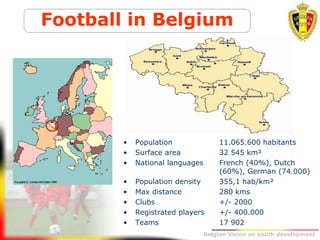
Football in Belgium
• Population 11.065.600 habitants
• Surface area 32 545 km²
• National languages French (40%), Dutch
(60%), German (74.000)
• Population density 355,1 hab/km²
• Max distance 280 kms
• Clubs +/- 2000
• Registrated players +/- 400.000
• Teams 17 902
Belgion Vision on youth development
CONTENT
• Football in Belgium
• Development Vision of the Belgian FA
• The Competition Structure
• The National Youth Teams
• Coach Education School
• The Topsport Schools
• Talent Identification
• Grassroots
Belgion Vision on youth development
Development Vision of the Belgian FA
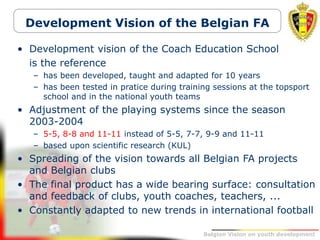
• Development vision of the Coach Education School
is the reference
– has been developed, taught and adapted for 10 years
– has been tested in pratice during training sessions at the topsport
school and in the national youth teams
• Adjustment of the playing systems since the season
2003-2004
– 5-5, 8-8 and 11-11 instead of 5-5, 7-7, 9-9 and 11-11
– based upon scientific research (KUL)
• Spreading of the vision towards all Belgian FA projects
and Belgian clubs
• The final product has a wide bearing surface: consultation
and feedback of clubs, youth coaches, teachers, ...
• Constantly adapted to new trends in international football
Belgion Vision on youth development
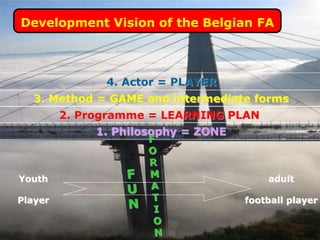
Youth
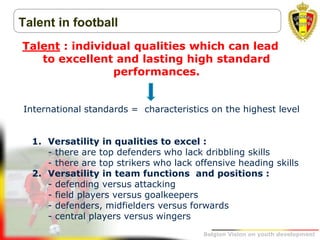
Player
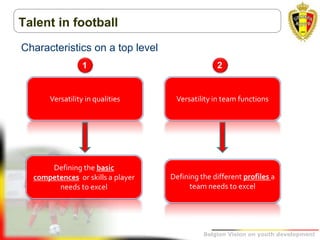
adult
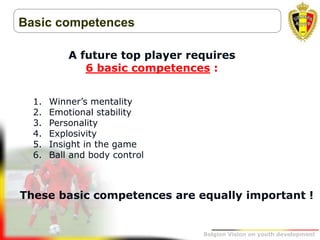
football player
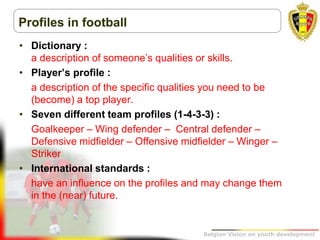
4. Actor = PLAYER
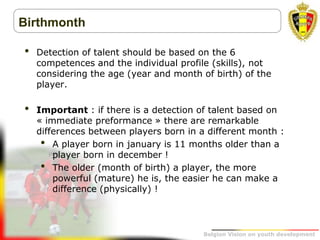
3. Method = GAME and intermediate forms
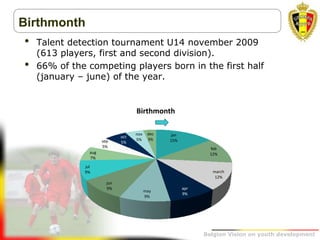
1. Philosophy = ZONE
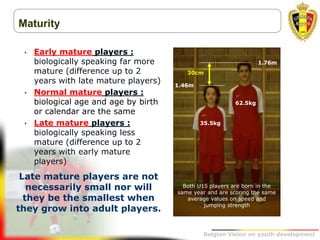
2. Programme = LEARNING PLAN
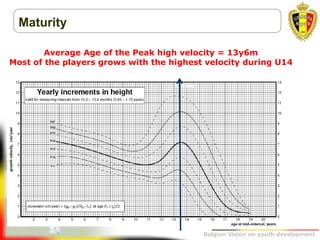
Development Vision of the Belgian FA
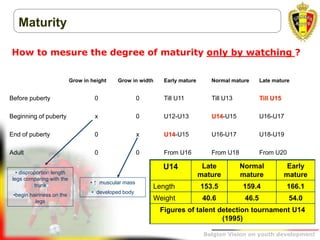
Belgion Vision on youth development
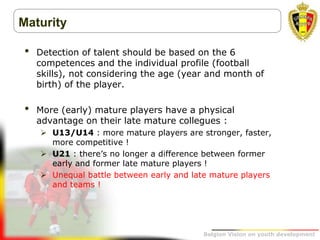
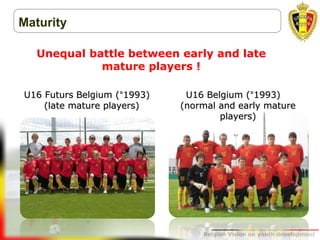
1.
The FUN-aspect
DEVELOPMENT
VISION OF THE
BELGIAN FA
Belgion Vision on youth development
FUN = learning while playing !
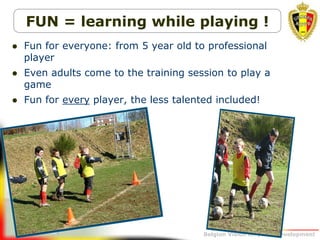
 Fun for everyone: from 5 year old to professional
player
 Even adults come to the training session to play a
game
 Fun for every player, the less talented included!
Belgion Vision on youth development
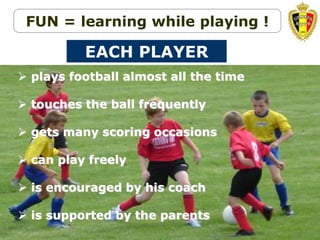
 plays football almost all the time
 touches the ball frequently
 gets many scoring occasions
 can play freely
 is encouraged by his coach
 is supported by the parents
EACH PLAYER
FUN = learning while playing !
Belgion Vision on youth development
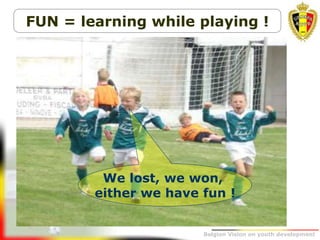
We lost, we won,
either we have fun !
FUN = learning while playing !
Belgion Vision on youth development
2.
The EDUCATION
aspect
DEVELOPMENT
VISION OF THE
BELGIAN FA
Belgion Vision on youth development
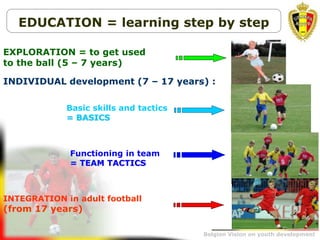
EXPLORATION = to get used
to the ball (5 – 7 years)
INDIVIDUAL development (7 – 17 years) :
Basic skills and tactics
= BASICS
Functioning in team
= TEAM TACTICS
INTEGRATION in adult football
(from 17 years)
EDUCATION = learning step by step
Belgion Vision on youth development
3. ZONE
PHILOSOPHY
DEVELOPMENT
VISION OF THE
BELGIAN FA
Belgion Vision on youth development
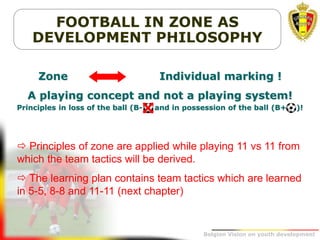
FOOTBALL IN ZONE AS
DEVELOPMENT PHILOSOPHY
Zone Individual marking !
A playing concept and not a playing system!
Principles in loss of the ball (B- and in possession of the ball (B+ )!
 Principles of zone are applied while playing 11 vs 11 from
which the team tactics will be derived.
 The learning plan contains team tactics which are learned
in 5-5, 8-8 and 11-11 (next chapter)
Belgion Vision on youth development
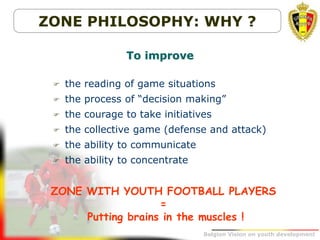
ZONE PHILOSOPHY: WHY ?
 the reading of game situations
 the process of “decision making”
 the courage to take initiatives
 the collective game (defense and attack)
 the ability to communicate
 the ability to concentrate
To improve
ZONE WITH YOUTH FOOTBALL PLAYERS
=
Putting brains in the muscles !
Belgion Vision on youth development
4.
THE LEARNING PLAN
DEVELOPMENT
VISION OF THE
BELGIAN FA
Belgion Vision on youth development
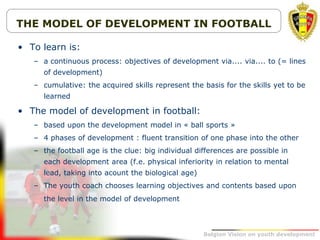
THE MODEL OF DEVELOPMENT IN FOOTBALL
• To learn is:
– a continuous process: objectives of development via.... via.... to (= lines
of development)
– cumulative: the acquired skills represent the basis for the skills yet to be
learned
• The model of development in football:
– based upon the development model in « ball sports »
– 4 phases of development : fluent transition of one phase into the other
– the football age is the clue: big individual differences are possible in
each development area (f.e. physical inferiority in relation to mental
lead, taking into acount the biological age)
– The youth coach chooses learning objectives and contents based upon
the level in the model of development
Belgion Vision on youth development
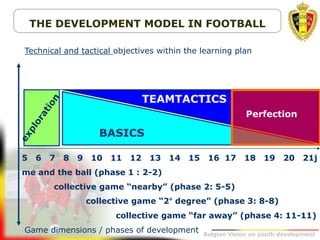
5 6 7 8 9 10 11 12 13 14 15 16 17 18 19 20 21j
me and the ball (phase 1 : 2-2)
collective game “nearby” (phase 2: 5-5)
collective game “2° degree” (phase 3: 8-8)
collective game “far away” (phase 4: 11-11)
Game dimensions / phases of development
Technical and tactical objectives within the learning plan
TEAMTACTICS
BASICS
THE DEVELOPMENT MODEL IN FOOTBALL
Perfection
Belgion Vision on youth development
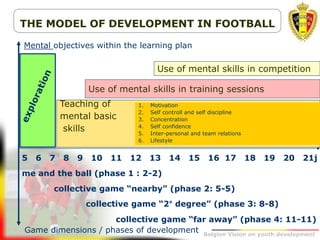
5 6 7 8 9 10 11 12 13 14 15 16 17 18 19 20 21j
me and the ball (phase 1 : 2-2)
collective game “nearby” (phase 2: 5-5)
collective game “2° degree” (phase 3: 8-8)
collective game “far away” (phase 4: 11-11)
Game dimensions / phases of development
Mental objectives within the learning plan
THE MODEL OF DEVELOPMENT IN FOOTBALL
Vervolmaking
Teaching of
mental basic
skills
1. Motivation
2. Self controll and self discipline
3. Concentration
4. Self confidence
5. Inter-personal and team relations
6. Lifestyle
Use of mental skills in training sessions
Use of mental skills in competition
Belgion Vision on youth development
5 6 7 8 9 10 11 12 13 14 15 16 17 18 19 20 21j
me and the ball (phase 1 : 2-2)
collective game “nearby” (phase 2: 5-5)
collective game “2° degree” (phase 3: 8-8)
collective game “far away” (phase 4: 11-11)
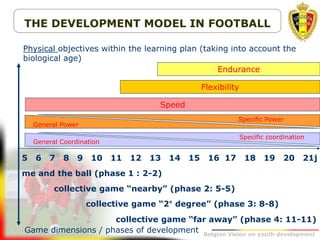
Game dimensions / phases of development
Physical objectives within the learning plan (taking into account the
biological age)
THE DEVELOPMENT MODEL IN FOOTBALL
Endurance
Flexibility
Speed
General Coordination
Specific coordination
General Power
Specific Power
Belgion Vision on youth development
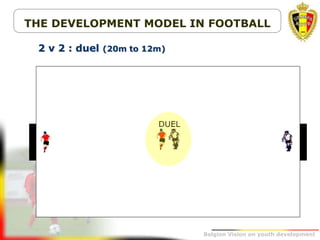
2 v 2 : duel (20m to 12m)
THE DEVELOPMENT MODEL IN FOOTBALL
DUEL
Belgion Vision on youth development
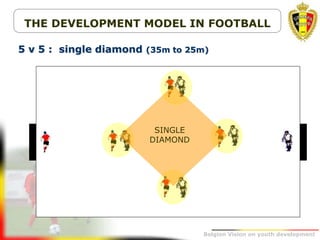
5 v 5 : single diamond (35m to 25m)
THE DEVELOPMENT MODEL IN FOOTBALL
SINGLE
DIAMOND
Belgion Vision on youth development
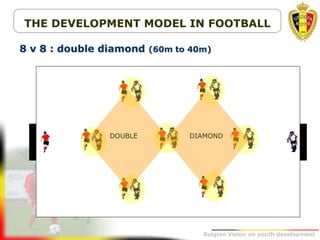
8 v 8 : double diamond (60m to 40m)
THE DEVELOPMENT MODEL IN FOOTBALL
DOUBLE DIAMOND
Belgion Vision on youth development
11 v 11 : 1-4-3-3 (100m to 60m)
THE DEVELOPMENT MODEL IN FOOTBALL
Belgion Vision on youth development
Description of different aspects
according to the development model
1+K/1+K 2/2 U6 ball acquaintance
Football as a dribbling and
shooting game(5y to 7y) U7 opposition games
4+K/4+K 5/5 U8 application 2/2
Football as a short passing game
without off-side rule(7y to 9y) U9 evolution towards
game nearby
7+K/7+K 8/8 U10 application 2/2 +
5/5
Football as a halflong passing
game without off-side rule(9y to 11y) U11 evolution to
medium long play
10+K/10+K
(11y to 17y)
11/11
(1)
U12-
U13
application 2/2,
5/5 and 8/8
Football as a long passing game
with off-side ruleU14-
U15
evolution to game
far away
11/11
(2)
U16-
U17
to perfect
Belgion Vision on youth development
11-11
Description of different aspects
according to the development model
BASICS
TEAM TACTICS
PHYSICAL
MENTAL
To learn is a
cumulative process
8-8
5-5
2-2
Belgion Vision on youth development
Description of different aspects
according to the development model
BASICS TEAM TACTICS PHYSICAL MENTAL
2-2
5-7 years
5-5
7-9 years
8-8
9-11 years
11-11 (1)
11-13 years
13-15 years
11-11(2)
15-17 years
• Setting out the basics and team tactics for each
development level
• Setting out the training session topics on a physical level
• Setting out the characteristics on a mental level
Belgion Vision on youth development
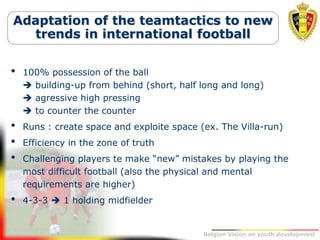
Adaptation of the teamtactics to new
trends in international football
• 100% possession of the ball
 building-up from behind (short, half long and long)
 agressive high pressing
 to counter the counter
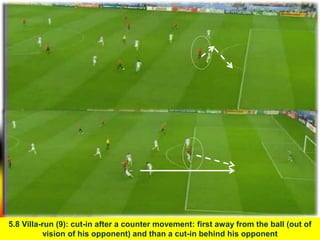
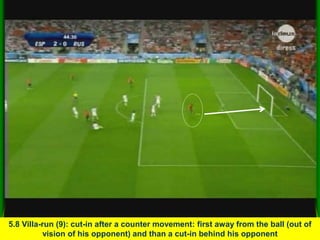
• Runs : create space and exploite space (ex. The Villa-run)
• Efficiency in the zone of truth
• Challenging players te make “new” mistakes by playing the
most difficult football (also the physical and mental
requirements are higher)
• 4-3-3  1 holding midfielder
Belgion Vision on youth development
1
3
5
4
7
9
11
2
6 8
10
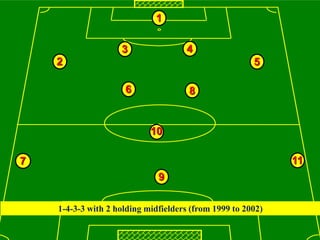
1-4-3-3 with 2 holding midfielders (from 1999 to 2002)
Belgion Vision on youth development
1
3
5
4
7
9
11
2
6
8 10
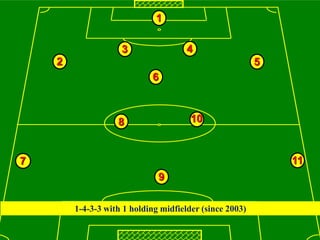
1-4-3-3 with 1 holding midfielder (since 2003)
Teamtactics anders bekeken
1
3
5
4
7 9 11
2
8
6
10
B+
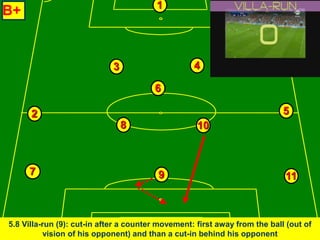
5.8 Villa-run (9): cut-in after a counter movement: first away from the ball (out of
vision of his opponent) and than a cut-in behind his opponent
Teamtactics anders bekeken
5.8 Villa-run (9): cut-in after a counter movement: first away from the ball (out of
vision of his opponent) and than a cut-in behind his opponent
Teamtactics anders bekeken
1
3
5
4
7 9 11
2
8
6
10
5.8 Villa-run (9): cut-in after a counter movement: first away from the ball (out of
vision of his opponent) and than a cut-in behind his opponent
Belgion Vision on youth development
5.
GAME and
INTERMEDIATE
forms
DEVELOPMENT
VISION OF THE
BELGIAN FA
Belgion Vision on youth development
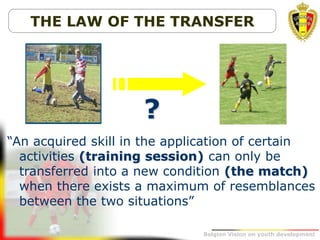
“An acquired skill in the application of certain
activities (training session) can only be
transferred into a new condition (the match)
when there exists a maximum of resemblances
between the two situations”
?
THE LAW OF THE TRANSFER
Belgion Vision on youth development
W
A
R
M
I
N
G
U
P
MA
T
C
H
F
O
RM
1
MA
T
C
H
F
O
RM
3
C
O
O
L
I
N
G
D
O
W
N
t
M
A
T
C
H
F
O
R
M
2
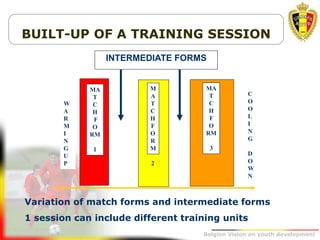
Variation of match forms and intermediate forms
1 session can include different training units
BUILT-UP OF A TRAINING SESSION
INTERMEDIATE FORMS
Belgion Vision on youth development
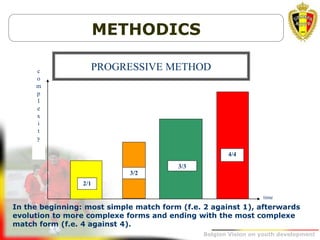
PROGRESSIVE METHOD
time
c
o
m
p
l
e
x
i
t
y
3/3
3/2
4/4
2/1
METHODICS
In the beginning: most simple match form (f.e. 2 against 1), afterwards
evolution to more complexe forms and ending with the most complexe
match form (f.e. 4 against 4).
Belgion Vision on youth development
4/4
3/3
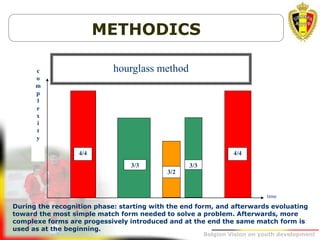
hourglass method
time
c
o
m
p
l
e
x
i
t
y
3/3
3/2
4/4
METHODICS
During the recognition phase: starting with the end form, and afterwards evoluating
toward the most simple match form needed to solve a problem. Afterwards, more
complexe forms are progessively introduced and at the end the same match form is
used as at the beginning.
Belgion Vision on youth development
6.
FOCUS ON THE
PLAYER
DEVELOPMENT
VISION OF THE
BELGIAN FA
Belgion Vision on youth development
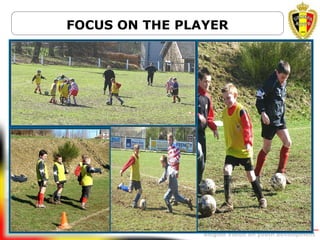
FOCUS ON THE PLAYER
Belgion Vision on youth development
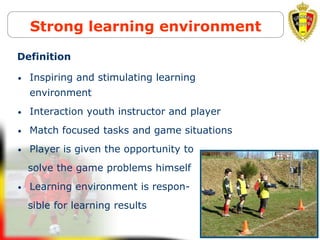
Strong learning environment
• Inspiring and stimulating learning
environment
• Interaction youth instructor and player
• Match focused tasks and game situations
• Player is given the opportunity to
solve the game problems himself
• Learning environment is respon-
sible for learning results
Definition
Belgion Vision on youth development
FOCUS ON THE PLAYER
 Let him - make his own decisions
- experience (own experience)
 Support him, be patient and give him confidence
 Help him - to make the right decisions
- to find a solution
- with a positive coaching
Give a man a fish, you feed him for a day …
Teach a man to fish, you feed him for a lifetime !
Belgion Vision on youth development
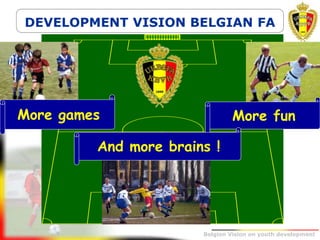
More games More fun
And more brains !
DEVELOPMENT VISION BELGIAN FA
Belgion Vision on youth development
CONTENT
• Football in Belgium
• Development Vision of the Belgian FA
• The Competition Structure
• The National Youth Teams
• Coach Education School
• The Topsport Schools
• Talent Identification
• Grassroots
Belgion Vision on youth development
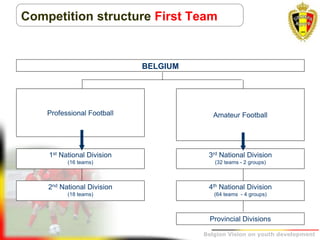
Competition structure First Team
BELGIUM
Professional Football
1st National Division
(16 teams)
2nd National Division
(18 teams)
3rd National Division
(32 teams - 2 groups)
4th National Division
(64 teams - 4 groups)
Provincial Divisions
Amateur Football
Belgion Vision on youth development
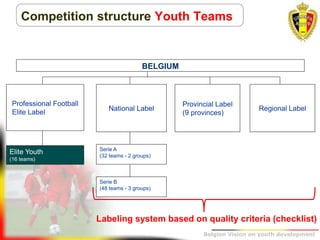
Professional Football
Elite Label
Elite Youth
(16 teams)
Serie A
(32 teams - 2 groups)
Serie B
(48 teams - 3 groups)
National Label
Provincial Label
(9 provinces)
Regional Label
BELGIUM
Competition structure Youth Teams
Labeling system based on quality criteria (checklist)
Belgion Vision on youth development
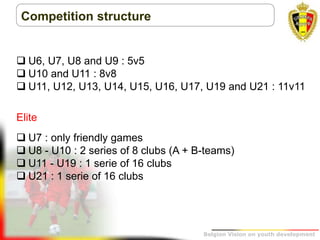
 U6, U7, U8 and U9 : 5v5
 U10 and U11 : 8v8
 U11, U12, U13, U14, U15, U16, U17, U19 and U21 : 11v11
 U7 : only friendly games
 U8 - U10 : 2 series of 8 clubs (A + B-teams)
 U11 - U19 : 1 serie of 16 clubs
 U21 : 1 serie of 16 clubs
Competition structure
Elite
Belgion Vision on youth development
CONTENT
• Football in Belgium
• Development Vision of the Belgian FA
• The Competition Structure
• The National Youth Teams
• Coach Education School
• The Topsport Schools
• Talent Identification
• Grassroots
Belgion Vision on youth development
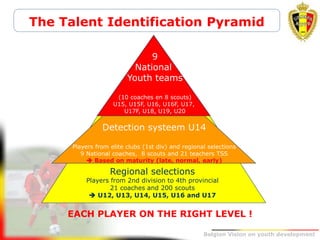
Regional selections
Players from 2nd division to 4th provincial
21 coaches and 200 scouts
 U12, U13, U14, U15, U16 and U17
Detection systeem U14
Players from elite clubs (1st div) and regional selections
9 National coaches, 8 scouts and 21 teachers TSS
 Based on maturity (late, normal, early)
9
National
Youth teams
(10 coaches en 8 scouts)
U15, U15F, U16, U16F, U17,
U17F, U18, U19, U20
The Talent Identification Pyramid
EACH PLAYER ON THE RIGHT LEVEL !
Belgion Vision on youth development
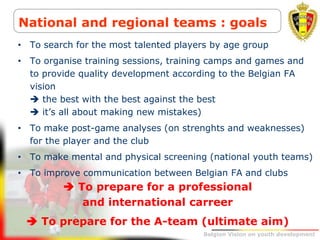
National and regional teams : goals
• To search for the most talented players by age group
• To organise training sessions, training camps and games and
to provide quality development according to the Belgian FA
vision
 the best with the best against the best
 it’s all about making new mistakes)
• To make post-game analyses (on strenghts and weaknesses)
for the player and the club
• To make mental and physical screening (national youth teams)
• To improve communication between Belgian FA and clubs
 To prepare for a professional
and international carreer
 To prepare for the A-team (ultimate aim)
Belgion Vision on youth development
CONTENT
• Football in Belgium
• Development Vision of the Belgian FA
• The Competition Structure
• The National Youth Teams
• Coach Education School
• The Topsport Schools
• Talent Identification
• Grassroots
Belgion Vision on youth development
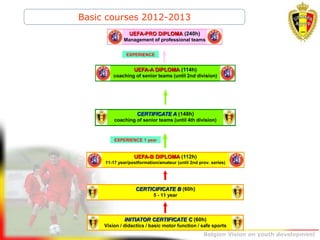
UEFA-B DIPLOMA (112h)
11-17 year/postformation/amateur (until 2nd prov. series)
UEFA-PRO DIPLOMA (240h)
Management of professional teams
EXPERIENCE
INITIATOR CERTIFICATE C (60h)
Vision / didactics / basic motor function / safe sports
CERTICIFICATE B (60h)
5 - 11 year
UEFA-A DIPLOMA (114h)
coaching of senior teams (until 2nd division)
CERTIFICATE A (148h)
coaching of senior teams (until 4th division)
EXPERIENCE 1 year
Basic courses 2012-2013
Belgion Vision on youth development
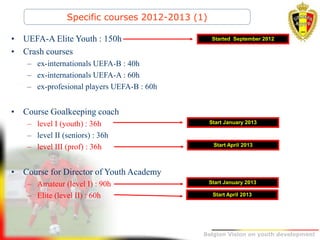
Specific courses 2012-2013 (1)
• UEFA-A Elite Youth : 150h
• Crash courses
– ex-internationals UEFA-B : 40h
– ex-internationals UEFA-A : 60h
– ex-profesional players UEFA-B : 60h
• Course Goalkeeping coach
– level I (youth) : 36h
– level II (seniors) : 36h
– level III (prof) : 36h
• Course for Director of Youth Academy
– Amateur (level I) : 90h
– Elite (level II) : 60h Start April 2013
Start January 2013
Start January 2013
Start April 2013
Started September 2012
Belgion Vision on youth development
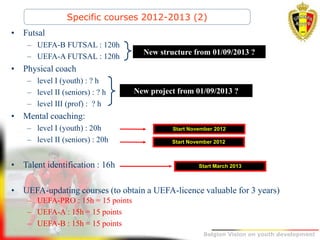
• Futsal
– UEFA-B FUTSAL : 120h
– UEFA-A FUTSAL : 120h
• Physical coach
– level I (youth) : ? h
– level II (seniors) : ? h
– level III (prof) : ? h
• Mental coaching:
– level I (youth) : 20h
– level II (seniors) : 20h
• Talent identification : 16h
• UEFA-updating courses (to obtain a UEFA-licence valuable for 3 years)
– UEFA-PRO : 15h = 15 points
– UEFA-A : 15h = 15 points
– UEFA-B : 15h = 15 points
Specific courses 2012-2013 (2)
New structure from 01/09/2013 ?
New project from 01/09/2013 ?
Start November 2012
Start November 2012
Start March 2013
Belgion Vision on youth development
• Focus on quantity  to increase the number of
qualified coaches (2000 candidates/year)
 organization of C-level (60 hours) on demand of the clubs
 on different days
 low fee
• Focus on quality
 to increase the number of competent coaches
 sessions of 4 hours (1x/week)  reflection time
 content continuously adapted on new trends
 to coach the (new) instructor
 mentorship during practical sessions in clubs
 focus on self-development and long life learning
 reality based learning
Main principles of our Coach Education
Belgion Vision on youth development
CONTENT
• Football in Belgium
• Development Vision of the Belgian FA
• The Competition Structure
• The National Youth Teams
• Coach Education School
• The Topsport Schools
• Talent Identification
• Grassroots
Belgion Vision on youth development
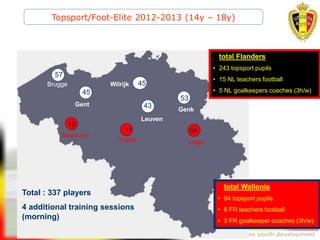
45
11
Brugge
Gent
Genk
Leuven
Wilrijk
Tubize Liège
57
45
53
43
64
19
Mouscron
Total : 337 players
4 additional training sessions
(morning)
total Flanders
• 243 topsport pupils
• 15 NL teachers football
• 5 NL goalkeepers coaches (3h/w)
total Wallonia
• 94 topsport pupils
• 6 FR teachers football
• 3 FR goalkeeper coaches (3h/w)
Topsport/Foot-Elite 2012-2013 (14y – 18y)
Belgion Vision on youth development
The objective of the Topsport Project
Talented players who automatically obtain
the topsport status:
• automatically as a youth international
• or after passing a selection test (elite label
clubs, national label clubs and provincial final
selection)
To offer a supplementary quality
education of 4 additional training
sessions a week, which is
complementary to the education in
the club (the HELP-FUNCTION)
Belgion Vision on youth development
5 crucial keys of success
1. All talented players have the opportunity
• early and late mature
• players mainly from 1st division clubs but also from lower divisions
and girls from national selections
• favorable geografical spreading (no problem of transport)
2. Strong learning environment:
• training sessions with all the most talented players
• 250 extra training hours a year, based upon the development vision
of the Belgian FA.
3. A specific educational "topsport"-management offering the
possibility to obtain a full diploma
• teachers of football (experience as players and coaches, diploma
UEFA-A and pedagogical diploma)
• smaller class groups, study guidance, specific exams regulations
and possibility to train with the A-team
Belgion Vision on youth development
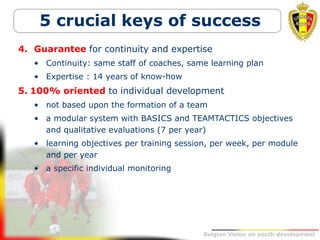
5 crucial keys of success
4. Guarantee for continuity and expertise
• Continuity: same staff of coaches, same learning plan
• Expertise : 14 years of know-how
5. 100% oriented to individual development
• not based upon the formation of a team
• a modular system with BASICS and TEAMTACTICS objectives
and qualitative evaluations (7 per year)
• learning objectives per training session, per week, per module
and per year
• a specific individual monitoring
Belgion Vision on youth development
11/18/2012
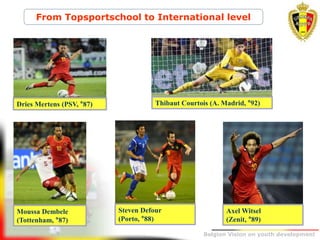
Dries Mertens (PSV, °87) Thibaut Courtois (A. Madrid, °92)
Moussa Dembele
(Tottenham, °87)
Steven Defour
(Porto, °88)
Axel Witsel
(Zenit, °89)
From Topsportschool to International level
Belgion Vision on youth development
CONTENT
• Football in Belgium
• Development Vision of the Belgian FA
• The Competition Structure
• The National Youth Teams
• Coach Education School
• The Topsport Schools
• Talent Identification
• Grassroots
Belgion Vision on youth development
Talent in football
Talent : individual qualities which can lead
to excellent and lasting high standard
performances.
International standards = characteristics on the highest level
1. Versatility in qualities to excel :
- there are top defenders who lack dribbling skills
- there are top strikers who lack offensive heading skills
2. Versatility in team functions and positions :
- defending versus attacking
- field players versus goalkeepers
- defenders, midfielders versus forwards
- central players versus wingers
Belgion Vision on youth development
Versatility in qualities Versatility in team functions
Defining the basic
competences or skills a player
needs to excel
Defining the different profiles a
team needs to excel
1 2
Talent in football
Characteristics on a top level
Belgion Vision on youth development
Basic competences
A future top player requires
6 basic competences :
1. Winner’s mentality
2. Emotional stability
3. Personality
4. Explosivity
5. Insight in the game
6. Ball and body control
These basic competences are equally important !
Belgion Vision on youth development
Profiles in football
• Dictionary :
a description of someone’s qualities or skills.
• Player’s profile :
a description of the specific qualities you need to be
(become) a top player.
• Seven different team profiles (1-4-3-3) :
Goalkeeper – Wing defender – Central defender –
Defensive midfielder – Offensive midfielder – Winger –
Striker
• International standards :
have an influence on the profiles and may change them
in the (near) future.
Belgion Vision on youth development
Birthmonth
• Detection of talent should be based on the 6
competences and the individual profile (skills), not
considering the age (year and month of birth) of the
player.
• Important : if there is a detection of talent based on
« immediate preformance » there are remarkable
differences between players born in a different month :
• A player born in january is 11 months older than a
player born in december !
• The older (month of birth) a player, the more
powerful (mature) he is, the easier he can make a
difference (physically) !
Belgion Vision on youth development
Birthmonth
jan
15%
feb
12%
march
12%
apr
9%
may
9%
jun
9%
jul
9%
aug
7%
sep
5%
oct
5%
nov
5%
dec
3%
Birthmonth
• Talent detection tournament U14 november 2009
(613 players, first and second division).
• 66% of the competing players born in the first half
(january – june) of the year.
Belgion Vision on youth development
Maturity
• Early mature players :
biologically speaking far more
mature (difference up to 2
years with late mature players)
• Normal mature players :
biological age and age by birth
or calendar are the same
• Late mature players :
biologically speaking less
mature (difference up to 2
years with early mature
players)
30cm
35.5kg
62.5kg
Both U15 players are born in the
same year and are scoring the same
average values on speed and
jumping strength
1.46m
1.76m
Late mature players are not
necessarily small nor will
they be the smallest when
they grow into adult players.
Belgion Vision on youth development
Maturity
1.46m
Average Age of the Peak high velocity = 13y6m
Most of the players grows with the highest velocity during U14
Belgion Vision on youth development
Grow in height Grow in width Early mature Normal mature Late mature
Before puberty 0 0 Till U11 Till U13 Till U15
Beginning of puberty x 0 U12-U13 U14-U15 U16-U17
End of puberty 0 x U14-U15 U16-U17 U18-U19
Adult 0 0 From U16 From U18 From U20
U14 Late
mature
Normal
mature
Early
mature
Length 153.5 159.4 166.1
Weight 40.6 46.5 54.0
Figures of talent detection tournament U14
(1995)
• ↑ muscular mass
• developed body
• disproportion length
legs comparing with the
trunk
•begin hairiness on the
legs
Maturity
How to mesure the degree of maturity only by watching ?
Belgion Vision on youth development
Maturity
• Detection of talent should be based on the 6
competences and the individual profile (football
skills), not considering the age (year and month of
birth) of the player.
• More (early) mature players have a physical
advantage on their late mature collegues :
 U13/U14 : more mature players are stronger, faster,
more competitive !
 U21 : there’s no longer a difference between former
early and former late mature players !
 Unequal battle between early and late mature players
and teams !
Belgion Vision on youth development
Maturity
Unequal battle between early and late
mature players !
U16 Futurs Belgium (°1993)
(late mature players)
U16 Belgium (°1993)
(normal and early mature
players)
Belgion Vision on youth development
CONTENT
• Football in Belgium
• Development Vision of the Belgian FA
• The Competition Structure
• The National Youth Teams
• Coach Education School
• The Topsport Schools
• Talent Identification
• Grassroots
Belgion Vision on youth development11/18/2012
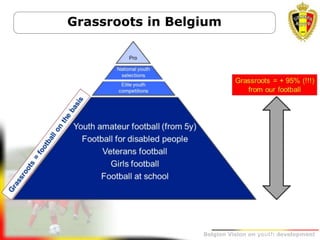
Grassroots in Belgium
Belgion Vision on youth development
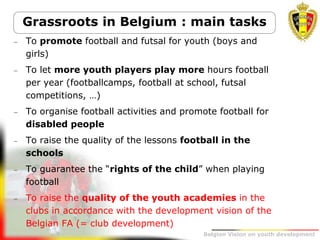
 To promote football and futsal for youth (boys and
girls)
 To let more youth players play more hours football
per year (footballcamps, football at school, futsal
competitions, …)
 To organise football activities and promote football for
disabled people
 To raise the quality of the lessons football in the
schools
 To guarantee the “rights of the child” when playing
football
 To raise the quality of the youth academies in the
clubs in accordance with the development vision of the
Belgian FA (= club development)
Grassroots in Belgium : main tasks
Belgion Vision on youth development
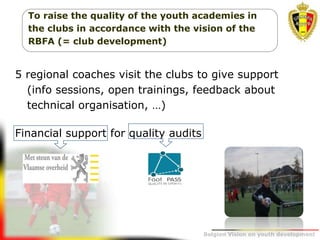
To raise the quality of the youth academies in
the clubs in accordance with the vision of the
RBFA (= club development)
5 regional coaches visit the clubs to give support
(info sessions, open trainings, feedback about
technical organisation, …)
Financial support for quality audits
Belgion Vision on youth development
Bob Browaeys
Split 21/11/2012
B+
The Belgium vision on
youth development

Belgium Youth Development

  • 1.
    Belgion Vision onyouth development Bob Browaeys Split 21/11/2012 B+ The Belgium vision on youth development
  • 2.
    Belgion Vision onyouth development CONTENT • Football in Belgium • Development Vision of the Belgian FA • The Competition Structure • The National Youth Teams • Coach Education School • The Topsport Schools • Talent Identification • Grassroots
  • 3.
    Belgion Vision onyouth development CONTENT • Football in Belgium • Development Vision of the Belgian FA • The Competition Structure • The National Youth Teams • Coach Education School • The Topsport Schools • Talent Identification • Grassroots
  • 4.
    Belgion Vision onyouth development Football in Belgium • Population 11.065.600 habitants • Surface area 32 545 km² • National languages French (40%), Dutch (60%), German (74.000) • Population density 355,1 hab/km² • Max distance 280 kms • Clubs +/- 2000 • Registrated players +/- 400.000 • Teams 17 902
  • 5.
    Belgion Vision onyouth development CONTENT • Football in Belgium • Development Vision of the Belgian FA • The Competition Structure • The National Youth Teams • Coach Education School • The Topsport Schools • Talent Identification • Grassroots
  • 6.
    Belgion Vision onyouth development Development Vision of the Belgian FA • Development vision of the Coach Education School is the reference – has been developed, taught and adapted for 10 years – has been tested in pratice during training sessions at the topsport school and in the national youth teams • Adjustment of the playing systems since the season 2003-2004 – 5-5, 8-8 and 11-11 instead of 5-5, 7-7, 9-9 and 11-11 – based upon scientific research (KUL) • Spreading of the vision towards all Belgian FA projects and Belgian clubs • The final product has a wide bearing surface: consultation and feedback of clubs, youth coaches, teachers, ... • Constantly adapted to new trends in international football
  • 7.
    Belgion Vision onyouth development Youth Player adult football player 4. Actor = PLAYER 3. Method = GAME and intermediate forms 1. Philosophy = ZONE 2. Programme = LEARNING PLAN Development Vision of the Belgian FA
  • 8.
    Belgion Vision onyouth development 1. The FUN-aspect DEVELOPMENT VISION OF THE BELGIAN FA
  • 9.
    Belgion Vision onyouth development FUN = learning while playing !  Fun for everyone: from 5 year old to professional player  Even adults come to the training session to play a game  Fun for every player, the less talented included!
  • 10.
    Belgion Vision onyouth development  plays football almost all the time  touches the ball frequently  gets many scoring occasions  can play freely  is encouraged by his coach  is supported by the parents EACH PLAYER FUN = learning while playing !
  • 11.
    Belgion Vision onyouth development We lost, we won, either we have fun ! FUN = learning while playing !
  • 12.
    Belgion Vision onyouth development 2. The EDUCATION aspect DEVELOPMENT VISION OF THE BELGIAN FA
  • 13.
    Belgion Vision onyouth development EXPLORATION = to get used to the ball (5 – 7 years) INDIVIDUAL development (7 – 17 years) : Basic skills and tactics = BASICS Functioning in team = TEAM TACTICS INTEGRATION in adult football (from 17 years) EDUCATION = learning step by step
  • 14.
    Belgion Vision onyouth development 3. ZONE PHILOSOPHY DEVELOPMENT VISION OF THE BELGIAN FA
  • 15.
    Belgion Vision onyouth development FOOTBALL IN ZONE AS DEVELOPMENT PHILOSOPHY Zone Individual marking ! A playing concept and not a playing system! Principles in loss of the ball (B- and in possession of the ball (B+ )!  Principles of zone are applied while playing 11 vs 11 from which the team tactics will be derived.  The learning plan contains team tactics which are learned in 5-5, 8-8 and 11-11 (next chapter)
  • 16.
    Belgion Vision onyouth development ZONE PHILOSOPHY: WHY ?  the reading of game situations  the process of “decision making”  the courage to take initiatives  the collective game (defense and attack)  the ability to communicate  the ability to concentrate To improve ZONE WITH YOUTH FOOTBALL PLAYERS = Putting brains in the muscles !
  • 17.
    Belgion Vision onyouth development 4. THE LEARNING PLAN DEVELOPMENT VISION OF THE BELGIAN FA
  • 18.
    Belgion Vision onyouth development THE MODEL OF DEVELOPMENT IN FOOTBALL • To learn is: – a continuous process: objectives of development via.... via.... to (= lines of development) – cumulative: the acquired skills represent the basis for the skills yet to be learned • The model of development in football: – based upon the development model in « ball sports » – 4 phases of development : fluent transition of one phase into the other – the football age is the clue: big individual differences are possible in each development area (f.e. physical inferiority in relation to mental lead, taking into acount the biological age) – The youth coach chooses learning objectives and contents based upon the level in the model of development
  • 19.
    Belgion Vision onyouth development 5 6 7 8 9 10 11 12 13 14 15 16 17 18 19 20 21j me and the ball (phase 1 : 2-2) collective game “nearby” (phase 2: 5-5) collective game “2° degree” (phase 3: 8-8) collective game “far away” (phase 4: 11-11) Game dimensions / phases of development Technical and tactical objectives within the learning plan TEAMTACTICS BASICS THE DEVELOPMENT MODEL IN FOOTBALL Perfection
  • 20.
    Belgion Vision onyouth development 5 6 7 8 9 10 11 12 13 14 15 16 17 18 19 20 21j me and the ball (phase 1 : 2-2) collective game “nearby” (phase 2: 5-5) collective game “2° degree” (phase 3: 8-8) collective game “far away” (phase 4: 11-11) Game dimensions / phases of development Mental objectives within the learning plan THE MODEL OF DEVELOPMENT IN FOOTBALL Vervolmaking Teaching of mental basic skills 1. Motivation 2. Self controll and self discipline 3. Concentration 4. Self confidence 5. Inter-personal and team relations 6. Lifestyle Use of mental skills in training sessions Use of mental skills in competition
  • 21.
    Belgion Vision onyouth development 5 6 7 8 9 10 11 12 13 14 15 16 17 18 19 20 21j me and the ball (phase 1 : 2-2) collective game “nearby” (phase 2: 5-5) collective game “2° degree” (phase 3: 8-8) collective game “far away” (phase 4: 11-11) Game dimensions / phases of development Physical objectives within the learning plan (taking into account the biological age) THE DEVELOPMENT MODEL IN FOOTBALL Endurance Flexibility Speed General Coordination Specific coordination General Power Specific Power
  • 22.
    Belgion Vision onyouth development 2 v 2 : duel (20m to 12m) THE DEVELOPMENT MODEL IN FOOTBALL DUEL
  • 23.
    Belgion Vision onyouth development 5 v 5 : single diamond (35m to 25m) THE DEVELOPMENT MODEL IN FOOTBALL SINGLE DIAMOND
  • 24.
    Belgion Vision onyouth development 8 v 8 : double diamond (60m to 40m) THE DEVELOPMENT MODEL IN FOOTBALL DOUBLE DIAMOND
  • 25.
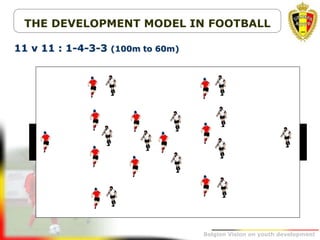
    Belgion Vision onyouth development 11 v 11 : 1-4-3-3 (100m to 60m) THE DEVELOPMENT MODEL IN FOOTBALL
  • 26.
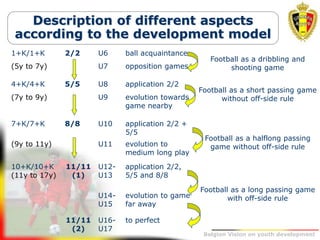
    Belgion Vision onyouth development Description of different aspects according to the development model 1+K/1+K 2/2 U6 ball acquaintance Football as a dribbling and shooting game(5y to 7y) U7 opposition games 4+K/4+K 5/5 U8 application 2/2 Football as a short passing game without off-side rule(7y to 9y) U9 evolution towards game nearby 7+K/7+K 8/8 U10 application 2/2 + 5/5 Football as a halflong passing game without off-side rule(9y to 11y) U11 evolution to medium long play 10+K/10+K (11y to 17y) 11/11 (1) U12- U13 application 2/2, 5/5 and 8/8 Football as a long passing game with off-side ruleU14- U15 evolution to game far away 11/11 (2) U16- U17 to perfect
  • 27.
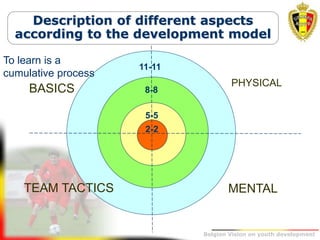
    Belgion Vision onyouth development 11-11 Description of different aspects according to the development model BASICS TEAM TACTICS PHYSICAL MENTAL To learn is a cumulative process 8-8 5-5 2-2
  • 28.
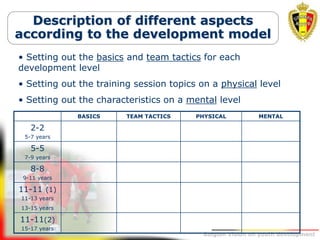
    Belgion Vision onyouth development Description of different aspects according to the development model BASICS TEAM TACTICS PHYSICAL MENTAL 2-2 5-7 years 5-5 7-9 years 8-8 9-11 years 11-11 (1) 11-13 years 13-15 years 11-11(2) 15-17 years • Setting out the basics and team tactics for each development level • Setting out the training session topics on a physical level • Setting out the characteristics on a mental level
  • 29.
    Belgion Vision onyouth development Adaptation of the teamtactics to new trends in international football • 100% possession of the ball  building-up from behind (short, half long and long)  agressive high pressing  to counter the counter • Runs : create space and exploite space (ex. The Villa-run) • Efficiency in the zone of truth • Challenging players te make “new” mistakes by playing the most difficult football (also the physical and mental requirements are higher) • 4-3-3  1 holding midfielder
  • 30.
    Belgion Vision onyouth development 1 3 5 4 7 9 11 2 6 8 10 1-4-3-3 with 2 holding midfielders (from 1999 to 2002)
  • 31.
    Belgion Vision onyouth development 1 3 5 4 7 9 11 2 6 8 10 1-4-3-3 with 1 holding midfielder (since 2003)
  • 32.
    Teamtactics anders bekeken 1 3 5 4 79 11 2 8 6 10 B+ 5.8 Villa-run (9): cut-in after a counter movement: first away from the ball (out of vision of his opponent) and than a cut-in behind his opponent
  • 33.
    Teamtactics anders bekeken 5.8Villa-run (9): cut-in after a counter movement: first away from the ball (out of vision of his opponent) and than a cut-in behind his opponent
  • 34.
    Teamtactics anders bekeken 1 3 5 4 79 11 2 8 6 10 5.8 Villa-run (9): cut-in after a counter movement: first away from the ball (out of vision of his opponent) and than a cut-in behind his opponent
  • 35.
    Belgion Vision onyouth development 5. GAME and INTERMEDIATE forms DEVELOPMENT VISION OF THE BELGIAN FA
  • 36.
    Belgion Vision onyouth development “An acquired skill in the application of certain activities (training session) can only be transferred into a new condition (the match) when there exists a maximum of resemblances between the two situations” ? THE LAW OF THE TRANSFER
  • 37.
    Belgion Vision onyouth development W A R M I N G U P MA T C H F O RM 1 MA T C H F O RM 3 C O O L I N G D O W N t M A T C H F O R M 2 Variation of match forms and intermediate forms 1 session can include different training units BUILT-UP OF A TRAINING SESSION INTERMEDIATE FORMS
  • 38.
    Belgion Vision onyouth development PROGRESSIVE METHOD time c o m p l e x i t y 3/3 3/2 4/4 2/1 METHODICS In the beginning: most simple match form (f.e. 2 against 1), afterwards evolution to more complexe forms and ending with the most complexe match form (f.e. 4 against 4).
  • 39.
    Belgion Vision onyouth development 4/4 3/3 hourglass method time c o m p l e x i t y 3/3 3/2 4/4 METHODICS During the recognition phase: starting with the end form, and afterwards evoluating toward the most simple match form needed to solve a problem. Afterwards, more complexe forms are progessively introduced and at the end the same match form is used as at the beginning.
  • 40.
    Belgion Vision onyouth development 6. FOCUS ON THE PLAYER DEVELOPMENT VISION OF THE BELGIAN FA
  • 41.
    Belgion Vision onyouth development FOCUS ON THE PLAYER
  • 42.
    Belgion Vision onyouth development Strong learning environment • Inspiring and stimulating learning environment • Interaction youth instructor and player • Match focused tasks and game situations • Player is given the opportunity to solve the game problems himself • Learning environment is respon- sible for learning results Definition
  • 43.
    Belgion Vision onyouth development FOCUS ON THE PLAYER  Let him - make his own decisions - experience (own experience)  Support him, be patient and give him confidence  Help him - to make the right decisions - to find a solution - with a positive coaching Give a man a fish, you feed him for a day … Teach a man to fish, you feed him for a lifetime !
  • 44.
    Belgion Vision onyouth development More games More fun And more brains ! DEVELOPMENT VISION BELGIAN FA
  • 45.
    Belgion Vision onyouth development CONTENT • Football in Belgium • Development Vision of the Belgian FA • The Competition Structure • The National Youth Teams • Coach Education School • The Topsport Schools • Talent Identification • Grassroots
  • 46.
    Belgion Vision onyouth development Competition structure First Team BELGIUM Professional Football 1st National Division (16 teams) 2nd National Division (18 teams) 3rd National Division (32 teams - 2 groups) 4th National Division (64 teams - 4 groups) Provincial Divisions Amateur Football
  • 47.
    Belgion Vision onyouth development Professional Football Elite Label Elite Youth (16 teams) Serie A (32 teams - 2 groups) Serie B (48 teams - 3 groups) National Label Provincial Label (9 provinces) Regional Label BELGIUM Competition structure Youth Teams Labeling system based on quality criteria (checklist)
  • 48.
    Belgion Vision onyouth development  U6, U7, U8 and U9 : 5v5  U10 and U11 : 8v8  U11, U12, U13, U14, U15, U16, U17, U19 and U21 : 11v11  U7 : only friendly games  U8 - U10 : 2 series of 8 clubs (A + B-teams)  U11 - U19 : 1 serie of 16 clubs  U21 : 1 serie of 16 clubs Competition structure Elite
  • 49.
    Belgion Vision onyouth development CONTENT • Football in Belgium • Development Vision of the Belgian FA • The Competition Structure • The National Youth Teams • Coach Education School • The Topsport Schools • Talent Identification • Grassroots
  • 50.
    Belgion Vision onyouth development Regional selections Players from 2nd division to 4th provincial 21 coaches and 200 scouts  U12, U13, U14, U15, U16 and U17 Detection systeem U14 Players from elite clubs (1st div) and regional selections 9 National coaches, 8 scouts and 21 teachers TSS  Based on maturity (late, normal, early) 9 National Youth teams (10 coaches en 8 scouts) U15, U15F, U16, U16F, U17, U17F, U18, U19, U20 The Talent Identification Pyramid EACH PLAYER ON THE RIGHT LEVEL !
  • 51.
    Belgion Vision onyouth development National and regional teams : goals • To search for the most talented players by age group • To organise training sessions, training camps and games and to provide quality development according to the Belgian FA vision  the best with the best against the best  it’s all about making new mistakes) • To make post-game analyses (on strenghts and weaknesses) for the player and the club • To make mental and physical screening (national youth teams) • To improve communication between Belgian FA and clubs  To prepare for a professional and international carreer  To prepare for the A-team (ultimate aim)
  • 52.
    Belgion Vision onyouth development CONTENT • Football in Belgium • Development Vision of the Belgian FA • The Competition Structure • The National Youth Teams • Coach Education School • The Topsport Schools • Talent Identification • Grassroots
  • 53.
    Belgion Vision onyouth development UEFA-B DIPLOMA (112h) 11-17 year/postformation/amateur (until 2nd prov. series) UEFA-PRO DIPLOMA (240h) Management of professional teams EXPERIENCE INITIATOR CERTIFICATE C (60h) Vision / didactics / basic motor function / safe sports CERTICIFICATE B (60h) 5 - 11 year UEFA-A DIPLOMA (114h) coaching of senior teams (until 2nd division) CERTIFICATE A (148h) coaching of senior teams (until 4th division) EXPERIENCE 1 year Basic courses 2012-2013
  • 54.
    Belgion Vision onyouth development Specific courses 2012-2013 (1) • UEFA-A Elite Youth : 150h • Crash courses – ex-internationals UEFA-B : 40h – ex-internationals UEFA-A : 60h – ex-profesional players UEFA-B : 60h • Course Goalkeeping coach – level I (youth) : 36h – level II (seniors) : 36h – level III (prof) : 36h • Course for Director of Youth Academy – Amateur (level I) : 90h – Elite (level II) : 60h Start April 2013 Start January 2013 Start January 2013 Start April 2013 Started September 2012
  • 55.
    Belgion Vision onyouth development • Futsal – UEFA-B FUTSAL : 120h – UEFA-A FUTSAL : 120h • Physical coach – level I (youth) : ? h – level II (seniors) : ? h – level III (prof) : ? h • Mental coaching: – level I (youth) : 20h – level II (seniors) : 20h • Talent identification : 16h • UEFA-updating courses (to obtain a UEFA-licence valuable for 3 years) – UEFA-PRO : 15h = 15 points – UEFA-A : 15h = 15 points – UEFA-B : 15h = 15 points Specific courses 2012-2013 (2) New structure from 01/09/2013 ? New project from 01/09/2013 ? Start November 2012 Start November 2012 Start March 2013
  • 56.
    Belgion Vision onyouth development • Focus on quantity  to increase the number of qualified coaches (2000 candidates/year)  organization of C-level (60 hours) on demand of the clubs  on different days  low fee • Focus on quality  to increase the number of competent coaches  sessions of 4 hours (1x/week)  reflection time  content continuously adapted on new trends  to coach the (new) instructor  mentorship during practical sessions in clubs  focus on self-development and long life learning  reality based learning Main principles of our Coach Education
  • 57.
    Belgion Vision onyouth development CONTENT • Football in Belgium • Development Vision of the Belgian FA • The Competition Structure • The National Youth Teams • Coach Education School • The Topsport Schools • Talent Identification • Grassroots
  • 58.
    Belgion Vision onyouth development 45 11 Brugge Gent Genk Leuven Wilrijk Tubize Liège 57 45 53 43 64 19 Mouscron Total : 337 players 4 additional training sessions (morning) total Flanders • 243 topsport pupils • 15 NL teachers football • 5 NL goalkeepers coaches (3h/w) total Wallonia • 94 topsport pupils • 6 FR teachers football • 3 FR goalkeeper coaches (3h/w) Topsport/Foot-Elite 2012-2013 (14y – 18y)
  • 59.
    Belgion Vision onyouth development The objective of the Topsport Project Talented players who automatically obtain the topsport status: • automatically as a youth international • or after passing a selection test (elite label clubs, national label clubs and provincial final selection) To offer a supplementary quality education of 4 additional training sessions a week, which is complementary to the education in the club (the HELP-FUNCTION)
  • 60.
    Belgion Vision onyouth development 5 crucial keys of success 1. All talented players have the opportunity • early and late mature • players mainly from 1st division clubs but also from lower divisions and girls from national selections • favorable geografical spreading (no problem of transport) 2. Strong learning environment: • training sessions with all the most talented players • 250 extra training hours a year, based upon the development vision of the Belgian FA. 3. A specific educational "topsport"-management offering the possibility to obtain a full diploma • teachers of football (experience as players and coaches, diploma UEFA-A and pedagogical diploma) • smaller class groups, study guidance, specific exams regulations and possibility to train with the A-team
  • 61.
    Belgion Vision onyouth development 5 crucial keys of success 4. Guarantee for continuity and expertise • Continuity: same staff of coaches, same learning plan • Expertise : 14 years of know-how 5. 100% oriented to individual development • not based upon the formation of a team • a modular system with BASICS and TEAMTACTICS objectives and qualitative evaluations (7 per year) • learning objectives per training session, per week, per module and per year • a specific individual monitoring
  • 62.
    Belgion Vision onyouth development 11/18/2012 Dries Mertens (PSV, °87) Thibaut Courtois (A. Madrid, °92) Moussa Dembele (Tottenham, °87) Steven Defour (Porto, °88) Axel Witsel (Zenit, °89) From Topsportschool to International level
  • 63.
    Belgion Vision onyouth development
  • 64.
    Belgion Vision onyouth development CONTENT • Football in Belgium • Development Vision of the Belgian FA • The Competition Structure • The National Youth Teams • Coach Education School • The Topsport Schools • Talent Identification • Grassroots
  • 65.
    Belgion Vision onyouth development Talent in football Talent : individual qualities which can lead to excellent and lasting high standard performances. International standards = characteristics on the highest level 1. Versatility in qualities to excel : - there are top defenders who lack dribbling skills - there are top strikers who lack offensive heading skills 2. Versatility in team functions and positions : - defending versus attacking - field players versus goalkeepers - defenders, midfielders versus forwards - central players versus wingers
  • 66.
    Belgion Vision onyouth development Versatility in qualities Versatility in team functions Defining the basic competences or skills a player needs to excel Defining the different profiles a team needs to excel 1 2 Talent in football Characteristics on a top level
  • 67.
    Belgion Vision onyouth development Basic competences A future top player requires 6 basic competences : 1. Winner’s mentality 2. Emotional stability 3. Personality 4. Explosivity 5. Insight in the game 6. Ball and body control These basic competences are equally important !
  • 68.
    Belgion Vision onyouth development Profiles in football • Dictionary : a description of someone’s qualities or skills. • Player’s profile : a description of the specific qualities you need to be (become) a top player. • Seven different team profiles (1-4-3-3) : Goalkeeper – Wing defender – Central defender – Defensive midfielder – Offensive midfielder – Winger – Striker • International standards : have an influence on the profiles and may change them in the (near) future.
  • 69.
    Belgion Vision onyouth development Birthmonth • Detection of talent should be based on the 6 competences and the individual profile (skills), not considering the age (year and month of birth) of the player. • Important : if there is a detection of talent based on « immediate preformance » there are remarkable differences between players born in a different month : • A player born in january is 11 months older than a player born in december ! • The older (month of birth) a player, the more powerful (mature) he is, the easier he can make a difference (physically) !
  • 70.
    Belgion Vision onyouth development Birthmonth jan 15% feb 12% march 12% apr 9% may 9% jun 9% jul 9% aug 7% sep 5% oct 5% nov 5% dec 3% Birthmonth • Talent detection tournament U14 november 2009 (613 players, first and second division). • 66% of the competing players born in the first half (january – june) of the year.
  • 71.
    Belgion Vision onyouth development Maturity • Early mature players : biologically speaking far more mature (difference up to 2 years with late mature players) • Normal mature players : biological age and age by birth or calendar are the same • Late mature players : biologically speaking less mature (difference up to 2 years with early mature players) 30cm 35.5kg 62.5kg Both U15 players are born in the same year and are scoring the same average values on speed and jumping strength 1.46m 1.76m Late mature players are not necessarily small nor will they be the smallest when they grow into adult players.
  • 72.
    Belgion Vision onyouth development Maturity 1.46m Average Age of the Peak high velocity = 13y6m Most of the players grows with the highest velocity during U14
  • 73.
    Belgion Vision onyouth development Grow in height Grow in width Early mature Normal mature Late mature Before puberty 0 0 Till U11 Till U13 Till U15 Beginning of puberty x 0 U12-U13 U14-U15 U16-U17 End of puberty 0 x U14-U15 U16-U17 U18-U19 Adult 0 0 From U16 From U18 From U20 U14 Late mature Normal mature Early mature Length 153.5 159.4 166.1 Weight 40.6 46.5 54.0 Figures of talent detection tournament U14 (1995) • ↑ muscular mass • developed body • disproportion length legs comparing with the trunk •begin hairiness on the legs Maturity How to mesure the degree of maturity only by watching ?
  • 74.
    Belgion Vision onyouth development Maturity • Detection of talent should be based on the 6 competences and the individual profile (football skills), not considering the age (year and month of birth) of the player. • More (early) mature players have a physical advantage on their late mature collegues :  U13/U14 : more mature players are stronger, faster, more competitive !  U21 : there’s no longer a difference between former early and former late mature players !  Unequal battle between early and late mature players and teams !
  • 75.
    Belgion Vision onyouth development Maturity Unequal battle between early and late mature players ! U16 Futurs Belgium (°1993) (late mature players) U16 Belgium (°1993) (normal and early mature players)
  • 76.
    Belgion Vision onyouth development CONTENT • Football in Belgium • Development Vision of the Belgian FA • The Competition Structure • The National Youth Teams • Coach Education School • The Topsport Schools • Talent Identification • Grassroots
  • 77.
    Belgion Vision onyouth development11/18/2012 Grassroots in Belgium
  • 78.
    Belgion Vision onyouth development  To promote football and futsal for youth (boys and girls)  To let more youth players play more hours football per year (footballcamps, football at school, futsal competitions, …)  To organise football activities and promote football for disabled people  To raise the quality of the lessons football in the schools  To guarantee the “rights of the child” when playing football  To raise the quality of the youth academies in the clubs in accordance with the development vision of the Belgian FA (= club development) Grassroots in Belgium : main tasks
  • 79.
    Belgion Vision onyouth development To raise the quality of the youth academies in the clubs in accordance with the vision of the RBFA (= club development) 5 regional coaches visit the clubs to give support (info sessions, open trainings, feedback about technical organisation, …) Financial support for quality audits
  • 80.
    Belgion Vision onyouth development Bob Browaeys Split 21/11/2012 B+ The Belgium vision on youth development