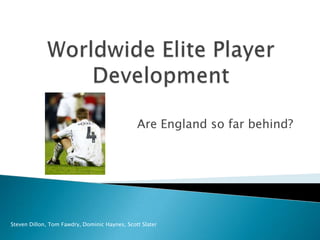
Worldwide Elite Player DevelopmentAre England so far behind?Steven Dillon, Tom Fawdry, Dominic Haynes, Scott Slater
Recent World Cup or European ChampionshipsPlayers Produced by Academies, both Men and WomenDifference In PrioritiesHow does England Compare?What Happens Next?Success – How does England compare?
Nicolas Anelka – ChelseaThierry Henry –BarcelonaWilliam Gallas – ArsenalSamir Nasri– ArsenalKarim Benzema – LyonWorld Cup Winners – 1998European Championships Winners –2000U21 European Championships Winners – 1988Olympic Gold Medallists – 1984France
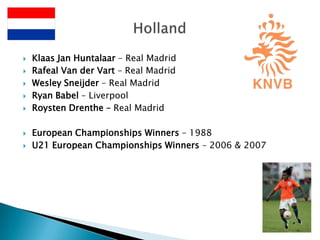
Klaas Jan Huntalaar – Real MadridRafeal Van der Vart – Real MadridWesley Sneijder – Real MadridRyan Babel – LiverpoolRoysten Drenthe – Real MadridEuropean Championships Winners – 1988U21 European Championships Winners – 2006 & 2007Holland
Bojan – BarcelonaFernando Torres - LiverpoolSergio Ramos – Real MadridCesc Fabregas – ArsenalDavid Villa – ValenciaEuropean Championship Winners – 2008U21 European Championships Winners – 1986 & 1998Olympic Gold Medallists – 1992Spain
Freddy Adu – BenficaDaMarcus Beasley – Glasgow RangersClint Dempsey – FulhamTaylor Twellman – New England RevolutionNatasha Kai – U.S WomenWomen’s World Cup Winners – 1991 & 1999Women’s U19 World Championship Winners – 2002Women's Olympic Gold Medallists – 1996, 2004 & 2008Women's U23 Nordic Tournament – 2008United States of America
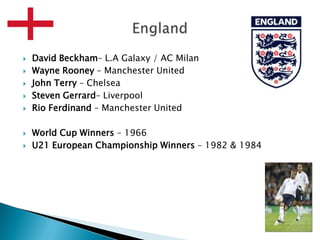
David Beckham– L.A Galaxy / AC MilanWayne Rooney – Manchester UnitedJohn Terry – ChelseaSteven Gerrard– LiverpoolRio Ferdinand – Manchester UnitedWorld Cup Winners – 1966U21 European Championship Winners – 1982 & 1984England
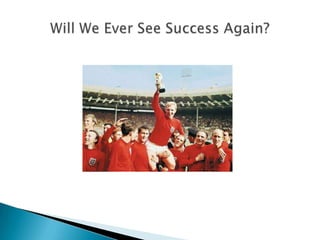
Will We Ever See Success Again?
England – (The F.A – The Football Association)‘To enjoy their football experience and improve their techniques.’‘To develop their movement and discover the benefits of learning.’Worldwide Soccer Development Priorities
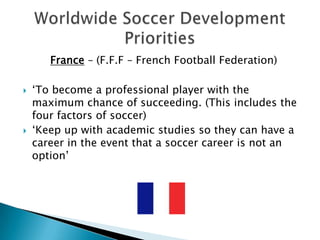
 France – (F.F.F – French Football Federation)‘To become a professional player with the maximum chance of succeeding. (This includes the four factors of soccer)‘Keep up with academic studies so they can have a career in the event that a soccer career is not an option’Worldwide Soccer Development Priorities
United States of America – (U.S.S.F – US Soccer Federation)‘To promote the implementation of small sided games as a vehicle for match play for players under the age of 12 throughout the United States’‘To promote and encourage in appropriate developmental environment for players that is based on both age and ability characteristics’Worldwide Soccer Development Priorities
French Football’s Elite Youth Development“Now France is quite simply the world-wide example for the production of young footballers”Williams (2006) Guardian
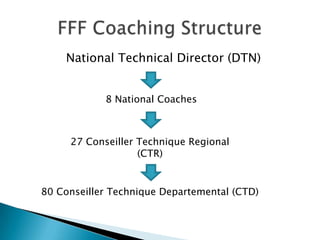
National Technical Director (DTN)FFF Coaching Structure8 National Coaches27 Conseiller Technique Regional (CTR)80 Conseiller Technique Departemental (CTD)
Lord Triesman – Independently appointed ChairmanSir Trevor Brooking – Head of Football Development Division53 County FA’sThe FA Player Development Structure
Centres de Preformation and Centres de Formation1970 – Centres de preformation and Centres de Formation introduced
“...set the standard in terms of ethos, pedagogy and general education” – Blaquart (2001)
Every member of the 1998 World Cup winning squad graduated from a Centre de Formation – Tournier and Rethacker (1999 : 161)Academies or Centre’s of Excellence made mandatory in 1998
Split into 3 age groups: 9-11 Year olds12-16 Year olds17 and 18 Year olds“It might all mean that youth development is no longer seen as a priority” – Howard Wilkinson (2007)English Centre’s of Excellence and Football Academies
Started functioning in 1988
“An excellent complement to the activities of preformation. Selection for  international matches gives the youngsters an international culture regarding tactics and irreplaceable experience of the highest level of football” – FFF’s justification of the National Centre de Preformation system – Morlans (2001)Clairefontain
Projected opening date, 2010
Will be based at a site near Burton-upon-Trent
First began preparations in 2001 under the supervision of Howard Wilkinson, the former Technical Director of the FANational Football Centre
“A good thing about buying a French player is a good education, a good attitude, very professional, very focused and tactically fully aware. He knows all the systems” – Marcelo Lippi – Hopkins and Williams (2001 : 189)
“There is already a massive problem with the lack of opportunity given to players of 17 and over. It will impact on the national team if we don't have players coming through from the academies” – Howard Wilkinson (2007)Conclusions
The Breeding Ground of Dutch Football(FIFA)29 league titles (Eredivisie)4 times winners of champions league17 times winners of league cup (KNVB Cup)Holland
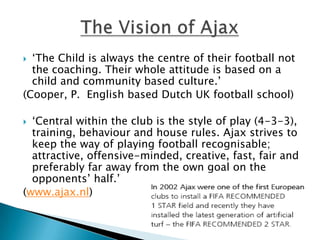
‘The Child is always the centre of their football not the coaching. Their whole attitude is based on a child and community based culture.’(Cooper, P.  English based Dutch UK football school) ‘Central within the club is the style of play (4-3-3), training, behaviour and house rules. Ajax strives to keep the way of playing football recognisable; attractive, offensive-minded, creative, fast, fair and preferably far away from the own goal on the opponents’ half.’(www.ajax.nl)The Vision of Ajax 
English Society & Culture(UNICEF, Child poverty in perspective:An overview of child well-being in rich countries, Innocenti Report Card 7, 2007UNICEF Innocenti Research Centre, Florence.)
“At the moment anyone who’s any good quickly goes through the system and is coaching 16-plus because that’s the only place to get any money, whereas in other countries they pay quality people to stay in the 5-11’s and to stay in the 11-16’s”(Sir Trevor Brooking) Premier League only signed up to UEFA’s coaching rules in 2003A View from the Top…
England must go Dutch to become world beatersWatford FC and the Harefield AcademyGovernment Academies InitiativeWhat Next?
USAElite Player Development
Too much pressure on young playersA severe lack of age appropriate coachingNo obvious system to accommodate for late developing playersToo much emphasis on results in all age groupsA lack of ability to develop talent early and placing them in the correct environment     (Allen 2008)Problems in the development of young players
    “In the United States, we have sought    to develop players in a somewhat backward    way compared with the rest of the world.”    (Allen 2008, p.17)   “...we have been trying to fit younger players into an adult scheme based upon the mistaken notion that they will develop through earlier and more intense competition.”    (Allen 2008, p.17)Problems continued...
The opportunities to mimic or copy from   observing other playersThe freedom to experiment without the fear of being cut from the squad or benchedPlaying with and against many different   players each day, allowing each player to adopt many different roles   (Allen 2008)Street Soccer
“Long term player development is an issue that every football club in the world has to address and a number of clubs around the globe are turning to a proven and successful club in this field to help meet their objectives”    (Everton Academy Online 2008)Illinois Youth Soccer AssociationOntario Soccer AssociationFC RevolutionNew England AztecsMaking Positive Change In Player Development...The Everton Way
How did we conduct our research?Where did we find our research?Did we encounter any problems?Strengths and Weaknesses of mediums?RESEARCH
Identified contemporary issue within sport ‘European Culture for Elite Player Development’Decision on approach, how would we tackle the subject?Initial general research of industry and topicsDecided how would information be presented? Concluded on PowerPoint presentationResearch Approach
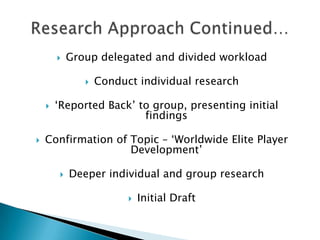
Group delegated and divided workloadConduct individual research‘Reported Back’ to group, presenting initial findingsConfirmation of Topic – ‘Worldwide Elite Player Development’Deeper individual and group researchInitial DraftResearch Approach Continued…
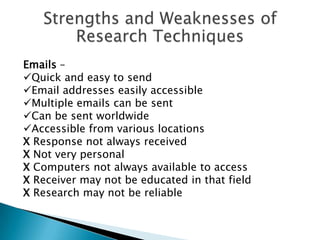
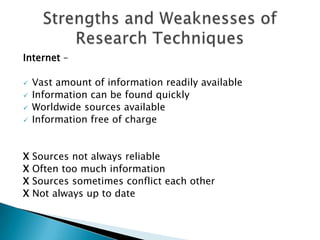
Strengths and Weaknesses of Research TechniquesEmails – Quick and easy to send
Email addresses easily accessible
Multiple emails can be sent

Worldwide Elite Player Development

  • 1.
    Worldwide Elite PlayerDevelopmentAre England so far behind?Steven Dillon, Tom Fawdry, Dominic Haynes, Scott Slater
  • 2.
    Recent World Cupor European ChampionshipsPlayers Produced by Academies, both Men and WomenDifference In PrioritiesHow does England Compare?What Happens Next?Success – How does England compare?
  • 3.
    Nicolas Anelka –ChelseaThierry Henry –BarcelonaWilliam Gallas – ArsenalSamir Nasri– ArsenalKarim Benzema – LyonWorld Cup Winners – 1998European Championships Winners –2000U21 European Championships Winners – 1988Olympic Gold Medallists – 1984France
  • 4.
    Klaas Jan Huntalaar– Real MadridRafeal Van der Vart – Real MadridWesley Sneijder – Real MadridRyan Babel – LiverpoolRoysten Drenthe – Real MadridEuropean Championships Winners – 1988U21 European Championships Winners – 2006 & 2007Holland
  • 5.
    Bojan – BarcelonaFernandoTorres - LiverpoolSergio Ramos – Real MadridCesc Fabregas – ArsenalDavid Villa – ValenciaEuropean Championship Winners – 2008U21 European Championships Winners – 1986 & 1998Olympic Gold Medallists – 1992Spain
  • 6.
    Freddy Adu –BenficaDaMarcus Beasley – Glasgow RangersClint Dempsey – FulhamTaylor Twellman – New England RevolutionNatasha Kai – U.S WomenWomen’s World Cup Winners – 1991 & 1999Women’s U19 World Championship Winners – 2002Women's Olympic Gold Medallists – 1996, 2004 & 2008Women's U23 Nordic Tournament – 2008United States of America
  • 7.
    David Beckham– L.AGalaxy / AC MilanWayne Rooney – Manchester UnitedJohn Terry – ChelseaSteven Gerrard– LiverpoolRio Ferdinand – Manchester UnitedWorld Cup Winners – 1966U21 European Championship Winners – 1982 & 1984England
  • 8.
    Will We EverSee Success Again?
  • 9.
    England – (TheF.A – The Football Association)‘To enjoy their football experience and improve their techniques.’‘To develop their movement and discover the benefits of learning.’Worldwide Soccer Development Priorities
  • 10.
     France – (F.F.F– French Football Federation)‘To become a professional player with the maximum chance of succeeding. (This includes the four factors of soccer)‘Keep up with academic studies so they can have a career in the event that a soccer career is not an option’Worldwide Soccer Development Priorities
  • 11.
    United States ofAmerica – (U.S.S.F – US Soccer Federation)‘To promote the implementation of small sided games as a vehicle for match play for players under the age of 12 throughout the United States’‘To promote and encourage in appropriate developmental environment for players that is based on both age and ability characteristics’Worldwide Soccer Development Priorities
  • 13.
    French Football’s EliteYouth Development“Now France is quite simply the world-wide example for the production of young footballers”Williams (2006) Guardian
  • 14.
    National Technical Director(DTN)FFF Coaching Structure8 National Coaches27 Conseiller Technique Regional (CTR)80 Conseiller Technique Departemental (CTD)
  • 15.
    Lord Triesman –Independently appointed ChairmanSir Trevor Brooking – Head of Football Development Division53 County FA’sThe FA Player Development Structure
  • 16.
    Centres de Preformationand Centres de Formation1970 – Centres de preformation and Centres de Formation introduced
  • 17.
    “...set the standardin terms of ethos, pedagogy and general education” – Blaquart (2001)
  • 18.
    Every member ofthe 1998 World Cup winning squad graduated from a Centre de Formation – Tournier and Rethacker (1999 : 161)Academies or Centre’s of Excellence made mandatory in 1998
  • 19.
    Split into 3age groups: 9-11 Year olds12-16 Year olds17 and 18 Year olds“It might all mean that youth development is no longer seen as a priority” – Howard Wilkinson (2007)English Centre’s of Excellence and Football Academies
  • 20.
  • 21.
    “An excellent complementto the activities of preformation. Selection for international matches gives the youngsters an international culture regarding tactics and irreplaceable experience of the highest level of football” – FFF’s justification of the National Centre de Preformation system – Morlans (2001)Clairefontain
  • 22.
  • 23.
    Will be basedat a site near Burton-upon-Trent
  • 24.
    First began preparationsin 2001 under the supervision of Howard Wilkinson, the former Technical Director of the FANational Football Centre
  • 25.
    “A good thingabout buying a French player is a good education, a good attitude, very professional, very focused and tactically fully aware. He knows all the systems” – Marcelo Lippi – Hopkins and Williams (2001 : 189)
  • 26.
    “There is alreadya massive problem with the lack of opportunity given to players of 17 and over. It will impact on the national team if we don't have players coming through from the academies” – Howard Wilkinson (2007)Conclusions
  • 28.
    The Breeding Groundof Dutch Football(FIFA)29 league titles (Eredivisie)4 times winners of champions league17 times winners of league cup (KNVB Cup)Holland
  • 29.
    ‘The Child isalways the centre of their football not the coaching. Their whole attitude is based on a child and community based culture.’(Cooper, P. English based Dutch UK football school) ‘Central within the club is the style of play (4-3-3), training, behaviour and house rules. Ajax strives to keep the way of playing football recognisable; attractive, offensive-minded, creative, fast, fair and preferably far away from the own goal on the opponents’ half.’(www.ajax.nl)The Vision of Ajax 
  • 30.
    English Society &Culture(UNICEF, Child poverty in perspective:An overview of child well-being in rich countries, Innocenti Report Card 7, 2007UNICEF Innocenti Research Centre, Florence.)
  • 31.
    “At the momentanyone who’s any good quickly goes through the system and is coaching 16-plus because that’s the only place to get any money, whereas in other countries they pay quality people to stay in the 5-11’s and to stay in the 11-16’s”(Sir Trevor Brooking) Premier League only signed up to UEFA’s coaching rules in 2003A View from the Top…
  • 32.
    England must goDutch to become world beatersWatford FC and the Harefield AcademyGovernment Academies InitiativeWhat Next?
  • 34.
  • 35.
    Too much pressureon young playersA severe lack of age appropriate coachingNo obvious system to accommodate for late developing playersToo much emphasis on results in all age groupsA lack of ability to develop talent early and placing them in the correct environment (Allen 2008)Problems in the development of young players
  • 36.
    “In the United States, we have sought to develop players in a somewhat backward way compared with the rest of the world.” (Allen 2008, p.17) “...we have been trying to fit younger players into an adult scheme based upon the mistaken notion that they will develop through earlier and more intense competition.” (Allen 2008, p.17)Problems continued...
  • 37.
    The opportunities tomimic or copy from observing other playersThe freedom to experiment without the fear of being cut from the squad or benchedPlaying with and against many different players each day, allowing each player to adopt many different roles (Allen 2008)Street Soccer
  • 38.
    “Long term playerdevelopment is an issue that every football club in the world has to address and a number of clubs around the globe are turning to a proven and successful club in this field to help meet their objectives” (Everton Academy Online 2008)Illinois Youth Soccer AssociationOntario Soccer AssociationFC RevolutionNew England AztecsMaking Positive Change In Player Development...The Everton Way
  • 39.
    How did weconduct our research?Where did we find our research?Did we encounter any problems?Strengths and Weaknesses of mediums?RESEARCH
  • 40.
    Identified contemporary issuewithin sport ‘European Culture for Elite Player Development’Decision on approach, how would we tackle the subject?Initial general research of industry and topicsDecided how would information be presented? Concluded on PowerPoint presentationResearch Approach
  • 41.
    Group delegated anddivided workloadConduct individual research‘Reported Back’ to group, presenting initial findingsConfirmation of Topic – ‘Worldwide Elite Player Development’Deeper individual and group researchInitial DraftResearch Approach Continued…
  • 42.
    Strengths and Weaknessesof Research TechniquesEmails – Quick and easy to send
  • 43.
  • 44.