Boroughbridge
Junior FC
Club development strategy
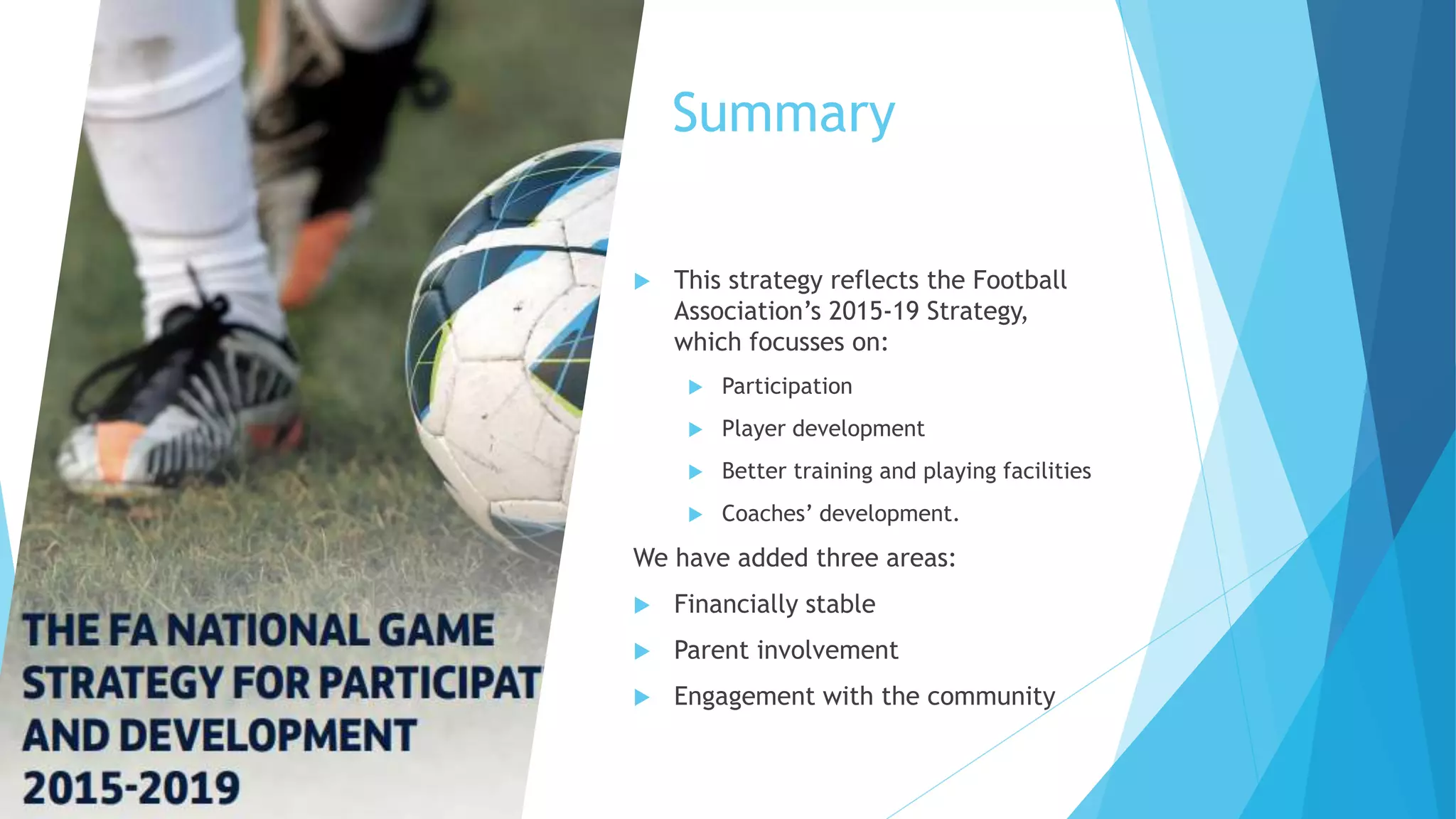
Summary
 This strategy reflects the Football
Association’s 2015-19 Strategy,
which focusses on:
 Participation
 Player development
 Better training and playing facilities
 Coaches’ development.
We have added three areas:
 Financially stable
 Parent involvement
 Engagement with the community
Our ethos
 To provide high-quality football
experiences for children and
young adults from five years of
age, regardless of ability and
prepare them for football into
adulthood.
Participation
 Objective: More players from wider age groups and all abilities
 Targets:
 Boost female participation
 Establish a new female team
 Establish older boys’ teams
 Support and grow the A4A team
 Provide a pathway for boys’ teams to U17 and beyond
 Next steps:
 Establish an U10 Girls team
 Establish U9s and U10s Boys teams
 Support the U14 Boys team through to U17
Player development
 Objective: Better quality players through development and providing access to
talent pathways.
 Targets:
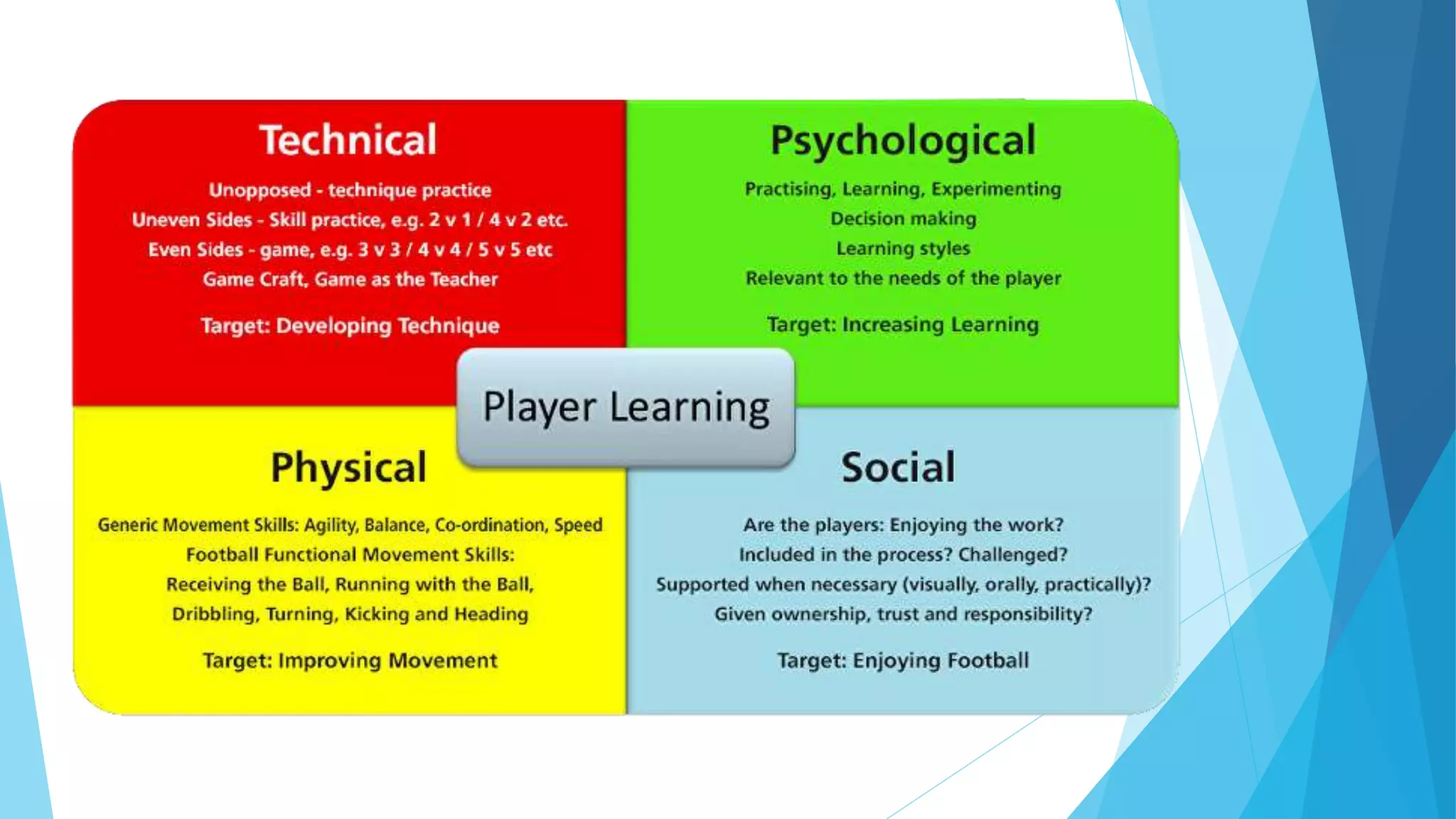
 Establish a training structure that reflects the FA’s four corners and England DNA
 Establish talent pathways to academies and district teams
 Invest in coaching training and development
 Next steps:
 Guest training sessions from the FA Skills programme and county FA staff
 Mentoring for new coaches
 Encourage play in local tournaments
 Emerging teams to join development and competitive leagues
 Overnight tournament or friendlies trip
6-8 Years: player pathway
Format: 4v4 and 5v5
Players aged 6 (the youngest we train) play 4v4 using a size 3 ball on a small pitch (e.g. 30m
by 20m) with junior or pop-up goals and no goalkeepers.
Players at 7 and 8 years should play the 5v5 format where the goal size is increased and a
goalkeeper is added.
Games played at this stage should be 10-15 minutes in duration with a maximum of four
games to be played in tournaments.
Club philosophy:
 Learning to love the game
 Movement, agility and flexibility
6-8 years: objectives
 To provide physical activity, encourage coordination and agility and basic skills
through football participation.
 Skills delivered through programmes centred around games-based, fun activities,
with all players involved.
 Simple rules – no offside, kick-ins, rolling subs, 10-15 minute game sessions
 Age-appropriate tournaments and galas allow the opportunity to express
enjoyment and develop skills through games.
4v4 & 5v5
 Lots of touches of the ball
 More attacking 1v1 situations and chances to score
 Improved decision-making
 Improved confidence
 Being brave with and without the ball
 Freedom of expression
9-12 years old player pathway
Format: 7v7 & 9v9
Club philosophy
 Learning to love the game
 Learning the skills of the game
Objectives
 Skill acquisition during these formative years, providing an ideal opportunity for focusing
on building the skills of the game.
 Use a game-based approach to motivate and develop our young players. From 1v1 to 7v7 is
appropriate – moving to 9v9 at Under 12 in the Harrogate & District Junior League.
 Speed and agility are key physical qualities that can be developed at this stage.
7v7
 Natural progression from 5v5
 More touches
 Additional rules to help challenge and develop players
 More attacking & defending situations than 4-a-side
 Opportunities to play in all positions
 More simplistic game than 11-a-side
 Improved confidence
 Freedom of expression
13 years and over player pathway
Developing the player
Format: 11v11
All FIFA Laws of the game apply at this stage, however, young players still play the game
predominantly to have fun, play with their friends and to improve their skills.
A player’s natural desire to compete should be fostered but winning games shouldn’t
become the only focus.
Coaches should continue to provide a positive learning environment with a focus on
enjoyment and long-term development.
Club philosophy
 Learning to love the game
 Playing the game
Objectives
 The focus of training is still on development.
 Players’ natural desire to win should be fostered by the coaches but training should
not be just focused on preparing a team to win, but also on developing the
individual player in-line with the FA Four Corners.
 More emphasis on technical and tactical development as skill and game competence
improves.
 Coaches retain a focus on core skills and tactical application in competitive
environments.
 Progressively develop strength, power, speed and endurance through individual
programmes.
 Encourage players to practice in their own time and set challenges.
Better training facilities
 Objective: Expand access to all-weather and other facilities
 Target: more use of all-weather and indoor facilities across the season
 How:
 Explore opportunities to play on 3G/4G pitches
 Ring-fence/raise funds to be used for hire of facilities as needed to maintain
continuity of play
 Increase use of indoor facilities for the youngest ages in winter
 Communicate to parents the need to make a contribution to pitch hire to ensure
continuity
 Establish a working group to apply for funding to acquire facilities
Coaches’ development
 Objective: A well-trained and motivated team of coaches and helpers
 Targets:
 More helpers and assistants to complete FA Level 1 training
 More games officiated by qualified referees
 How:
 Progress all helpers to become FA Level 1 coaches
 Attract potential coaches and referees from parents, helpers and older age groups
 Provide support and mentoring to new coaches
 Two more FA Level 2 coaches
Financial sustainability
 Prepare income/expenditure/reserve projections for 2018/19 to 2022/23
 Retain spending control at committee level
 Prioritise spending in core areas: equipment, pitches, leagues and
tournaments, coach development, insurance, branding
 Source additional funding:
 Review subscriptions
 Grants
 Community donations
 Sponsorship
Community engagement
 Objective: to ensure that community
organisations continue to support the club
and its activities.
 How:
 Continued representation on the BAFC
committee.
 Create formal and informal links with local
organisations and people such as: the youth
club, Town Council, Chamber of Trade, Town
Mayor, local media, schools, Boroughbridge
Lions etc.

Boroughbridge Junior FC development plan

  • 1.
  • 2.
    Summary  This strategyreflects the Football Association’s 2015-19 Strategy, which focusses on:  Participation  Player development  Better training and playing facilities  Coaches’ development. We have added three areas:  Financially stable  Parent involvement  Engagement with the community
  • 3.
    Our ethos  Toprovide high-quality football experiences for children and young adults from five years of age, regardless of ability and prepare them for football into adulthood.
  • 4.
    Participation  Objective: Moreplayers from wider age groups and all abilities  Targets:  Boost female participation  Establish a new female team  Establish older boys’ teams  Support and grow the A4A team  Provide a pathway for boys’ teams to U17 and beyond  Next steps:  Establish an U10 Girls team  Establish U9s and U10s Boys teams  Support the U14 Boys team through to U17
  • 5.
    Player development  Objective:Better quality players through development and providing access to talent pathways.  Targets:  Establish a training structure that reflects the FA’s four corners and England DNA  Establish talent pathways to academies and district teams  Invest in coaching training and development  Next steps:  Guest training sessions from the FA Skills programme and county FA staff  Mentoring for new coaches  Encourage play in local tournaments  Emerging teams to join development and competitive leagues  Overnight tournament or friendlies trip
  • 7.
    6-8 Years: playerpathway Format: 4v4 and 5v5 Players aged 6 (the youngest we train) play 4v4 using a size 3 ball on a small pitch (e.g. 30m by 20m) with junior or pop-up goals and no goalkeepers. Players at 7 and 8 years should play the 5v5 format where the goal size is increased and a goalkeeper is added. Games played at this stage should be 10-15 minutes in duration with a maximum of four games to be played in tournaments. Club philosophy:  Learning to love the game  Movement, agility and flexibility
  • 8.
    6-8 years: objectives To provide physical activity, encourage coordination and agility and basic skills through football participation.  Skills delivered through programmes centred around games-based, fun activities, with all players involved.  Simple rules – no offside, kick-ins, rolling subs, 10-15 minute game sessions  Age-appropriate tournaments and galas allow the opportunity to express enjoyment and develop skills through games. 4v4 & 5v5  Lots of touches of the ball  More attacking 1v1 situations and chances to score  Improved decision-making  Improved confidence  Being brave with and without the ball  Freedom of expression
  • 9.
    9-12 years oldplayer pathway Format: 7v7 & 9v9 Club philosophy  Learning to love the game  Learning the skills of the game Objectives  Skill acquisition during these formative years, providing an ideal opportunity for focusing on building the skills of the game.  Use a game-based approach to motivate and develop our young players. From 1v1 to 7v7 is appropriate – moving to 9v9 at Under 12 in the Harrogate & District Junior League.  Speed and agility are key physical qualities that can be developed at this stage.
  • 10.
    7v7  Natural progressionfrom 5v5  More touches  Additional rules to help challenge and develop players  More attacking & defending situations than 4-a-side  Opportunities to play in all positions  More simplistic game than 11-a-side  Improved confidence  Freedom of expression
  • 11.
    13 years andover player pathway Developing the player Format: 11v11 All FIFA Laws of the game apply at this stage, however, young players still play the game predominantly to have fun, play with their friends and to improve their skills. A player’s natural desire to compete should be fostered but winning games shouldn’t become the only focus. Coaches should continue to provide a positive learning environment with a focus on enjoyment and long-term development. Club philosophy  Learning to love the game  Playing the game
  • 12.
    Objectives  The focusof training is still on development.  Players’ natural desire to win should be fostered by the coaches but training should not be just focused on preparing a team to win, but also on developing the individual player in-line with the FA Four Corners.  More emphasis on technical and tactical development as skill and game competence improves.  Coaches retain a focus on core skills and tactical application in competitive environments.  Progressively develop strength, power, speed and endurance through individual programmes.  Encourage players to practice in their own time and set challenges.
  • 13.
    Better training facilities Objective: Expand access to all-weather and other facilities  Target: more use of all-weather and indoor facilities across the season  How:  Explore opportunities to play on 3G/4G pitches  Ring-fence/raise funds to be used for hire of facilities as needed to maintain continuity of play  Increase use of indoor facilities for the youngest ages in winter  Communicate to parents the need to make a contribution to pitch hire to ensure continuity  Establish a working group to apply for funding to acquire facilities
  • 14.
    Coaches’ development  Objective:A well-trained and motivated team of coaches and helpers  Targets:  More helpers and assistants to complete FA Level 1 training  More games officiated by qualified referees  How:  Progress all helpers to become FA Level 1 coaches  Attract potential coaches and referees from parents, helpers and older age groups  Provide support and mentoring to new coaches  Two more FA Level 2 coaches
  • 15.
    Financial sustainability  Prepareincome/expenditure/reserve projections for 2018/19 to 2022/23  Retain spending control at committee level  Prioritise spending in core areas: equipment, pitches, leagues and tournaments, coach development, insurance, branding  Source additional funding:  Review subscriptions  Grants  Community donations  Sponsorship
  • 16.
    Community engagement  Objective:to ensure that community organisations continue to support the club and its activities.  How:  Continued representation on the BAFC committee.  Create formal and informal links with local organisations and people such as: the youth club, Town Council, Chamber of Trade, Town Mayor, local media, schools, Boroughbridge Lions etc.