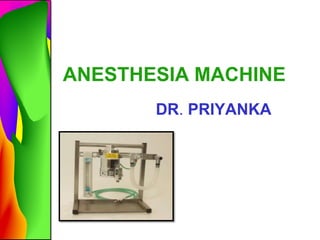
ANESTHESIA MACHINE
       DR. PRIYANKA
ANESTHESIA MACHINE


• The function of anesthesia
  machine is preparation of
  anesthesia gas mixture of pure
  and precisely known yet
  variable composition at
  controlled & known pressure.
MACHINE STANDARDS

• 1979 – ANSI
• 1988 – ASTM

• Defined
  design, performance, safety
  requirements of anesthesia
  machine.
ANESTHESIA MACHINE
ANESTHESIA MACHINE
DIVEDED IN TO TWO
      PARTS


• ELECTRICAL SYSTEM

• PNEUMATIC SYSTEM
ELECTRICAL SYSTEM

• Master switch
• Battery back up
• Battery recharge
• Electric outlet for in built
  monitor
• Circuit breaker
PNEUMATIC SYSTEM

• High pressure system

• Intermediate pressure system

• Low pressure system
HIGH PRESSURE

• From cylinders to the pressure
  regulating valve/ preset valve.

• Convert variable pressure flow
  from cylinders to lower and
  most constant pressure
  suitable for machine
• 760 Psi, 1800 Psi to 40-48 Psi
INTERMEDIATE PRESSURE

• Receives gases from pressure
  regulating valve or pipeline &
  supply to the flowmeters &
  oxygen flush valve.

• 40 – 55 Psi from pipeline
• 40 – 48 Psi from pressure
  regulating valve
LOW PRESSURE

• From flow regulating valve to
  common gas outlet.

• Pressure in this system is
  slightly above the atmospheric
  pressure

• 14 -20 Psi
HIGH PRESSURE SYSTEM
HANGER YOKE
 ASSEMBLY
      • Retaining screw

      • Swinging gate
        (Toggle gate
        Swivel gate)

      • Nipple

      • Index pins
7PIN INDEX SYSTEM
       •   machine – pins
       •   Cylinder – holes
       •   Pins – 4 mm in dia
       •   6mm in length, 12°
       •   9/16 inch radius
 7     •   O2 – 2,5
       •   N2O - 3,5
       •   Air – 1,5
       •   Entonox -7
       •   Cyclopropane -3,6
LIMITATIONS OF PIN
        INDEX
• Broken pin

• Upside down yoke block

• Use of double washer
HANGER YOKE
        ASSEMBLY
• WASHER            • FILTER
• GASKET
• Must be present   • Acc to ASTM
• Placed around       standards.
  the nipple
• Only one washer   • 100 µm should
• Two nullify pin     be installed in
  index system        between cylinder
• Must be in good     & reducing valve
  condition
CHECK VALVE ASSEMBLY
• One way valve
• Prevent gas leak from empty
  yoke
• Allow cylinder change while
  using one
• Prevent transfilling of cylinder
• Yoke block, not to keep empty
• cylinder closed – pipeline used.
BOURDEN PRESSURE
     GUAGE


         ELASTIC TUBE
DIFFERENCE IN O2 &
       N2O
PRESSURE
REGULATING VALVE
        • High pressure
          small area, large
          area drop in
          pressure.

        • Spring added for
          constant same
          low pressure
          output.
INTERMIDATE PRESSURE
PIPELINE INLET
 CONNECTION
       • ASTM
       • DISS
       • Check valve
         assembly
       • Pipeline pressure
         indicator gauge
       • 45-55 Psi
       • Cylinder should be
         closed
INTERMIDATE
           PRESSURE
• LEAK –             • GAS POWER
  connection           OUTLET
  inside machine     • Supply to
                       ventilator or jet
• ASTM                 ventilating system
                     • PRESSURE < 50
                       Psi not allowed -
• Leak should not
                       ventilators will not
  be more than 25
                       function
  ml/min at normal
  service pressure   • Quick coupler
                     • DISS
MASTER SWITCH

       • INTERMIDATE
         SYSTEM
       • Downstream the
         inlet
       • Oxygen flush will
         work even if
         standby position
       • Sudden turn off is
         dangerous
OXYGEN PRESSURE
     FAILURE DEVICES
• OXYGN FAILURE        • OXYGEN
  SAFTY – ASTM           FAILURE ALARM
• Set pressure o2      • ASTM
  conc. should not <   • < Set P (30Psi)
  19%                  • Initiated within 5
                         sec .
                       • May be silenced
                         not more than 120
                         sec.
                       • Can’t disabled
OXYGEN PRESSURE
   FAILURE DEVICES
• Drager
• 30-37 Psi 207-255 KPa

• Ohmeda
• 28 Psi 190 KPa
LIMITATIONS
  oxygen failure safety
        device
• System may be pressured for
  weeks if it is gas tight; without
  being connected to the oxygen
  source.

• Do not offer total protection
  against hypoxic mixture
QUICK FLUSH SYSTEM
          • 35 – 75 lit/min
          • 40 - 55 Psi
          • Percutaneous
            catheter –
            adequate
            ventilation
          • Work even when
            master switch off.
          • Collar to prevent
            accidental
            activation.
LIMITATIONS OF
      OXYGEN FLUSH
• ASTM it should     • Flush valve
  not increase or      sticking in ON
  decrease P at        position leads to
  vaporizer outlet
  > 10 KPa           • BAROTRAUMA
  or output > 20 %
                     • AWARENESS
• CHECK VALVE
  IN MACHINE
SECOND STAGE
   REDUCING DEVICE
• Just upstream the N2O & O2
  control valve.
• Gases from pressure reducing
  valve or central supply.
• N2O – 26 Psi
• O2 – 14 Psi
• Flow will be constant below
  normal fluctutation range
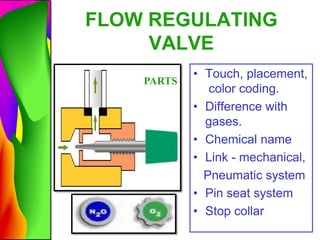
FLOW REGULATING
     VALVE
            • Touch, placement,
    PARTS
               color coding.
            • Difference with
              gases.
            • Chemical name
            • Link - mechanical,
              Pneumatic system
            • Pin seat system
            • Stop collar
PROBLEMS WITH FLOW
   CONTROL VALVE
• Inadvertent             • Leak through the
  alteration -              open flow control
   Light                    valve.
  touch, accidental
  brushing                • Failure to allow
                            adequate gas
• Inability to turn the     flow – broken
  control knob ON           stem blocking the
                            path.
LOW PRESSURE SYSTEM
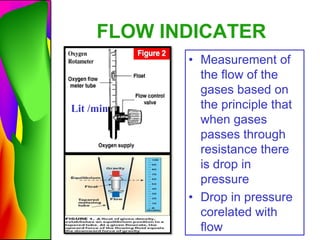
FLOW INDICATER
            • Measurement of
              the flow of the
              gases based on
Lit /min      the principle that
              when gases
              passes through
              resistance there
              is drop in
              pressure
            • Drop in pressure
              corelated with
              flow
FLOWMETER
PHYSICS FLOWMETER

         • LOW FLOWS –
         • LAMINAR FLOW
           VISCOSITY

         • HIGH FLOWS
         • TURBULANT
         • DENSITY
FLOW INDICATER

• RATE OF FLOW          • PRESSURE DROP

• Pressure drop         • Frictional
  across constriction     resistance float &
• Size of annular         tube wall
  opening               • Turbulent flow
• Physical properties   • Drop in energy
  of gas                • Wt float / cross
                          sectional area
FLOW METER
    • Thrope tube
    • Narrow at bottom
    • Calibrated for gas at
      atm. Pressure, 20° C
    • Single, dual taper
    • Antistatic coating
    • Float
    • Float rest, stop
    • Annular space
    • Fluorescent
FLOAT OR BOBBIN
       • Nonrotating
       • Plumb bob, striked
         rotating
       • Ball
       • Indicator of constant
         flow
       • Important to monitor
       • Float stop
       • Float rest
       • Rib guides
PROBLEMS OF
FLOWMETER ASSEMBLY
• FLOWMETER           • FLOAT

• Inaccuracy at low   • Sudden
  flow                  projection to top
• Calibration           with opening of
• Sticking dust         cylinder
• Back pressure       • Block outlet flow
  drops float to      • Wrong flow meter
  lower position.       used.
SEQUENCE OF FLOW
     INDICATER
• Series – one flow control knob
• Such that delivery of hypoxic
  mixture is prevented.
• ASTM – O2 downstream - flow
  indicator – near outlet
• Any separate vaporizer flow
  indicator should be separated
  by at least 10 cm.
IMPORTANCE OF
DOWNSTREAM OF O2
        • Downstream of
          oxygen prevent
           hypoxic mixture
          going to patient in
          case of leak in
          the flow indicator
        • Safety
          mechanism
        • Downstream leak
          change in
          quantity
MINIMUM O2 RATIO
         DEVICES
• Pneumatic systems
• Mechanical systems
• Alarm systems
• Oxygen ratio monitor controller
  & alarm
• Next generation will be
  electronic flow measurement
OHMEDA LINK 25
   SYSTEM
        • Pneumatic -
        • At least 25% of
          oxygen flows in
          the system
        • One of the
          hypoxia guard
        • Mechanical-
          linkage in O2
          N2O knobs by 14
          vs 29 tooth
          sproket
MECHANICAL
O2 RATIO MONITOR
CONTROLLER & ALARM


              Drager
              machine
LOCATION OF
UNIDIRECTIONAL VALVE
UNIDIRECTIONL CHECK
        VALVE
                       • Unidirectional
                         check valve
                       • Between vaporizer
• Positive pressure      & common gas
  from the breathing     outlet
  system is
                       • Upstream of O2
  transmitted to
                         flush flow joins
  machine in IPPV &
                         fresh gas flow
  assisted
  ventilation&O2       • Gas must flow
  flush                  from flowmeter
                       • Leak not detected
PRESSURE RELIEF
        VALVE
• Near the common     • Opens at 100 cm
  gas outlet            of H2O
• To prevent high
  pressure from       • Limits anesthesia
  being transmitted     machine to
  in to machine         deliver jet
• To prevent high       ventilation
  pressure being
  transmitted to Pt   • Present in some
  from machine          machine
VAPORIZER MOUNTING
      DEVICE
• Located in
  between
  flowmeter device
  and common gas
  outlet

• Permanent
  mounting
• Change of
  vaporizer
LOW PRESSURE PIPING

• Large number of connections
• Subject to break or leak

• Flow should not exceed above
  30 ml/min at a pressure of
  3KPa or 30 cm of water
COMMON GAS
         OUTLET
• Receives gases & vapors from
  the machine
• Outlet in most of the machines
  have 15 mm female slip-joint
  connection, with coaxial 22 mm
  male connection
• Frequent location for leak
SAFTY MECHANISMS
• Antistatic coating   • Fluorescent back
• Antistatic wheels      of flow meter
• Color coding         • Master & slaves
• Pin index            • O2 failure alarm
• DISS                 • Oxygen flush
• Pressure guage       • Pressure relief
• Touch, coding, pl      valve
  acement of flow      • Unidirectional
  regulator              check valve
• Rotating bobbin      • Trilene interlock
                         with close system
THANK YOU

Anesthesia machine

  • 1.
    ANESTHESIA MACHINE DR. PRIYANKA
  • 2.
    ANESTHESIA MACHINE • Thefunction of anesthesia machine is preparation of anesthesia gas mixture of pure and precisely known yet variable composition at controlled & known pressure.
  • 3.
    MACHINE STANDARDS • 1979– ANSI • 1988 – ASTM • Defined design, performance, safety requirements of anesthesia machine.
  • 4.
  • 5.
  • 6.
    DIVEDED IN TOTWO PARTS • ELECTRICAL SYSTEM • PNEUMATIC SYSTEM
  • 7.
    ELECTRICAL SYSTEM • Masterswitch • Battery back up • Battery recharge • Electric outlet for in built monitor • Circuit breaker
  • 8.
    PNEUMATIC SYSTEM • Highpressure system • Intermediate pressure system • Low pressure system
  • 9.
    HIGH PRESSURE • Fromcylinders to the pressure regulating valve/ preset valve. • Convert variable pressure flow from cylinders to lower and most constant pressure suitable for machine • 760 Psi, 1800 Psi to 40-48 Psi
  • 10.
    INTERMEDIATE PRESSURE • Receivesgases from pressure regulating valve or pipeline & supply to the flowmeters & oxygen flush valve. • 40 – 55 Psi from pipeline • 40 – 48 Psi from pressure regulating valve
  • 11.
    LOW PRESSURE • Fromflow regulating valve to common gas outlet. • Pressure in this system is slightly above the atmospheric pressure • 14 -20 Psi
  • 12.
  • 13.
    HANGER YOKE ASSEMBLY • Retaining screw • Swinging gate (Toggle gate Swivel gate) • Nipple • Index pins
  • 14.
    7PIN INDEX SYSTEM • machine – pins • Cylinder – holes • Pins – 4 mm in dia • 6mm in length, 12° • 9/16 inch radius 7 • O2 – 2,5 • N2O - 3,5 • Air – 1,5 • Entonox -7 • Cyclopropane -3,6
  • 15.
    LIMITATIONS OF PIN INDEX • Broken pin • Upside down yoke block • Use of double washer
  • 16.
    HANGER YOKE ASSEMBLY • WASHER • FILTER • GASKET • Must be present • Acc to ASTM • Placed around standards. the nipple • Only one washer • 100 µm should • Two nullify pin be installed in index system between cylinder • Must be in good & reducing valve condition
  • 17.
    CHECK VALVE ASSEMBLY •One way valve • Prevent gas leak from empty yoke • Allow cylinder change while using one • Prevent transfilling of cylinder • Yoke block, not to keep empty • cylinder closed – pipeline used.
  • 18.
    BOURDEN PRESSURE GUAGE ELASTIC TUBE
  • 19.
  • 20.
    PRESSURE REGULATING VALVE • High pressure small area, large area drop in pressure. • Spring added for constant same low pressure output.
  • 21.
  • 22.
    PIPELINE INLET CONNECTION • ASTM • DISS • Check valve assembly • Pipeline pressure indicator gauge • 45-55 Psi • Cylinder should be closed
  • 23.
    INTERMIDATE PRESSURE • LEAK – • GAS POWER connection OUTLET inside machine • Supply to ventilator or jet • ASTM ventilating system • PRESSURE < 50 Psi not allowed - • Leak should not ventilators will not be more than 25 function ml/min at normal service pressure • Quick coupler • DISS
  • 24.
    MASTER SWITCH • INTERMIDATE SYSTEM • Downstream the inlet • Oxygen flush will work even if standby position • Sudden turn off is dangerous
  • 25.
    OXYGEN PRESSURE FAILURE DEVICES • OXYGN FAILURE • OXYGEN SAFTY – ASTM FAILURE ALARM • Set pressure o2 • ASTM conc. should not < • < Set P (30Psi) 19% • Initiated within 5 sec . • May be silenced not more than 120 sec. • Can’t disabled
  • 26.
    OXYGEN PRESSURE FAILURE DEVICES • Drager • 30-37 Psi 207-255 KPa • Ohmeda • 28 Psi 190 KPa
  • 27.
    LIMITATIONS oxygenfailure safety device • System may be pressured for weeks if it is gas tight; without being connected to the oxygen source. • Do not offer total protection against hypoxic mixture
  • 28.
    QUICK FLUSH SYSTEM • 35 – 75 lit/min • 40 - 55 Psi • Percutaneous catheter – adequate ventilation • Work even when master switch off. • Collar to prevent accidental activation.
  • 29.
    LIMITATIONS OF OXYGEN FLUSH • ASTM it should • Flush valve not increase or sticking in ON decrease P at position leads to vaporizer outlet > 10 KPa • BAROTRAUMA or output > 20 % • AWARENESS • CHECK VALVE IN MACHINE
  • 30.
    SECOND STAGE REDUCING DEVICE • Just upstream the N2O & O2 control valve. • Gases from pressure reducing valve or central supply. • N2O – 26 Psi • O2 – 14 Psi • Flow will be constant below normal fluctutation range
  • 31.
    FLOW REGULATING VALVE • Touch, placement, PARTS color coding. • Difference with gases. • Chemical name • Link - mechanical, Pneumatic system • Pin seat system • Stop collar
  • 32.
    PROBLEMS WITH FLOW CONTROL VALVE • Inadvertent • Leak through the alteration - open flow control Light valve. touch, accidental brushing • Failure to allow adequate gas • Inability to turn the flow – broken control knob ON stem blocking the path.
  • 33.
  • 34.
    FLOW INDICATER • Measurement of the flow of the gases based on Lit /min the principle that when gases passes through resistance there is drop in pressure • Drop in pressure corelated with flow
  • 35.
  • 36.
    PHYSICS FLOWMETER • LOW FLOWS – • LAMINAR FLOW VISCOSITY • HIGH FLOWS • TURBULANT • DENSITY
  • 37.
    FLOW INDICATER • RATEOF FLOW • PRESSURE DROP • Pressure drop • Frictional across constriction resistance float & • Size of annular tube wall opening • Turbulent flow • Physical properties • Drop in energy of gas • Wt float / cross sectional area
  • 38.
    FLOW METER • Thrope tube • Narrow at bottom • Calibrated for gas at atm. Pressure, 20° C • Single, dual taper • Antistatic coating • Float • Float rest, stop • Annular space • Fluorescent
  • 39.
    FLOAT OR BOBBIN • Nonrotating • Plumb bob, striked rotating • Ball • Indicator of constant flow • Important to monitor • Float stop • Float rest • Rib guides
  • 40.
    PROBLEMS OF FLOWMETER ASSEMBLY •FLOWMETER • FLOAT • Inaccuracy at low • Sudden flow projection to top • Calibration with opening of • Sticking dust cylinder • Back pressure • Block outlet flow drops float to • Wrong flow meter lower position. used.
  • 41.
    SEQUENCE OF FLOW INDICATER • Series – one flow control knob • Such that delivery of hypoxic mixture is prevented. • ASTM – O2 downstream - flow indicator – near outlet • Any separate vaporizer flow indicator should be separated by at least 10 cm.
  • 42.
    IMPORTANCE OF DOWNSTREAM OFO2 • Downstream of oxygen prevent hypoxic mixture going to patient in case of leak in the flow indicator • Safety mechanism • Downstream leak change in quantity
  • 43.
    MINIMUM O2 RATIO DEVICES • Pneumatic systems • Mechanical systems • Alarm systems • Oxygen ratio monitor controller & alarm • Next generation will be electronic flow measurement
  • 44.
    OHMEDA LINK 25 SYSTEM • Pneumatic - • At least 25% of oxygen flows in the system • One of the hypoxia guard • Mechanical- linkage in O2 N2O knobs by 14 vs 29 tooth sproket
  • 45.
  • 46.
    O2 RATIO MONITOR CONTROLLER& ALARM Drager machine
  • 47.
  • 48.
    UNIDIRECTIONL CHECK VALVE • Unidirectional check valve • Between vaporizer • Positive pressure & common gas from the breathing outlet system is • Upstream of O2 transmitted to flush flow joins machine in IPPV & fresh gas flow assisted ventilation&O2 • Gas must flow flush from flowmeter • Leak not detected
  • 49.
    PRESSURE RELIEF VALVE • Near the common • Opens at 100 cm gas outlet of H2O • To prevent high pressure from • Limits anesthesia being transmitted machine to in to machine deliver jet • To prevent high ventilation pressure being transmitted to Pt • Present in some from machine machine
  • 50.
    VAPORIZER MOUNTING DEVICE • Located in between flowmeter device and common gas outlet • Permanent mounting • Change of vaporizer
  • 51.
    LOW PRESSURE PIPING •Large number of connections • Subject to break or leak • Flow should not exceed above 30 ml/min at a pressure of 3KPa or 30 cm of water
  • 52.
    COMMON GAS OUTLET • Receives gases & vapors from the machine • Outlet in most of the machines have 15 mm female slip-joint connection, with coaxial 22 mm male connection • Frequent location for leak
  • 53.
    SAFTY MECHANISMS • Antistaticcoating • Fluorescent back • Antistatic wheels of flow meter • Color coding • Master & slaves • Pin index • O2 failure alarm • DISS • Oxygen flush • Pressure guage • Pressure relief • Touch, coding, pl valve acement of flow • Unidirectional regulator check valve • Rotating bobbin • Trilene interlock with close system
  • 54.