GATT AND TRIPS AGREEMENT
AND WTO

PRESENTED BY
MANOJ KUMAR
AMITY UNIVERSITY
Page 1
GATT
• The general agreement on tariffs and trade (GATT) was
originally created by the Bretton Woods Conferences as a
part of economics of world after world war –II in 1947.
• It was came into force in January 1948 after Geneva
Conference.
• In starting about 23 countries was involved in GATT.
• They thought to organized ITO (International Trade
Organization) but after discussion it was not success and
GATT was came in force in 1948.

Page 2
OBJECTIVE
• Raising standards of living.
• Ensuring full employment.
• A large and steadily growing volume of real income and
effective demand.
• Developing the full use of the resource of the world.
• Expanding the production and exchange of goods.
• to provide industries and business enterprises from
different countries a secure, stable and predictable
environment in which they can trade with one another
under conditions of fair and equitable competition.
• to promote through increased trade, greater investment,
production and employment.
Page 3
PRINCIPLE OF GATT
1- TRADE WITHOUT DISCRIMINATION• This principle involve the provision of most favored
nation (MFN) means each contracting parties give any
other contracting parties the same benefits as those gives
to another parties.

• It also involve the national treatment means the imported
product treatment is preferment similar to the national
product with similar tax and regulation.
Page 4
2-PROTECTION ONLY THROUGH TARIFF-

• Protection should be given to domestic industries only
through the customs tariffs and not through other
commercial measures .

• The aim of this rules ,the extent of protection clear and to
make competition possible.
Page 5
3- A STABLE BASIS OF TRADE-

• The contracting countries provide a stable predictable
basis for trade.

• The binding of tariffs means that these can not be
increased unilaterally. So that this provision is made for
the renegotiation of bound tariffs.

Page 6
4- CONSULTATIONS
• A basic principle of GATT is that members countries
should consult one another on trade matters and
problems.

• They can call on GATT for a fair settlement of cases in
which they feel that their rights under GATT are being
with held or compromised by other members.

Page 7
LIMITATION
• Benefitted mainly for industrialized world.
• Unfavorable for developing countries.
• No specialization for intellectual properties.
• No legal body included.

Page 8
Impact on developing countries• The role of GATT in integrating developing countries is
open multilateral trading system.
• The GATT provide the trading system and programmatic
support through certain rules helped in both ways expand
and diversify their trade.
• The developing countries have become full partners in
the systems means they actively participate in the
Uruguay Round.
• The free trade has become the backbone of economic
prosperity and development of the developing countries.
• So that the GATT provide the good impact on developing
countries.
Page 9
TRIPPS AGREEMENT
• Trade related intellectual properties agreement was
signed in Marrakesh, Morocco, on 15,april 1994.
OBJECTIVE• To protection and enforcement of intellectual property
right of persons.
• To promotion of technological innovation.
• To transfer and dissemination of technology.
• To mutual advantage of producers and users of
technological knowledge and easy to social and
economic welfare.
• To become of right and obligations.
Page 10
PRINCIPLE OF TRIPS• The principles of TRIPS is that the members formulating
or amending their laws and regulation.
• Adopt measures necessary to protect public health and
nutritions.
• Promotes the public interest in sectors of vital importance
to their socio-economic and technological development
with the provision of TRIPS Agreement.

Page 11
TRIPS COVERAGE AREA
•
•
•
•
•
•
•
•

Copyright and related Rights.
Trademark and related Rights.
Geographical indication related.
Industrial designs related.
Patent related.
Layout designs of integrated circuits.
Protection of undisclosed information.
Control of licensing authority.

Page 12
WTO (WORLD TRADE ORGANISATION)
•
•
•
•

WTO was established on January 1,1995.
WTO is the result of Uruguary Round of GATT.
Organization created by the Marrakesh Agreement
WTO is completely replacement of GATT predecessor
and has a very different characters.
• WTO is an international organization that established
rules for international trades.
• It also resolves disputes between the members which are
all signatories to its set of trade agreement.
• 76 Governments became members of the WTO on its
first day. The present membership accounts for more
than 90 per cent of world trade.
Page 13
OBJECTIVE• To set and enforce rules for international trades.
• To provide a forum for negotiating and monitoring
further trade liberalization.
• To resolve trade disputes.
• To increase the transparency of decision-making
processes.
• To co-operate with other major international economic
institutions involve in global economic management.
• To help developing countries benefits fully from the
global trading system.
• Ensuring growth of real income and demand
Page 14
SCOPE OF WTO• The WTO shall provide the common institutional
framework for the conduct of trade relations among its
Members in matters related to the agreements and
associated legal instruments included in the Annexes to
the Marrakesh Agreement.”
• Multilateral Trade Agreement
• Plurilateral Trade Agreements

Page 15
FUNCTION OF WTO
•
•
•
•

Forum for trade negotiations.
Monitoring trade policy of countries.
Proving technical advises to member countries.
It shall provide the frame work for the implementation ,
administration and operation of the plurilateral trade
agreement.
• Handling trade disputes.
• WTO shall administer the understanding on rules and
procedures governing the settlement of disputes.
• It shall co-operate as appropriate, with the International
Monetary Fund and the International Bank for
Reconstruction and Development.
Page 16
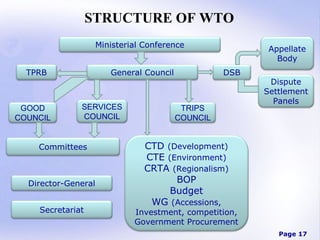
STRUCTURE OF WTO
Ministerial Conference
TPRB

GOOD
COUNCIL

General Council

SERVICES
COUNCIL

Committees

Director-General
Secretariat

Appellate
Body
DSB

TRIPS
COUNCIL

Dispute
Settlement
Panels

CTD (Development)
CTE (Environment)
CRTA (Regionalism)
BOP
Budget
WG (Accessions,

Investment, competition,
Government Procurement
Page 17
STATUS OF WTO
• The WTO shall have a legal personality and shall legal
capacity as may be necessary for the exercise of its
function.
• WTO shall be accorded by each of its members such as
privileges and immunities as are necessary for the
exercise of its function.
• The official of WTO and the representative of members
shall similarly be accorded by each of its members are
necessary for the independent exercise of their function in
connection with the WTO.
• WTO may conclude a headquarter agreement.
Page 18
MEMBERSHIP AND WITHDRAWAL• Members
–

Established by the Marrakesh Agreement – 153
Members.

–

Members can be States or separate customs territory
possessing full autonomy in the conduct of its
external commercial relations

–

Membership is delivered after an accession
procedure (around 30 candidates)

Page 19
WITHDRAWAL• Any member may be withdrawal from this agreement.
• Such withdrawal shall apply both to this agreement and
the multilateral.
• Shall take effect upon the expiration of six months from
the date on which written notice of withdrawal is
received by director general of the WTO.
• Withdrawal from a plurilateral trade agreement shall be
governed by the provisions of that agreement.

Page 20
DISPUTE SETTLEMENT
• The basic principle of the dispute settlement committee
is1-Equitable
2-Fast
3-Effective
4-Mutually acceptable
• There are some stages involved in dispute settlment1- The first step conducted for 60 days.In this step if the
dispute is not solve then step –II is followed.
2- In this step the committee is formed within 45 days.
And this committee should submitted report with in 6
months.

Page 21
•
•
•
•
•
•
•
•
•
•

There is some steps involved in this steps as followsBefore the first hearing
First hearing
Rebuttals
Expert
First draft
Interim report
Reviews
Final report
Report become ruling

Page 22
ROLE OF WTO IN GLOBALIZATION• WTO plays an important role in the principle of trade
withdrawal discrimination in the free market trade.
• Most favored nation (MFN) treating other people equally
under the WTO agreement ,countries can not normally
discriminate between their trading partner.
• National treatment treating the foreigners and local
equally.
• Freer trade ,in this lowering trade barriers is one of the
most obvious means of encouraging trade. The barriers
concerned include customs duties and measures such as
import bans that restrict quantities selectively.
Page 23
• Predictability with suitability and predictability
investment is encouraged , jobs are created and
consumers can fully enjoy the benefits of competitions
such as choice and lower prices.
• Promotion fair competition ,the WTO is sometimes
describes as a “free trade” institution ,but it is not entirely
accurate the system does not allow tariffs .
• More accurate it is a system of rules dedicated to open
fair and undistorted competition.
• WTO contributes to development. On other hand ,
developing countries need flexibility in the time they take
to implement the system’s agreement.

Page 24
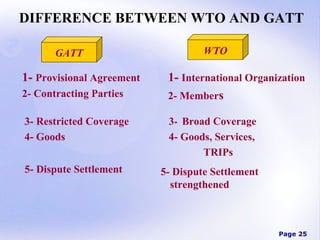
DIFFERENCE BETWEEN WTO AND GATT
GATT

1- Provisional Agreement
2- Contracting Parties

WTO

1- International Organization
2- Members

3- Restricted Coverage
4- Goods

3- Broad Coverage
4- Goods, Services,
TRIPs

5- Dispute Settlement

5- Dispute Settlement
strengthened

Page 25
Page 26

Wto

  • 1.
    GATT AND TRIPSAGREEMENT AND WTO PRESENTED BY MANOJ KUMAR AMITY UNIVERSITY Page 1
  • 2.
    GATT • The generalagreement on tariffs and trade (GATT) was originally created by the Bretton Woods Conferences as a part of economics of world after world war –II in 1947. • It was came into force in January 1948 after Geneva Conference. • In starting about 23 countries was involved in GATT. • They thought to organized ITO (International Trade Organization) but after discussion it was not success and GATT was came in force in 1948. Page 2
  • 3.
    OBJECTIVE • Raising standardsof living. • Ensuring full employment. • A large and steadily growing volume of real income and effective demand. • Developing the full use of the resource of the world. • Expanding the production and exchange of goods. • to provide industries and business enterprises from different countries a secure, stable and predictable environment in which they can trade with one another under conditions of fair and equitable competition. • to promote through increased trade, greater investment, production and employment. Page 3
  • 4.
    PRINCIPLE OF GATT 1-TRADE WITHOUT DISCRIMINATION• This principle involve the provision of most favored nation (MFN) means each contracting parties give any other contracting parties the same benefits as those gives to another parties. • It also involve the national treatment means the imported product treatment is preferment similar to the national product with similar tax and regulation. Page 4
  • 5.
    2-PROTECTION ONLY THROUGHTARIFF- • Protection should be given to domestic industries only through the customs tariffs and not through other commercial measures . • The aim of this rules ,the extent of protection clear and to make competition possible. Page 5
  • 6.
    3- A STABLEBASIS OF TRADE- • The contracting countries provide a stable predictable basis for trade. • The binding of tariffs means that these can not be increased unilaterally. So that this provision is made for the renegotiation of bound tariffs. Page 6
  • 7.
    4- CONSULTATIONS • Abasic principle of GATT is that members countries should consult one another on trade matters and problems. • They can call on GATT for a fair settlement of cases in which they feel that their rights under GATT are being with held or compromised by other members. Page 7
  • 8.
    LIMITATION • Benefitted mainlyfor industrialized world. • Unfavorable for developing countries. • No specialization for intellectual properties. • No legal body included. Page 8
  • 9.
    Impact on developingcountries• The role of GATT in integrating developing countries is open multilateral trading system. • The GATT provide the trading system and programmatic support through certain rules helped in both ways expand and diversify their trade. • The developing countries have become full partners in the systems means they actively participate in the Uruguay Round. • The free trade has become the backbone of economic prosperity and development of the developing countries. • So that the GATT provide the good impact on developing countries. Page 9
  • 10.
    TRIPPS AGREEMENT • Traderelated intellectual properties agreement was signed in Marrakesh, Morocco, on 15,april 1994. OBJECTIVE• To protection and enforcement of intellectual property right of persons. • To promotion of technological innovation. • To transfer and dissemination of technology. • To mutual advantage of producers and users of technological knowledge and easy to social and economic welfare. • To become of right and obligations. Page 10
  • 11.
    PRINCIPLE OF TRIPS•The principles of TRIPS is that the members formulating or amending their laws and regulation. • Adopt measures necessary to protect public health and nutritions. • Promotes the public interest in sectors of vital importance to their socio-economic and technological development with the provision of TRIPS Agreement. Page 11
  • 12.
    TRIPS COVERAGE AREA • • • • • • • • Copyrightand related Rights. Trademark and related Rights. Geographical indication related. Industrial designs related. Patent related. Layout designs of integrated circuits. Protection of undisclosed information. Control of licensing authority. Page 12
  • 13.
    WTO (WORLD TRADEORGANISATION) • • • • WTO was established on January 1,1995. WTO is the result of Uruguary Round of GATT. Organization created by the Marrakesh Agreement WTO is completely replacement of GATT predecessor and has a very different characters. • WTO is an international organization that established rules for international trades. • It also resolves disputes between the members which are all signatories to its set of trade agreement. • 76 Governments became members of the WTO on its first day. The present membership accounts for more than 90 per cent of world trade. Page 13
  • 14.
    OBJECTIVE• To setand enforce rules for international trades. • To provide a forum for negotiating and monitoring further trade liberalization. • To resolve trade disputes. • To increase the transparency of decision-making processes. • To co-operate with other major international economic institutions involve in global economic management. • To help developing countries benefits fully from the global trading system. • Ensuring growth of real income and demand Page 14
  • 15.
    SCOPE OF WTO•The WTO shall provide the common institutional framework for the conduct of trade relations among its Members in matters related to the agreements and associated legal instruments included in the Annexes to the Marrakesh Agreement.” • Multilateral Trade Agreement • Plurilateral Trade Agreements Page 15
  • 16.
    FUNCTION OF WTO • • • • Forumfor trade negotiations. Monitoring trade policy of countries. Proving technical advises to member countries. It shall provide the frame work for the implementation , administration and operation of the plurilateral trade agreement. • Handling trade disputes. • WTO shall administer the understanding on rules and procedures governing the settlement of disputes. • It shall co-operate as appropriate, with the International Monetary Fund and the International Bank for Reconstruction and Development. Page 16
  • 17.
    STRUCTURE OF WTO MinisterialConference TPRB GOOD COUNCIL General Council SERVICES COUNCIL Committees Director-General Secretariat Appellate Body DSB TRIPS COUNCIL Dispute Settlement Panels CTD (Development) CTE (Environment) CRTA (Regionalism) BOP Budget WG (Accessions, Investment, competition, Government Procurement Page 17
  • 18.
    STATUS OF WTO •The WTO shall have a legal personality and shall legal capacity as may be necessary for the exercise of its function. • WTO shall be accorded by each of its members such as privileges and immunities as are necessary for the exercise of its function. • The official of WTO and the representative of members shall similarly be accorded by each of its members are necessary for the independent exercise of their function in connection with the WTO. • WTO may conclude a headquarter agreement. Page 18
  • 19.
    MEMBERSHIP AND WITHDRAWAL•Members – Established by the Marrakesh Agreement – 153 Members. – Members can be States or separate customs territory possessing full autonomy in the conduct of its external commercial relations – Membership is delivered after an accession procedure (around 30 candidates) Page 19
  • 20.
    WITHDRAWAL• Any membermay be withdrawal from this agreement. • Such withdrawal shall apply both to this agreement and the multilateral. • Shall take effect upon the expiration of six months from the date on which written notice of withdrawal is received by director general of the WTO. • Withdrawal from a plurilateral trade agreement shall be governed by the provisions of that agreement. Page 20
  • 21.
    DISPUTE SETTLEMENT • Thebasic principle of the dispute settlement committee is1-Equitable 2-Fast 3-Effective 4-Mutually acceptable • There are some stages involved in dispute settlment1- The first step conducted for 60 days.In this step if the dispute is not solve then step –II is followed. 2- In this step the committee is formed within 45 days. And this committee should submitted report with in 6 months. Page 21
  • 22.
    • • • • • • • • • • There is somesteps involved in this steps as followsBefore the first hearing First hearing Rebuttals Expert First draft Interim report Reviews Final report Report become ruling Page 22
  • 23.
    ROLE OF WTOIN GLOBALIZATION• WTO plays an important role in the principle of trade withdrawal discrimination in the free market trade. • Most favored nation (MFN) treating other people equally under the WTO agreement ,countries can not normally discriminate between their trading partner. • National treatment treating the foreigners and local equally. • Freer trade ,in this lowering trade barriers is one of the most obvious means of encouraging trade. The barriers concerned include customs duties and measures such as import bans that restrict quantities selectively. Page 23
  • 24.
    • Predictability withsuitability and predictability investment is encouraged , jobs are created and consumers can fully enjoy the benefits of competitions such as choice and lower prices. • Promotion fair competition ,the WTO is sometimes describes as a “free trade” institution ,but it is not entirely accurate the system does not allow tariffs . • More accurate it is a system of rules dedicated to open fair and undistorted competition. • WTO contributes to development. On other hand , developing countries need flexibility in the time they take to implement the system’s agreement. Page 24
  • 25.
    DIFFERENCE BETWEEN WTOAND GATT GATT 1- Provisional Agreement 2- Contracting Parties WTO 1- International Organization 2- Members 3- Restricted Coverage 4- Goods 3- Broad Coverage 4- Goods, Services, TRIPs 5- Dispute Settlement 5- Dispute Settlement strengthened Page 25
  • 26.