INTRODUCTION GATT was created in 1947. The purpose was to facilitate international bargaining and to reduce barriers to trade. WTO replaced GATT on January 1 1995. The purpose was to facilitate smooth and hassle free trade.
Benefits of WTO The system helps promote peace. Rules make life easier for all. Disputes are handled constructively. Free trade cuts the cost of living.
It provides more choice of product and  quality Trade raises income. Trade stimulate economic growth. The basic principle make life more. efficient.
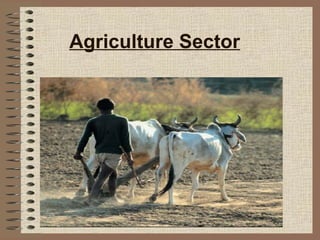
Agriculture Sector
THE IMPACT OF WTO ON INDIAN AGRICULTURE Farmers Subjected To WTO Protectism WTO Uniform Rules Liberalization Of World Trade High Tariff Rate  Developing Country Effect Developing  Country  Biotechnological Advancement
IMPACT ON TEXTILE India a part of Multi-Fibre Agreement (MFA). Contributes to 4% of national GDP and 20% of manufacturing value added. Provides employment to 6.5 million persons directly or indirectly. Quota phase out – Opportunity as well as threat. Contributes to almost 35% of foreign exchange earnings.
Major reform under WTO in 2005 resulted : A gain to world of around $23 billion, including  $12.3 billion for the US, $0.8 billion for Canada, $2.2 billion for Europe and around  $8 billion for developing countries.
IMPACT OF WTO ON SSI UNITS IMPORTANCE OF SMALL SCALE  INDUSTRIES IMPACT ON SSI FUTURE AGENDA
Pharmaceutical industry in India
Introduction 15 th  largest individual market Drug sales of $5.2 billion 24000 players
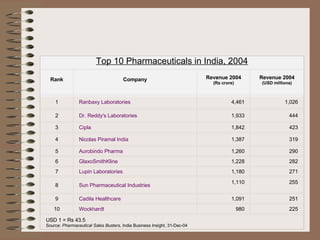
Top 10 Pharmaceuticals in India, 2004 Rank Company Revenue 2004  (Rs crore) Revenue 2004  (USD millions) 1 Ranbaxy Laboratories 4,461 1,026 2 Dr. Reddy's Laboratories 1,933 444 3 Cipla 1,842 423 4 Nicolas Piramal India 1,387 319 5 Aurobindo Pharma 1,260 290 6 GlaxoSmithKline 1,228 282 7 Lupin Laboratories 1,180 271 8 Sun Pharmaceutical Industries 1,110 255 9 Cadila Healthcare 1,091 251 10 Wockhardt 980 225 USD 1 = Rs 43.5 Source:  Pharmaceutical Sales Busters , India Business Insight, 31-Dec-04
Main Features of Pharma Industry in India One of the two fast growing knowledge  based industries in India (the other: IT). 330 large and about 5000 small scale  units. They produce over 400bulk drugs and the complete range of formulations. One of the main world leaders in Bulk drugs. Meeting 80% domestic demand for  bulk drugs along with sizeable  exports. Pharma industry in India growing at a rate of 15% per annum . 15th in terms of value but 4th in terms of volume.
Bulk Drugs One of the World leaders. Over 400 basic drugs produced. To name some: Aspirin, Ibuprofen, Ampicillin, Paracetamol, Amoxicillin, Cephalexin,  Cloxacillin, Erythromycin, Rifampacin, Ciprofloxacin, Chloroquine,  Ethambutol,  Metronidezole, Prednisolone, various Vitamins, Ranitidine, Omiprazole, Celecoxib,  Reficoxib, Simvastatin, etc World class Quality. Many items approved by US FDA, FDAs  of UK, Brazil, Germany, Australia etc. Over 100 manufacturers approved by WHO for GMP. Most competitive prices. Exported to over 70 countries.
Formulation Entire domestic demand for formulation met with substantial surplus for exports. Many companies registered in different countries such as USA, UK, Germany, France, Brazil, China, etc. Actually exporting to all these countries. Many product separately registered in countries. Where product registration is in force. Exports of formulation growing  @ 15%- 20%
History  Bengal Chemical And Pharmaceutical Works
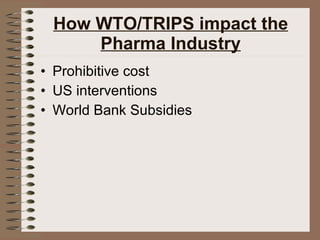
How WTO/TRIPS impact the Pharma Industry Prohibitive cost US interventions World Bank Subsidies
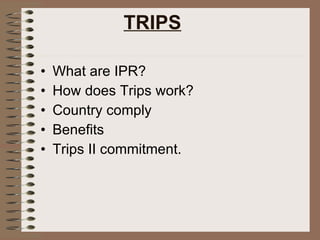
TRIPS What are IPR? How does Trips work? Country comply Benefits Trips II commitment.
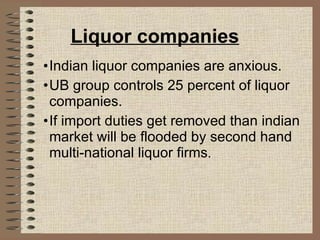
Liquor companies   Indian liquor companies are anxious.   UB group controls 25 percent of liquor companies. If import duties get removed than indian market will be flooded by second hand  multi-national liquor firms .
THANKS Thanks for your attention

Wto Final

  • 1.
    INTRODUCTION GATT wascreated in 1947. The purpose was to facilitate international bargaining and to reduce barriers to trade. WTO replaced GATT on January 1 1995. The purpose was to facilitate smooth and hassle free trade.
  • 2.
    Benefits of WTOThe system helps promote peace. Rules make life easier for all. Disputes are handled constructively. Free trade cuts the cost of living.
  • 3.
    It provides morechoice of product and quality Trade raises income. Trade stimulate economic growth. The basic principle make life more. efficient.
  • 4.
  • 5.
    THE IMPACT OFWTO ON INDIAN AGRICULTURE Farmers Subjected To WTO Protectism WTO Uniform Rules Liberalization Of World Trade High Tariff Rate Developing Country Effect Developing Country Biotechnological Advancement
  • 6.
    IMPACT ON TEXTILEIndia a part of Multi-Fibre Agreement (MFA). Contributes to 4% of national GDP and 20% of manufacturing value added. Provides employment to 6.5 million persons directly or indirectly. Quota phase out – Opportunity as well as threat. Contributes to almost 35% of foreign exchange earnings.
  • 7.
    Major reform underWTO in 2005 resulted : A gain to world of around $23 billion, including $12.3 billion for the US, $0.8 billion for Canada, $2.2 billion for Europe and around $8 billion for developing countries.
  • 8.
    IMPACT OF WTOON SSI UNITS IMPORTANCE OF SMALL SCALE INDUSTRIES IMPACT ON SSI FUTURE AGENDA
  • 9.
  • 10.
    Introduction 15 th largest individual market Drug sales of $5.2 billion 24000 players
  • 11.
    Top 10 Pharmaceuticalsin India, 2004 Rank Company Revenue 2004 (Rs crore) Revenue 2004 (USD millions) 1 Ranbaxy Laboratories 4,461 1,026 2 Dr. Reddy's Laboratories 1,933 444 3 Cipla 1,842 423 4 Nicolas Piramal India 1,387 319 5 Aurobindo Pharma 1,260 290 6 GlaxoSmithKline 1,228 282 7 Lupin Laboratories 1,180 271 8 Sun Pharmaceutical Industries 1,110 255 9 Cadila Healthcare 1,091 251 10 Wockhardt 980 225 USD 1 = Rs 43.5 Source: Pharmaceutical Sales Busters , India Business Insight, 31-Dec-04
  • 12.
    Main Features ofPharma Industry in India One of the two fast growing knowledge based industries in India (the other: IT). 330 large and about 5000 small scale units. They produce over 400bulk drugs and the complete range of formulations. One of the main world leaders in Bulk drugs. Meeting 80% domestic demand for bulk drugs along with sizeable exports. Pharma industry in India growing at a rate of 15% per annum . 15th in terms of value but 4th in terms of volume.
  • 13.
    Bulk Drugs Oneof the World leaders. Over 400 basic drugs produced. To name some: Aspirin, Ibuprofen, Ampicillin, Paracetamol, Amoxicillin, Cephalexin, Cloxacillin, Erythromycin, Rifampacin, Ciprofloxacin, Chloroquine, Ethambutol, Metronidezole, Prednisolone, various Vitamins, Ranitidine, Omiprazole, Celecoxib, Reficoxib, Simvastatin, etc World class Quality. Many items approved by US FDA, FDAs of UK, Brazil, Germany, Australia etc. Over 100 manufacturers approved by WHO for GMP. Most competitive prices. Exported to over 70 countries.
  • 14.
    Formulation Entire domesticdemand for formulation met with substantial surplus for exports. Many companies registered in different countries such as USA, UK, Germany, France, Brazil, China, etc. Actually exporting to all these countries. Many product separately registered in countries. Where product registration is in force. Exports of formulation growing @ 15%- 20%
  • 15.
    History BengalChemical And Pharmaceutical Works
  • 16.
    How WTO/TRIPS impactthe Pharma Industry Prohibitive cost US interventions World Bank Subsidies
  • 17.
    TRIPS What areIPR? How does Trips work? Country comply Benefits Trips II commitment.
  • 18.
    Liquor companies Indian liquor companies are anxious. UB group controls 25 percent of liquor companies. If import duties get removed than indian market will be flooded by second hand multi-national liquor firms .
  • 19.
    THANKS Thanks foryour attention