WIPO-world Intellectual
Property Organization
SIDDARAJ B
PGS 17AGR 7577
Intellectual property…..?
“Intangible creation of a human mind like ideas,skill,technique usually
transformed into tangible form to which certain rights are assigned
to protect interest of a creator or inventor”.
How one can claim protection for their invention or
product…?
In India by filing a application for protection to the national patent office,
Department of industrial policy and promotion, Ministry of commerce and
industry.
At the international level by filing a single application, if the country is
member state of WIPO through multiwindow system for seeking protection
to their invention simultaneously in large number of countries at the global
level.
World Intellectual Property Organization
 Establishment: 1967
 Membership: 191 member states
 Director General: Francis Gurry
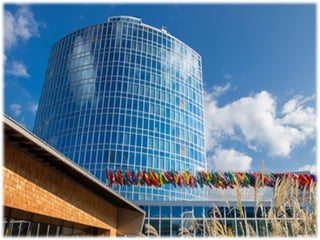
 Headquarters: Geneva, Switzerland.
What is WIPO…..?
WIPO is the global forum for intellectual property services, policy,
information and cooperation.
The main objective of WIPO is development of a balanced and
effective international intellectual property (IP) system that enables
innovation and creativity for the benefit of all.
WIPO — A Brief History
One of the oldest specialized agencies of the United Nations, the
World Intellectual Property Organization (WIPO) has a long and
interesting past.
1883 – Paris Convention
The Paris Convention for the Protection of Industrial Property is
born. This international agreement is the first major step taken to
help creators ensure that their intellectual works are protected in
other countries.
1886 – Berne Convention
The aim is to give creators the right to control and receive
payment for their creative works on an international level.
1891 – Madrid Agreement
With the adoption of the Madrid Agreement, the first
international IP filing service is launched: the Madrid System for
the international registration of marks.
1893 – BIRPI established
The two secretariats set up to administer the Paris and Berne
Conventions combine to form WIPO's immediate predecessor,
the United International Bureaux for the Protection of Intellectual
Property – best known by its French acronym, BIRPI.
1970 – BIRPI becomes WIPO
The Convention establishing the World Intellectual Property
Organization (WIPO) comes into force and BIRPI is thus
transformed to become WIPO.
 WIPO has significant financial resources independent of the
contributions from its member states.
 In December 2011 , WIPO published it’s first world property report
on the changing face of innovations , the first such report of the new
office of the chief economist.
 WIPO is also a co-publisher of the global innovation index.
Member States
WIPO’s member states determine the direction, budget and
activities of the organization through the decision-making bodies.
WIPO currently has 191 member states.
WIPO has established WIPOnet, a global information network.
The project seeks to link over 300 intellectual property offices (IP
offices) in all WIPO Member States. In addition to providing a
means of secure communication among all connected parties,
WIPOnet is the foundation for WIPO's intellectual property
services.
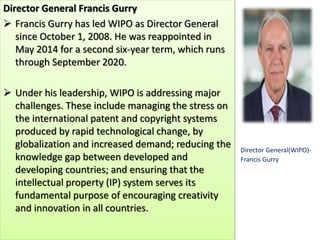
Director General Francis Gurry
 Francis Gurry has led WIPO as Director General
since October 1, 2008. He was reappointed in
May 2014 for a second six-year term, which runs
through September 2020.
 Under his leadership, WIPO is addressing major
challenges. These include managing the stress on
the international patent and copyright systems
produced by rapid technological change, by
globalization and increased demand; reducing the
knowledge gap between developed and
developing countries; and ensuring that the
intellectual property (IP) system serves its
fundamental purpose of encouraging creativity
and innovation in all countries.
Director General(WIPO)-
Francis Gurry
Activities by Unit
 WIPO's organizational structure is based on seven Sectors,
each headed by a Deputy Director General (DDG) or Assistant
Director General (ADG), under the overall leadership of the
Director General.
 Each Sector comprises several units, usually called Divisions
or Departments, led by Directors. These are responsible for
delivering the programs and activities approved by member
states in the program and budget.
WIPO Academy
The Academy acts as a catalyst for a virtual network of
partners, experts and teachers in development-oriented IP
training. It provides professional and open-access online
learning and training.
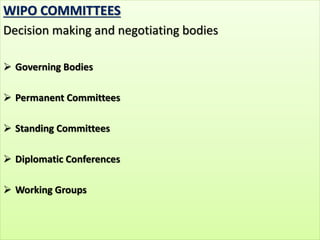
WIPO COMMITTEES
Decision making and negotiating bodies
 Governing Bodies
 Permanent Committees
 Standing Committees
 Diplomatic Conferences
 Working Groups
Services of WIPO
 WIPO Academy : Sign up for distance learning or face
to face courses all year round , taught by people who
Know intellectual property.
 WIPO provide access to the world IP information –
search technology & brand related information in our
global database.
 WIPO deliver global services for protecting IP.
 WIPO shapes international IP rules for a changing
society.
IP Services administered by WIPO:
WIPO offers a range of global services for protecting intellectual
property (IP) across borders, and for resolving IP disputes outside
the courts.
 Patents
 Trademarks
 Copyright
 Industrial designs
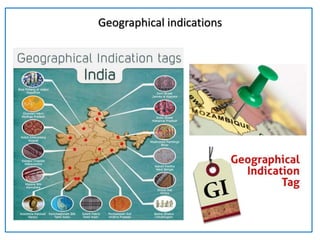
 Geographical indications
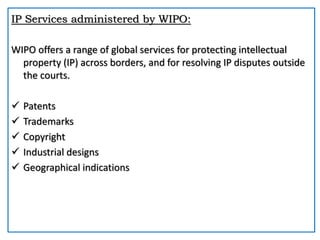
Patents
Trademarks
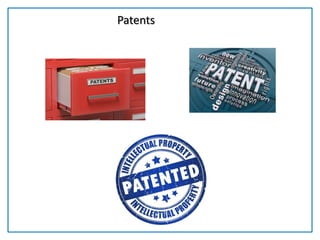
Copyright
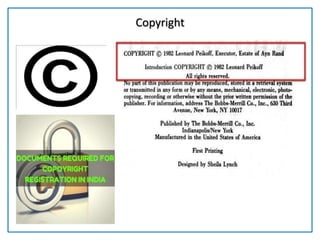
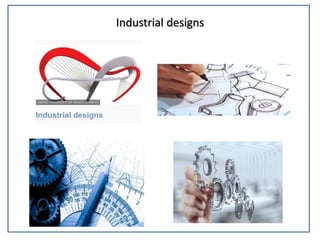
Industrial designs
Geographical indications
External Offices:
WIPO’s network of External Offices forms an integral part of the
organization designed to bring our services and cooperation closer to
our member states, our stakeholders and our partners. In doing so, our
external offices add clear value, efficiency and effectiveness to
program delivery and respond to the specific needs and priorities of
the countries and regions they serve.
The external offices provide cost-effective support services in
relation to the PCT, Madrid and Hague systems; arbitration and
mediation; collective management; and development and capacity
building.
WIPO Awards Program
WIPO presents awards to outstanding innovators and creators, on the
basis of nominations submitted by the national intellectual
property offices of WIPO member states.
The publicity generated by the WIPO awards also promotes wider
understanding of how the intellectual property system works to
serve creativity and innovation.
The WIPO magazine explores intellectual property, creativity and
innovation in action across the world. It is published in English,
French and Spanish.
WIPO Assemblies
The main policy and decision making bodies of WIPO are the
general assembly and the coordination committee. Twenty-one
assemblies, and other bodies of the member states of WIPO and of
the unions administered by WIPO, traditionally meet in ordinary or
extraordinary session in autumn.
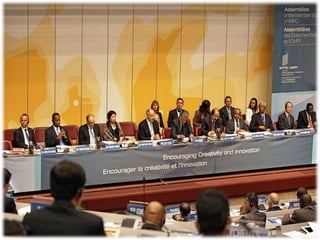
Fifty-Eighth Series of Meetings
September 24 to October 2, 2018
The fifty-eighth series of meetings of the assemblies of the member
states of WIPO will take place at the WIPO headquarters in Geneva,
Switzerland.
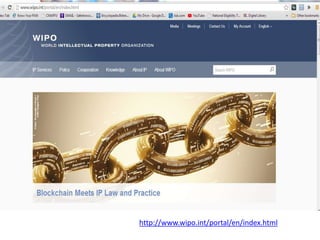
http://www.wipo.int/portal/en/index.html
Wipo
Wipo

Wipo

  • 1.
  • 2.
    Intellectual property…..? “Intangible creationof a human mind like ideas,skill,technique usually transformed into tangible form to which certain rights are assigned to protect interest of a creator or inventor”. How one can claim protection for their invention or product…? In India by filing a application for protection to the national patent office, Department of industrial policy and promotion, Ministry of commerce and industry. At the international level by filing a single application, if the country is member state of WIPO through multiwindow system for seeking protection to their invention simultaneously in large number of countries at the global level.
  • 3.
    World Intellectual PropertyOrganization  Establishment: 1967  Membership: 191 member states  Director General: Francis Gurry  Headquarters: Geneva, Switzerland. What is WIPO…..? WIPO is the global forum for intellectual property services, policy, information and cooperation. The main objective of WIPO is development of a balanced and effective international intellectual property (IP) system that enables innovation and creativity for the benefit of all.
  • 4.
    WIPO — ABrief History One of the oldest specialized agencies of the United Nations, the World Intellectual Property Organization (WIPO) has a long and interesting past. 1883 – Paris Convention The Paris Convention for the Protection of Industrial Property is born. This international agreement is the first major step taken to help creators ensure that their intellectual works are protected in other countries. 1886 – Berne Convention The aim is to give creators the right to control and receive payment for their creative works on an international level.
  • 5.
    1891 – MadridAgreement With the adoption of the Madrid Agreement, the first international IP filing service is launched: the Madrid System for the international registration of marks. 1893 – BIRPI established The two secretariats set up to administer the Paris and Berne Conventions combine to form WIPO's immediate predecessor, the United International Bureaux for the Protection of Intellectual Property – best known by its French acronym, BIRPI. 1970 – BIRPI becomes WIPO The Convention establishing the World Intellectual Property Organization (WIPO) comes into force and BIRPI is thus transformed to become WIPO.
  • 6.
     WIPO hassignificant financial resources independent of the contributions from its member states.  In December 2011 , WIPO published it’s first world property report on the changing face of innovations , the first such report of the new office of the chief economist.  WIPO is also a co-publisher of the global innovation index. Member States WIPO’s member states determine the direction, budget and activities of the organization through the decision-making bodies. WIPO currently has 191 member states. WIPO has established WIPOnet, a global information network. The project seeks to link over 300 intellectual property offices (IP offices) in all WIPO Member States. In addition to providing a means of secure communication among all connected parties, WIPOnet is the foundation for WIPO's intellectual property services.
  • 7.
    Director General FrancisGurry  Francis Gurry has led WIPO as Director General since October 1, 2008. He was reappointed in May 2014 for a second six-year term, which runs through September 2020.  Under his leadership, WIPO is addressing major challenges. These include managing the stress on the international patent and copyright systems produced by rapid technological change, by globalization and increased demand; reducing the knowledge gap between developed and developing countries; and ensuring that the intellectual property (IP) system serves its fundamental purpose of encouraging creativity and innovation in all countries. Director General(WIPO)- Francis Gurry
  • 8.
    Activities by Unit WIPO's organizational structure is based on seven Sectors, each headed by a Deputy Director General (DDG) or Assistant Director General (ADG), under the overall leadership of the Director General.  Each Sector comprises several units, usually called Divisions or Departments, led by Directors. These are responsible for delivering the programs and activities approved by member states in the program and budget. WIPO Academy The Academy acts as a catalyst for a virtual network of partners, experts and teachers in development-oriented IP training. It provides professional and open-access online learning and training.
  • 9.
    WIPO COMMITTEES Decision makingand negotiating bodies  Governing Bodies  Permanent Committees  Standing Committees  Diplomatic Conferences  Working Groups
  • 11.
    Services of WIPO WIPO Academy : Sign up for distance learning or face to face courses all year round , taught by people who Know intellectual property.  WIPO provide access to the world IP information – search technology & brand related information in our global database.  WIPO deliver global services for protecting IP.  WIPO shapes international IP rules for a changing society.
  • 12.
    IP Services administeredby WIPO: WIPO offers a range of global services for protecting intellectual property (IP) across borders, and for resolving IP disputes outside the courts.  Patents  Trademarks  Copyright  Industrial designs  Geographical indications
  • 13.
  • 14.
  • 15.
  • 16.
  • 17.
  • 18.
    External Offices: WIPO’s networkof External Offices forms an integral part of the organization designed to bring our services and cooperation closer to our member states, our stakeholders and our partners. In doing so, our external offices add clear value, efficiency and effectiveness to program delivery and respond to the specific needs and priorities of the countries and regions they serve. The external offices provide cost-effective support services in relation to the PCT, Madrid and Hague systems; arbitration and mediation; collective management; and development and capacity building.
  • 19.
    WIPO Awards Program WIPOpresents awards to outstanding innovators and creators, on the basis of nominations submitted by the national intellectual property offices of WIPO member states. The publicity generated by the WIPO awards also promotes wider understanding of how the intellectual property system works to serve creativity and innovation. The WIPO magazine explores intellectual property, creativity and innovation in action across the world. It is published in English, French and Spanish.
  • 21.
    WIPO Assemblies The mainpolicy and decision making bodies of WIPO are the general assembly and the coordination committee. Twenty-one assemblies, and other bodies of the member states of WIPO and of the unions administered by WIPO, traditionally meet in ordinary or extraordinary session in autumn. Fifty-Eighth Series of Meetings September 24 to October 2, 2018 The fifty-eighth series of meetings of the assemblies of the member states of WIPO will take place at the WIPO headquarters in Geneva, Switzerland.
  • 23.