i
PARENTAL INVOLVEMENT AND ACADEMIC PERFORMANCE AMONG
PRIMARY PUPILS IN AYER SUB COUNTY, KOLE DISTRICT
BY
OGWANG FELIX
REG. NO: 16/U/0121/LCP
Supervisor
DR.AMIR
Lira University
Faculty of Health Sciences Lira University
A Research Proposal Submitted to the Faculty of Health Sciences Lira
University in Partial Fulfillment of the Requirements for the Award of a
Bachelor of Science in Community Psychology and Psychotherapy of Lira
University
APRIL, 2019
ii
DECLARATION
Declaration by Student
This proposal is my original work and has not been presented for any other degree, published or
submitted for examination in this or any other university. No part of this work may be
reproduced without prior permission from the author and/or Lira University.
OGWANG FELIX Date
REG. NO: 16/U/0121/LCP
Declaration by Supervisors
I /We confirm that the work reported in this thesis was carried out by the candidate under my/our
supervision as the university supervisors.
________________________________ __________________________
DR. AMIR Date
Department of Mental Health,
Lira University
iii
TABLE OF CONTENTS
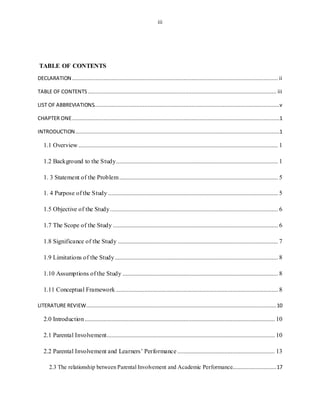
DECLARATION ................................................................................................................................... ii
TABLE OF CONTENTS ........................................................................................................................ iii
LIST OF ABBREVIATIONS......................................................................................................................v
CHAPTER ONE....................................................................................................................................1
INTRODUCTION..................................................................................................................................1
1.1 Overview ............................................................................................................................... 1
1.2 Background to the Study....................................................................................................... 1
1. 3 Statement of the Problem..................................................................................................... 5
1. 4 Purpose of the Study ............................................................................................................ 5
1.5 Objective of the Study........................................................................................................... 6
1.7 The Scope of the Study ......................................................................................................... 6
1.8 Significance of the Study ...................................................................................................... 7
1.9 Limitations of the Study........................................................................................................ 8
1.10 Assumptions of the Study ................................................................................................... 8
1.11 Conceptual Framework ....................................................................................................... 8
LITERATURE REVIEW.........................................................................................................................10
2.0 Introduction......................................................................................................................... 10
2.1 Parental Involvement........................................................................................................... 10
2.2 Parental Involvement and Learners’ Performance .............................................................. 13
2.3 The relationship between Parental Involvement and Academic Performance............................17
iv
2.4 Summary of Literature Review........................................................................................... 21
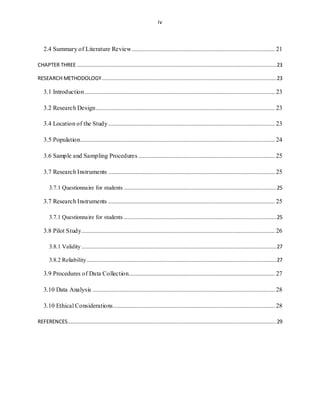
CHAPTER THREE ...............................................................................................................................23
RESEARCH METHODOLOGY...............................................................................................................23
3.1 Introduction......................................................................................................................... 23
3.2 Research Design.................................................................................................................. 23
3.4 Location of the Study.......................................................................................................... 23
3.5 Population............................................................................................................................ 24
3.6 Sample and Sampling Procedures....................................................................................... 25
3.7 Research Instruments .......................................................................................................... 25
3.7.1 Questionnaire for students .................................................................................................25
3.7 Research Instruments .......................................................................................................... 25
3.7.1 Questionnaire for students .................................................................................................25
3.8 Pilot Study........................................................................................................................... 26
3.8.1 Validity ............................................................................................................................27
3.8.2 Reliability.........................................................................................................................27
3.9 Procedures of Data Collection............................................................................................. 27
3.10 Data Analysis .................................................................................................................... 28
3.10 Ethical Considerations....................................................................................................... 28
REFERENCES.....................................................................................................................................29
v
LIST OF ABBREVIATIONS
UPE Universal Primary Education
PTA Parents-Teachers’ Associations
SPSS Statistical Package for the Social sciences
U.S United States
UNICEF United Nations International Children Emergency Fund
MoE Ministry of Education
DEO District Education Officer
1
CHAPTER ONE
INTRODUCTION
1.1 Overview
This introductory chapter will provide the basis for this study. It contains the background of the
study, statement of the problem, research objectives, research questions, significance of the
study, justification of the study, limitations of the study, scope and delimitations of the study,
assumptions and operational definition of key terms used in the study.
1.2 Background to the Study
Education is considered as the development of the endowed capacities in the individual,
which will enable them to control environment and fulfill their possibilities (Saxton,
2017). Indeed, in this era of globalization, economic change and technological revolution,
education is considered as the first step for every human activity. It plays a vital role in the
development of human capital and is linked with an individual’s well-being and opportunities for
better living (Battle & Lewis, 2016). Therefore without doubt all children need education and the
importance of education as a tool for bringing transformation in the society cannot be refuted
(Merz, Oort, Ozeke-Kocabas & Schuengel, 2017). Primary education is the most basic formal
education and valued very highly for preparing learners for other levels of education, world of
work, scientific and technical application of knowledge and life skills. However, attaining
primary education is not natural. It is influenced by many factors including parental
involvement. The role of parents in their children’s education has been recognized as a
significant factor in influencing academic success (Gadeyne et al., 2014).
2
According to Jeynes (2010), parental involvement means different things to different people.
According to Levanda (2017) parental involvement includes a wide variety of actions parents
take for the benefit of children’s academic success at school. These include parenting style,
parental expectations and aspirations, home rules and parental supervision; parents’ attitudes
towards children activities, helping with homework, visiting the school to talk to teachers, and
beliefs regarding their child’s education (Porumbu & Necsoi, 2013). Castro, Casas, Martin,
Lizasoain, Asencio and Gaviria, (2015) added that parental involvement is an individual right
and responsibility for families and social need and should be considered as a lever to promote the
academic performance of the children.
Although there was some disagreement among theorists as to what constituted of parental
involvement, educators came to some consensus that these activities included actions that parents
took on behalf of their children both at home and at school, including, helping with homework,
communicating with teachers and volunteering at school (Bower & Griffin, 2011). Epstein et al
(2009) asserts that parental involvement has six aspects including parenting, communicating
with the school, volunteering at school, learning at home, participating in school decision
making, and collaborating with communityin the same study established four components of
parental involvement: parental aspirations for the children’s education, parent-child
communication about school, home structure and parental participation in school related
activities (Porumbu & Necsoi, 2013). The present study however, will adapt four of thec Epstein
et al’s (2009) domains including; parenting, communicating with the school, learning at home
and participating in school decision making to show their influence on students’ performance in
Ayer Sub County.
3
Research suggests that parents, pupils and teachers benefit from increased parental involvement
(Lemmer, 2016). Greater parental involvement leads to teachers having better relationships with
parents and pupils, fewer behavioural problems, a reduced workload and a more positive attitude
towards teaching (Fan & Williams, 2010). Research studies have established that parent
involvement at all levels of education had an impact on student academic success (Hilgendorf,
2012). It has many positive effects on students other than academics, including increased
motivation and academic performance. On the contrary, research shows that inadequate or poor
parental involvement leads to low student achievement (Bower & Griffin, 2011). In essence,
parents and guardian can create favourable learning environments to enhance children’s
academic development. Brannon (2018) noted that parental involvement leads to higher
academic achievement. Brannon (2018) adds that the increasing evidence of the benefits of
parental involvement in the calls for continued research in this area and the necessity of
implementing parental involvement programs at all levels of school education.
Large number of research conducted in the past several decades showed a strong association of
parental involvement and students’ academic achievement; students whose parents involved
actively in their education perform much better in their schooling than peers whose parents did
not involve (Hsu et al., 2011). In Norway, studies indicate that parents’ involvement in
homework has significant influence on students’ academic achievement (Huang, 2009). This is
supported by studies from Latin America (Desarrollo 2007). In Pakistan, Waqas Rafiq et al,
(2013) explored the effect of parental involvement in the academic achievement of their children.
It was found that parental involvement has significance effect in better academic performance of
their children. Nyarko (2011) investigated the effect of parental involvement in school on
4
students’ academic performance in Ghana. The results reveal a positive and significant
correlation between mothers’ school involvement and academic performance of children.
In Rwanda Kaberere et.al (2013) found that parents of children in high performing schools were
significantly more involved than their peers with children in low performing schools particularly
in support for learning and assisting children in homework. In Kenya Kibet (2010) investigated
the role of parents in enhancing preschool children’s education in Uasin Gishu district and found
that parental involvement in education was low. Earlier Ciaraka (2003), sought to establish the
role of parents in facilitating the learning processes in selected primary schools in Egoji-Meru
found that parental involvement in homework was high. However, Sperns (2011) indicated that
there was no relationship between parental involvement and students’ academic performance.
This finding was echoed by several other studies which indicated no association (Patall, Cooper,
& Robinson, 2008; Barnard, 2004; Fan & Chen, 2014) and even others reported negative
association (Coleman & McNeese, 2009; Fan, 2014; Koskei, 2012),)
Although, parental involvement has now come to be recognized as a key process in children’s
learning the bulk of research studies are outside Ayer Sub County. In addition as Martinez,
Martinez and Peres, (2004) observe different cultures and their education systems may differ in
the ways their families and schools work together. Therefore a study on the effects influencing
such functioning is vital in order to understand and provide insight into family-school-
community partnerships. Such a study would be helpful in effective and efficient problem-
solving and creating sustainable partnerships in Uganda and Ayer Sub County in particular.
5
1. 3 Statement of the Problem
Students’ academic performance in terms of output grades in national examinations and in test
scores in schools is largely dependent on parental involvement, which includes participation in
school meetings, payment of school fees on time, provision of scholastic materials, among
others. Coincidentally, primary schools in Ayer Sub County perform poorly in national
examinations. Is this kind of performance as a result of limited parental involvement? A number
of studies have shown the need to improve student’s academic performance in schools and if this
is not addressed then Ayer Sub County will lag behind the rest of the country in terms of
development since education and development are interdependent.
Literature continues to support a positive relationship between parent involvement and
performance students; however, there is limited research that has specifically focused on the
primary population and situation is total dearth in Ayer Sub County. Given the importance of this
critical time period in a child’s growth and development, it is necessary to investigate,
specifically, the influence that parent involvement has on the performance among primary
students. Regardless of a parent’s chosen part of involvement or the factors that contributed to
that choice, developmental psychologists agree that it plays a significant role in children’s
overall performance. For this reason, parent involvement and its significant role in the
performance of children in primary are the focus to this study
1. 4 Purpose of the Study
The main purpose of the study is examine the relationship between parental involvement and
academic performance among primary Pupils in Ayer Sub County
6
1.5 Objective of the Study
i. To explore the extent of parental involvement in academic activities of their children’s in
primary in Ayer Sub County
ii. To establish the teachers’ opinion about parents’ involvement in academic performance in
primary students in Ayer Sub County
iii. To examine relationship between parental involvement and academic performance in primary
students in Ayer Sub County
1.6 ResearchQuestions
The present study seeks to answer the following research questions;
i. To what extend do parents are involved in academic performance of their children in
Ayer Sub County?
ii. What is the teachers’ opinion about parents’ involvement in academic performance in
primary Pupils in Ayer Sub County?
iii. What is the relationship between parental involvement and academic performance in
primary Pupils in Ayer Sub County?
1.7 The Scope of the Study
The scope of the study refers to the boundaries of the study in terms of context, time, methods
and theoretical coverage of the study (Oso & Onen, 2009). The study will be conducted in Ayer
sub county, in Uganda. It will be conducted among teachers, parents and students of primary.
The study will focus on exploring the influence of parental involvement on the students,
academic performance among primary students.
7
1.8 Significance of the Study
This research study will highlight the contributions that may help researchers and policy makers
and offers practical solutions of solving these problems. Specifically, the teachers, parents and
children may benefit from this study by understanding the significant contribution of parental
involvement to academic performance of students. The teachers may know that parental
involvement in academic achievement of children is indispensable. Children may develop
positive attitude to towards the parental involvement in matters related to their academics.
The study may help in the designing and formulation of parental school curricula by policy
makers at Institutional and National level. The Ministry of Education (MoE) and District
Education Officers (DEO) may benefit from the study findings in a number of ways namely:
they may have benchmarks for the effective and efficient parental involvement ideas and put in
place parental guidance counselling services. The study may help to realise the need for the
development of school-family-community partnerships as an essential component of larger
school improvement efforts.
The members of the Board of Governors may improve on the importance of parental
involvement in enhancing students’ performance and hence put measures in place that may help
parents love and respect their responsibilities all of which may lead to improved academic
performance.
It is hoped that the results of this study may help fill in some gaps that previous similar studies
could have left, and contribute to relevant information.
8
1.9 Limitations of the Study
Parental involvement is a serious cutting across the entire republic of Uganda, it would be
necessary to study primary schools in Uganda. However this is not possible give the time and
financial constraints. It is important to note that cross-sectional surveys are carried out within a
certain short interval of time and therefore cannot be utilized to make direct causal inferences
(cause-effect relationships) about involvement and students’ performance schools.
1.10 Assumptions of the Study
This study is based on assumption that an academic achievement of students is a goal which all
parents and teachers aspired to achieve. The study also assumes that each child had a
parent/guardian. The study also assumes that the mean score of students is a true indicator of
academic performance of students. Lastly the study assumes that parental involvement has an
impact on students’ performance.
1.11 Conceptual Framework
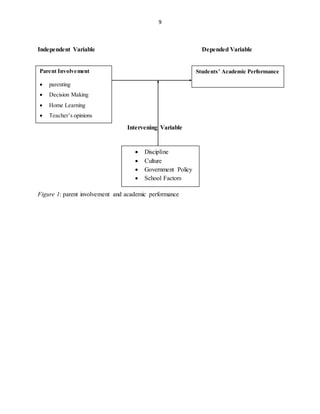
The conceptual framework of the study is based on the Epstein’s (1987) theory of overlapping
spheres of influence. It illustrates how the independent variables of parental participation in
parenting, communication, decision making and home learning influence academic performance.
It also shows that there are other determinants of academic performance such as discipline,
cultural factors, government policy, school factors and discipline as intervening variables which
the researcher will attempt to control. Epstein (1995) parental involvement frame work will
direct the study variables by the assertion that the overlapping spheres of influence which focus
on the complex interrelationships of family, and school affects students’ academic performance.
9
Independent Variable Depended Variable
Intervening Variable
Figure 1: parent involvement and academic performance
Students’ Academic PerformanceParent Involvement
 parenting
 Decision Making
 Home Learning
 Teacher’s opinions
 Discipline
 Culture
 Government Policy
 School Factors
10
CHAPTER TWO
LITERATURE REVIEW
2.0 Introduction
This chapter will contain review of research literature. It includes discussion and critique of
studies done by other people on the same aspects related to the study topic. This chapter is
divided into three subsections namely: : parental involvement, parental involvement and
learners’ performance ,relationship between parental involvement and academic performance
and it ends with summary of related literature.
2.1 Parental Involvement
Despite increasing recognition that parental involvement in education, there is lack of consensus
regarding the definition of parental involvement (Fan & Chen, 2014). Grolnick and Slowiaczek
(1994) defined parental involvement as “the dedication of resources by the parent to the child
within a given domain”. Larocque, Kleiman, and Darling (2011) defined the construct as the
parents’ or caregivers’ investment in the education of their children”. Parental involvement is
defined as the level of participation that a parent has in the child’s education and school.
Parent involvement can broadly be defined as the ways in which parents support their children’s
education in word and deed. Parental involvement has also been defined as representing different
behaviours and practices presented by parents both at home and school. According to Levanda
(2017) parental involvement includes a wide variety of actions parents take for the benefit of
children’s academic success. These include parenting style, parental expectations and
aspirations, home rules and parental supervision; parents’ attitudes towards children activities,
11
helping with homework, visiting the school to talk to teachers, and beliefs regarding their child’s
education (Levand, 2011; Porumbu & Necsoi, 2013).
Robinson and Harris (2014) describe parent involvement as practices that entail parent
communication with their children about education; behaviours in which parents engage with the
exclusive aim of increasing academic outcomes; and parental engagement with schools and
teachers. In fact studies, researchers choose to avoid a general definition of parental involvement
and instead they focus on specific types of the involvement exhibited by parents (Kohl, Lengua,
and McMahon, 2016). However, one of the most notable definitions comes from Epstein (1988),
whose model consists of six components: parenting, communication with schools, volunteering
in schools, learning at home, active participation in school decision‐making and collaboration
with the community. In sum, researchers have used various definitions of parent involvement.
This has led to difficulty in comparing findings across. In order to have a more consistent
approach, Epstein (1988) definition will be adapted to guide the present study.
Various researchers have conceptualized parental involvement as having multiple dimensions
with distinct influences on students’ academic achievement (Fan, Williams & Wolters, 2012;
Wilder, 2014). While researchers tend to draw on different combinations of dimensions the field
of parental involvement has been shaped by two leading theories developed by Epstein (1995)
and Hoover-Dempsey & Sandler (2005) emphasizing on different but interrelated aspects (Chen
and Gregory, 2010). Epstein argued that home-school cooperative behavioural practice can
optimize students’ academic achievement (Chen & Gregory, 2010). This model contains
involvement types including, parenting volunteering communicating with school; participating
in school-related activities at home by helping with homework or checking that homework; and
12
collaborating with the community (Epstein, 1995). Unlike to Epstein, Hoover-Dempsey’s (et al.,
2005) model focuses on psychological constructs such as role construction, self-efficacy,
perceived invitation from students and teachers and perceived life contexts and mechanisms
influencing students’ academic achievement (Hoover-Dempsey et al., 2005).
Though there is ambiguity in the literature surrounding type and extent of parental behaviours
that lead to school success (Fan & Williams, 2010) researchers however, have categorised
parental involvement into two: school based and home-based involvement (Hill & Tyson, 2009).
The vast majority of studies, regardless of children’s developmental level, assess school-based
involvement, such as discussions with teachers, attendance at school events, volunteering in
schools, and attending parent–teacher conferences (Henry et al., 2011). In the present study, the
parent involvement is reflected in four aspects: parenting, communication participation in
decision making and learning at home.
In some African countries especially South Africa, Uganda and Burundi, policies that support
parental involvement in education have been put in place. In South Africa, the Schools Act (Act
84 of 1996) requires all public schools to have elected school governing body comprising of the
head teacher, teachers, parents, non-teaching staff and students (Dubbeldan, 2000). In Burundi,
education policies require parents to make financial for schools while in Uganda Universal
Primary Education policy of 1997 stipulates parents’ role at home and school in support of
children’s learning. In Kenya too, successive governments have recognized the need to improve
learning environment by involving parents. The Basic Education Act of Kenya (2013) required
the school Boards of Management to assess school needs with full participation of parents.
13
2.2 Parental Involvement and Learners’ Performance
Academic performance is a notable indicator of one’s success in life. Thus, excelling in
academics is the most dominant feature of education system around the world. A healthy parent
participation offers emotional security to children during their study. Generally, research results
have shown that parent involvement has positive effects on children’s academic performance
(Hayakawa, Englund, Warner Richter, & Reynolds, 2013) and rates of high school dropout and
increased on-time high school completion (Barnard, 2004). Parent involvement apparently
affects parenting practices and leads to rates of childhood behavioural problems (Brotman et al.,
2011). However, other studies found that parent involvement has little or no effect on children’s
outcomes. For instance Mattingly et al. (2015) examined 41 studies that looked at kindergarten
through 12th grade achievement and parent involvement programs. The study that was
qualitative in nature concluded that there was little empirical support for the claim that parent
involvement programs are an effective way of raising academic performance. White et al. (1992)
examined the effect of parent involvement in early childhood interventions on children’s
outcomes. Similarly, this study found little to no evidence that children benefited from parent
involvement programs. Such mixed results call for another study and thus present study.
Hung (2017) argues that, society needs to increase its level of educational involvement and that
this starts with the support by the parents. For the schools to realise higher standards and greater
accountability requires the commitment from the teachers and parents (Machen, Wilson & Notar,
2005). In this regard, parent-school relationship can be enhanced through the teacher/parent
mutual cooperation. Kgaffe (2007) points out that there is need to convince both parents and
schools of the value of reciprocal cooperation. In many countries, one of the strongest trends has
been to give parents and parents an increased role in governing schools (Lemmer, 2007). Many
14
governments now have legislation to ensure that parents are involved in their children's
education more than before (Friedman, 2011).
In America, Topor, Keane, Terri and Calkins (2010) examined two potential mechanisms of the
child's perception of cognitive competence and the quality of the student-teacher relationship.
This study used a sample of 158 seven-year old participants, their mothers, and their teachers.
Results indicated a statistically significant association between parent involvement and a child's
academic performance, over and above the impact of the child's intelligence. A multiple
mediation model indicated that the child's perception of cognitive competence fully mediated the
relation between parent involvement and the child's performance on a standardized achievement
test. The quality of the student-teacher relationship fully mediated the relation between parent
involvement and teacher ratings of the child's classroom academic performance. However this
study was done in America which has a different environment. There is need for another study
especially in Ayer Sub County context.
Barnyak and McNelly (2009) conducted a quantitative study to examine the practices and beliefs
of administrators and teachers regarding parent involvement in an urban school district.
Administrators and teachers from an urban school district were surveyed. The instrument used
for this study was adapted from “The Parent Involvement Inventory”. A two-tailed t-test was
conducted and findings indicate some statistically significant differences between many beliefs
and practices. The results of this study showed a mismatch between teachers’ and administrators’
beliefs and practices about parent involvement. Although teachers and administrators have strong
beliefs about parent involvement and its importance in strengthening student achievement, what
they practice in their schools and classrooms was not congruent with these beliefs. Therefore this
15
study, did not determine the influence of parental involvement on students performance which is
the main aim of this study.
Hountenvilli and Conway (2008) conducted a research on how parental involvement impacts on
academic achievement. The results showed that parental involvement in education has a strong
positive effect on student achievements. Hountenvilli and Conway (2008) used national data
from more than 10,000 eight-grade students in public and private schools, their parents, teachers
and school administrations. The results showed that higher academic achievement of students
was due to parents spending more time talking to their children during dinner time to understand
their worries and fears.
In Pakistan, Waqas Rafiq et al, (2013) explored the effect of parental involvement in the
academic achievement of their children. A total of 150 students of 9th class of secondary schools
(public and private) were taken as respondents. Four schools were selected through simple
random sampling which include one boy and one girl from each of the public and private schools
categories for equal representation of both boy and girl students in the sample frame of present
study. Survey questionnaire was used as a tool for data collection. The study found that parental
involvement has significance effect in better academic performance of their children. While this
study may be informative to the current study, it was done in secondary schools and in Pakistan
which have different conditions. The present research will deviate from this study and will
examine the influence of parental involvement on academic performance in primary in Ayer Sub
County.
In Namibia, Guolaung Erlendsdottir (2010) conducted a qualitative survey study to examine
the parental involvement in students’ academic performance. The study sample involved seven
16
parents of students who had achieved high grades in examinations. All parents reported very
high level of involvement in their children’s education. However, this study was limited in
design since the sample was too small to make generalization to a larger population. Secondly
the study was qualitative in nature which has its limitations. The present study is mixed in
approach which will give a wider perspective of the relationship between parent involvement and
learners’ performance among primary in Kajaido central hence need for same this study in Ayer
Sub County.
In Tanzania, Kimaro and Machumu (2015) conducted a study to explore the extent of parental
involvement in school activities and its relationship with schooling process among primary
school children. Parental involvement questionnaire and children academic questionnaire with
two rating scales each were administered to 288 children and 125 teachers from six primary
schools. The study found a positive significant relationship between parental involvement in
school activities and children’s academic standing and the provision of key school items related
to schooling outcomes respectively. Parents-teacher conferences and parent-teacher face-to-face
contacts were perceived to be desirable modes of communications that impacts children’s school
academic achievement. Again this was done among upper primary and in Tanzania. A study in
Uganda context especially in Agriculturalist County like Ayer Sub County is needed.
In Kenya, Ciaraka (2003) conducted a research that to establish the role of parents in facilitating
the learning processes in selected primary schools in Meru found that parental involvement in
homework was high but majority (93%) of the parents did not check children’s exercise books
regularly. Sperns (2011) also indicated no shared responsibility between parents and schools in
Kenyan rural primary schools and that schools were solely responsible for students’ education
17
and there was hardly any relationship between parental involvement and students’ academic
performance. This study was limited in design and scope given that it covered only one school
involving a sample of twelve respondents. This sample was too small to get sufficient data to
allow generalizations to the entire population. Mbugua (1987) examined the role of surrounding
communities in primary school education in Thika Municipality and indicated existence of
parental involvement in education but these results cannot be relied completely because learners
were excluded yet they form part of the key stakeholders. This suggests that another study is
needed, thus the current study.
2.3 The relationship between Parental Involvement and Academic Performance
Parental involvement has been defined in various ways by various authors in the literature. For
example, typology of parental involvement includes six categories such as basic parenting,
facilitating learning at home, communicating with the school, volunteering at the school,
participating in school decision making and collaborating with the community (Epstein, 1995)
Other authors and researchers in their studies have used a typology of parental involvement that
is based on either intuitive appeal or factor analysis of existing data. It should be noted that
studies that did not apply a multifaceted typology of parental involvement tend to either describe
it as a one-dimensional construct(McCarron et al, 2006) and Oyserman et al (2007)
distinguished it broadly by the context in which it takes place that is, at home or in school
Jeynes (2003) Home-based parental involvement includes helping students with homework,
talking with them about school, expressing high expectations, encouraging school success, and
providing structures that are conducive for learning (Altschul,2012) said School-based parental
involvement on the other hand includes volunteering at school, participating in school events and
school organizations as well as communicating with teachers and school staff .
Parental involvement is the degree to which a parent is committed to his or her role as a parent
and to the fostering of optimal child development. It typically concerns the amount of effort put
into child-oriented education as well as other activities (Nyarko, 2011). In the educational
18
domain for example, parental involvement has primarily focused on specific activities such as
participating in school events; helping with homework and the number of contacts between
families and schools. It has been conceptualized parental involvement in education as the
dedication of resources by parents to children within the educational domain (Epstein, 2005).
The level of parental involvement has significant effects on children’s academic performance.
Social cognitive theory suggests that children absorb messages about appropriate behaviour and
socially accepted goals by observing and talking with important people in their lives. Based on
this assumption, parents have the potential to model positive attitudes and behaviours of their
children toward the school. Several researchers in their studies in the developed countries have
found that parental involvement contributes to academic success of their children (outenvilleet
al, 2008).
Jeynes (2007) asserts that this is because children are more likely to apply themselves and
perform better in school when their parents show an interest in their school work, are willing to
assist them with homework and are willing to hold their children accountable for completion of
school assignments. Children who are not working hard at school may begin to perceive school
as valuable when parents actively demonstrate that they value schooling through involvement.
Besides parents have the distinct advantage over anyone else in that they can provide a more
stable and continuously positive influence that could enhance and complement what the school
fosters on their children. In this regard, parental involvement is undeniably critical (Mji, et al,
2006)
Guolaug (2010) Research findings suggest that parents’ attitudes, together with their behaviour
and activities with regard to their children’s education have an effect on academic achievement.
However, with regard to the content of what children learn, many parents fall short because in
general they do not possess the necessary education and therefore find it difficult to determine
and understand what was done at school (Mji et al,2005). This is a point also raised by a learner
in a related study, “... my parents don't know maths and physics so how can they be involved...?”
( Mji et al,2005)
Parental involvement is a multidimensional and bidirectional construct that has been shown to
have clear links with social and academic outcomes for children. Traditionally, parental
involvement has been defined as engaging parents in school-based activities and events related to
19
their child’s education. However, a more comprehensive view of parental involvement envisaged
in the current study goes beyond just parent activities in school settings but in subject-oriented
participations with specific reference to Mathematics and English Language. This
comprehensive view of parental involvement is grounded in the understanding that success of
students in Mathematics and English Language at the senior high school level is influenced by
multiple contexts such as the home, the school, and the community in a dynamic and
bidirectional manner (Sanders at el, 2009)
Sheldon (2009) said Several researchers and educators have recognised the important role of a
strong positive bond between homes and schools in the development and education of children
Research has also shown that successful students have strong academic support from their
involved parents. Similarly, research on effective schools where students are learning and
achieving has consistently shown that these schools, despite often working in low social and
economic neighbourhoods, have strong and positive school-home relationships (Sheldon (2009).
More importantly, these effective schools have made a real effort in reaching out to their
students’ families in order to bring about liaison and cooperation.
(Guy, 2008) put It has been hypothesized that parental involvement primarily influences
children’s attributes and behaviours which in turn affect their achievement in mathematics
similarly, the theoretical framework provided by Hoover-Dempsey and Sandler suggests that
parental involvement enhances academic self-efficacy, intrinsic motivation to learn, self-
regulatory use and social self-efficacy of children which in turn operate to enhance academic
performance. For example, a study found that parental involvement (home involvement, school
involvement, parent-teacher communication) was predictive of children’s school engagement
and socio-emotional. Chowa et al (2013) Studies have also shown that students performed better
academically and have a more positive school attitude if they had parents who are aware,
knowledgeable and involved Anthony et al (2009)
Conducive learning environments that incorporate meaningful mathematical experiences are
associated with higher achievement and genuine home and school collaboration have also been
found to lift children’s academic performance significantly. Results from a study conducted by
indicated that parental involvement is a statistically significant predictor of mathematical
20
achievement and also promoted positive behaviours and emotional development in children.
Friedel et al (2010) have argued that parental involvement in its many and varied ways is a vital
parameter for increasing children’s academic achievement.
Farooq et at(2011) in his Empirical studies have indicated that some specific factors that play an
essential role in increasing children’s mathematics achievement are parental aspirations, parent-
child communication, home structure, and parents’ involvement in school’s activities. For
example, in their study reported that students whose parents are educated score higher on
standardized tests than those whose parents were not educated. This is because educated parents
can better communicate with their children regarding the school work, activities and the
information being taught at school. They can better assist their children in their work and
participate at school. Therefore, academic performance of students heavily depends upon the
parental involvement in their academic activities to attain the higher level of quality in academic
success.
However, few studies that differentiate between home and school-based parental involvement
reported contradictory findings. For example, in some studies home-based parental involvement
has significant positive effect while in other studies, school-based involvement has significant
negative effects related to academic outcomes. It can be argued that the interventions promoting
parental involvement vary based on the context in which the involvement occurs. The empirical
literature so far has shown that parental involvement is consistently related to a child's increased
academic performance but the specific mechanisms through which parents exert their influence
on a child’s academic performance are yet not fully understood.
From the literature, we also observed that while the relationship between parental involvement
and children’s academic performance is well established at the lower level of education,
researchers in the area have not yet fully explored how parental involvement is related to
students’ academic performance in Mathematics and English Language at the senior high school
levels. Parents are usually very much involved in their children’s early education but this
involvement tends to decrease when children proceed to high school (Shinn,2002) Therefore, the
present study on the relationship between parental involvement and academic performance of
senior high school students in Ghana is an attempt to fill this gap.
21
2.4 Summary of Literature Review
Related literature was reviewed and gaps were identified. The body of literature concerning
parental involvement and learners performance has continued to grow over the years as policy
makers, parents and school administrators increasingly became aware of it benefits. The
literature looks into the parental involvement and students’ performance. The literature revealed
that indeed parental involvement is very crucial to students’ wellbeing and their performance.
The concept parental involvement was reviewed and the researcher note lack of consensus
regarding the definition of parental involvement. Despite its intuitive meaning, the operational
use of parental involvement has not been clear and consistent (Fan & Chen, 2001). In fact due
varying definitions, some researchers choose to avoid a general definition of parental
involvement and instead they focus on specific types of the involvement exhibited by parents
(Kohl, Lengua & McMahon, 2000).
A review of literature indicates that there are contradictory findings regarding the perceptions of
parental involvement on children’s academic success. Some studies reported positive
associations with academic achievement (Tipor, Keane, Shelton, & Calkins 2010; Hong & Ho,
2005). Other studies indicated no association (Patall, Cooper, & Robinson, 2008; Barnard, 2004;
Fan & Chen, 2001) and even others reported negative association (Coleman & McNeese, 2009;
Domina, 2005; Fan, 2001).
The reviewed literature however, provides pertinent insights of relevance to the influence of
parental involvement in education on performance of students. From the literature, it can be
noted that parental involvement in education of their children is very important. However most
studies reviewed were generally outside Uganda and hardly any in Ayer Sub County which may
22
be having unique challenges. Secondly most of these were either qualitative or quantitative in
approach but not both. Again the sample size in these studies was quite small. All this created
gaps gap that the study wanted to fill.
23
CHAPTER THREE
RESEARCH METHODOLOGY
3.1 Introduction
This chapter will discuss the methodology which will be used to conduct the research. It includes
the research design, study population, sample size and sampling techniques, data collection
instruments, validity and reliability of instruments, data collection procedure and data analysis.
3.2 ResearchDesign
The study will utilize the quantitative research design approach. Specifically, a descriptive
correlation research design will be employed to examine the relationship between parental
involvement and academic performance of primary School students. It is noted that, corelational
research describes an existing relationship between variables (Shinn,2002). Correlation research
design, will therefore, be used for this study since the objective of the study to assess how the
independent variables (parental involvement and parental academic ambition) relate to the
dependent variable (students’ academic performance). In selecting a method to conduct the
descriptive correlation study, a survey method will be chosen to collect data from the
respondent’s parental involvement and academic performance in primary schools in Ayer Sub
County.
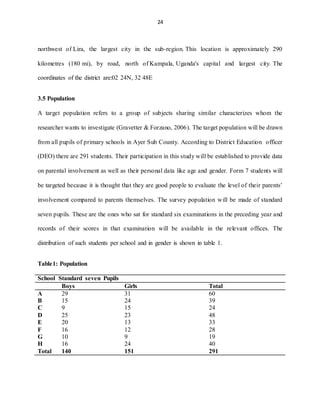
3.4 Location of the Study
The study will be carried out in Kole, Ayer Sub County in Uganda. Kole District is bordered
by Lira District to the east, Apac District to the south and Oyam District to the west and
north. Kole, the district capital, is located approximately 28 kilometres (17 mi), by road,
24
northwest of Lira, the largest city in the sub-region. This location is approximately 290
kilometres (180 mi), by road, north of Kampala, Uganda's capital and largest city. The
coordinates of the district are:02 24N, 32 48E
3.5 Population
A target population refers to a group of subjects sharing similar characterizes whom the
researcher wants to investigate (Gravetter & Forzano, 2006). The target population will be drawn
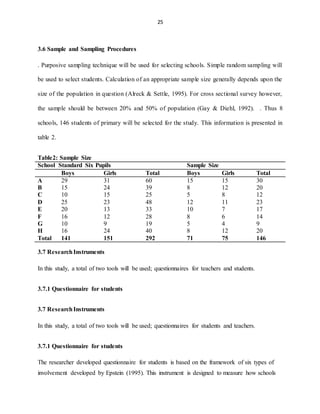
from all pupils of primary schools in Ayer Sub County. According to District Education officer
(DEO) there are 291 students. Their participation in this study will be established to provide data
on parental involvement as well as their personal data like age and gender. Form 7 students will
be targeted because it is thought that they are good people to evaluate the level of their parents’
involvement compared to parents themselves. The survey population will be made of standard
seven pupils. These are the ones who sat for standard six examinations in the preceding year and
records of their scores in that examination will be available in the relevant offices. The
distribution of such students per school and in gender is shown in table 1.
Table1: Population
School Standard seven Pupils
Boys Girls Total
A 29 31 60
B 15 24 39
C 9 15 24
D 25 23 48
E 20 13 33
F 16 12 28
G 10 9 19
H 16 24 40
Total 140 151 291
25
3.6 Sample and Sampling Procedures
. Purposive sampling technique will be used for selecting schools. Simple random sampling will
be used to select students. Calculation of an appropriate sample size generally depends upon the
size of the population in question (Alreck & Settle, 1995). For cross sectional survey however,
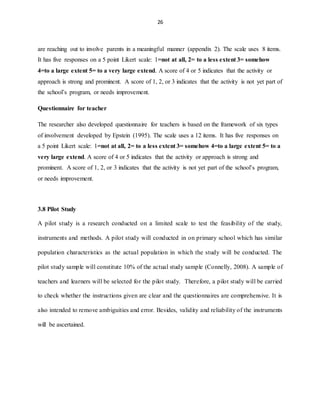
the sample should be between 20% and 50% of population (Gay & Diehl, 1992). . Thus 8
schools, 146 students of primary will be selected for the study. This information is presented in
table 2.
Table2: Sample Size
School Standard Six Pupils Sample Size
Boys Girls Total Boys Girls Total
A 29 31 60 15 15 30
B 15 24 39 8 12 20
C 10 15 25 5 8 12
D 25 23 48 12 11 23
E 20 13 33 10 7 17
F 16 12 28 8 6 14
G 10 9 19 5 4 9
H 16 24 40 8 12 20
Total 141 151 292 71 75 146
3.7 ResearchInstruments
In this study, a total of two tools will be used; questionnaires for teachers and students.
3.7.1 Questionnaire for students
3.7 ResearchInstruments
In this study, a total of two tools will be used; questionnaires for students and teachers.
3.7.1 Questionnaire for students
The researcher developed questionnaire for students is based on the framework of six types of
involvement developed by Epstein (1995). This instrument is designed to measure how schools
26
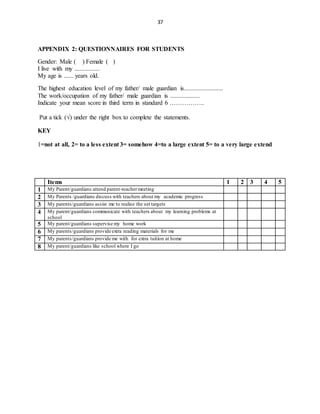
are reaching out to involve parents in a meaningful manner (appendix 2). The scale uses 8 items.
It has five responses on a 5 point Likert scale: 1=not at all, 2= to a less extent 3= somehow
4=to a large extent 5= to a very large extend. A score of 4 or 5 indicates that the activity or
approach is strong and prominent. A score of 1, 2, or 3 indicates that the activity is not yet part of
the school’s program, or needs improvement.
Questionnaire for teacher
The researcher also developed questionnaire for teachers is based on the framework of six types
of involvement developed by Epstein (1995). The scale uses a 12 items. It has five responses on
a 5 point Likert scale: 1=not at all, 2= to a less extent 3= somehow 4=to a large extent 5= to a
very large extend. A score of 4 or 5 indicates that the activity or approach is strong and
prominent. A score of 1, 2, or 3 indicates that the activity is not yet part of the school’s program,
or needs improvement.
3.8 Pilot Study
A pilot study is a research conducted on a limited scale to test the feasibility of the study,
instruments and methods. A pilot study will conducted in on primary school which has similar
population characteristics as the actual population in which the study will be conducted. The
pilot study sample will constitute 10% of the actual study sample (Connelly, 2008). A sample of
teachers and learners will be selected for the pilot study. Therefore, a pilot study will be carried
to check whether the instructions given are clear and the questionnaires are comprehensive. It is
also intended to remove ambiguities and error. Besides, validity and reliability of the instruments
will be ascertained.
27
3.8.1 Validity
Validity is the degree to which a test or instrument measures what it is intended to measure
(Bowling, 2012). The instruments will be pre-tested among a group of subjects similar to the
intended respondents where they will be required to write comments on its veracity, ease of
comprehending the instructions and recommendations for any improvements. The validity of the
tools will be determined based on construct, content and face validity. Besides, the researcher
and supervisors will assess whether the items in tools are clear and appropriate. This will be
ascertained by ensuring that all the objectives and variables of the study are addressed tools.
3.8.2 Reliability
Reliability of the instruments signifies the issue of consistency of measures or the ability of the
instrument to measure the same thing each time it is used (Kulter, 2007). It is a measure of the
degree to which a research instrument yields consistent results or data after repeated trials. The
instruments for this study will be pilot-tested to determine their appropriateness to the Ayer Sub
County situation before actual data collection. The instruments will be administered to the same
pilot sample twice in an interval of two weeks. The two weeks interval is enough to avoid the
impact of repetition by respondents. The reliability index of the tools will be calculated using
Pearson’s product moment correlation coefficient from the test-retest scores. The acceptable
reliability coefficient will be 0.07 and above which are above adequate benchmark coefficient of
0.50.
3.9 Procedures of Data Collection
The first step will be to obtain an introduction letter from Lira university which will be presented
to the relevant authorities to grant permission to carry out research. The research permit from the
28
District Education Officer(DEO) will be obtained before proceeding to the field for data
collection. Arrangements on how to meet the respondents will be done by the researcher by
visiting the schools. The researcher will give teachers questionnaires to fill. Once they will be
filled, they will be collected for analysis.
3.10 Data Analysis
Data collected will be edited coded, classified and tabulated. After tabulation, the data will be
analyzed using the Statistical Package for Social Sciences (SPSS) version 21.descriptive
statistics including frequencies and percentages will be employed for close ended questions.
Pearson’s Product Moment Coefficient Correlations to determine the relationship between
variables. The data will be summarised through frequency tables and bar graphs
3.10 Ethical Considerations
All the respondents will be informed about the purpose of the study. It will be explained to the
respondents that they are free to withdraw from the study at any time without penalty. It will be
made clear that there will be no financial or any other form of gain as a result of their
participation. All respondents will be assured that their participation is anonymous, confidential
and voluntary. In order to observe confidentiality, the respondents will not be required to sign
anywhere on questionnaire. It will be explained that the respondents who volunteered to
complete the data collection instruments will be assumed to have given informed consent.
The questionnaire has an information sheet attached to it explaining the purpose of the study, the
time frame for the study and assurance that the information given will be utilized for study
purposes only and strict confidentiality will be observed. The information sheet also included
instructions to the respondents not to write their names or any identifiers on the questionnaires.
This information is presented in an informed consent letters that will be handed out to the
respondents (see Appendix 1)
29
REFERENCES
Barnard, W. (2004). Parent involvement in elementary school and educational attainment.
Children and Youth Services Review, 26(1), 39-62. doi: 10.1016/j.childyouth.2003.11.002
Barnyak, N. C., & McNelly, T. A. (2009). An urban school district’s parent involvement: A
study of teachers’ and administrators’ beliefs and practices. The School Community
Journal, 19(1)
Barton, P.E. (2003). Parsing the Achievement Gap: Baselines for Tracking Progress. Princeton,
NJ: Policy Information Report, Educational Testing Service.
Battle, J., & Lewis, M. (2016). The increasing significance of class: The relative effects of race
and socioeconomic status on academic achievement. Journal of Poverty, 6(2), 21-35.
Belfield, C. R. and H.M. Levin, H.M. (2007). The Price We Pay: Economic and Social
Consequences of Inadequate Education. Washington, DC: Brookings Institution Press.
Bower, H., & Griffin, D. (2011). Can the Epstein model of parental involvement work in a high-
minority, high-poverty elementary school? A case study. Professional School
Counseling, 15(2), 77–87. doi:10.5330/PSC.n.2011-15.77
Bowling, A. (2012) Research methods in health. Philadelphia: Open University Press.
Brannon, D. 2018. Character education: it is a joint responsibility. Kappa delta Pirecord,
44(2):62-65
Bridgemohan, R. R. (2018). Parent involvement in early childhood development in Kwa-Zulu
Natal. Unpublished doctoral dissertation. Johannesburg: University of South Africa.
Brotman LM, Calzada EJ, Kingston S, Huang KY, Dawson-McClure S, Kamboukos D, Petkova
E. (2011). Promoting effective parenting practices and preventing child behavior
problems in school among ethnically diverse families from underserved, urban
communities. Child Development. 82:258–276
Castro, M., Casas, E.,Martin, E.,Lizasoain, L., Asencio, E., & Gaviria, J. (2015). Parental
involvement on student academic achievement: A meta-analysis. Educational Research
Review, 14,33-46.
Chemagosi, M. J. (2012). Influence of Parental Involvement on Academic Performance of Pre-
School Children. Masters of Education Project Paper U.O.N.
Chen, W-B., & Gregory, A. (2010). Parental involvement as a protective factor during the
transition to high school. The Journal of Educational Research, 103(1), 53-62
30
Christian, K., Morrison, F.J. & Bryant, F.B. (1998). Predicting kindergarten academic skills:
Interactions among child care, maternal education, and family literacy environments.
Early Childhood Research Quarterly. 1998;13:501–521.
Ciaraka,M (2003). Parental Involvement in Facilitating the Learning Process: a case Study of
Standard Eight Pupils in Selected Schools of Egoji-Meru, Kenya (Masters’ project)
Kenyatta University
Coleman, B., & McNeese, M. N. (2009). From home to school: The relationship among parental
involvement, student motivation, and academic achievement. The International Journal
of Learning, 16 (7), 459–470.
Connelly, L.M. (2008). Pilot studies. Medsurg Nursing, 17(6), 411-2.
Cotton, K. & Wikelund K.R (2015). Parental Involvement in education:
http://multiculturaleducole.pbworks.com
Creswell, J.W. (2012). Educational Research: Planning, Conducting, and Evaluating Qualitative
and Quantitative Research, 4th Ed. Toronto: Pearson.
Creswell, J.W. (2013). Research design: Qualitative, quantitative, and mixed methods
approaches. Thousand Oaks, CA: Sage
Desarrollo, I. (2007). Quality of education in Latin America and Caribbean Latin America.
Research work Institute: Desarrollo, Paraguay.
Desforges, C. & Abouchaar, A. (2013). The impact of parent involvement, parental support and
family education on pupil achievement and adjustment: A review of literature. from:
www.dcsf.gov,uk/research/rb433.doc
Domina, T. (2005). Leveling the home advantage: Assessing the effectiveness of parental
involvement in elementary school. Sociology of Education, 78,233–249.
Englund, M.M., Egeland B. & Collins, B.A. 2008. Exceptions to high school dropouts
predictions in a low-income sample: Do adults make a difference? Journal of Social
Issues, 64(1):77-94.
Epstein, J. L. & Sheldon, S. B. (2005). Parent involvement in schools. Journal of Educational
Research, 98 (4):196-206.
Epstein, J., Sanders, M., Simon, B., Salinas, K., Jansorn, N., & Van Voorhis, F. (2009). School,
family, and community partnerships: Your handbook for action. Thousand Oaks, CA:
Corwin.
Epstein, J.L. (1988). How do we improve programs for parental involvement? Educational
Horizons, 66:58-59
31
Epstein, J.L. (1995). School/family/community partnerships: Caring for the children we share.
Phi Delta Kappan, 76(9):701-712
European Commission. (2001). European report on quality of school education: Sixteen quality
indicators May (2000). Luxembourg: Office for Official Publications of the European
Communities.
Fan, W., & Williams, C. (2010). The effects of parental involvement on students’ academic self-
efficacy, engagement and intrinsic motivation. Educational Psychology, 30(1), 53-74.
doi: 10.1080/01443410903353302
Fan, W., Williams, C. M., & Wolters, C. A. (2012). Parental involvement in predicting school
motivation: similar and differential effects across ethnic groups. Journal of Educational
Research, 105(1), 21-35.
Fan, X., & Chen, M. (2018). Parental involvement and students’ academic achievement: A meta-
analysis. Educational Psychology Review, 13(1), 1–2
Friedman, T.L. (2011). We need better parents. New York Times, Sunday. Available from:
www.nytimes.com/2011/20/opinion/sunday/friedman-howabout-better-parent
Gadeyne, E., Ghesquie ́re, P., & Onghena, P. (2014). Longitudinal relations between parenting
and child adjustment in young children. Journal of Clinical Child and Adolescent
Psychology, 33, 347-358
Georgiou, S.N. (2008). Bullying and victimization at school: the role of mothers. British
Journal of Psychology, 78(1):109-125
Government of Kenya (2013). The Basic Education Act. Government Printer, Nairobi.
Grolnick, W. S., & Slowiaczek, M. L. (1994). Parents’ involvement in children’s schooling: A
multidimensional conceptualization and motivational model. Child Development,
65,237–252
Guolang, E. & Machumu, H.J. (2010). Effects of parental involvement in education: A case study
of Namibia. (Masters’ thesis) University of Icelan
Haas, R., & Reiley K. (2008). Increasing homework completion of middle school students by
using parental involvement strategies and establishing routines (Master’s thesis). Saint
Xavier University.
Hayakawa, M., Englund, M. M., Warner-Richter, M. N., & Reynolds, A. J. (2013). The
longitudinal process of early parent involvement on student achievement: A path
analysis. Dialog, 16(1), 103-126.
Henry, K. L., Cavanagh, T. M., & Oetting, E. R. (2011). Perceived parental investment in school
as a mediator of the relationship between socio-economic indicators and educational
32
outcomes in rural America. Journal of Youth and Adolescence, 40,1164–
1177.doi:10.1007/s10964-010-9616-
Hilgendorf, A. E. (2012). Through a limiting lens: Comparing student, parent, and teacher
perspectives of African American boys' support for school. School Community Journal,
22(2), 111-130.
Hill, N.E., & Tyson, D.F. (2009). Parental involvement in middle school: a meta-analytic
assessment of the strategies that promote achievement. Developmental psychology, 45(3),
740-763.
Hoover-Dempsey, K.V., & Sandler, H.M. (2005). The Social Context of Parental Involvement: A
Path to Enhanced Achievement. Final Performance Report
Hountenvilli, A.J.and Conway, S. (2008). Parental involvement strongly impact student
achievement .Science Daily. Pp 28 May 16th.
Hsu, H.,Zhang, D., Kwok, O., Li, Y.&Ju, S. (2011). Distinguishing the Influences of Father's and
Mother's Involvementon Adolescent Academic Achievement: Analyses of Taiwan
Education Panel Survey Data. The Journal of Early Adolescence, 31(5), 694–713
Hung, C.L. (2017). Family, schools and Taiwanese children’s outcomes. Educational Research,
49(2):115-125.
Jeynes, W. (2017). The salience of the subtle aspects of parental involvement and encouraging
that involvement: Implications for school-based programs. Teachers College Record,
112(3), 747–774
Kaberere, V., Makewa, T., Muchee, T., and Role, E. (2013). Parental involvement in high and
low performing schools in Gasabo District, Rwanda. Review of educational research.
Kafas, P. (2009). Child Neglect. A Review; The Internet Journal of Forensic Science.
Kgaffe, M.M. 2001. Barriers to parent involvement in rural communities in North West
Province. Unpublished master’s dissertation. Johannesburg: University of South Africa
Kibet, K. P. (2010). Teacher-parent partnership for enhancing quality in pre-school education: A
case study of Uasin Gishu district, Kenya (PhD thesis) Kenyatta University. Nairobi.
Kimaro, A.R., Machumu, H.J. (2015). Impacts of parental involvement in school activities on
academic achievement of primary school children. International Journal of Education
and Research, Vol. 3 No. 8, 489-494.
Kohl, G. O., Lengua, L. J., & McMahon, R. J. (2000). Parent involvement in school
conceptualizing multiple dimensions and their relations with family and demographic risk
factors. Journal of School Psychology, 38(6), 501-523.
33
Koros, P. K., Ngware, M.W., and Sang, A.K. (2009). Principals’ and students perceptions on
parental involvement in financial management in secondary schools in Kenya. Quality
assurance education, 17(1):61-78
Koskei, B. K. (2012). Influence of socio-economic background on academic performance of
public mixed day secondary school students in Kuresoi district. Masters thesis, Moi
University, Eldoret Kenya.
Kreider, H. (2002). Getting parents “ready” for kindergarten: The role of early childhood
education. Amherst, MA: Harvard Family Research Project.
http://www.gse.harvard.edu/hfrp/projects/fine/resources/research/kreider.html
Kultar, S. (2007). Quantitative social research methods. New Delh: Sage Publications.
LaRocque, M., Kleiman, I., & Darling, S. M. (2011). Parental involvement: The missing link in
school achievement. Preventing School Failure, 55(3), 115-122.
Lemmer, E.N. (2007). Parent involvement in teacher education in South Africa. International
Journal about Parents in Education, 1(9):218-229.
Lesanjir, B. M.(2016). Factors influencing academic performance of girls in public primary
schools in Sereolipi Zone in Samburu County, Kenya (Masters’ thesis) University of
Nairobi, Nairobi.
Levanda, O. (2017). Parental involvement in school: A test of Hoover-Dempsey and Sandler’s
model among Jewish and Arab parents in Israel. Children & Youth Service Review, 33,
927-935
MacNeil, A. & Patin, M. (2010). The principal’s role in improving and sustaining parental
involvement. Available from http://cnx.org/content/m12925/latest/. (Accessed 18 May
2008
MacNeil, A. & Patin, M. (2010). The principal's role in improving and sustaining parent
involvement. The Connexions Project. Retrieved from http://cnx.org/content/m1292/1.2/.
Martinez, R.A., Martinez, R., & Perez, M.H. (2004). Children’s school assessment: Implications
for family-school partnerships. International journal of Educational Research, 41(1):24-
39.
Maxon, D.N.M. (2017). The implementation of parent-teacher conferences in the primary
school. Unpublished masters dissertation. Pretoria: University of South Africa
Mbugua, W. C. (1987). A survey of activities and problems associated with administrative task
of school – community relations with reference to head teachers of primary schools in
Thika municipality (Masters’ project) Kenyatta University. Nairobi.
McMillan, J.H. & Schumacher, S. (2006). Research in education: Evidence-based inquiry. (6th
ed.) Boston: Pearson Education
34
Mcmonor M. (2016). Parental involvement in the classroom. Journal of Instructional
Psychology, 32(1):13-16.
Merz, E.-M., Oort, F., Ozeke-Kocabas, E., & Schuengel, C. (2017). Intergenerational Family
Solidarity: Value Differences between Immigrant Groups and Generations. Journal of
Family Psychology, 23(3), 291-300.
Monadjem, L .(2003). The development of a programme for parental involvement in senior
primary schools in Swaziland. Ph.D. Thesis, Unpublished. Pretoria: University of South
Africa
Muola, J. M. (2010). The relationship between academic achievement motivation and home
environment among standard eight pupils in Machakos, Educational Research and
Review Vol. 5(5) pp213-215.
Muya, F. K., & Kabunga, A. (2016). Class Size and Learning Outcomes: Perceptions of In-
Service Teachers. Researchjournali’s Journal of Education, 4(1) PP. 1-7
Naidoo, J.P. (2005). Educational decentralization and school governance: From policy to
practice. International Institute for Educational Planning 7-9 rue Eugene Delacroix,
75116, Paris: UNESCO. 1997.
Nyarko, K. (2011). Parental involvement: The case of Ghana. Journal of Emerging Trends in
Educational Research and Policy Studies. Vol. 2, Issue 5, pp378.
Olmstead, C. (2013). Using technology to increase parent involvement in schools. TechTrends,
57(6), 28-37.
Ondieki, J. T. O (1988). A survey of the home- school relations in primary schools within Kisii
municipal council, Kisii district (Masters’ thesis) Kenyatta University. Nairobi.
Oso,W. & Onen, D.(2009). Writing research proposal and report: A hand for beginning
researchers. (revised edition). Nairobi: Prints Art Ltd.
Otewa, F., Role, E., and Makewa, N. L. (2011). Parental factors affecting achievement of grade
six pupils in Kisumu City- Kenya. International Journal of Social Sciences.
http://www.aessweb.com/journal.
Patall, E. A., Cooper, H., & Robinson, J. C. (2008). Parent involvement in homework: A
research synthesis. Review of Educational Research, 78, 1039–1101.
doi:10.3102/0034654308325185
Peterson, S. D. (2014). Education and displacement in Uganda-challenges and ways forward.
retrieved from: www.refugeelawproject.org
Porumbu, D., & Necsoi, D, V. (2013). Relationship between parental involvement, attitude and
children’s school achievement. Procedia-Social & Behavioral Sciences, 76,706-710.
35
Rafiq Waqas, M. H., Fatima, T., Sohail, M.M., Saleem, M. Khan, A. M. (2013). Parental
Involvement and academic achievement; a study on secondary School students of Lahore,
Pakistan. International Journal of Humanities and Social Science,3(8)
Republic of Kenya, & UNICEF. (2008). Policy Framework for Nomadic Education in Kenya.
Nairobi: Government Printers
Republic of Kenya, (2005). Sessional Paper No. 1 of 2005: A policy framework for educational
training and research. Nairobi: Government Printers
Republic of Kenya. (2011). Economic Survey. Nairobi: Government Printers
Robinson, K., & Harris, A. L. (2014). The broken compass: Parental involvement with children's
education. Cambridge, MA: Harvard University Press.
Saxton, Jim (2000). Investment in Education: Private and Public Returns. Joint Economic
Committee Study
Semela, M.S. (2004). Parental involvement in schools in the Motheo District of the Free State
Education Department. Masters thesis. Bloemfontein: University of the Free State.
Singh, K., Bickley, P.G., Keith, T.Z., Keith, P.B., Trivette, P., and Anderson, E. (1995). The
effects of four components of parental involvement on eighth grade student achievement:
structural analysis of NELS-88 data. School Psychology Review, 24, 2, 299-317
Spernes, K. (2011). I buy paraffin so can read in the evening: A study from Kenya about parental
involvement in school. Ostfold University College. Norway
Symeou Loizos (2014). Fostering children’s learning: An investigation of the role of teacher-
parent briefing. In British Educational Research Association Annual conference. En line:
http://www.leeds.ac.uk
Topor, DR., Keane S.P., Terri, L.S., & Calkins, S.D. (2010). Parent involvement and student
academic performance: A multiple meditational analysis. J Prev Interv Community.
38(3): 183–197. doi: 10.1080/10852352.2010.486297
United Nations International Children Emergency Fund (UNICEF). (2008). Curriculum report
card. Working Paper Series, Education Section, Programme Division. New York, NY:
Author.
Van der Westhuizen, G.J. (2007). Evaluations of Transformation of Higher Education in South
Africa. South African Journal of Higher Education, 21(3): 552-569
Van Wyk, J. N. (2008). A comparative perspective on the theories, policies and practices of
parent involvement in education. Lecture paper: University of South Africa.
Wilder, S. (2014). Effects of parental involvement on academic achievement: a meta-synthesis.
Educational Review, 66(3), 377-397.
36
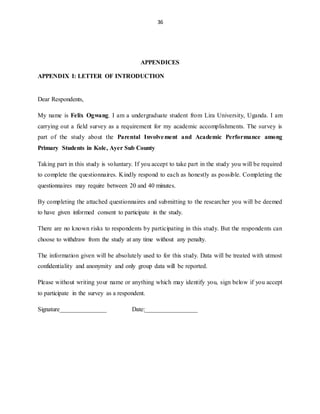
APPENDICES
APPENDIX I: LETTER OF INTRODUCTION
Dear Respondents,
My name is Felix Ogwang. I am a undergraduate student from Lira University, Uganda. I am
carrying out a field survey as a requirement for my academic accomplishments. The survey is
part of the study about the Parental Involvement and Academic Performance among
Primary Students in Kole, Ayer Sub County
Taking part in this study is voluntary. If you accept to take part in the study you will be required
to complete the questionnaires. Kindly respond to each as honestly as possible. Completing the
questionnaires may require between 20 and 40 minutes.
By completing the attached questionnaires and submitting to the researcher you will be deemed
to have given informed consent to participate in the study.
There are no known risks to respondents by participating in this study. But the respondents can
choose to withdraw from the study at any time without any penalty.
The information given will be absolutely used to for this study. Data will be treated with utmost
confidentiality and anonymity and only group data will be reported.
Please without writing your name or anything which may identify you, sign below if you accept
to participate in the survey as a respondent.
Signature_______________ Date:_________________
37
APPENDIX 2: QUESTIONNAIRES FOR STUDENTS
Gender: Male ( ) Female ( )
I live with my ................
My age is ...... years old.
The highest education level of my father/ male guardian is.........................
The work/occupation of my father/ male guardian is ...................
Indicate your mean score in third term in standard 6 ……………..
Put a tick (√) under the right box to complete the statements.
KEY
1=not at all, 2= to a less extent 3= somehow 4=to a large extent 5= to a very large extend
Items 1 2 3 4 5
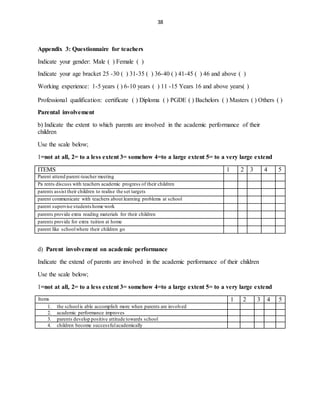
1 My Parent/guardians attend parent-teachermeeting
2 My Parents /guardians discuss with teachers about my academic progress
3 My parents/guardians assist me to realise the set targets
4 My parent/guardians communicate with teachers about my learning problems at
school
5 My parent/guardians supervise my home work
6 My parents/guardians provide extra reading materials for me
7 My parents/guardians provide me with for extra tuition at home
8 My parent/guardians like school where I go
38
Appendix 3: Questionnaire for teachers
Indicate your gender: Male ( ) Female ( )
Indicate your age bracket 25 -30 ( ) 31-35 ( ) 36-40 ( ) 41-45 ( ) 46 and above ( )
Working experience: 1-5 years ( ) 6-10 years ( ) 11 -15 Years 16 and above years( )
Professional qualification: certificate ( ) Diploma ( ) PGDE ( ) Bachelors ( ) Masters ( ) Others ( )
Parental involvement
b) Indicate the extent to which parents are involved in the academic performance of their
children
Use the scale below;
1=not at all, 2= to a less extent 3= somehow 4=to a large extent 5= to a very large extend
ITEMS 1 2 3 4 5
Parent attend parent-teacher meeting
Pa rents discuss with teachers academic progress of their children
parents assist their children to realise the set targets
parent communicate with teachers about learning problems at school
parent supervise studentshome work
parents provide extra reading materials for their children
parents provide for extra tuition at home
parent like schoolwhere their children go
d) Parent involvement on academic performance
Indicate the extend of parents are involved in the academic performance of their children
Use the scale below;
1=not at all, 2= to a less extent 3= somehow 4=to a large extent 5= to a very large extend
Items 1 2 3 4 5
1. the schoolis able accomplish more when parents are involved
2. academic performance improves
3. parents develop positive attitude towards school
4. children become successfulacademically

PARENTAL INVOLVEMENT AND ACADEMIC PERFORMANCE

  • 1.
    i PARENTAL INVOLVEMENT ANDACADEMIC PERFORMANCE AMONG PRIMARY PUPILS IN AYER SUB COUNTY, KOLE DISTRICT BY OGWANG FELIX REG. NO: 16/U/0121/LCP Supervisor DR.AMIR Lira University Faculty of Health Sciences Lira University A Research Proposal Submitted to the Faculty of Health Sciences Lira University in Partial Fulfillment of the Requirements for the Award of a Bachelor of Science in Community Psychology and Psychotherapy of Lira University APRIL, 2019
  • 2.
    ii DECLARATION Declaration by Student Thisproposal is my original work and has not been presented for any other degree, published or submitted for examination in this or any other university. No part of this work may be reproduced without prior permission from the author and/or Lira University. OGWANG FELIX Date REG. NO: 16/U/0121/LCP Declaration by Supervisors I /We confirm that the work reported in this thesis was carried out by the candidate under my/our supervision as the university supervisors. ________________________________ __________________________ DR. AMIR Date Department of Mental Health, Lira University
  • 3.
    iii TABLE OF CONTENTS DECLARATION................................................................................................................................... ii TABLE OF CONTENTS ........................................................................................................................ iii LIST OF ABBREVIATIONS......................................................................................................................v CHAPTER ONE....................................................................................................................................1 INTRODUCTION..................................................................................................................................1 1.1 Overview ............................................................................................................................... 1 1.2 Background to the Study....................................................................................................... 1 1. 3 Statement of the Problem..................................................................................................... 5 1. 4 Purpose of the Study ............................................................................................................ 5 1.5 Objective of the Study........................................................................................................... 6 1.7 The Scope of the Study ......................................................................................................... 6 1.8 Significance of the Study ...................................................................................................... 7 1.9 Limitations of the Study........................................................................................................ 8 1.10 Assumptions of the Study ................................................................................................... 8 1.11 Conceptual Framework ....................................................................................................... 8 LITERATURE REVIEW.........................................................................................................................10 2.0 Introduction......................................................................................................................... 10 2.1 Parental Involvement........................................................................................................... 10 2.2 Parental Involvement and Learners’ Performance .............................................................. 13 2.3 The relationship between Parental Involvement and Academic Performance............................17
  • 4.
    iv 2.4 Summary ofLiterature Review........................................................................................... 21 CHAPTER THREE ...............................................................................................................................23 RESEARCH METHODOLOGY...............................................................................................................23 3.1 Introduction......................................................................................................................... 23 3.2 Research Design.................................................................................................................. 23 3.4 Location of the Study.......................................................................................................... 23 3.5 Population............................................................................................................................ 24 3.6 Sample and Sampling Procedures....................................................................................... 25 3.7 Research Instruments .......................................................................................................... 25 3.7.1 Questionnaire for students .................................................................................................25 3.7 Research Instruments .......................................................................................................... 25 3.7.1 Questionnaire for students .................................................................................................25 3.8 Pilot Study........................................................................................................................... 26 3.8.1 Validity ............................................................................................................................27 3.8.2 Reliability.........................................................................................................................27 3.9 Procedures of Data Collection............................................................................................. 27 3.10 Data Analysis .................................................................................................................... 28 3.10 Ethical Considerations....................................................................................................... 28 REFERENCES.....................................................................................................................................29
  • 5.
    v LIST OF ABBREVIATIONS UPEUniversal Primary Education PTA Parents-Teachers’ Associations SPSS Statistical Package for the Social sciences U.S United States UNICEF United Nations International Children Emergency Fund MoE Ministry of Education DEO District Education Officer
  • 6.
    1 CHAPTER ONE INTRODUCTION 1.1 Overview Thisintroductory chapter will provide the basis for this study. It contains the background of the study, statement of the problem, research objectives, research questions, significance of the study, justification of the study, limitations of the study, scope and delimitations of the study, assumptions and operational definition of key terms used in the study. 1.2 Background to the Study Education is considered as the development of the endowed capacities in the individual, which will enable them to control environment and fulfill their possibilities (Saxton, 2017). Indeed, in this era of globalization, economic change and technological revolution, education is considered as the first step for every human activity. It plays a vital role in the development of human capital and is linked with an individual’s well-being and opportunities for better living (Battle & Lewis, 2016). Therefore without doubt all children need education and the importance of education as a tool for bringing transformation in the society cannot be refuted (Merz, Oort, Ozeke-Kocabas & Schuengel, 2017). Primary education is the most basic formal education and valued very highly for preparing learners for other levels of education, world of work, scientific and technical application of knowledge and life skills. However, attaining primary education is not natural. It is influenced by many factors including parental involvement. The role of parents in their children’s education has been recognized as a significant factor in influencing academic success (Gadeyne et al., 2014).
  • 7.
    2 According to Jeynes(2010), parental involvement means different things to different people. According to Levanda (2017) parental involvement includes a wide variety of actions parents take for the benefit of children’s academic success at school. These include parenting style, parental expectations and aspirations, home rules and parental supervision; parents’ attitudes towards children activities, helping with homework, visiting the school to talk to teachers, and beliefs regarding their child’s education (Porumbu & Necsoi, 2013). Castro, Casas, Martin, Lizasoain, Asencio and Gaviria, (2015) added that parental involvement is an individual right and responsibility for families and social need and should be considered as a lever to promote the academic performance of the children. Although there was some disagreement among theorists as to what constituted of parental involvement, educators came to some consensus that these activities included actions that parents took on behalf of their children both at home and at school, including, helping with homework, communicating with teachers and volunteering at school (Bower & Griffin, 2011). Epstein et al (2009) asserts that parental involvement has six aspects including parenting, communicating with the school, volunteering at school, learning at home, participating in school decision making, and collaborating with communityin the same study established four components of parental involvement: parental aspirations for the children’s education, parent-child communication about school, home structure and parental participation in school related activities (Porumbu & Necsoi, 2013). The present study however, will adapt four of thec Epstein et al’s (2009) domains including; parenting, communicating with the school, learning at home and participating in school decision making to show their influence on students’ performance in Ayer Sub County.
  • 8.
    3 Research suggests thatparents, pupils and teachers benefit from increased parental involvement (Lemmer, 2016). Greater parental involvement leads to teachers having better relationships with parents and pupils, fewer behavioural problems, a reduced workload and a more positive attitude towards teaching (Fan & Williams, 2010). Research studies have established that parent involvement at all levels of education had an impact on student academic success (Hilgendorf, 2012). It has many positive effects on students other than academics, including increased motivation and academic performance. On the contrary, research shows that inadequate or poor parental involvement leads to low student achievement (Bower & Griffin, 2011). In essence, parents and guardian can create favourable learning environments to enhance children’s academic development. Brannon (2018) noted that parental involvement leads to higher academic achievement. Brannon (2018) adds that the increasing evidence of the benefits of parental involvement in the calls for continued research in this area and the necessity of implementing parental involvement programs at all levels of school education. Large number of research conducted in the past several decades showed a strong association of parental involvement and students’ academic achievement; students whose parents involved actively in their education perform much better in their schooling than peers whose parents did not involve (Hsu et al., 2011). In Norway, studies indicate that parents’ involvement in homework has significant influence on students’ academic achievement (Huang, 2009). This is supported by studies from Latin America (Desarrollo 2007). In Pakistan, Waqas Rafiq et al, (2013) explored the effect of parental involvement in the academic achievement of their children. It was found that parental involvement has significance effect in better academic performance of their children. Nyarko (2011) investigated the effect of parental involvement in school on
  • 9.
    4 students’ academic performancein Ghana. The results reveal a positive and significant correlation between mothers’ school involvement and academic performance of children. In Rwanda Kaberere et.al (2013) found that parents of children in high performing schools were significantly more involved than their peers with children in low performing schools particularly in support for learning and assisting children in homework. In Kenya Kibet (2010) investigated the role of parents in enhancing preschool children’s education in Uasin Gishu district and found that parental involvement in education was low. Earlier Ciaraka (2003), sought to establish the role of parents in facilitating the learning processes in selected primary schools in Egoji-Meru found that parental involvement in homework was high. However, Sperns (2011) indicated that there was no relationship between parental involvement and students’ academic performance. This finding was echoed by several other studies which indicated no association (Patall, Cooper, & Robinson, 2008; Barnard, 2004; Fan & Chen, 2014) and even others reported negative association (Coleman & McNeese, 2009; Fan, 2014; Koskei, 2012),) Although, parental involvement has now come to be recognized as a key process in children’s learning the bulk of research studies are outside Ayer Sub County. In addition as Martinez, Martinez and Peres, (2004) observe different cultures and their education systems may differ in the ways their families and schools work together. Therefore a study on the effects influencing such functioning is vital in order to understand and provide insight into family-school- community partnerships. Such a study would be helpful in effective and efficient problem- solving and creating sustainable partnerships in Uganda and Ayer Sub County in particular.
  • 10.
    5 1. 3 Statementof the Problem Students’ academic performance in terms of output grades in national examinations and in test scores in schools is largely dependent on parental involvement, which includes participation in school meetings, payment of school fees on time, provision of scholastic materials, among others. Coincidentally, primary schools in Ayer Sub County perform poorly in national examinations. Is this kind of performance as a result of limited parental involvement? A number of studies have shown the need to improve student’s academic performance in schools and if this is not addressed then Ayer Sub County will lag behind the rest of the country in terms of development since education and development are interdependent. Literature continues to support a positive relationship between parent involvement and performance students; however, there is limited research that has specifically focused on the primary population and situation is total dearth in Ayer Sub County. Given the importance of this critical time period in a child’s growth and development, it is necessary to investigate, specifically, the influence that parent involvement has on the performance among primary students. Regardless of a parent’s chosen part of involvement or the factors that contributed to that choice, developmental psychologists agree that it plays a significant role in children’s overall performance. For this reason, parent involvement and its significant role in the performance of children in primary are the focus to this study 1. 4 Purpose of the Study The main purpose of the study is examine the relationship between parental involvement and academic performance among primary Pupils in Ayer Sub County
  • 11.
    6 1.5 Objective ofthe Study i. To explore the extent of parental involvement in academic activities of their children’s in primary in Ayer Sub County ii. To establish the teachers’ opinion about parents’ involvement in academic performance in primary students in Ayer Sub County iii. To examine relationship between parental involvement and academic performance in primary students in Ayer Sub County 1.6 ResearchQuestions The present study seeks to answer the following research questions; i. To what extend do parents are involved in academic performance of their children in Ayer Sub County? ii. What is the teachers’ opinion about parents’ involvement in academic performance in primary Pupils in Ayer Sub County? iii. What is the relationship between parental involvement and academic performance in primary Pupils in Ayer Sub County? 1.7 The Scope of the Study The scope of the study refers to the boundaries of the study in terms of context, time, methods and theoretical coverage of the study (Oso & Onen, 2009). The study will be conducted in Ayer sub county, in Uganda. It will be conducted among teachers, parents and students of primary. The study will focus on exploring the influence of parental involvement on the students, academic performance among primary students.
  • 12.
    7 1.8 Significance ofthe Study This research study will highlight the contributions that may help researchers and policy makers and offers practical solutions of solving these problems. Specifically, the teachers, parents and children may benefit from this study by understanding the significant contribution of parental involvement to academic performance of students. The teachers may know that parental involvement in academic achievement of children is indispensable. Children may develop positive attitude to towards the parental involvement in matters related to their academics. The study may help in the designing and formulation of parental school curricula by policy makers at Institutional and National level. The Ministry of Education (MoE) and District Education Officers (DEO) may benefit from the study findings in a number of ways namely: they may have benchmarks for the effective and efficient parental involvement ideas and put in place parental guidance counselling services. The study may help to realise the need for the development of school-family-community partnerships as an essential component of larger school improvement efforts. The members of the Board of Governors may improve on the importance of parental involvement in enhancing students’ performance and hence put measures in place that may help parents love and respect their responsibilities all of which may lead to improved academic performance. It is hoped that the results of this study may help fill in some gaps that previous similar studies could have left, and contribute to relevant information.
  • 13.
    8 1.9 Limitations ofthe Study Parental involvement is a serious cutting across the entire republic of Uganda, it would be necessary to study primary schools in Uganda. However this is not possible give the time and financial constraints. It is important to note that cross-sectional surveys are carried out within a certain short interval of time and therefore cannot be utilized to make direct causal inferences (cause-effect relationships) about involvement and students’ performance schools. 1.10 Assumptions of the Study This study is based on assumption that an academic achievement of students is a goal which all parents and teachers aspired to achieve. The study also assumes that each child had a parent/guardian. The study also assumes that the mean score of students is a true indicator of academic performance of students. Lastly the study assumes that parental involvement has an impact on students’ performance. 1.11 Conceptual Framework The conceptual framework of the study is based on the Epstein’s (1987) theory of overlapping spheres of influence. It illustrates how the independent variables of parental participation in parenting, communication, decision making and home learning influence academic performance. It also shows that there are other determinants of academic performance such as discipline, cultural factors, government policy, school factors and discipline as intervening variables which the researcher will attempt to control. Epstein (1995) parental involvement frame work will direct the study variables by the assertion that the overlapping spheres of influence which focus on the complex interrelationships of family, and school affects students’ academic performance.
  • 14.
    9 Independent Variable DependedVariable Intervening Variable Figure 1: parent involvement and academic performance Students’ Academic PerformanceParent Involvement  parenting  Decision Making  Home Learning  Teacher’s opinions  Discipline  Culture  Government Policy  School Factors
  • 15.
    10 CHAPTER TWO LITERATURE REVIEW 2.0Introduction This chapter will contain review of research literature. It includes discussion and critique of studies done by other people on the same aspects related to the study topic. This chapter is divided into three subsections namely: : parental involvement, parental involvement and learners’ performance ,relationship between parental involvement and academic performance and it ends with summary of related literature. 2.1 Parental Involvement Despite increasing recognition that parental involvement in education, there is lack of consensus regarding the definition of parental involvement (Fan & Chen, 2014). Grolnick and Slowiaczek (1994) defined parental involvement as “the dedication of resources by the parent to the child within a given domain”. Larocque, Kleiman, and Darling (2011) defined the construct as the parents’ or caregivers’ investment in the education of their children”. Parental involvement is defined as the level of participation that a parent has in the child’s education and school. Parent involvement can broadly be defined as the ways in which parents support their children’s education in word and deed. Parental involvement has also been defined as representing different behaviours and practices presented by parents both at home and school. According to Levanda (2017) parental involvement includes a wide variety of actions parents take for the benefit of children’s academic success. These include parenting style, parental expectations and aspirations, home rules and parental supervision; parents’ attitudes towards children activities,
  • 16.
    11 helping with homework,visiting the school to talk to teachers, and beliefs regarding their child’s education (Levand, 2011; Porumbu & Necsoi, 2013). Robinson and Harris (2014) describe parent involvement as practices that entail parent communication with their children about education; behaviours in which parents engage with the exclusive aim of increasing academic outcomes; and parental engagement with schools and teachers. In fact studies, researchers choose to avoid a general definition of parental involvement and instead they focus on specific types of the involvement exhibited by parents (Kohl, Lengua, and McMahon, 2016). However, one of the most notable definitions comes from Epstein (1988), whose model consists of six components: parenting, communication with schools, volunteering in schools, learning at home, active participation in school decision‐making and collaboration with the community. In sum, researchers have used various definitions of parent involvement. This has led to difficulty in comparing findings across. In order to have a more consistent approach, Epstein (1988) definition will be adapted to guide the present study. Various researchers have conceptualized parental involvement as having multiple dimensions with distinct influences on students’ academic achievement (Fan, Williams & Wolters, 2012; Wilder, 2014). While researchers tend to draw on different combinations of dimensions the field of parental involvement has been shaped by two leading theories developed by Epstein (1995) and Hoover-Dempsey & Sandler (2005) emphasizing on different but interrelated aspects (Chen and Gregory, 2010). Epstein argued that home-school cooperative behavioural practice can optimize students’ academic achievement (Chen & Gregory, 2010). This model contains involvement types including, parenting volunteering communicating with school; participating in school-related activities at home by helping with homework or checking that homework; and
  • 17.
    12 collaborating with thecommunity (Epstein, 1995). Unlike to Epstein, Hoover-Dempsey’s (et al., 2005) model focuses on psychological constructs such as role construction, self-efficacy, perceived invitation from students and teachers and perceived life contexts and mechanisms influencing students’ academic achievement (Hoover-Dempsey et al., 2005). Though there is ambiguity in the literature surrounding type and extent of parental behaviours that lead to school success (Fan & Williams, 2010) researchers however, have categorised parental involvement into two: school based and home-based involvement (Hill & Tyson, 2009). The vast majority of studies, regardless of children’s developmental level, assess school-based involvement, such as discussions with teachers, attendance at school events, volunteering in schools, and attending parent–teacher conferences (Henry et al., 2011). In the present study, the parent involvement is reflected in four aspects: parenting, communication participation in decision making and learning at home. In some African countries especially South Africa, Uganda and Burundi, policies that support parental involvement in education have been put in place. In South Africa, the Schools Act (Act 84 of 1996) requires all public schools to have elected school governing body comprising of the head teacher, teachers, parents, non-teaching staff and students (Dubbeldan, 2000). In Burundi, education policies require parents to make financial for schools while in Uganda Universal Primary Education policy of 1997 stipulates parents’ role at home and school in support of children’s learning. In Kenya too, successive governments have recognized the need to improve learning environment by involving parents. The Basic Education Act of Kenya (2013) required the school Boards of Management to assess school needs with full participation of parents.
  • 18.
    13 2.2 Parental Involvementand Learners’ Performance Academic performance is a notable indicator of one’s success in life. Thus, excelling in academics is the most dominant feature of education system around the world. A healthy parent participation offers emotional security to children during their study. Generally, research results have shown that parent involvement has positive effects on children’s academic performance (Hayakawa, Englund, Warner Richter, & Reynolds, 2013) and rates of high school dropout and increased on-time high school completion (Barnard, 2004). Parent involvement apparently affects parenting practices and leads to rates of childhood behavioural problems (Brotman et al., 2011). However, other studies found that parent involvement has little or no effect on children’s outcomes. For instance Mattingly et al. (2015) examined 41 studies that looked at kindergarten through 12th grade achievement and parent involvement programs. The study that was qualitative in nature concluded that there was little empirical support for the claim that parent involvement programs are an effective way of raising academic performance. White et al. (1992) examined the effect of parent involvement in early childhood interventions on children’s outcomes. Similarly, this study found little to no evidence that children benefited from parent involvement programs. Such mixed results call for another study and thus present study. Hung (2017) argues that, society needs to increase its level of educational involvement and that this starts with the support by the parents. For the schools to realise higher standards and greater accountability requires the commitment from the teachers and parents (Machen, Wilson & Notar, 2005). In this regard, parent-school relationship can be enhanced through the teacher/parent mutual cooperation. Kgaffe (2007) points out that there is need to convince both parents and schools of the value of reciprocal cooperation. In many countries, one of the strongest trends has been to give parents and parents an increased role in governing schools (Lemmer, 2007). Many
  • 19.
    14 governments now havelegislation to ensure that parents are involved in their children's education more than before (Friedman, 2011). In America, Topor, Keane, Terri and Calkins (2010) examined two potential mechanisms of the child's perception of cognitive competence and the quality of the student-teacher relationship. This study used a sample of 158 seven-year old participants, their mothers, and their teachers. Results indicated a statistically significant association between parent involvement and a child's academic performance, over and above the impact of the child's intelligence. A multiple mediation model indicated that the child's perception of cognitive competence fully mediated the relation between parent involvement and the child's performance on a standardized achievement test. The quality of the student-teacher relationship fully mediated the relation between parent involvement and teacher ratings of the child's classroom academic performance. However this study was done in America which has a different environment. There is need for another study especially in Ayer Sub County context. Barnyak and McNelly (2009) conducted a quantitative study to examine the practices and beliefs of administrators and teachers regarding parent involvement in an urban school district. Administrators and teachers from an urban school district were surveyed. The instrument used for this study was adapted from “The Parent Involvement Inventory”. A two-tailed t-test was conducted and findings indicate some statistically significant differences between many beliefs and practices. The results of this study showed a mismatch between teachers’ and administrators’ beliefs and practices about parent involvement. Although teachers and administrators have strong beliefs about parent involvement and its importance in strengthening student achievement, what they practice in their schools and classrooms was not congruent with these beliefs. Therefore this
  • 20.
    15 study, did notdetermine the influence of parental involvement on students performance which is the main aim of this study. Hountenvilli and Conway (2008) conducted a research on how parental involvement impacts on academic achievement. The results showed that parental involvement in education has a strong positive effect on student achievements. Hountenvilli and Conway (2008) used national data from more than 10,000 eight-grade students in public and private schools, their parents, teachers and school administrations. The results showed that higher academic achievement of students was due to parents spending more time talking to their children during dinner time to understand their worries and fears. In Pakistan, Waqas Rafiq et al, (2013) explored the effect of parental involvement in the academic achievement of their children. A total of 150 students of 9th class of secondary schools (public and private) were taken as respondents. Four schools were selected through simple random sampling which include one boy and one girl from each of the public and private schools categories for equal representation of both boy and girl students in the sample frame of present study. Survey questionnaire was used as a tool for data collection. The study found that parental involvement has significance effect in better academic performance of their children. While this study may be informative to the current study, it was done in secondary schools and in Pakistan which have different conditions. The present research will deviate from this study and will examine the influence of parental involvement on academic performance in primary in Ayer Sub County. In Namibia, Guolaung Erlendsdottir (2010) conducted a qualitative survey study to examine the parental involvement in students’ academic performance. The study sample involved seven
  • 21.
    16 parents of studentswho had achieved high grades in examinations. All parents reported very high level of involvement in their children’s education. However, this study was limited in design since the sample was too small to make generalization to a larger population. Secondly the study was qualitative in nature which has its limitations. The present study is mixed in approach which will give a wider perspective of the relationship between parent involvement and learners’ performance among primary in Kajaido central hence need for same this study in Ayer Sub County. In Tanzania, Kimaro and Machumu (2015) conducted a study to explore the extent of parental involvement in school activities and its relationship with schooling process among primary school children. Parental involvement questionnaire and children academic questionnaire with two rating scales each were administered to 288 children and 125 teachers from six primary schools. The study found a positive significant relationship between parental involvement in school activities and children’s academic standing and the provision of key school items related to schooling outcomes respectively. Parents-teacher conferences and parent-teacher face-to-face contacts were perceived to be desirable modes of communications that impacts children’s school academic achievement. Again this was done among upper primary and in Tanzania. A study in Uganda context especially in Agriculturalist County like Ayer Sub County is needed. In Kenya, Ciaraka (2003) conducted a research that to establish the role of parents in facilitating the learning processes in selected primary schools in Meru found that parental involvement in homework was high but majority (93%) of the parents did not check children’s exercise books regularly. Sperns (2011) also indicated no shared responsibility between parents and schools in Kenyan rural primary schools and that schools were solely responsible for students’ education
  • 22.
    17 and there washardly any relationship between parental involvement and students’ academic performance. This study was limited in design and scope given that it covered only one school involving a sample of twelve respondents. This sample was too small to get sufficient data to allow generalizations to the entire population. Mbugua (1987) examined the role of surrounding communities in primary school education in Thika Municipality and indicated existence of parental involvement in education but these results cannot be relied completely because learners were excluded yet they form part of the key stakeholders. This suggests that another study is needed, thus the current study. 2.3 The relationship between Parental Involvement and Academic Performance Parental involvement has been defined in various ways by various authors in the literature. For example, typology of parental involvement includes six categories such as basic parenting, facilitating learning at home, communicating with the school, volunteering at the school, participating in school decision making and collaborating with the community (Epstein, 1995) Other authors and researchers in their studies have used a typology of parental involvement that is based on either intuitive appeal or factor analysis of existing data. It should be noted that studies that did not apply a multifaceted typology of parental involvement tend to either describe it as a one-dimensional construct(McCarron et al, 2006) and Oyserman et al (2007) distinguished it broadly by the context in which it takes place that is, at home or in school Jeynes (2003) Home-based parental involvement includes helping students with homework, talking with them about school, expressing high expectations, encouraging school success, and providing structures that are conducive for learning (Altschul,2012) said School-based parental involvement on the other hand includes volunteering at school, participating in school events and school organizations as well as communicating with teachers and school staff . Parental involvement is the degree to which a parent is committed to his or her role as a parent and to the fostering of optimal child development. It typically concerns the amount of effort put into child-oriented education as well as other activities (Nyarko, 2011). In the educational
  • 23.
    18 domain for example,parental involvement has primarily focused on specific activities such as participating in school events; helping with homework and the number of contacts between families and schools. It has been conceptualized parental involvement in education as the dedication of resources by parents to children within the educational domain (Epstein, 2005). The level of parental involvement has significant effects on children’s academic performance. Social cognitive theory suggests that children absorb messages about appropriate behaviour and socially accepted goals by observing and talking with important people in their lives. Based on this assumption, parents have the potential to model positive attitudes and behaviours of their children toward the school. Several researchers in their studies in the developed countries have found that parental involvement contributes to academic success of their children (outenvilleet al, 2008). Jeynes (2007) asserts that this is because children are more likely to apply themselves and perform better in school when their parents show an interest in their school work, are willing to assist them with homework and are willing to hold their children accountable for completion of school assignments. Children who are not working hard at school may begin to perceive school as valuable when parents actively demonstrate that they value schooling through involvement. Besides parents have the distinct advantage over anyone else in that they can provide a more stable and continuously positive influence that could enhance and complement what the school fosters on their children. In this regard, parental involvement is undeniably critical (Mji, et al, 2006) Guolaug (2010) Research findings suggest that parents’ attitudes, together with their behaviour and activities with regard to their children’s education have an effect on academic achievement. However, with regard to the content of what children learn, many parents fall short because in general they do not possess the necessary education and therefore find it difficult to determine and understand what was done at school (Mji et al,2005). This is a point also raised by a learner in a related study, “... my parents don't know maths and physics so how can they be involved...?” ( Mji et al,2005) Parental involvement is a multidimensional and bidirectional construct that has been shown to have clear links with social and academic outcomes for children. Traditionally, parental involvement has been defined as engaging parents in school-based activities and events related to
  • 24.
    19 their child’s education.However, a more comprehensive view of parental involvement envisaged in the current study goes beyond just parent activities in school settings but in subject-oriented participations with specific reference to Mathematics and English Language. This comprehensive view of parental involvement is grounded in the understanding that success of students in Mathematics and English Language at the senior high school level is influenced by multiple contexts such as the home, the school, and the community in a dynamic and bidirectional manner (Sanders at el, 2009) Sheldon (2009) said Several researchers and educators have recognised the important role of a strong positive bond between homes and schools in the development and education of children Research has also shown that successful students have strong academic support from their involved parents. Similarly, research on effective schools where students are learning and achieving has consistently shown that these schools, despite often working in low social and economic neighbourhoods, have strong and positive school-home relationships (Sheldon (2009). More importantly, these effective schools have made a real effort in reaching out to their students’ families in order to bring about liaison and cooperation. (Guy, 2008) put It has been hypothesized that parental involvement primarily influences children’s attributes and behaviours which in turn affect their achievement in mathematics similarly, the theoretical framework provided by Hoover-Dempsey and Sandler suggests that parental involvement enhances academic self-efficacy, intrinsic motivation to learn, self- regulatory use and social self-efficacy of children which in turn operate to enhance academic performance. For example, a study found that parental involvement (home involvement, school involvement, parent-teacher communication) was predictive of children’s school engagement and socio-emotional. Chowa et al (2013) Studies have also shown that students performed better academically and have a more positive school attitude if they had parents who are aware, knowledgeable and involved Anthony et al (2009) Conducive learning environments that incorporate meaningful mathematical experiences are associated with higher achievement and genuine home and school collaboration have also been found to lift children’s academic performance significantly. Results from a study conducted by indicated that parental involvement is a statistically significant predictor of mathematical
  • 25.
    20 achievement and alsopromoted positive behaviours and emotional development in children. Friedel et al (2010) have argued that parental involvement in its many and varied ways is a vital parameter for increasing children’s academic achievement. Farooq et at(2011) in his Empirical studies have indicated that some specific factors that play an essential role in increasing children’s mathematics achievement are parental aspirations, parent- child communication, home structure, and parents’ involvement in school’s activities. For example, in their study reported that students whose parents are educated score higher on standardized tests than those whose parents were not educated. This is because educated parents can better communicate with their children regarding the school work, activities and the information being taught at school. They can better assist their children in their work and participate at school. Therefore, academic performance of students heavily depends upon the parental involvement in their academic activities to attain the higher level of quality in academic success. However, few studies that differentiate between home and school-based parental involvement reported contradictory findings. For example, in some studies home-based parental involvement has significant positive effect while in other studies, school-based involvement has significant negative effects related to academic outcomes. It can be argued that the interventions promoting parental involvement vary based on the context in which the involvement occurs. The empirical literature so far has shown that parental involvement is consistently related to a child's increased academic performance but the specific mechanisms through which parents exert their influence on a child’s academic performance are yet not fully understood. From the literature, we also observed that while the relationship between parental involvement and children’s academic performance is well established at the lower level of education, researchers in the area have not yet fully explored how parental involvement is related to students’ academic performance in Mathematics and English Language at the senior high school levels. Parents are usually very much involved in their children’s early education but this involvement tends to decrease when children proceed to high school (Shinn,2002) Therefore, the present study on the relationship between parental involvement and academic performance of senior high school students in Ghana is an attempt to fill this gap.
  • 26.
    21 2.4 Summary ofLiterature Review Related literature was reviewed and gaps were identified. The body of literature concerning parental involvement and learners performance has continued to grow over the years as policy makers, parents and school administrators increasingly became aware of it benefits. The literature looks into the parental involvement and students’ performance. The literature revealed that indeed parental involvement is very crucial to students’ wellbeing and their performance. The concept parental involvement was reviewed and the researcher note lack of consensus regarding the definition of parental involvement. Despite its intuitive meaning, the operational use of parental involvement has not been clear and consistent (Fan & Chen, 2001). In fact due varying definitions, some researchers choose to avoid a general definition of parental involvement and instead they focus on specific types of the involvement exhibited by parents (Kohl, Lengua & McMahon, 2000). A review of literature indicates that there are contradictory findings regarding the perceptions of parental involvement on children’s academic success. Some studies reported positive associations with academic achievement (Tipor, Keane, Shelton, & Calkins 2010; Hong & Ho, 2005). Other studies indicated no association (Patall, Cooper, & Robinson, 2008; Barnard, 2004; Fan & Chen, 2001) and even others reported negative association (Coleman & McNeese, 2009; Domina, 2005; Fan, 2001). The reviewed literature however, provides pertinent insights of relevance to the influence of parental involvement in education on performance of students. From the literature, it can be noted that parental involvement in education of their children is very important. However most studies reviewed were generally outside Uganda and hardly any in Ayer Sub County which may
  • 27.
    22 be having uniquechallenges. Secondly most of these were either qualitative or quantitative in approach but not both. Again the sample size in these studies was quite small. All this created gaps gap that the study wanted to fill.
  • 28.
    23 CHAPTER THREE RESEARCH METHODOLOGY 3.1Introduction This chapter will discuss the methodology which will be used to conduct the research. It includes the research design, study population, sample size and sampling techniques, data collection instruments, validity and reliability of instruments, data collection procedure and data analysis. 3.2 ResearchDesign The study will utilize the quantitative research design approach. Specifically, a descriptive correlation research design will be employed to examine the relationship between parental involvement and academic performance of primary School students. It is noted that, corelational research describes an existing relationship between variables (Shinn,2002). Correlation research design, will therefore, be used for this study since the objective of the study to assess how the independent variables (parental involvement and parental academic ambition) relate to the dependent variable (students’ academic performance). In selecting a method to conduct the descriptive correlation study, a survey method will be chosen to collect data from the respondent’s parental involvement and academic performance in primary schools in Ayer Sub County. 3.4 Location of the Study The study will be carried out in Kole, Ayer Sub County in Uganda. Kole District is bordered by Lira District to the east, Apac District to the south and Oyam District to the west and north. Kole, the district capital, is located approximately 28 kilometres (17 mi), by road,
  • 29.
    24 northwest of Lira,the largest city in the sub-region. This location is approximately 290 kilometres (180 mi), by road, north of Kampala, Uganda's capital and largest city. The coordinates of the district are:02 24N, 32 48E 3.5 Population A target population refers to a group of subjects sharing similar characterizes whom the researcher wants to investigate (Gravetter & Forzano, 2006). The target population will be drawn from all pupils of primary schools in Ayer Sub County. According to District Education officer (DEO) there are 291 students. Their participation in this study will be established to provide data on parental involvement as well as their personal data like age and gender. Form 7 students will be targeted because it is thought that they are good people to evaluate the level of their parents’ involvement compared to parents themselves. The survey population will be made of standard seven pupils. These are the ones who sat for standard six examinations in the preceding year and records of their scores in that examination will be available in the relevant offices. The distribution of such students per school and in gender is shown in table 1. Table1: Population School Standard seven Pupils Boys Girls Total A 29 31 60 B 15 24 39 C 9 15 24 D 25 23 48 E 20 13 33 F 16 12 28 G 10 9 19 H 16 24 40 Total 140 151 291
  • 30.
    25 3.6 Sample andSampling Procedures . Purposive sampling technique will be used for selecting schools. Simple random sampling will be used to select students. Calculation of an appropriate sample size generally depends upon the size of the population in question (Alreck & Settle, 1995). For cross sectional survey however, the sample should be between 20% and 50% of population (Gay & Diehl, 1992). . Thus 8 schools, 146 students of primary will be selected for the study. This information is presented in table 2. Table2: Sample Size School Standard Six Pupils Sample Size Boys Girls Total Boys Girls Total A 29 31 60 15 15 30 B 15 24 39 8 12 20 C 10 15 25 5 8 12 D 25 23 48 12 11 23 E 20 13 33 10 7 17 F 16 12 28 8 6 14 G 10 9 19 5 4 9 H 16 24 40 8 12 20 Total 141 151 292 71 75 146 3.7 ResearchInstruments In this study, a total of two tools will be used; questionnaires for teachers and students. 3.7.1 Questionnaire for students 3.7 ResearchInstruments In this study, a total of two tools will be used; questionnaires for students and teachers. 3.7.1 Questionnaire for students The researcher developed questionnaire for students is based on the framework of six types of involvement developed by Epstein (1995). This instrument is designed to measure how schools
  • 31.
    26 are reaching outto involve parents in a meaningful manner (appendix 2). The scale uses 8 items. It has five responses on a 5 point Likert scale: 1=not at all, 2= to a less extent 3= somehow 4=to a large extent 5= to a very large extend. A score of 4 or 5 indicates that the activity or approach is strong and prominent. A score of 1, 2, or 3 indicates that the activity is not yet part of the school’s program, or needs improvement. Questionnaire for teacher The researcher also developed questionnaire for teachers is based on the framework of six types of involvement developed by Epstein (1995). The scale uses a 12 items. It has five responses on a 5 point Likert scale: 1=not at all, 2= to a less extent 3= somehow 4=to a large extent 5= to a very large extend. A score of 4 or 5 indicates that the activity or approach is strong and prominent. A score of 1, 2, or 3 indicates that the activity is not yet part of the school’s program, or needs improvement. 3.8 Pilot Study A pilot study is a research conducted on a limited scale to test the feasibility of the study, instruments and methods. A pilot study will conducted in on primary school which has similar population characteristics as the actual population in which the study will be conducted. The pilot study sample will constitute 10% of the actual study sample (Connelly, 2008). A sample of teachers and learners will be selected for the pilot study. Therefore, a pilot study will be carried to check whether the instructions given are clear and the questionnaires are comprehensive. It is also intended to remove ambiguities and error. Besides, validity and reliability of the instruments will be ascertained.
  • 32.
    27 3.8.1 Validity Validity isthe degree to which a test or instrument measures what it is intended to measure (Bowling, 2012). The instruments will be pre-tested among a group of subjects similar to the intended respondents where they will be required to write comments on its veracity, ease of comprehending the instructions and recommendations for any improvements. The validity of the tools will be determined based on construct, content and face validity. Besides, the researcher and supervisors will assess whether the items in tools are clear and appropriate. This will be ascertained by ensuring that all the objectives and variables of the study are addressed tools. 3.8.2 Reliability Reliability of the instruments signifies the issue of consistency of measures or the ability of the instrument to measure the same thing each time it is used (Kulter, 2007). It is a measure of the degree to which a research instrument yields consistent results or data after repeated trials. The instruments for this study will be pilot-tested to determine their appropriateness to the Ayer Sub County situation before actual data collection. The instruments will be administered to the same pilot sample twice in an interval of two weeks. The two weeks interval is enough to avoid the impact of repetition by respondents. The reliability index of the tools will be calculated using Pearson’s product moment correlation coefficient from the test-retest scores. The acceptable reliability coefficient will be 0.07 and above which are above adequate benchmark coefficient of 0.50. 3.9 Procedures of Data Collection The first step will be to obtain an introduction letter from Lira university which will be presented to the relevant authorities to grant permission to carry out research. The research permit from the
  • 33.
    28 District Education Officer(DEO)will be obtained before proceeding to the field for data collection. Arrangements on how to meet the respondents will be done by the researcher by visiting the schools. The researcher will give teachers questionnaires to fill. Once they will be filled, they will be collected for analysis. 3.10 Data Analysis Data collected will be edited coded, classified and tabulated. After tabulation, the data will be analyzed using the Statistical Package for Social Sciences (SPSS) version 21.descriptive statistics including frequencies and percentages will be employed for close ended questions. Pearson’s Product Moment Coefficient Correlations to determine the relationship between variables. The data will be summarised through frequency tables and bar graphs 3.10 Ethical Considerations All the respondents will be informed about the purpose of the study. It will be explained to the respondents that they are free to withdraw from the study at any time without penalty. It will be made clear that there will be no financial or any other form of gain as a result of their participation. All respondents will be assured that their participation is anonymous, confidential and voluntary. In order to observe confidentiality, the respondents will not be required to sign anywhere on questionnaire. It will be explained that the respondents who volunteered to complete the data collection instruments will be assumed to have given informed consent. The questionnaire has an information sheet attached to it explaining the purpose of the study, the time frame for the study and assurance that the information given will be utilized for study purposes only and strict confidentiality will be observed. The information sheet also included instructions to the respondents not to write their names or any identifiers on the questionnaires. This information is presented in an informed consent letters that will be handed out to the respondents (see Appendix 1)
  • 34.
    29 REFERENCES Barnard, W. (2004).Parent involvement in elementary school and educational attainment. Children and Youth Services Review, 26(1), 39-62. doi: 10.1016/j.childyouth.2003.11.002 Barnyak, N. C., & McNelly, T. A. (2009). An urban school district’s parent involvement: A study of teachers’ and administrators’ beliefs and practices. The School Community Journal, 19(1) Barton, P.E. (2003). Parsing the Achievement Gap: Baselines for Tracking Progress. Princeton, NJ: Policy Information Report, Educational Testing Service. Battle, J., & Lewis, M. (2016). The increasing significance of class: The relative effects of race and socioeconomic status on academic achievement. Journal of Poverty, 6(2), 21-35. Belfield, C. R. and H.M. Levin, H.M. (2007). The Price We Pay: Economic and Social Consequences of Inadequate Education. Washington, DC: Brookings Institution Press. Bower, H., & Griffin, D. (2011). Can the Epstein model of parental involvement work in a high- minority, high-poverty elementary school? A case study. Professional School Counseling, 15(2), 77–87. doi:10.5330/PSC.n.2011-15.77 Bowling, A. (2012) Research methods in health. Philadelphia: Open University Press. Brannon, D. 2018. Character education: it is a joint responsibility. Kappa delta Pirecord, 44(2):62-65 Bridgemohan, R. R. (2018). Parent involvement in early childhood development in Kwa-Zulu Natal. Unpublished doctoral dissertation. Johannesburg: University of South Africa. Brotman LM, Calzada EJ, Kingston S, Huang KY, Dawson-McClure S, Kamboukos D, Petkova E. (2011). Promoting effective parenting practices and preventing child behavior problems in school among ethnically diverse families from underserved, urban communities. Child Development. 82:258–276 Castro, M., Casas, E.,Martin, E.,Lizasoain, L., Asencio, E., & Gaviria, J. (2015). Parental involvement on student academic achievement: A meta-analysis. Educational Research Review, 14,33-46. Chemagosi, M. J. (2012). Influence of Parental Involvement on Academic Performance of Pre- School Children. Masters of Education Project Paper U.O.N. Chen, W-B., & Gregory, A. (2010). Parental involvement as a protective factor during the transition to high school. The Journal of Educational Research, 103(1), 53-62
  • 35.
    30 Christian, K., Morrison,F.J. & Bryant, F.B. (1998). Predicting kindergarten academic skills: Interactions among child care, maternal education, and family literacy environments. Early Childhood Research Quarterly. 1998;13:501–521. Ciaraka,M (2003). Parental Involvement in Facilitating the Learning Process: a case Study of Standard Eight Pupils in Selected Schools of Egoji-Meru, Kenya (Masters’ project) Kenyatta University Coleman, B., & McNeese, M. N. (2009). From home to school: The relationship among parental involvement, student motivation, and academic achievement. The International Journal of Learning, 16 (7), 459–470. Connelly, L.M. (2008). Pilot studies. Medsurg Nursing, 17(6), 411-2. Cotton, K. & Wikelund K.R (2015). Parental Involvement in education: http://multiculturaleducole.pbworks.com Creswell, J.W. (2012). Educational Research: Planning, Conducting, and Evaluating Qualitative and Quantitative Research, 4th Ed. Toronto: Pearson. Creswell, J.W. (2013). Research design: Qualitative, quantitative, and mixed methods approaches. Thousand Oaks, CA: Sage Desarrollo, I. (2007). Quality of education in Latin America and Caribbean Latin America. Research work Institute: Desarrollo, Paraguay. Desforges, C. & Abouchaar, A. (2013). The impact of parent involvement, parental support and family education on pupil achievement and adjustment: A review of literature. from: www.dcsf.gov,uk/research/rb433.doc Domina, T. (2005). Leveling the home advantage: Assessing the effectiveness of parental involvement in elementary school. Sociology of Education, 78,233–249. Englund, M.M., Egeland B. & Collins, B.A. 2008. Exceptions to high school dropouts predictions in a low-income sample: Do adults make a difference? Journal of Social Issues, 64(1):77-94. Epstein, J. L. & Sheldon, S. B. (2005). Parent involvement in schools. Journal of Educational Research, 98 (4):196-206. Epstein, J., Sanders, M., Simon, B., Salinas, K., Jansorn, N., & Van Voorhis, F. (2009). School, family, and community partnerships: Your handbook for action. Thousand Oaks, CA: Corwin. Epstein, J.L. (1988). How do we improve programs for parental involvement? Educational Horizons, 66:58-59
  • 36.
    31 Epstein, J.L. (1995).School/family/community partnerships: Caring for the children we share. Phi Delta Kappan, 76(9):701-712 European Commission. (2001). European report on quality of school education: Sixteen quality indicators May (2000). Luxembourg: Office for Official Publications of the European Communities. Fan, W., & Williams, C. (2010). The effects of parental involvement on students’ academic self- efficacy, engagement and intrinsic motivation. Educational Psychology, 30(1), 53-74. doi: 10.1080/01443410903353302 Fan, W., Williams, C. M., & Wolters, C. A. (2012). Parental involvement in predicting school motivation: similar and differential effects across ethnic groups. Journal of Educational Research, 105(1), 21-35. Fan, X., & Chen, M. (2018). Parental involvement and students’ academic achievement: A meta- analysis. Educational Psychology Review, 13(1), 1–2 Friedman, T.L. (2011). We need better parents. New York Times, Sunday. Available from: www.nytimes.com/2011/20/opinion/sunday/friedman-howabout-better-parent Gadeyne, E., Ghesquie ́re, P., & Onghena, P. (2014). Longitudinal relations between parenting and child adjustment in young children. Journal of Clinical Child and Adolescent Psychology, 33, 347-358 Georgiou, S.N. (2008). Bullying and victimization at school: the role of mothers. British Journal of Psychology, 78(1):109-125 Government of Kenya (2013). The Basic Education Act. Government Printer, Nairobi. Grolnick, W. S., & Slowiaczek, M. L. (1994). Parents’ involvement in children’s schooling: A multidimensional conceptualization and motivational model. Child Development, 65,237–252 Guolang, E. & Machumu, H.J. (2010). Effects of parental involvement in education: A case study of Namibia. (Masters’ thesis) University of Icelan Haas, R., & Reiley K. (2008). Increasing homework completion of middle school students by using parental involvement strategies and establishing routines (Master’s thesis). Saint Xavier University. Hayakawa, M., Englund, M. M., Warner-Richter, M. N., & Reynolds, A. J. (2013). The longitudinal process of early parent involvement on student achievement: A path analysis. Dialog, 16(1), 103-126. Henry, K. L., Cavanagh, T. M., & Oetting, E. R. (2011). Perceived parental investment in school as a mediator of the relationship between socio-economic indicators and educational
  • 37.
    32 outcomes in ruralAmerica. Journal of Youth and Adolescence, 40,1164– 1177.doi:10.1007/s10964-010-9616- Hilgendorf, A. E. (2012). Through a limiting lens: Comparing student, parent, and teacher perspectives of African American boys' support for school. School Community Journal, 22(2), 111-130. Hill, N.E., & Tyson, D.F. (2009). Parental involvement in middle school: a meta-analytic assessment of the strategies that promote achievement. Developmental psychology, 45(3), 740-763. Hoover-Dempsey, K.V., & Sandler, H.M. (2005). The Social Context of Parental Involvement: A Path to Enhanced Achievement. Final Performance Report Hountenvilli, A.J.and Conway, S. (2008). Parental involvement strongly impact student achievement .Science Daily. Pp 28 May 16th. Hsu, H.,Zhang, D., Kwok, O., Li, Y.&Ju, S. (2011). Distinguishing the Influences of Father's and Mother's Involvementon Adolescent Academic Achievement: Analyses of Taiwan Education Panel Survey Data. The Journal of Early Adolescence, 31(5), 694–713 Hung, C.L. (2017). Family, schools and Taiwanese children’s outcomes. Educational Research, 49(2):115-125. Jeynes, W. (2017). The salience of the subtle aspects of parental involvement and encouraging that involvement: Implications for school-based programs. Teachers College Record, 112(3), 747–774 Kaberere, V., Makewa, T., Muchee, T., and Role, E. (2013). Parental involvement in high and low performing schools in Gasabo District, Rwanda. Review of educational research. Kafas, P. (2009). Child Neglect. A Review; The Internet Journal of Forensic Science. Kgaffe, M.M. 2001. Barriers to parent involvement in rural communities in North West Province. Unpublished master’s dissertation. Johannesburg: University of South Africa Kibet, K. P. (2010). Teacher-parent partnership for enhancing quality in pre-school education: A case study of Uasin Gishu district, Kenya (PhD thesis) Kenyatta University. Nairobi. Kimaro, A.R., Machumu, H.J. (2015). Impacts of parental involvement in school activities on academic achievement of primary school children. International Journal of Education and Research, Vol. 3 No. 8, 489-494. Kohl, G. O., Lengua, L. J., & McMahon, R. J. (2000). Parent involvement in school conceptualizing multiple dimensions and their relations with family and demographic risk factors. Journal of School Psychology, 38(6), 501-523.
  • 38.
    33 Koros, P. K.,Ngware, M.W., and Sang, A.K. (2009). Principals’ and students perceptions on parental involvement in financial management in secondary schools in Kenya. Quality assurance education, 17(1):61-78 Koskei, B. K. (2012). Influence of socio-economic background on academic performance of public mixed day secondary school students in Kuresoi district. Masters thesis, Moi University, Eldoret Kenya. Kreider, H. (2002). Getting parents “ready” for kindergarten: The role of early childhood education. Amherst, MA: Harvard Family Research Project. http://www.gse.harvard.edu/hfrp/projects/fine/resources/research/kreider.html Kultar, S. (2007). Quantitative social research methods. New Delh: Sage Publications. LaRocque, M., Kleiman, I., & Darling, S. M. (2011). Parental involvement: The missing link in school achievement. Preventing School Failure, 55(3), 115-122. Lemmer, E.N. (2007). Parent involvement in teacher education in South Africa. International Journal about Parents in Education, 1(9):218-229. Lesanjir, B. M.(2016). Factors influencing academic performance of girls in public primary schools in Sereolipi Zone in Samburu County, Kenya (Masters’ thesis) University of Nairobi, Nairobi. Levanda, O. (2017). Parental involvement in school: A test of Hoover-Dempsey and Sandler’s model among Jewish and Arab parents in Israel. Children & Youth Service Review, 33, 927-935 MacNeil, A. & Patin, M. (2010). The principal’s role in improving and sustaining parental involvement. Available from http://cnx.org/content/m12925/latest/. (Accessed 18 May 2008 MacNeil, A. & Patin, M. (2010). The principal's role in improving and sustaining parent involvement. The Connexions Project. Retrieved from http://cnx.org/content/m1292/1.2/. Martinez, R.A., Martinez, R., & Perez, M.H. (2004). Children’s school assessment: Implications for family-school partnerships. International journal of Educational Research, 41(1):24- 39. Maxon, D.N.M. (2017). The implementation of parent-teacher conferences in the primary school. Unpublished masters dissertation. Pretoria: University of South Africa Mbugua, W. C. (1987). A survey of activities and problems associated with administrative task of school – community relations with reference to head teachers of primary schools in Thika municipality (Masters’ project) Kenyatta University. Nairobi. McMillan, J.H. & Schumacher, S. (2006). Research in education: Evidence-based inquiry. (6th ed.) Boston: Pearson Education
  • 39.
    34 Mcmonor M. (2016).Parental involvement in the classroom. Journal of Instructional Psychology, 32(1):13-16. Merz, E.-M., Oort, F., Ozeke-Kocabas, E., & Schuengel, C. (2017). Intergenerational Family Solidarity: Value Differences between Immigrant Groups and Generations. Journal of Family Psychology, 23(3), 291-300. Monadjem, L .(2003). The development of a programme for parental involvement in senior primary schools in Swaziland. Ph.D. Thesis, Unpublished. Pretoria: University of South Africa Muola, J. M. (2010). The relationship between academic achievement motivation and home environment among standard eight pupils in Machakos, Educational Research and Review Vol. 5(5) pp213-215. Muya, F. K., & Kabunga, A. (2016). Class Size and Learning Outcomes: Perceptions of In- Service Teachers. Researchjournali’s Journal of Education, 4(1) PP. 1-7 Naidoo, J.P. (2005). Educational decentralization and school governance: From policy to practice. International Institute for Educational Planning 7-9 rue Eugene Delacroix, 75116, Paris: UNESCO. 1997. Nyarko, K. (2011). Parental involvement: The case of Ghana. Journal of Emerging Trends in Educational Research and Policy Studies. Vol. 2, Issue 5, pp378. Olmstead, C. (2013). Using technology to increase parent involvement in schools. TechTrends, 57(6), 28-37. Ondieki, J. T. O (1988). A survey of the home- school relations in primary schools within Kisii municipal council, Kisii district (Masters’ thesis) Kenyatta University. Nairobi. Oso,W. & Onen, D.(2009). Writing research proposal and report: A hand for beginning researchers. (revised edition). Nairobi: Prints Art Ltd. Otewa, F., Role, E., and Makewa, N. L. (2011). Parental factors affecting achievement of grade six pupils in Kisumu City- Kenya. International Journal of Social Sciences. http://www.aessweb.com/journal. Patall, E. A., Cooper, H., & Robinson, J. C. (2008). Parent involvement in homework: A research synthesis. Review of Educational Research, 78, 1039–1101. doi:10.3102/0034654308325185 Peterson, S. D. (2014). Education and displacement in Uganda-challenges and ways forward. retrieved from: www.refugeelawproject.org Porumbu, D., & Necsoi, D, V. (2013). Relationship between parental involvement, attitude and children’s school achievement. Procedia-Social & Behavioral Sciences, 76,706-710.
  • 40.
    35 Rafiq Waqas, M.H., Fatima, T., Sohail, M.M., Saleem, M. Khan, A. M. (2013). Parental Involvement and academic achievement; a study on secondary School students of Lahore, Pakistan. International Journal of Humanities and Social Science,3(8) Republic of Kenya, & UNICEF. (2008). Policy Framework for Nomadic Education in Kenya. Nairobi: Government Printers Republic of Kenya, (2005). Sessional Paper No. 1 of 2005: A policy framework for educational training and research. Nairobi: Government Printers Republic of Kenya. (2011). Economic Survey. Nairobi: Government Printers Robinson, K., & Harris, A. L. (2014). The broken compass: Parental involvement with children's education. Cambridge, MA: Harvard University Press. Saxton, Jim (2000). Investment in Education: Private and Public Returns. Joint Economic Committee Study Semela, M.S. (2004). Parental involvement in schools in the Motheo District of the Free State Education Department. Masters thesis. Bloemfontein: University of the Free State. Singh, K., Bickley, P.G., Keith, T.Z., Keith, P.B., Trivette, P., and Anderson, E. (1995). The effects of four components of parental involvement on eighth grade student achievement: structural analysis of NELS-88 data. School Psychology Review, 24, 2, 299-317 Spernes, K. (2011). I buy paraffin so can read in the evening: A study from Kenya about parental involvement in school. Ostfold University College. Norway Symeou Loizos (2014). Fostering children’s learning: An investigation of the role of teacher- parent briefing. In British Educational Research Association Annual conference. En line: http://www.leeds.ac.uk Topor, DR., Keane S.P., Terri, L.S., & Calkins, S.D. (2010). Parent involvement and student academic performance: A multiple meditational analysis. J Prev Interv Community. 38(3): 183–197. doi: 10.1080/10852352.2010.486297 United Nations International Children Emergency Fund (UNICEF). (2008). Curriculum report card. Working Paper Series, Education Section, Programme Division. New York, NY: Author. Van der Westhuizen, G.J. (2007). Evaluations of Transformation of Higher Education in South Africa. South African Journal of Higher Education, 21(3): 552-569 Van Wyk, J. N. (2008). A comparative perspective on the theories, policies and practices of parent involvement in education. Lecture paper: University of South Africa. Wilder, S. (2014). Effects of parental involvement on academic achievement: a meta-synthesis. Educational Review, 66(3), 377-397.
  • 41.
    36 APPENDICES APPENDIX I: LETTEROF INTRODUCTION Dear Respondents, My name is Felix Ogwang. I am a undergraduate student from Lira University, Uganda. I am carrying out a field survey as a requirement for my academic accomplishments. The survey is part of the study about the Parental Involvement and Academic Performance among Primary Students in Kole, Ayer Sub County Taking part in this study is voluntary. If you accept to take part in the study you will be required to complete the questionnaires. Kindly respond to each as honestly as possible. Completing the questionnaires may require between 20 and 40 minutes. By completing the attached questionnaires and submitting to the researcher you will be deemed to have given informed consent to participate in the study. There are no known risks to respondents by participating in this study. But the respondents can choose to withdraw from the study at any time without any penalty. The information given will be absolutely used to for this study. Data will be treated with utmost confidentiality and anonymity and only group data will be reported. Please without writing your name or anything which may identify you, sign below if you accept to participate in the survey as a respondent. Signature_______________ Date:_________________
  • 42.
    37 APPENDIX 2: QUESTIONNAIRESFOR STUDENTS Gender: Male ( ) Female ( ) I live with my ................ My age is ...... years old. The highest education level of my father/ male guardian is......................... The work/occupation of my father/ male guardian is ................... Indicate your mean score in third term in standard 6 …………….. Put a tick (√) under the right box to complete the statements. KEY 1=not at all, 2= to a less extent 3= somehow 4=to a large extent 5= to a very large extend Items 1 2 3 4 5 1 My Parent/guardians attend parent-teachermeeting 2 My Parents /guardians discuss with teachers about my academic progress 3 My parents/guardians assist me to realise the set targets 4 My parent/guardians communicate with teachers about my learning problems at school 5 My parent/guardians supervise my home work 6 My parents/guardians provide extra reading materials for me 7 My parents/guardians provide me with for extra tuition at home 8 My parent/guardians like school where I go
  • 43.
    38 Appendix 3: Questionnairefor teachers Indicate your gender: Male ( ) Female ( ) Indicate your age bracket 25 -30 ( ) 31-35 ( ) 36-40 ( ) 41-45 ( ) 46 and above ( ) Working experience: 1-5 years ( ) 6-10 years ( ) 11 -15 Years 16 and above years( ) Professional qualification: certificate ( ) Diploma ( ) PGDE ( ) Bachelors ( ) Masters ( ) Others ( ) Parental involvement b) Indicate the extent to which parents are involved in the academic performance of their children Use the scale below; 1=not at all, 2= to a less extent 3= somehow 4=to a large extent 5= to a very large extend ITEMS 1 2 3 4 5 Parent attend parent-teacher meeting Pa rents discuss with teachers academic progress of their children parents assist their children to realise the set targets parent communicate with teachers about learning problems at school parent supervise studentshome work parents provide extra reading materials for their children parents provide for extra tuition at home parent like schoolwhere their children go d) Parent involvement on academic performance Indicate the extend of parents are involved in the academic performance of their children Use the scale below; 1=not at all, 2= to a less extent 3= somehow 4=to a large extent 5= to a very large extend Items 1 2 3 4 5 1. the schoolis able accomplish more when parents are involved 2. academic performance improves 3. parents develop positive attitude towards school 4. children become successfulacademically