Topic 2 Educating Rita
The roots of education are bitter, but the fruit is sweet
Nina Dearle
By PresenterMedia.com
VOCABULARY WORK
English Vocabulary in Use Upper Intermediate:
43 Education
English Vocabulary in Use Advanced:
11 Study and Academic Work
12 Education: Debates and Issues
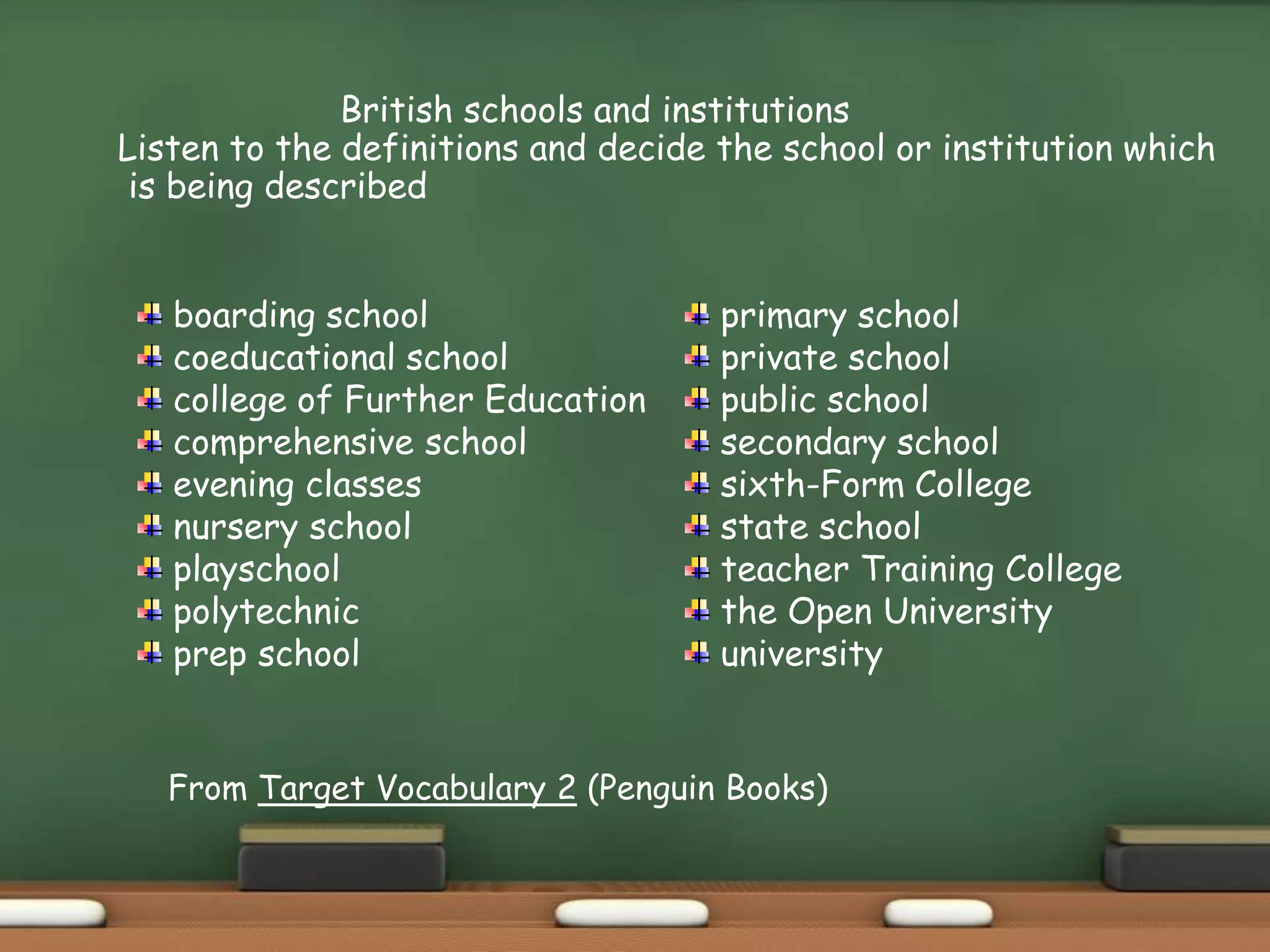
British schools and institutions
Listen to the definitions and decide the school or institution which
is being described
boarding school
coeducational school
college of Further Education
comprehensive school
evening classes
nursery school
playschool
polytechnic
prep school
primary school
private school
public school
secondary school
sixth-Form College
state school
teacher Training College
the Open University
university
From Target Vocabulary 2 (Penguin Books)
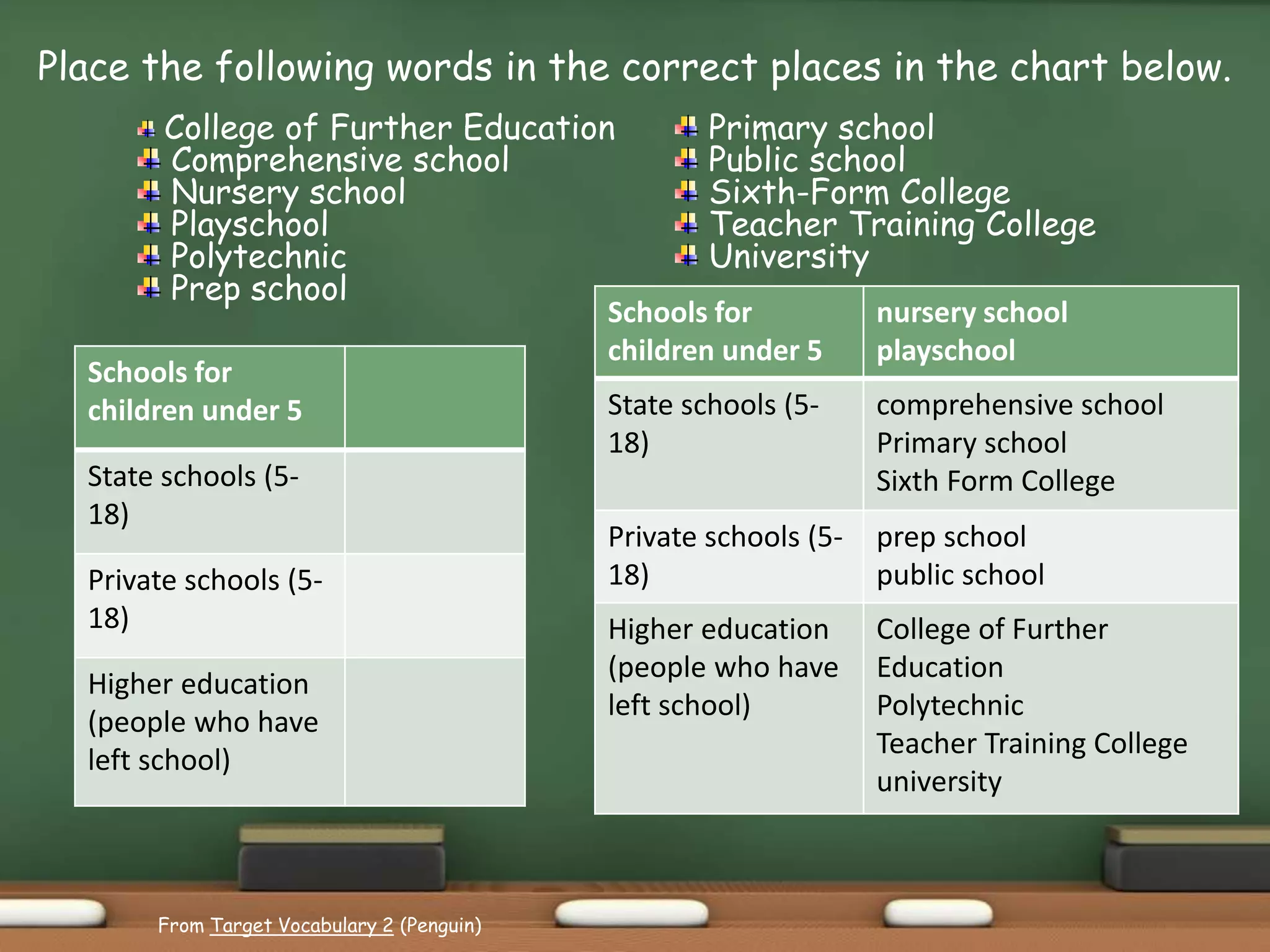
Schools for
children under 5
State schools (5-
18)
Private schools (5-
18)
Higher education
(people who have
left school)
College of Further Education
Comprehensive school
Nursery school
Playschool
Polytechnic
Prep school
Primary school
Public school
Sixth-Form College
Teacher Training College
University
Place the following words in the correct places in the chart below.
From Target Vocabulary 2 (Penguin)
Schools for
children under 5
nursery school
playschool
State schools (5-
18)
comprehensive school
Primary school
Sixth Form College
Private schools (5-
18)
prep school
public school
Higher education
(people who have
left school)
College of Further
Education
Polytechnic
Teacher Training College
university
PART 1
1) What do we learn about Philip Beadle in the
introduction?
2) Why isn’t it a good idea for teachers to duck down to
the school canteen and eat lunch with their students?
3) Why is it a good idea for teachers to duck down to the
school canteen and eat lunch with their students?
Interview with Philip Beadle.
PART 2
1) How many rules do they talk about?
2) What are they?
3) Why is it important for teachers to turn up?
4) What happens when higher achieving boys are
grouped with lower achieving girls?
5) And the reverse?
PART 3
1) What does Philip Beadle say about the teacher’s role
in the classroom?
2) What does he say about tolerance?
3) What are the value system of the community?
4) What is Philip Beadle’s opinion on school rules?
5) What ultimately determines the response of the
teacher to “challenging” behaviour?
How to teach: teaching tips for new teachers
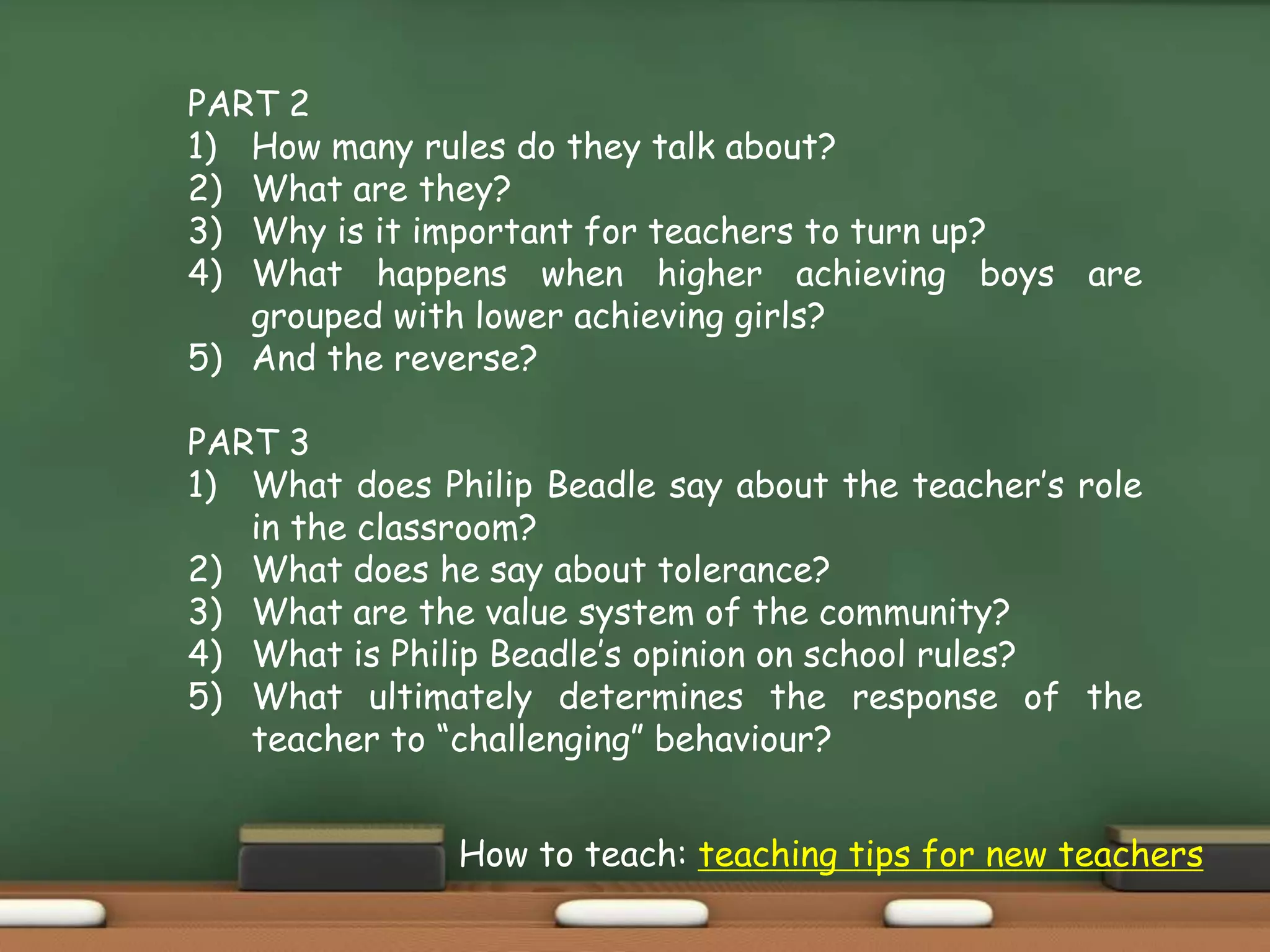
Find out all you can about …
… and be prepared to talk about
it next lesson!
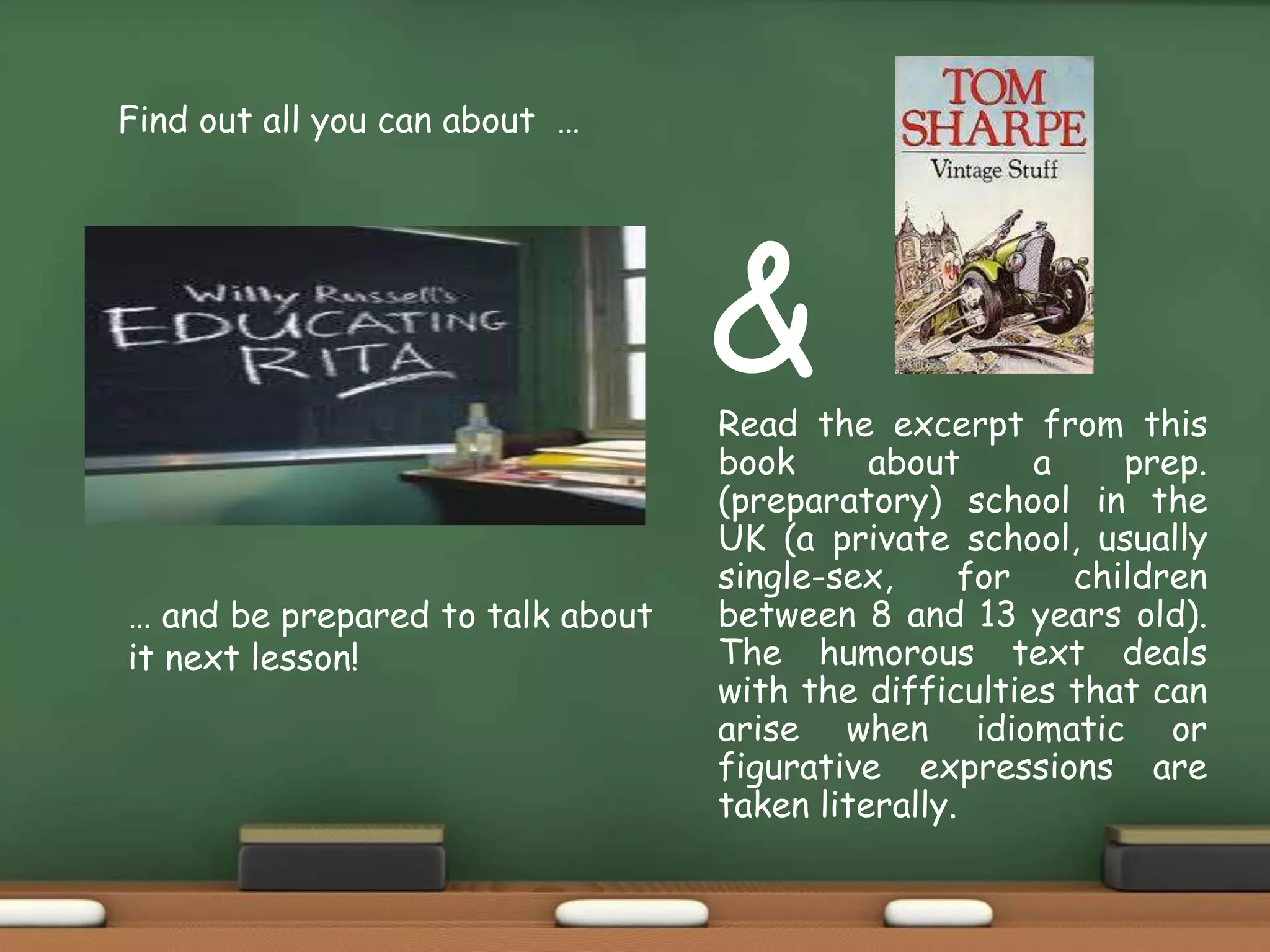
&Read the excerpt from this
book about a prep.
(preparatory) school in the
UK (a private school, usually
single-sex, for children
between 8 and 13 years old).
The humorous text deals
with the difficulties that can
arise when idiomatic or
figurative expressions are
taken literally.
Grammar antics
Consider these two sentences:
a) Whitaker did not like the woman standing in front of him at the
parade.
b) Whitaker did not like the woman’s standing in front of him at
the parade.
Which sentence means:
1) Whitaker did not like the woman who was standing in front of
him at the parade.
2) Whitaker did not like the fact that someone was standing in
front of him at the parade.
From Get it Write
 In colloquial usage the object forms (me, them, etc) are very
often used instead of possessive forms. Expressions such as If
you don’t mind me saying so are widespread; examination
candidates should, however, avoid them in their written work.

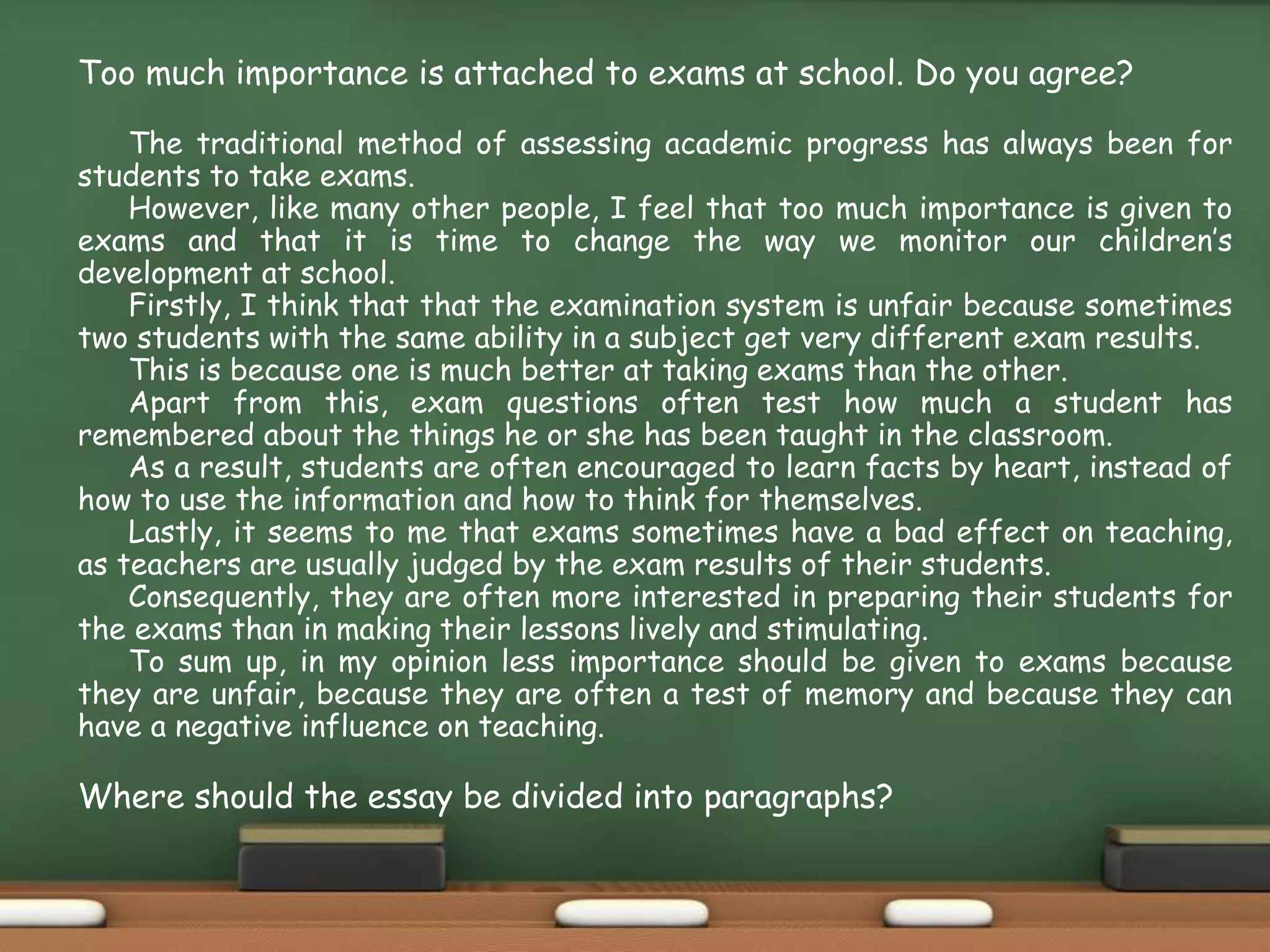
Too much importance is attached to exams at school. Do you agree?
The traditional method of assessing academic progress has always been for
students to take exams.
However, like many other people, I feel that too much importance is given to
exams and that it is time to change the way we monitor our children’s
development at school.
Firstly, I think that that the examination system is unfair because sometimes
two students with the same ability in a subject get very different exam results.
This is because one is much better at taking exams than the other.
Apart from this, exam questions often test how much a student has
remembered about the things he or she has been taught in the classroom.
As a result, students are often encouraged to learn facts by heart, instead of
how to use the information and how to think for themselves.
Lastly, it seems to me that exams sometimes have a bad effect on teaching,
as teachers are usually judged by the exam results of their students.
Consequently, they are often more interested in preparing their students for
the exams than in making their lessons lively and stimulating.
To sum up, in my opinion less importance should be given to exams because
they are unfair, because they are often a test of memory and because they can
have a negative influence on teaching.
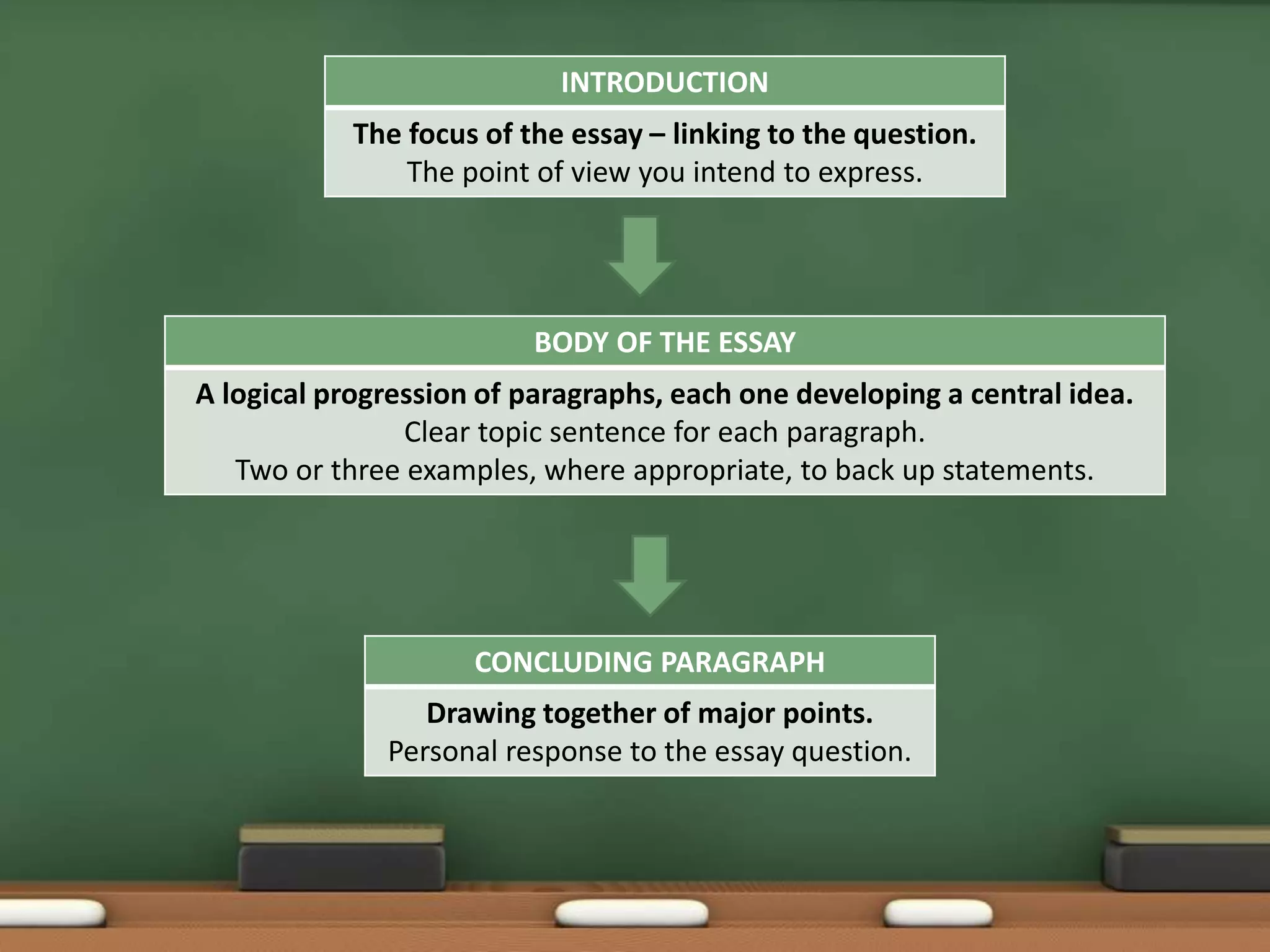
Where should the essay be divided into paragraphs?
INTRODUCTION
The focus of the essay – linking to the question.
The point of view you intend to express.
BODY OF THE ESSAY
A logical progression of paragraphs, each one developing a central idea.
Clear topic sentence for each paragraph.
Two or three examples, where appropriate, to back up statements.
CONCLUDING PARAGRAPH
Drawing together of major points.
Personal response to the essay question.
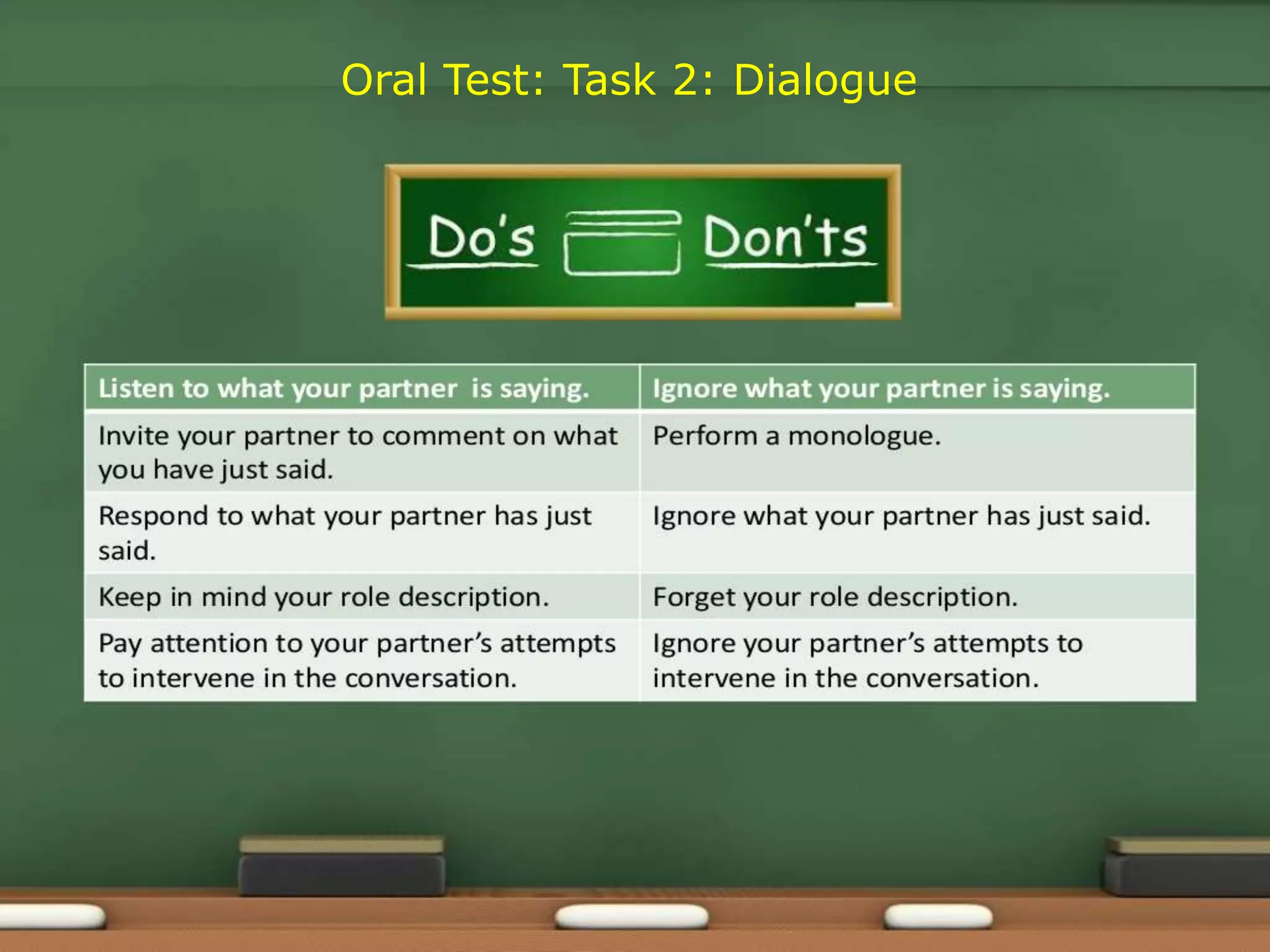
Oral Test: Task 2: Dialogue
Nina’s Cabbages
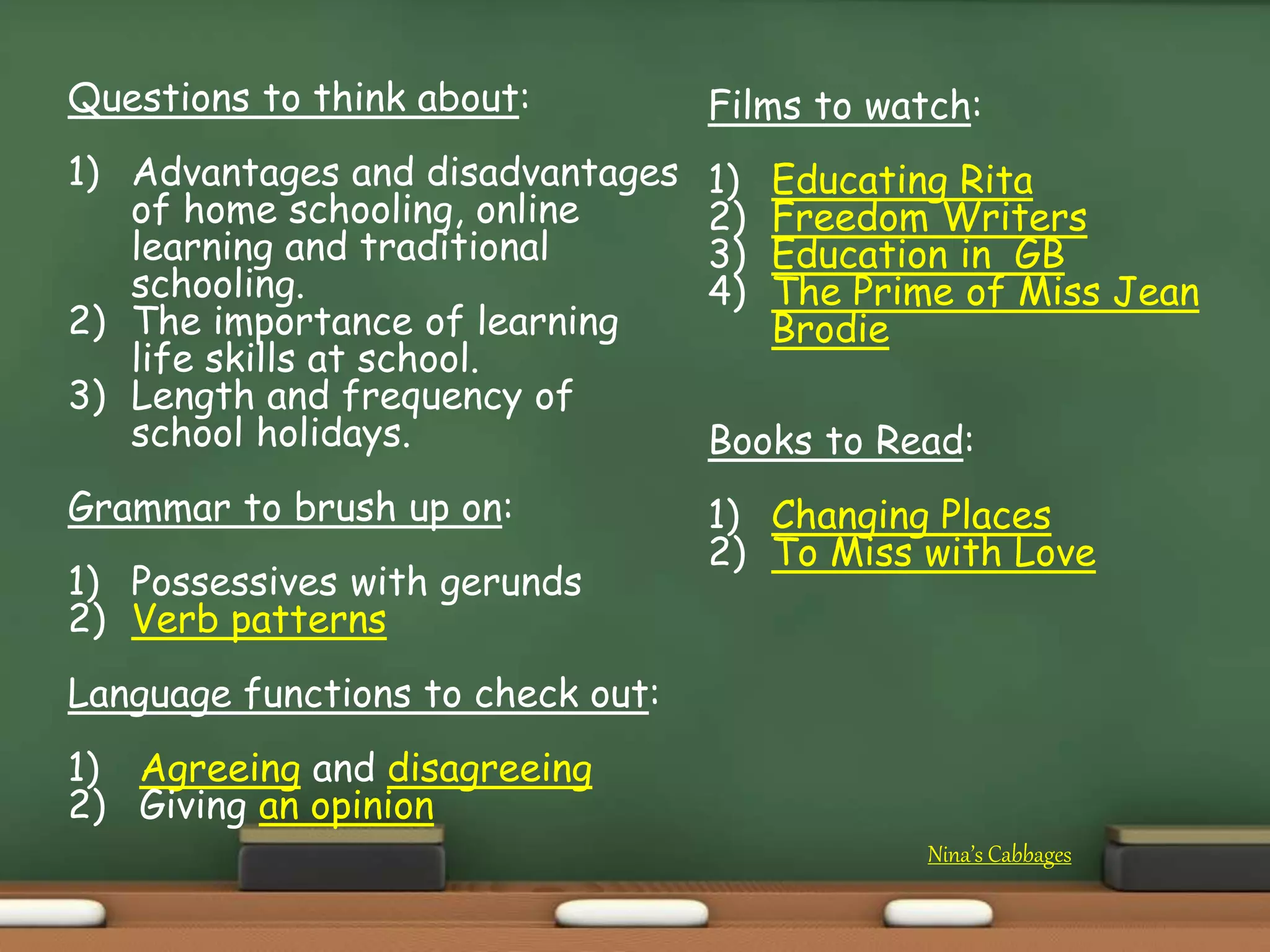
Questions to think about:
1) Advantages and disadvantages
of home schooling, online
learning and traditional
schooling.
2) The importance of learning
life skills at school.
3) Length and frequency of
school holidays.
Grammar to brush up on:
1) Possessives with gerunds
2) Verb patterns
Language functions to check out:
1) Agreeing and disagreeing
2) Giving an opinion
Films to watch:
1) Educating Rita
2) Freedom Writers
3) Education in GB
4) The Prime of Miss Jean
Brodie
Books to Read:
1) Changing Places
2) To Miss with Love

C1 Topic 2 Educating Rita

  • 1.
    Topic 2 EducatingRita The roots of education are bitter, but the fruit is sweet Nina Dearle By PresenterMedia.com
  • 2.
    VOCABULARY WORK English Vocabularyin Use Upper Intermediate: 43 Education English Vocabulary in Use Advanced: 11 Study and Academic Work 12 Education: Debates and Issues
  • 3.
    British schools andinstitutions Listen to the definitions and decide the school or institution which is being described boarding school coeducational school college of Further Education comprehensive school evening classes nursery school playschool polytechnic prep school primary school private school public school secondary school sixth-Form College state school teacher Training College the Open University university From Target Vocabulary 2 (Penguin Books)
  • 4.
    Schools for children under5 State schools (5- 18) Private schools (5- 18) Higher education (people who have left school) College of Further Education Comprehensive school Nursery school Playschool Polytechnic Prep school Primary school Public school Sixth-Form College Teacher Training College University Place the following words in the correct places in the chart below. From Target Vocabulary 2 (Penguin) Schools for children under 5 nursery school playschool State schools (5- 18) comprehensive school Primary school Sixth Form College Private schools (5- 18) prep school public school Higher education (people who have left school) College of Further Education Polytechnic Teacher Training College university
  • 5.
    PART 1 1) Whatdo we learn about Philip Beadle in the introduction? 2) Why isn’t it a good idea for teachers to duck down to the school canteen and eat lunch with their students? 3) Why is it a good idea for teachers to duck down to the school canteen and eat lunch with their students? Interview with Philip Beadle.
  • 6.
    PART 2 1) Howmany rules do they talk about? 2) What are they? 3) Why is it important for teachers to turn up? 4) What happens when higher achieving boys are grouped with lower achieving girls? 5) And the reverse? PART 3 1) What does Philip Beadle say about the teacher’s role in the classroom? 2) What does he say about tolerance? 3) What are the value system of the community? 4) What is Philip Beadle’s opinion on school rules? 5) What ultimately determines the response of the teacher to “challenging” behaviour? How to teach: teaching tips for new teachers
  • 7.
    Find out allyou can about … … and be prepared to talk about it next lesson! &Read the excerpt from this book about a prep. (preparatory) school in the UK (a private school, usually single-sex, for children between 8 and 13 years old). The humorous text deals with the difficulties that can arise when idiomatic or figurative expressions are taken literally.
  • 8.
    Grammar antics Consider thesetwo sentences: a) Whitaker did not like the woman standing in front of him at the parade. b) Whitaker did not like the woman’s standing in front of him at the parade. Which sentence means: 1) Whitaker did not like the woman who was standing in front of him at the parade. 2) Whitaker did not like the fact that someone was standing in front of him at the parade. From Get it Write  In colloquial usage the object forms (me, them, etc) are very often used instead of possessive forms. Expressions such as If you don’t mind me saying so are widespread; examination candidates should, however, avoid them in their written work. 
  • 9.
    Too much importanceis attached to exams at school. Do you agree? The traditional method of assessing academic progress has always been for students to take exams. However, like many other people, I feel that too much importance is given to exams and that it is time to change the way we monitor our children’s development at school. Firstly, I think that that the examination system is unfair because sometimes two students with the same ability in a subject get very different exam results. This is because one is much better at taking exams than the other. Apart from this, exam questions often test how much a student has remembered about the things he or she has been taught in the classroom. As a result, students are often encouraged to learn facts by heart, instead of how to use the information and how to think for themselves. Lastly, it seems to me that exams sometimes have a bad effect on teaching, as teachers are usually judged by the exam results of their students. Consequently, they are often more interested in preparing their students for the exams than in making their lessons lively and stimulating. To sum up, in my opinion less importance should be given to exams because they are unfair, because they are often a test of memory and because they can have a negative influence on teaching. Where should the essay be divided into paragraphs?
  • 10.
    INTRODUCTION The focus ofthe essay – linking to the question. The point of view you intend to express. BODY OF THE ESSAY A logical progression of paragraphs, each one developing a central idea. Clear topic sentence for each paragraph. Two or three examples, where appropriate, to back up statements. CONCLUDING PARAGRAPH Drawing together of major points. Personal response to the essay question.
  • 11.
    Oral Test: Task2: Dialogue
  • 12.
    Nina’s Cabbages Questions tothink about: 1) Advantages and disadvantages of home schooling, online learning and traditional schooling. 2) The importance of learning life skills at school. 3) Length and frequency of school holidays. Grammar to brush up on: 1) Possessives with gerunds 2) Verb patterns Language functions to check out: 1) Agreeing and disagreeing 2) Giving an opinion Films to watch: 1) Educating Rita 2) Freedom Writers 3) Education in GB 4) The Prime of Miss Jean Brodie Books to Read: 1) Changing Places 2) To Miss with Love

Editor's Notes

  • #4 (co-educational school) (co-educational school)