EDUCATION
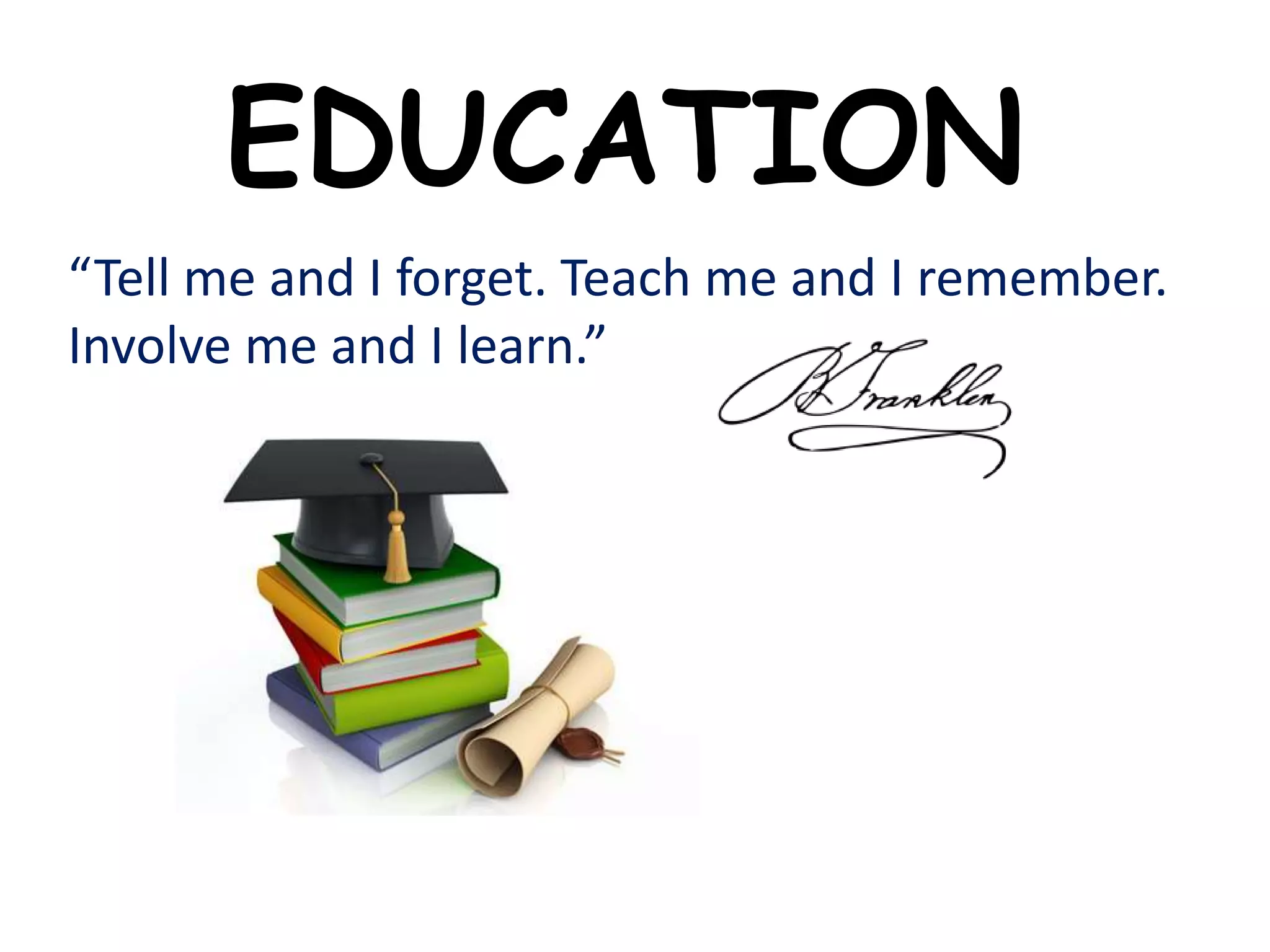
“Tell me and I forget. Teach me and I remember.
Involve me and I learn.”
It seems people have very different experiences of school. Some
find it good preparation for life, others find the exams difficult
and the subjects irrelevant.
Maths and English are the main subjects but it is also important
to study practical subjects like science and information
technology.
There can be a lot of homework and many pupils dislike the
discipline and the uniform.
But with a good teacher, lessons can be interesting and
educational. It
all depends on the people in the classroom.
Running dictation
It seems people have very different experiences of school.
Some find it good preparation for life, others find the exams
difficult and the subjects irrelevant.
Maths and English are the main subjects but it is also important
to study practical subjects like science and information
technology.
There can be a lot of homework and many pupils dislike the
discipline and the uniform.
But with a good teacher, lessons can be interesting and
educational. It all depends on the people in the classroom.
You’re likely to be asked questions about Education.
• You might have to talk about a class, a teacher or
a school memory.
• You might have to give your opinions on education
Read the following IELTS-style questions and
answers below and pay attention to the phrases
in bold.
Examiner: Are you studying English at a school?
Michel: Yes … I’m taking an intensive course at a
local private language school … I attend classes three
times a week …
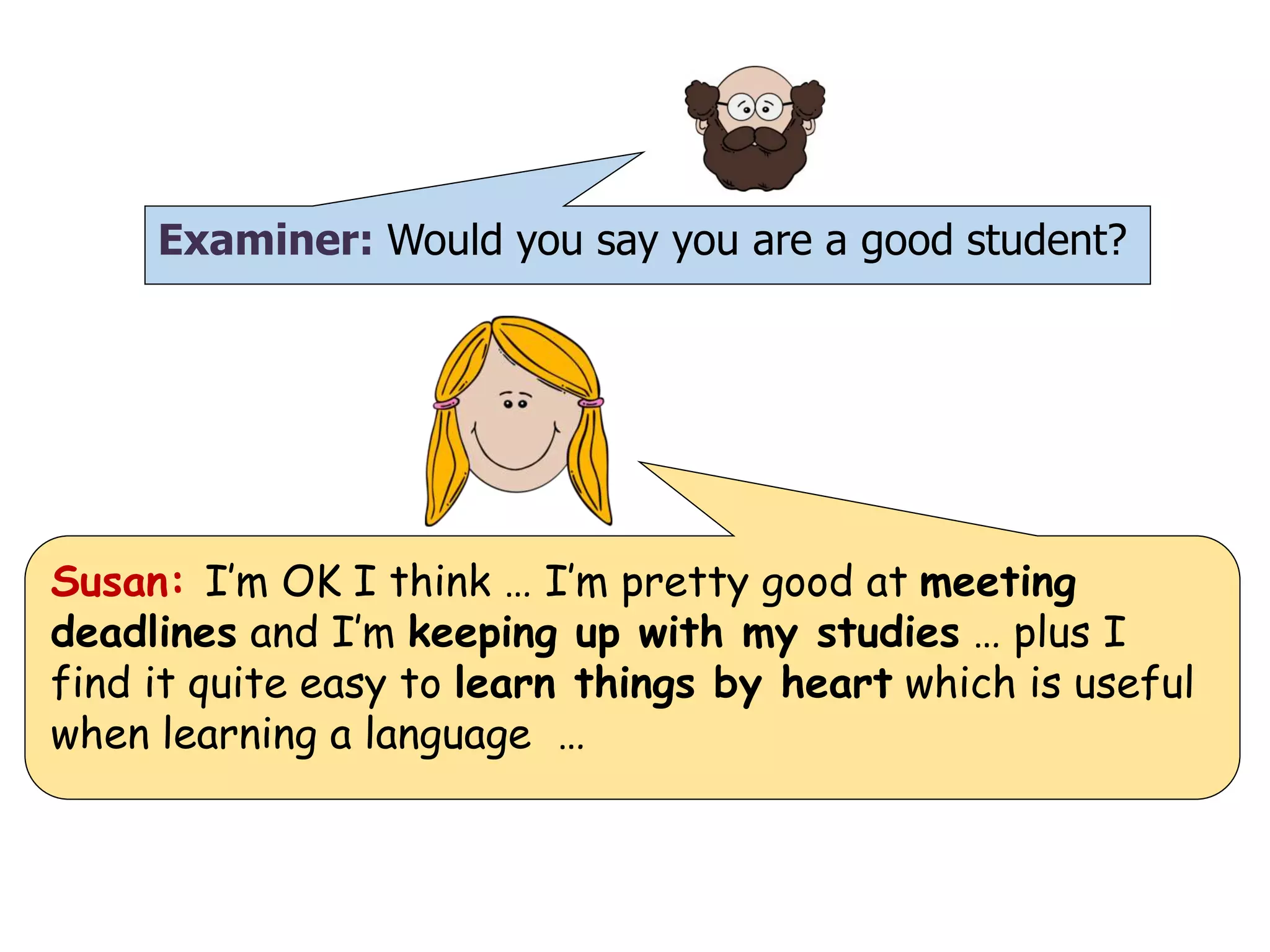
Examiner: Would you say you are a good student?
Susan: I’m OK I think … I’m pretty good at meeting
deadlines and I’m keeping up with my studies … plus I
find it quite easy to learn things by heart which is useful
when learning a language …
Linda: Yes … I liked school … it was an ordinary state
school … nothing special … a single-sex school …
which I’m not sure I liked … but the teachers were
great … I had lots of friends and I never played
truant like some pupils there …
Examiner: When you were younger did you enjoy your
time at school?
Examiner: Describe a time during your education that you really enjoyed. You
should say: when this period was, where you were and what you were studying
at the time. And say why you were so happy.
Mat: I’d like to tell you about my time at university … I was a mature
student … I didn’t go to university until I was 25 … I was doing a Bachelors
Degree and it was a bit of a challenge … some people take a year out but
I’d been away from education for 8 years … plus I had to work my way
through uni so I was very busy … and sitting exams at the end of each year
was a new experience for me as well but I really enjoyed higher
education learning about a subject I loved … history … and the social life
was great as well …
I had my graduation ceremony last year in the local cathedral and I know
my parents were really proud … so yes … that was a really happy time … I’m
thinking of doing a Masters Degree soon … though that might be
through distance learning as I have a full-time job now …
MONOLOGUES
Examiner: What are the advantages of studying on a
distance learning course?
Florrie: It’s a more flexible way of studying especially if you have a
job … tuition fees are usually cheaper … but you have to be very
motivated … and I would imagine more people fall behind with their
studies compared to face-to-face classes …
MONOLOGUES
Examiner: Do all children get equal opportunities in
education?
MONOLOGUES
Pierre: In my country I think it is quite equal but in
the UK I’ve heard that most people who go to the top
universities have studied at public schools … you have
to be very rich to study in a school like that …
they’re usually boarding schools as well so the fees
are enormous …
Now it’s your
turn!
In pairs, discuss the following
questions:
 What are your best memories about your school time?
 Do you know anyone who has decided to study when they
were older?
 Is there a proper age for studying? And learning?
 Look at some reasons why people don’t study when they are
young. Number them (1-4) in order of importance to you.
Lack of economic resources
Family commitments
Lack of time
Lack of motivation
Intermediate 2. Education

Intermediate 2. Education

  • 1.
    EDUCATION “Tell me andI forget. Teach me and I remember. Involve me and I learn.”
  • 2.
    It seems peoplehave very different experiences of school. Some find it good preparation for life, others find the exams difficult and the subjects irrelevant. Maths and English are the main subjects but it is also important to study practical subjects like science and information technology. There can be a lot of homework and many pupils dislike the discipline and the uniform. But with a good teacher, lessons can be interesting and educational. It all depends on the people in the classroom. Running dictation
  • 3.
    It seems peoplehave very different experiences of school. Some find it good preparation for life, others find the exams difficult and the subjects irrelevant. Maths and English are the main subjects but it is also important to study practical subjects like science and information technology. There can be a lot of homework and many pupils dislike the discipline and the uniform. But with a good teacher, lessons can be interesting and educational. It all depends on the people in the classroom.
  • 4.
    You’re likely tobe asked questions about Education. • You might have to talk about a class, a teacher or a school memory. • You might have to give your opinions on education Read the following IELTS-style questions and answers below and pay attention to the phrases in bold.
  • 5.
    Examiner: Are youstudying English at a school? Michel: Yes … I’m taking an intensive course at a local private language school … I attend classes three times a week …
  • 6.
    Examiner: Would yousay you are a good student? Susan: I’m OK I think … I’m pretty good at meeting deadlines and I’m keeping up with my studies … plus I find it quite easy to learn things by heart which is useful when learning a language …
  • 7.
    Linda: Yes …I liked school … it was an ordinary state school … nothing special … a single-sex school … which I’m not sure I liked … but the teachers were great … I had lots of friends and I never played truant like some pupils there … Examiner: When you were younger did you enjoy your time at school?
  • 8.
    Examiner: Describe atime during your education that you really enjoyed. You should say: when this period was, where you were and what you were studying at the time. And say why you were so happy. Mat: I’d like to tell you about my time at university … I was a mature student … I didn’t go to university until I was 25 … I was doing a Bachelors Degree and it was a bit of a challenge … some people take a year out but I’d been away from education for 8 years … plus I had to work my way through uni so I was very busy … and sitting exams at the end of each year was a new experience for me as well but I really enjoyed higher education learning about a subject I loved … history … and the social life was great as well … I had my graduation ceremony last year in the local cathedral and I know my parents were really proud … so yes … that was a really happy time … I’m thinking of doing a Masters Degree soon … though that might be through distance learning as I have a full-time job now … MONOLOGUES
  • 9.
    Examiner: What arethe advantages of studying on a distance learning course? Florrie: It’s a more flexible way of studying especially if you have a job … tuition fees are usually cheaper … but you have to be very motivated … and I would imagine more people fall behind with their studies compared to face-to-face classes … MONOLOGUES
  • 10.
    Examiner: Do allchildren get equal opportunities in education? MONOLOGUES Pierre: In my country I think it is quite equal but in the UK I’ve heard that most people who go to the top universities have studied at public schools … you have to be very rich to study in a school like that … they’re usually boarding schools as well so the fees are enormous …
  • 11.
    Now it’s your turn! Inpairs, discuss the following questions:
  • 12.
     What areyour best memories about your school time?  Do you know anyone who has decided to study when they were older?  Is there a proper age for studying? And learning?  Look at some reasons why people don’t study when they are young. Number them (1-4) in order of importance to you. Lack of economic resources Family commitments Lack of time Lack of motivation