Hemali Rangoliya
01 | What is Data Breach & Data Loss ?
02 | Common Causes of Data Loss
03 | Effects of Data Loss on Businesses
04 | Prevention & Privacy Legislation Worldwide
04 | Mind-Boggling Statistics & Facts
Overview
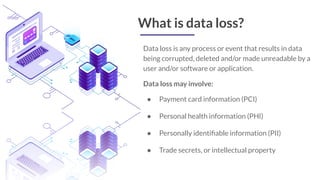
What is data loss?
Data loss is any process or event that results in data
being corrupted, deleted and/or made unreadable by a
user and/or software or application.
Data loss may involve:
● Payment card information (PCI)
● Personal health information (PHI)
● Personally identifiable information (PII)
● Trade secrets, or intellectual property
What is data breach?
A data breach comes as a result of a cyberattack that
allows cybercriminals to gain unauthorized access to a
computer system or network and steal the private,
sensitive, or confidential personal and financial data of
the customers or users contained within
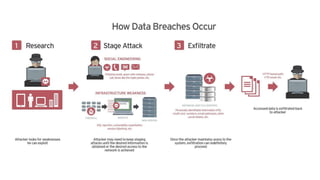
Phases of a Data Breach :
● Research
● Attack
● Exfiltrate
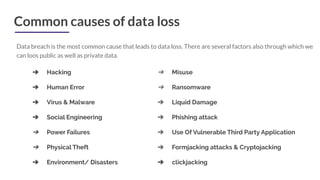
Common causes of data loss
Data breach is the most common cause that leads to data loss. There are several factors also through which we
can loos public as well as private data.
➔ Hacking
➔ Human Error
➔ Virus & Malware
➔ Social Engineering
➔ Power Failures
➔ Physical Theft
➔ Environment/ Disasters
➔ Misuse
➔ Ransomware
➔ Liquid Damage
➔ Phishing attack
➔ Use Of Vulnerable Third Party Application
➔ Formjacking attacks & Cryptojacking
➔ clickjacking
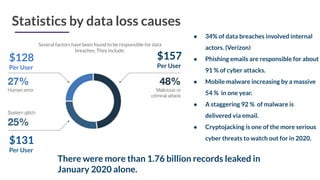
Statistics by data loss causes
Several factors have been found to be responsible for data
breaches. They include:
$157
Per User
$131
Per User
$128
Per User
There were more than 1.76 billion records leaked in
January 2020 alone.
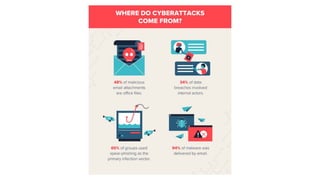
● 34% of data breaches involved internal
actors. (Verizon)
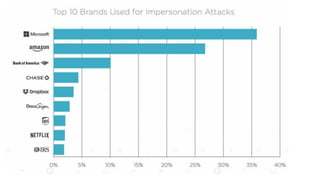
● Phishing emails are responsible for about
91 % of cyber attacks.
● Mobile malware increasing by a massive
54 % in one year.
● A staggering 92 % of malware is
delivered via email.
● Cryptojacking is one of the more serious
cyber threats to watch out for in 2020.
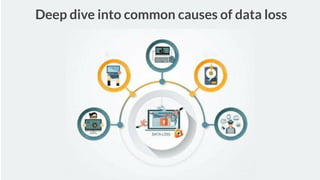
Deep Dive into 4 Common Causes
Deep dive into common causes of data loss
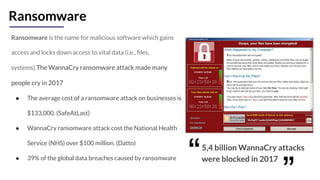
Ransomware
Ransomware is the name for malicious software which gains
access and locks down access to vital data (i.e., files,
systems).The WannaCry ransomware attack made many
people cry in 2017
● The average cost of a ransomware attack on businesses is
$133,000. (SafeAtLast)
● WannaCry ransomware attack cost the National Health
Service (NHS) over $100 million. (Datto)
● 39% of the global data breaches caused by ransomware
5,4 billion WannaCry attacks
were blocked in 2017“
“
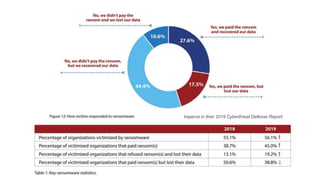
Imperva in their 2019 Cyberthreat Defense Report.
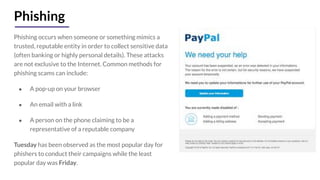
Phishing
Phishing occurs when someone or something mimics a
trusted, reputable entity in order to collect sensitive data
(often banking or highly personal details). These attacks
are not exclusive to the Internet. Common methods for
phishing scams can include:
● A pop-up on your browser
● An email with a link
● A person on the phone claiming to be a
representative of a reputable company
Tuesday has been observed as the most popular day for
phishers to conduct their campaigns while the least
popular day was Friday.
Denial-of-Service (DoS)
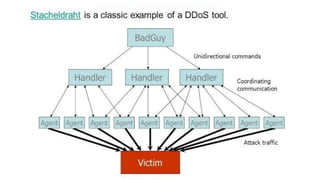
DoS breach essentially takes away access to
websites and webpages. When this happens at large
scale, it’s known as a distributed denial-of-service
(DDoS)
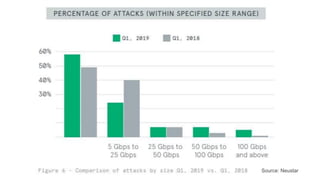
● The cost of a DDoS attack averages between
$20,000-$40,000 per hour.
● The average size of DDoS attacks was at the
mindblowing 26.37 GBps in Q2 2018.
● The longest attack in 2018 lasted 329 hours nearly 2
weeks
● The majority of DDoS attacks are launched from(over 4.5
million in 2018)
Source: Neustar
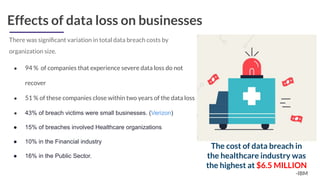
Effects of data loss on businesses
There was significant variation in total data breach costs by
organization size.
● 94 % of companies that experience severe data loss do not
recover
● 51 % of these companies close within two years of the data loss
● 43% of breach victims were small businesses. (Verizon)
● 15% of breaches involved Healthcare organizations
● 10% in the Financial industry
● 16% in the Public Sector.
The cost of data breach in
the healthcare industry was
the highest at $6.5 MILLION
-IBM
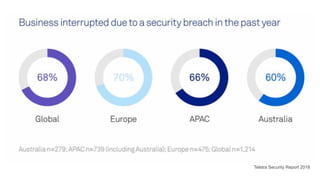
Telstra Security Report 2018
Data Loss Prevention &
Privacy Legislation Worldwide
What is data loss prevention
Data loss prevention (DLP) technology aims to identify,
monitor and protect your data, both in storage or in motion
through network, from misuse/theft/ransomware/leakage.
How to prevent your data?
● Backup
● Use of anti-virus software
● Complying network policies like principle of least privilege (POLP)
● Adhering to data protection Certification such as PCI DSS, HIPPA, Cloud Security Alliance, FEDRAMP,
HITRUST, ISO 27001/2/17/18, SOC ⅔, Privacy Shield Framework, US-EU Safe Harbor Privacy Framework
Privacy Legislation Worldwide
● US includes California Consumer Privacy Act (CCPA)
● Brazil’s Lei Geral de Proteção de Dados (LGPD)
● Thailand’s Personal Data Protection Act (PDPA).
● European Union’s General Data Protection Regulation (GDPR)
● Switzerland's Federal Act
● India’s The Information Technology Act
● South Africa's Electronic Communications and Transactions Act
● New Zealand's Privacy Act of 1993
As 2018 was the year
of the GDPR, 2020
will be the year of the
CCPA. Its
enforcement is likely
to set an example for
other US states and
may serve as a
secondary blueprint
for international data
protection legislation
looking for an
alternative to the
strict model of the
GDPR.
“
“
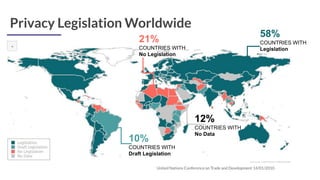
Privacy Legislation Worldwide
58%
COUNTRIES WITH
Legislation
10%
COUNTRIES WITH
Draft Legislation
21%
COUNTRIES WITH
No Legislation
12%
COUNTRIES WITH
No Data
United Nations Conference on Trade and Development 14/01/2010
Mind-Boggling Statistics & Facts
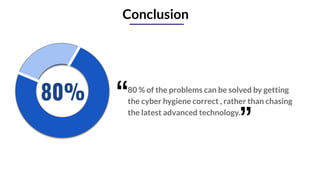
80 % of the problems can be solved by getting
the cyber hygiene correct , rather than chasing
the latest advanced technology.
“
“
Conclusion
80%

DATA BREACH & PREVENTION - Hemali Rangoliya

  • 1.
  • 3.
    01 | Whatis Data Breach & Data Loss ? 02 | Common Causes of Data Loss 03 | Effects of Data Loss on Businesses 04 | Prevention & Privacy Legislation Worldwide 04 | Mind-Boggling Statistics & Facts Overview
  • 4.
    What is dataloss? Data loss is any process or event that results in data being corrupted, deleted and/or made unreadable by a user and/or software or application. Data loss may involve: ● Payment card information (PCI) ● Personal health information (PHI) ● Personally identifiable information (PII) ● Trade secrets, or intellectual property
  • 5.
    What is databreach? A data breach comes as a result of a cyberattack that allows cybercriminals to gain unauthorized access to a computer system or network and steal the private, sensitive, or confidential personal and financial data of the customers or users contained within Phases of a Data Breach : ● Research ● Attack ● Exfiltrate
  • 7.
    Common causes ofdata loss Data breach is the most common cause that leads to data loss. There are several factors also through which we can loos public as well as private data. ➔ Hacking ➔ Human Error ➔ Virus & Malware ➔ Social Engineering ➔ Power Failures ➔ Physical Theft ➔ Environment/ Disasters ➔ Misuse ➔ Ransomware ➔ Liquid Damage ➔ Phishing attack ➔ Use Of Vulnerable Third Party Application ➔ Formjacking attacks & Cryptojacking ➔ clickjacking
  • 8.
    Statistics by dataloss causes Several factors have been found to be responsible for data breaches. They include: $157 Per User $131 Per User $128 Per User There were more than 1.76 billion records leaked in January 2020 alone. ● 34% of data breaches involved internal actors. (Verizon) ● Phishing emails are responsible for about 91 % of cyber attacks. ● Mobile malware increasing by a massive 54 % in one year. ● A staggering 92 % of malware is delivered via email. ● Cryptojacking is one of the more serious cyber threats to watch out for in 2020.
  • 9.
    Deep Dive into4 Common Causes Deep dive into common causes of data loss
  • 10.
    Ransomware Ransomware is thename for malicious software which gains access and locks down access to vital data (i.e., files, systems).The WannaCry ransomware attack made many people cry in 2017 ● The average cost of a ransomware attack on businesses is $133,000. (SafeAtLast) ● WannaCry ransomware attack cost the National Health Service (NHS) over $100 million. (Datto) ● 39% of the global data breaches caused by ransomware 5,4 billion WannaCry attacks were blocked in 2017“ “
  • 11.
    Imperva in their2019 Cyberthreat Defense Report.
  • 12.
    Phishing Phishing occurs whensomeone or something mimics a trusted, reputable entity in order to collect sensitive data (often banking or highly personal details). These attacks are not exclusive to the Internet. Common methods for phishing scams can include: ● A pop-up on your browser ● An email with a link ● A person on the phone claiming to be a representative of a reputable company Tuesday has been observed as the most popular day for phishers to conduct their campaigns while the least popular day was Friday.
  • 14.
    Denial-of-Service (DoS) DoS breachessentially takes away access to websites and webpages. When this happens at large scale, it’s known as a distributed denial-of-service (DDoS) ● The cost of a DDoS attack averages between $20,000-$40,000 per hour. ● The average size of DDoS attacks was at the mindblowing 26.37 GBps in Q2 2018. ● The longest attack in 2018 lasted 329 hours nearly 2 weeks ● The majority of DDoS attacks are launched from(over 4.5 million in 2018)
  • 16.
  • 17.
    Effects of dataloss on businesses There was significant variation in total data breach costs by organization size. ● 94 % of companies that experience severe data loss do not recover ● 51 % of these companies close within two years of the data loss ● 43% of breach victims were small businesses. (Verizon) ● 15% of breaches involved Healthcare organizations ● 10% in the Financial industry ● 16% in the Public Sector. The cost of data breach in the healthcare industry was the highest at $6.5 MILLION -IBM
  • 18.
  • 20.
    Data Loss Prevention& Privacy Legislation Worldwide
  • 21.
    What is dataloss prevention Data loss prevention (DLP) technology aims to identify, monitor and protect your data, both in storage or in motion through network, from misuse/theft/ransomware/leakage. How to prevent your data? ● Backup ● Use of anti-virus software ● Complying network policies like principle of least privilege (POLP) ● Adhering to data protection Certification such as PCI DSS, HIPPA, Cloud Security Alliance, FEDRAMP, HITRUST, ISO 27001/2/17/18, SOC ⅔, Privacy Shield Framework, US-EU Safe Harbor Privacy Framework
  • 22.
    Privacy Legislation Worldwide ●US includes California Consumer Privacy Act (CCPA) ● Brazil’s Lei Geral de Proteção de Dados (LGPD) ● Thailand’s Personal Data Protection Act (PDPA). ● European Union’s General Data Protection Regulation (GDPR) ● Switzerland's Federal Act ● India’s The Information Technology Act ● South Africa's Electronic Communications and Transactions Act ● New Zealand's Privacy Act of 1993 As 2018 was the year of the GDPR, 2020 will be the year of the CCPA. Its enforcement is likely to set an example for other US states and may serve as a secondary blueprint for international data protection legislation looking for an alternative to the strict model of the GDPR. “ “
  • 23.
    Privacy Legislation Worldwide 58% COUNTRIESWITH Legislation 10% COUNTRIES WITH Draft Legislation 21% COUNTRIES WITH No Legislation 12% COUNTRIES WITH No Data United Nations Conference on Trade and Development 14/01/2010
  • 24.
  • 33.
    80 % ofthe problems can be solved by getting the cyber hygiene correct , rather than chasing the latest advanced technology. “ “ Conclusion 80%