Research Title
Proposals
Place your screenshot here
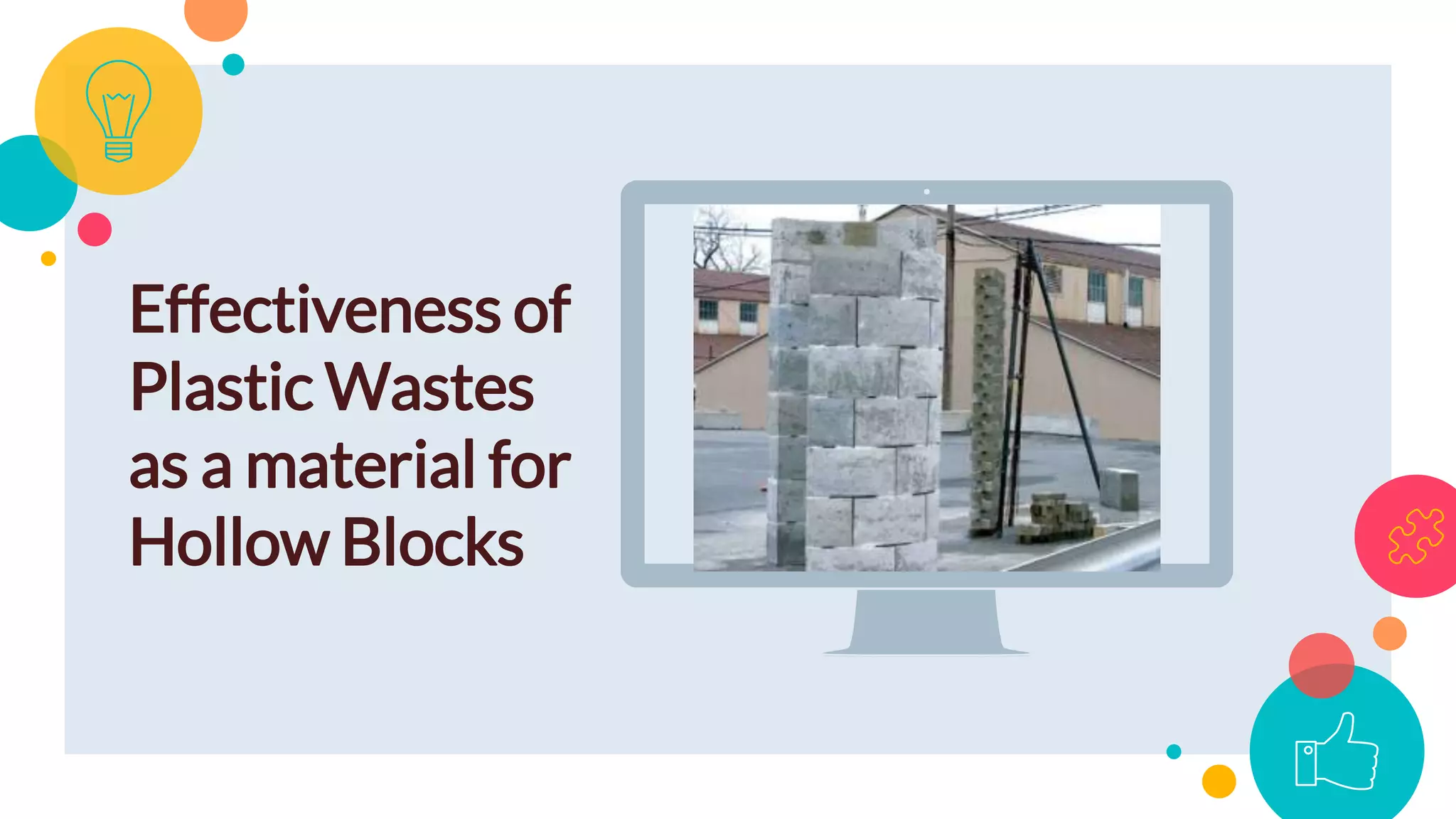
Effectiveness of
Plastic Wastes
as a material for
Hollow Blocks
Statement
of the
Problem
1. Is the use of plastic waste materials an effective
ingredient in enhancing the strength and durability of
hollowblocks?
2. Rampant and abundant throwing of plastic wastes is
one of the biggest problems of the country
3. According to a statistics in 2010, there are already
265 million tons of plastics produced having an
increasing rate of 5% in the past 20 years.
Objectives
1. To cite the advantages and disadvantages of hollow
blocks made out of plastic waste materials
2. To determine if plastics are suitable in making
construction material.
3. To determine the characteristics of concrete with
plastics additives.
4. To implement and develop alternative eco-friendly
hollowblocks for construction
Materials
•Sand
•cement
•plastic wastes
•Cement molder
•Shredder machine
For experimentation:
We will need
-heat from fires
-flowing water (with
increased pressure
Methodology
Methodology
Building the hollow
blocks:
●Shred the plastics
●mix jt in the mixture.
● put it in the molder.
● remove it from the
mold let it dry from 14
to 21 days
Experimentation:
Checking for the
following factors:
1. Resistance to heat
2. Resistance to
different water
pressure
3. Durability and
strength
Respondents
NONE
Bibliography
Ashaboglu S. (2016, August 1).Building Blocks Made from Waste Plastic.
Retrieved from
http://www.ecobuildingpulse.com/products/building-blocks-made-
from-waste-plastic_s
Corpuz A. (2015, March 15). Making Hollow Block with Shredded
Plastic. Retrieved from https://prezi.com/ftuh3yuxesc7/making-
hollow-block-with-shredded-plastic/
Farmer T. (September 21, 2009). Plastic Concrete: Building Bricks Made
From Landfill Waste. Retrieved from http://inhabitat.com/plastic-
concrete-repurposes-landfill-waste-into-building-bricks/
GMA news. (2008, July 14). Mandaluyong to pulverize plastic waste to
make cement block. Retrievd from
http://www.gmanetwork.com/news/news/nation/106844/mandaluy
ong-to-pulverize-plastic-waste-to-make-cement-blocks/story/
Manga K. A. (reposted article from Bato Balani Magazine). (2012,
June 8). Hollow Blocks from Plastic. Retrieved from
http://keniaamormanga-saveearth.blogspot.com/2012/06/hollow-
blocks-from-plastic.html
Correlation of CCB’s
Building Structures to SHS
Students’ Academic
Performances
Statement of
the problem
1. Does the following qualities of a building affects the
student's performance in terms of
a. Size
b. Capacity
c. Indoor air quality
d. Interior design
e. Temperature and humidity
f. Lighting
g. Acoustics
h. Building age and aesthetics
2. At what school facility do the SHS students perform the
best?
3. What building qualities is required for the betterment of
SHS student’s academic performance
Objectives
1. To explore the relationship between student
performance and the physical condition of school
buildings structure and specific classrooms in
Columban College-Barretto.
2. For this to serve as a reference for the future
improvement and better building of facilities and
structures inside the campus.
3. To conduct further studies to prove and
strengthen the existing theories about the
correlation of building structures to students
academic performance
4. Know the qualities of a facility where students
excel the best in their performances
Materials
○ Survey questionnaires and forms
○ Different Facilities inside Columban
College Barretto
○ Summary report of the written
outputs and activities of students in
different school facilities
○ Laptop
Methodology
1. Conduct survey regarding on the performance of
SHS students in different school facilities.
2. Know the qualities of a facility where students
excel the best in their performances based on
their answered survey forms.
3. Interviews will be carry out with the students to
find out how the design, and different characteristics
of each structure affect their performance.
Methodology
●Data Collection Procedure:
1. Both qualitative and quantitative type of research
is to be considered in the data analysis of the
correlation of different structures of building to
Senior High Students’ Performance.
2. The data from the survey form will be sort out and
clustered according to the facilities preferred by
the students
Respondents
Columban College-
Barretto Senior High
School Students
Bibliography
●Ariani, M.& Mirdad F. (2015, December 29). The Effect of School Design on Student
Performance . Retrieved August 07, 2017, from
http://files.eric.ed.gov/fulltext/EJ1086689.pdf
●Lewinski, P. (2015). Effects of classrooms’ architecture on academic performance in view of telic
versus paratelic motivation: a review. Retrieved from
https://www.ncbi.nlm.nih.gov/pmc/articles/PMC4453269/
●(n.d.). Relating Building and Classroom Conditions with Student Achievement in Virginia’s
Elementary Schools. Retrieved August 07, 2017, from
https://theses.lib.vt.edu/theses/available/etd-041899-
150623/unrestricted/MainTextp1to148.pdf
●(n.d.). Retrieved August 07, 2017, from https://sites.psu.edu/ceepa/2015/06/07/the-
importance-of-school-facilities-in-improving-student-outcomes/
● Schneider, M. (2002, November). Do School Facilities Affect Academic Outcomes. Retrieved
August 07, 2017, from http://www.ncef.org/pubs/outcomes.pdf
Effectiveness of Plastic
Wastes as an added
material for Floor Tiles
Statement of
the Problem
● Does floor tiles made out of plastics are an
effective alternative to ceramic tiles?
● Is the use of plastic waste materials an
effective ingredient in enhancing the
strength and durability of floor tiles?
● Is the composite floor tiles an effective
waste reduction management solution?
.
Objectives
● To mitigate the adverse effect of non –
biodegradable plastic products to the
environment.
● To produce an alternative product that is
affordable, durable, cheaper than in
ceramic tiles.
● To determine if plastic sachet/ bottle are
suitable for tiles making.
● To test the durability and resistance of the
composite tile.
20
Materials
● Plastic sachet/
bottles
● weighing scale
● Hydraulic Hot
Press
● Metal Stab
● Measuring Cylinder
● Hand Towel
● Sieve
● Hand Glove
● Wood Stirrer
● Coal Pot
● Mouth Mask
● Scissors
● Razors Knives
21
Methodology
● Collection of raw materials
● Sorting washing & shredding process
● Collection of sun- dried saw dust and sieving
operation
● Melting of the shredded plastics and curing
process
● Laboratory tests on the composite testing
Water absorption
Crushing test
Frictional coefficient test
Flammability test ( composite, conventional testing)
22
Respondents
NONE
23
Bibliography
● Ak,T. & Oo,A..Et. al( 2015, August 30) A Pilot Recycling of Plastic Pure Water
Sachets/ Bottles into Composite Floor Tiles: A Case Study from Selected
Dumping Site in Ogbomoso. J Material. Retrieve from
http://www.omicsgroup.org/journals/a-pilot-recycling-ofplastic-pure-
water-sachetsbottles-into-compositefloor-tiles-a-case-study-from-
selected-dumping-site-in-ogbomoso-2169-0022-10000201.php?aid=61784
● Hazzan EB. (2003) A Study of Plastic Moulding Techniques in Oyo State.
Ladoke Akintola university of Technology, Ogbomoso,Oyo State.
● Abota CA (2012) Recycling of Plastic Wastes in Ghana; A way to reduce
environmental problems/pollutions. University of Ghana, Accra, Ghana.
● Hopewell J , Dvorak R, Kosior E (2009) Plastics recycling; Challenges and
opportunities. Phil trans R Soc B 364;2115-2126.
● (2013). American Chemistry Council Life Cycle of a Plastic Product.
Researchers:
25
Monica C. Quillas
Madeline Sunga
Shaina Mae D. Jimenez
Jerchelle P. Barbero

Research title defense

  • 1.
  • 2.
    Place your screenshothere Effectiveness of Plastic Wastes as a material for Hollow Blocks
  • 3.
    Statement of the Problem 1. Isthe use of plastic waste materials an effective ingredient in enhancing the strength and durability of hollowblocks? 2. Rampant and abundant throwing of plastic wastes is one of the biggest problems of the country 3. According to a statistics in 2010, there are already 265 million tons of plastics produced having an increasing rate of 5% in the past 20 years.
  • 4.
    Objectives 1. To citethe advantages and disadvantages of hollow blocks made out of plastic waste materials 2. To determine if plastics are suitable in making construction material. 3. To determine the characteristics of concrete with plastics additives. 4. To implement and develop alternative eco-friendly hollowblocks for construction
  • 5.
    Materials •Sand •cement •plastic wastes •Cement molder •Shreddermachine For experimentation: We will need -heat from fires -flowing water (with increased pressure
  • 6.
  • 7.
    Methodology Building the hollow blocks: ●Shredthe plastics ●mix jt in the mixture. ● put it in the molder. ● remove it from the mold let it dry from 14 to 21 days Experimentation: Checking for the following factors: 1. Resistance to heat 2. Resistance to different water pressure 3. Durability and strength
  • 8.
  • 9.
    Bibliography Ashaboglu S. (2016,August 1).Building Blocks Made from Waste Plastic. Retrieved from http://www.ecobuildingpulse.com/products/building-blocks-made- from-waste-plastic_s Corpuz A. (2015, March 15). Making Hollow Block with Shredded Plastic. Retrieved from https://prezi.com/ftuh3yuxesc7/making- hollow-block-with-shredded-plastic/ Farmer T. (September 21, 2009). Plastic Concrete: Building Bricks Made From Landfill Waste. Retrieved from http://inhabitat.com/plastic- concrete-repurposes-landfill-waste-into-building-bricks/ GMA news. (2008, July 14). Mandaluyong to pulverize plastic waste to make cement block. Retrievd from http://www.gmanetwork.com/news/news/nation/106844/mandaluy ong-to-pulverize-plastic-waste-to-make-cement-blocks/story/ Manga K. A. (reposted article from Bato Balani Magazine). (2012, June 8). Hollow Blocks from Plastic. Retrieved from http://keniaamormanga-saveearth.blogspot.com/2012/06/hollow- blocks-from-plastic.html
  • 10.
    Correlation of CCB’s BuildingStructures to SHS Students’ Academic Performances
  • 11.
    Statement of the problem 1.Does the following qualities of a building affects the student's performance in terms of a. Size b. Capacity c. Indoor air quality d. Interior design e. Temperature and humidity f. Lighting g. Acoustics h. Building age and aesthetics 2. At what school facility do the SHS students perform the best? 3. What building qualities is required for the betterment of SHS student’s academic performance
  • 12.
    Objectives 1. To explorethe relationship between student performance and the physical condition of school buildings structure and specific classrooms in Columban College-Barretto. 2. For this to serve as a reference for the future improvement and better building of facilities and structures inside the campus. 3. To conduct further studies to prove and strengthen the existing theories about the correlation of building structures to students academic performance 4. Know the qualities of a facility where students excel the best in their performances
  • 13.
    Materials ○ Survey questionnairesand forms ○ Different Facilities inside Columban College Barretto ○ Summary report of the written outputs and activities of students in different school facilities ○ Laptop
  • 14.
    Methodology 1. Conduct surveyregarding on the performance of SHS students in different school facilities. 2. Know the qualities of a facility where students excel the best in their performances based on their answered survey forms. 3. Interviews will be carry out with the students to find out how the design, and different characteristics of each structure affect their performance.
  • 15.
    Methodology ●Data Collection Procedure: 1.Both qualitative and quantitative type of research is to be considered in the data analysis of the correlation of different structures of building to Senior High Students’ Performance. 2. The data from the survey form will be sort out and clustered according to the facilities preferred by the students
  • 16.
  • 17.
    Bibliography ●Ariani, M.& MirdadF. (2015, December 29). The Effect of School Design on Student Performance . Retrieved August 07, 2017, from http://files.eric.ed.gov/fulltext/EJ1086689.pdf ●Lewinski, P. (2015). Effects of classrooms’ architecture on academic performance in view of telic versus paratelic motivation: a review. Retrieved from https://www.ncbi.nlm.nih.gov/pmc/articles/PMC4453269/ ●(n.d.). Relating Building and Classroom Conditions with Student Achievement in Virginia’s Elementary Schools. Retrieved August 07, 2017, from https://theses.lib.vt.edu/theses/available/etd-041899- 150623/unrestricted/MainTextp1to148.pdf ●(n.d.). Retrieved August 07, 2017, from https://sites.psu.edu/ceepa/2015/06/07/the- importance-of-school-facilities-in-improving-student-outcomes/ ● Schneider, M. (2002, November). Do School Facilities Affect Academic Outcomes. Retrieved August 07, 2017, from http://www.ncef.org/pubs/outcomes.pdf
  • 18.
    Effectiveness of Plastic Wastesas an added material for Floor Tiles
  • 19.
    Statement of the Problem ●Does floor tiles made out of plastics are an effective alternative to ceramic tiles? ● Is the use of plastic waste materials an effective ingredient in enhancing the strength and durability of floor tiles? ● Is the composite floor tiles an effective waste reduction management solution? .
  • 20.
    Objectives ● To mitigatethe adverse effect of non – biodegradable plastic products to the environment. ● To produce an alternative product that is affordable, durable, cheaper than in ceramic tiles. ● To determine if plastic sachet/ bottle are suitable for tiles making. ● To test the durability and resistance of the composite tile. 20
  • 21.
    Materials ● Plastic sachet/ bottles ●weighing scale ● Hydraulic Hot Press ● Metal Stab ● Measuring Cylinder ● Hand Towel ● Sieve ● Hand Glove ● Wood Stirrer ● Coal Pot ● Mouth Mask ● Scissors ● Razors Knives 21
  • 22.
    Methodology ● Collection ofraw materials ● Sorting washing & shredding process ● Collection of sun- dried saw dust and sieving operation ● Melting of the shredded plastics and curing process ● Laboratory tests on the composite testing Water absorption Crushing test Frictional coefficient test Flammability test ( composite, conventional testing) 22
  • 23.
  • 24.
    Bibliography ● Ak,T. &Oo,A..Et. al( 2015, August 30) A Pilot Recycling of Plastic Pure Water Sachets/ Bottles into Composite Floor Tiles: A Case Study from Selected Dumping Site in Ogbomoso. J Material. Retrieve from http://www.omicsgroup.org/journals/a-pilot-recycling-ofplastic-pure- water-sachetsbottles-into-compositefloor-tiles-a-case-study-from- selected-dumping-site-in-ogbomoso-2169-0022-10000201.php?aid=61784 ● Hazzan EB. (2003) A Study of Plastic Moulding Techniques in Oyo State. Ladoke Akintola university of Technology, Ogbomoso,Oyo State. ● Abota CA (2012) Recycling of Plastic Wastes in Ghana; A way to reduce environmental problems/pollutions. University of Ghana, Accra, Ghana. ● Hopewell J , Dvorak R, Kosior E (2009) Plastics recycling; Challenges and opportunities. Phil trans R Soc B 364;2115-2126. ● (2013). American Chemistry Council Life Cycle of a Plastic Product.
  • 25.
    Researchers: 25 Monica C. Quillas MadelineSunga Shaina Mae D. Jimenez Jerchelle P. Barbero