DR. D.Y. PATIL SCHOOL OF ENGINEERING AND TECHNOLOGY. PUNE.
DEPARTMENT OF CIVIL ENGINEERING
“MANUFACTURING & PERFORMANCE OF FLY-ASH PLASTO TILES”
PRESENTED BY ROLL NO. GUIDED BY :- PROF. ASHWINI WAGHULE
MR. DINESH D. NAKHATE 17
MISS. HEENA G. PATHAN 21
MR. ROHIT S. PATIL 22
MR. SHRIPAD D. PAWAR 28
SAVITRIBAI PHULE PUNE UNIVERSITY, PUNE
2023-24
Contents
 INTRODUCTION
 SCOPE OF WORK
 PROBLEM STATEMENT
 LITERATURE REVIEW
 METHODOLOGY
 REFERENCES
INTRODUCTION
 Plastic is a very useful substance in our daily life work, but after the use of plastic
it is very difficult for us to dispose of it because it is a non- biodegradable
substance. After its usage it is a hazardous material.
 Plastic is a new engineering material in which researchers take more interest to
invest their time and money because it has a wide scope to enhance the usage of
plastic in different work.
 The properties of plastic are very unique and it can mix with every kind of
material. Plastic is a composition of synthetic and semi synthetic organic
compounds.
 In construction field, many types of tiles are used like - clay tiles etc. In this
project we try to us plastic based tiles which have better characteristics than any
other type of tiles.
 Plastic fly-ash tiles are cheaper than normal tiles. People can easily afford these
types of tiles.
 The largest component of the plastic waste is polyethylene, followed by
polypropylene, polyethylene terephthalate and polystyrene.
Scope Of Work
 Material Sourcing & Preparation
 Manufacturing Process Design
 Quality Control & Testing
 Environmental Compliance
 Cost Analysis & Optimization
 Market Research & Distribution
 Documentation & Reporting
Problem Statement
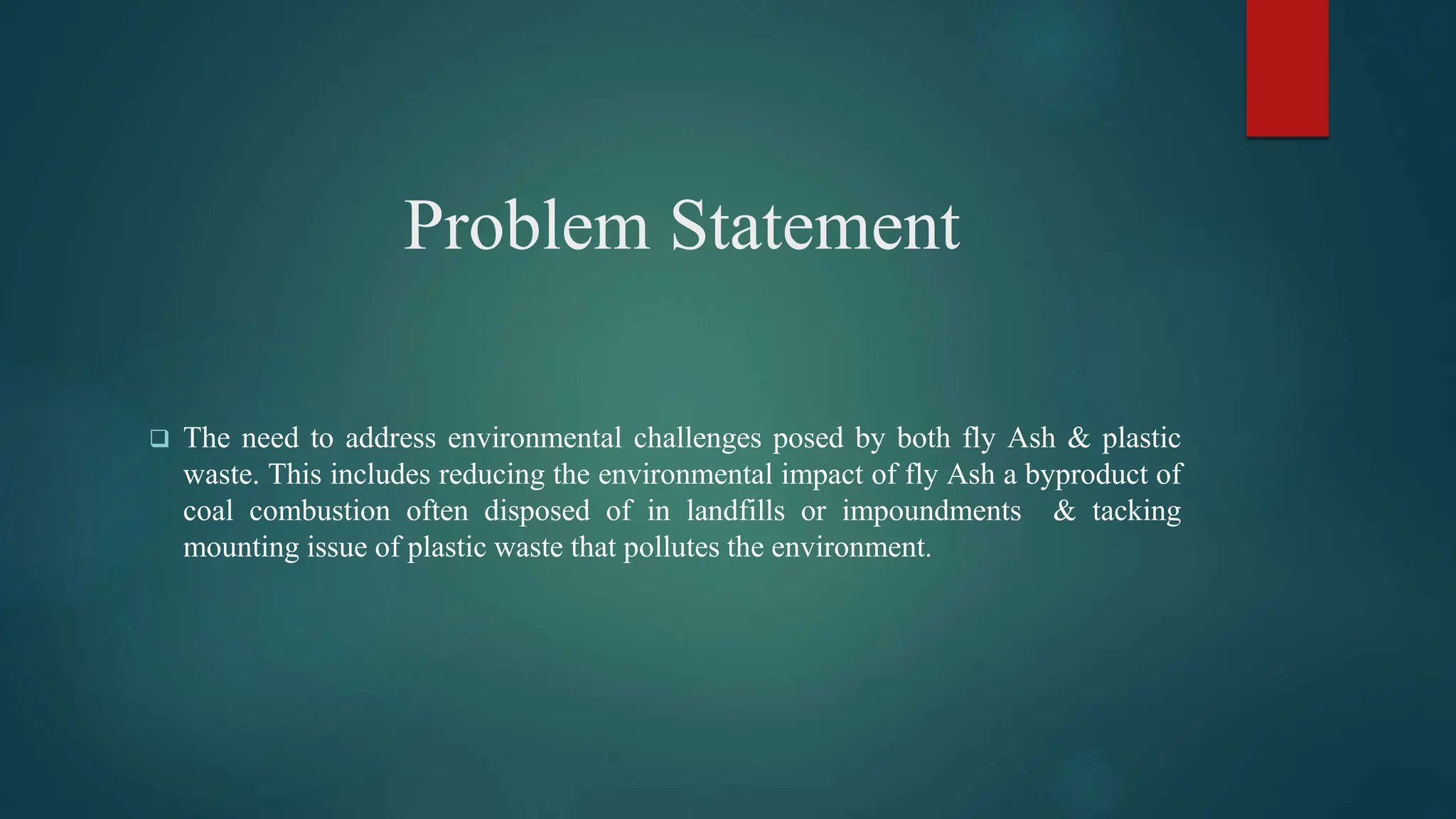
 The need to address environmental challenges posed by both fly Ash & plastic
waste. This includes reducing the environmental impact of fly Ash a byproduct of
coal combustion often disposed of in landfills or impoundments & tacking
mounting issue of plastic waste that pollutes the environment.
OBJECTIVES
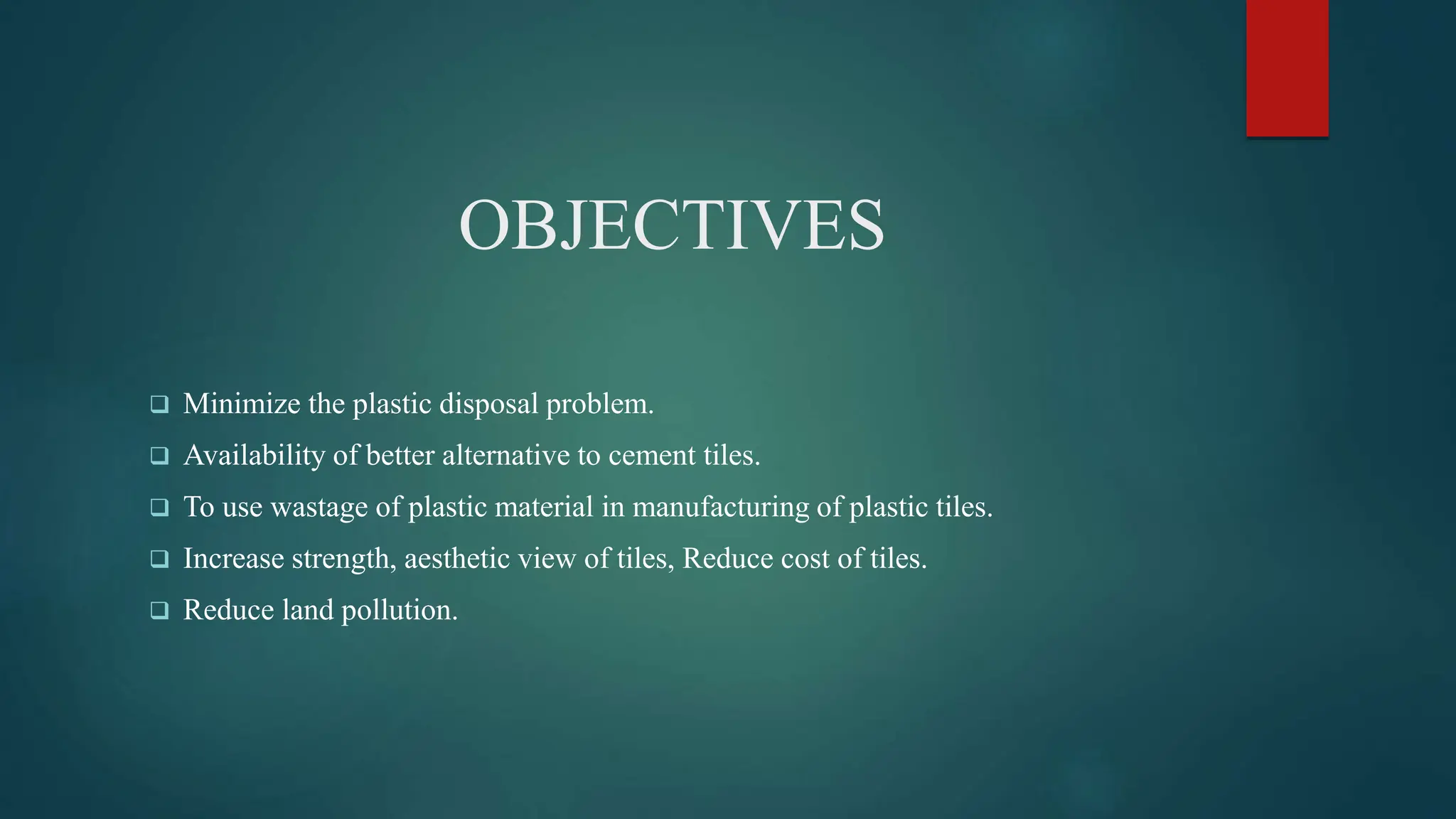
 Minimize the plastic disposal problem.
 Availability of better alternative to cement tiles.
 To use wastage of plastic material in manufacturing of plastic tiles.
 Increase strength, aesthetic view of tiles, Reduce cost of tiles.
 Reduce land pollution.
Literature Review
Title Published Year Author Research
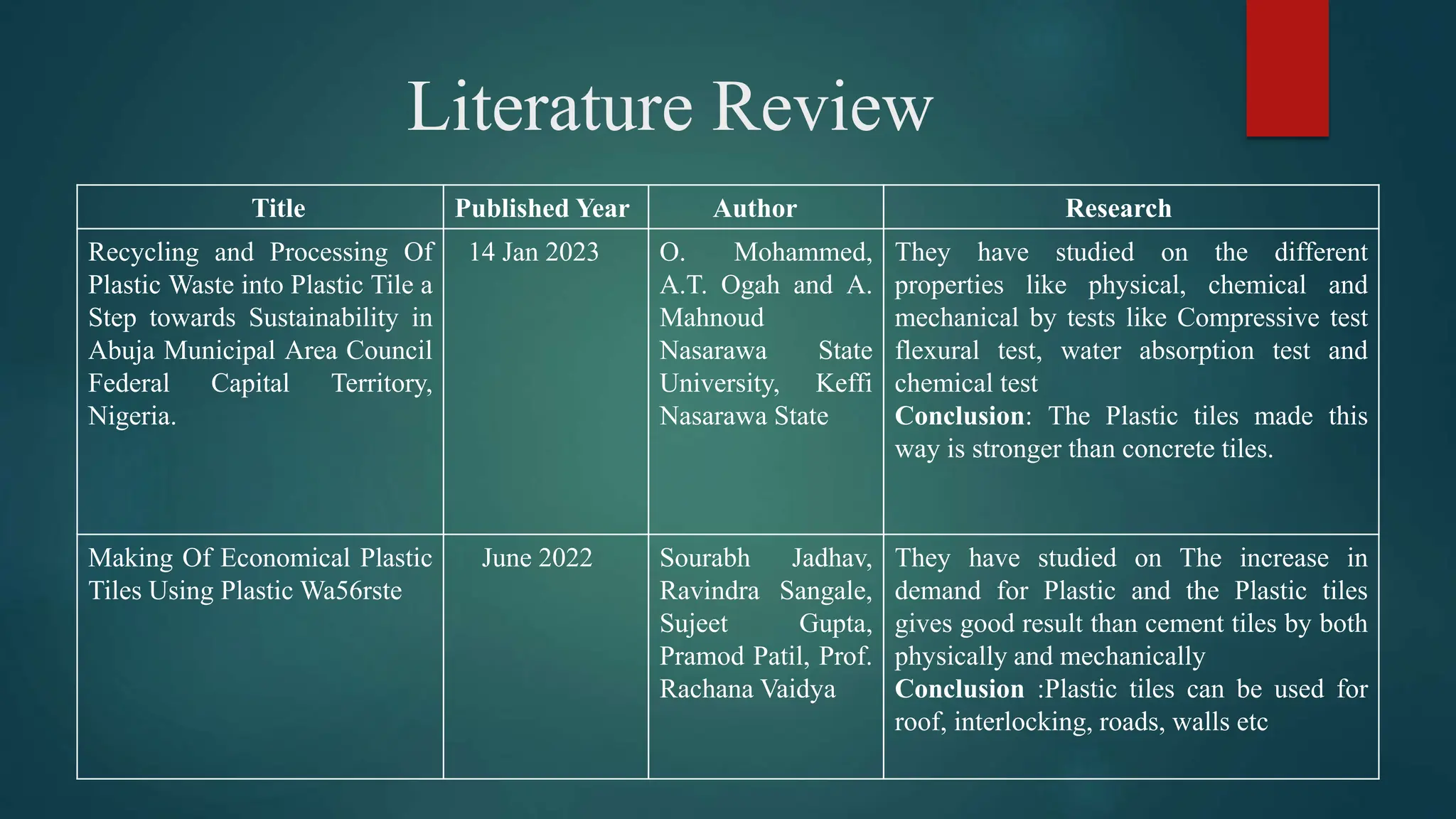
Recycling and Processing Of
Plastic Waste into Plastic Tile a
Step towards Sustainability in
Abuja Municipal Area Council
Federal Capital Territory,
Nigeria.
14 Jan 2023 O. Mohammed,
A.T. Ogah and A.
Mahnoud
Nasarawa State
University, Keffi
Nasarawa State
They have studied on the different
properties like physical, chemical and
mechanical by tests like Compressive test
flexural test, water absorption test and
chemical test
Conclusion: The Plastic tiles made this
way is stronger than concrete tiles.
Making Of Economical Plastic
Tiles Using Plastic Wa56rste
June 2022 Sourabh Jadhav,
Ravindra Sangale,
Sujeet Gupta,
Pramod Patil, Prof.
Rachana Vaidya
They have studied on The increase in
demand for Plastic and the Plastic tiles
gives good result than cement tiles by both
physically and mechanically
Conclusion :Plastic tiles can be used for
roof, interlocking, roads, walls etc
Literature Review
Title Published Year Author Research
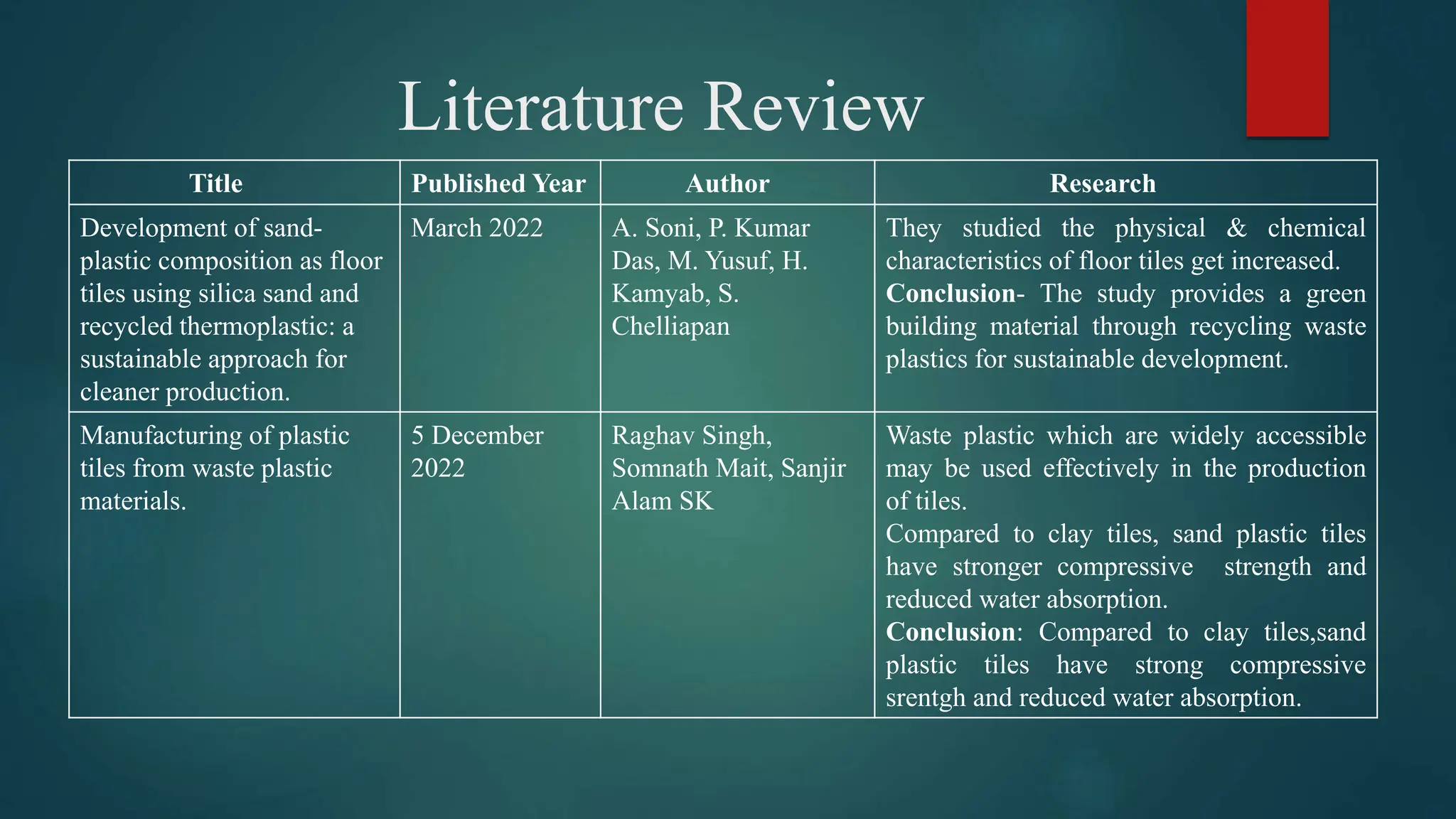
Development of sand-
plastic composition as floor
tiles using silica sand and
recycled thermoplastic: a
sustainable approach for
cleaner production.
March 2022 A. Soni, P. Kumar
Das, M. Yusuf, H.
Kamyab, S.
Chelliapan
They studied the physical & chemical
characteristics of floor tiles get increased.
Conclusion- The study provides a green
building material through recycling waste
plastics for sustainable development.
Manufacturing of plastic
tiles from waste plastic
materials.
5 December
2022
Raghav Singh,
Somnath Mait, Sanjir
Alam SK
Waste plastic which are widely accessible
may be used effectively in the production
of tiles.
Compared to clay tiles, sand plastic tiles
have stronger compressive strength and
reduced water absorption.
Conclusion: Compared to clay tiles,sand
plastic tiles have strong compressive
srentgh and reduced water absorption.
Literature Review
Title Published Year Author Research
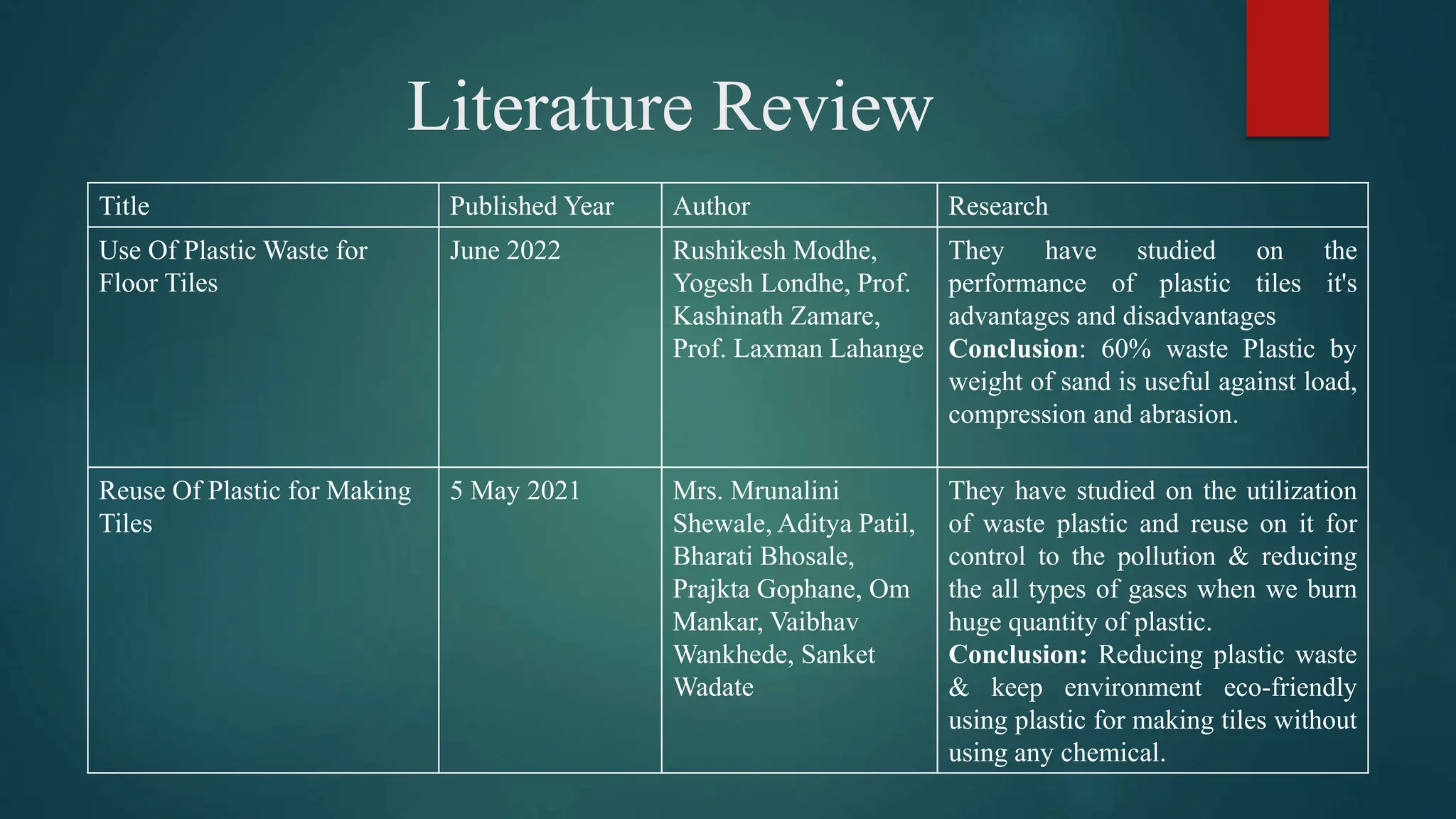
Use Of Plastic Waste for
Floor Tiles
June 2022 Rushikesh Modhe,
Yogesh Londhe, Prof.
Kashinath Zamare,
Prof. Laxman Lahange
They have studied on the
performance of plastic tiles it's
advantages and disadvantages
Conclusion: 60% waste Plastic by
weight of sand is useful against load,
compression and abrasion.
Reuse Of Plastic for Making
Tiles
5 May 2021 Mrs. Mrunalini
Shewale, Aditya Patil,
Bharati Bhosale,
Prajkta Gophane, Om
Mankar, Vaibhav
Wankhede, Sanket
Wadate
They have studied on the utilization
of waste plastic and reuse on it for
control to the pollution & reducing
the all types of gases when we burn
huge quantity of plastic.
Conclusion: Reducing plastic waste
& keep environment eco-friendly
using plastic for making tiles without
using any chemical.
Literature Review
Title Published Year Author Research
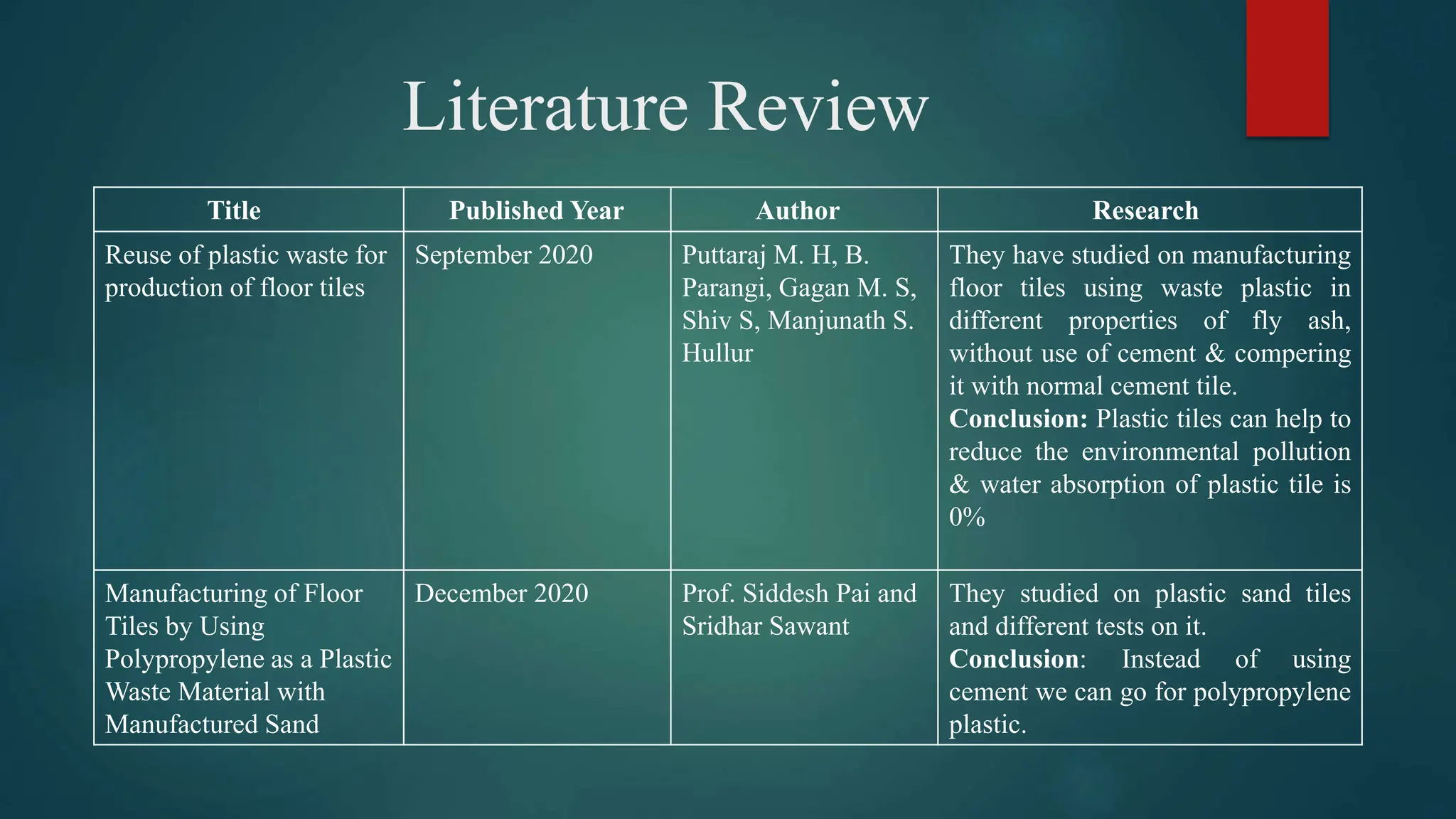
Reuse of plastic waste for
production of floor tiles
September 2020 Puttaraj M. H, B.
Parangi, Gagan M. S,
Shiv S, Manjunath S.
Hullur
They have studied on manufacturing
floor tiles using waste plastic in
different properties of fly ash,
without use of cement & compering
it with normal cement tile.
Conclusion: Plastic tiles can help to
reduce the environmental pollution
& water absorption of plastic tile is
0%
Manufacturing of Floor
Tiles by Using
Polypropylene as a Plastic
Waste Material with
Manufactured Sand
December 2020 Prof. Siddesh Pai and
Sridhar Sawant
They studied on plastic sand tiles
and different tests on it.
Conclusion: Instead of using
cement we can go for polypropylene
plastic.
Literature Review
Title Published Year Author Research
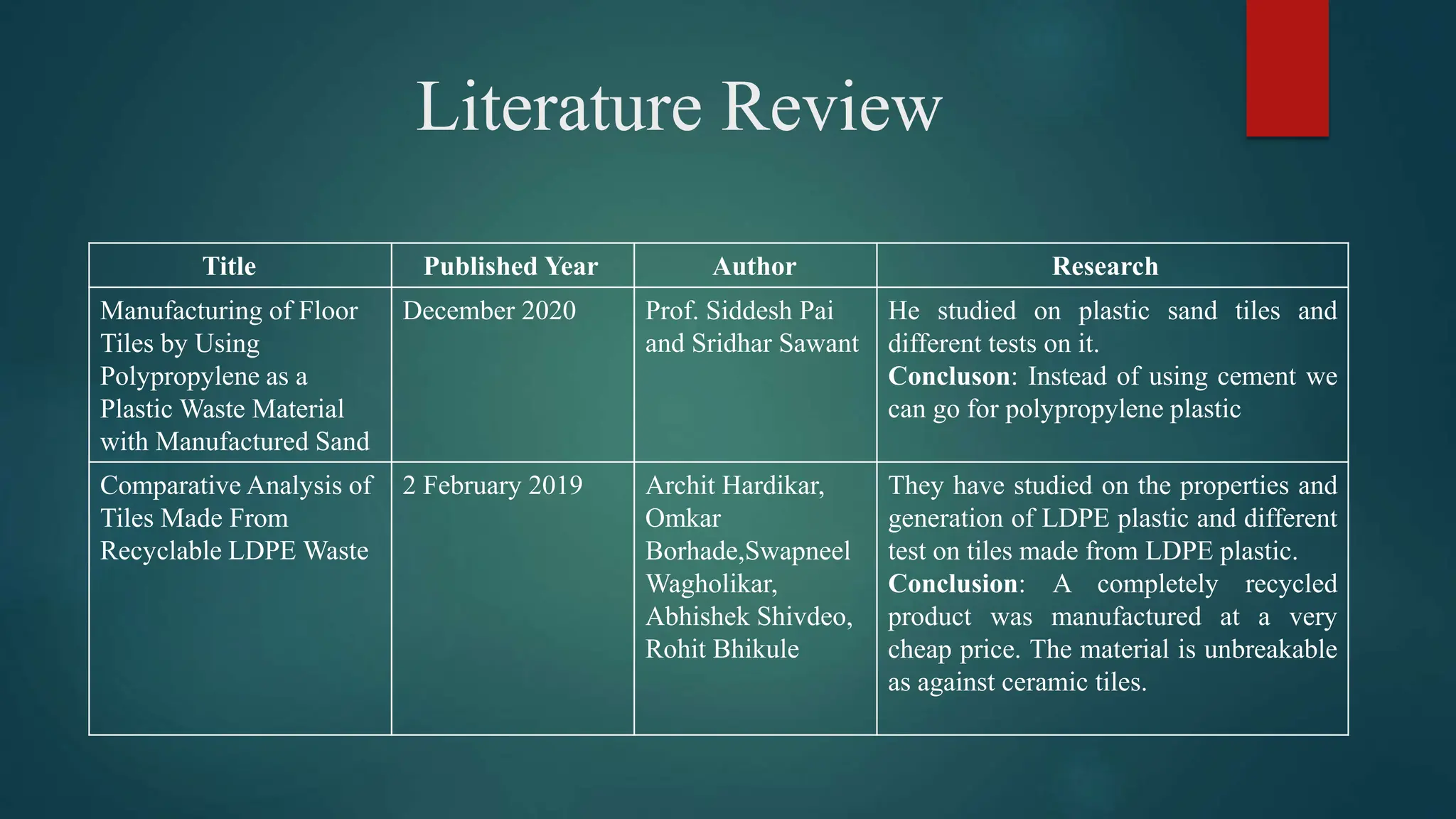
Manufacturing of Floor
Tiles by Using
Polypropylene as a
Plastic Waste Material
with Manufactured Sand
December 2020 Prof. Siddesh Pai
and Sridhar Sawant
He studied on plastic sand tiles and
different tests on it.
Concluson: Instead of using cement we
can go for polypropylene plastic
Comparative Analysis of
Tiles Made From
Recyclable LDPE Waste
2 February 2019 Archit Hardikar,
Omkar
Borhade,Swapneel
Wagholikar,
Abhishek Shivdeo,
Rohit Bhikule
They have studied on the properties and
generation of LDPE plastic and different
test on tiles made from LDPE plastic.
Conclusion: A completely recycled
product was manufactured at a very
cheap price. The material is unbreakable
as against ceramic tiles.
Literature Review
Title Published Year Author Research
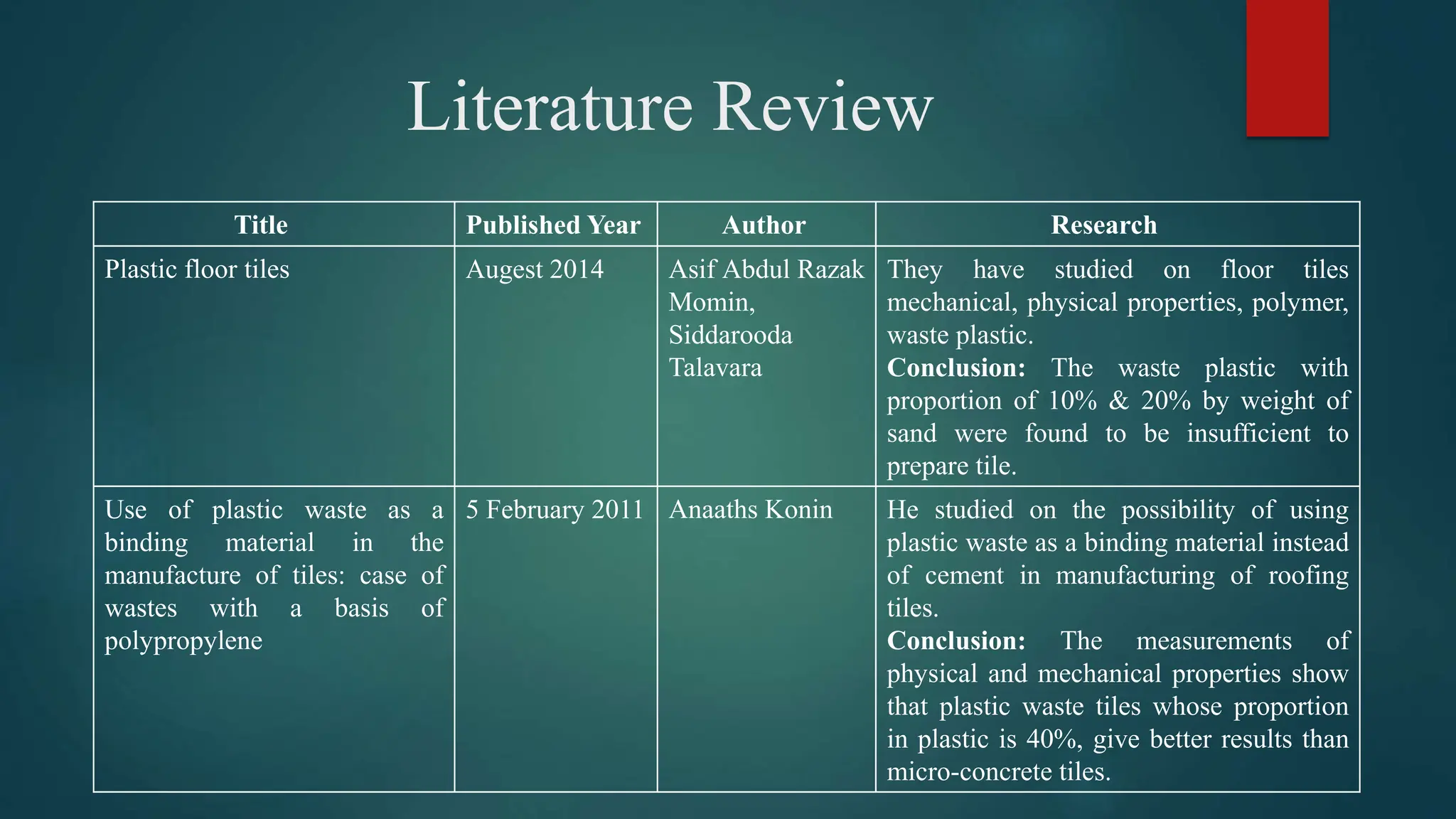
Plastic floor tiles Augest 2014 Asif Abdul Razak
Momin,
Siddarooda
Talavara
They have studied on floor tiles
mechanical, physical properties, polymer,
waste plastic.
Conclusion: The waste plastic with
proportion of 10% & 20% by weight of
sand were found to be insufficient to
prepare tile.
Use of plastic waste as a
binding material in the
manufacture of tiles: case of
wastes with a basis of
polypropylene
5 February 2011 Anaaths Konin He studied on the possibility of using
plastic waste as a binding material instead
of cement in manufacturing of roofing
tiles.
Conclusion: The measurements of
physical and mechanical properties show
that plastic waste tiles whose proportion
in plastic is 40%, give better results than
micro-concrete tiles.
Methodology
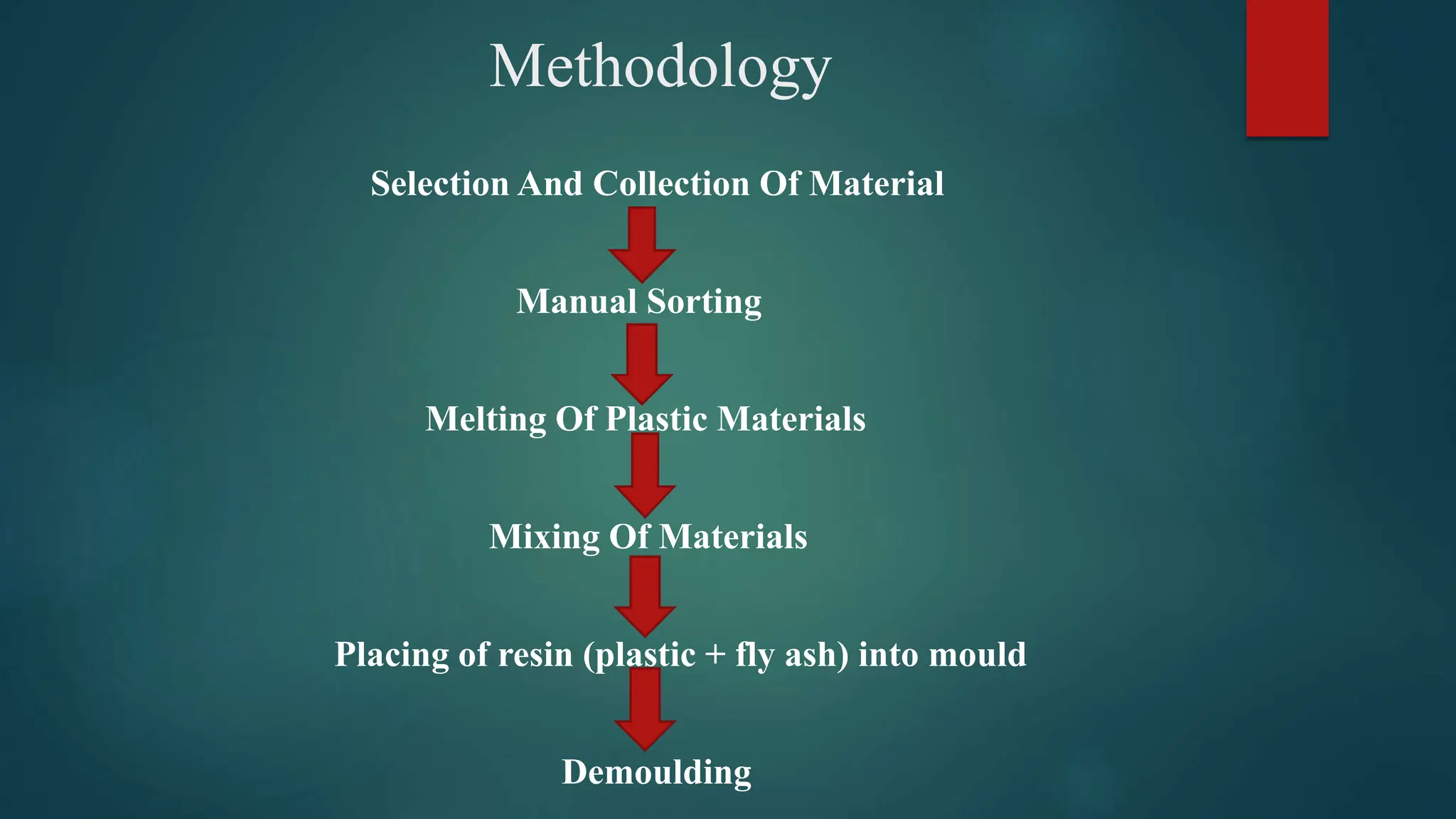
Selection And Collection Of Material
Manual Sorting
Melting Of Plastic Materials
Mixing Of Materials
Placing of resin (plastic + fly ash) into mould
Demoulding
Methodology
Selection Of Material
 PLASTIC WASTE
Plastic waste is generated from waste elements of plastic bottles, containers, caps etc
 FLY-ASH
Fly ash, a solid waste from thermal power plants has been a major source of
environmental pollution. About 95 million tones of fly ash is being produced by the
various power plants in the country.
Procedure
 Plastic collection: The plastic wastes for recycling were collected around the
area.
 Manual sorting: each plastic waste type were separated from each other and
unwanted materials were removed from the waste, like in waste plastic bottles,
the plastics normally attached on the skin of bottles and the bottle caps were
removed. Chipping: the various plastic waste sorted were then chopped into
smaller pieces. Washing: The chips were then washed to remove glue, paper
labels, dirt and any remnants of the product they once contained
 Melting of Plastic Material: The selected waste plastic from different elements is
weighed crushed and then melted in a container at its melting point (150-170°C).
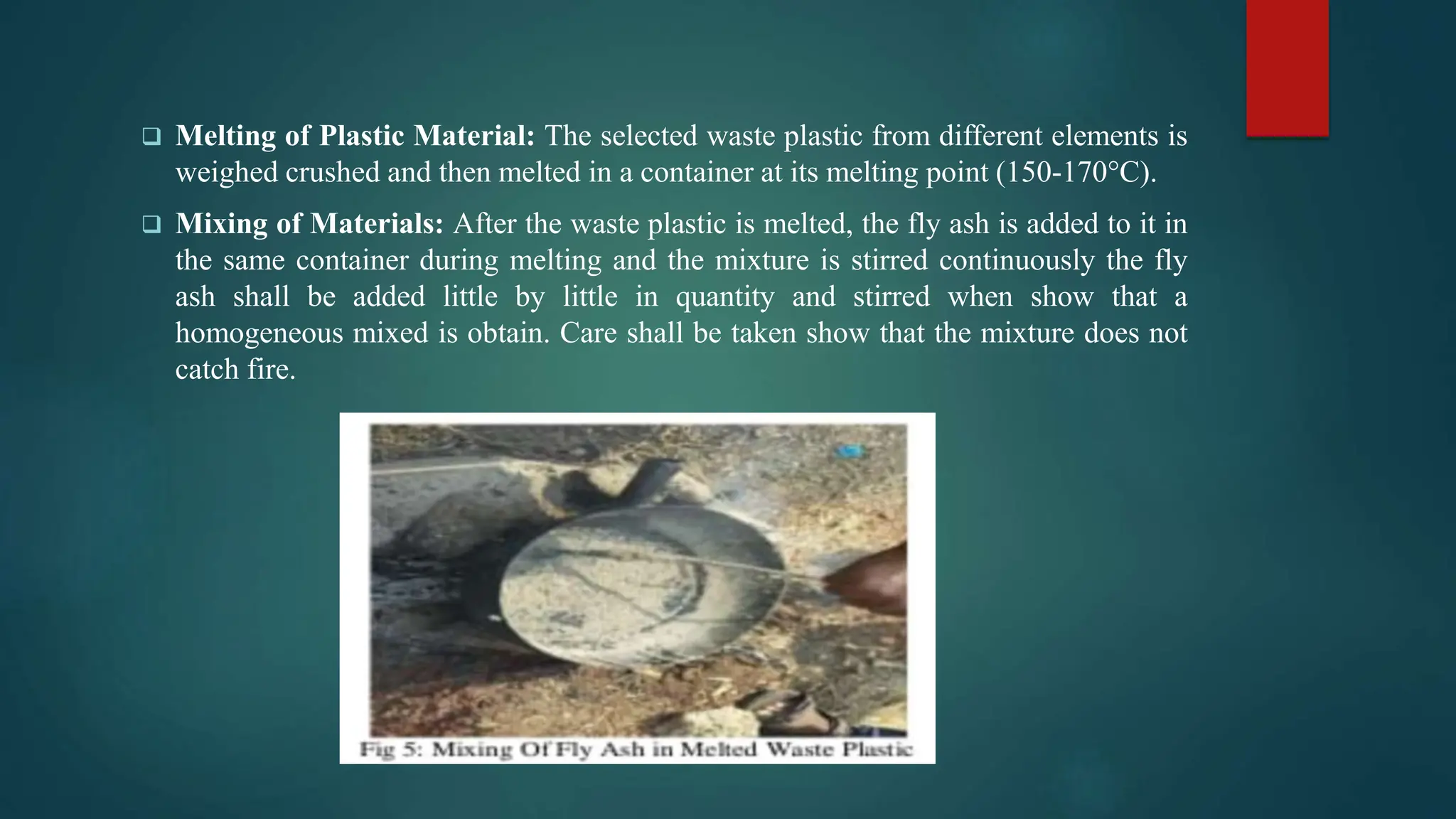
 Mixing of Materials: After the waste plastic is melted, the fly ash is added to it in
the same container during melting and the mixture is stirred continuously the fly
ash shall be added little by little in quantity and stirred when show that a
homogeneous mixed is obtain. Care shall be taken show that the mixture does not
catch fire.
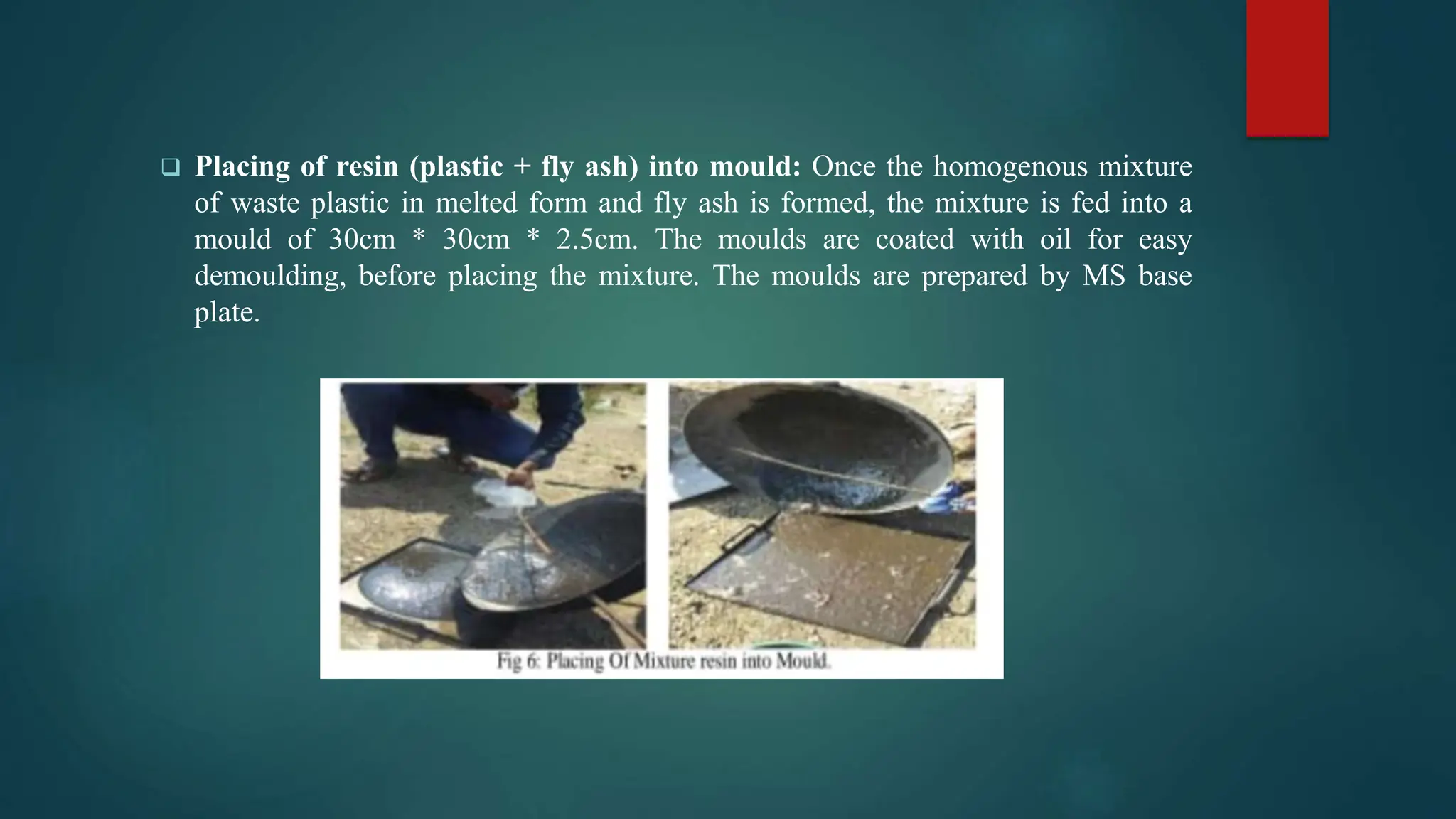
 Placing of resin (plastic + fly ash) into mould: Once the homogenous mixture
of waste plastic in melted form and fly ash is formed, the mixture is fed into a
mould of 30cm * 30cm * 2.5cm. The moulds are coated with oil for easy
demoulding, before placing the mixture. The moulds are prepared by MS base
plate.
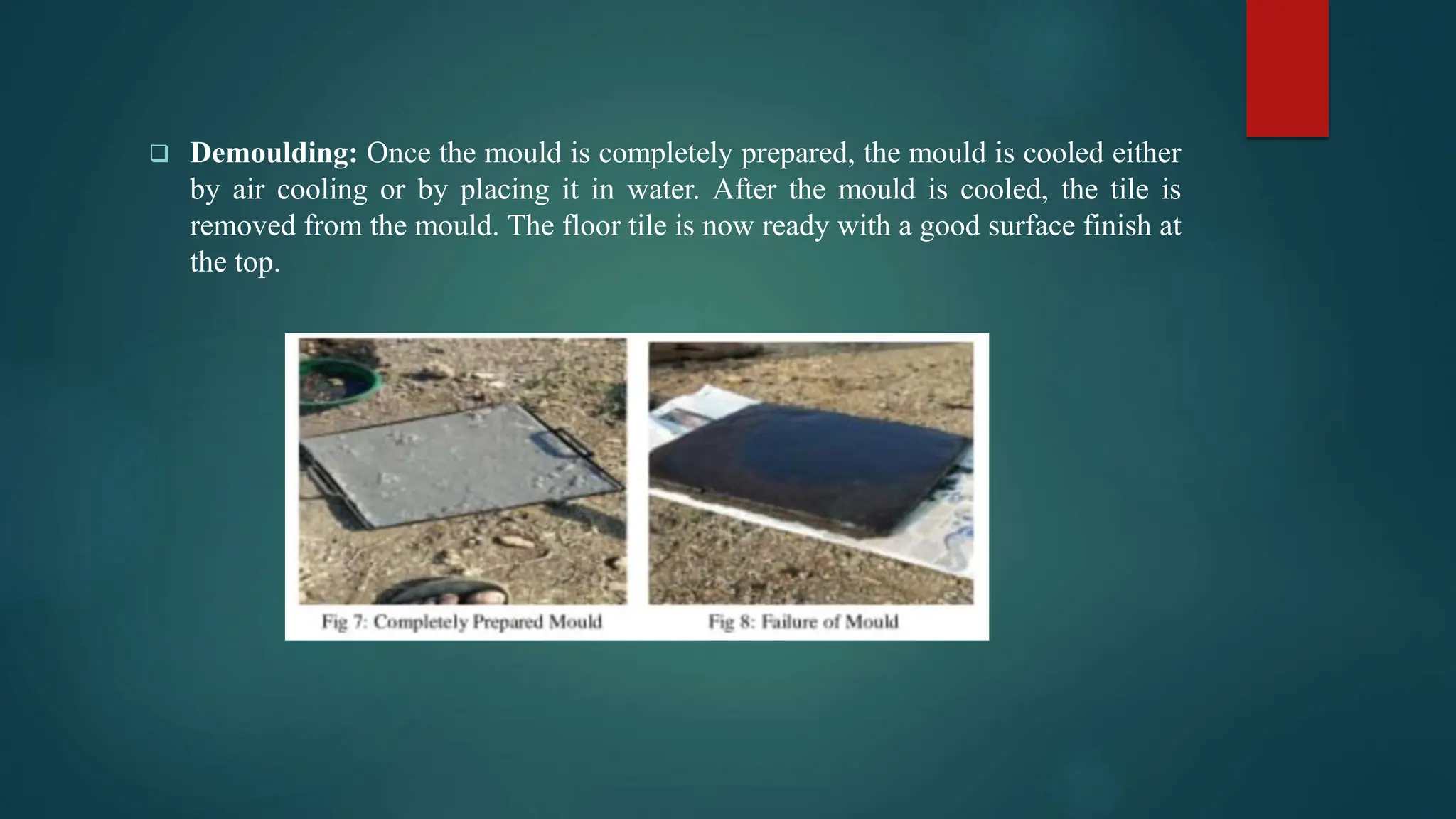
 Demoulding: Once the mould is completely prepared, the mould is cooled either
by air cooling or by placing it in water. After the mould is cooled, the tile is
removed from the mould. The floor tile is now ready with a good surface finish at
the top.
Tests On Tiles
 Water Absorption Test
 Compressive Strength Test
 Flexural Strength Test
 Density Test
 Thermal Conductivity Test
 Fire Resistance Test
 Dimensional Stability Test
References
 Dinesh S, Dinesh A, Kirubaran K (2016) "Utilization of waste plastic in
manufacturing of bricks and paver blocks" International Journal of Applied
Engineering Research, Vol. 11 No.3 (2016).
 Noel Deepak Shiri, P. Varun Kajava, Ranjan H. V. Nikhil Lloyd Pais, Vikhyat M.
Naik(2015) Processing of Waste Plastics into Building Materials Using a Plastic
Extruder and Compression Testing of Plastic Bricks" Journal of Mechanical
Engineering and Automation.
 Ganesh Tapkire. Satish parihar. Pramod Patil, Hemraj R Kumavat (2014)
"Recycled Plastic Used in Concrete Paver Block" IJRET: International Journal of
Research in Engineering and technology.
 V.G Smitha; Compressed Plastic Block International Research Journal of Engineering and
Technology (IRJET) Volume: 04 Issue: 09 Sep-2017.
 Archit Hardikar. Omkar Borhade, Swapneel Wagholikar, Abhishek Shivdeo. "Comparative
Analysis of Tiles Made from Recyclable LDPE Plastic waste" VOLUME 08, ISSUE 02
(FEBRUARY 2019)
 Mohammad N. Akhta, Jannisar Akhtar, Omar H. A Hattamleh, Abdulsamee M.Halahla
"Sustainable Fly Ash Based Roof Tiles with Waste Polythene Fiber".
 Arvind Singhal, Dr. Omprakash Netula, Utalisation of plastic waste in manufacturing of
plastic sand bricks"3rd International Conference on New Frontiers of Engineering,
Science, Management and Humanities (ICNFESMH- 2018).
Thank You.

BE Project Presentation on Reclaimed Asphalt

  • 1.
    DR. D.Y. PATILSCHOOL OF ENGINEERING AND TECHNOLOGY. PUNE. DEPARTMENT OF CIVIL ENGINEERING “MANUFACTURING & PERFORMANCE OF FLY-ASH PLASTO TILES” PRESENTED BY ROLL NO. GUIDED BY :- PROF. ASHWINI WAGHULE MR. DINESH D. NAKHATE 17 MISS. HEENA G. PATHAN 21 MR. ROHIT S. PATIL 22 MR. SHRIPAD D. PAWAR 28 SAVITRIBAI PHULE PUNE UNIVERSITY, PUNE 2023-24
  • 2.
    Contents  INTRODUCTION  SCOPEOF WORK  PROBLEM STATEMENT  LITERATURE REVIEW  METHODOLOGY  REFERENCES
  • 3.
    INTRODUCTION  Plastic isa very useful substance in our daily life work, but after the use of plastic it is very difficult for us to dispose of it because it is a non- biodegradable substance. After its usage it is a hazardous material.  Plastic is a new engineering material in which researchers take more interest to invest their time and money because it has a wide scope to enhance the usage of plastic in different work.  The properties of plastic are very unique and it can mix with every kind of material. Plastic is a composition of synthetic and semi synthetic organic compounds.  In construction field, many types of tiles are used like - clay tiles etc. In this project we try to us plastic based tiles which have better characteristics than any other type of tiles.  Plastic fly-ash tiles are cheaper than normal tiles. People can easily afford these types of tiles.  The largest component of the plastic waste is polyethylene, followed by polypropylene, polyethylene terephthalate and polystyrene.
  • 4.
    Scope Of Work Material Sourcing & Preparation  Manufacturing Process Design  Quality Control & Testing  Environmental Compliance  Cost Analysis & Optimization  Market Research & Distribution  Documentation & Reporting
  • 5.
    Problem Statement  Theneed to address environmental challenges posed by both fly Ash & plastic waste. This includes reducing the environmental impact of fly Ash a byproduct of coal combustion often disposed of in landfills or impoundments & tacking mounting issue of plastic waste that pollutes the environment.
  • 6.
    OBJECTIVES  Minimize theplastic disposal problem.  Availability of better alternative to cement tiles.  To use wastage of plastic material in manufacturing of plastic tiles.  Increase strength, aesthetic view of tiles, Reduce cost of tiles.  Reduce land pollution.
  • 7.
    Literature Review Title PublishedYear Author Research Recycling and Processing Of Plastic Waste into Plastic Tile a Step towards Sustainability in Abuja Municipal Area Council Federal Capital Territory, Nigeria. 14 Jan 2023 O. Mohammed, A.T. Ogah and A. Mahnoud Nasarawa State University, Keffi Nasarawa State They have studied on the different properties like physical, chemical and mechanical by tests like Compressive test flexural test, water absorption test and chemical test Conclusion: The Plastic tiles made this way is stronger than concrete tiles. Making Of Economical Plastic Tiles Using Plastic Wa56rste June 2022 Sourabh Jadhav, Ravindra Sangale, Sujeet Gupta, Pramod Patil, Prof. Rachana Vaidya They have studied on The increase in demand for Plastic and the Plastic tiles gives good result than cement tiles by both physically and mechanically Conclusion :Plastic tiles can be used for roof, interlocking, roads, walls etc
  • 8.
    Literature Review Title PublishedYear Author Research Development of sand- plastic composition as floor tiles using silica sand and recycled thermoplastic: a sustainable approach for cleaner production. March 2022 A. Soni, P. Kumar Das, M. Yusuf, H. Kamyab, S. Chelliapan They studied the physical & chemical characteristics of floor tiles get increased. Conclusion- The study provides a green building material through recycling waste plastics for sustainable development. Manufacturing of plastic tiles from waste plastic materials. 5 December 2022 Raghav Singh, Somnath Mait, Sanjir Alam SK Waste plastic which are widely accessible may be used effectively in the production of tiles. Compared to clay tiles, sand plastic tiles have stronger compressive strength and reduced water absorption. Conclusion: Compared to clay tiles,sand plastic tiles have strong compressive srentgh and reduced water absorption.
  • 9.
    Literature Review Title PublishedYear Author Research Use Of Plastic Waste for Floor Tiles June 2022 Rushikesh Modhe, Yogesh Londhe, Prof. Kashinath Zamare, Prof. Laxman Lahange They have studied on the performance of plastic tiles it's advantages and disadvantages Conclusion: 60% waste Plastic by weight of sand is useful against load, compression and abrasion. Reuse Of Plastic for Making Tiles 5 May 2021 Mrs. Mrunalini Shewale, Aditya Patil, Bharati Bhosale, Prajkta Gophane, Om Mankar, Vaibhav Wankhede, Sanket Wadate They have studied on the utilization of waste plastic and reuse on it for control to the pollution & reducing the all types of gases when we burn huge quantity of plastic. Conclusion: Reducing plastic waste & keep environment eco-friendly using plastic for making tiles without using any chemical.
  • 10.
    Literature Review Title PublishedYear Author Research Reuse of plastic waste for production of floor tiles September 2020 Puttaraj M. H, B. Parangi, Gagan M. S, Shiv S, Manjunath S. Hullur They have studied on manufacturing floor tiles using waste plastic in different properties of fly ash, without use of cement & compering it with normal cement tile. Conclusion: Plastic tiles can help to reduce the environmental pollution & water absorption of plastic tile is 0% Manufacturing of Floor Tiles by Using Polypropylene as a Plastic Waste Material with Manufactured Sand December 2020 Prof. Siddesh Pai and Sridhar Sawant They studied on plastic sand tiles and different tests on it. Conclusion: Instead of using cement we can go for polypropylene plastic.
  • 11.
    Literature Review Title PublishedYear Author Research Manufacturing of Floor Tiles by Using Polypropylene as a Plastic Waste Material with Manufactured Sand December 2020 Prof. Siddesh Pai and Sridhar Sawant He studied on plastic sand tiles and different tests on it. Concluson: Instead of using cement we can go for polypropylene plastic Comparative Analysis of Tiles Made From Recyclable LDPE Waste 2 February 2019 Archit Hardikar, Omkar Borhade,Swapneel Wagholikar, Abhishek Shivdeo, Rohit Bhikule They have studied on the properties and generation of LDPE plastic and different test on tiles made from LDPE plastic. Conclusion: A completely recycled product was manufactured at a very cheap price. The material is unbreakable as against ceramic tiles.
  • 12.
    Literature Review Title PublishedYear Author Research Plastic floor tiles Augest 2014 Asif Abdul Razak Momin, Siddarooda Talavara They have studied on floor tiles mechanical, physical properties, polymer, waste plastic. Conclusion: The waste plastic with proportion of 10% & 20% by weight of sand were found to be insufficient to prepare tile. Use of plastic waste as a binding material in the manufacture of tiles: case of wastes with a basis of polypropylene 5 February 2011 Anaaths Konin He studied on the possibility of using plastic waste as a binding material instead of cement in manufacturing of roofing tiles. Conclusion: The measurements of physical and mechanical properties show that plastic waste tiles whose proportion in plastic is 40%, give better results than micro-concrete tiles.
  • 13.
    Methodology Selection And CollectionOf Material Manual Sorting Melting Of Plastic Materials Mixing Of Materials Placing of resin (plastic + fly ash) into mould Demoulding
  • 14.
    Methodology Selection Of Material PLASTIC WASTE Plastic waste is generated from waste elements of plastic bottles, containers, caps etc  FLY-ASH Fly ash, a solid waste from thermal power plants has been a major source of environmental pollution. About 95 million tones of fly ash is being produced by the various power plants in the country.
  • 15.
    Procedure  Plastic collection:The plastic wastes for recycling were collected around the area.  Manual sorting: each plastic waste type were separated from each other and unwanted materials were removed from the waste, like in waste plastic bottles, the plastics normally attached on the skin of bottles and the bottle caps were removed. Chipping: the various plastic waste sorted were then chopped into smaller pieces. Washing: The chips were then washed to remove glue, paper labels, dirt and any remnants of the product they once contained
  • 16.
     Melting ofPlastic Material: The selected waste plastic from different elements is weighed crushed and then melted in a container at its melting point (150-170°C).  Mixing of Materials: After the waste plastic is melted, the fly ash is added to it in the same container during melting and the mixture is stirred continuously the fly ash shall be added little by little in quantity and stirred when show that a homogeneous mixed is obtain. Care shall be taken show that the mixture does not catch fire.
  • 17.
     Placing ofresin (plastic + fly ash) into mould: Once the homogenous mixture of waste plastic in melted form and fly ash is formed, the mixture is fed into a mould of 30cm * 30cm * 2.5cm. The moulds are coated with oil for easy demoulding, before placing the mixture. The moulds are prepared by MS base plate.
  • 18.
     Demoulding: Oncethe mould is completely prepared, the mould is cooled either by air cooling or by placing it in water. After the mould is cooled, the tile is removed from the mould. The floor tile is now ready with a good surface finish at the top.
  • 19.
    Tests On Tiles Water Absorption Test  Compressive Strength Test  Flexural Strength Test  Density Test  Thermal Conductivity Test  Fire Resistance Test  Dimensional Stability Test
  • 20.
    References  Dinesh S,Dinesh A, Kirubaran K (2016) "Utilization of waste plastic in manufacturing of bricks and paver blocks" International Journal of Applied Engineering Research, Vol. 11 No.3 (2016).  Noel Deepak Shiri, P. Varun Kajava, Ranjan H. V. Nikhil Lloyd Pais, Vikhyat M. Naik(2015) Processing of Waste Plastics into Building Materials Using a Plastic Extruder and Compression Testing of Plastic Bricks" Journal of Mechanical Engineering and Automation.  Ganesh Tapkire. Satish parihar. Pramod Patil, Hemraj R Kumavat (2014) "Recycled Plastic Used in Concrete Paver Block" IJRET: International Journal of Research in Engineering and technology.
  • 21.
     V.G Smitha;Compressed Plastic Block International Research Journal of Engineering and Technology (IRJET) Volume: 04 Issue: 09 Sep-2017.  Archit Hardikar. Omkar Borhade, Swapneel Wagholikar, Abhishek Shivdeo. "Comparative Analysis of Tiles Made from Recyclable LDPE Plastic waste" VOLUME 08, ISSUE 02 (FEBRUARY 2019)  Mohammad N. Akhta, Jannisar Akhtar, Omar H. A Hattamleh, Abdulsamee M.Halahla "Sustainable Fly Ash Based Roof Tiles with Waste Polythene Fiber".  Arvind Singhal, Dr. Omprakash Netula, Utalisation of plastic waste in manufacturing of plastic sand bricks"3rd International Conference on New Frontiers of Engineering, Science, Management and Humanities (ICNFESMH- 2018).
  • 22.