Downloaded 54 times















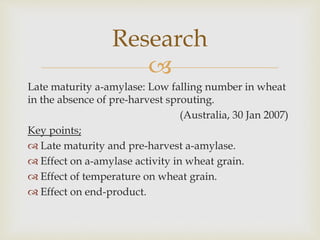



This document provides information about falling number testing. It begins with a brief history of falling number testing, describing how the test was developed in the 1960s and standardized internationally. It then explains the basic working principle of falling number testing, which involves measuring the viscosity of a flour and water mixture over time to determine alpha-amylase enzyme activity. Higher alpha-amylase activity causes faster viscosity breakdown and a lower falling number. The document notes that falling number is important for applications like pasta/noodle manufacturing and baking, where too little or too much alpha-amylase can cause quality problems.


