Macbeth
Literary Heritage
What will pupils be asked to do?
Pupils will write an essay up to 2000 words
 comparing a Shakespeare play with another text.

It is worth 25% of GCSE English Literature.
Here are the Assessment Objectives
(specified by AQA)
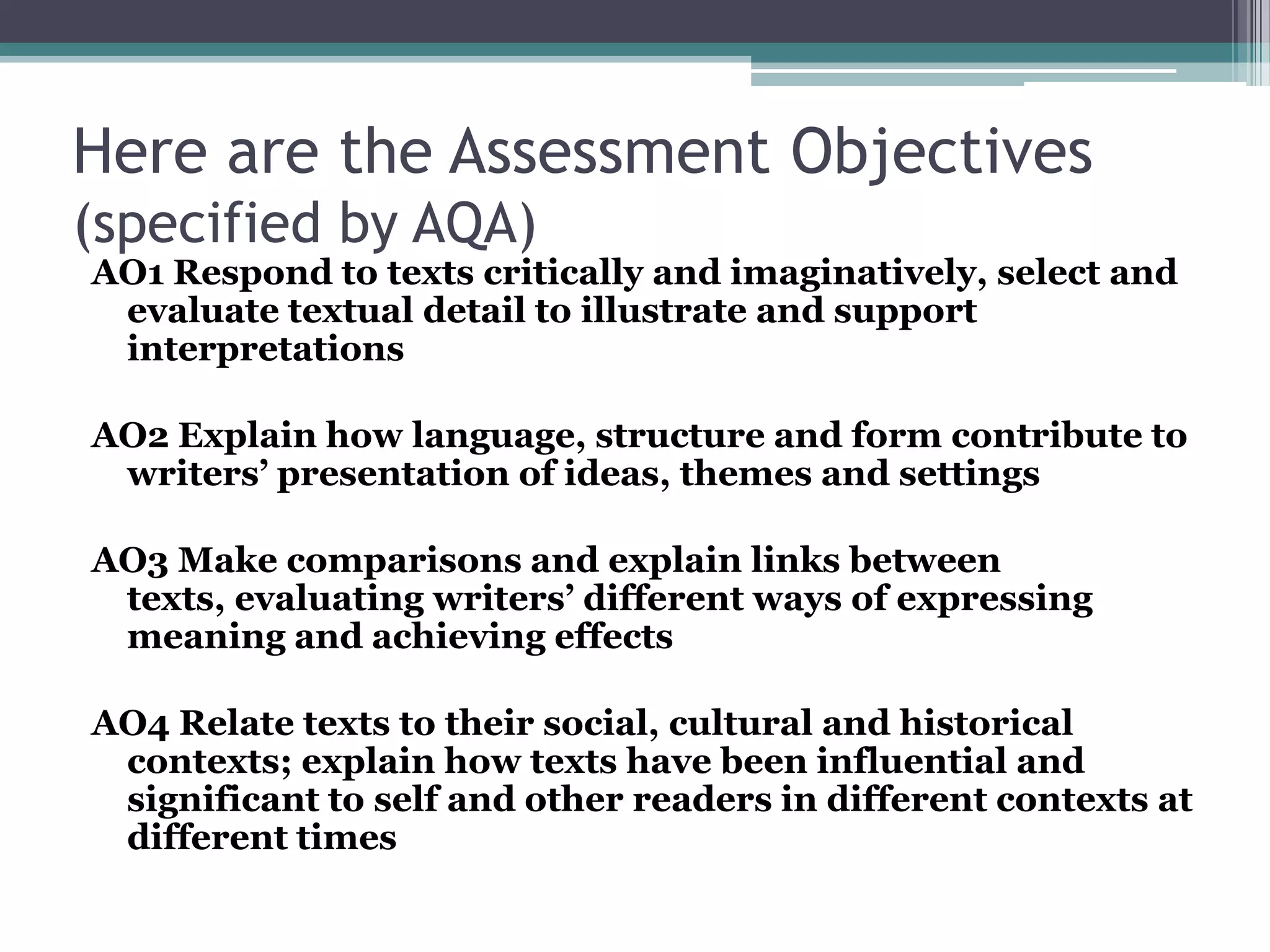
AO1 Respond to texts critically and imaginatively, select and
 evaluate textual detail to illustrate and support
 interpretations

AO2 Explain how language, structure and form contribute to
 writers’ presentation of ideas, themes and settings

AO3 Make comparisons and explain links between
 texts, evaluating writers’ different ways of expressing
 meaning and achieving effects

AO4 Relate texts to their social, cultural and historical
 contexts; explain how texts have been influential and
 significant to self and other readers in different contexts at
 different times
Put more simply, this means:


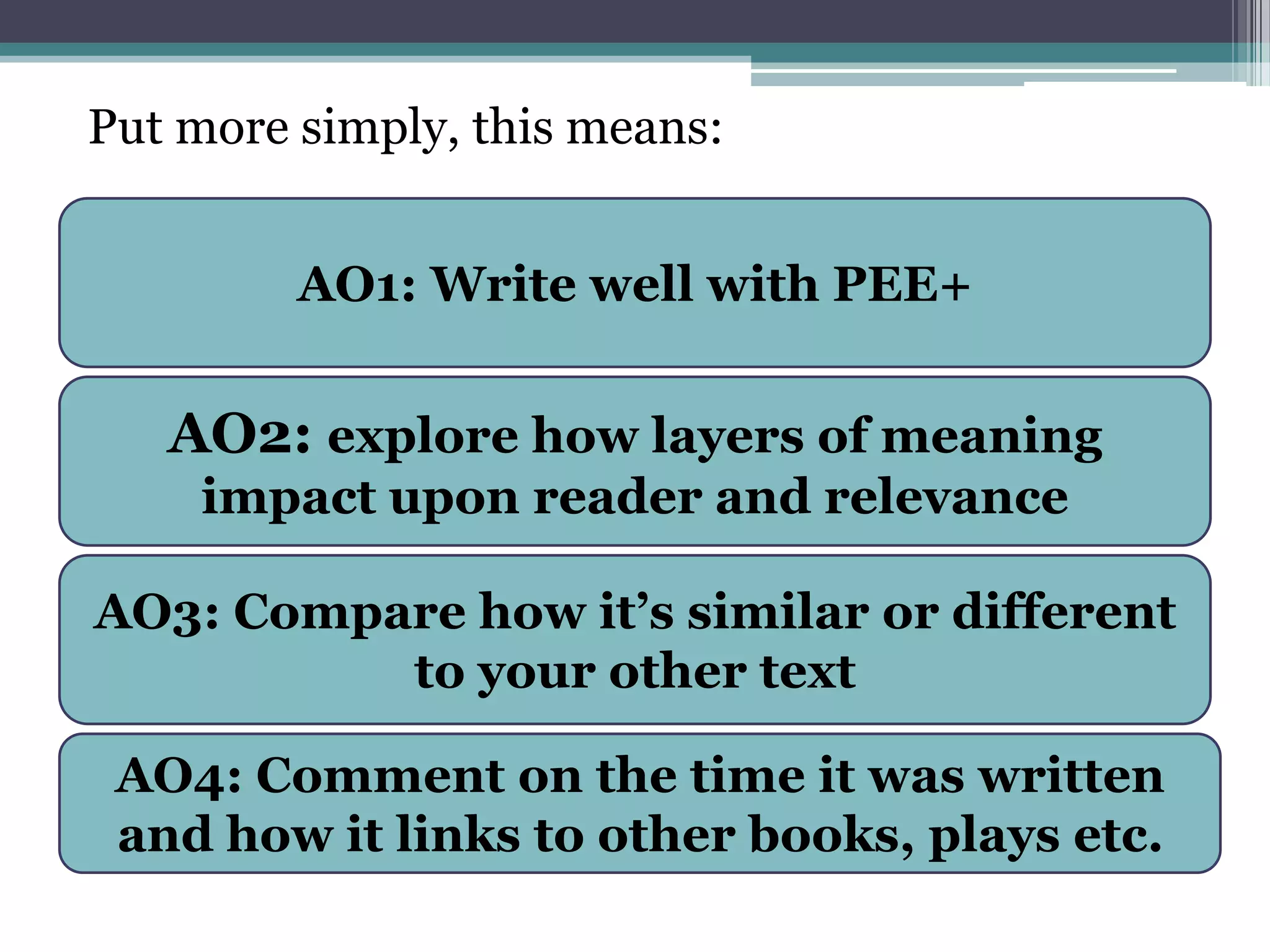
         AO1: Write well with PEE+


   AO2: explore how layers of meaning
     impact upon reader and relevance

AO3: Compare how it’s similar or different
          to your other text

 AO4: Comment on the time it was written
 and how it links to other books, plays etc.
Or the pupils may see it in class as
this...
Success Criteria
Skilled Writing 1. Identify, comment and compare the
will               writers’ use of language, structure and
                     form contribute to effect.
                  2. Identify and comment on the historical
                     context.
                  3. Commentary embeds appropriate
                     quotations to support main idea
Excellent         1. Have an increasingly detailed explanation,
Writing              with appropriate terminology, of how
                     language, structure and form create layers
will
                     of meaning
                  2. Comments develop increasingly precise,
                     perceptive comparison between texts
                  3. Commentary incorporates detailed
                     reference to the historical context
How does this look?
Pupils are familiar with PEE+
Point
Evidence
Explanation
+ Further Explanation (context in this case).
This is a structure we use in English to ensure that writing
 remains analytical.
The most common error it storytelling. Pupils should not
 tell the story; writing should analyse the quotations
 selected.
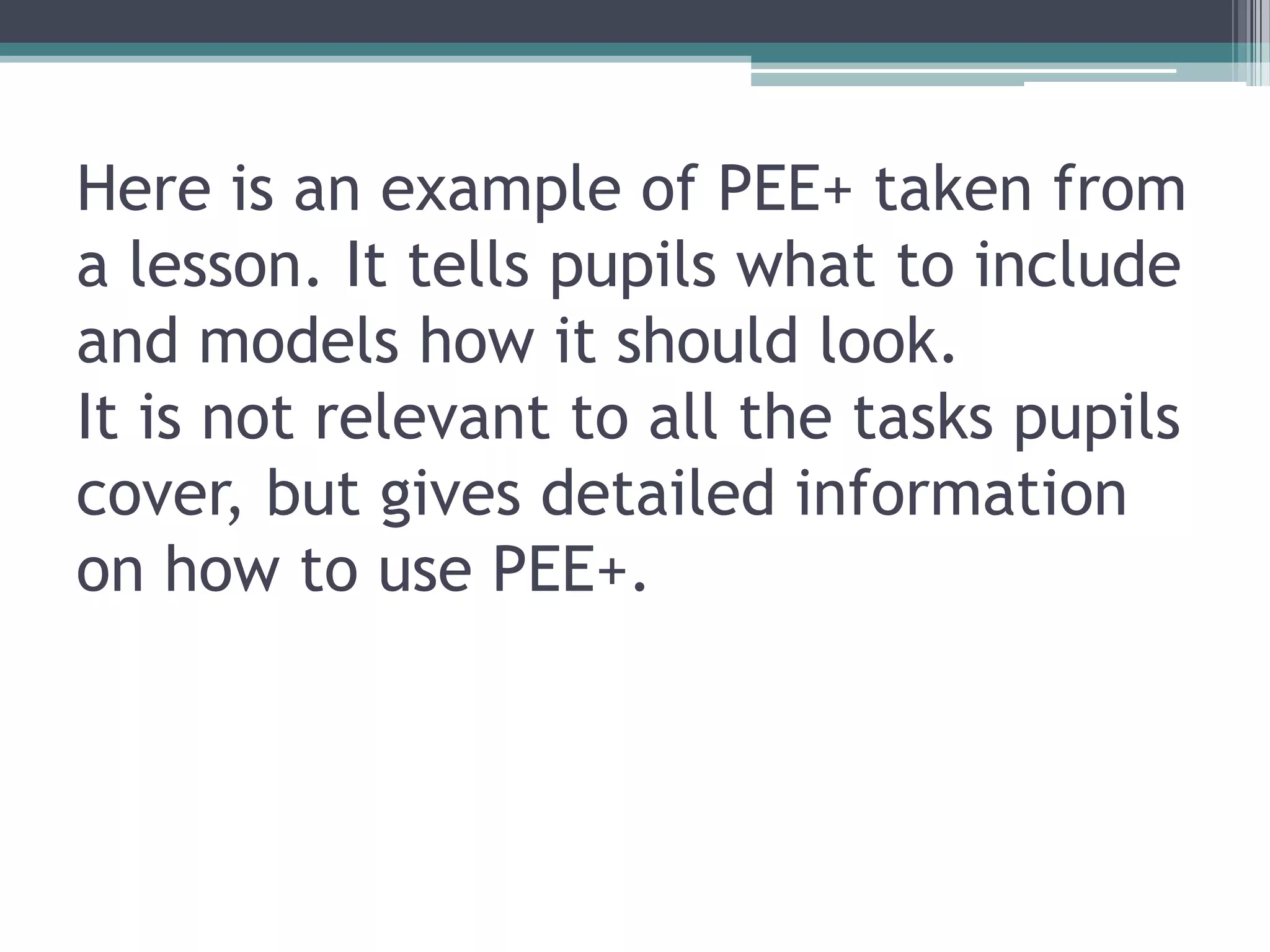
Here is an example of PEE+ taken from
a lesson. It tells pupils what to include
and models how it should look.
It is not relevant to all the tasks pupils
cover, but gives detailed information
on how to use PEE+.
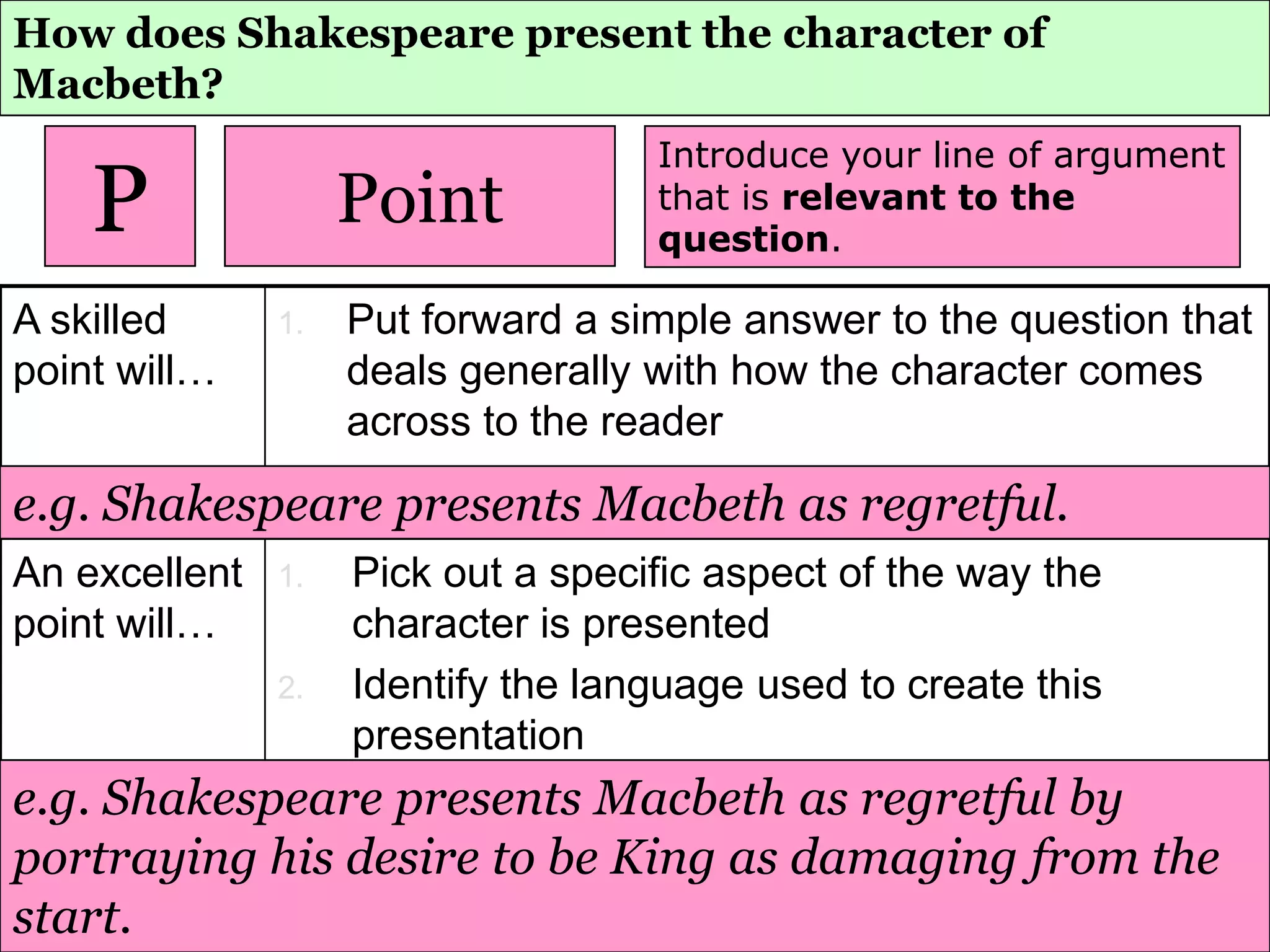
How does Shakespeare present the character of
Macbeth?
                                    Introduce your line of argument
    P               Point           that is relevant to the
                                    question.

A skilled      1.   Put forward a simple answer to the question that
point will…         deals generally with how the character comes
                    across to the reader

e.g. Shakespeare presents Macbeth as regretful.
An excellent   1.   Pick out a specific aspect of the way the
point will…         character is presented
               2.   Identify the language used to create this
                    presentation
e.g. Shakespeare presents Macbeth as regretful by
portraying his desire to be King as damaging from the
start.
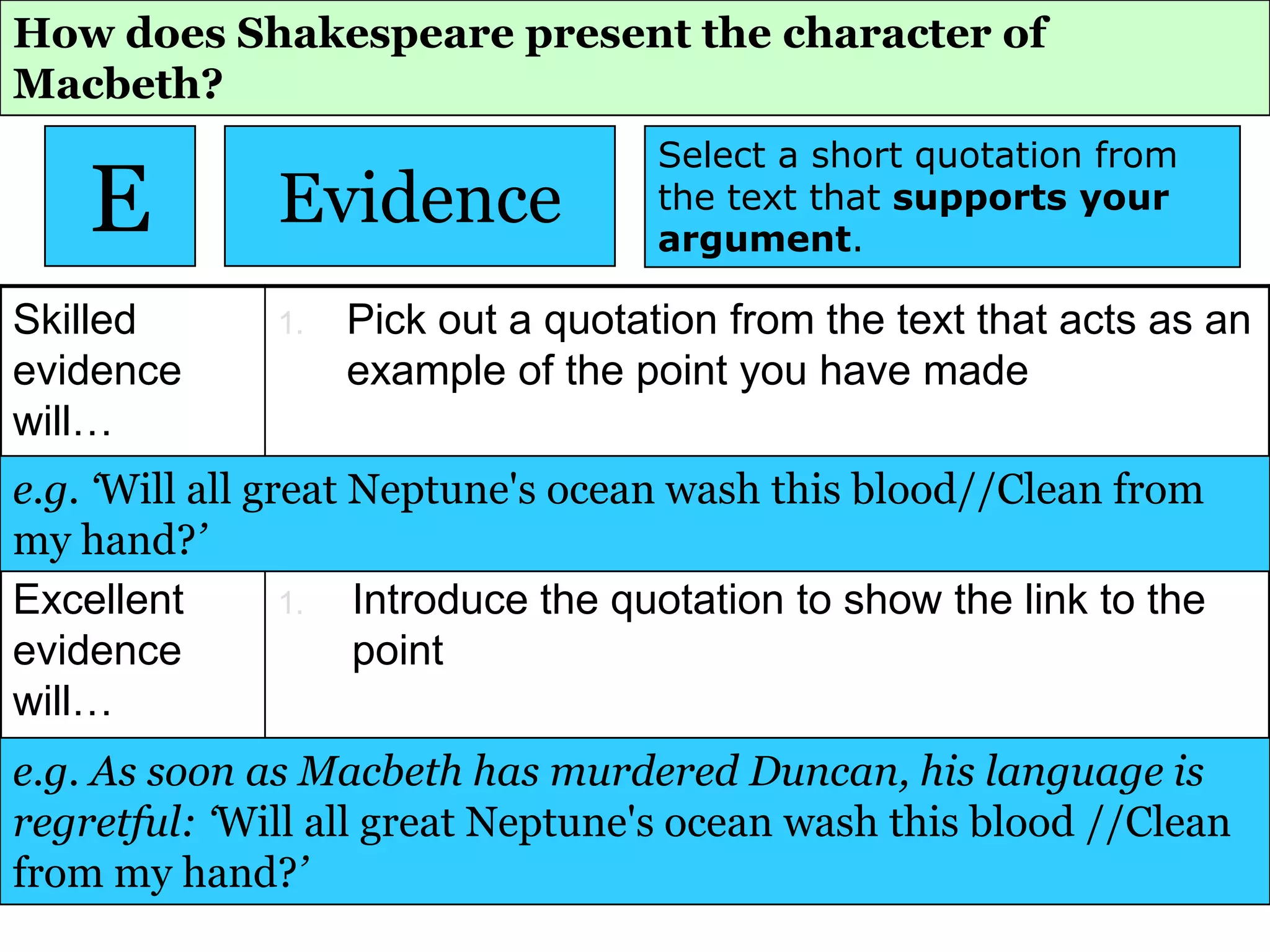
How does Shakespeare present the character of
Macbeth?
                                     Select a short quotation from
    E          Evidence              the text that supports your
                                     argument.

Skilled        1.   Pick out a quotation from the text that acts as an
evidence            example of the point you have made
will…
e.g. ‘Will all great Neptune's ocean wash this blood//Clean from
my hand?’
Excellent        1.  Introduce the quotation to show the link to the
evidence             point
will…
e.g. As soon as Macbeth has murdered Duncan, his language is
regretful: ‘Will all great Neptune's ocean wash this blood //Clean
from my hand?’
How does Shakespeare present the character of
Macbeth?
                                              Directly analyse your
     E         Explanation                    quotation to demonstrate how
                                              it supports your argument.


A skilled         1.   Give an overview of why your quotation proves your
explanation            point
will…
e.g. Lots of bad things then go on to happen to Macbeth, proving that he was wrong to
kill the King as he was going against the Divine Right of Kings , which James the I (the
King at the time), believed in.
An excellent      1.    Put forward more than one idea – and those ideas will be
explanation             increasingly original (not the obvious ones)
will…             2.    Refer to specific words within the quotation and explain
                        their impact on the reader (connotations)
e.g. Macbeth’s reference to ‘Neptune’ makes conveys a sense of prayer to the language
and the question mark suggests doubt at his actions. Neptune is the God of the sea, this
would have been known to the Jacobean audience. However, as this is not the Christian
god, the audience would have also viewed this with suspicion; Macbeth has also gone
How does Shakespeare present the character of
Macbeth?
                                                 Link your analysis to other ideas and
                  Further
     +
                                                 quotations from the rest of the book
                                                 or its social/ historical context to
                explanation                      conclude your argument.

Skilled further    1.   Link the explanation very briefly to another part of the text, but without
                        reference to the text
explanation        2.   Comment very briefly on what was going on in the world when the book
will…                   was written
e.g. This also shows that he is feels regretful because it suggests that this is something
that will not go away easily; all the water in the ocean will not make his hands clean.
Excellent     1.    Bring in short quotations from elsewhere in the book to show how the
                    same idea is explored in different places
further       2.    Put forward original alternative interpretations of the context
explanation   3.    Explain in detail why the writer wrote in this way
will… immediacy of Macbeth’s guilt and regret is made apparent with a direct link to
e.g. The
the metaphor of having blood on your hands. The metaphor is used throughout the
play as Lady Macbeth sees an immovable ‘spot’ on her hand and, at the end of the play
when Macbeth’s downfall is imminent, it is said that ‘His secret murders [are]sticking
on his hands’. The tragic outcome is inevitable because Macbeth will not be able to
wash his hands clean and the audience know that this will end in his own death.
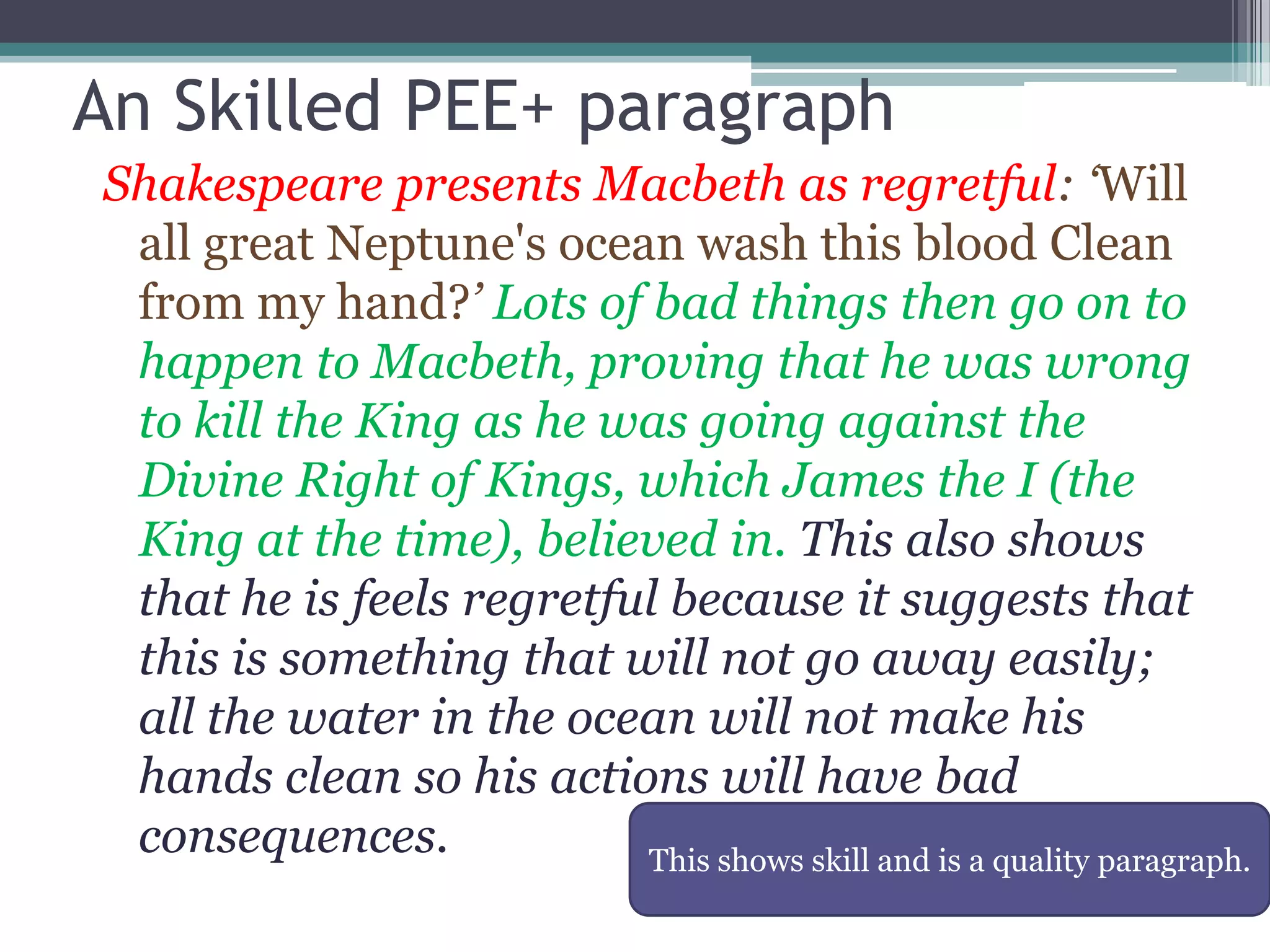
An Skilled PEE+ paragraph
Shakespeare presents Macbeth as regretful: ‘Will
 all great Neptune's ocean wash this blood Clean
 from my hand?’ Lots of bad things then go on to
 happen to Macbeth, proving that he was wrong
 to kill the King as he was going against the
 Divine Right of Kings, which James the I (the
 King at the time), believed in. This also shows
 that he is feels regretful because it suggests that
 this is something that will not go away easily;
 all the water in the ocean will not make his
 hands clean so his actions will have bad
 consequences.            This shows skill and is a quality paragraph.
An excellent PEE+ paragraph
 Shakespeare presents Macbeth as regretful by portraying his desire to
be King as damaging from the start. As soon as Macbeth has murdered
Duncan, his language is regretful: ‘Will all great Neptune's ocean wash
this blood Clean from my hand?’ Macbeth’s reference to ‘Neptune’ makes
conveys a sense of prayer to the language and the question mark
suggests doubt at his actions. Neptune is the God of the sea, this would
have been known to the Jacobean audience. However, as this is not the
Christian god the audience would have also viewed this with suspicion;
Macbeth has also gone against the Christian god by going against the
Divine Right of Kings. The immediacy of Macbeth’s guilt and regret is
made apparent with a link to the metaphor of having blood on your
hands. The metaphor is used throughout the play as Lady Macbeth sees
an immovable ‘spot’ on her hand and, at the end of the play when
Macbeth’s downfall is imminent, it is said that ‘His secret murders
[are]sticking on his hands’. The tragic outcome is inevitable because
Macbeth will not be able to wash his hands clean and the audience know
that this will end in his own death creating drama and tension.
The essentials
  Include quotes.
  Do not tell the story.
  Make links and compare with other text.
  Comment on the historical context.

Macbeth PEE+ example

  • 1.
  • 2.
    What will pupilsbe asked to do? Pupils will write an essay up to 2000 words comparing a Shakespeare play with another text. It is worth 25% of GCSE English Literature.
  • 3.
    Here are theAssessment Objectives (specified by AQA) AO1 Respond to texts critically and imaginatively, select and evaluate textual detail to illustrate and support interpretations AO2 Explain how language, structure and form contribute to writers’ presentation of ideas, themes and settings AO3 Make comparisons and explain links between texts, evaluating writers’ different ways of expressing meaning and achieving effects AO4 Relate texts to their social, cultural and historical contexts; explain how texts have been influential and significant to self and other readers in different contexts at different times
  • 4.
    Put more simply,this means: AO1: Write well with PEE+ AO2: explore how layers of meaning impact upon reader and relevance AO3: Compare how it’s similar or different to your other text AO4: Comment on the time it was written and how it links to other books, plays etc.
  • 5.
    Or the pupilsmay see it in class as this...
  • 6.
    Success Criteria Skilled Writing1. Identify, comment and compare the will writers’ use of language, structure and form contribute to effect. 2. Identify and comment on the historical context. 3. Commentary embeds appropriate quotations to support main idea Excellent 1. Have an increasingly detailed explanation, Writing with appropriate terminology, of how language, structure and form create layers will of meaning 2. Comments develop increasingly precise, perceptive comparison between texts 3. Commentary incorporates detailed reference to the historical context
  • 7.
    How does thislook? Pupils are familiar with PEE+ Point Evidence Explanation + Further Explanation (context in this case). This is a structure we use in English to ensure that writing remains analytical. The most common error it storytelling. Pupils should not tell the story; writing should analyse the quotations selected.
  • 8.
    Here is anexample of PEE+ taken from a lesson. It tells pupils what to include and models how it should look. It is not relevant to all the tasks pupils cover, but gives detailed information on how to use PEE+.
  • 9.
    How does Shakespearepresent the character of Macbeth? Introduce your line of argument P Point that is relevant to the question. A skilled 1. Put forward a simple answer to the question that point will… deals generally with how the character comes across to the reader e.g. Shakespeare presents Macbeth as regretful. An excellent 1. Pick out a specific aspect of the way the point will… character is presented 2. Identify the language used to create this presentation e.g. Shakespeare presents Macbeth as regretful by portraying his desire to be King as damaging from the start.
  • 10.
    How does Shakespearepresent the character of Macbeth? Select a short quotation from E Evidence the text that supports your argument. Skilled 1. Pick out a quotation from the text that acts as an evidence example of the point you have made will… e.g. ‘Will all great Neptune's ocean wash this blood//Clean from my hand?’ Excellent 1. Introduce the quotation to show the link to the evidence point will… e.g. As soon as Macbeth has murdered Duncan, his language is regretful: ‘Will all great Neptune's ocean wash this blood //Clean from my hand?’
  • 11.
    How does Shakespearepresent the character of Macbeth? Directly analyse your E Explanation quotation to demonstrate how it supports your argument. A skilled 1. Give an overview of why your quotation proves your explanation point will… e.g. Lots of bad things then go on to happen to Macbeth, proving that he was wrong to kill the King as he was going against the Divine Right of Kings , which James the I (the King at the time), believed in. An excellent 1. Put forward more than one idea – and those ideas will be explanation increasingly original (not the obvious ones) will… 2. Refer to specific words within the quotation and explain their impact on the reader (connotations) e.g. Macbeth’s reference to ‘Neptune’ makes conveys a sense of prayer to the language and the question mark suggests doubt at his actions. Neptune is the God of the sea, this would have been known to the Jacobean audience. However, as this is not the Christian god, the audience would have also viewed this with suspicion; Macbeth has also gone
  • 12.
    How does Shakespearepresent the character of Macbeth? Link your analysis to other ideas and Further + quotations from the rest of the book or its social/ historical context to explanation conclude your argument. Skilled further 1. Link the explanation very briefly to another part of the text, but without reference to the text explanation 2. Comment very briefly on what was going on in the world when the book will… was written e.g. This also shows that he is feels regretful because it suggests that this is something that will not go away easily; all the water in the ocean will not make his hands clean. Excellent 1. Bring in short quotations from elsewhere in the book to show how the same idea is explored in different places further 2. Put forward original alternative interpretations of the context explanation 3. Explain in detail why the writer wrote in this way will… immediacy of Macbeth’s guilt and regret is made apparent with a direct link to e.g. The the metaphor of having blood on your hands. The metaphor is used throughout the play as Lady Macbeth sees an immovable ‘spot’ on her hand and, at the end of the play when Macbeth’s downfall is imminent, it is said that ‘His secret murders [are]sticking on his hands’. The tragic outcome is inevitable because Macbeth will not be able to wash his hands clean and the audience know that this will end in his own death.
  • 13.
    An Skilled PEE+paragraph Shakespeare presents Macbeth as regretful: ‘Will all great Neptune's ocean wash this blood Clean from my hand?’ Lots of bad things then go on to happen to Macbeth, proving that he was wrong to kill the King as he was going against the Divine Right of Kings, which James the I (the King at the time), believed in. This also shows that he is feels regretful because it suggests that this is something that will not go away easily; all the water in the ocean will not make his hands clean so his actions will have bad consequences. This shows skill and is a quality paragraph.
  • 14.
    An excellent PEE+paragraph Shakespeare presents Macbeth as regretful by portraying his desire to be King as damaging from the start. As soon as Macbeth has murdered Duncan, his language is regretful: ‘Will all great Neptune's ocean wash this blood Clean from my hand?’ Macbeth’s reference to ‘Neptune’ makes conveys a sense of prayer to the language and the question mark suggests doubt at his actions. Neptune is the God of the sea, this would have been known to the Jacobean audience. However, as this is not the Christian god the audience would have also viewed this with suspicion; Macbeth has also gone against the Christian god by going against the Divine Right of Kings. The immediacy of Macbeth’s guilt and regret is made apparent with a link to the metaphor of having blood on your hands. The metaphor is used throughout the play as Lady Macbeth sees an immovable ‘spot’ on her hand and, at the end of the play when Macbeth’s downfall is imminent, it is said that ‘His secret murders [are]sticking on his hands’. The tragic outcome is inevitable because Macbeth will not be able to wash his hands clean and the audience know that this will end in his own death creating drama and tension.
  • 15.
    The essentials Include quotes. Do not tell the story. Make links and compare with other text. Comment on the historical context.