Frankenstein
The Modern Prometheus
Mirror, mirror on the wall
Title: Finding my own
quotations
Learning Objectives
We are learning to...
•Understand and explain the presentation
 of emotion in Frankenstein

S4L: Team- work and independence
What makes a good
  quotation?

  Think – Pair - Share
Last lesson.
Annotated Chapter 5 and focussed on the
 opening.
Written a TEPEE paragraph for:
 How does Shelley show emotion at the
            opening of Chapter 5?

                Assess
                 www
                  ebi
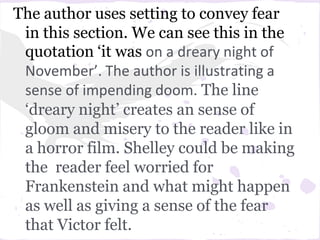
The author uses setting to convey fear
 in this section. We can see this in the
 quotation ‘it was on a dreary night of
 November’. The author is illustrating a
 sense of impending doom. The line
 ‘dreary night’ creates an sense of
 gloom and misery to the reader like in
 a horror film. Shelley could be making
 the reader feel worried for
 Frankenstein and what might happen
 as well as giving a sense of the fear
 that Victor felt.
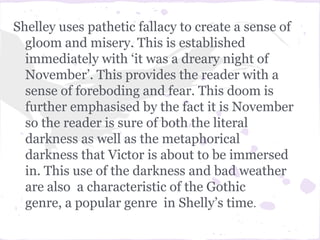
Shelley uses pathetic fallacy to create a sense of
  gloom and misery. This is established
  immediately with ‘it was a dreary night of
  November’. This provides the reader with a
  sense of foreboding and fear. This doom is
  further emphasised by the fact it is November
  so the reader is sure of both the literal
  darkness as well as the metaphorical
  darkness that Victor is about to be immersed
  in. This use of the darkness and bad weather
  are also a characteristic of the Gothic
  genre, a popular genre in Shelly’s time.
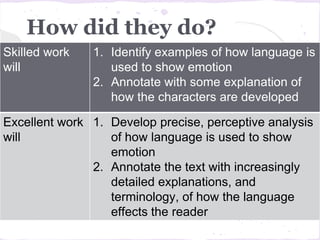
How did they do?
Skilled work   1. Identify examples of how language is
will              used to show emotion
               2. Annotate with some explanation of
                  how the characters are developed

Excellent work 1. Develop precise, perceptive analysis
will              of how language is used to show
                  emotion
               2. Annotate the text with increasingly
                  detailed explanations, and
                  terminology, of how the language
                  effects the reader
Last lesson
What annotation is like...
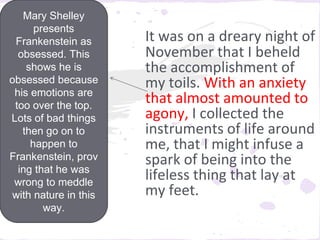
Mary Shelley
      presents
 Frankenstein as      It was on a dreary night of
  obsessed. This      November that I beheld
    shows he is       the accomplishment of
obsessed because      my toils. With an anxiety
 his emotions are
 too over the top.
                      that almost amounted to
Lots of bad things    agony, I collected the
   then go on to      instruments of life around
     happen to        me, that I might infuse a
Frankenstein, prov    spark of being into the
  ing that he was
 wrong to meddle
                      lifeless thing that lay at
with nature in this   my feet.
        way.
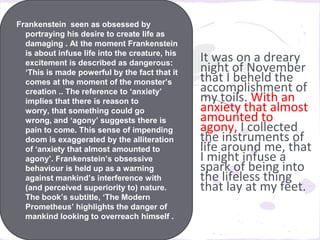
Frankenstein seen as obsessed by
  portraying his desire to create life as
  damaging . At the moment Frankenstein
  is about infuse life into the creature, his
  excitement is described as dangerous:
                                                It was on a dreary
  ‘This is made powerful by the fact that it    night of November
  comes at the moment of the monster’s          that I beheld the
  creation .. The reference to ‘anxiety’        accomplishment of
  implies that there is reason to               my toils. With an
  worry, that something could go                anxiety that almost
  wrong, and ‘agony’ suggests there is          amounted to
  pain to come. This sense of impending         agony, I collected
  doom is exaggerated by the alliteration       the instruments of
  of ‘anxiety that almost amounted to           life around me, that
  agony’. Frankenstein’s obsessive              I might infuse a
  behaviour is held up as a warning             spark of being into
  against mankind’s interference with           the lifeless thing
  (and perceived superiority to) nature.        that lay at my feet.
  The book’s subtitle, ‘The Modern
  Prometheus’ highlights the danger of
  mankind looking to overreach himself .
Now – find your own
quotations
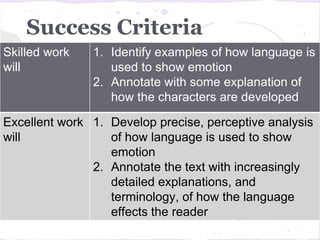
Success Criteria
Skilled work   1. Identify examples of how language is
will              used to show emotion
               2. Annotate with some explanation of
                  how the characters are developed

Excellent work 1. Develop precise, perceptive analysis
will              of how language is used to show
                  emotion
               2. Annotate the text with increasingly
                  detailed explanations, and
                  terminology, of how the language
                  effects the reader
Use you target to annotate Ch 5
and finish for homework due on Monday...


You cannot write well without good annotation
  this will be an awesome reference.
How to do it...
Skilled work will 1. Identify examples of how language is
                     used to show emotion
                  2. Annotate with some explanation of how
                     the characters are developed

Excellent work   1. Develop precise, perceptive analysis of
will                how language is used to show emotion
                 2. Annotate the text with increasingly
                    detailed explanations, and terminology,
                    of how the language effects the reader
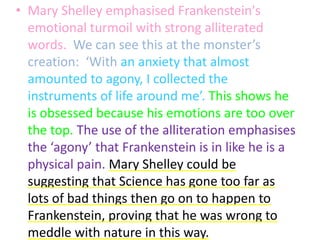
• Mary Shelley emphasised Frankenstein's
  emotional turmoil with strong alliterated
  words. We can see this at the monster’s
  creation: ‘With an anxiety that almost
  amounted to agony, I collected the
  instruments of life around me’. This shows he
  is obsessed because his emotions are too over
  the top. The use of the alliteration emphasises
  the ‘agony’ that Frankenstein is in like he is a
  physical pain. Mary Shelley could be
  suggesting that Science has gone too far as
  lots of bad things then go on to happen to
  Frankenstein, proving that he was wrong to
  meddle with nature in this way.
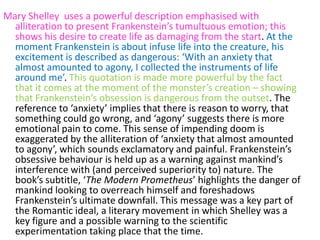
Mary Shelley uses a powerful description emphasised with
  alliteration to present Frankenstein’s tumultuous emotion; this
  shows his desire to create life as damaging from the start. At the
  moment Frankenstein is about infuse life into the creature, his
  excitement is described as dangerous: ‘With an anxiety that
  almost amounted to agony, I collected the instruments of life
  around me’. This quotation is made more powerful by the fact
  that it comes at the moment of the monster’s creation – showing
  that Frankenstein’s obsession is dangerous from the outset. The
  reference to ‘anxiety’ implies that there is reason to worry, that
  something could go wrong, and ‘agony’ suggests there is more
  emotional pain to come. This sense of impending doom is
  exaggerated by the alliteration of ‘anxiety that almost amounted
  to agony’, which sounds exclamatory and painful. Frankenstein’s
  obsessive behaviour is held up as a warning against mankind’s
  interference with (and perceived superiority to) nature. The
  book’s subtitle, ‘The Modern Prometheus’ highlights the danger of
  mankind looking to overreach himself and foreshadows
  Frankenstein’s ultimate downfall. This message was a key part of
  the Romantic ideal, a literary movement in which Shelley was a
  key figure and a possible warning to the scientific
  experimentation taking place that the time.
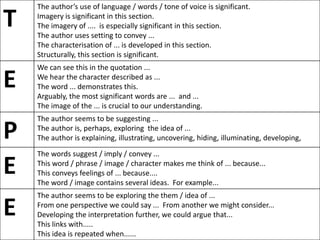
The author’s use of language / words / tone of voice is significant.

T   Imagery is significant in this section.
    The imagery of .... is especially significant in this section.
    The author uses setting to convey ...
    The characterisation of ... is developed in this section.
    Structurally, this section is significant.
    We can see this in the quotation ...

E   We hear the character described as ...
    The word ... demonstrates this.
    Arguably, the most significant words are ... and ...
    The image of the ... is crucial to our understanding.
    The author seems to be suggesting ...

P   The author is, perhaps, exploring the idea of ...
    The author is explaining, illustrating, uncovering, hiding, illuminating, developing,
    The words suggest / imply / convey ...

E   This word / phrase / image / character makes me think of ... because...
    This conveys feelings of ... because....
    The word / image contains several ideas. For example...
    The author seems to be exploring the them / idea of ...

E   From one perspective we could say ... From another we might consider...
    Developing the interpretation further, we could argue that...
    This links with.....
    This idea is repeated when......
• Mary Shelley emphasised Frankenstein's
  emotional turmoil with strong alliterated
  words. We can see this at the monster’s
  creation: ‘With an anxiety that almost
  amounted to agony, I collected the
  instruments of life around me’. This shows he
  is obsessed because his emotions are too over
  the top. The use of the alliteration emphasises
  the ‘agony’ that Frankenstein is in like he is a
  physical pain. Mary Shelley could be
  suggesting that Science has gone too far as
  lots of bad things then go on to happen to
  Frankenstein, proving that he was wrong to
  meddle with nature in this way.
Mary Shelley uses a powerful description emphasised with
  alliteration to present Frankenstein’s tumultuous emotion; this
  shows his desire to create life as damaging from the start. At the
  moment Frankenstein is about infuse life into the creature, his
  excitement is described as dangerous: ‘With an anxiety that
  almost amounted to agony, I collected the instruments of life
  around me’. This quotation is made more powerful by the fact
  that it comes at the moment of the monster’s creation – showing
  that Frankenstein’s obsession is dangerous from the outset. The
  reference to ‘anxiety’ implies that there is reason to worry, that
  something could go wrong, and ‘agony’ suggests there is more
  emotional pain to come. This sense of impending doom is
  exaggerated by the alliteration of ‘anxiety that almost amounted
  to agony’, which sounds exclamatory and painful. Frankenstein’s
  obsessive behaviour is held up as a warning against mankind’s
  interference with (and perceived superiority to) nature. The
  book’s subtitle, ‘The Modern Prometheus’ highlights the danger of
  mankind looking to overreach himself and foreshadows
  Frankenstein’s ultimate downfall. This message was a key part of
  the Romantic ideal, a literary movement in which Shelley was a
  key figure and a possible warning to the scientific
  experimentation taking place that the time.

Frankenstein find Quotes

  • 1.
  • 2.
  • 3.
    Title: Finding myown quotations Learning Objectives We are learning to... •Understand and explain the presentation of emotion in Frankenstein S4L: Team- work and independence
  • 4.
    What makes agood quotation? Think – Pair - Share
  • 5.
    Last lesson. Annotated Chapter5 and focussed on the opening. Written a TEPEE paragraph for: How does Shelley show emotion at the opening of Chapter 5? Assess www ebi
  • 6.
    The author usessetting to convey fear in this section. We can see this in the quotation ‘it was on a dreary night of November’. The author is illustrating a sense of impending doom. The line ‘dreary night’ creates an sense of gloom and misery to the reader like in a horror film. Shelley could be making the reader feel worried for Frankenstein and what might happen as well as giving a sense of the fear that Victor felt.
  • 7.
    Shelley uses patheticfallacy to create a sense of gloom and misery. This is established immediately with ‘it was a dreary night of November’. This provides the reader with a sense of foreboding and fear. This doom is further emphasised by the fact it is November so the reader is sure of both the literal darkness as well as the metaphorical darkness that Victor is about to be immersed in. This use of the darkness and bad weather are also a characteristic of the Gothic genre, a popular genre in Shelly’s time.
  • 8.
    How did theydo? Skilled work 1. Identify examples of how language is will used to show emotion 2. Annotate with some explanation of how the characters are developed Excellent work 1. Develop precise, perceptive analysis will of how language is used to show emotion 2. Annotate the text with increasingly detailed explanations, and terminology, of how the language effects the reader
  • 9.
  • 10.
    Mary Shelley presents Frankenstein as It was on a dreary night of obsessed. This November that I beheld shows he is the accomplishment of obsessed because my toils. With an anxiety his emotions are too over the top. that almost amounted to Lots of bad things agony, I collected the then go on to instruments of life around happen to me, that I might infuse a Frankenstein, prov spark of being into the ing that he was wrong to meddle lifeless thing that lay at with nature in this my feet. way.
  • 11.
    Frankenstein seen asobsessed by portraying his desire to create life as damaging . At the moment Frankenstein is about infuse life into the creature, his excitement is described as dangerous: It was on a dreary ‘This is made powerful by the fact that it night of November comes at the moment of the monster’s that I beheld the creation .. The reference to ‘anxiety’ accomplishment of implies that there is reason to my toils. With an worry, that something could go anxiety that almost wrong, and ‘agony’ suggests there is amounted to pain to come. This sense of impending agony, I collected doom is exaggerated by the alliteration the instruments of of ‘anxiety that almost amounted to life around me, that agony’. Frankenstein’s obsessive I might infuse a behaviour is held up as a warning spark of being into against mankind’s interference with the lifeless thing (and perceived superiority to) nature. that lay at my feet. The book’s subtitle, ‘The Modern Prometheus’ highlights the danger of mankind looking to overreach himself .
  • 12.
    Now – findyour own quotations
  • 13.
    Success Criteria Skilled work 1. Identify examples of how language is will used to show emotion 2. Annotate with some explanation of how the characters are developed Excellent work 1. Develop precise, perceptive analysis will of how language is used to show emotion 2. Annotate the text with increasingly detailed explanations, and terminology, of how the language effects the reader
  • 14.
    Use you targetto annotate Ch 5 and finish for homework due on Monday... You cannot write well without good annotation this will be an awesome reference.
  • 15.
    How to doit... Skilled work will 1. Identify examples of how language is used to show emotion 2. Annotate with some explanation of how the characters are developed Excellent work 1. Develop precise, perceptive analysis of will how language is used to show emotion 2. Annotate the text with increasingly detailed explanations, and terminology, of how the language effects the reader
  • 16.
    • Mary Shelleyemphasised Frankenstein's emotional turmoil with strong alliterated words. We can see this at the monster’s creation: ‘With an anxiety that almost amounted to agony, I collected the instruments of life around me’. This shows he is obsessed because his emotions are too over the top. The use of the alliteration emphasises the ‘agony’ that Frankenstein is in like he is a physical pain. Mary Shelley could be suggesting that Science has gone too far as lots of bad things then go on to happen to Frankenstein, proving that he was wrong to meddle with nature in this way.
  • 17.
    Mary Shelley usesa powerful description emphasised with alliteration to present Frankenstein’s tumultuous emotion; this shows his desire to create life as damaging from the start. At the moment Frankenstein is about infuse life into the creature, his excitement is described as dangerous: ‘With an anxiety that almost amounted to agony, I collected the instruments of life around me’. This quotation is made more powerful by the fact that it comes at the moment of the monster’s creation – showing that Frankenstein’s obsession is dangerous from the outset. The reference to ‘anxiety’ implies that there is reason to worry, that something could go wrong, and ‘agony’ suggests there is more emotional pain to come. This sense of impending doom is exaggerated by the alliteration of ‘anxiety that almost amounted to agony’, which sounds exclamatory and painful. Frankenstein’s obsessive behaviour is held up as a warning against mankind’s interference with (and perceived superiority to) nature. The book’s subtitle, ‘The Modern Prometheus’ highlights the danger of mankind looking to overreach himself and foreshadows Frankenstein’s ultimate downfall. This message was a key part of the Romantic ideal, a literary movement in which Shelley was a key figure and a possible warning to the scientific experimentation taking place that the time.
  • 18.
    The author’s useof language / words / tone of voice is significant. T Imagery is significant in this section. The imagery of .... is especially significant in this section. The author uses setting to convey ... The characterisation of ... is developed in this section. Structurally, this section is significant. We can see this in the quotation ... E We hear the character described as ... The word ... demonstrates this. Arguably, the most significant words are ... and ... The image of the ... is crucial to our understanding. The author seems to be suggesting ... P The author is, perhaps, exploring the idea of ... The author is explaining, illustrating, uncovering, hiding, illuminating, developing, The words suggest / imply / convey ... E This word / phrase / image / character makes me think of ... because... This conveys feelings of ... because.... The word / image contains several ideas. For example... The author seems to be exploring the them / idea of ... E From one perspective we could say ... From another we might consider... Developing the interpretation further, we could argue that... This links with..... This idea is repeated when......
  • 19.
    • Mary Shelleyemphasised Frankenstein's emotional turmoil with strong alliterated words. We can see this at the monster’s creation: ‘With an anxiety that almost amounted to agony, I collected the instruments of life around me’. This shows he is obsessed because his emotions are too over the top. The use of the alliteration emphasises the ‘agony’ that Frankenstein is in like he is a physical pain. Mary Shelley could be suggesting that Science has gone too far as lots of bad things then go on to happen to Frankenstein, proving that he was wrong to meddle with nature in this way.
  • 20.
    Mary Shelley usesa powerful description emphasised with alliteration to present Frankenstein’s tumultuous emotion; this shows his desire to create life as damaging from the start. At the moment Frankenstein is about infuse life into the creature, his excitement is described as dangerous: ‘With an anxiety that almost amounted to agony, I collected the instruments of life around me’. This quotation is made more powerful by the fact that it comes at the moment of the monster’s creation – showing that Frankenstein’s obsession is dangerous from the outset. The reference to ‘anxiety’ implies that there is reason to worry, that something could go wrong, and ‘agony’ suggests there is more emotional pain to come. This sense of impending doom is exaggerated by the alliteration of ‘anxiety that almost amounted to agony’, which sounds exclamatory and painful. Frankenstein’s obsessive behaviour is held up as a warning against mankind’s interference with (and perceived superiority to) nature. The book’s subtitle, ‘The Modern Prometheus’ highlights the danger of mankind looking to overreach himself and foreshadows Frankenstein’s ultimate downfall. This message was a key part of the Romantic ideal, a literary movement in which Shelley was a key figure and a possible warning to the scientific experimentation taking place that the time.