Prof. Moustafa M. Elsayed (consultant) 1
Duct Construction
By
Prof. Moustafa M. Elsayed
Consultant
moustafa.elsayed@egec-xprt.com
Prof. Moustafa M. Elsayed (consultant)
2
Contents
• Construction Drawings Symbols
• Duct Sizing
• Duct Pressure
• Duct Seal
• Controlling Costs
• Recommended Duct Velocities
• Noise Control
• Duct Liner & Duct Insulation
Prof. Moustafa M. Elsayed (consultant)
3
Contents
• Material: Galvanized Sheet
• Flexible Duct and Connectors
• Rectangular Duct Construction Schedule
• Transverse Joints for Rectangular Ducts
• Longitudinal Seams for Rectangular Ducts
• Round Ducts
• Duct Supports
• Typical Project
• References
Prof. Moustafa M. Elsayed (consultant)
4
Construction Drawings Symbols
Prof. Moustafa M. Elsayed (consultant)
5
Construction Drawings
Symbols
Prof. Moustafa M. Elsayed (consultant)
6
Construction Drawings
Symbols
Prof. Moustafa M. Elsayed (consultant)
7
Construction Drawings
Symbols
Prof. Moustafa M. Elsayed (consultant)
8
Duct Sizing
• Velocity Method
• Equal Friction Method
• Static Regain
• Balancing Method
Prof. Moustafa M. Elsayed (consultant)
9
Duct Pressure -1: Pressure
Gradient
Prof. Moustafa M. Elsayed (consultant)
10
Duct Pressure -2: Pressure Class
SMACNA-HVAC Pressure Ratings
± ½“ ± 1“ ± 2“ ± 3“ ± 4“ ± 6“ ± 10“
Ductwork Testing
-3” w.g. to lower 1.5* pressure rating
-2” w.g. to 2” Generally not tested
+3” w.g. to higher 1.5* pressure rating
Prof. Moustafa M. Elsayed (consultant)
11
Duct Pressure -3:
Pressure
Class
Designation
Prof. Moustafa M. Elsayed (consultant)
12
Duct Seals – 1
• Purpose of sealing
• Location of seal:
All joints
Transverse seams
Longitudinal seams
Connections
• Sealing Requirements: See Table 1-2
Prof. Moustafa M. Elsayed (consultant)
13
Duct Seals – 2: Seal Classes
Prof. Moustafa M. Elsayed (consultant)
14
Duct Seals – 3: Methods of Sealing
• Welding
Gaskets: this is used in flanged joints
Mastics (adhesives): this used in grooves
or between flanges
Mastics-plus-embedded-fabrics systems
(this is the preferable flexible sealant)
• Tapes
• Liquid sealant
Prof. Moustafa M. Elsayed (consultant)
15
Duct Seals – 4:
Methods of
Sealing
Prof. Moustafa M. Elsayed (consultant)
16
Duct Seals – 5: Leakage Test
• Leakage test is an added cost and thus is not
recommended for duct systems constructed to 3”
w.g. or lower.
• Apparent differences of about 10% between fan
delivery and sum of airflow measurements at
terminals do not necessarily mean poor sealing
and excessive leakage
Prof. Moustafa M. Elsayed (consultant)
17
Controlling Costs -1
• Use minimum number of fittings
• Consider the use of semi-extended plenums
• Seal duct work to minimize leakage
• Consider using round duct where space and
initial duct cost allows
• When using rectangular duct, maintain
aspect ratio as close to1:1 as possible to
minimize both initial and friction losses.
Prof. Moustafa M. Elsayed (consultant)
18
Controlling Costs - 2: Aspect
Ratio
Prof. Moustafa M. Elsayed (consultant)
19
Controlling Costs - 3:
Aspect Ratio
Relative
Installed
Cost
Prof. Moustafa M. Elsayed (consultant)
20
Controlling Costs - 4:
Aspect Ratio
Relative
Operating
Cost
Prof. Moustafa M. Elsayed (consultant)
21
Controlling Costs - 5:
Pressure Classification Relative Cost
Prof. Moustafa M. Elsayed (consultant)
22
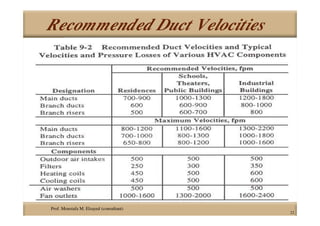
Recommended Duct Velocities
Prof. Moustafa M. Elsayed (consultant)
23
Recommended Duct Velocities
Prof. Moustafa M. Elsayed (consultant)
24
Liner Problem
• Erosion and presence of glass
fibers in the air stream and in the
room ambient environment. Some
people have expressed the concern
that inspired glass fibers from
glass fiber duct lining could cause
cancer.
Prof. Moustafa M. Elsayed (consultant)
25
Liner Problem
• Since 1966, many studies have been performed
that show no significant erosion of glass fibers
from the surface of duct board or duct liner. The
UL tests showed no evidence of erosion on the
samples tested
• The 1995 ASHRAE Handbook--Applications
and the 1997 ASHRAE Handbook--
Fundamentals state that there is no clear
evidence that any man-made mineral fiber is
carcinogenic. An extensive study presented to the
World Health Organization in 1988 stated that
"fibers were not a cause of adverse health effects
in building occupants..."
Prof. Moustafa M. Elsayed (consultant)
26
Duct Liner & Duct Insulation - 1
• Duct insulation is mounted or inner-lined to
reduce heat loss and heat gain as well as
to prevent the condensation on the outer
surface of the duct.
• Duct liner provides both thermal
insulation and sound attenuation.
• The thickness of an insulation layer is
based on economical analysis
Prof. Moustafa M. Elsayed (consultant)
27
Duct Insulation Choices
• External duct wrap or mechanical board
insulation
• Internal duct liner insulation
• Fiber glass duct board systems in place
of rectangular metal ducts
• Flexible round air ducts
Prof. Moustafa M. Elsayed (consultant)
28
Duct Insulation Choices
External duct wrap or mechanical board
insulation
• They serve as a vapor retarder and thermal
insulation
• High-density mechanical boards will also
provide a slight reduction of break-out and
vibration-related noise from the metal air
ducts
Prof. Moustafa M. Elsayed (consultant)
29
Duct Insulation Choices
Internal duct liner insulation
• Duct lining materials are applied to the interior
duct surfaces
• Duct liner serve as a very effective passive noise
reduction system
• Internal duct insulations offer the thermal benefits
of exterior duct insulations
• Duct liner is available in medium-density flexible
form, and as a higher density rigid form
Prof. Moustafa M. Elsayed (consultant)
30
Duct Insulation Choices
Fiber glass duct board systems
• Rigid, high-density fiber glass board ducts
(replacement for sealed, insulated metal air
duct)
• Duct board combines structural integrity
and thermal/acoustical insulation
• No vibration or regenerated noise
• Possible health hazard
• Possible short life
Prof. Moustafa M. Elsayed (consultant)
31
Duct Insulation Choices
Flexible round air ducts
• Available in a wide variety of diameters and
lengths,
• Flex duct provides good thermal performance,
and incorporates an internal air barrier and
external vapor retarder jacket.
• Acoustical absorption varies by flex product;
typical values (measured by Noise Reduction
Coefficient, or NRC) are only 20 to 30% of
values demonstrated by duct liner or fiber glass
duct systems.
Prof. Moustafa M. Elsayed (consultant)
32
Duct Material
• Galvanized
• Fiber Glass
Prof. Moustafa M. Elsayed (consultant)
33
Galvanized Sheet
Prof. Moustafa M. Elsayed (consultant)
34
Galvanized Sheet
Prof. Moustafa M. Elsayed (consultant)
35
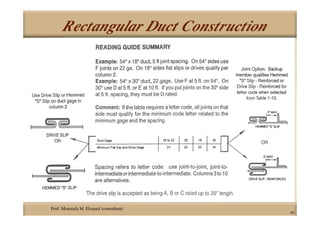
Rectangular Duct Construction: Procedure
• Determine pressure class
• Use Table 1-3 to 1-9 for reinforcement schedule
• The greater duct dimension determines the gage
for all sides.
• Reinforcement may be different on sides with
unequal dimension.
• Joint connection without reinforcement: Column
2 with minimum gage, use flat type joint
connection
Prof. Moustafa M. Elsayed (consultant)
36
Rectangular Duct Construction: Procedure
• Joint with reinforcement: Columns 3 to 10,
use required reinforcement interval to get
the minimum gage and the letter code for
the type of joint.
• Type of Intermediate Reinforcement; see
Table 1-10
• Type of Transverse Joint Reinforcement;
see Tables 1-11 to 1-13
Prof. Moustafa M. Elsayed (consultant)
37
Rectangular Duct Construction
General Notes
• Beading and cross breaking are not substitute
for reinforcement
• Type of reinforcement:
Transverse Joint Reinforcement
Intermediate Reinforcement
• Fittings shall be reinforced like sections of
straight duct. On size change fittings, the
greater fitting dimension determines the duct
gage.
Prof. Moustafa M. Elsayed (consultant)
38
Rectangular Duct Construction
General Notes
• Duct sides that are:
19” and over with more than 10 square
feet of unbraced panel area, or
20 gage or less with more than 10 square
feet of unbraced panel area
shall be cross-broken or beaded as indicated in
Figure 1.8. This will not be required if duct is
lined or externally insulated.
• Duct wall thickness, joints, seams and
reinforcement must be coordinated to provide
proper assembly.
Prof. Moustafa M. Elsayed (consultant)
39
Rectangular Duct Construction
Cross-Broken or Beaded Ducts
Prof. Moustafa M. Elsayed (consultant)
40
Rectangular Duct Construction
Prof. Moustafa M. Elsayed (consultant)
41
Rectangular Duct Construction
Prof. Moustafa M. Elsayed (consultant)
42
Prof. Moustafa M. Elsayed (consultant)
43
Prof. Moustafa M. Elsayed (consultant)
44
Prof. Moustafa M. Elsayed (consultant)
45
Example
• Given: 1” wg duct with dimension 18” ×
11”
• Determine: SMACNA construction
recommendation for this duct
Recommendations
• Use Table 1-4
• Use Table 1-11 for type B reinforcement
• Use Table 1-10 for intermediate
reinforcement
Prof. Moustafa M. Elsayed (consultant)
46
Example: continued
Use Table 1-4
At 18” use 22ga without
reinforcement
Or 26 ga with type B
reinforcement at 8’
interval
At 12”, use 26ga
without
reinforcement
Prof. Moustafa M. Elsayed (consultant)
47
Example: continued
Prof. Moustafa M. Elsayed (consultant)
48
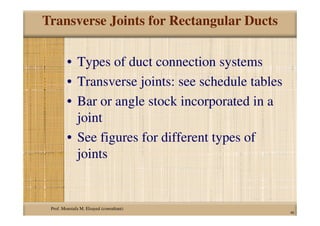
• Types of duct connection systems
• Transverse joints: see schedule tables
• Bar or angle stock incorporated in a
joint
• See figures for different types of
joints
Transverse Joints for Rectangular Ducts
Prof. Moustafa M. Elsayed (consultant)
49
Transverse
Joints
for
Rectangular
Ducts
Prof. Moustafa M. Elsayed (consultant)
50
Longitudinal Seams for
Rectangular Duct
Prof. Moustafa M. Elsayed (consultant)
51
Longitudinal Seams for Rectangular Duct
Prof. Moustafa M. Elsayed (consultant)
52
Longitudinal
Seams
for
Rectangular
Duct
Prof. Moustafa M. Elsayed (consultant)
53
Round Ducts
• Categories:
All continuously welded or braced
Tack or spot welded (sealed or unsealed)
Seam locked
Rivet, screw or punched-die-stamp locked
• Gage Schedule:
See Table 3-2A for +ve pressure and
See Table 3-2B for -ve pressure
• Seams: See Fig. 3-1
• Traverse Joints: See Fig. 3-2
Prof. Moustafa M. Elsayed (consultant)
54
Round
Ducts
Prof. Moustafa M. Elsayed (consultant)
55
Round Ducts
Prof. Moustafa M. Elsayed (consultant)
56
Round Ducts
Prof. Moustafa M. Elsayed (consultant)
57
Round Ducts
Prof. Moustafa M. Elsayed (consultant)
58
Round
Ducts
Transverse
Joints
Prof. Moustafa M. Elsayed (consultant)
59
Duct Supports
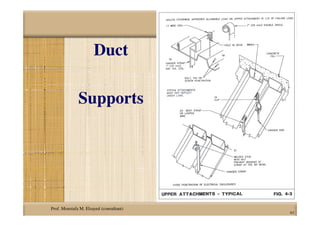
• Components of duct hanging system
Upper attachment to building: see Figs 4-1, 4-2, 4-3
Hanger itself: strips of galvanized steel or round
steel rod
Lower attachment to duct: see Fig. 4-4
• Horizontal duct sheet shall have a support
Within two feet (0.61 m) of each elbow
Within four feet of each branch insertion
Prof. Moustafa M. Elsayed (consultant)
60
Duct Supports
• Hanger Sizing and Spacing:
Rectangular Duct: See Table 4-1
Round Duct; See Table 4-2
• Riser Support:
Rectangular Duct, Support from Floor: See Fig.
4.7
Rectangular Duct, Support from Wall: See Fig. 4-8
Circular Duct, Support from Floor: See Fig. 4-9
Prof. Moustafa M. Elsayed (consultant)
61
Duct
Supports
Prof. Moustafa M. Elsayed (consultant)
62
Duct
Supports
Prof. Moustafa M. Elsayed (consultant)
63
Duct
Supports
Prof. Moustafa M. Elsayed (consultant)
64
Duct
Supports
Prof. Moustafa M. Elsayed (consultant)
65
Duct Supports
Prof. Moustafa M. Elsayed (consultant)
66
Duct Supports
Prof. Moustafa M. Elsayed (consultant)
67
Duct Supports
Prof. Moustafa M. Elsayed (consultant)
68
Duct Supports
Prof. Moustafa M. Elsayed (consultant)
69
Duct
Supports
Prof. Moustafa M. Elsayed (consultant)
70
Duct
Supports
Prof. Moustafa M. Elsayed (consultant)
71
Duct
Supports
Prof. Moustafa M. Elsayed (consultant)
72
References
1. HVAC Duct Construction Standards, Metal and
Flexible, Sheet Metal and Air Conditioning Contractors’
National Association, Inc., Second Edition, 1995,
Fourth printing 1998.
2. HVAC Systems Duct Design, Sheet Metal and Air
Conditioning contractors’ National Association, Inc.,
Third Edition, 1990, Fourth printing 1998.
3. Howell R. H., Sauer H. J., and Coad, Principals of
Heating, Ventilating and Air conditioning, American
society of Heating, Refrigeration and Air Conditioning
Engineers, Inc., Atlanta, Georgia, 1998.
4. Bell A. B, JR: HVAC Equations, Data, and Rules of
Thumb, McGraw-Hill, 2000.
Prof. Moustafa M. Elsayed (consultant)
73
References
• ROBERT W. TINSLEY , Duct Liner: Problem or
Solution? , HPAC Engineering Journal, May 1998..
Prof. Moustafa M. Elsayed (consultant)
74

Duct Construction 050507

  • 1.
    Prof. Moustafa M.Elsayed (consultant) 1 Duct Construction By Prof. Moustafa M. Elsayed Consultant moustafa.elsayed@egec-xprt.com
  • 2.
    Prof. Moustafa M.Elsayed (consultant) 2 Contents • Construction Drawings Symbols • Duct Sizing • Duct Pressure • Duct Seal • Controlling Costs • Recommended Duct Velocities • Noise Control • Duct Liner & Duct Insulation
  • 3.
    Prof. Moustafa M.Elsayed (consultant) 3 Contents • Material: Galvanized Sheet • Flexible Duct and Connectors • Rectangular Duct Construction Schedule • Transverse Joints for Rectangular Ducts • Longitudinal Seams for Rectangular Ducts • Round Ducts • Duct Supports • Typical Project • References
  • 4.
    Prof. Moustafa M.Elsayed (consultant) 4 Construction Drawings Symbols
  • 5.
    Prof. Moustafa M.Elsayed (consultant) 5 Construction Drawings Symbols
  • 6.
    Prof. Moustafa M.Elsayed (consultant) 6 Construction Drawings Symbols
  • 7.
    Prof. Moustafa M.Elsayed (consultant) 7 Construction Drawings Symbols
  • 8.
    Prof. Moustafa M.Elsayed (consultant) 8 Duct Sizing • Velocity Method • Equal Friction Method • Static Regain • Balancing Method
  • 9.
    Prof. Moustafa M.Elsayed (consultant) 9 Duct Pressure -1: Pressure Gradient
  • 10.
    Prof. Moustafa M.Elsayed (consultant) 10 Duct Pressure -2: Pressure Class SMACNA-HVAC Pressure Ratings ± ½“ ± 1“ ± 2“ ± 3“ ± 4“ ± 6“ ± 10“ Ductwork Testing -3” w.g. to lower 1.5* pressure rating -2” w.g. to 2” Generally not tested +3” w.g. to higher 1.5* pressure rating
  • 11.
    Prof. Moustafa M.Elsayed (consultant) 11 Duct Pressure -3: Pressure Class Designation
  • 12.
    Prof. Moustafa M.Elsayed (consultant) 12 Duct Seals – 1 • Purpose of sealing • Location of seal: All joints Transverse seams Longitudinal seams Connections • Sealing Requirements: See Table 1-2
  • 13.
    Prof. Moustafa M.Elsayed (consultant) 13 Duct Seals – 2: Seal Classes
  • 14.
    Prof. Moustafa M.Elsayed (consultant) 14 Duct Seals – 3: Methods of Sealing • Welding Gaskets: this is used in flanged joints Mastics (adhesives): this used in grooves or between flanges Mastics-plus-embedded-fabrics systems (this is the preferable flexible sealant) • Tapes • Liquid sealant
  • 15.
    Prof. Moustafa M.Elsayed (consultant) 15 Duct Seals – 4: Methods of Sealing
  • 16.
    Prof. Moustafa M.Elsayed (consultant) 16 Duct Seals – 5: Leakage Test • Leakage test is an added cost and thus is not recommended for duct systems constructed to 3” w.g. or lower. • Apparent differences of about 10% between fan delivery and sum of airflow measurements at terminals do not necessarily mean poor sealing and excessive leakage
  • 17.
    Prof. Moustafa M.Elsayed (consultant) 17 Controlling Costs -1 • Use minimum number of fittings • Consider the use of semi-extended plenums • Seal duct work to minimize leakage • Consider using round duct where space and initial duct cost allows • When using rectangular duct, maintain aspect ratio as close to1:1 as possible to minimize both initial and friction losses.
  • 18.
    Prof. Moustafa M.Elsayed (consultant) 18 Controlling Costs - 2: Aspect Ratio
  • 19.
    Prof. Moustafa M.Elsayed (consultant) 19 Controlling Costs - 3: Aspect Ratio Relative Installed Cost
  • 20.
    Prof. Moustafa M.Elsayed (consultant) 20 Controlling Costs - 4: Aspect Ratio Relative Operating Cost
  • 21.
    Prof. Moustafa M.Elsayed (consultant) 21 Controlling Costs - 5: Pressure Classification Relative Cost
  • 22.
    Prof. Moustafa M.Elsayed (consultant) 22 Recommended Duct Velocities
  • 23.
    Prof. Moustafa M.Elsayed (consultant) 23 Recommended Duct Velocities
  • 24.
    Prof. Moustafa M.Elsayed (consultant) 24 Liner Problem • Erosion and presence of glass fibers in the air stream and in the room ambient environment. Some people have expressed the concern that inspired glass fibers from glass fiber duct lining could cause cancer.
  • 25.
    Prof. Moustafa M.Elsayed (consultant) 25 Liner Problem • Since 1966, many studies have been performed that show no significant erosion of glass fibers from the surface of duct board or duct liner. The UL tests showed no evidence of erosion on the samples tested • The 1995 ASHRAE Handbook--Applications and the 1997 ASHRAE Handbook-- Fundamentals state that there is no clear evidence that any man-made mineral fiber is carcinogenic. An extensive study presented to the World Health Organization in 1988 stated that "fibers were not a cause of adverse health effects in building occupants..."
  • 26.
    Prof. Moustafa M.Elsayed (consultant) 26 Duct Liner & Duct Insulation - 1 • Duct insulation is mounted or inner-lined to reduce heat loss and heat gain as well as to prevent the condensation on the outer surface of the duct. • Duct liner provides both thermal insulation and sound attenuation. • The thickness of an insulation layer is based on economical analysis
  • 27.
    Prof. Moustafa M.Elsayed (consultant) 27 Duct Insulation Choices • External duct wrap or mechanical board insulation • Internal duct liner insulation • Fiber glass duct board systems in place of rectangular metal ducts • Flexible round air ducts
  • 28.
    Prof. Moustafa M.Elsayed (consultant) 28 Duct Insulation Choices External duct wrap or mechanical board insulation • They serve as a vapor retarder and thermal insulation • High-density mechanical boards will also provide a slight reduction of break-out and vibration-related noise from the metal air ducts
  • 29.
    Prof. Moustafa M.Elsayed (consultant) 29 Duct Insulation Choices Internal duct liner insulation • Duct lining materials are applied to the interior duct surfaces • Duct liner serve as a very effective passive noise reduction system • Internal duct insulations offer the thermal benefits of exterior duct insulations • Duct liner is available in medium-density flexible form, and as a higher density rigid form
  • 30.
    Prof. Moustafa M.Elsayed (consultant) 30 Duct Insulation Choices Fiber glass duct board systems • Rigid, high-density fiber glass board ducts (replacement for sealed, insulated metal air duct) • Duct board combines structural integrity and thermal/acoustical insulation • No vibration or regenerated noise • Possible health hazard • Possible short life
  • 31.
    Prof. Moustafa M.Elsayed (consultant) 31 Duct Insulation Choices Flexible round air ducts • Available in a wide variety of diameters and lengths, • Flex duct provides good thermal performance, and incorporates an internal air barrier and external vapor retarder jacket. • Acoustical absorption varies by flex product; typical values (measured by Noise Reduction Coefficient, or NRC) are only 20 to 30% of values demonstrated by duct liner or fiber glass duct systems.
  • 32.
    Prof. Moustafa M.Elsayed (consultant) 32 Duct Material • Galvanized • Fiber Glass
  • 33.
    Prof. Moustafa M.Elsayed (consultant) 33 Galvanized Sheet
  • 34.
    Prof. Moustafa M.Elsayed (consultant) 34 Galvanized Sheet
  • 35.
    Prof. Moustafa M.Elsayed (consultant) 35 Rectangular Duct Construction: Procedure • Determine pressure class • Use Table 1-3 to 1-9 for reinforcement schedule • The greater duct dimension determines the gage for all sides. • Reinforcement may be different on sides with unequal dimension. • Joint connection without reinforcement: Column 2 with minimum gage, use flat type joint connection
  • 36.
    Prof. Moustafa M.Elsayed (consultant) 36 Rectangular Duct Construction: Procedure • Joint with reinforcement: Columns 3 to 10, use required reinforcement interval to get the minimum gage and the letter code for the type of joint. • Type of Intermediate Reinforcement; see Table 1-10 • Type of Transverse Joint Reinforcement; see Tables 1-11 to 1-13
  • 37.
    Prof. Moustafa M.Elsayed (consultant) 37 Rectangular Duct Construction General Notes • Beading and cross breaking are not substitute for reinforcement • Type of reinforcement: Transverse Joint Reinforcement Intermediate Reinforcement • Fittings shall be reinforced like sections of straight duct. On size change fittings, the greater fitting dimension determines the duct gage.
  • 38.
    Prof. Moustafa M.Elsayed (consultant) 38 Rectangular Duct Construction General Notes • Duct sides that are: 19” and over with more than 10 square feet of unbraced panel area, or 20 gage or less with more than 10 square feet of unbraced panel area shall be cross-broken or beaded as indicated in Figure 1.8. This will not be required if duct is lined or externally insulated. • Duct wall thickness, joints, seams and reinforcement must be coordinated to provide proper assembly.
  • 39.
    Prof. Moustafa M.Elsayed (consultant) 39 Rectangular Duct Construction Cross-Broken or Beaded Ducts
  • 40.
    Prof. Moustafa M.Elsayed (consultant) 40 Rectangular Duct Construction
  • 41.
    Prof. Moustafa M.Elsayed (consultant) 41 Rectangular Duct Construction
  • 42.
    Prof. Moustafa M.Elsayed (consultant) 42
  • 43.
    Prof. Moustafa M.Elsayed (consultant) 43
  • 44.
    Prof. Moustafa M.Elsayed (consultant) 44
  • 45.
    Prof. Moustafa M.Elsayed (consultant) 45 Example • Given: 1” wg duct with dimension 18” × 11” • Determine: SMACNA construction recommendation for this duct Recommendations • Use Table 1-4 • Use Table 1-11 for type B reinforcement • Use Table 1-10 for intermediate reinforcement
  • 46.
    Prof. Moustafa M.Elsayed (consultant) 46 Example: continued Use Table 1-4 At 18” use 22ga without reinforcement Or 26 ga with type B reinforcement at 8’ interval At 12”, use 26ga without reinforcement
  • 47.
    Prof. Moustafa M.Elsayed (consultant) 47 Example: continued
  • 48.
    Prof. Moustafa M.Elsayed (consultant) 48 • Types of duct connection systems • Transverse joints: see schedule tables • Bar or angle stock incorporated in a joint • See figures for different types of joints Transverse Joints for Rectangular Ducts
  • 49.
    Prof. Moustafa M.Elsayed (consultant) 49 Transverse Joints for Rectangular Ducts
  • 50.
    Prof. Moustafa M.Elsayed (consultant) 50 Longitudinal Seams for Rectangular Duct
  • 51.
    Prof. Moustafa M.Elsayed (consultant) 51 Longitudinal Seams for Rectangular Duct
  • 52.
    Prof. Moustafa M.Elsayed (consultant) 52 Longitudinal Seams for Rectangular Duct
  • 53.
    Prof. Moustafa M.Elsayed (consultant) 53 Round Ducts • Categories: All continuously welded or braced Tack or spot welded (sealed or unsealed) Seam locked Rivet, screw or punched-die-stamp locked • Gage Schedule: See Table 3-2A for +ve pressure and See Table 3-2B for -ve pressure • Seams: See Fig. 3-1 • Traverse Joints: See Fig. 3-2
  • 54.
    Prof. Moustafa M.Elsayed (consultant) 54 Round Ducts
  • 55.
    Prof. Moustafa M.Elsayed (consultant) 55 Round Ducts
  • 56.
    Prof. Moustafa M.Elsayed (consultant) 56 Round Ducts
  • 57.
    Prof. Moustafa M.Elsayed (consultant) 57 Round Ducts
  • 58.
    Prof. Moustafa M.Elsayed (consultant) 58 Round Ducts Transverse Joints
  • 59.
    Prof. Moustafa M.Elsayed (consultant) 59 Duct Supports • Components of duct hanging system Upper attachment to building: see Figs 4-1, 4-2, 4-3 Hanger itself: strips of galvanized steel or round steel rod Lower attachment to duct: see Fig. 4-4 • Horizontal duct sheet shall have a support Within two feet (0.61 m) of each elbow Within four feet of each branch insertion
  • 60.
    Prof. Moustafa M.Elsayed (consultant) 60 Duct Supports • Hanger Sizing and Spacing: Rectangular Duct: See Table 4-1 Round Duct; See Table 4-2 • Riser Support: Rectangular Duct, Support from Floor: See Fig. 4.7 Rectangular Duct, Support from Wall: See Fig. 4-8 Circular Duct, Support from Floor: See Fig. 4-9
  • 61.
    Prof. Moustafa M.Elsayed (consultant) 61 Duct Supports
  • 62.
    Prof. Moustafa M.Elsayed (consultant) 62 Duct Supports
  • 63.
    Prof. Moustafa M.Elsayed (consultant) 63 Duct Supports
  • 64.
    Prof. Moustafa M.Elsayed (consultant) 64 Duct Supports
  • 65.
    Prof. Moustafa M.Elsayed (consultant) 65 Duct Supports
  • 66.
    Prof. Moustafa M.Elsayed (consultant) 66 Duct Supports
  • 67.
    Prof. Moustafa M.Elsayed (consultant) 67 Duct Supports
  • 68.
    Prof. Moustafa M.Elsayed (consultant) 68 Duct Supports
  • 69.
    Prof. Moustafa M.Elsayed (consultant) 69 Duct Supports
  • 70.
    Prof. Moustafa M.Elsayed (consultant) 70 Duct Supports
  • 71.
    Prof. Moustafa M.Elsayed (consultant) 71 Duct Supports
  • 72.
    Prof. Moustafa M.Elsayed (consultant) 72 References 1. HVAC Duct Construction Standards, Metal and Flexible, Sheet Metal and Air Conditioning Contractors’ National Association, Inc., Second Edition, 1995, Fourth printing 1998. 2. HVAC Systems Duct Design, Sheet Metal and Air Conditioning contractors’ National Association, Inc., Third Edition, 1990, Fourth printing 1998. 3. Howell R. H., Sauer H. J., and Coad, Principals of Heating, Ventilating and Air conditioning, American society of Heating, Refrigeration and Air Conditioning Engineers, Inc., Atlanta, Georgia, 1998. 4. Bell A. B, JR: HVAC Equations, Data, and Rules of Thumb, McGraw-Hill, 2000.
  • 73.
    Prof. Moustafa M.Elsayed (consultant) 73 References • ROBERT W. TINSLEY , Duct Liner: Problem or Solution? , HPAC Engineering Journal, May 1998..
  • 74.
    Prof. Moustafa M.Elsayed (consultant) 74