Engineering in Construction
Business
By
Professor Moustafa M. Elsayed
Consultant, EGEC
moustafa.elsayed@egec-xprt.com
1
Contents
• History of Construction
• Engineering Education
• Constructions Fields
• Construction Big Picture
• Engineers Role in Construction Industry
• Construction Project Life Cycle
• Project Management
• Project Design
• Design for Sustainability
• Bidding for Construction Project
• Project Construction Supervision
• Testing and Commissioning
• References 2
History of Construction
3
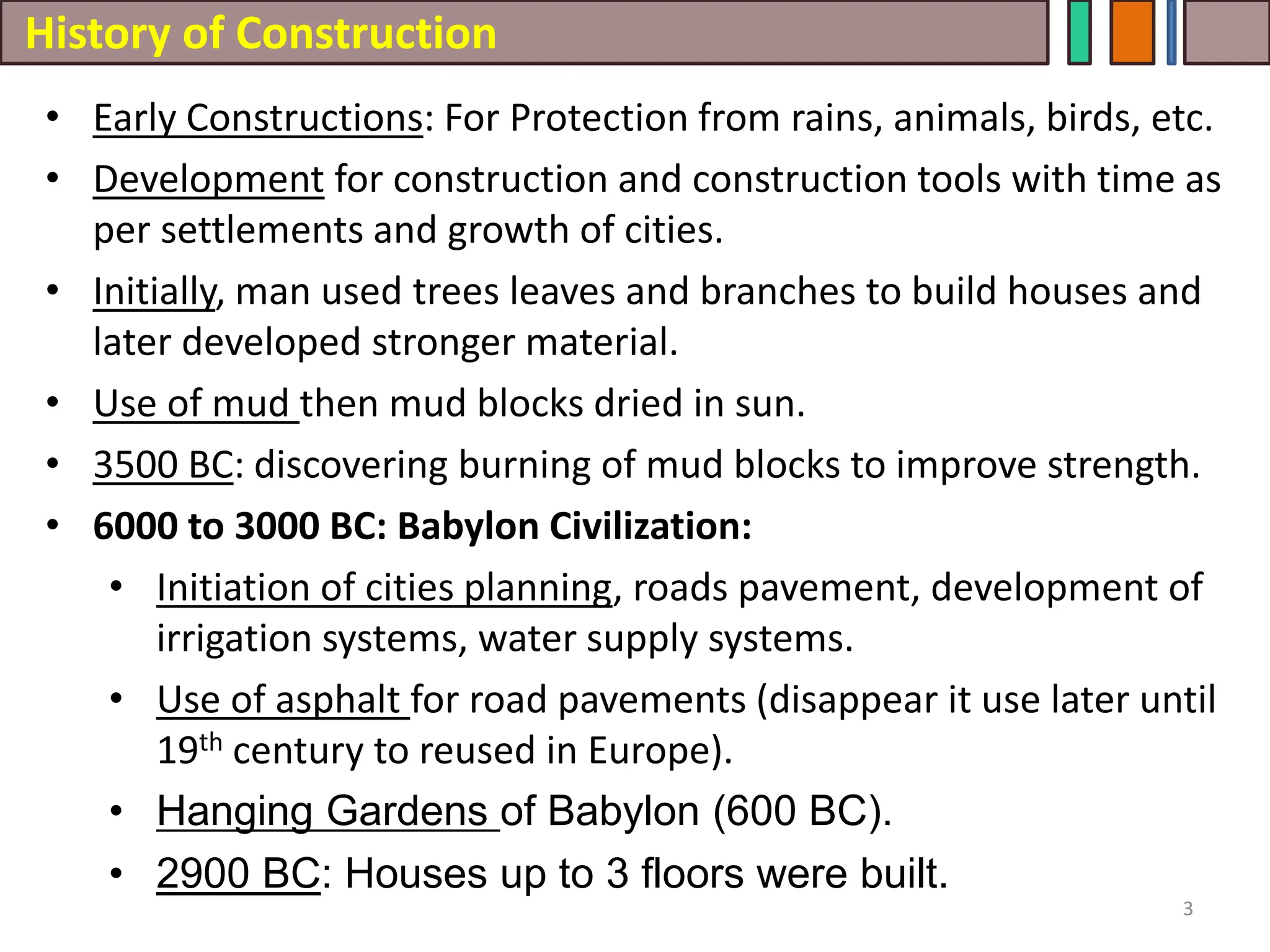
• Early Constructions: For Protection from rains, animals, birds, etc.
• Development for construction and construction tools with time as
per settlements and growth of cities.
• Initially, man used trees leaves and branches to build houses and
later developed stronger material.
• Use of mud then mud blocks dried in sun.
• 3500 BC: discovering burning of mud blocks to improve strength.
• 6000 to 3000 BC: Babylon Civilization:
• Initiation of cities planning, roads pavement, development of
irrigation systems, water supply systems.
• Use of asphalt for road pavements (disappear it use later until
19th century to reused in Europe).
• Hanging Gardens of Babylon (600 BC).
• 2900 BC: Houses up to 3 floors were built.
History of Construction
4
Hanging Gardens of Babylon (600 BC)
History of Construction
5
• 3000 to 300 BC: Ancient Egyptians
• Strong constructions like pyramids, temples, were built.
• Development of unknown techniques of using very heavy
stones (up to 2.5 ton each) in constructions.
• Water supply systems
• Drainage systems.
• 600 to 400 BC: Greek and Romans
• Greek transferred construction know how from Egyptians and
made further development.
• Roman transferred construction know how of countries they
invaded and made good development for construction of
palaces, temples, bridges, roads, water supply systems,
irrigation systems.
History of Construction
6
• 290 BC: Great Wall of China as protection against invasion
by neighbors.
History of Construction
7
Islamic Era
• Development for Islamic architecture for beautiful shaped
buildings.
• Development of techniques for effective transfer of sounds in
mosques.
• Development of dams and water supply systems (e.g. transfer of
water from Nile to Castel on top of Mokattum Mountain using
rotating wheels by animals).
• Development for construction of military castles.
• Planning of cities: location of mosque, souk, health protection
(rotting test), secured water supply, water drainage system,
natural ventilation, cold breath…
• Development of housing buildings, libraries, mosques,
government building and facilities, hospitals, hotels, roads, water
lifting, use of natural lighting, …
History of Construction
8
Western Industrial Revolution Era
• 1760: start of industrial revolution in UK and spreading to other
European contourites.
• Spread of us of machines operated by steam engines.
• 1860: wide spread of production of steel and its use in
construction for buildings with metal frame.
• Use of reinforced concrete
• 19th century: wide spread of use of electricity, spread of use of
electrical motors to replace steam operated engines.
• 1902: invention of cooling machines by Willis Carrier.
• 1920: Use of forced ventilation leading to building with large
footprint.
• Water pumps and drainage pumps leading to infrastructure for
water supply and drainage systems.
History of Construction
9
• Electrical power distribution infra structure systems.
• 1880: Invention of Electrical Elevators in Germany.
• Sky scrapers buildings: 1931 Empire State Building, New York,
1998 Petronas Twin Towers in Malaysia, 2010 Burj Khalifa in Dubai
Contents
• History of Construction
• Engineering Education
• Constructions Fields
• Construction Big Picture
• Engineers Role in Construction Industry
• Construction Project Life Cycle
• Project Management
• Project Design
• Design for Sustainability
• Bidding for Construction Project
• Project Construction Supervision
• Testing and Commissioning
• References 10
Engineering Education
11
Definition of Engineering
• Oxford English Dictionary: “the branch of science and technology
concerned with the design, building, and use of engines,
machines, and structures.”
• Wikipedia: “Engineering is the practice of using natural
science, mathematics, and the engineering design process to solve
technical problems, increase efficiency and productivity, and
improve systems.”
• American Engineers Council for Professional Development: “The
creative application of scientific principles to design or develop
structures, machines, apparatus, or manufacturing processes, or
works utilizing them singly or in combination; or to construct or
operate the same with full cognizance of their design; or to
forecast their behavior under specific operating conditions; all as
respects an intended function, economics of operation and safety
to life and property.”
Engineering Education
12
Engineer
• A person who is practicing Engineering is called and engineer.
• Early civilizations did not differentiate between different
disciplines of engineering like architecture, structural, mechanical,
etc.
• First engineer known by name in
history is Imhoteb (2670 BC) who
was an ancient engineer in
charge of building the Pyramid of
Djoser, a pyramid at Saqqara.
• He may also have been
responsible for the first known
use of stone columns to support a
building.
Engineering Education
13
Engineering Education in Early Days
• Transfer from one person to another
• Documentation by experienced people and by scientists.
• First Century BC: Marcus Vitruvius Pollio
was a Roman architect and engineer. He
put the first book on architectural
theory, and the book was also a major
source on the canon of classical
architecture.
• His book entitled “De architectura, libri
decem”, known today as The Ten Books
on Architecture.
Engineering Education
14
Islamic Era
• Engineer is called “Meaamary,
Mohandas, or Hasseb”
• Year 830: Establishment in
Bagdad first university in the
world to teach engineering.
• This called Beit Elhakma.
Courses include mathematics,
algebra, mechanics, drawings,
architecture, astronomy, and
physics.
• Engineers made design
drawings on leather and later
on paper when discovered.
Engineering Education
15
• Ibn al-Haytham ( 965 – 1040 )was a
great architect in addition of his great
knowledge in mathematics, pysics,
optics and astronomy.
• In year 1000 he was appointed by
Calif Al Hakim bi Amr Allah to
investigate the construction of high
dam on the river Nile at Aswan
location.
• His most famous work is his seven-
volume treatise on optics Kitab al-
Manazir (Book of Optics), written from
1011 to 1021.
Ibn al-Haytham
Engineering Education
16
• With Industrial Revolution and accompanied growth and
scientific research, the engineering education in
universities and schools grew with fast rate in Europe and
USA.
• New engineering branches appeared to keep pace with
the development of industry and technology.
• Translation of books from old civilizations put the bases
for the newly rising engineering education.
• Ranking of the oldest technical universities of Europe and
USA according to the year of establishment.
Western Development in Engineering Education
Engineering Education
17
Western Development in Engineering Education
https://old.lpnu.ua/en/200/ranking-oldest-technical-universities-europe
Engineering Education
18
Western Development in Engineering Education
https://old.lpnu.ua/en/200/ranking-oldest-technical-universities-europe
Engineering Education
19
Western Development in Engineering Education
https://old.lpnu.ua/en/200/ranking-oldest-technical-universities-europe
Contents
• History of Construction
• Engineering Education
• Constructions Fields
• Construction Big Picture
• Engineers Role in Construction Industry
• Construction Project Life Cycle
• Project Management
• Project Design
• Design for Sustainability
• Bidding for Construction Project
• Project Construction Supervision
• Testing and Commissioning
• References 20
Constructions Fields
• Infrastructure has been defined as "the physical components of
interrelated systems providing commodities and services
essential to enable, sustain, or enhance societal living
conditions" and maintain the surrounding environment.
• Infrastructure is the set of facilities and systems that serve a
country, city, or other areas, and encompasses the services and
facilities necessary for its economy, households and firms to
function.
• Infrastructure is composed of public and private physical
structures such as roads, railways, bridges, tunnels, water
supply, sewers, electrical grids, and telecommunications
(including Internet connectivity and broadband access).
21
Infrastructure
Constructions Fields
22
Infrastructure: Roads, Bridges, Railways, Tunnels
Constructions Fields
23
Infrastructure: Water Supply
Constructions Fields
24
Infrastructure: Water Supply, Dams, Sewage
Constructions Fields
25
Infrastructure: Power Grid
Constructions Fields
26
Infrastructure: Power Grid
Constructions Fields
• Airports
• Train stations
• Residential
• Office Buildings
• Restaurants
• Multi purpose buildings
• Educational buildings
• Hospitals
• Police stations
• Commercial buildings
• Governmental buildings
• Etc. 27
Buildings
Constructions Fields
Industrial Constructions
28
• This deals with factories, power
plants, warehouses, and other highly
specialized facilities.
• It refers to any business that
manufactures goods.
• Many industrial buildings have
special conveyance requirements
such as 24/7 shipping and receiving,
accessible nearby air or railroad
transportation, or access to major
highways.
• Industrial buildings are built for
functionality, not style
Contents
• History of Construction
• Engineering Education
• Constructions Fields
• Construction Big Picture
• Engineers Role in Construction Industry
• Construction Project Life Cycle
• Project Management
• Project Design
• Design for Sustainability
• Bidding for Construction Project
• Project Construction Supervision
• Testing and Commissioning
• References 29
Constructions Big Picture
Urban Planning
30
• Urban planning, is also known
as town planning, city
planning, regional planning,
or rural planning.
• It is a technical and political
process that is focused on the
development and design of land
use and the built environment,
including air, water, and
the infrastructure passing into and
out of urban areas, such
as transportation, communication,
and distribution networks and
their accessibility.
Constructions Big Picture
Urban Planning
31
Constructions Big Picture
Master Planning
32
• Master planning is a type
of urban planning that pertains
to the physical development of a
city or town over the long term.
• It may be defined as a general
plan for the future layout of a
city showing both the existing
and proposed streets or roads,
open spaces, public buildings
etc.
• A master plan is prepared either
for improvement of an old city
or for a new town to be
developed on a virgin soil.
Constructions Big Picture
Master Planning
33
Contents
• History of Construction
• Engineering Education
• Constructions Fields
• Construction Big Picture
• Engineers Role in Construction Industry
• Construction Project Life Cycle
• Project Management
• Project Design
• Design for Sustainability
• Bidding for Construction Project
• Project Construction Supervision
• Testing and Commissioning
• References 34
Engineers Role in Construction Industry
• Education: Undergraduate, Graduate,
Continuous
• R & D: in relation to all fields of construction
industry
• Contracting: Buildings, Infrastructure, Industrial
Facilities
• Consultation: Feasibility Studies, Project
Management, Design, Construction Supervision,
Testing, Commissioning, Renovation,
Demolishing
• Industrial: Manufacturing material and
equipment for different fields of construction
• Operation and Maintenance
• Supplying of construction project material and
equipment 35
Contents
• History of Construction
• Engineering Education
• Constructions Fields
• Construction Big Picture
• Engineers Role in Construction Industry
• Construction Project Life Cycle
• Project Management
• Project Design
• Design for Sustainability
• Bidding for Construction Project
• Project Construction Supervision
• Testing and Commissioning
• References 36
Construction Project Life Cycle
37
Construction Project Life Cycle
Feasibility Study
38
Contents
• History of Construction
• Engineering Education
• Constructions Fields
• Construction Big Picture
• Engineers Role in Construction Industry
• Construction Project Life Cycle
• Project Management
• Project Design
• Design for Sustainability
• Bidding for Construction Project
• Project Construction Supervision
• Testing and Commissioning
• References 39
Project Management
• Usually small projects do not need project management
whereas large projects must do
• Analysis of Production Process: Frederick W. Taylor (1856 –
1915): Detailed analysis of production process to improve
productivity. If a labor does not produce what is expected in a
time shift, deduct from his pay. No incentives for extra
production.
• Planning and Control Techniques: Henry Gantt (1861–1919), the
father of planning and control techniques
• Gantt Chart: Gantt Chart to compare planed production to
actual. Recommended fare relation between owner and labor.
Full pay for caring labor even if target is not achieve. Pay
incentive for extra productive for labor and team leader if all
team achieved goal. 40
Early Start of Project Management
Project Management
41
Gantt Chart
Project Management
• Program Evaluation and Review Technique (PERT) is a method
of analyzing the tasks involved in completing a given project,
especially the time needed to complete each task, and to
identify the minimum time needed to complete the total
project.
• It incorporates uncertainty by making it possible to schedule a
project while not knowing precisely the details and durations of
all the activities.
• The Critical Path Method (CPM) is a vital project management
tool that represents the most extended sequence of tasks that
must be accomplished to ensure the completion of the entire
project.
42
PERT and CPM
Project Management
43
….. PERT and CPM
• Determine the critical path
by measuring the longest
sequence of dependent
activities from start to end.
• The figure shows the PERT
network chart for a seven-
month project with
five milestones (10 through
50) and six activities (A
through F).
• Time for critical path in
shown example is 7 month.
Project Management
• Client
representatives
• Managing all tasks in
project including:
• Planning
• Time frame
• Cost and cash
flow time plan
• Project progress
evaluation
indices
• Quality control
44
Project Management Team Roles
Project Management
45
Contents
• History of Construction
• Engineering Education
• Constructions Fields
• Construction Big Picture
• Engineers Role in Construction Industry
• Construction Project Life Cycle
• Project Management
• Project Design
• Design for Sustainability
• Bidding for Construction Project
• Project Construction Supervision
• Testing and Commissioning
• References 46
Project Design
• Project Related Design
Disciplines
• Design Technical Manager
• Design Project Manager
• Design Stages
• Design Concept
• Design Schematic
• Final Design
• Design Codes and Standards
• Definition
• Importance
• Source
47
Project Design
48
Sample of Design Codes
and Standards
Project Design
49
• Design Documents:
• Project Description
& Construction
Tasks
• Design Drawings
• Specifications
• Bill of Quantities
• Calculations Notes
• Approved Suppliers
• Construction
Bidding Documents
Project Design
• Coordination of Infrastructure with Master Plan
• Roads, Bridges, landscape, location of Buildings
• Water Supply, Irrigation network, Storm, Sewage
• Chilled and Hot Water Networks
• Bosting Pumping Stations: Supply and Drainage
• Power Supply, Street Lighting, Data cables, Phones
• Substations, Power Control Stations
• Coordination of Building Construction with
• Landscape works
• Architecture Works
• Structural Works
• MEP Works
50
Coordination between Disciplines
Project Design
BIM (Building Information Modeling)
51
Project Design
BIM (Building Information Modeling)
52
‫ش‬
‫كل‬ 6- 6
‫الهندسية‬ ‫الرسومات‬ ‫باستخدام‬ ‫المباني‬ ‫أحد‬ ‫من‬ ‫لجزء‬
Project Design
BIM (Building Information Modeling)
53
Contents
• History of Construction
• Engineering Education
• Constructions Fields
• Construction Big Picture
• Engineers Role in Construction Industry
• Construction Project Life Cycle
• Project Management
• Project Design
• Design for Sustainability
• Bidding for Construction Project
• Project Construction Supervision
• Testing and Commissioning
• References 54
Design for Sustainability
55
Contribution to Global Warming
Design for Sustainability
• According to some studies, construction
is responsible for up to 50% of climate
change.
• It also impacts landfills and air, water,
and noise pollution.
• The construction industry can help
support the environment in a number
of ways, using new technology and
developing greener materials.
• Construction can be noisy, produce
excess waste and be energy inefficient.
• Green construction practices are being
introduced to minimize the negative
effects of these issues. 56
Construction and The Environment
Design for Sustainability
• Quieter, fuel-efficient tools
and machines are now
available, as well as recycling
and reusing materials where
possible to reduce waste.
• Sustainable building
operations.
• People who use the building
should be educated how to
maintain good environmental
practices such as recycling,
managing waste and being
energy efficient.
57
Construction and The Environment
Design for Sustainability
Sustainable Construction
58
Design for Sustainability
Sustainable Design Strategy
59
Design for Sustainability
• Environmentally sustainable building design (also
called environmentally conscious design, eco-
design, green design etc.) is the philosophy of
designing a building to comply with the
principles of ecological sustainability and also
aimed at improving the health and comfort of
occupants in a building.
• Sustainable design seeks to reduce negative
impacts on the environment, the health and
well-being of building occupants, thereby
improving building performance.
• The basic objectives of sustainability are to
reduce the consumption of non-renewable
resources, minimize waste, and create healthy,
productive environments. 60
Sustainable Building Design
Design for Sustainability
61
Principle of Sustainable Design
Design for Sustainability
• Certification is an essential aspect to provide a framework for
measuring the sustainability of a building or space and can help
identify areas for improvement.
• Certification can increase a property’s value, help comply with
environmental regulations, and demonstrate corporate social
responsibility.
• There are several authorities world wide for the certification of
sustainable designs.
• The most globally known authority in LEED (Leadership in Energy
and Environmental Design) in USA.
62
Certification of Sustainable Design
Design for Sustainability
63
Certification of Sustainable Design
Design for Sustainability
64
Certification of Sustainable Design
Contents
• History of Construction
• Engineering Education
• Constructions Fields
• Construction Big Picture
• Engineers Role in Construction Industry
• Construction Project Life Cycle
• Project Management
• Project Design
• Design for Sustainability
• Bidding for Construction Project
• Project Construction Supervision
• Testing and Commissioning
• References 65
Bidding for Construction Projects
• These documents are prepared by
design team.
• The documents guide the bidding
contractor to bid for the project and
explain how the bid is awarded.
• The client representative (client
team, PM company hired by client or
Construction Supervision team hired
by client) makes the invitation to
contractors.
• This is done by announcing a request
for proposal (RFP) to contractors or a
selected group of contractors.
66
Construction Bidding Documents
Bidding for Construction Projects
• Title page
• List of Contents
• Conditions to Qualify
• Owners Responsibilities
• Project Descriptions
• Scope of Work
• Time Frame
• Payment Method
• Terms for Variation Orders
• Achievements Reports
• Handing Over Requirements
• Approval of material and
supplies 67
Contents of RFP (Depending on Project)
• Approval of Construction
Drawings
• Financial Proposal Contents
• Financial Guarantees
• Financial Deductions if any
Bidding for Construction Projects
• Technical Proposal Contents
• Previous Experience
• Work Methodology
• Testing and Quality Control
• Security, Safety and Environ.
• Project Working Organization
• Working schedule of labors
• List of subcontractors if any
• List of forms to be used in RFP
• Date for opening of RFP
68
Contents of RFP (Depending on Project)
• Date of Announcing Winning
Contractor
• Method to select winning bid
• Draft of contract
• Date to submit RFP
• Etc.
Bidding for Construction Projects
69
Types of Construction Contracts
Contents
• History of Construction
• Engineering Education
• Constructions Fields
• Construction Big Picture
• Engineers Role in Construction Industry
• Construction Project Life Cycle
• Project Management
• Project Design
• Design for Sustainability
• Bidding for Construction Project
• Project Construction Supervision
• Testing and Commissioning
• References 70
Project Construction Supervision
• Monitoring and supervising all the
construction activities at the site to
ensure all construction practices are
followed and the legal regulations
and standards are enforced
• Ensuring that the structural,
mechanical, and electrical aspects
of building construction are carried
out in conformance with the plans,
specifications, and required
standards.
• Updating the client regularly on the
progress of the project in terms of
time, cost, and quality 71
Importance of Construction Supervision
Project Construction Supervision
• Quality control by ensuring
adherence to the original
design and planning decision
• Guaranteeing the materials,
equipment, and system used
are of good quality and
conform to the standards
• Ensuring the cost of the project
stays within the budget
throughout the whole project
• Enforcing site safety
procedures to minimize work-
related injuries or accidents
72
Importance of Construction Supervision
Contents
• History of Construction
• Engineering Education
• Constructions Fields
• Construction Big Picture
• Engineers Role in Construction Industry
• Construction Project Life Cycle
• Project Management
• Project Design
• Design for Sustainability
• Bidding for Construction Project
• Project Construction Supervision
• Testing and Commissioning
• References 73
Testing and Commissioning
• Material testing puts resources
like soil, concrete, rebar,
structural steel, and masonry
through a series of assessments
that examine and analyze
performance prior to and during
construction.
• At the construction site, wet
materials like concrete must be
tested because wet
characteristics impact how that
material sets and strengthens
over time.
74
Construction Material Testing
Testing and Commissioning
• There are many tests that can be
performed prior to, during, or after
construction to assist in the conformity
of the project.
• For example, floor moisture analysis and
floor flatness testing define the safety
and longevity of a concrete slab
foundation.
• Floor moisture analysis detects any
wetness or moisture within the concrete
slab, eliminating future flooring issues.
• Floor flatness testing measures how
close the concrete slab is to planar,
detecting any waves that move across
the top. 75
floor flatness testing
floor moisture testing
Testing and Commissioning
• Testing of electrical installations
is the step that follows the
completion of the connection of
equipment in the field and
connection to electrical
cabinets.
• Examples of tests are : Wiring
continuity test, Insulation
resistance test, Earth continuity
test, Earth resistivity test,
Performance test, and any other
tests as instructed by the
Supervising Engineer
76
Electrical Testing
Testing and Commissioning
• Testing, Adjusting, and Balancing
(TAB) involves measuring and
adjusting air and water flows to
meet design requirements.
• HVAC system efficiency, sound
levels, and human comfort are all
influenced by system airflow.
77
HVAC Testing, Adjusting and Balancing (TAB)
Testing and Commissioning
• In previous slides we showed some
examples of tests in construction
projects.
• There are many other tests like:
• Fire fighting systems tests
• Tests for roads and bridges
• Tests for water supply networks
• Tests for pumping stations
• Etc.
78
Other Tests
Testing and Commissioning
• Project commissioning is the
process of ensuring that all
systems and components of
a building or industrial plant are
designed, installed, tested,
operated, and maintained
according to the owner's or
final client's operational
requirements.
• A commissioning process may
be applied not only to
new projects but also to
existing units and systems
subject to expansion or
renovation. 79
Commissioning
Testing and Commissioning
• Commissioning activities in the
broader sense applicable to all
phases of the project from the
basic and detailed design,
procurement, construction and
assembly until the final
handover to the owner.
• The earlier a Commissioning
Provider is involved in the
project process the greater the
chance there is for the
Commissioning Provider to
influence corrections without
increased costs later.
80
Commissioning
References
Most of the material in this
presentation is taken from:
Moustafa M. Elsayed,
Engineering
Electromechanical
Consultation for Construction
Works. In Arabic Published by
Dar Elfekr Elarabi, Cairo,
Egypt, 2017.
A digital copy is available
free of charge from linkedin
Search for:
“moustafa-m-elsayed”
81
References
82
83

T19 Engineering in Construction Business 231211.pdf

  • 1.
    Engineering in Construction Business By ProfessorMoustafa M. Elsayed Consultant, EGEC moustafa.elsayed@egec-xprt.com 1
  • 2.
    Contents • History ofConstruction • Engineering Education • Constructions Fields • Construction Big Picture • Engineers Role in Construction Industry • Construction Project Life Cycle • Project Management • Project Design • Design for Sustainability • Bidding for Construction Project • Project Construction Supervision • Testing and Commissioning • References 2
  • 3.
    History of Construction 3 •Early Constructions: For Protection from rains, animals, birds, etc. • Development for construction and construction tools with time as per settlements and growth of cities. • Initially, man used trees leaves and branches to build houses and later developed stronger material. • Use of mud then mud blocks dried in sun. • 3500 BC: discovering burning of mud blocks to improve strength. • 6000 to 3000 BC: Babylon Civilization: • Initiation of cities planning, roads pavement, development of irrigation systems, water supply systems. • Use of asphalt for road pavements (disappear it use later until 19th century to reused in Europe). • Hanging Gardens of Babylon (600 BC). • 2900 BC: Houses up to 3 floors were built.
  • 4.
    History of Construction 4 HangingGardens of Babylon (600 BC)
  • 5.
    History of Construction 5 •3000 to 300 BC: Ancient Egyptians • Strong constructions like pyramids, temples, were built. • Development of unknown techniques of using very heavy stones (up to 2.5 ton each) in constructions. • Water supply systems • Drainage systems. • 600 to 400 BC: Greek and Romans • Greek transferred construction know how from Egyptians and made further development. • Roman transferred construction know how of countries they invaded and made good development for construction of palaces, temples, bridges, roads, water supply systems, irrigation systems.
  • 6.
    History of Construction 6 •290 BC: Great Wall of China as protection against invasion by neighbors.
  • 7.
    History of Construction 7 IslamicEra • Development for Islamic architecture for beautiful shaped buildings. • Development of techniques for effective transfer of sounds in mosques. • Development of dams and water supply systems (e.g. transfer of water from Nile to Castel on top of Mokattum Mountain using rotating wheels by animals). • Development for construction of military castles. • Planning of cities: location of mosque, souk, health protection (rotting test), secured water supply, water drainage system, natural ventilation, cold breath… • Development of housing buildings, libraries, mosques, government building and facilities, hospitals, hotels, roads, water lifting, use of natural lighting, …
  • 8.
    History of Construction 8 WesternIndustrial Revolution Era • 1760: start of industrial revolution in UK and spreading to other European contourites. • Spread of us of machines operated by steam engines. • 1860: wide spread of production of steel and its use in construction for buildings with metal frame. • Use of reinforced concrete • 19th century: wide spread of use of electricity, spread of use of electrical motors to replace steam operated engines. • 1902: invention of cooling machines by Willis Carrier. • 1920: Use of forced ventilation leading to building with large footprint. • Water pumps and drainage pumps leading to infrastructure for water supply and drainage systems.
  • 9.
    History of Construction 9 •Electrical power distribution infra structure systems. • 1880: Invention of Electrical Elevators in Germany. • Sky scrapers buildings: 1931 Empire State Building, New York, 1998 Petronas Twin Towers in Malaysia, 2010 Burj Khalifa in Dubai
  • 10.
    Contents • History ofConstruction • Engineering Education • Constructions Fields • Construction Big Picture • Engineers Role in Construction Industry • Construction Project Life Cycle • Project Management • Project Design • Design for Sustainability • Bidding for Construction Project • Project Construction Supervision • Testing and Commissioning • References 10
  • 11.
    Engineering Education 11 Definition ofEngineering • Oxford English Dictionary: “the branch of science and technology concerned with the design, building, and use of engines, machines, and structures.” • Wikipedia: “Engineering is the practice of using natural science, mathematics, and the engineering design process to solve technical problems, increase efficiency and productivity, and improve systems.” • American Engineers Council for Professional Development: “The creative application of scientific principles to design or develop structures, machines, apparatus, or manufacturing processes, or works utilizing them singly or in combination; or to construct or operate the same with full cognizance of their design; or to forecast their behavior under specific operating conditions; all as respects an intended function, economics of operation and safety to life and property.”
  • 12.
    Engineering Education 12 Engineer • Aperson who is practicing Engineering is called and engineer. • Early civilizations did not differentiate between different disciplines of engineering like architecture, structural, mechanical, etc. • First engineer known by name in history is Imhoteb (2670 BC) who was an ancient engineer in charge of building the Pyramid of Djoser, a pyramid at Saqqara. • He may also have been responsible for the first known use of stone columns to support a building.
  • 13.
    Engineering Education 13 Engineering Educationin Early Days • Transfer from one person to another • Documentation by experienced people and by scientists. • First Century BC: Marcus Vitruvius Pollio was a Roman architect and engineer. He put the first book on architectural theory, and the book was also a major source on the canon of classical architecture. • His book entitled “De architectura, libri decem”, known today as The Ten Books on Architecture.
  • 14.
    Engineering Education 14 Islamic Era •Engineer is called “Meaamary, Mohandas, or Hasseb” • Year 830: Establishment in Bagdad first university in the world to teach engineering. • This called Beit Elhakma. Courses include mathematics, algebra, mechanics, drawings, architecture, astronomy, and physics. • Engineers made design drawings on leather and later on paper when discovered.
  • 15.
    Engineering Education 15 • Ibnal-Haytham ( 965 – 1040 )was a great architect in addition of his great knowledge in mathematics, pysics, optics and astronomy. • In year 1000 he was appointed by Calif Al Hakim bi Amr Allah to investigate the construction of high dam on the river Nile at Aswan location. • His most famous work is his seven- volume treatise on optics Kitab al- Manazir (Book of Optics), written from 1011 to 1021. Ibn al-Haytham
  • 16.
    Engineering Education 16 • WithIndustrial Revolution and accompanied growth and scientific research, the engineering education in universities and schools grew with fast rate in Europe and USA. • New engineering branches appeared to keep pace with the development of industry and technology. • Translation of books from old civilizations put the bases for the newly rising engineering education. • Ranking of the oldest technical universities of Europe and USA according to the year of establishment. Western Development in Engineering Education
  • 17.
    Engineering Education 17 Western Developmentin Engineering Education https://old.lpnu.ua/en/200/ranking-oldest-technical-universities-europe
  • 18.
    Engineering Education 18 Western Developmentin Engineering Education https://old.lpnu.ua/en/200/ranking-oldest-technical-universities-europe
  • 19.
    Engineering Education 19 Western Developmentin Engineering Education https://old.lpnu.ua/en/200/ranking-oldest-technical-universities-europe
  • 20.
    Contents • History ofConstruction • Engineering Education • Constructions Fields • Construction Big Picture • Engineers Role in Construction Industry • Construction Project Life Cycle • Project Management • Project Design • Design for Sustainability • Bidding for Construction Project • Project Construction Supervision • Testing and Commissioning • References 20
  • 21.
    Constructions Fields • Infrastructurehas been defined as "the physical components of interrelated systems providing commodities and services essential to enable, sustain, or enhance societal living conditions" and maintain the surrounding environment. • Infrastructure is the set of facilities and systems that serve a country, city, or other areas, and encompasses the services and facilities necessary for its economy, households and firms to function. • Infrastructure is composed of public and private physical structures such as roads, railways, bridges, tunnels, water supply, sewers, electrical grids, and telecommunications (including Internet connectivity and broadband access). 21 Infrastructure
  • 22.
  • 23.
  • 24.
  • 25.
  • 26.
  • 27.
    Constructions Fields • Airports •Train stations • Residential • Office Buildings • Restaurants • Multi purpose buildings • Educational buildings • Hospitals • Police stations • Commercial buildings • Governmental buildings • Etc. 27 Buildings
  • 28.
    Constructions Fields Industrial Constructions 28 •This deals with factories, power plants, warehouses, and other highly specialized facilities. • It refers to any business that manufactures goods. • Many industrial buildings have special conveyance requirements such as 24/7 shipping and receiving, accessible nearby air or railroad transportation, or access to major highways. • Industrial buildings are built for functionality, not style
  • 29.
    Contents • History ofConstruction • Engineering Education • Constructions Fields • Construction Big Picture • Engineers Role in Construction Industry • Construction Project Life Cycle • Project Management • Project Design • Design for Sustainability • Bidding for Construction Project • Project Construction Supervision • Testing and Commissioning • References 29
  • 30.
    Constructions Big Picture UrbanPlanning 30 • Urban planning, is also known as town planning, city planning, regional planning, or rural planning. • It is a technical and political process that is focused on the development and design of land use and the built environment, including air, water, and the infrastructure passing into and out of urban areas, such as transportation, communication, and distribution networks and their accessibility.
  • 31.
  • 32.
    Constructions Big Picture MasterPlanning 32 • Master planning is a type of urban planning that pertains to the physical development of a city or town over the long term. • It may be defined as a general plan for the future layout of a city showing both the existing and proposed streets or roads, open spaces, public buildings etc. • A master plan is prepared either for improvement of an old city or for a new town to be developed on a virgin soil.
  • 33.
  • 34.
    Contents • History ofConstruction • Engineering Education • Constructions Fields • Construction Big Picture • Engineers Role in Construction Industry • Construction Project Life Cycle • Project Management • Project Design • Design for Sustainability • Bidding for Construction Project • Project Construction Supervision • Testing and Commissioning • References 34
  • 35.
    Engineers Role inConstruction Industry • Education: Undergraduate, Graduate, Continuous • R & D: in relation to all fields of construction industry • Contracting: Buildings, Infrastructure, Industrial Facilities • Consultation: Feasibility Studies, Project Management, Design, Construction Supervision, Testing, Commissioning, Renovation, Demolishing • Industrial: Manufacturing material and equipment for different fields of construction • Operation and Maintenance • Supplying of construction project material and equipment 35
  • 36.
    Contents • History ofConstruction • Engineering Education • Constructions Fields • Construction Big Picture • Engineers Role in Construction Industry • Construction Project Life Cycle • Project Management • Project Design • Design for Sustainability • Bidding for Construction Project • Project Construction Supervision • Testing and Commissioning • References 36
  • 37.
  • 38.
    Construction Project LifeCycle Feasibility Study 38
  • 39.
    Contents • History ofConstruction • Engineering Education • Constructions Fields • Construction Big Picture • Engineers Role in Construction Industry • Construction Project Life Cycle • Project Management • Project Design • Design for Sustainability • Bidding for Construction Project • Project Construction Supervision • Testing and Commissioning • References 39
  • 40.
    Project Management • Usuallysmall projects do not need project management whereas large projects must do • Analysis of Production Process: Frederick W. Taylor (1856 – 1915): Detailed analysis of production process to improve productivity. If a labor does not produce what is expected in a time shift, deduct from his pay. No incentives for extra production. • Planning and Control Techniques: Henry Gantt (1861–1919), the father of planning and control techniques • Gantt Chart: Gantt Chart to compare planed production to actual. Recommended fare relation between owner and labor. Full pay for caring labor even if target is not achieve. Pay incentive for extra productive for labor and team leader if all team achieved goal. 40 Early Start of Project Management
  • 41.
  • 42.
    Project Management • ProgramEvaluation and Review Technique (PERT) is a method of analyzing the tasks involved in completing a given project, especially the time needed to complete each task, and to identify the minimum time needed to complete the total project. • It incorporates uncertainty by making it possible to schedule a project while not knowing precisely the details and durations of all the activities. • The Critical Path Method (CPM) is a vital project management tool that represents the most extended sequence of tasks that must be accomplished to ensure the completion of the entire project. 42 PERT and CPM
  • 43.
    Project Management 43 ….. PERTand CPM • Determine the critical path by measuring the longest sequence of dependent activities from start to end. • The figure shows the PERT network chart for a seven- month project with five milestones (10 through 50) and six activities (A through F). • Time for critical path in shown example is 7 month.
  • 44.
    Project Management • Client representatives •Managing all tasks in project including: • Planning • Time frame • Cost and cash flow time plan • Project progress evaluation indices • Quality control 44 Project Management Team Roles
  • 45.
  • 46.
    Contents • History ofConstruction • Engineering Education • Constructions Fields • Construction Big Picture • Engineers Role in Construction Industry • Construction Project Life Cycle • Project Management • Project Design • Design for Sustainability • Bidding for Construction Project • Project Construction Supervision • Testing and Commissioning • References 46
  • 47.
    Project Design • ProjectRelated Design Disciplines • Design Technical Manager • Design Project Manager • Design Stages • Design Concept • Design Schematic • Final Design • Design Codes and Standards • Definition • Importance • Source 47
  • 48.
    Project Design 48 Sample ofDesign Codes and Standards
  • 49.
    Project Design 49 • DesignDocuments: • Project Description & Construction Tasks • Design Drawings • Specifications • Bill of Quantities • Calculations Notes • Approved Suppliers • Construction Bidding Documents
  • 50.
    Project Design • Coordinationof Infrastructure with Master Plan • Roads, Bridges, landscape, location of Buildings • Water Supply, Irrigation network, Storm, Sewage • Chilled and Hot Water Networks • Bosting Pumping Stations: Supply and Drainage • Power Supply, Street Lighting, Data cables, Phones • Substations, Power Control Stations • Coordination of Building Construction with • Landscape works • Architecture Works • Structural Works • MEP Works 50 Coordination between Disciplines
  • 51.
    Project Design BIM (BuildingInformation Modeling) 51
  • 52.
    Project Design BIM (BuildingInformation Modeling) 52 ‫ش‬ ‫كل‬ 6- 6 ‫الهندسية‬ ‫الرسومات‬ ‫باستخدام‬ ‫المباني‬ ‫أحد‬ ‫من‬ ‫لجزء‬
  • 53.
    Project Design BIM (BuildingInformation Modeling) 53
  • 54.
    Contents • History ofConstruction • Engineering Education • Constructions Fields • Construction Big Picture • Engineers Role in Construction Industry • Construction Project Life Cycle • Project Management • Project Design • Design for Sustainability • Bidding for Construction Project • Project Construction Supervision • Testing and Commissioning • References 54
  • 55.
  • 56.
    Design for Sustainability •According to some studies, construction is responsible for up to 50% of climate change. • It also impacts landfills and air, water, and noise pollution. • The construction industry can help support the environment in a number of ways, using new technology and developing greener materials. • Construction can be noisy, produce excess waste and be energy inefficient. • Green construction practices are being introduced to minimize the negative effects of these issues. 56 Construction and The Environment
  • 57.
    Design for Sustainability •Quieter, fuel-efficient tools and machines are now available, as well as recycling and reusing materials where possible to reduce waste. • Sustainable building operations. • People who use the building should be educated how to maintain good environmental practices such as recycling, managing waste and being energy efficient. 57 Construction and The Environment
  • 58.
  • 59.
  • 60.
    Design for Sustainability •Environmentally sustainable building design (also called environmentally conscious design, eco- design, green design etc.) is the philosophy of designing a building to comply with the principles of ecological sustainability and also aimed at improving the health and comfort of occupants in a building. • Sustainable design seeks to reduce negative impacts on the environment, the health and well-being of building occupants, thereby improving building performance. • The basic objectives of sustainability are to reduce the consumption of non-renewable resources, minimize waste, and create healthy, productive environments. 60 Sustainable Building Design
  • 61.
  • 62.
    Design for Sustainability •Certification is an essential aspect to provide a framework for measuring the sustainability of a building or space and can help identify areas for improvement. • Certification can increase a property’s value, help comply with environmental regulations, and demonstrate corporate social responsibility. • There are several authorities world wide for the certification of sustainable designs. • The most globally known authority in LEED (Leadership in Energy and Environmental Design) in USA. 62 Certification of Sustainable Design
  • 63.
  • 64.
  • 65.
    Contents • History ofConstruction • Engineering Education • Constructions Fields • Construction Big Picture • Engineers Role in Construction Industry • Construction Project Life Cycle • Project Management • Project Design • Design for Sustainability • Bidding for Construction Project • Project Construction Supervision • Testing and Commissioning • References 65
  • 66.
    Bidding for ConstructionProjects • These documents are prepared by design team. • The documents guide the bidding contractor to bid for the project and explain how the bid is awarded. • The client representative (client team, PM company hired by client or Construction Supervision team hired by client) makes the invitation to contractors. • This is done by announcing a request for proposal (RFP) to contractors or a selected group of contractors. 66 Construction Bidding Documents
  • 67.
    Bidding for ConstructionProjects • Title page • List of Contents • Conditions to Qualify • Owners Responsibilities • Project Descriptions • Scope of Work • Time Frame • Payment Method • Terms for Variation Orders • Achievements Reports • Handing Over Requirements • Approval of material and supplies 67 Contents of RFP (Depending on Project) • Approval of Construction Drawings • Financial Proposal Contents • Financial Guarantees • Financial Deductions if any
  • 68.
    Bidding for ConstructionProjects • Technical Proposal Contents • Previous Experience • Work Methodology • Testing and Quality Control • Security, Safety and Environ. • Project Working Organization • Working schedule of labors • List of subcontractors if any • List of forms to be used in RFP • Date for opening of RFP 68 Contents of RFP (Depending on Project) • Date of Announcing Winning Contractor • Method to select winning bid • Draft of contract • Date to submit RFP • Etc.
  • 69.
    Bidding for ConstructionProjects 69 Types of Construction Contracts
  • 70.
    Contents • History ofConstruction • Engineering Education • Constructions Fields • Construction Big Picture • Engineers Role in Construction Industry • Construction Project Life Cycle • Project Management • Project Design • Design for Sustainability • Bidding for Construction Project • Project Construction Supervision • Testing and Commissioning • References 70
  • 71.
    Project Construction Supervision •Monitoring and supervising all the construction activities at the site to ensure all construction practices are followed and the legal regulations and standards are enforced • Ensuring that the structural, mechanical, and electrical aspects of building construction are carried out in conformance with the plans, specifications, and required standards. • Updating the client regularly on the progress of the project in terms of time, cost, and quality 71 Importance of Construction Supervision
  • 72.
    Project Construction Supervision •Quality control by ensuring adherence to the original design and planning decision • Guaranteeing the materials, equipment, and system used are of good quality and conform to the standards • Ensuring the cost of the project stays within the budget throughout the whole project • Enforcing site safety procedures to minimize work- related injuries or accidents 72 Importance of Construction Supervision
  • 73.
    Contents • History ofConstruction • Engineering Education • Constructions Fields • Construction Big Picture • Engineers Role in Construction Industry • Construction Project Life Cycle • Project Management • Project Design • Design for Sustainability • Bidding for Construction Project • Project Construction Supervision • Testing and Commissioning • References 73
  • 74.
    Testing and Commissioning •Material testing puts resources like soil, concrete, rebar, structural steel, and masonry through a series of assessments that examine and analyze performance prior to and during construction. • At the construction site, wet materials like concrete must be tested because wet characteristics impact how that material sets and strengthens over time. 74 Construction Material Testing
  • 75.
    Testing and Commissioning •There are many tests that can be performed prior to, during, or after construction to assist in the conformity of the project. • For example, floor moisture analysis and floor flatness testing define the safety and longevity of a concrete slab foundation. • Floor moisture analysis detects any wetness or moisture within the concrete slab, eliminating future flooring issues. • Floor flatness testing measures how close the concrete slab is to planar, detecting any waves that move across the top. 75 floor flatness testing floor moisture testing
  • 76.
    Testing and Commissioning •Testing of electrical installations is the step that follows the completion of the connection of equipment in the field and connection to electrical cabinets. • Examples of tests are : Wiring continuity test, Insulation resistance test, Earth continuity test, Earth resistivity test, Performance test, and any other tests as instructed by the Supervising Engineer 76 Electrical Testing
  • 77.
    Testing and Commissioning •Testing, Adjusting, and Balancing (TAB) involves measuring and adjusting air and water flows to meet design requirements. • HVAC system efficiency, sound levels, and human comfort are all influenced by system airflow. 77 HVAC Testing, Adjusting and Balancing (TAB)
  • 78.
    Testing and Commissioning •In previous slides we showed some examples of tests in construction projects. • There are many other tests like: • Fire fighting systems tests • Tests for roads and bridges • Tests for water supply networks • Tests for pumping stations • Etc. 78 Other Tests
  • 79.
    Testing and Commissioning •Project commissioning is the process of ensuring that all systems and components of a building or industrial plant are designed, installed, tested, operated, and maintained according to the owner's or final client's operational requirements. • A commissioning process may be applied not only to new projects but also to existing units and systems subject to expansion or renovation. 79 Commissioning
  • 80.
    Testing and Commissioning •Commissioning activities in the broader sense applicable to all phases of the project from the basic and detailed design, procurement, construction and assembly until the final handover to the owner. • The earlier a Commissioning Provider is involved in the project process the greater the chance there is for the Commissioning Provider to influence corrections without increased costs later. 80 Commissioning
  • 81.
    References Most of thematerial in this presentation is taken from: Moustafa M. Elsayed, Engineering Electromechanical Consultation for Construction Works. In Arabic Published by Dar Elfekr Elarabi, Cairo, Egypt, 2017. A digital copy is available free of charge from linkedin Search for: “moustafa-m-elsayed” 81
  • 82.
  • 83.