1
E M E R G E N C Y R O O M
P R E S E N T E D B Y :
M O H A N N A D A L G H A R A Y B E H
Triage
Emergency Severity Index
Out Line :
2
 Definition of triage .
 The personal abilities that are essential to be
an effective triage nurse
 Daily triage in hospital setting .
 Triage process .
 What is ESI ?
 ESI ALGORITHIM
 Resources .
Objectives :
3
At the end of this lecture , all audiences will be able to :
• Define the Triage and ESI .
• Classify the patients by using ESI on their level of
acuity .
• Expect how many resources needed for
patients to but them on there level .
• Differentiate between resources and
non-resources on your hospital .
Definition of triage
4
 It is the process which places the right
patient in the right place at the right time to
receive the right level of care.
 Accurate triage allow the nurse to do
the greatest good for the greatest number of
afflicted .
The personal abilities that are essential to be an effective
triage nurse
5
 Clinically experience .
 Good judgment and leadership .
 Calm and cool under stress.
 Knowledgeable of available resources .
 Creative problem solver .
 Availability .
 Experienced and knowledgeable
Daily Triage in Hospital Setting:
 Nurses perform daily triage on a routine
bases every day in the emergency
department .
The purpose :
 Is to identify those patient who have the
highest degree of compromise for the purpose of
providing rapid care to the sickest patient
first .
Triage Process
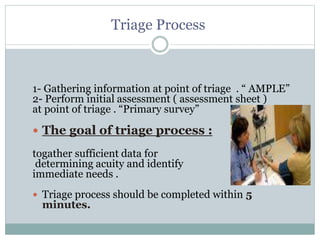
1- Gathering information at point of triage . “ AMPLE”
2- Perform initial assessment ( assessment sheet )
at point of triage . “Primary survey”
 The goal of triage process :
togather sufficient data for
determining acuity and identify
immediate needs .
 Triage process should be completed within 5
minutes.
8
What is ESI?
 Emergency Severity Index
 A five level triage scale that uses prioritization based
on urgency (acuity) of condition but also considers
resources needed to get the patient thru to ED
disposition.
 Rapid, accurate triage is key to successful emergency
department operations.
What is ESI?
9
 Undertriage leaves a patient at risk for
deteriorating while waiting. Overtriage uses
scarce resources limiting availability of an open
ED bed for another more critical patient.
Initial triage must be accurate.
 ESI is a tool for Emergency Department Triage.
 The Algorithm yields rapid, reproducible, and clinically
relevant stratification of patients into five groups-from
Level 1 (Most urgent) to Level 5 (least urgent).
10
So, a 5 Level rating?
 5 levels have meaningful differences between
each level compared to previous 3 Level
systems.
 ESI levels can be used to describe acuity levels.
 ESI levels can be used to describe acuity of
patients.
11
Emergency Severity Index
ESI
• Acuity assessment
- Airway, breathing, circulation
- Potential for life, organ or limb threat
- How soon the patient needs to be seen
• Expected resource assessment
- Number of resources, as estimated by the
triage nurse, that a patient is expected to
consume in order for a disposition decision.
12
ESI ALGORITHIM
13
14
15
16
17
18
19
20
• An experienced triage nurse is able to
recognize a patient in extremis with an
across the room brief assessment.
• Level 1 patients comprise 1-3% of all ED
patients.
21
22
23
Decision Point B
is this a high risk situation?
24
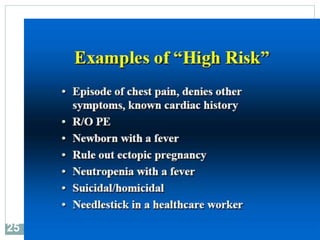
 The nurse utilizes experience to identify a patient
at High Risk.
 ESI level 2 patients are a high priority and
placement and treatment should begin within 10
minutes of arrival.
25
26
27
28
29
30
31
32
33
34
Resource Examples
 CBC,BMP, PT/PTT=One Resource
 CBC, CXR=Two Resources
 CXR, ABD Series=One Resource
 CXR,CT Scan=Two Resources
 CBC,CT Scan, EKG=Three Resources
ESI Level 5
35
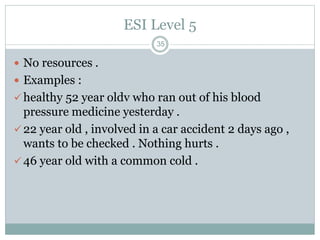
 No resources .
 Examples :
 healthy 52 year oldv who ran out of his blood
pressure medicine yesterday .
 22 year old , involved in a car accident 2 days ago ,
wants to be checked . Nothing hurts .
 46 year old with a common cold .
36
37
38
39
40
41
Summary
42
43
Resources
• Emergency Severity Index (ESI) A Triage Tool for Emerge
ncy Department Care Version 4

triage-final.ppt

  • 1.
    1 E M ER G E N C Y R O O M P R E S E N T E D B Y : M O H A N N A D A L G H A R A Y B E H Triage Emergency Severity Index
  • 2.
    Out Line : 2 Definition of triage .  The personal abilities that are essential to be an effective triage nurse  Daily triage in hospital setting .  Triage process .  What is ESI ?  ESI ALGORITHIM  Resources .
  • 3.
    Objectives : 3 At theend of this lecture , all audiences will be able to : • Define the Triage and ESI . • Classify the patients by using ESI on their level of acuity . • Expect how many resources needed for patients to but them on there level . • Differentiate between resources and non-resources on your hospital .
  • 4.
    Definition of triage 4 It is the process which places the right patient in the right place at the right time to receive the right level of care.  Accurate triage allow the nurse to do the greatest good for the greatest number of afflicted .
  • 5.
    The personal abilitiesthat are essential to be an effective triage nurse 5  Clinically experience .  Good judgment and leadership .  Calm and cool under stress.  Knowledgeable of available resources .  Creative problem solver .  Availability .  Experienced and knowledgeable
  • 6.
    Daily Triage inHospital Setting:  Nurses perform daily triage on a routine bases every day in the emergency department . The purpose :  Is to identify those patient who have the highest degree of compromise for the purpose of providing rapid care to the sickest patient first .
  • 7.
    Triage Process 1- Gatheringinformation at point of triage . “ AMPLE” 2- Perform initial assessment ( assessment sheet ) at point of triage . “Primary survey”  The goal of triage process : togather sufficient data for determining acuity and identify immediate needs .  Triage process should be completed within 5 minutes.
  • 8.
    8 What is ESI? Emergency Severity Index  A five level triage scale that uses prioritization based on urgency (acuity) of condition but also considers resources needed to get the patient thru to ED disposition.  Rapid, accurate triage is key to successful emergency department operations.
  • 9.
    What is ESI? 9 Undertriage leaves a patient at risk for deteriorating while waiting. Overtriage uses scarce resources limiting availability of an open ED bed for another more critical patient. Initial triage must be accurate.  ESI is a tool for Emergency Department Triage.  The Algorithm yields rapid, reproducible, and clinically relevant stratification of patients into five groups-from Level 1 (Most urgent) to Level 5 (least urgent).
  • 10.
    10 So, a 5Level rating?  5 levels have meaningful differences between each level compared to previous 3 Level systems.  ESI levels can be used to describe acuity levels.  ESI levels can be used to describe acuity of patients.
  • 11.
    11 Emergency Severity Index ESI •Acuity assessment - Airway, breathing, circulation - Potential for life, organ or limb threat - How soon the patient needs to be seen • Expected resource assessment - Number of resources, as estimated by the triage nurse, that a patient is expected to consume in order for a disposition decision.
  • 12.
  • 13.
  • 14.
  • 15.
  • 16.
  • 17.
  • 18.
  • 19.
  • 20.
    20 • An experiencedtriage nurse is able to recognize a patient in extremis with an across the room brief assessment. • Level 1 patients comprise 1-3% of all ED patients.
  • 21.
  • 22.
  • 23.
  • 24.
    Decision Point B isthis a high risk situation? 24  The nurse utilizes experience to identify a patient at High Risk.  ESI level 2 patients are a high priority and placement and treatment should begin within 10 minutes of arrival.
  • 25.
  • 26.
  • 27.
  • 28.
  • 29.
  • 30.
  • 31.
  • 32.
  • 33.
  • 34.
    34 Resource Examples  CBC,BMP,PT/PTT=One Resource  CBC, CXR=Two Resources  CXR, ABD Series=One Resource  CXR,CT Scan=Two Resources  CBC,CT Scan, EKG=Three Resources
  • 35.
    ESI Level 5 35 No resources .  Examples :  healthy 52 year oldv who ran out of his blood pressure medicine yesterday .  22 year old , involved in a car accident 2 days ago , wants to be checked . Nothing hurts .  46 year old with a common cold .
  • 36.
  • 37.
  • 38.
  • 39.
  • 40.
  • 41.
  • 42.
  • 43.
    43 Resources • Emergency SeverityIndex (ESI) A Triage Tool for Emerge ncy Department Care Version 4