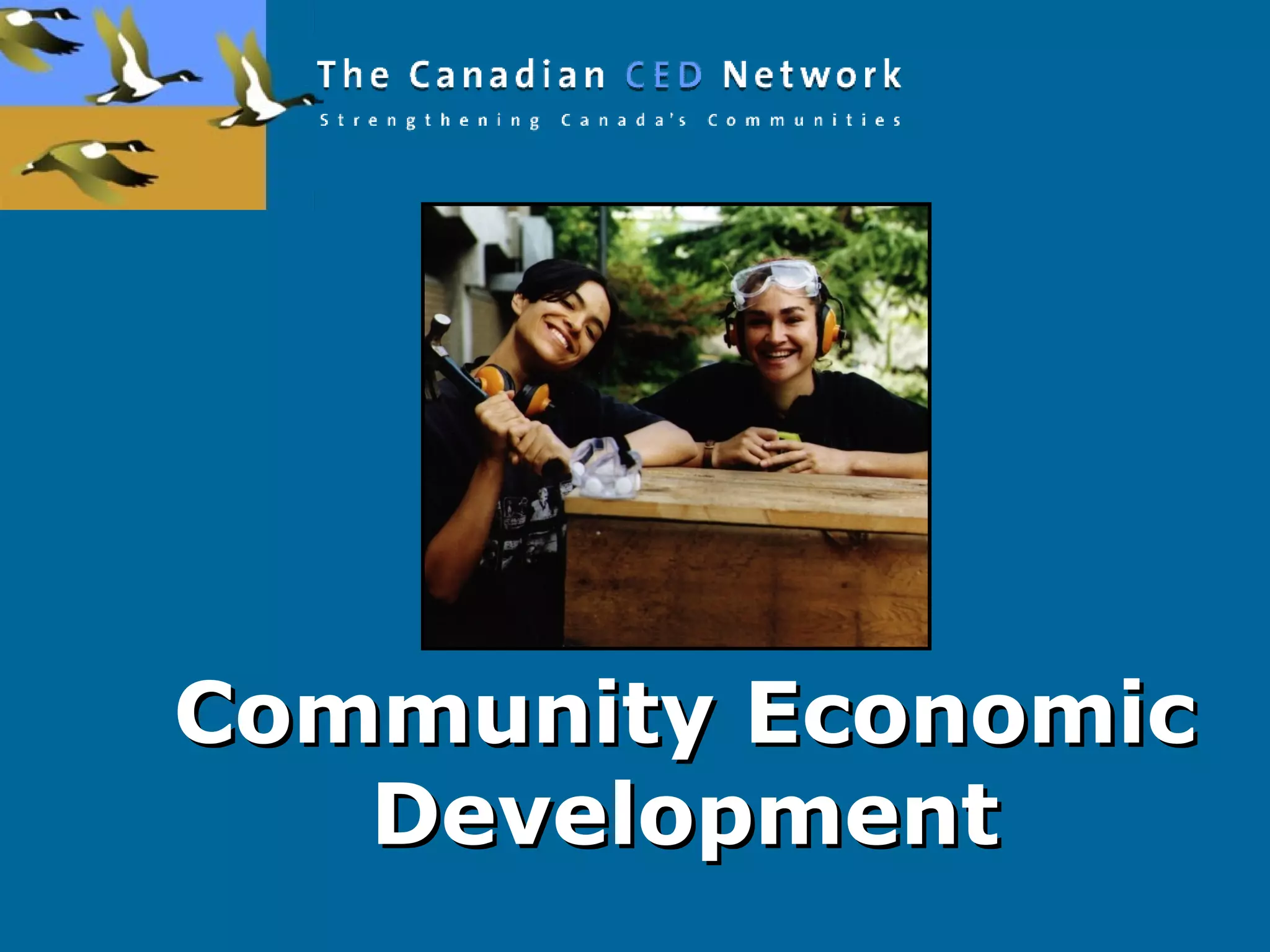
Community EconomicCommunity Economic
DevelopmentDevelopment
Canadian CED NetworkCanadian CED Network
National, member-driven organization.
CCEDNet promotes CED as an
economic development model that
integrates social, economic and
environmental goals.
MembershipMembership
Several thousand networked organizations,
including:
Community based organisations involved in
social and economic development: urban, rural,
Aboriginal, Northern
Other sectors: municipalities, co-operatives,
social enterprises, credit unions, universities,
foundations etc
WHAT WE DO:WHAT WE DO:
– Capacity-building, information sharing, and
networking.
– Research and development re: new models,
tools and strategies
– Evidence-based policy development
– Promote community economic development
as an alternative model to respond to social,
economic and environmental challenges
Canadian CED Network
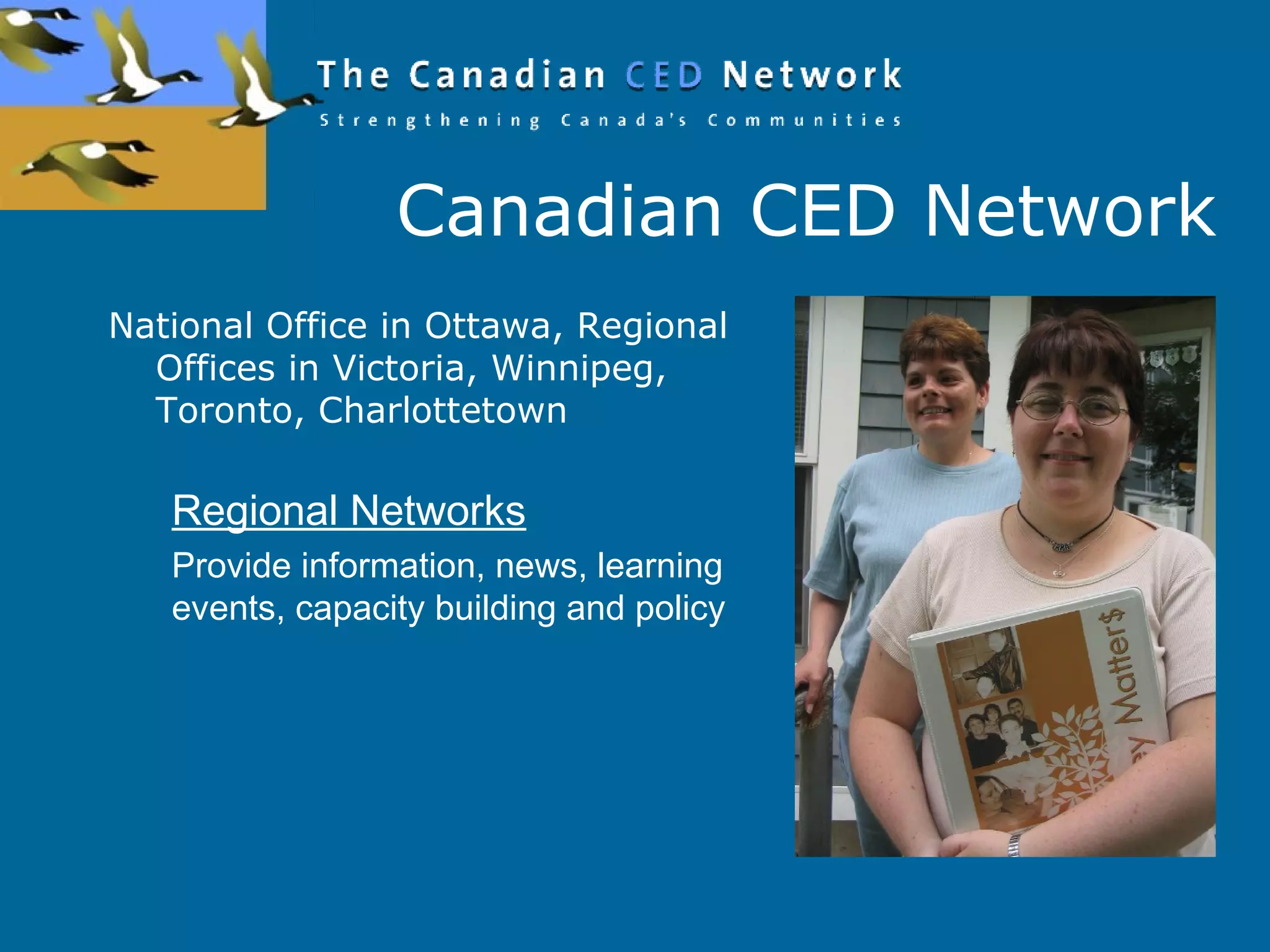
National Office in Ottawa, Regional
Offices in Victoria, Winnipeg,
Toronto, Charlottetown
Regional Networks
Provide information, news, learning
events, capacity building and policy
What is CommunityWhat is Community
Economic Development?Economic Development?
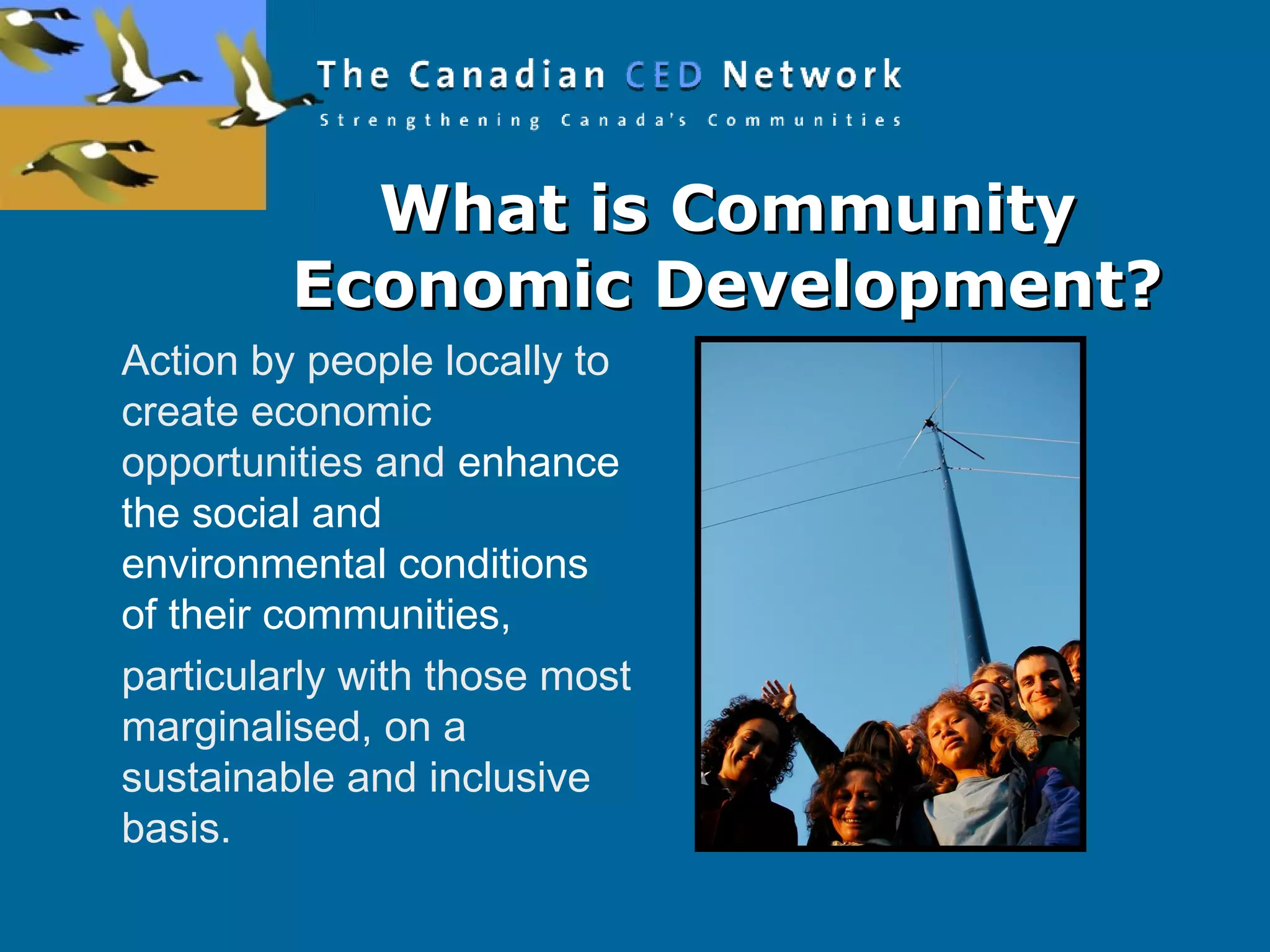
Action by people locally to
create economic
opportunities and enhance
the social and
environmental conditions
of their communities,
particularly with those most
marginalised, on a
sustainable and inclusive
basis.
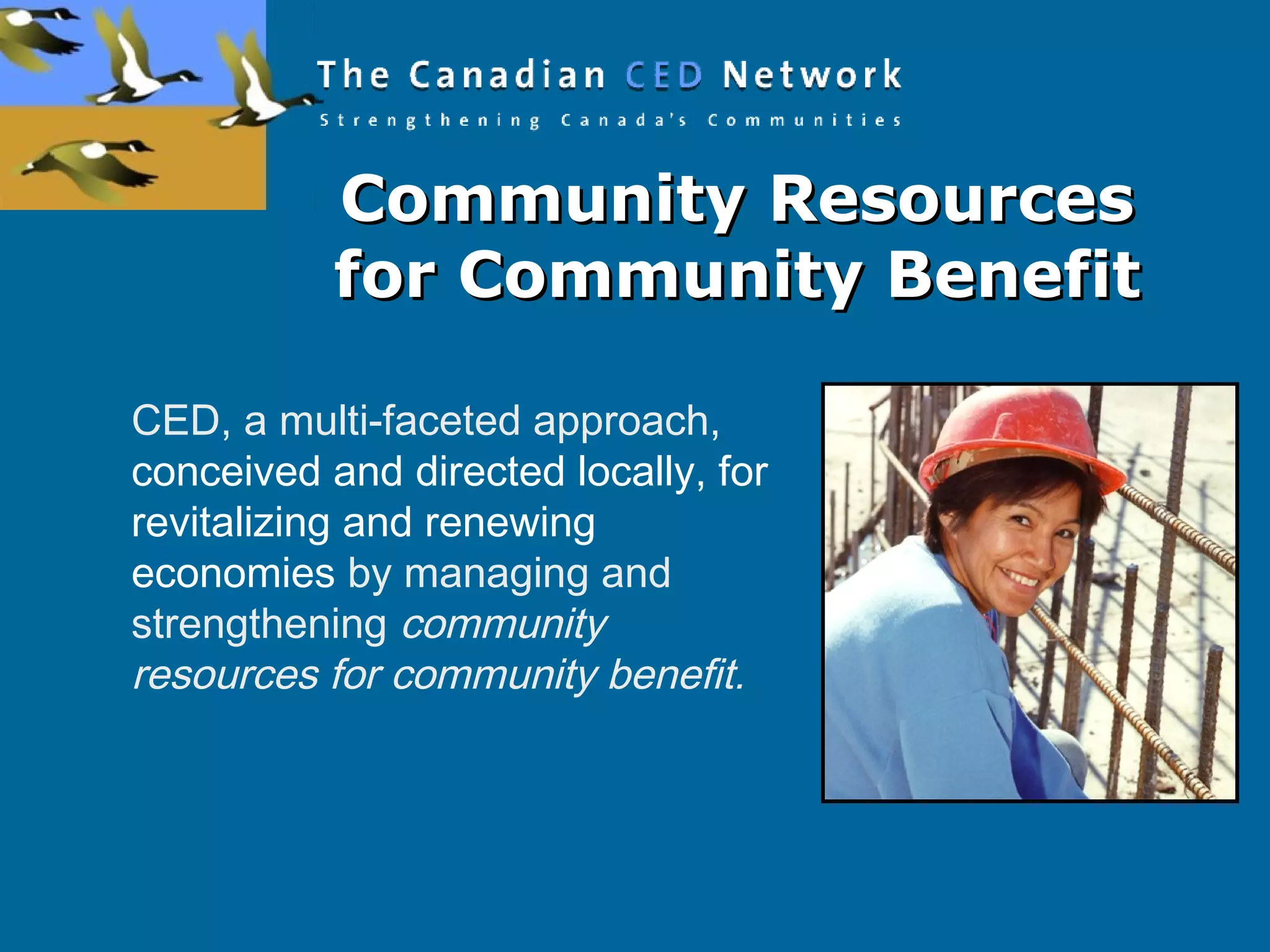
CED, a multi-faceted approach,
conceived and directed locally, for
revitalizing and renewing
economies by managing and
strengthening community
resources for community benefit.
Community ResourcesCommunity Resources
for Community Benefitfor Community Benefit
Building Local EconomiesBuilding Local Economies
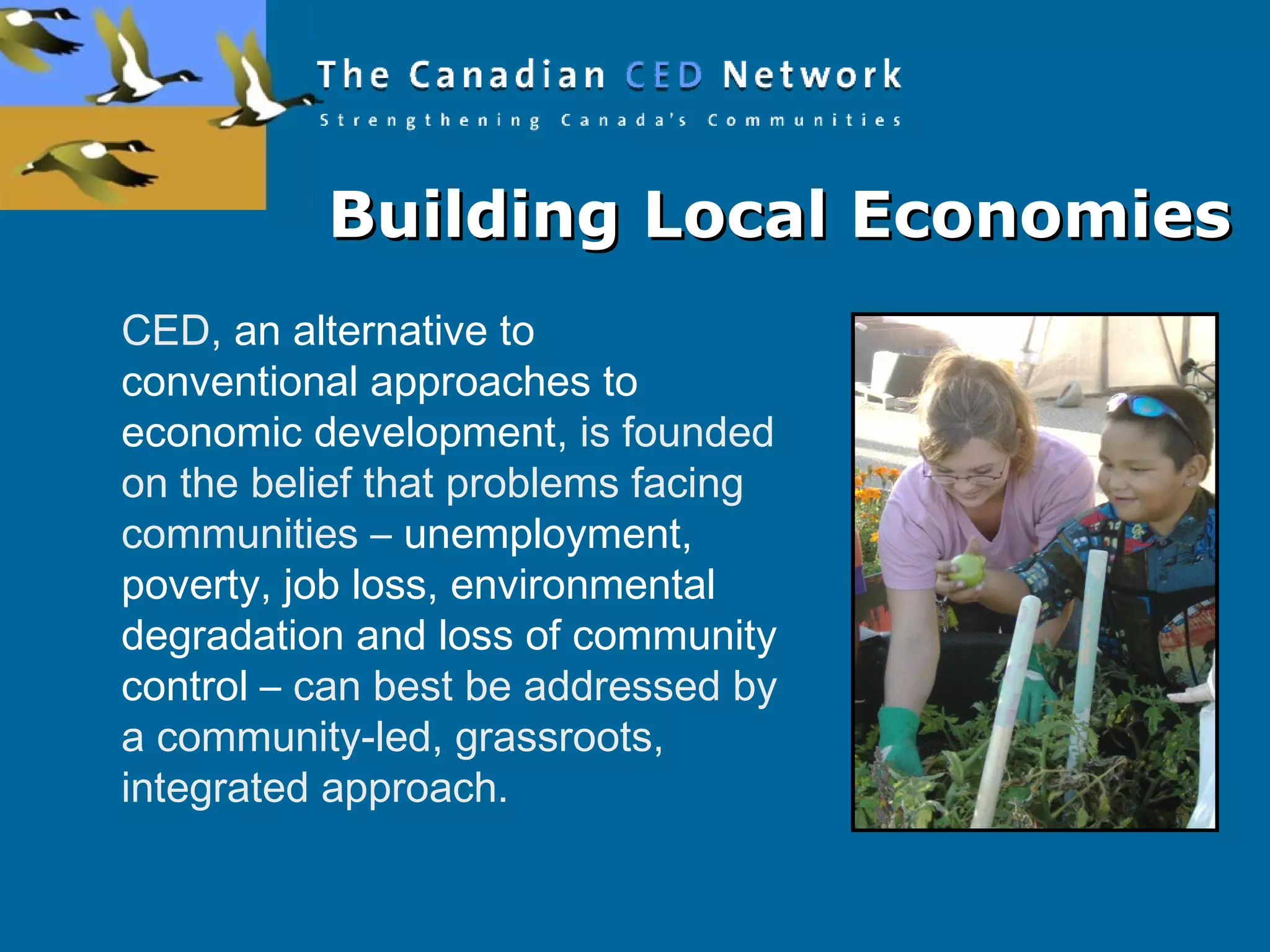
CED, an alternative to
conventional approaches to
economic development, is founded
on the belief that problems facing
communities – unemployment,
poverty, job loss, environmental
degradation and loss of community
control – can best be addressed by
a community-led, grassroots,
integrated approach.
Building a Social Economy
Building on assets which the community already possess
 Social and human capital
 Traditional practices
 Cultural diversity
 Community learning networks
 Local environmental knowledge
 Creativity and entrepreneurial spirit
Growing collectively owned enterprises for community benefit
 Social assets (housing, child care, etc.)
 Social enterprises including cooperatives
 Community investment funds (capital)
 Capacity building and community empowerment
 Integrated social and economic planning
 Investing in human, social, cultural, financial and natural capital of
communities
Why CED ?Why CED ?
Despite high overall national prosperity indicators, there are
still declining social and economic conditions in some
urban and rural communities.
•Growing and inter-related concentration of social and
economic disadvantage in communities/regions.
•Regional/local inequality has major aggregate impact on
national productivity and wellbeing
•Other jurisdictions regard this as number one priority for
social/economic policy
•CED models generating real social and economic
outcomes – IT WORKS !
Government Support
Federal Social Economy Initiative – now cancelled
except for research program.
Quebec:
CED organizations created partnerships with co-
operative, social movement, labour and credit
union organizations to create a common agenda
and network (Le Chantier de l’économie sociale).
Generated over $10 m in a capital investment funds
for social enterprises and social economy.
Government Support
Manitoba
CED priority of provincial government – cabinet
committee, long term funding , tax credits
Nova Scotia
Community and Regional Development Act, Tax
credits for cooperative and community enterprises
Devolved authority to communities for regional social
and economic development
Nunavut
Comprehensive CED policy framework
Example 1Example 1
Greater Trail Community Skills CentreGreater Trail Community Skills Centre
Social Enterprise distributes newspapers etc. for
region
Provides life skills and employability training to
unemployed youth
Jobs running the enterprise
Promoting youth retention in region
Surpluses re-invested in youth and community
development priorities
Employment Development specific to local
business and industry needs
Example 2Example 2
Revelstoke Enterprise CentreRevelstoke Enterprise Centre
Community Development Action Plan engaging all
sectors of the community
Enterprise Centre run jointly by Municipal,
economic and social organizations
Six key ingredients: Human Development
(Learning Centre); Planning and Research;
Infrastructure; Loan Funds; Equity: Promotion and
Brokering.
Community Forest Corporation, Community
Foundation ($600k in capital)
Example 3Example 3
Upper Skeena Development Centre, HazeltonUpper Skeena Development Centre, Hazelton
Regional CED strategy with First Nations and non-
aboriginal communities in Upper Skeena.
Healthy community initiative targeted to youth and
healthy lifestyles.
Use of new technologies and networking to build
capacity.
Learning shop and ‘service learning’ to develop life,
civic and work skills, promote Aboriginal culture and
language
Example 4Example 4
City of EdmontonCity of Edmonton
Municipal policy and program supports to CED.
 ‘Social enterprise trust’ with foundations to provide
loans for microenterprises – access to capital.
Municipal priority on support to neighborhood
groups/revitalization.
Regional health authority support to community
health promotion, including community economic
development to reduce poverty.
Success FactorsSuccess Factors
Asset Based Community
Development
 Build on capacity of
communities, not outside
solutions, emphasise
assets not deficits,
mobilise social capital
Evidence Based Planning
 Clear measures to track
change, set benchmarks,
identify outcomes and their
causes
Success FactorsSuccess Factors
Community Cooperation and
Leadership
 Harness the energy, vision and
resources of the non-profit
sector and its partnership
capacity with all sectors of the
community
Accessible and Relevant Learning
 Learning opportunities that are
relevant & accessible to people
and respond to local
circumstances
Success FactorsSuccess Factors
Integrate Social AND Economic
Development
 Support “joined up” approaches to
addressing inter-related social and
economic challenges facing
communities
Innovation and Entrepreneurship
 CED that creates new niche
products, services, markets
building on locally unique skills,
resources, assets – “social
enterprises”
Policy PrioritiesPolicy Priorities
Build Fairer and Stronger Local
Economies that Contribute to Self
-Sufficiency
Capital for community enterprises, tax credits for
investing in local Community Investment Funds
Procurement policies that advantage local and
social enterprises
Enabling environment for co-operatives and social
enterprise growth
Enterprise development and training support to
local communities
Policy PrioritiesPolicy Priorities
Tackle Poverty
Shift tax and benefit structures to benefit those on
low income, reduce dependency and provide
incentives for asset building
Support community-based, comprehensive
strategies for poverty reduction through community
non-profit organizations
Invest in children and non-profit, quality child care
options
Combine housing and CED strategies to break the
cycle of poverty
Policy PrioritiesPolicy Priorities
Invest in Sustainable Communities
Support municipalities and community agencies to
create sustainable development action plans to
revitalize urban and rural communities
Promote sustainable local agriculture and food
systems, local eco-tourism led by communities
Promote community-based renewable energy
systems that generate sustainable revenues to
local communities
Support community forest land tenures linked to
development of value-added forest products
InitiativesInitiatives
Government (federal, provincial, municipal)
dialogue and research on CED policies and
programs – advocate for legislation
Annual National Conference and Tele-Learning
Program
Place-Based Poverty Reduction: National Action
Research Program and Learning Network
Immigrant and Refugee CED Demonstration
Program
National Roundtable on Social Enterprise
Development and Financing
National Working Group on Sustainable Agriculture
and Food Security
InitiativesInitiatives
Population health and social inclusion
Innovative models of employment
development
Youth leadership, development and
retention
National Social Economy Research
Program
Profile of municipal engagement in CED
InternationalInternational
• International Committee of members including
Uniterra, CUSO, Crossroads International,
Canadian Cooperative Association
• Canadian representative to the Intl Network for the
Promotion of the Social Solidarity Economy
(RIPESS), and the Local Economic Development
Knowledge Network of the Americas (RIDELC)
• Co-director of the Canadian Social Economy
Research Partnership connected to CIRIEC
International
More information on our
activities:
www.ccednet-rcdec.cawww.ccednet-rcdec.ca

What is Community Economic Develompent? Presentation prepared by the Canadian CED Network, 2008

  • 1.
  • 2.
    Canadian CED NetworkCanadianCED Network National, member-driven organization. CCEDNet promotes CED as an economic development model that integrates social, economic and environmental goals.
  • 3.
    MembershipMembership Several thousand networkedorganizations, including: Community based organisations involved in social and economic development: urban, rural, Aboriginal, Northern Other sectors: municipalities, co-operatives, social enterprises, credit unions, universities, foundations etc
  • 4.
    WHAT WE DO:WHATWE DO: – Capacity-building, information sharing, and networking. – Research and development re: new models, tools and strategies – Evidence-based policy development – Promote community economic development as an alternative model to respond to social, economic and environmental challenges
  • 5.
    Canadian CED Network NationalOffice in Ottawa, Regional Offices in Victoria, Winnipeg, Toronto, Charlottetown Regional Networks Provide information, news, learning events, capacity building and policy
  • 6.
    What is CommunityWhatis Community Economic Development?Economic Development? Action by people locally to create economic opportunities and enhance the social and environmental conditions of their communities, particularly with those most marginalised, on a sustainable and inclusive basis.
  • 7.
    CED, a multi-facetedapproach, conceived and directed locally, for revitalizing and renewing economies by managing and strengthening community resources for community benefit. Community ResourcesCommunity Resources for Community Benefitfor Community Benefit
  • 8.
    Building Local EconomiesBuildingLocal Economies CED, an alternative to conventional approaches to economic development, is founded on the belief that problems facing communities – unemployment, poverty, job loss, environmental degradation and loss of community control – can best be addressed by a community-led, grassroots, integrated approach.
  • 9.
    Building a SocialEconomy Building on assets which the community already possess  Social and human capital  Traditional practices  Cultural diversity  Community learning networks  Local environmental knowledge  Creativity and entrepreneurial spirit Growing collectively owned enterprises for community benefit  Social assets (housing, child care, etc.)  Social enterprises including cooperatives  Community investment funds (capital)  Capacity building and community empowerment  Integrated social and economic planning  Investing in human, social, cultural, financial and natural capital of communities
  • 10.
    Why CED ?WhyCED ? Despite high overall national prosperity indicators, there are still declining social and economic conditions in some urban and rural communities. •Growing and inter-related concentration of social and economic disadvantage in communities/regions. •Regional/local inequality has major aggregate impact on national productivity and wellbeing •Other jurisdictions regard this as number one priority for social/economic policy •CED models generating real social and economic outcomes – IT WORKS !
  • 11.
    Government Support Federal SocialEconomy Initiative – now cancelled except for research program. Quebec: CED organizations created partnerships with co- operative, social movement, labour and credit union organizations to create a common agenda and network (Le Chantier de l’économie sociale). Generated over $10 m in a capital investment funds for social enterprises and social economy.
  • 12.
    Government Support Manitoba CED priorityof provincial government – cabinet committee, long term funding , tax credits Nova Scotia Community and Regional Development Act, Tax credits for cooperative and community enterprises Devolved authority to communities for regional social and economic development Nunavut Comprehensive CED policy framework
  • 13.
    Example 1Example 1 GreaterTrail Community Skills CentreGreater Trail Community Skills Centre Social Enterprise distributes newspapers etc. for region Provides life skills and employability training to unemployed youth Jobs running the enterprise Promoting youth retention in region Surpluses re-invested in youth and community development priorities Employment Development specific to local business and industry needs
  • 14.
    Example 2Example 2 RevelstokeEnterprise CentreRevelstoke Enterprise Centre Community Development Action Plan engaging all sectors of the community Enterprise Centre run jointly by Municipal, economic and social organizations Six key ingredients: Human Development (Learning Centre); Planning and Research; Infrastructure; Loan Funds; Equity: Promotion and Brokering. Community Forest Corporation, Community Foundation ($600k in capital)
  • 15.
    Example 3Example 3 UpperSkeena Development Centre, HazeltonUpper Skeena Development Centre, Hazelton Regional CED strategy with First Nations and non- aboriginal communities in Upper Skeena. Healthy community initiative targeted to youth and healthy lifestyles. Use of new technologies and networking to build capacity. Learning shop and ‘service learning’ to develop life, civic and work skills, promote Aboriginal culture and language
  • 16.
    Example 4Example 4 Cityof EdmontonCity of Edmonton Municipal policy and program supports to CED.  ‘Social enterprise trust’ with foundations to provide loans for microenterprises – access to capital. Municipal priority on support to neighborhood groups/revitalization. Regional health authority support to community health promotion, including community economic development to reduce poverty.
  • 17.
    Success FactorsSuccess Factors AssetBased Community Development  Build on capacity of communities, not outside solutions, emphasise assets not deficits, mobilise social capital Evidence Based Planning  Clear measures to track change, set benchmarks, identify outcomes and their causes
  • 18.
    Success FactorsSuccess Factors CommunityCooperation and Leadership  Harness the energy, vision and resources of the non-profit sector and its partnership capacity with all sectors of the community Accessible and Relevant Learning  Learning opportunities that are relevant & accessible to people and respond to local circumstances
  • 19.
    Success FactorsSuccess Factors IntegrateSocial AND Economic Development  Support “joined up” approaches to addressing inter-related social and economic challenges facing communities Innovation and Entrepreneurship  CED that creates new niche products, services, markets building on locally unique skills, resources, assets – “social enterprises”
  • 20.
    Policy PrioritiesPolicy Priorities BuildFairer and Stronger Local Economies that Contribute to Self -Sufficiency Capital for community enterprises, tax credits for investing in local Community Investment Funds Procurement policies that advantage local and social enterprises Enabling environment for co-operatives and social enterprise growth Enterprise development and training support to local communities
  • 21.
    Policy PrioritiesPolicy Priorities TacklePoverty Shift tax and benefit structures to benefit those on low income, reduce dependency and provide incentives for asset building Support community-based, comprehensive strategies for poverty reduction through community non-profit organizations Invest in children and non-profit, quality child care options Combine housing and CED strategies to break the cycle of poverty
  • 22.
    Policy PrioritiesPolicy Priorities Investin Sustainable Communities Support municipalities and community agencies to create sustainable development action plans to revitalize urban and rural communities Promote sustainable local agriculture and food systems, local eco-tourism led by communities Promote community-based renewable energy systems that generate sustainable revenues to local communities Support community forest land tenures linked to development of value-added forest products
  • 23.
    InitiativesInitiatives Government (federal, provincial,municipal) dialogue and research on CED policies and programs – advocate for legislation Annual National Conference and Tele-Learning Program Place-Based Poverty Reduction: National Action Research Program and Learning Network Immigrant and Refugee CED Demonstration Program National Roundtable on Social Enterprise Development and Financing National Working Group on Sustainable Agriculture and Food Security
  • 24.
    InitiativesInitiatives Population health andsocial inclusion Innovative models of employment development Youth leadership, development and retention National Social Economy Research Program Profile of municipal engagement in CED
  • 25.
    InternationalInternational • International Committeeof members including Uniterra, CUSO, Crossroads International, Canadian Cooperative Association • Canadian representative to the Intl Network for the Promotion of the Social Solidarity Economy (RIPESS), and the Local Economic Development Knowledge Network of the Americas (RIDELC) • Co-director of the Canadian Social Economy Research Partnership connected to CIRIEC International
  • 26.
    More information onour activities: www.ccednet-rcdec.cawww.ccednet-rcdec.ca