Community Economic Development:
What Is It, and Why Should it Matter
to Corporate Canada?
Edward T. Jackson
Carleton University
2
3
Community Economic Development:
What is It?
A field of practice in which community-based non-profits:
 blend business and social techniques
 mobilize both local and external resources
 to reduce poverty and unemployment
 and revitalize geographic communities (rural and remote
areas, urban neighbourhoods)
 or communities of interest
4
What Does CED Look Like?
1. Community development corporations
2. Community Futures Corporations
3. Co-operatives (consumer, producer, worker,
multi-stakeholder)
4. Businesses owned by social-service non-profits
or charities
5. Aboriginal development corporations
6. Community land trusts
7. Community loan funds
8. Micro-finance programs
9. Social venture philanthropy
5
Why Should CED Matter to Corporate Canada?
 CED contributes to solving social problems
 Stronger communities have healthier economies
 Local heroes need allies
 CED is good for the corporate bottom line
6
The Business Case for
Corporate Support of CED
CED is a tool for corporate social responsibility that
generates benefits to corporate partners,
including:
 Reputational gains among investors and the public
 Open policy and regulatory relations with
government
 Brand differentiation
 Customer loyalty
 Employee recruitment and retention
 Procurement savings
 A “social license to operate”
7
Corporate Social Responsibility through Social
Community Economic Development
 Strategies:
 Grantmaking to CED projects
 Venture philanthropy
 Joint ventures
 Procurement from community enterprises
 Employee volunteer engagement
8
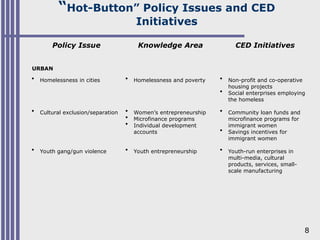
“Hot-Button” Policy Issues and CED
Initiatives
Policy Issue Knowledge Area CED Initiatives
URBAN
 Homelessness in cities  Homelessness and poverty  Non-profit and co-operative
housing projects
 Social enterprises employing
the homeless
 Cultural exclusion/separation  Women’s entrepreneurship
 Microfinance programs
 Individual development
accounts
 Community loan funds and
microfinance programs for
immigrant women
 Savings incentives for
immigrant women
 Youth gang/gun violence  Youth entrepreneurship  Youth-run enterprises in
multi-media, cultural
products, services, small-
scale manufacturing
9
“Hot-Button” Policy Issues and CED
Initiatives
Policy Issue Knowledge Area CED Initiatives
RURAL
 Softwood lumber dispute  Forestry sector  Value-added wood
manufacturing
 Multi-stakeholder, sustainable
forest management
 Mad Cow disease  Agriculture and rural
economic diversification
 New meat and crop
production
 Local food-processing facilities
 Tourism expansion
 E-marketing and e-commerce
 Aboriginal poverty  Aboriginal business
development
 Procurement of goods and
services from Aboriginal
businesses (eg. equipment,
supplies, transport, tourism
etc.), including technical
advice, quality standards and
working capital
10
•Governments
•Regional Agencies
•Corporations
Capital Markets for Community Economic
Development
Grants
Loans / Equity
•Governments
•Development Agencies
•Foundations
•Corporations
$1M $2M $3M $4M $5M $6M $7M
0 $50K $100K $250K $500K
$10K
•Community
Futures
•Community Loan
Funds
•Credit Unions
•Social Venture
Capital
•Banks
•Corporations
•Credit Unions
•Business
Development Bank
•Regional Agencies
•Labour Funds
•Banks
•Corporations
•Credit Unions
•Targeted Pension
Investments
•Regional Agencies
•Labour Funds
$1M $2M $3M $4M $5M $6M $7M
0 $50K $100K $250K $500K
$10K
11
Intermediaries Optimize
CED Success
 Forms: Community development corporation, non-profit
umbrella, foundation, program, network, consortium
 Functions: Technical assistance (consulting, training,
business planning, market studies); financing (grants,
loans, equity); management support; political support
(promotion, lobbying, regulatory change)
 Funding: Foundation, corporate and government grants;
loans and other program-related investments; contracts;
enterprise surplus; asset appreciation; private
philanthropy; donations and gifts; volunteer time
 Factors of Intermediary Success: Leadership (skills,
vision continuity, succession); structure (flexible,
evolving); strategy (growth opportunities, backward and
forward linkages, first-mover advantage); management;
human resources; innovation; replication and scaling up;
financing (diversification of revenues); accountability
12
Case Study – New Dawn Enterprises
Cape Breton
Association for
Co-op
Development
New Dawn
Enterprises
(Non-Profit CDC)
Cape Care
Services Ltd.
•Home Care Services
Cape Breton
Association
for Housing
Development
•Real estate
company for
affordable housing
Highland
Resources Ltd.
 Private career
college
New Dawn Guest
Home Ltd.
• 30-bed residential
care facility
David Realties
• Commercial
landlord
Credo
•Business
processes
outsourcer
Sydney Senior
Care Home
Living Ltd
•37-bed program
Pine Tree Park Estates
• revitalized military base
Corporate
Partnerships
• Home Depot
Government
Grants/Contracts
New Dawn
Holdings
• Investment
Firm
BCA Holdings
• Venture Fund
(Equity, Loans)
1973
Source: newdawn.ca
13
Case Study – Social Capital Partners
Social Capital Partners
Social Venture
Portfolio
Renaissance,
Montreal
Inner City Renovations,
Winnipeg
Social
Enterprise
Investment-Decision Steps
1. Concept Review
2. Business Plan Review
3. Due Diligence
4. Alignment and Deal structure
5. Investment and Ongoing Working
Relationship
6. Monitoring and Reinvestment
Social
Enterprise
Research on SROI/
Evaluation
Bill Young/ Bealight
Foundation
Sector and Policy
Engagement
•$100K equity
•$100K loan
•Used to test new ideas in
marketing, merchandizing and
pricing
•$50 K grant and board
involvement
Grants, Loans, Equity
Sean VanDoorselaer, “Venture Capital for Social Enterprise,” Making
Waves, 15(3), 2004, 10-13
Challenges
• “Dearth of great social entrepreneurs”
• Lack of sophisticated business models
• Limited sources of social capital
14
Evaluation of Community
Economic Development
Evaluation Defined: Assessment of social, environmental and
commercial results, lessons learned and accountability systems by key
stakeholders.
Promising Methods:
 Return on Taxpayer Investment (ROTI) – Input-output modeling
of direct, indirect and induced effects of government-supported
interventions
 Social Return on Investment (SROI) – Method for assessing the
social costs associated with the individual employees and the
community enterprise itself (Social Capital Partners, Roberts
Enterprise Development Fund)
 Enhanced Value-Added Statement (EVAS) – Quantifies the value
of social impacts and volunteer contributions of a non-profit or
cooperative (Quarter et al, OISE/UT)
 Return on CSR investment in CED to the corporate bottom line
(surveys, focus groups on stakeholder perceptions and decisions)
15
Questions
 If your company is not engaged in CED, what else
do you need to know in order to decide on taking
action?
 If your company is engaged in CED already, what
strategies can you use to increase the impact of
your efforts?
16
Useful Websites
Blended Value Project (tools for social return on investment) blendedvalue.org
Canadian Business for Social Responsibility cbsr.ca
Canadian Community Economic Development Network ccednet-redec.ca
Chantier de l’économie sociale chantier.gc.ca
Community Economic Development Technical Assistance Program carleton.ca/cedtap
Conference Board of Canada Conferenceboard.ca
Imagine Canada imaginecanada.ca
Harvard Business School – Initiative on Social Enterprise hbs.edu/social enterprise
Making Waves (Canadian CED newsletter) cedworks.com
Social Capital Partners (social venture capital) Socialcapitalpartners.ca
Stanford Social Innovation Review ssireview.com
Skoll Foundation (grantmaking to social entrepreneurs) skollfoundation.org
VanCity Credit Union vancity.com
Vibrant Communities Project (15 Canadian cities, including Victoria) vibrantcommunities.ca

CEDtoCorpsdasdsadasdasdasdasdorateCanada.ppt

  • 1.
    Community Economic Development: WhatIs It, and Why Should it Matter to Corporate Canada? Edward T. Jackson Carleton University
  • 2.
  • 3.
    3 Community Economic Development: Whatis It? A field of practice in which community-based non-profits:  blend business and social techniques  mobilize both local and external resources  to reduce poverty and unemployment  and revitalize geographic communities (rural and remote areas, urban neighbourhoods)  or communities of interest
  • 4.
    4 What Does CEDLook Like? 1. Community development corporations 2. Community Futures Corporations 3. Co-operatives (consumer, producer, worker, multi-stakeholder) 4. Businesses owned by social-service non-profits or charities 5. Aboriginal development corporations 6. Community land trusts 7. Community loan funds 8. Micro-finance programs 9. Social venture philanthropy
  • 5.
    5 Why Should CEDMatter to Corporate Canada?  CED contributes to solving social problems  Stronger communities have healthier economies  Local heroes need allies  CED is good for the corporate bottom line
  • 6.
    6 The Business Casefor Corporate Support of CED CED is a tool for corporate social responsibility that generates benefits to corporate partners, including:  Reputational gains among investors and the public  Open policy and regulatory relations with government  Brand differentiation  Customer loyalty  Employee recruitment and retention  Procurement savings  A “social license to operate”
  • 7.
    7 Corporate Social Responsibilitythrough Social Community Economic Development  Strategies:  Grantmaking to CED projects  Venture philanthropy  Joint ventures  Procurement from community enterprises  Employee volunteer engagement
  • 8.
    8 “Hot-Button” Policy Issuesand CED Initiatives Policy Issue Knowledge Area CED Initiatives URBAN  Homelessness in cities  Homelessness and poverty  Non-profit and co-operative housing projects  Social enterprises employing the homeless  Cultural exclusion/separation  Women’s entrepreneurship  Microfinance programs  Individual development accounts  Community loan funds and microfinance programs for immigrant women  Savings incentives for immigrant women  Youth gang/gun violence  Youth entrepreneurship  Youth-run enterprises in multi-media, cultural products, services, small- scale manufacturing
  • 9.
    9 “Hot-Button” Policy Issuesand CED Initiatives Policy Issue Knowledge Area CED Initiatives RURAL  Softwood lumber dispute  Forestry sector  Value-added wood manufacturing  Multi-stakeholder, sustainable forest management  Mad Cow disease  Agriculture and rural economic diversification  New meat and crop production  Local food-processing facilities  Tourism expansion  E-marketing and e-commerce  Aboriginal poverty  Aboriginal business development  Procurement of goods and services from Aboriginal businesses (eg. equipment, supplies, transport, tourism etc.), including technical advice, quality standards and working capital
  • 10.
    10 •Governments •Regional Agencies •Corporations Capital Marketsfor Community Economic Development Grants Loans / Equity •Governments •Development Agencies •Foundations •Corporations $1M $2M $3M $4M $5M $6M $7M 0 $50K $100K $250K $500K $10K •Community Futures •Community Loan Funds •Credit Unions •Social Venture Capital •Banks •Corporations •Credit Unions •Business Development Bank •Regional Agencies •Labour Funds •Banks •Corporations •Credit Unions •Targeted Pension Investments •Regional Agencies •Labour Funds $1M $2M $3M $4M $5M $6M $7M 0 $50K $100K $250K $500K $10K
  • 11.
    11 Intermediaries Optimize CED Success Forms: Community development corporation, non-profit umbrella, foundation, program, network, consortium  Functions: Technical assistance (consulting, training, business planning, market studies); financing (grants, loans, equity); management support; political support (promotion, lobbying, regulatory change)  Funding: Foundation, corporate and government grants; loans and other program-related investments; contracts; enterprise surplus; asset appreciation; private philanthropy; donations and gifts; volunteer time  Factors of Intermediary Success: Leadership (skills, vision continuity, succession); structure (flexible, evolving); strategy (growth opportunities, backward and forward linkages, first-mover advantage); management; human resources; innovation; replication and scaling up; financing (diversification of revenues); accountability
  • 12.
    12 Case Study –New Dawn Enterprises Cape Breton Association for Co-op Development New Dawn Enterprises (Non-Profit CDC) Cape Care Services Ltd. •Home Care Services Cape Breton Association for Housing Development •Real estate company for affordable housing Highland Resources Ltd.  Private career college New Dawn Guest Home Ltd. • 30-bed residential care facility David Realties • Commercial landlord Credo •Business processes outsourcer Sydney Senior Care Home Living Ltd •37-bed program Pine Tree Park Estates • revitalized military base Corporate Partnerships • Home Depot Government Grants/Contracts New Dawn Holdings • Investment Firm BCA Holdings • Venture Fund (Equity, Loans) 1973 Source: newdawn.ca
  • 13.
    13 Case Study –Social Capital Partners Social Capital Partners Social Venture Portfolio Renaissance, Montreal Inner City Renovations, Winnipeg Social Enterprise Investment-Decision Steps 1. Concept Review 2. Business Plan Review 3. Due Diligence 4. Alignment and Deal structure 5. Investment and Ongoing Working Relationship 6. Monitoring and Reinvestment Social Enterprise Research on SROI/ Evaluation Bill Young/ Bealight Foundation Sector and Policy Engagement •$100K equity •$100K loan •Used to test new ideas in marketing, merchandizing and pricing •$50 K grant and board involvement Grants, Loans, Equity Sean VanDoorselaer, “Venture Capital for Social Enterprise,” Making Waves, 15(3), 2004, 10-13 Challenges • “Dearth of great social entrepreneurs” • Lack of sophisticated business models • Limited sources of social capital
  • 14.
    14 Evaluation of Community EconomicDevelopment Evaluation Defined: Assessment of social, environmental and commercial results, lessons learned and accountability systems by key stakeholders. Promising Methods:  Return on Taxpayer Investment (ROTI) – Input-output modeling of direct, indirect and induced effects of government-supported interventions  Social Return on Investment (SROI) – Method for assessing the social costs associated with the individual employees and the community enterprise itself (Social Capital Partners, Roberts Enterprise Development Fund)  Enhanced Value-Added Statement (EVAS) – Quantifies the value of social impacts and volunteer contributions of a non-profit or cooperative (Quarter et al, OISE/UT)  Return on CSR investment in CED to the corporate bottom line (surveys, focus groups on stakeholder perceptions and decisions)
  • 15.
    15 Questions  If yourcompany is not engaged in CED, what else do you need to know in order to decide on taking action?  If your company is engaged in CED already, what strategies can you use to increase the impact of your efforts?
  • 16.
    16 Useful Websites Blended ValueProject (tools for social return on investment) blendedvalue.org Canadian Business for Social Responsibility cbsr.ca Canadian Community Economic Development Network ccednet-redec.ca Chantier de l’économie sociale chantier.gc.ca Community Economic Development Technical Assistance Program carleton.ca/cedtap Conference Board of Canada Conferenceboard.ca Imagine Canada imaginecanada.ca Harvard Business School – Initiative on Social Enterprise hbs.edu/social enterprise Making Waves (Canadian CED newsletter) cedworks.com Social Capital Partners (social venture capital) Socialcapitalpartners.ca Stanford Social Innovation Review ssireview.com Skoll Foundation (grantmaking to social entrepreneurs) skollfoundation.org VanCity Credit Union vancity.com Vibrant Communities Project (15 Canadian cities, including Victoria) vibrantcommunities.ca

Editor's Notes

  • #2 Centre: MCC Employment Development - Intranet project and Calgary Social Purchasing Portal Middle left and top: Peace Energy Renewable Cooperative Middle right: Upper Similkameen Indian Band - Hedley Mascot Gold Mine Bottom right: Potluck Café Society – Flash frozen gourmet meals project Bottom: Namgis Grease trail - ecotourism project