Beyond the sentence
Scott Thornbury
What makes a text?
Texts are:
Self-contained
Well-formed
Cohesive
Coherent
Recognizable text types
Appropriate to their contexts of use
And have a clear communicative purpose
Cohesion: a text is made cohesive by a
combination of cohesive devices
Lexical cohesion
 Direct repetition, word families, synonyms and antonyms
 Words from the same semantic field, lexical chains and lists
 Substitution with one/ones
Grammatical cohesion
 Reference: pronouns, articles
 Substitution/ellipsis of clause elements
 Conjuncts (connect clauses inside sentences
 Linkers (link sentences)
 Comparatives
 Tense
Rhetorical cohesion
 Question-answer
 Parallelism (sentences echo one another)
Reference: the elements in a text refer to other
elements, both inside and outside the text
anaphoric reference :the referent is back
in the text
Reference cataphoric reference: anticipate the
referent
exophoric reference: the referent is outside
the text
Coherence: capacity of a text to make sense. It is
approached from 2 perspectives
Micro-level coherence
At the sentence level
Logical relationships: Theme contains
given information, rheme contains
new information.The rheme often
becomes the theme of the next
sentence or the same theme is carried
over and a new rheme is made about
it.
Passive constructions: place the object
of the verb in the theme slot and new
information in the rheme slot.
Cleft sentences: alter the normal order
of sentences elements, to place special
emphasis on new information
Macro-level coherence
At the whole text level
Topic: text are about sth, there is an
identifiable topic or topics.
Key words: words that occur with a
significant frequency.
Schema: is the way knowledge is
represented mentally.
Scripts: are the ways in which we
come to expect things to happen.
Keep the reader in mind.
Texts in context
text not only connect internally, but they connect with their
context of use.
The study of language in its context of use is known as Pragmatics.
Without context knowledge, the meaning of a text is difficult, if not impossible, to
unpack.
Given a text it is posible to make confident predictions
about both the text type and context.
Conversely, given sufficient information about the
context, we can make predictions about the text type
and the textual features of the text.
The language choices in a text reflect the kind of text it is. And the kind of text
reflects particular context factors, such as the text´s purposes and topic, its
audience and its mode (spoken or written).
context
Text
type
Text
Text functions
Halliday defines text as language that is functional, language
that is doing some job in context.
Texts are divided in two main categories factual-informational
rules and regulations
Macro-functions
1. Referring: using language to convey or solicit information
2. Expressing feelings: saying what you like or dislike
3. Regulating: using language to influence people and get things done, such as using
language requesting, ordering, warning, etc.
4. Interacting: using language to maintain and establlish social relations
5. Playing: using language imaginatively and playfully
Context and register
The register of a text is determined by three contextual dimensions
1. Field: the what of the situation (the topic)
2. Tenor: the who of the situation (the participants)
3. Mode: the how of the situation ( spoken or written)
Different configurations of these dimensions demand different choices at the level of
grammar and vocabulary, and these choices create textual effects that we recognize as
being appropriate to the context of the text´s use.
Certain recurring register combinations becme institutionalized over time and are
known as genres.
Classroom texts
Are a genre in its own right. These texts have a purely pedagodic function (teaching).
Such texts provide poor models of real language use, are easier to understand at the
level of vocabulary and grammar but as coherent discourse are less transparent.
Communicative approach
Suggests the use of authentic text for guidance in the classroom
Teachers alleviate text difficulty using Text-adaptation strategies
Task-design strategies
Text-adaptation strategies:
1. Shortening: cutting out unnecessary sections, shortening the length of the text
2. Segmenting: dealing with the text in short sections, one at a time
3. Simplifying: replace difficult vocabulary or reduce the length and complexity of sentences
4. Co-textualizing: giving learners the article embedded in its surrounding text can help them
actívate top-down schema
5. Glossing: providing a glossary of difficult words in the text
Task-desing strategies
1. Pre-teaching: pre-teach key vocabulary ítems in advance of Reading or listening
2. Brainstorming: ask learners to brainstorm what they already know about the topic
3. Predicting: to activate both background knowledge and schema learners can
predict the content and organization of the text on the basis of verbal clues
4. Initial skimming: learners skim the text quickly in order to get a general idea
5. While-reading and while-listening tasks: giving learners something to do while
reading or listening can help make sense of a text, but only so long as the task is
well suited to the text type
In order to become efficient readers and listeners in their second language, learners
need to be exposed to texts designed to display pre-selected language features Talo
text as linguistic objects but also to tavi (authentic texts) texts as vehicles of
information, so texts should combine the two purposes and the tasks that acompany
the text can focus both on its content (TAVI-type tasks) and on its linguistic forms
(TALO-type tasks).
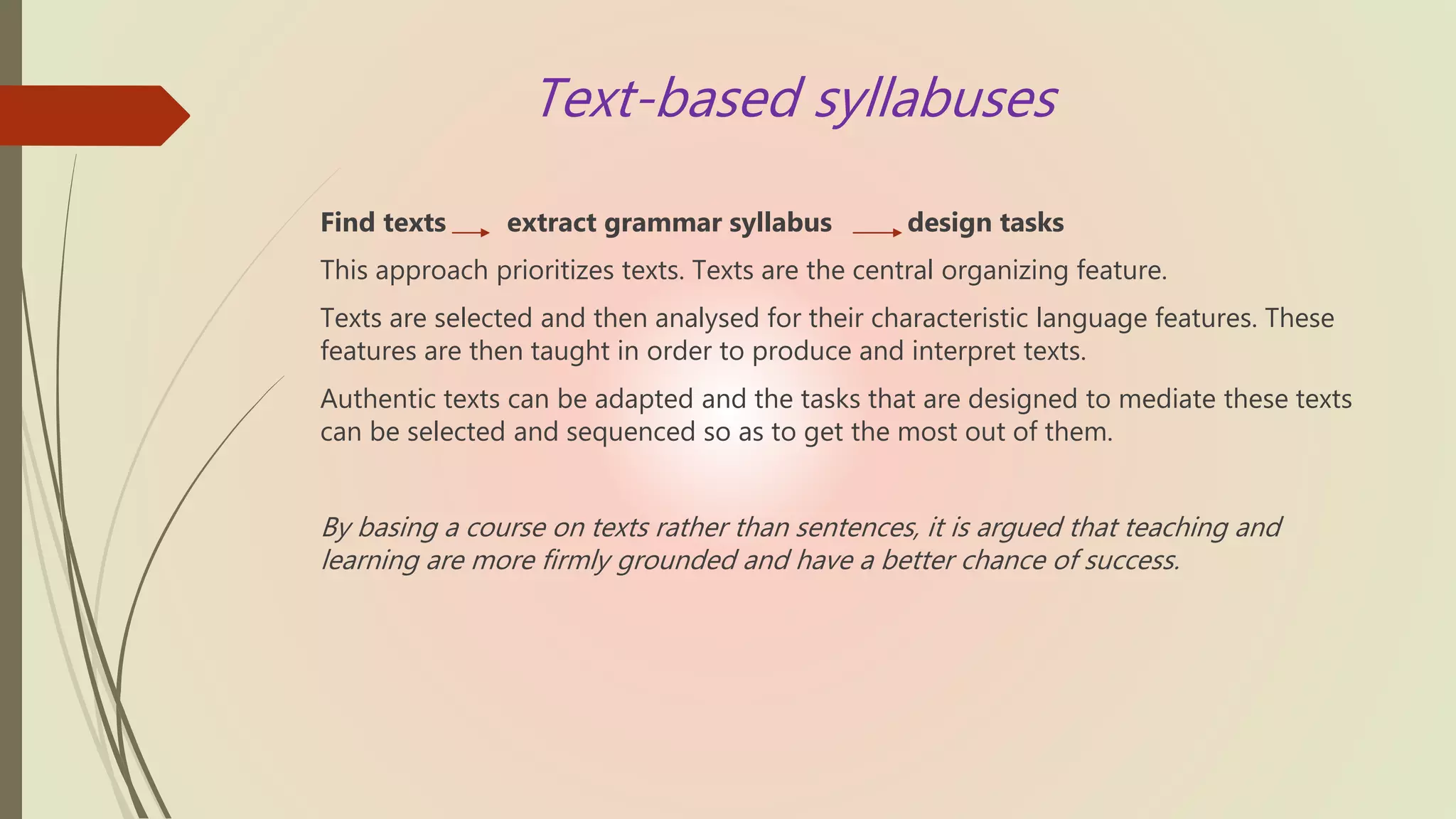
Text-based syllabuses
Find texts extract grammar syllabus design tasks
This approach prioritizes texts. Texts are the central organizing feature.
Texts are selected and then analysed for their characteristic language features. These
features are then taught in order to produce and interpret texts.
Authentic texts can be adapted and the tasks that are designed to mediate these texts
can be selected and sequenced so as to get the most out of them.
By basing a course on texts rather than sentences, it is argued that teaching and
learning are more firmly grounded and have a better chance of success.
Literary texts
Their function is primarily expressive
There are at least five reasons for using literary texts in the classroom
1. Variety: they provide exposure to other kinds of texts and language functions.
2. Language awareness: they offer instances of real language use.
3. Challenge and skill: they raise the level of challenge and they help train learners in the
more interpretative kinds of text processing skills, such as inferencing and identifying
the writer´s point of view, etc.
4. Pleasure: they are originally designed to entertain and give pleasure.
5. Cultural knowledge: they encode a lot of cultural knowledge about the society that
both produced and values the texts.
Bibliography
Thornbury, Scott (2005) Beyond the sentence.
Introducing discourse analysis.
UK, Macmillan. Chapters 2-3-5-6-7

Beyond the sentence

  • 1.
  • 2.
    What makes atext? Texts are: Self-contained Well-formed Cohesive Coherent Recognizable text types Appropriate to their contexts of use And have a clear communicative purpose
  • 3.
    Cohesion: a textis made cohesive by a combination of cohesive devices Lexical cohesion  Direct repetition, word families, synonyms and antonyms  Words from the same semantic field, lexical chains and lists  Substitution with one/ones Grammatical cohesion  Reference: pronouns, articles  Substitution/ellipsis of clause elements  Conjuncts (connect clauses inside sentences  Linkers (link sentences)  Comparatives  Tense Rhetorical cohesion  Question-answer  Parallelism (sentences echo one another)
  • 4.
    Reference: the elementsin a text refer to other elements, both inside and outside the text anaphoric reference :the referent is back in the text Reference cataphoric reference: anticipate the referent exophoric reference: the referent is outside the text
  • 5.
    Coherence: capacity ofa text to make sense. It is approached from 2 perspectives Micro-level coherence At the sentence level Logical relationships: Theme contains given information, rheme contains new information.The rheme often becomes the theme of the next sentence or the same theme is carried over and a new rheme is made about it. Passive constructions: place the object of the verb in the theme slot and new information in the rheme slot. Cleft sentences: alter the normal order of sentences elements, to place special emphasis on new information Macro-level coherence At the whole text level Topic: text are about sth, there is an identifiable topic or topics. Key words: words that occur with a significant frequency. Schema: is the way knowledge is represented mentally. Scripts: are the ways in which we come to expect things to happen. Keep the reader in mind.
  • 6.
    Texts in context textnot only connect internally, but they connect with their context of use. The study of language in its context of use is known as Pragmatics. Without context knowledge, the meaning of a text is difficult, if not impossible, to unpack. Given a text it is posible to make confident predictions about both the text type and context. Conversely, given sufficient information about the context, we can make predictions about the text type and the textual features of the text. The language choices in a text reflect the kind of text it is. And the kind of text reflects particular context factors, such as the text´s purposes and topic, its audience and its mode (spoken or written). context Text type Text
  • 7.
    Text functions Halliday definestext as language that is functional, language that is doing some job in context. Texts are divided in two main categories factual-informational rules and regulations Macro-functions 1. Referring: using language to convey or solicit information 2. Expressing feelings: saying what you like or dislike 3. Regulating: using language to influence people and get things done, such as using language requesting, ordering, warning, etc. 4. Interacting: using language to maintain and establlish social relations 5. Playing: using language imaginatively and playfully
  • 8.
    Context and register Theregister of a text is determined by three contextual dimensions 1. Field: the what of the situation (the topic) 2. Tenor: the who of the situation (the participants) 3. Mode: the how of the situation ( spoken or written) Different configurations of these dimensions demand different choices at the level of grammar and vocabulary, and these choices create textual effects that we recognize as being appropriate to the context of the text´s use. Certain recurring register combinations becme institutionalized over time and are known as genres.
  • 9.
    Classroom texts Are agenre in its own right. These texts have a purely pedagodic function (teaching). Such texts provide poor models of real language use, are easier to understand at the level of vocabulary and grammar but as coherent discourse are less transparent.
  • 10.
    Communicative approach Suggests theuse of authentic text for guidance in the classroom Teachers alleviate text difficulty using Text-adaptation strategies Task-design strategies Text-adaptation strategies: 1. Shortening: cutting out unnecessary sections, shortening the length of the text 2. Segmenting: dealing with the text in short sections, one at a time 3. Simplifying: replace difficult vocabulary or reduce the length and complexity of sentences 4. Co-textualizing: giving learners the article embedded in its surrounding text can help them actívate top-down schema 5. Glossing: providing a glossary of difficult words in the text
  • 11.
    Task-desing strategies 1. Pre-teaching:pre-teach key vocabulary ítems in advance of Reading or listening 2. Brainstorming: ask learners to brainstorm what they already know about the topic 3. Predicting: to activate both background knowledge and schema learners can predict the content and organization of the text on the basis of verbal clues 4. Initial skimming: learners skim the text quickly in order to get a general idea 5. While-reading and while-listening tasks: giving learners something to do while reading or listening can help make sense of a text, but only so long as the task is well suited to the text type In order to become efficient readers and listeners in their second language, learners need to be exposed to texts designed to display pre-selected language features Talo text as linguistic objects but also to tavi (authentic texts) texts as vehicles of information, so texts should combine the two purposes and the tasks that acompany the text can focus both on its content (TAVI-type tasks) and on its linguistic forms (TALO-type tasks).
  • 12.
    Text-based syllabuses Find textsextract grammar syllabus design tasks This approach prioritizes texts. Texts are the central organizing feature. Texts are selected and then analysed for their characteristic language features. These features are then taught in order to produce and interpret texts. Authentic texts can be adapted and the tasks that are designed to mediate these texts can be selected and sequenced so as to get the most out of them. By basing a course on texts rather than sentences, it is argued that teaching and learning are more firmly grounded and have a better chance of success.
  • 13.
    Literary texts Their functionis primarily expressive There are at least five reasons for using literary texts in the classroom 1. Variety: they provide exposure to other kinds of texts and language functions. 2. Language awareness: they offer instances of real language use. 3. Challenge and skill: they raise the level of challenge and they help train learners in the more interpretative kinds of text processing skills, such as inferencing and identifying the writer´s point of view, etc. 4. Pleasure: they are originally designed to entertain and give pleasure. 5. Cultural knowledge: they encode a lot of cultural knowledge about the society that both produced and values the texts.
  • 14.
    Bibliography Thornbury, Scott (2005)Beyond the sentence. Introducing discourse analysis. UK, Macmillan. Chapters 2-3-5-6-7