CLASSROOM TEXT
CHAPTER 6
PRESENTED BY:
KIM ANTONIETTE O. GAVIOLA
JAN MHARIE V. BELIA
CONTENTS OF THIS PRESENTATION:
CLASSROOM TEXTS
THE PROBLEM WITH TRADITIONAL
CLASSROOM TEXT
THE RISE OF AUTHENTICITY
PURPOSE OF CLASSROOM TEXT
GRADING THE TASK NOT THE TEXT
FACTORS INFLUENCING TEXT
DIFFICULTY
STRATEGIES IN ALLEVIATING
TEXT DIFFICULTY
TAVI vs. TALO
TEXT BASED SYLLABUS
Classroom Texts
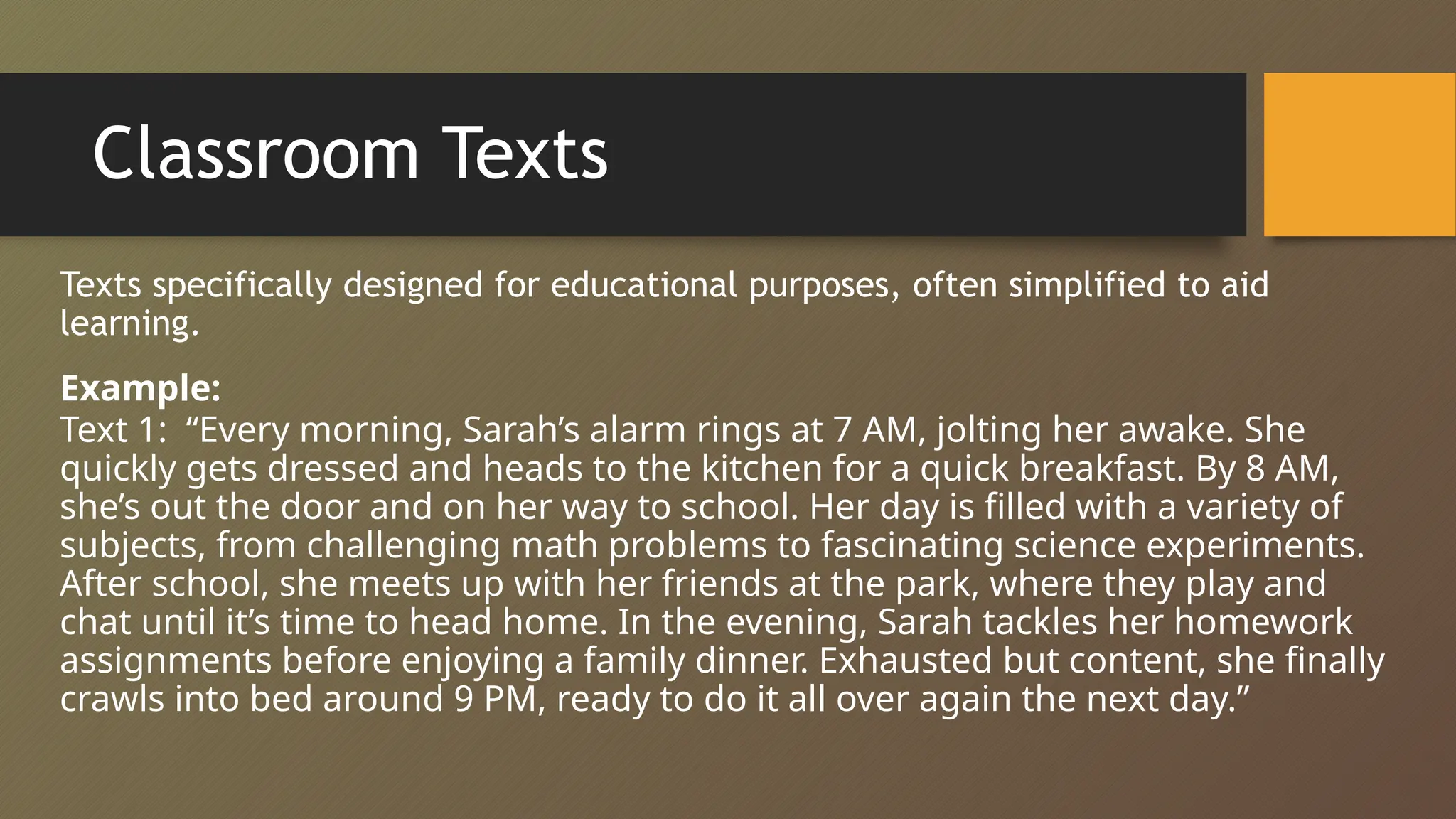
Texts specifically designed for educational purposes, often simplified to aid
learning.
Example:
Text 1: “Every morning, Sarah’s alarm rings at 7 AM, jolting her awake. She
quickly gets dressed and heads to the kitchen for a quick breakfast. By 8 AM,
she’s out the door and on her way to school. Her day is filled with a variety of
subjects, from challenging math problems to fascinating science experiments.
After school, she meets up with her friends at the park, where they play and
chat until it’s time to head home. In the evening, Sarah tackles her homework
assignments before enjoying a family dinner. Exhausted but content, she finally
crawls into bed around 9 PM, ready to do it all over again the next day.”
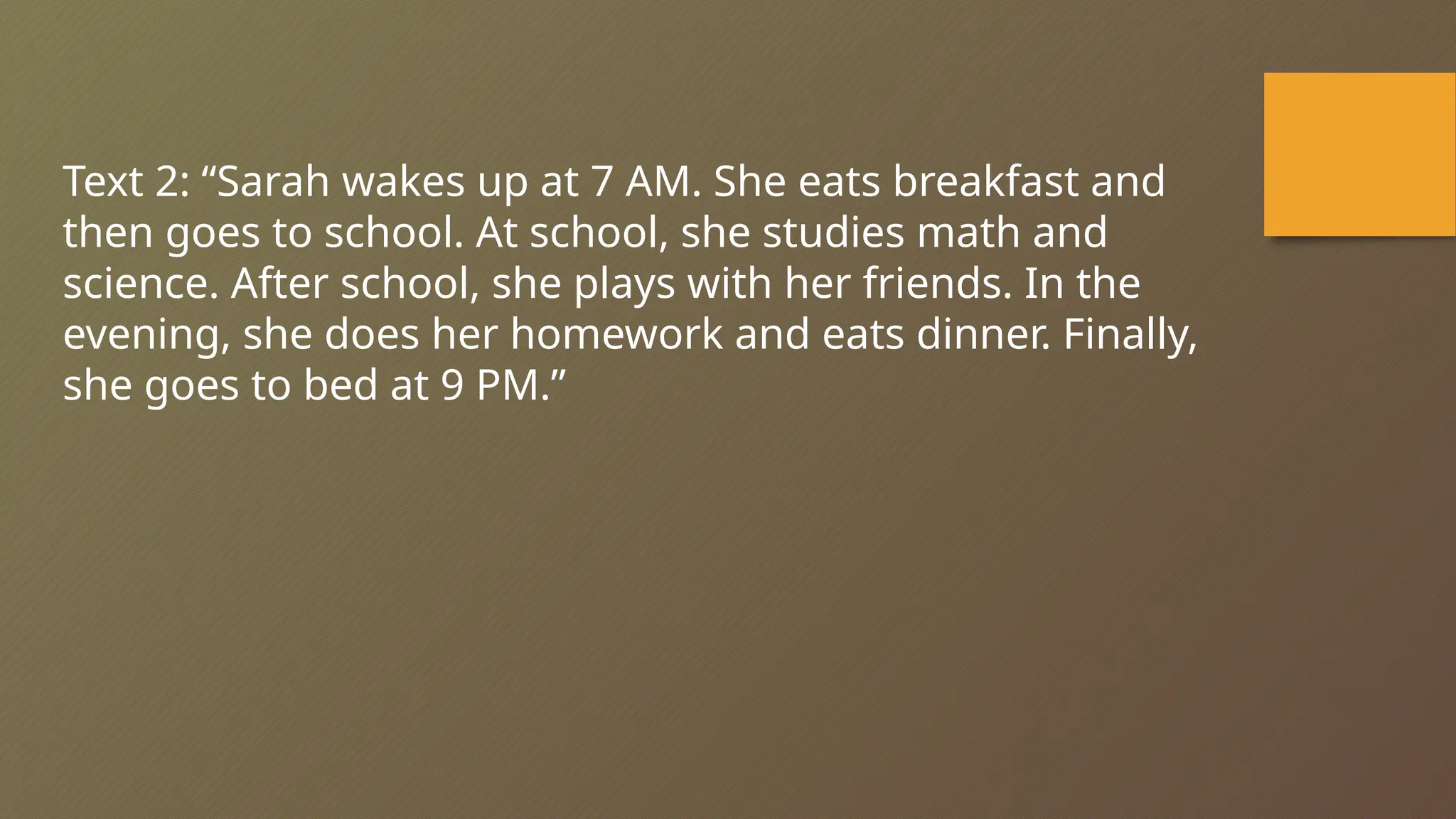
Text 2: “Sarah wakes up at 7 AM. She eats breakfast and
then goes to school. At school, she studies math and
science. After school, she plays with her friends. In the
evening, she does her homework and eats dinner. Finally,
she goes to bed at 9 PM.”
THE PROBLEM WITH TRADITIONAL CLASSROOM
TEXT
• Lack of Authenticity: Often do not reflect real-world language use.
• Simplification: May oversimplify language, reducing exposure to
complex structures.
• Engagement: Can be less engaging for students compared to
authentic texts.
THE RISE OF AUTHENTICITY
AUTHENTIC TEXT
Texts not specifically designed for educational purposes,
reflecting real-world language use (e.g., news articles,
emails).
Ex: Advertisement
“Experience the future with the new XYZ Smartphone.
Featuring a stunning display, powerful processor, and long-
lasting battery life. Available now at all major retailers.”
THE RISE OF AUTHENTICITY
SEMI-AUTHENTIC TEXT
Texts adapted from authentic sources but modified for
educational purposes.
Ex: Advertisement
“Try the new XYZ Smartphone. It has a great screen, fast
processor, and long battery life. You can buy it now in
stores.”
PURPOSE OF CLASSROOM TEXT

LINGUISTIC PURPOSE
 Providing learners with a clear understanding of how language works and
exposing them to contextualized grammar structures, vocabulary items,
pragmatic functions, and model for text production.
TEXT-AS-STIMULUS
 The text is used to introduce content in the classroom that learners can
respond to. This involves using texts as prompts for discussion, role
playing, creative writing, and other activities that encourages learners
to think critically, express themselves, and to interact with the
material.
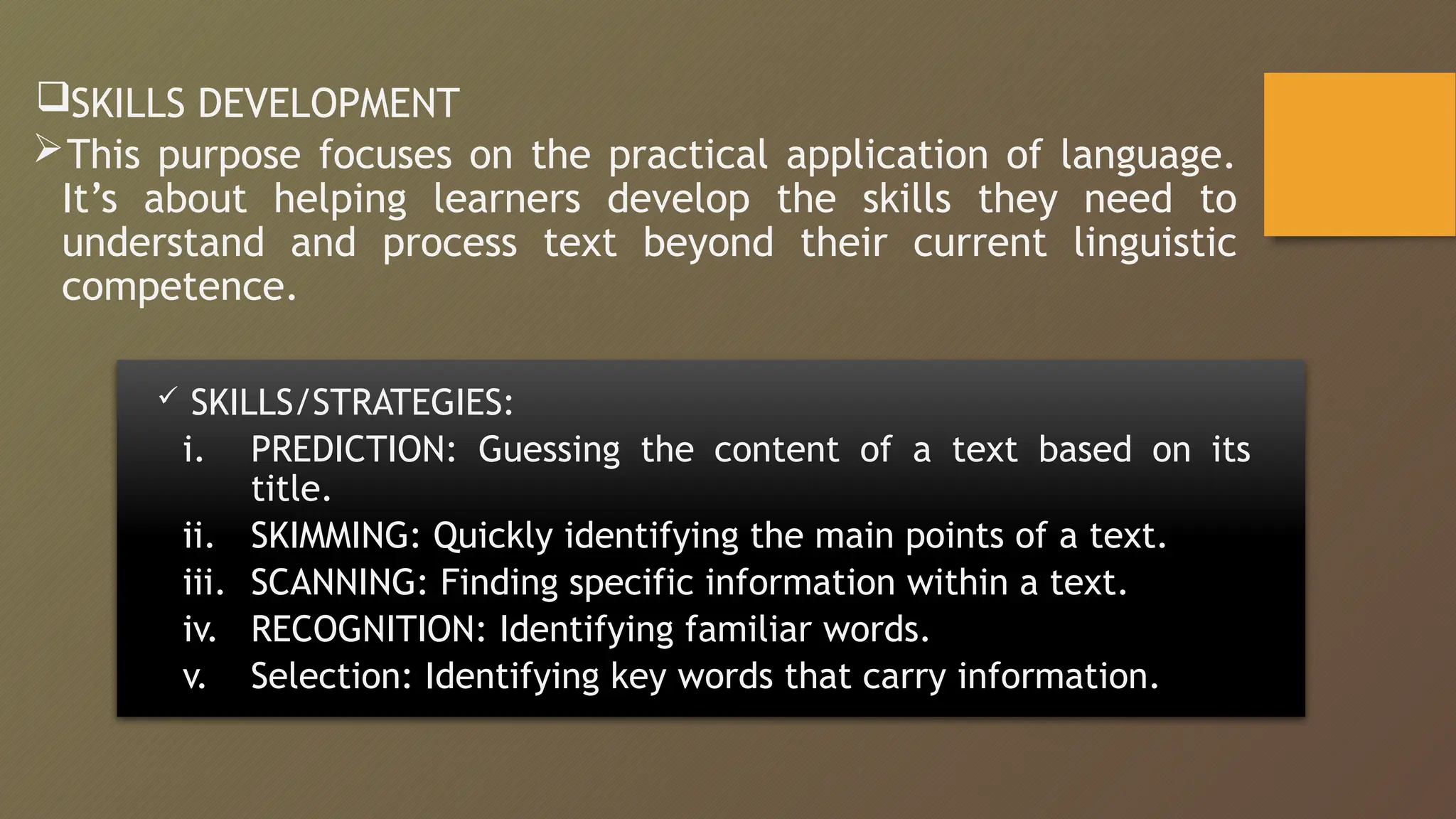
SKILLS DEVELOPMENT
This purpose focuses on the practical application of language.
It’s about helping learners develop the skills they need to
understand and process text beyond their current linguistic
competence.
 SKILLS/STRATEGIES:
i. PREDICTION: Guessing the content of a text based on its
title.
ii. SKIMMING: Quickly identifying the main points of a text.
iii. SCANNING: Finding specific information within a text.
iv. RECOGNITION: Identifying familiar words.
v. Selection: Identifying key words that carry information.
GRADING THE TASK NOT THE TEXT
It focused on the difficulty of the task rather
than simplifying the text itself.
2 LEARNING PRINCIPLES
TASK-BASED LEARNING
VARYING TASK DIFFICULTY
TASK-BASED LEARNING
 Engaging learners in meaningful task. In discourse, it focuses
on using task to improve learners ability to communicate
effectively in spoken and written English.
Ex. DEBATE, ROLE PLAYS, PROJECT-BASED LEARNING
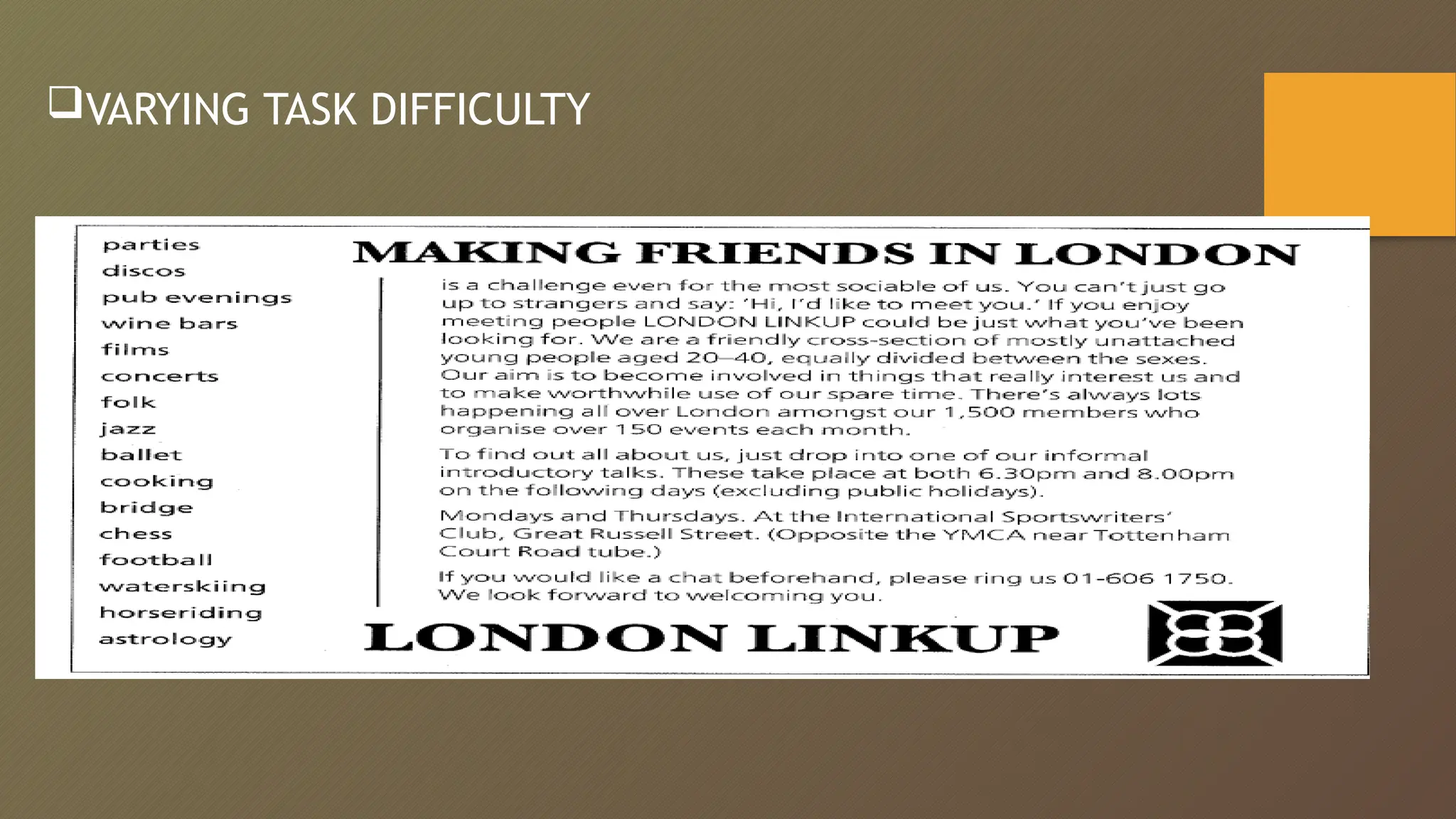
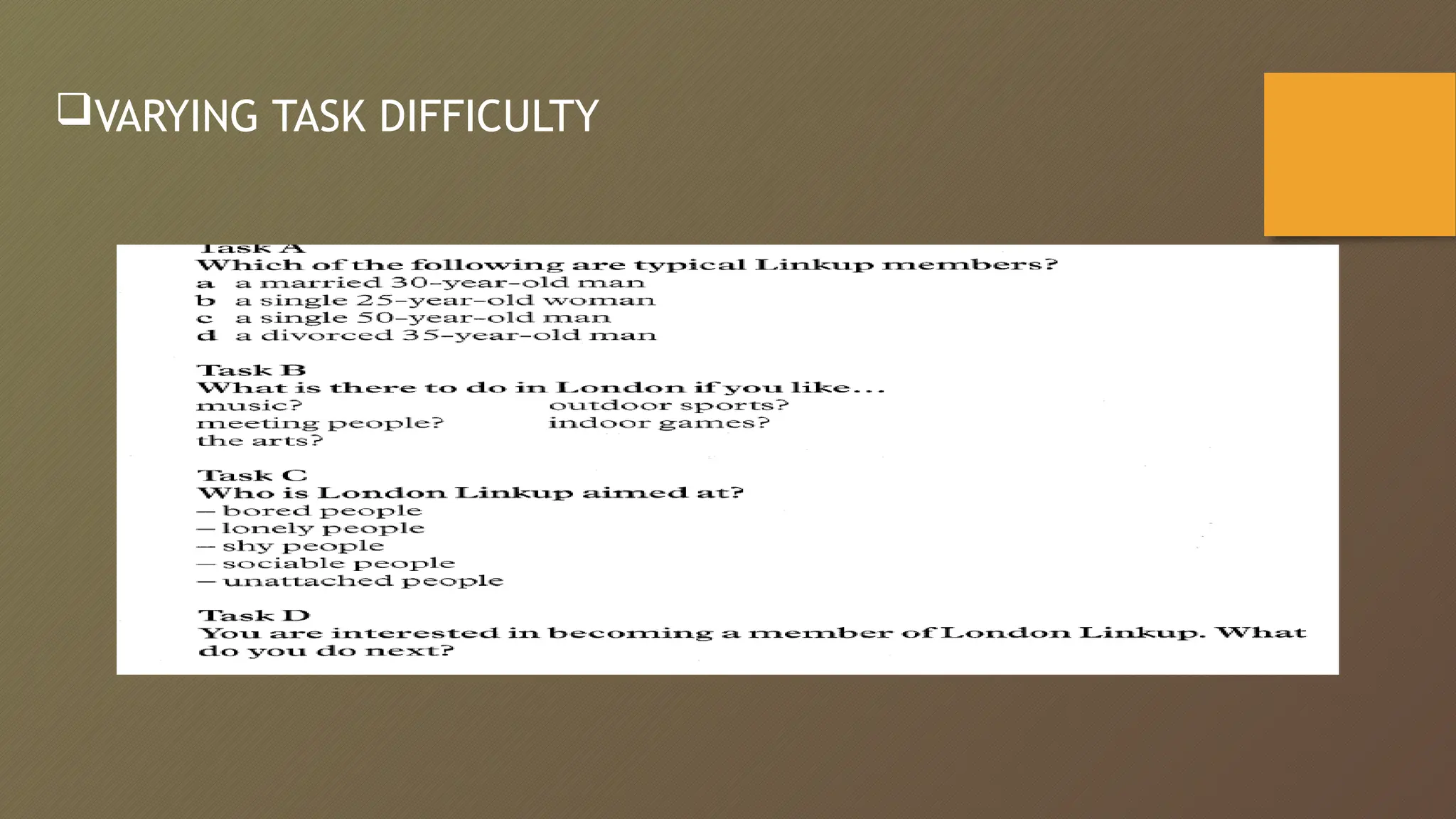
VARYING TASK DIFFICULTY
Task can be designed to require different levels of text
processing from superficial to deep understanding.
VARYING TASK DIFFICULTY
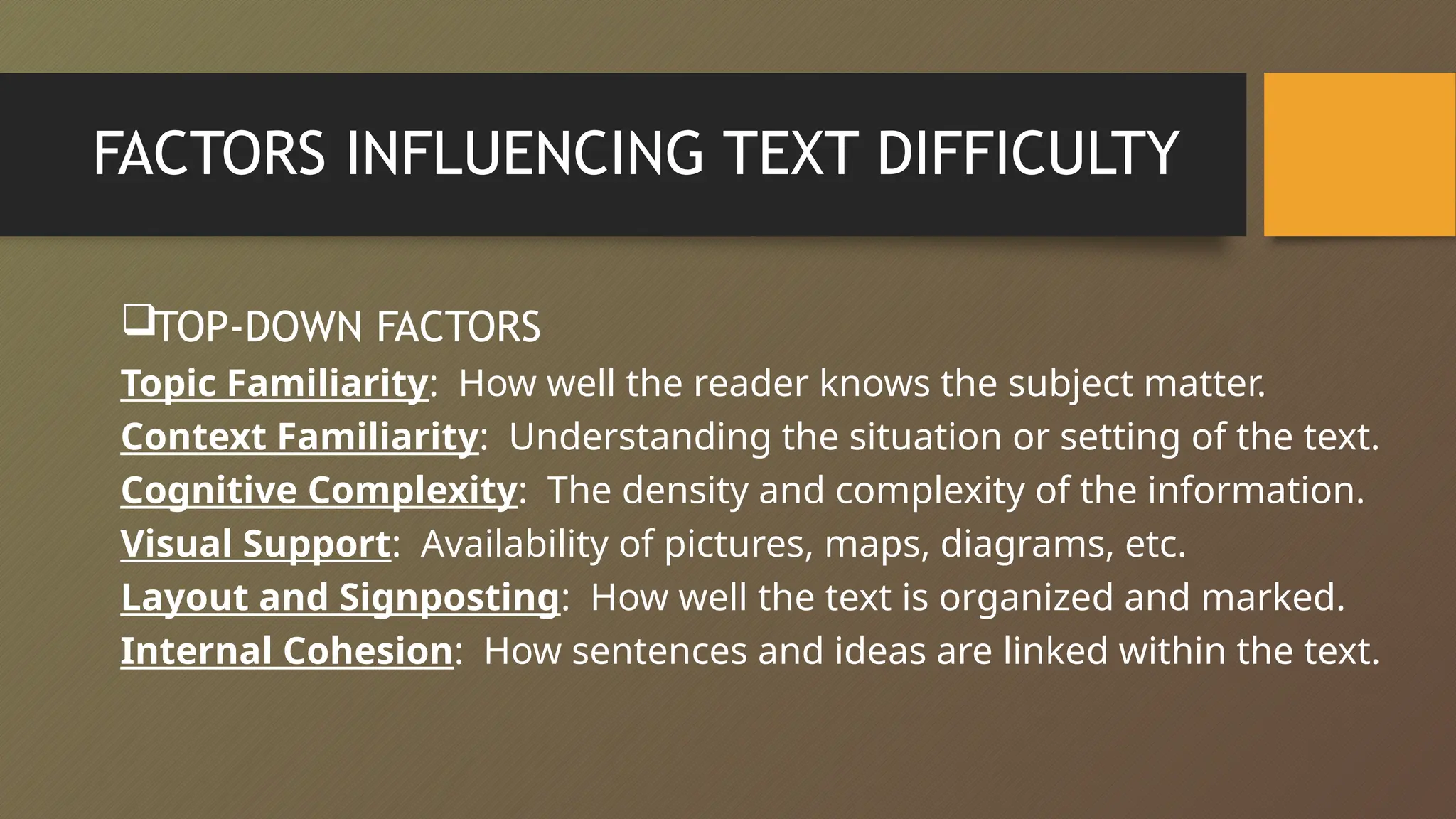
FACTORS INFLUENCING TEXT DIFFICULTY
TOP-DOWN FACTORS
Topic Familiarity: How well the reader knows the subject matter.
Context Familiarity: Understanding the situation or setting of the text.
Cognitive Complexity: The density and complexity of the information.
Visual Support: Availability of pictures, maps, diagrams, etc.
Layout and Signposting: How well the text is organized and marked.
Internal Cohesion: How sentences and ideas are linked within the text.
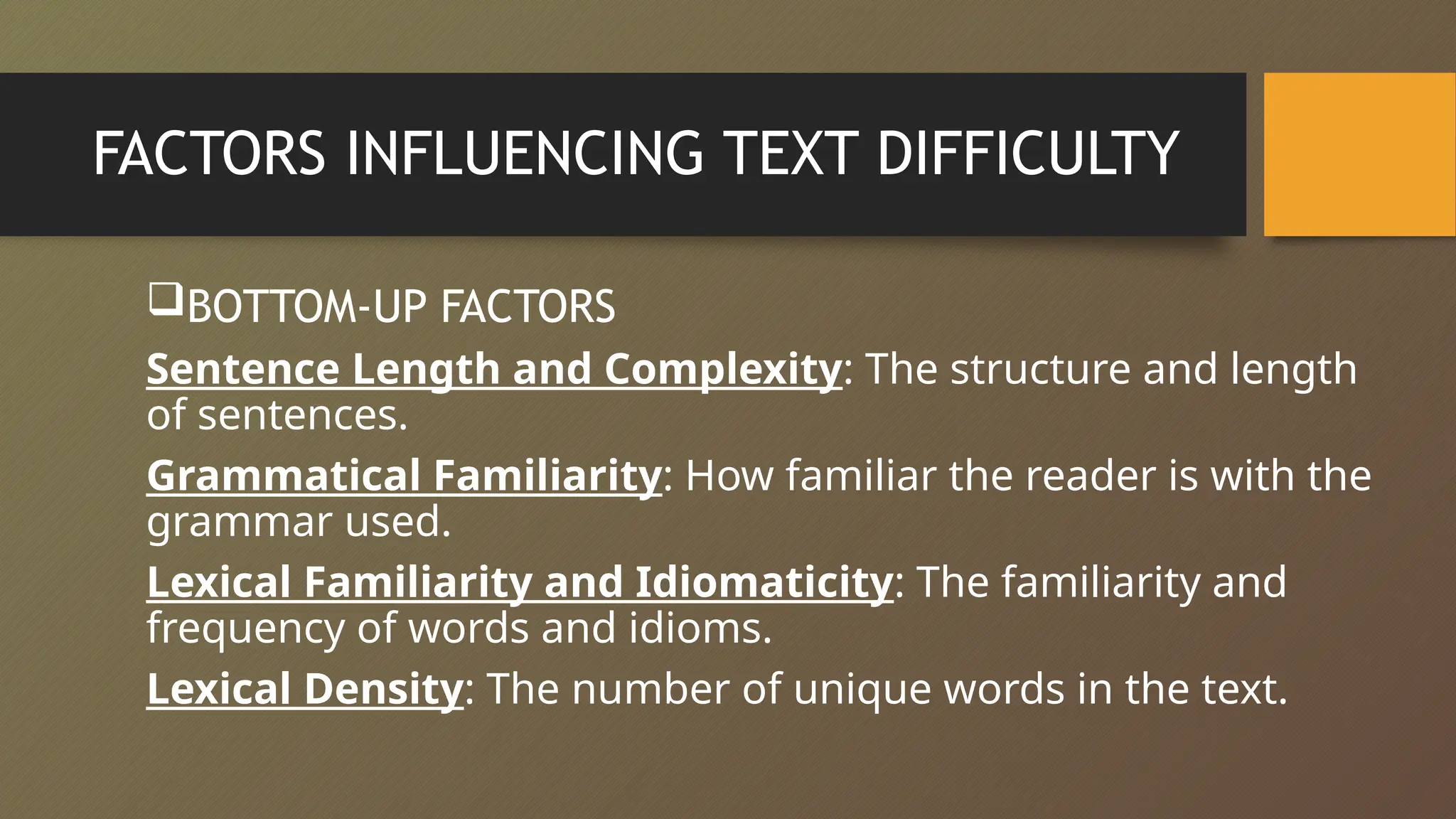
FACTORS INFLUENCING TEXT DIFFICULTY
BOTTOM-UP FACTORS
Sentence Length and Complexity: The structure and length
of sentences.
Grammatical Familiarity: How familiar the reader is with the
grammar used.
Lexical Familiarity and Idiomaticity: The familiarity and
frequency of words and idioms.
Lexical Density: The number of unique words in the text.
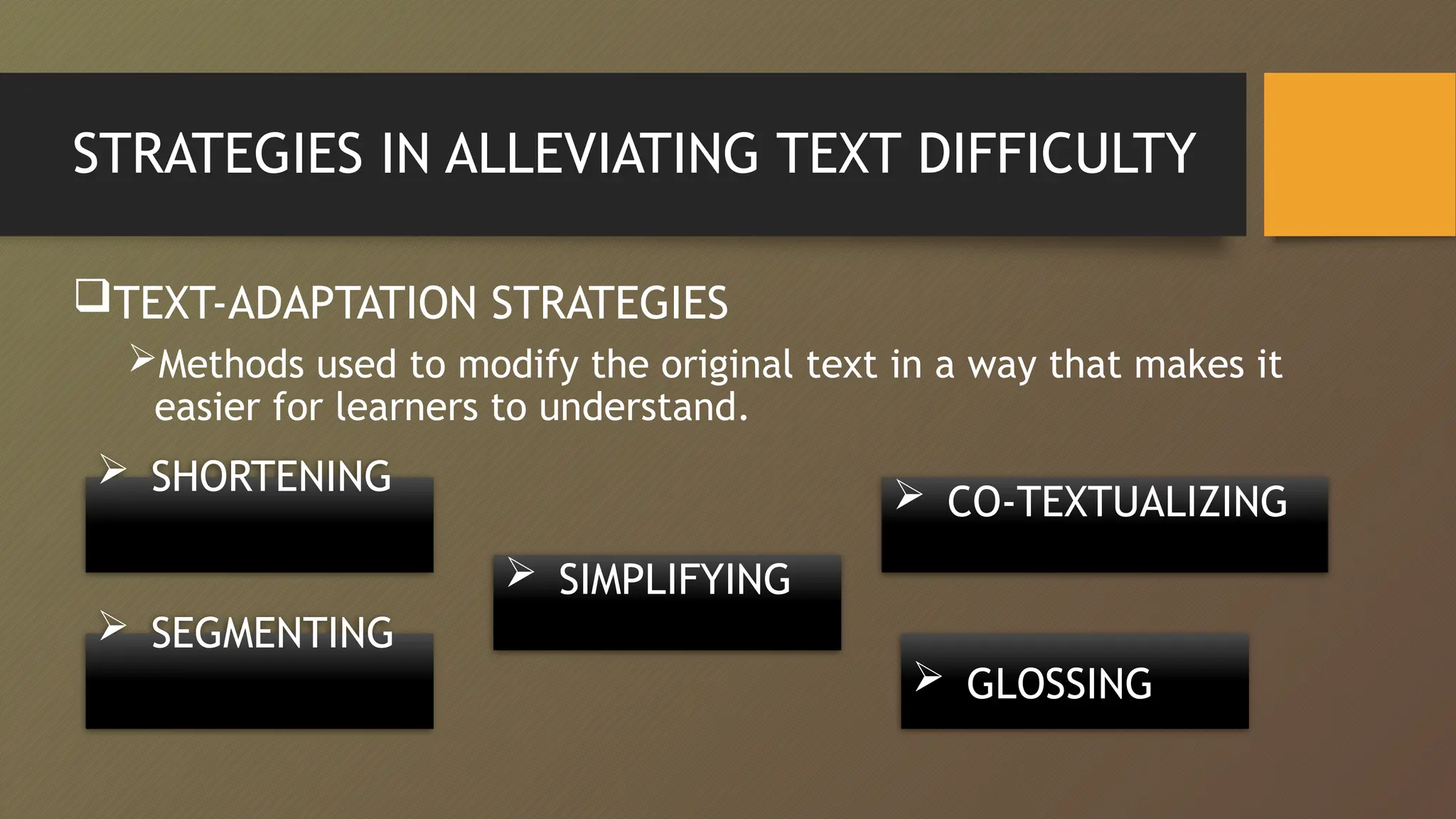
STRATEGIES IN ALLEVIATING TEXT DIFFICULTY
 SHORTENING
TEXT-ADAPTATION STRATEGIES
Methods used to modify the original text in a way that makes it
easier for learners to understand.
 SEGMENTING
 SIMPLIFYING
 CO-TEXTUALIZING
 GLOSSING
TEXT-ADAPTATION STRATEGIES
This involves removing unnecessary sections to reduce the
length of the text and make it easier to process.
Ex. Original: The increasing popularity of social media has led
to a significant shift in the way people communicate and
consume information.
Shortened: Social media changes communication and
information consumption.
 SHORTENING
Breaking down long texts into smaller, manageable sections
which can ease the processing load.
Ex. A long article from a scientific journal might best be dealt
with in sections: abstract, the background, the research
question, the method, etc.
 SEGMENTING
 This involves making the text easier to understand by replacing
complex vocabulary with simpler terms, reducing the length and
complexity of sentences by making dependent clauses into
independent sentences. This strategy aims to make the text more
accessible without losing its meaning.
 SIMPLIFYING
Ex. Original: She was apprehensive about the upcoming
presentation, but she eventually found the courage to deliver
it flawlessly.
Simplified: She was nervous about giving her presentation,
but she did a great job in the end.
 CO-TEXTUALIZING
Presenting the text within its surrounding text. It refers to
the process of analyzing and interpreting the relationships
between a text and its surrounding text.
 GLOSSING
Providing a glossary of difficult words in the text either
alongside the text or as footnotes. This can help reduce the
vocabulary load for learners, saving them time and effort
consulting dictionaries.
Ex. Synonyms and translations
Sentence: The prolific author has published over 50 novels.
Prolific means “producing a large amount of something.
APPROACHES IN ALLEVIATING TEXT DIFFICULTY
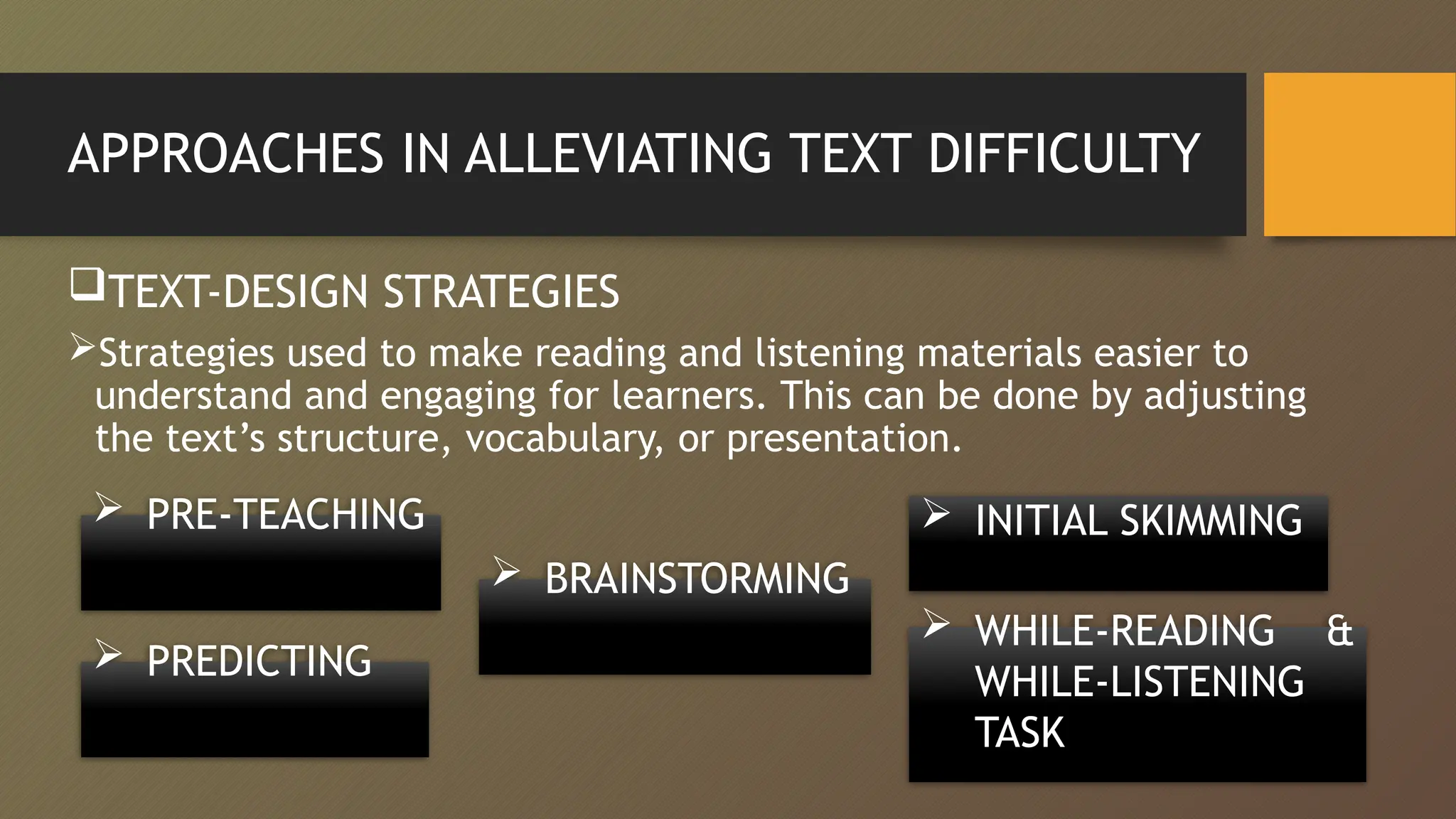
TEXT-DESIGN STRATEGIES
Strategies used to make reading and listening materials easier to
understand and engaging for learners. This can be done by adjusting
the text’s structure, vocabulary, or presentation.
 PRE-TEACHING
 BRAINSTORMING
 PREDICTING
 INITIAL SKIMMING
 WHILE-READING &
WHILE-LISTENING
TASK
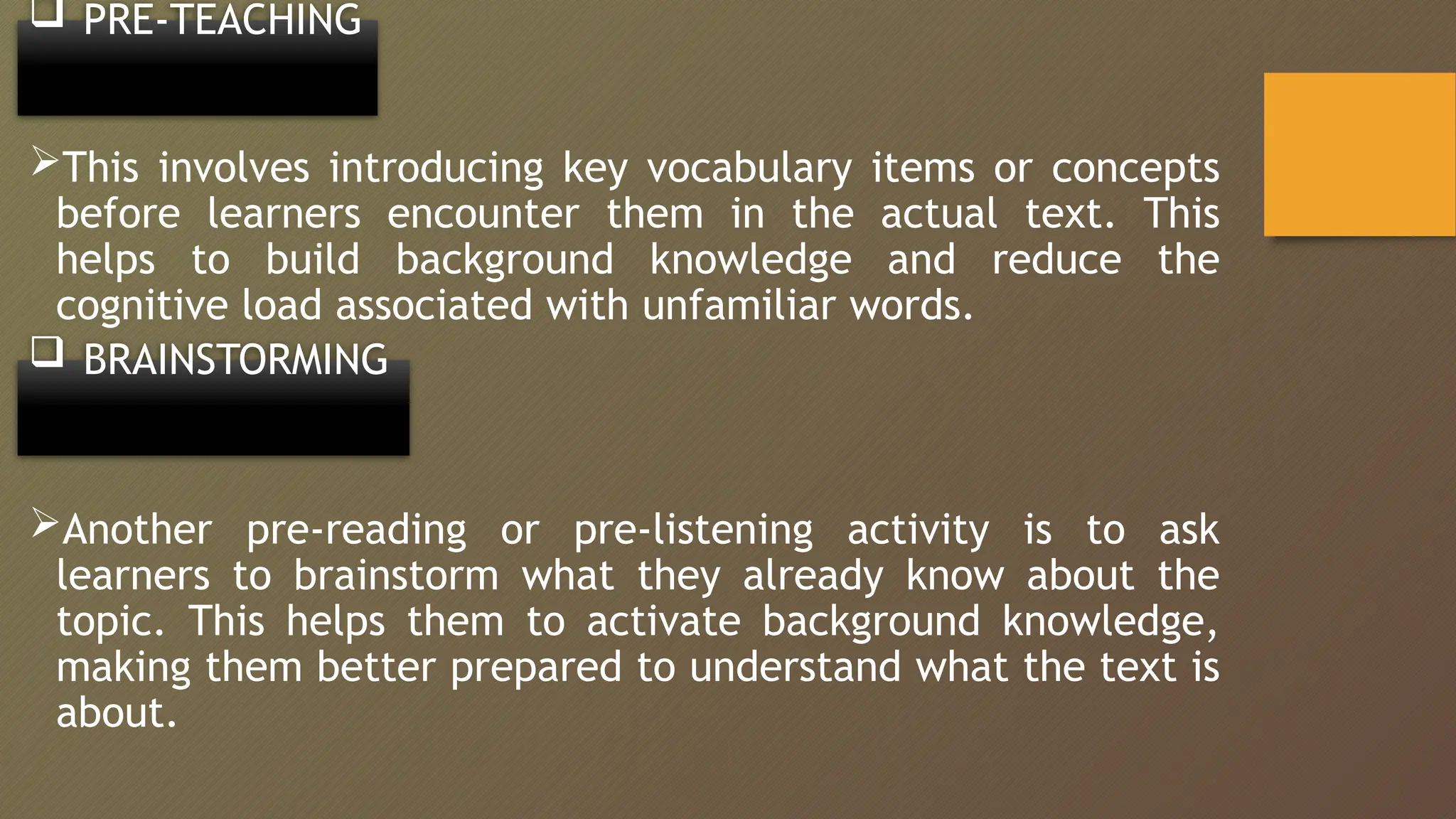
 PRE-TEACHING
This involves introducing key vocabulary items or concepts
before learners encounter them in the actual text. This
helps to build background knowledge and reduce the
cognitive load associated with unfamiliar words.
 BRAINSTORMING
Another pre-reading or pre-listening activity is to ask
learners to brainstorm what they already know about the
topic. This helps them to activate background knowledge,
making them better prepared to understand what the text is
about.
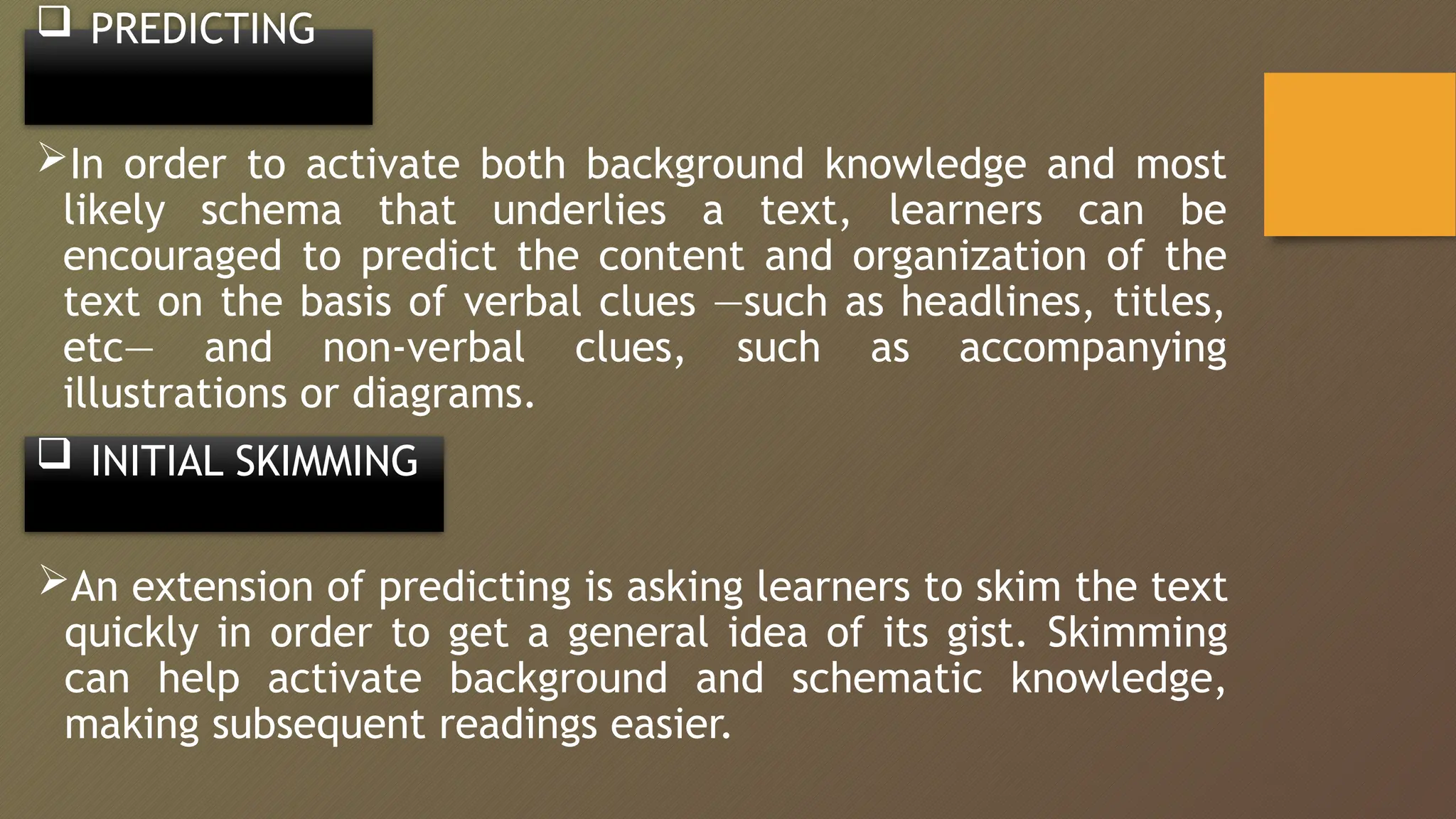
 PREDICTING
In order to activate both background knowledge and most
likely schema that underlies a text, learners can be
encouraged to predict the content and organization of the
text on the basis of verbal clues ―such as headlines, titles,
etc― and non-verbal clues, such as accompanying
illustrations or diagrams.
 INITIAL SKIMMING
An extension of predicting is asking learners to skim the text
quickly in order to get a general idea of its gist. Skimming
can help activate background and schematic knowledge,
making subsequent readings easier.
 WHILE-READING & WHILE-LISTENING TASK
 Giving learners something to do while reading or listening
can help make sense of a text and ease the load, but only so
long as the task is well suited to the text type.
TAVI vs. TALO
TAVI (Text As a Vehicle for Information)
The primary purpose is to use the text as a tool for
understanding and extracting information. The emphasis is
on the content and meaning of the text, not its linguistic
features.
Example: A class might read a news article to understand
global warming. The focus is on the article’s message, not the
grammar or vocabulary used.
TAVI vs. TALO
TALO (Text As a Linguistic Object)
The emphasis is on analyzing the language of the text itself,
such as its vocabulary, grammar, or style. The text serves as
a tool for linguistic exploration.
Example: Using the same news article on global warming, a
TALO activity might involve identifying all the instances of
the present perfect tense and discussing why it was used.
TEXT-BASED SYLLABUS
GRAMMAR-DRIVEN APPROACH
Starts with a list of grammar points (verb tenses,
articles, prepositions), then finds texts to illustrate
them (articles, stories), and finally designs tasks
around those texts (identifying examples, gap-fill
exercises, sentence writing).
TEXT-BASED SYLLBUS
TEXT-DRIVEN APPROACH
 It focuses on using authentic texts as the starting point
for learning, rather than beginning with isolated grammar
rules. This approach emphasizes understanding grammar
within the context of authentic materials and aims to
make language learning more engaging for students.
THE END
THANK YOU FOR
LISTENING^-^

CLASSROOM-TEXT for Discourse Analysis.pptx

  • 1.
    CLASSROOM TEXT CHAPTER 6 PRESENTEDBY: KIM ANTONIETTE O. GAVIOLA JAN MHARIE V. BELIA
  • 2.
    CONTENTS OF THISPRESENTATION: CLASSROOM TEXTS THE PROBLEM WITH TRADITIONAL CLASSROOM TEXT THE RISE OF AUTHENTICITY PURPOSE OF CLASSROOM TEXT GRADING THE TASK NOT THE TEXT FACTORS INFLUENCING TEXT DIFFICULTY STRATEGIES IN ALLEVIATING TEXT DIFFICULTY TAVI vs. TALO TEXT BASED SYLLABUS
  • 3.
    Classroom Texts Texts specificallydesigned for educational purposes, often simplified to aid learning. Example: Text 1: “Every morning, Sarah’s alarm rings at 7 AM, jolting her awake. She quickly gets dressed and heads to the kitchen for a quick breakfast. By 8 AM, she’s out the door and on her way to school. Her day is filled with a variety of subjects, from challenging math problems to fascinating science experiments. After school, she meets up with her friends at the park, where they play and chat until it’s time to head home. In the evening, Sarah tackles her homework assignments before enjoying a family dinner. Exhausted but content, she finally crawls into bed around 9 PM, ready to do it all over again the next day.”
  • 4.
    Text 2: “Sarahwakes up at 7 AM. She eats breakfast and then goes to school. At school, she studies math and science. After school, she plays with her friends. In the evening, she does her homework and eats dinner. Finally, she goes to bed at 9 PM.”
  • 5.
    THE PROBLEM WITHTRADITIONAL CLASSROOM TEXT • Lack of Authenticity: Often do not reflect real-world language use. • Simplification: May oversimplify language, reducing exposure to complex structures. • Engagement: Can be less engaging for students compared to authentic texts.
  • 6.
    THE RISE OFAUTHENTICITY AUTHENTIC TEXT Texts not specifically designed for educational purposes, reflecting real-world language use (e.g., news articles, emails). Ex: Advertisement “Experience the future with the new XYZ Smartphone. Featuring a stunning display, powerful processor, and long- lasting battery life. Available now at all major retailers.”
  • 7.
    THE RISE OFAUTHENTICITY SEMI-AUTHENTIC TEXT Texts adapted from authentic sources but modified for educational purposes. Ex: Advertisement “Try the new XYZ Smartphone. It has a great screen, fast processor, and long battery life. You can buy it now in stores.”
  • 8.
    PURPOSE OF CLASSROOMTEXT  LINGUISTIC PURPOSE  Providing learners with a clear understanding of how language works and exposing them to contextualized grammar structures, vocabulary items, pragmatic functions, and model for text production. TEXT-AS-STIMULUS  The text is used to introduce content in the classroom that learners can respond to. This involves using texts as prompts for discussion, role playing, creative writing, and other activities that encourages learners to think critically, express themselves, and to interact with the material.
  • 9.
    SKILLS DEVELOPMENT This purposefocuses on the practical application of language. It’s about helping learners develop the skills they need to understand and process text beyond their current linguistic competence.  SKILLS/STRATEGIES: i. PREDICTION: Guessing the content of a text based on its title. ii. SKIMMING: Quickly identifying the main points of a text. iii. SCANNING: Finding specific information within a text. iv. RECOGNITION: Identifying familiar words. v. Selection: Identifying key words that carry information.
  • 10.
    GRADING THE TASKNOT THE TEXT It focused on the difficulty of the task rather than simplifying the text itself. 2 LEARNING PRINCIPLES TASK-BASED LEARNING VARYING TASK DIFFICULTY
  • 11.
    TASK-BASED LEARNING  Engaginglearners in meaningful task. In discourse, it focuses on using task to improve learners ability to communicate effectively in spoken and written English. Ex. DEBATE, ROLE PLAYS, PROJECT-BASED LEARNING VARYING TASK DIFFICULTY Task can be designed to require different levels of text processing from superficial to deep understanding.
  • 12.
  • 13.
  • 14.
    FACTORS INFLUENCING TEXTDIFFICULTY TOP-DOWN FACTORS Topic Familiarity: How well the reader knows the subject matter. Context Familiarity: Understanding the situation or setting of the text. Cognitive Complexity: The density and complexity of the information. Visual Support: Availability of pictures, maps, diagrams, etc. Layout and Signposting: How well the text is organized and marked. Internal Cohesion: How sentences and ideas are linked within the text.
  • 15.
    FACTORS INFLUENCING TEXTDIFFICULTY BOTTOM-UP FACTORS Sentence Length and Complexity: The structure and length of sentences. Grammatical Familiarity: How familiar the reader is with the grammar used. Lexical Familiarity and Idiomaticity: The familiarity and frequency of words and idioms. Lexical Density: The number of unique words in the text.
  • 16.
    STRATEGIES IN ALLEVIATINGTEXT DIFFICULTY  SHORTENING TEXT-ADAPTATION STRATEGIES Methods used to modify the original text in a way that makes it easier for learners to understand.  SEGMENTING  SIMPLIFYING  CO-TEXTUALIZING  GLOSSING
  • 17.
    TEXT-ADAPTATION STRATEGIES This involvesremoving unnecessary sections to reduce the length of the text and make it easier to process. Ex. Original: The increasing popularity of social media has led to a significant shift in the way people communicate and consume information. Shortened: Social media changes communication and information consumption.  SHORTENING
  • 18.
    Breaking down longtexts into smaller, manageable sections which can ease the processing load. Ex. A long article from a scientific journal might best be dealt with in sections: abstract, the background, the research question, the method, etc.  SEGMENTING  This involves making the text easier to understand by replacing complex vocabulary with simpler terms, reducing the length and complexity of sentences by making dependent clauses into independent sentences. This strategy aims to make the text more accessible without losing its meaning.  SIMPLIFYING
  • 19.
    Ex. Original: Shewas apprehensive about the upcoming presentation, but she eventually found the courage to deliver it flawlessly. Simplified: She was nervous about giving her presentation, but she did a great job in the end.  CO-TEXTUALIZING Presenting the text within its surrounding text. It refers to the process of analyzing and interpreting the relationships between a text and its surrounding text.
  • 20.
     GLOSSING Providing aglossary of difficult words in the text either alongside the text or as footnotes. This can help reduce the vocabulary load for learners, saving them time and effort consulting dictionaries. Ex. Synonyms and translations Sentence: The prolific author has published over 50 novels. Prolific means “producing a large amount of something.
  • 21.
    APPROACHES IN ALLEVIATINGTEXT DIFFICULTY TEXT-DESIGN STRATEGIES Strategies used to make reading and listening materials easier to understand and engaging for learners. This can be done by adjusting the text’s structure, vocabulary, or presentation.  PRE-TEACHING  BRAINSTORMING  PREDICTING  INITIAL SKIMMING  WHILE-READING & WHILE-LISTENING TASK
  • 22.
     PRE-TEACHING This involvesintroducing key vocabulary items or concepts before learners encounter them in the actual text. This helps to build background knowledge and reduce the cognitive load associated with unfamiliar words.  BRAINSTORMING Another pre-reading or pre-listening activity is to ask learners to brainstorm what they already know about the topic. This helps them to activate background knowledge, making them better prepared to understand what the text is about.
  • 23.
     PREDICTING In orderto activate both background knowledge and most likely schema that underlies a text, learners can be encouraged to predict the content and organization of the text on the basis of verbal clues ―such as headlines, titles, etc― and non-verbal clues, such as accompanying illustrations or diagrams.  INITIAL SKIMMING An extension of predicting is asking learners to skim the text quickly in order to get a general idea of its gist. Skimming can help activate background and schematic knowledge, making subsequent readings easier.
  • 24.
     WHILE-READING &WHILE-LISTENING TASK  Giving learners something to do while reading or listening can help make sense of a text and ease the load, but only so long as the task is well suited to the text type.
  • 25.
    TAVI vs. TALO TAVI(Text As a Vehicle for Information) The primary purpose is to use the text as a tool for understanding and extracting information. The emphasis is on the content and meaning of the text, not its linguistic features. Example: A class might read a news article to understand global warming. The focus is on the article’s message, not the grammar or vocabulary used.
  • 26.
    TAVI vs. TALO TALO(Text As a Linguistic Object) The emphasis is on analyzing the language of the text itself, such as its vocabulary, grammar, or style. The text serves as a tool for linguistic exploration. Example: Using the same news article on global warming, a TALO activity might involve identifying all the instances of the present perfect tense and discussing why it was used.
  • 27.
    TEXT-BASED SYLLABUS GRAMMAR-DRIVEN APPROACH Startswith a list of grammar points (verb tenses, articles, prepositions), then finds texts to illustrate them (articles, stories), and finally designs tasks around those texts (identifying examples, gap-fill exercises, sentence writing).
  • 28.
    TEXT-BASED SYLLBUS TEXT-DRIVEN APPROACH It focuses on using authentic texts as the starting point for learning, rather than beginning with isolated grammar rules. This approach emphasizes understanding grammar within the context of authentic materials and aims to make language learning more engaging for students.
  • 29.
    THE END THANK YOUFOR LISTENING^-^