Principles and Elements of ArtMegan CoonVAEDUJanuary 26th
Principles of Art
BalanceLeonardo da Vinci , The Last Supper, 1495-1498, dry wall (fresco)- The ways in which the elements are arranged, a feeling of visual weight. Formal balance is symmetrical. Informal balance is typically asymmetrical
Unity- When all the elements of a piece combine to make a piece harmonious, complete, and whole.  The different elements compliment each other. Vincent Van Gogh, The Starry Night, 1889, oil on canvas
Movement- The direction in which art directs the viewers eyes through the piece. This gives life to artwork Francisco Goya, The Forge, 1817, oil on canvas
Proportion-the relationships between the elements  throughout the entire piece, through amounts Leonardo da Vinci, Vitruvian Man, c. 1487, drawing  pen and ink on paper
Repetition, Rhythm Pattern-the movement in a piece of art, repetition creates this movement through repeating of shapes and colors. This repetition forms rhythm and patternAndy Warhol, Campbell Soup Cans, 1962 , silk screen
Emphasis-the part of a piece of artwork that catches your eye when you first look, the focus or center of attentionJohn Trumbull, Surrender of Lord Cornwallis at Yorktown, Virginia, 1820, oil on canvas
Variety-the differences in a piece of art, contrasting elements liven up the pieceGeorges Seurat,  A Sunday Afternoon on the Island of La Grande Jatte, 1884-1886, oil on canvas
Elements of Art
Color-when light hits an object and reflects back to the viewers eye, has three properties 1. hue, 2. value, and 3. intensity or chromaClaude Monet, Bathing at La Grenouillere, 1869, oil on canvas
Line- The pathway of a point moving through space, can vary in width, length, curvature, direction,  and texture.  Is a record of movementM.C. Escher, Relativity, 1953, lithograph
Shape-when a line moves through the piece and connects with its start. This enclosure is a shape. May be a perceived area of elementsElizabeth Murray, Wiggle Manhattan, 1992, lithograph
Space-the distance of an area around, between, within or above shapes. It can be 3d or 2d, actual or pictorialFrancisco Lucientes,  He Can No Longer at the Age of 98, 1819-1823, brush india ink wash.
Texture- The “feel” (surface quality) of an object. Examples would be roughness, smoothness, or softness. There are different types of texture, actual texture is one that can be felt by a viewer. Vincent Van Gogh, Sunflowers, 1888, oil on canvas.
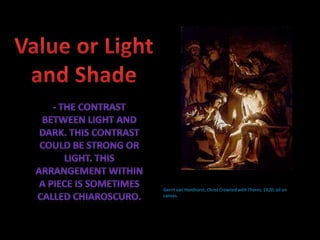
Value or Light and Shade- The contrast between light and dark. This contrast could be strong or light. This arrangement within a piece is sometimes called chiaroscuro. Gerrit van Honthorst, Christ Crowned with Thorns, 1620, oil on canvas.

Elements and Principles

  • 1.
    Principles and Elementsof ArtMegan CoonVAEDUJanuary 26th
  • 2.
  • 3.
    BalanceLeonardo da Vinci, The Last Supper, 1495-1498, dry wall (fresco)- The ways in which the elements are arranged, a feeling of visual weight. Formal balance is symmetrical. Informal balance is typically asymmetrical
  • 4.
    Unity- When allthe elements of a piece combine to make a piece harmonious, complete, and whole. The different elements compliment each other. Vincent Van Gogh, The Starry Night, 1889, oil on canvas
  • 5.
    Movement- The directionin which art directs the viewers eyes through the piece. This gives life to artwork Francisco Goya, The Forge, 1817, oil on canvas
  • 6.
    Proportion-the relationships betweenthe elements throughout the entire piece, through amounts Leonardo da Vinci, Vitruvian Man, c. 1487, drawing pen and ink on paper
  • 7.
    Repetition, Rhythm Pattern-themovement in a piece of art, repetition creates this movement through repeating of shapes and colors. This repetition forms rhythm and patternAndy Warhol, Campbell Soup Cans, 1962 , silk screen
  • 8.
    Emphasis-the part ofa piece of artwork that catches your eye when you first look, the focus or center of attentionJohn Trumbull, Surrender of Lord Cornwallis at Yorktown, Virginia, 1820, oil on canvas
  • 9.
    Variety-the differences ina piece of art, contrasting elements liven up the pieceGeorges Seurat, A Sunday Afternoon on the Island of La Grande Jatte, 1884-1886, oil on canvas
  • 10.
  • 11.
    Color-when light hitsan object and reflects back to the viewers eye, has three properties 1. hue, 2. value, and 3. intensity or chromaClaude Monet, Bathing at La Grenouillere, 1869, oil on canvas
  • 12.
    Line- The pathwayof a point moving through space, can vary in width, length, curvature, direction, and texture. Is a record of movementM.C. Escher, Relativity, 1953, lithograph
  • 13.
    Shape-when a linemoves through the piece and connects with its start. This enclosure is a shape. May be a perceived area of elementsElizabeth Murray, Wiggle Manhattan, 1992, lithograph
  • 14.
    Space-the distance ofan area around, between, within or above shapes. It can be 3d or 2d, actual or pictorialFrancisco Lucientes, He Can No Longer at the Age of 98, 1819-1823, brush india ink wash.
  • 15.
    Texture- The “feel”(surface quality) of an object. Examples would be roughness, smoothness, or softness. There are different types of texture, actual texture is one that can be felt by a viewer. Vincent Van Gogh, Sunflowers, 1888, oil on canvas.
  • 16.
    Value or Lightand Shade- The contrast between light and dark. This contrast could be strong or light. This arrangement within a piece is sometimes called chiaroscuro. Gerrit van Honthorst, Christ Crowned with Thorns, 1620, oil on canvas.