BY
MARIE MAX-FRITZ
What is a still life?

• A still life is a drawing or painting of objects. Originally, these
  objects had a symbolic meaning that represented life, death,
  beauty, and decay.

• This has been a style of drawing and painting images since the
  Classic Roman time-period.

• Still life images have a foreground, mid-ground, and background.
    – This is the layering of objects in front of each other to create depth.
    – Shading the images with types of value scales creates a sense of
      volume and mass in the objects.

• As a whole, the image becomes dimensional and the art element of
  movement is presented in the picture.
Brief History and Background:

• A still life is a display of objects that narrate an idea or create a
  mood. Still life subject matter is intended to tell a story. To tell the
  story, artists use objects that relate to each other or have a
  symbolic meaning and apply colors and hues to help set the mood.
• Since the classical period in ancient Rome to the Puritan era of
  early America, still life paintings were descriptive in meaning and
  symbolism surrounding life, death, and eternity. In Latin terms, this
  is called 'memento mori' or, translated, 'remember your mortality'.
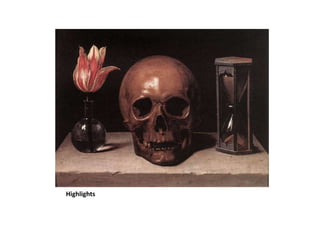
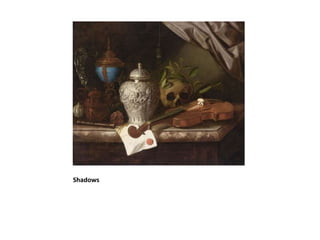
• Vanitas art is a style within this art genre also known as funerary
  art. This was primarily a Dutch form of art in the 1600s and was
  devoted to narrating a story through symbolic imagery that focused
  on life, beauty, death, and decay.
• This style is also referred to as funerary art and represented
  humankind's mortality and painted with high contrast and dark
  color schemes (chromas) .
Highlights
Shadows
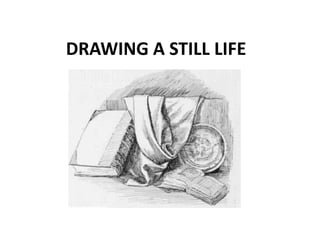
DRAWING A STILL LIFE
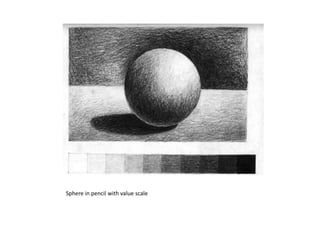
Sphere in pencil with value scale
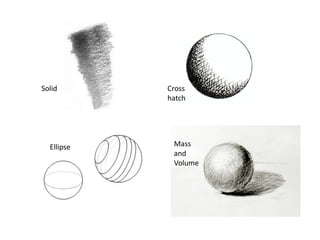
Solid       Cross
            hatch


  Ellipse    Mass
             and
             Volume
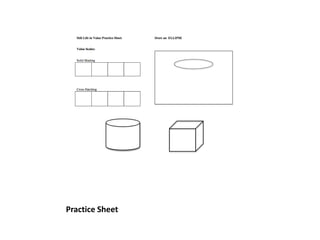
Practice Sheet
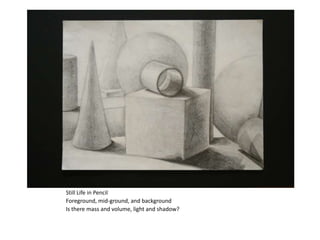
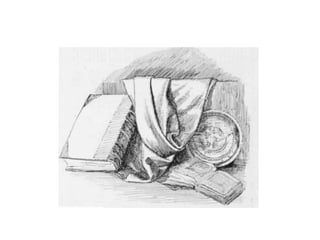
Still Life in Pencil
Foreground, mid-ground, and background
Is there mass and volume, light and shadow?
STILL LIFE IN THE 1800’S
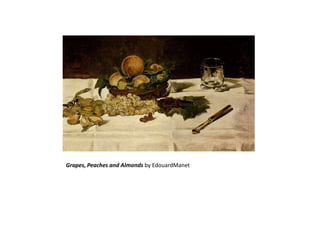
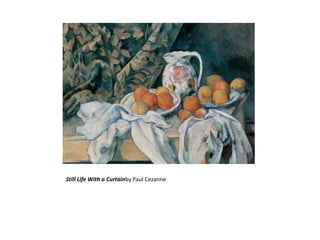
 In the 1800s, French artists continued the symbolic and narrative style in the
themes of their paintings This style was best portrayed by EdouardManet and Paul
Cezanne with their loosely arranged fresh cut flowers or tables that were bountiful
with foods.
These artists began to use color and texture to increase the moodiness or
characteristics of the still life subject matter. The meaning or symbolism of still life
paintings were being enhanced with manipulated gestural brush strokes, textures,
and light qualities.
They influenced the world of painted imagery by allowing the nature of the
medium and utensils to compliment the symbolic nature of the scene. This, in turn,
was the birth of a style of painting that allowed gesture and color to produce the
illusion of space, form, and volume. Their paintings reflected a new way to see and
portray the world around them. This became known as Impressionism.
Grapes, Peaches and Almonds by EdouardManet
Still Life With a Curtainby Paul Cezanne
MODERN
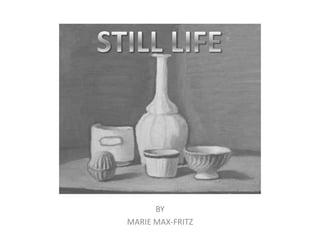
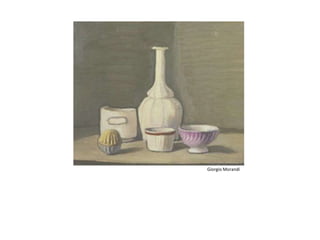
Also, Giorgio Morandi (early 1900s) painted with
very low intensity and added a hazy softness to a
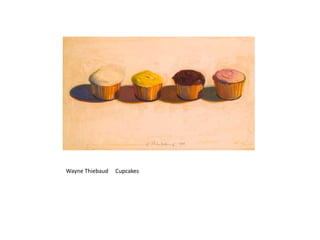
still life. More recently, artists, namely Wayne
Thiebaud, creatively reproduced foods that were
common and appreciated by society in a manner
that was much like the Impressionists. His style of
painting is thick with paint, loosely blended, and
rich with color and light, yet imagery is
recognizable. Through this gestural brush strokes,
intensity of colors, and varieties in contrast,
paintings seem to possess an individual life and
personality that is unique to the subject that is
rendered.
Giorgio Morandi
Wayne Thiebaud   Cupcakes
References
Bibliography/References:

Kuhl, Isabel. (2009) Impressionism. New York: Parragon

Oceana Books. (2003). The painting handbook. London: Quantum Publishing Ltd.

Quantum Books. (2003). The great masters. London: Quantum Publishing Ltd.

Rodriquez, Susan. (2007). Art smart, Pearson Education


Artists and Terms:
•Cezanne, Paul
•Chroma
•Manet, Edouard
•Momentomori
•Morandi, Giorgio
•Thiebaud, Wayne
•Vanitas

Still life

  • 1.
  • 2.
    What is astill life? • A still life is a drawing or painting of objects. Originally, these objects had a symbolic meaning that represented life, death, beauty, and decay. • This has been a style of drawing and painting images since the Classic Roman time-period. • Still life images have a foreground, mid-ground, and background. – This is the layering of objects in front of each other to create depth. – Shading the images with types of value scales creates a sense of volume and mass in the objects. • As a whole, the image becomes dimensional and the art element of movement is presented in the picture.
  • 3.
    Brief History andBackground: • A still life is a display of objects that narrate an idea or create a mood. Still life subject matter is intended to tell a story. To tell the story, artists use objects that relate to each other or have a symbolic meaning and apply colors and hues to help set the mood. • Since the classical period in ancient Rome to the Puritan era of early America, still life paintings were descriptive in meaning and symbolism surrounding life, death, and eternity. In Latin terms, this is called 'memento mori' or, translated, 'remember your mortality'. • Vanitas art is a style within this art genre also known as funerary art. This was primarily a Dutch form of art in the 1600s and was devoted to narrating a story through symbolic imagery that focused on life, beauty, death, and decay. • This style is also referred to as funerary art and represented humankind's mortality and painted with high contrast and dark color schemes (chromas) .
  • 4.
  • 5.
  • 6.
  • 7.
    Sphere in pencilwith value scale
  • 8.
    Solid Cross hatch Ellipse Mass and Volume
  • 9.
  • 12.
    Still Life inPencil Foreground, mid-ground, and background Is there mass and volume, light and shadow?
  • 14.
    STILL LIFE INTHE 1800’S In the 1800s, French artists continued the symbolic and narrative style in the themes of their paintings This style was best portrayed by EdouardManet and Paul Cezanne with their loosely arranged fresh cut flowers or tables that were bountiful with foods. These artists began to use color and texture to increase the moodiness or characteristics of the still life subject matter. The meaning or symbolism of still life paintings were being enhanced with manipulated gestural brush strokes, textures, and light qualities. They influenced the world of painted imagery by allowing the nature of the medium and utensils to compliment the symbolic nature of the scene. This, in turn, was the birth of a style of painting that allowed gesture and color to produce the illusion of space, form, and volume. Their paintings reflected a new way to see and portray the world around them. This became known as Impressionism.
  • 15.
    Grapes, Peaches andAlmonds by EdouardManet
  • 16.
    Still Life Witha Curtainby Paul Cezanne
  • 17.
    MODERN Also, Giorgio Morandi(early 1900s) painted with very low intensity and added a hazy softness to a still life. More recently, artists, namely Wayne Thiebaud, creatively reproduced foods that were common and appreciated by society in a manner that was much like the Impressionists. His style of painting is thick with paint, loosely blended, and rich with color and light, yet imagery is recognizable. Through this gestural brush strokes, intensity of colors, and varieties in contrast, paintings seem to possess an individual life and personality that is unique to the subject that is rendered.
  • 18.
  • 19.
  • 20.
    References Bibliography/References: Kuhl, Isabel. (2009)Impressionism. New York: Parragon Oceana Books. (2003). The painting handbook. London: Quantum Publishing Ltd. Quantum Books. (2003). The great masters. London: Quantum Publishing Ltd. Rodriquez, Susan. (2007). Art smart, Pearson Education Artists and Terms: •Cezanne, Paul •Chroma •Manet, Edouard •Momentomori •Morandi, Giorgio •Thiebaud, Wayne •Vanitas