 This is to present basic functional principles of high frequency x-ray
generators. The emphasis is put on physical concepts that determine the
engineering solutions to the problem of efficient generation and control of
high voltage power required to drive the x-ray tube. The physics of
magnetically coupled circuits is discussed first, as a background for the
discussion of Study related to high-frequency power transformer design by
X-ray Generator. Attention is paid to physical processes that influence such
factors as size, efficiency, and reliability of a high voltage power
transformer. The basic electrical circuit of a high frequency generator is
analyzed next, with focus on functional principles. This section investigates
the role and function of basic components, such as power supply, inverter,
and others. Essential electronic circuits of geneand timing of electrical
power delivery to the x-ray tube. Finally, issues related to efficient rator
control are then examined, including regulation of voltage, current
feedback control, including basic design of the AEC circuitry are reviewed.
1
ABSTARCT
 Objective.
 Introduction.
 Background history.
 X -Ray generation process.
 components .
 Types of X-ray generator.
 Quality Assurance test for X-ray generator.
 General Safety of X-ray Equipments.
 Limitation of x-ray.
 Conclusion.
 Future Work.
 References.
2
Objective
The main objectives of this thesis :
About X-ray Generator.
Different types of X-ray Generator.
The operation X-ray Generator.
Analysis of X-ray Generator.
Quality Assurances Test of X-ray Generator.
Advantages & disadvantage of X-ray Generator.
 How to develop the X-ray Generator.
3
Introduction
X-rays are a form of electromagnetic radiation combination of radio
waves, infrared radiation, visible light, ultraviolet radiation and
microwaves. One of the most common and beneficial uses of X-rays
is for medical imaging. X-rays are also used in treating cancer and in
exploring the cosmos.
Electromagnetic radiation is transmitted in waves or particles at
different wavelengths and frequencies. This broad range of
wavelengths is known as the electromagnetic spectrum. The EM
spectrum is generally divided into seven regions in order of
decreasing wavelength and increasing energy and frequency. The
common designations are: radio waves, microwaves, infrared (IR),
visible light, ultraviolet (UV), X-rays and gamma-rays.
4
Background history
In 1895, a German physicist, W. k. Roentgen was
working with a cathode ray tube in his laboratory.
He was working with tubes similar to our
fluorescent light bulbs.
5
HISTORY OF X-RAYS
1895 X-rays were discovered on November 8, 1895 by Wilhelm Konrad
Roentgen - a German physicist
1901 Prof. Roentgen was awarded the first Nobel prize for Physics
1913 Wilham David Coolidge invents a new type of X-ray tube known as hot
filament cathode tube or thermionic emission tube. This is still used for
producing X-rays
1937 First practical rotating anode tubes were manufactured.
6
Worlds First X-Ray(1895)
7
X-rays are produced by energy conversion when fast
moving electrons collide with target material in
vacuumed envelope .
The electrical energy obtained from the power supply line
is not in the correct form for direct application to the x-ray
tube. An x-ray machine has a number of components that
rearrange and control the electrical energy referred to as
either power supply or the generator.
8
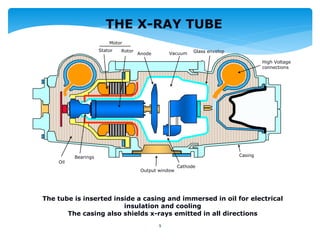
Casing
High Voltage
connections
Oil
Output window
Rotor
Anode
Cathode
Glass envelop
Bearings
Vacuum
Stator
Motor
The tube is inserted inside a casing and immersed in oil for electrical
insulation and cooling
The casing also shields x-rays emitted in all directions
THE X-RAY TUBE
9
Static
Balancer
Control
Panel
HT Rectifier Tube
Radiography
or
Fluoroscopy
Collimator
3
Phase
1 Phase
Recording
Device
X-RAY GNERATOR - COMPONENTS
10
The generator controls the
technique parameters:
kV: High Voltage generator
mA: filament heating
Time: direct control or
automatic exposure
Dose measuring device
(automatic exposure)
Image receptor
HV cables
Generator and
control console
Transformer rating:
kW = max kV x max mA / 1000
ex: 100 kV and 800 mA => 80 kW
X-Ray GENERATOR APPLICATION
11
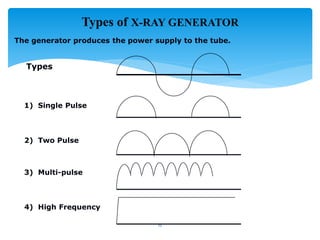
Types of X-RAY GENERATOR
The generator produces the power supply to the tube.
Types
1) Single Pulse
2) Two Pulse
3) Multi-pulse
4) High Frequency
12
These generators convert a 60 Hz power supply to 6500 Hz before entering to
the HT.
The ripple factor is very less and voltage across the tube is almost constant.
Ripple Factor is the difference between minimum and maximum voltages
expressed as a percentage of maximum voltage.
The ripple factor for various generators are :
single phase, 2pulse 100 %
Three Phase, 6 pulse 13 to 25 %
Three Phase, 12 pulse 3 to 12 %
High Frequency 1 to 12 %
DC output 0 to
4 %
HIGH FREQUENCY GENERATORS
13
QUALITY ASSURANCE TEST FOR X-RAY
GENERATOR
We are use in 500ma X-Ray Machine for this QA test purpose as
per Rules of WHO, BAERA, NDA, RSNA, IAERA & others.
Use Beam Alignment test tools . Take radiograph at 100 cm Target
to Film Distance 100 cm.
Use Focal Spot test tool. Use cassette without screens. Take a
radiograph.
Use KVP Meter : Ray safe QA Tools.
Use pocket dosimeter. Keep Focus to dosimeter distance = 50 cm
and others tools
14
Ray safe Xi View X-ray Generator QA Test
Tools
15
QUALITY ASSURANCE TEST FOR X-RAY
GENERATOR
60 KVP 85 KVP 100KVP
mA x Sec KV meter
reading
mA x Sec KV meter
reading
mA x Sec KV meter
reading
50 X 0.2 55 50 X 0.2 80 50 X 0.2 94
100 X 0.2 56 100 X 0.2 78 100 X 0.2 93
200 X 0.2 63 200 X 0.2 81 200 X 0.2 95
300 X 0.2 57 300 X 0.2 78 300 X 0.2 91
400 X 0.2 55 400 X 0.2 73
500 X 0.2 59
Average of above KV
Readings
Average of above KV
Readings
Average of above KV
Readings
57.5 KV 78 KV 93.25 KV16
Ma
range
SELECTED
PARAMETERS
INSTRUMENT READINGS
IN mR
mR/
mAs
Ma Se
c
KV X1 X2 X3 X4 X5 Av X
mR
= X*
50-100 50/60/70/80/90 0.2 70 3.49 4.1
9
4.8
9
5.59 6.29 4.89 0.34
100-200 100/120/140/160/
180
0.2 75 7.29 8.7
5
1.0
2
1.16 1.31 3.90 0.14
200-300 200/220/240/260/
280
0.2 80 1.53 1.6
8
1.8
4
1.99 2.14 1.83 0.04
300-400 300/320/340/360/
380
0.2 85 2.34 2.3
4
2.6
6
2.81 2.97 2.65 0.03
17
LINEARITY OF mA LOADING STATIONS
Coefficient of Linearity = (X* max - X* min ) / (X* max +
X* min )
X*max= 6.29, X*min =3.49
For 50-100ma
= (6.29-3.49) / (6.29+3.49)
=2.8 / 9.78 =0.28
Acceptable Value= less than 3.5 Acceptable Value= less than 0.1
18
Coefficient of Linearity
General Safety of X-ray Equipment
We should not drop the x-ray tube. It is made of glass
and is quite fragile.
 The x-ray machine chassis/cabinet must be properly
electrically grounded.
 Electrical cords should be inspected periodically to look
for possible damage.
 Avoid continuous high mA radiography which causes
filament breakage.
 Periodically monitor the temperature of the anode. If the
temperature of the anode increases rapidly, anode can
crack and then become unstable in rotation.
19
X-rays in medical diagnosis are normally used to obtain
a visual image of the subject radio graphed.
The image results from the differential attenuation of the
radiation which depends on the thickness, density and
configuration of the organ irradiated and on the proportion
and nature of the different chemical elements present.
 The nature of biological material is such that the
contrast differentiation between organs or parts of an
organ is frequently poor and despite methods to increase
the contrast this remains one of the principal limitations.
Limitation of x-ray
20
Conclusion
21
Future Recommendations
A purchase decision should be based on issues such as life-cycle cost, local
service support, discount rates and non-price-related benefits offered by the
supplier, And standardization with existing equipment in the department or
hospital (i.e., purchasing all x-ray generators from one supplier). The
initial acquisition cost's only a fraction of the total cost of operation.
Therefore, before making a purchase decision based solely on the
acquisition cost of an x-ray generator, buyers should consider operating
costs over the lifetime of the equipment. The following costs should be
considered when purchasing an x-ray generator:
• Special features (e.g., pulsed fluoroscopy capability)
• Service contract
• X-ray tube replacement
• Utilities
22
Reference Books
. Principles of Biomedical Instrumentation and Measurement by Richard Aston
Biomechanics by Y.C. Fung
 Medical Instrumentation: Application and Design by John G. Webster
 Introduction to Biomedical Engineering by John Enderle, Susan Blanchard
and Joseph Bronzino
 Introduction to Medical Imaging: Physics, Engineering and Clinical
Applications by Nadine Barrie Smith and Andrew Webb
 Medical Imaging Physics by William R. Hendee and E. Russell Ritenour
 The Physics of Medical Imaging by S. Webb
 Handbook of Biomedical Instrumentation by: Dr R.S. Khandpur
23
Thank you
24

X ray generator basic

  • 1.
     This isto present basic functional principles of high frequency x-ray generators. The emphasis is put on physical concepts that determine the engineering solutions to the problem of efficient generation and control of high voltage power required to drive the x-ray tube. The physics of magnetically coupled circuits is discussed first, as a background for the discussion of Study related to high-frequency power transformer design by X-ray Generator. Attention is paid to physical processes that influence such factors as size, efficiency, and reliability of a high voltage power transformer. The basic electrical circuit of a high frequency generator is analyzed next, with focus on functional principles. This section investigates the role and function of basic components, such as power supply, inverter, and others. Essential electronic circuits of geneand timing of electrical power delivery to the x-ray tube. Finally, issues related to efficient rator control are then examined, including regulation of voltage, current feedback control, including basic design of the AEC circuitry are reviewed. 1 ABSTARCT
  • 2.
     Objective.  Introduction. Background history.  X -Ray generation process.  components .  Types of X-ray generator.  Quality Assurance test for X-ray generator.  General Safety of X-ray Equipments.  Limitation of x-ray.  Conclusion.  Future Work.  References. 2
  • 3.
    Objective The main objectivesof this thesis : About X-ray Generator. Different types of X-ray Generator. The operation X-ray Generator. Analysis of X-ray Generator. Quality Assurances Test of X-ray Generator. Advantages & disadvantage of X-ray Generator.  How to develop the X-ray Generator. 3
  • 4.
    Introduction X-rays are aform of electromagnetic radiation combination of radio waves, infrared radiation, visible light, ultraviolet radiation and microwaves. One of the most common and beneficial uses of X-rays is for medical imaging. X-rays are also used in treating cancer and in exploring the cosmos. Electromagnetic radiation is transmitted in waves or particles at different wavelengths and frequencies. This broad range of wavelengths is known as the electromagnetic spectrum. The EM spectrum is generally divided into seven regions in order of decreasing wavelength and increasing energy and frequency. The common designations are: radio waves, microwaves, infrared (IR), visible light, ultraviolet (UV), X-rays and gamma-rays. 4
  • 5.
    Background history In 1895,a German physicist, W. k. Roentgen was working with a cathode ray tube in his laboratory. He was working with tubes similar to our fluorescent light bulbs. 5
  • 6.
    HISTORY OF X-RAYS 1895X-rays were discovered on November 8, 1895 by Wilhelm Konrad Roentgen - a German physicist 1901 Prof. Roentgen was awarded the first Nobel prize for Physics 1913 Wilham David Coolidge invents a new type of X-ray tube known as hot filament cathode tube or thermionic emission tube. This is still used for producing X-rays 1937 First practical rotating anode tubes were manufactured. 6
  • 7.
  • 8.
    X-rays are producedby energy conversion when fast moving electrons collide with target material in vacuumed envelope . The electrical energy obtained from the power supply line is not in the correct form for direct application to the x-ray tube. An x-ray machine has a number of components that rearrange and control the electrical energy referred to as either power supply or the generator. 8
  • 9.
    Casing High Voltage connections Oil Output window Rotor Anode Cathode Glassenvelop Bearings Vacuum Stator Motor The tube is inserted inside a casing and immersed in oil for electrical insulation and cooling The casing also shields x-rays emitted in all directions THE X-RAY TUBE 9
  • 10.
  • 11.
    The generator controlsthe technique parameters: kV: High Voltage generator mA: filament heating Time: direct control or automatic exposure Dose measuring device (automatic exposure) Image receptor HV cables Generator and control console Transformer rating: kW = max kV x max mA / 1000 ex: 100 kV and 800 mA => 80 kW X-Ray GENERATOR APPLICATION 11
  • 12.
    Types of X-RAYGENERATOR The generator produces the power supply to the tube. Types 1) Single Pulse 2) Two Pulse 3) Multi-pulse 4) High Frequency 12
  • 13.
    These generators converta 60 Hz power supply to 6500 Hz before entering to the HT. The ripple factor is very less and voltage across the tube is almost constant. Ripple Factor is the difference between minimum and maximum voltages expressed as a percentage of maximum voltage. The ripple factor for various generators are : single phase, 2pulse 100 % Three Phase, 6 pulse 13 to 25 % Three Phase, 12 pulse 3 to 12 % High Frequency 1 to 12 % DC output 0 to 4 % HIGH FREQUENCY GENERATORS 13
  • 14.
    QUALITY ASSURANCE TESTFOR X-RAY GENERATOR We are use in 500ma X-Ray Machine for this QA test purpose as per Rules of WHO, BAERA, NDA, RSNA, IAERA & others. Use Beam Alignment test tools . Take radiograph at 100 cm Target to Film Distance 100 cm. Use Focal Spot test tool. Use cassette without screens. Take a radiograph. Use KVP Meter : Ray safe QA Tools. Use pocket dosimeter. Keep Focus to dosimeter distance = 50 cm and others tools 14
  • 15.
    Ray safe XiView X-ray Generator QA Test Tools 15
  • 16.
    QUALITY ASSURANCE TESTFOR X-RAY GENERATOR 60 KVP 85 KVP 100KVP mA x Sec KV meter reading mA x Sec KV meter reading mA x Sec KV meter reading 50 X 0.2 55 50 X 0.2 80 50 X 0.2 94 100 X 0.2 56 100 X 0.2 78 100 X 0.2 93 200 X 0.2 63 200 X 0.2 81 200 X 0.2 95 300 X 0.2 57 300 X 0.2 78 300 X 0.2 91 400 X 0.2 55 400 X 0.2 73 500 X 0.2 59 Average of above KV Readings Average of above KV Readings Average of above KV Readings 57.5 KV 78 KV 93.25 KV16
  • 17.
    Ma range SELECTED PARAMETERS INSTRUMENT READINGS IN mR mR/ mAs MaSe c KV X1 X2 X3 X4 X5 Av X mR = X* 50-100 50/60/70/80/90 0.2 70 3.49 4.1 9 4.8 9 5.59 6.29 4.89 0.34 100-200 100/120/140/160/ 180 0.2 75 7.29 8.7 5 1.0 2 1.16 1.31 3.90 0.14 200-300 200/220/240/260/ 280 0.2 80 1.53 1.6 8 1.8 4 1.99 2.14 1.83 0.04 300-400 300/320/340/360/ 380 0.2 85 2.34 2.3 4 2.6 6 2.81 2.97 2.65 0.03 17 LINEARITY OF mA LOADING STATIONS
  • 18.
    Coefficient of Linearity= (X* max - X* min ) / (X* max + X* min ) X*max= 6.29, X*min =3.49 For 50-100ma = (6.29-3.49) / (6.29+3.49) =2.8 / 9.78 =0.28 Acceptable Value= less than 3.5 Acceptable Value= less than 0.1 18 Coefficient of Linearity
  • 19.
    General Safety ofX-ray Equipment We should not drop the x-ray tube. It is made of glass and is quite fragile.  The x-ray machine chassis/cabinet must be properly electrically grounded.  Electrical cords should be inspected periodically to look for possible damage.  Avoid continuous high mA radiography which causes filament breakage.  Periodically monitor the temperature of the anode. If the temperature of the anode increases rapidly, anode can crack and then become unstable in rotation. 19
  • 20.
    X-rays in medicaldiagnosis are normally used to obtain a visual image of the subject radio graphed. The image results from the differential attenuation of the radiation which depends on the thickness, density and configuration of the organ irradiated and on the proportion and nature of the different chemical elements present.  The nature of biological material is such that the contrast differentiation between organs or parts of an organ is frequently poor and despite methods to increase the contrast this remains one of the principal limitations. Limitation of x-ray 20
  • 21.
  • 22.
    Future Recommendations A purchasedecision should be based on issues such as life-cycle cost, local service support, discount rates and non-price-related benefits offered by the supplier, And standardization with existing equipment in the department or hospital (i.e., purchasing all x-ray generators from one supplier). The initial acquisition cost's only a fraction of the total cost of operation. Therefore, before making a purchase decision based solely on the acquisition cost of an x-ray generator, buyers should consider operating costs over the lifetime of the equipment. The following costs should be considered when purchasing an x-ray generator: • Special features (e.g., pulsed fluoroscopy capability) • Service contract • X-ray tube replacement • Utilities 22
  • 23.
    Reference Books . Principlesof Biomedical Instrumentation and Measurement by Richard Aston Biomechanics by Y.C. Fung  Medical Instrumentation: Application and Design by John G. Webster  Introduction to Biomedical Engineering by John Enderle, Susan Blanchard and Joseph Bronzino  Introduction to Medical Imaging: Physics, Engineering and Clinical Applications by Nadine Barrie Smith and Andrew Webb  Medical Imaging Physics by William R. Hendee and E. Russell Ritenour  The Physics of Medical Imaging by S. Webb  Handbook of Biomedical Instrumentation by: Dr R.S. Khandpur 23
  • 24.

Editor's Notes

  • #10 Then it is necessary to extract the heat produced to avoid the temperature to raise too much. Oil is a good thermal conductor as well as a good electrical insulator
  • #12 The generator powers the x-ray tube. It is rated by the range of kV it can provide, and in how many steps, and by the how much mA it can supply. It controls also the exposure time, directly or through the measurement of the dose received by the image detector in order to stop the beam when enough radiation have been received.
  • #13 Two pulse 100% ripple 6 pulse 13.5% ripple 12 pulse 3.5 % ripple
  • #14 One of the benefit of a hf generator is the small size of the generator. Here V is proportional to fnA, where f is the fny , n is the no. of turns and A is the cross section area of the core of the transformer. So for a given voltage, if f is high, n can be low. Means, if the frequency is vry high, the no. of turns of the transformer can be low, as well as the cross section area of the core.