Soft on people, hard on code
Interpersonal approaches
that promote high quality software
Have you ever played with Lego?
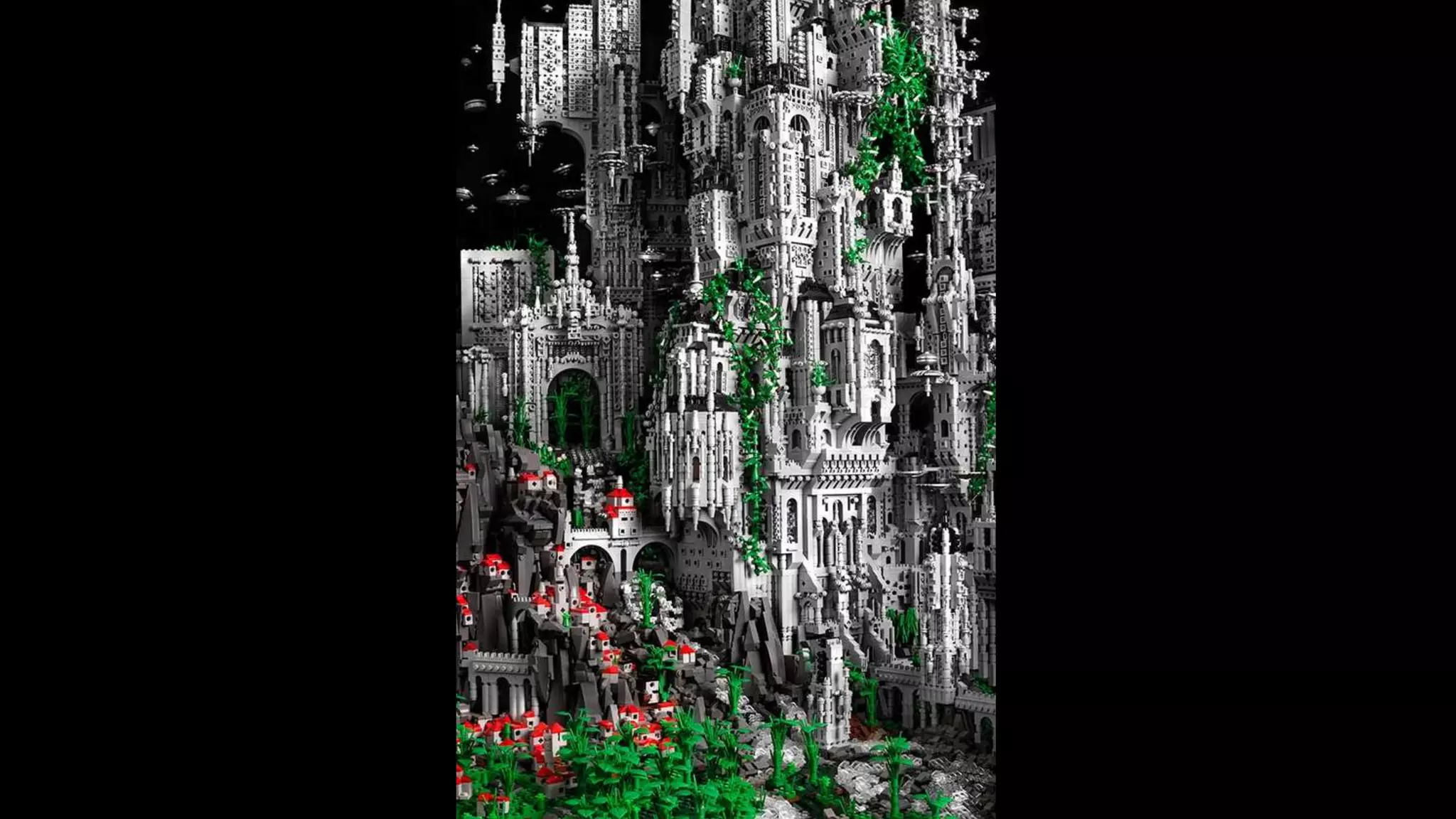
How did we get from Duplo to Odan?
What is software quality?
Some possible definitions and measures (unless you know better ones)
• Customer Satisfaction
• Conformance to Requirements
• Freedom from defects (as a % or as a rate)
• KPIs, SLAs, Performance
• Design, elegance
• Documentation, processes, testability, support
• “Operational excellence”
• Feedback loops
• Truth, beauty, justice? (ἀρετή)
• ?
• (wait! Don’t forget to add a dash of Security™!)
What are the magic ingredients?
High Quality software is not produced from a mere checklist of
requirements and desirable attributes (or standards).
It is produced by master builders…
?
It is produced by master builders…
• Good judgement
• Rich Experience(s)
• Accurate knowledge
• Correct intuition
• Intrinsic love of quality
• (human beings, not machines)
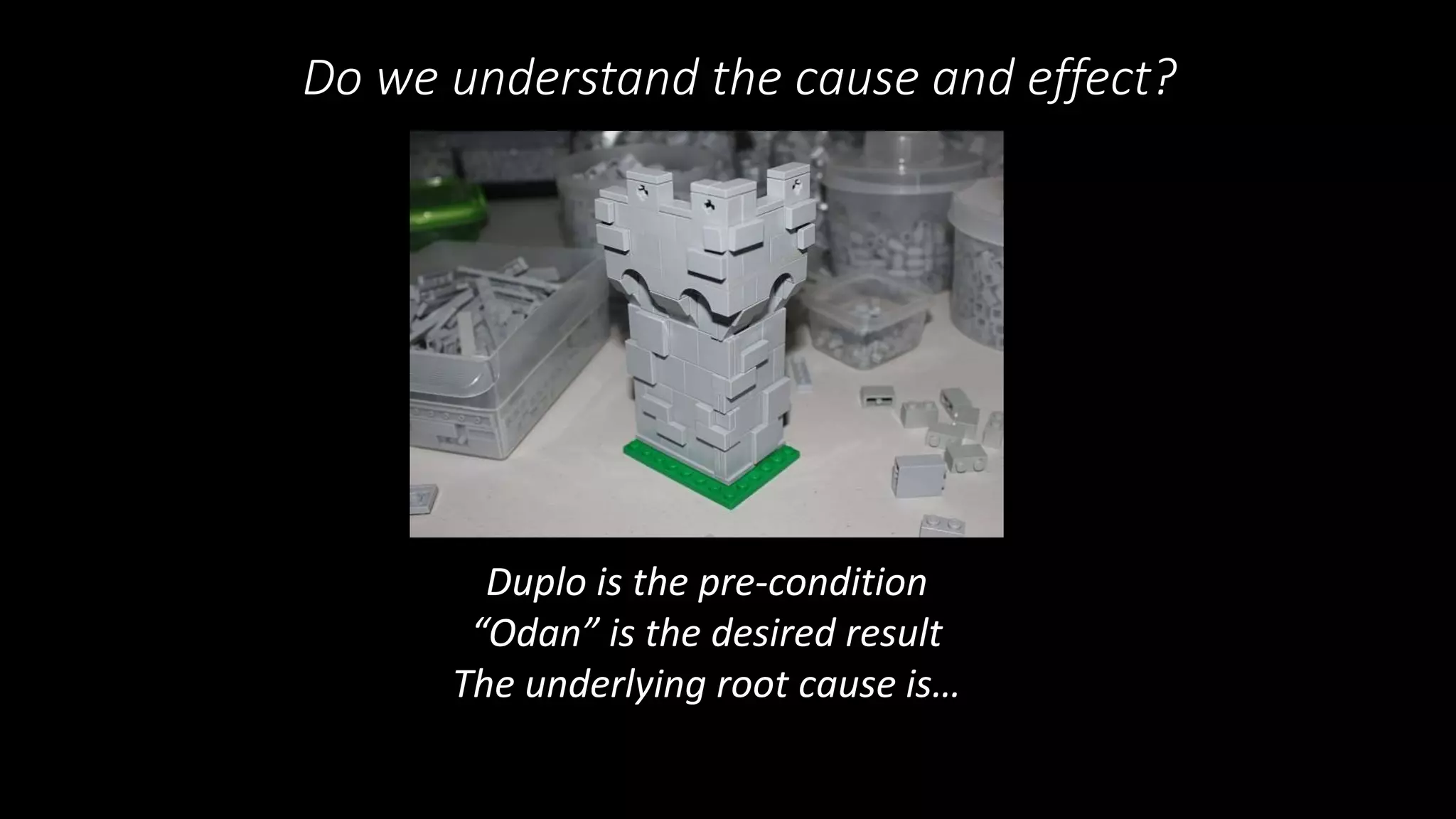
Do we understand the cause and effect?
Duplo is the pre-condition
“Odan” is the desired result
The underlying root cause is…
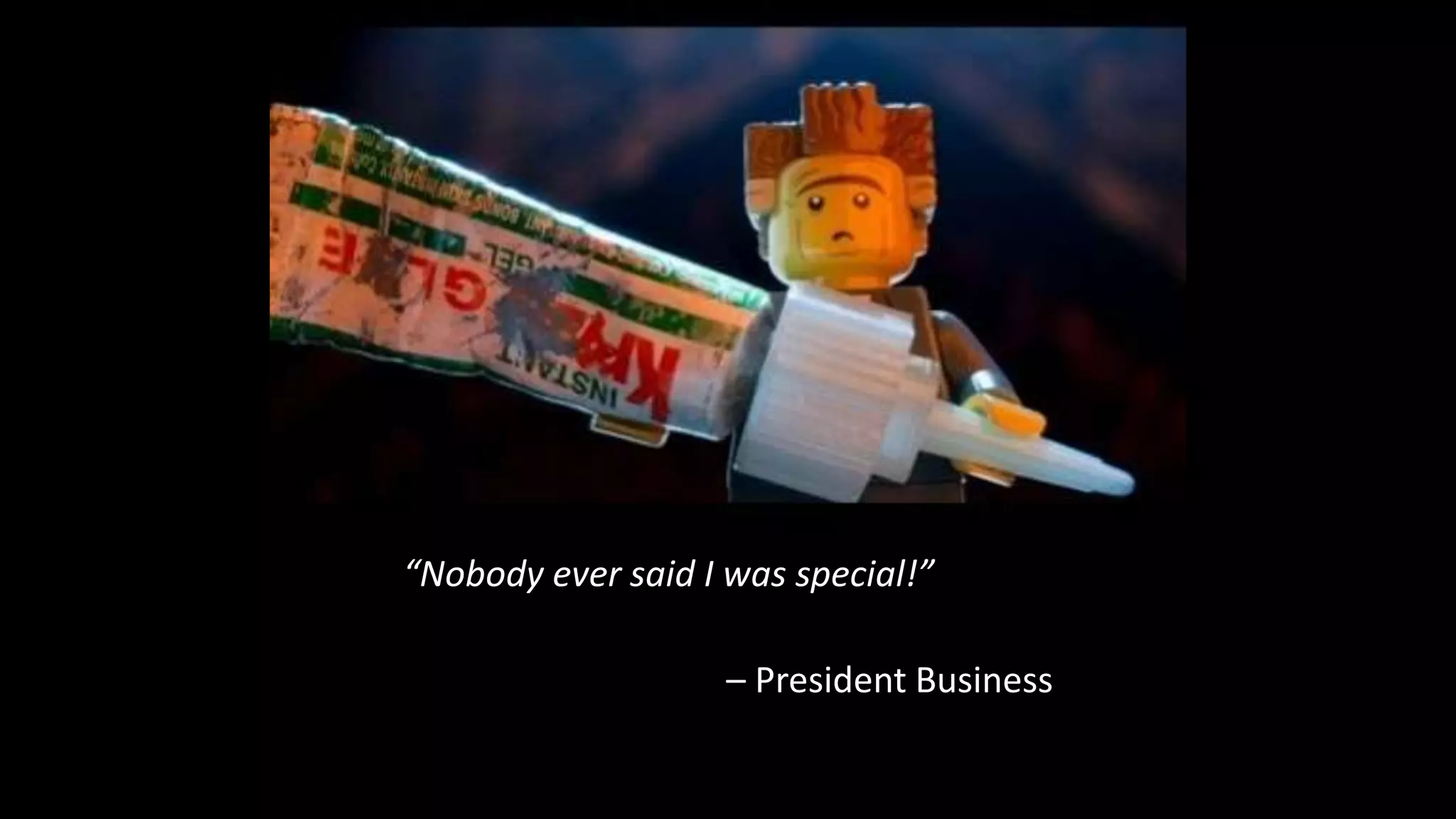
“Nobody ever said I was special!”
– President Business
Key metric: Customer satisfaction
(…customers are never satisfied)
:-/
If you think this is too hard on literary
criticism, read the Wikipedia article on
deconstruction.
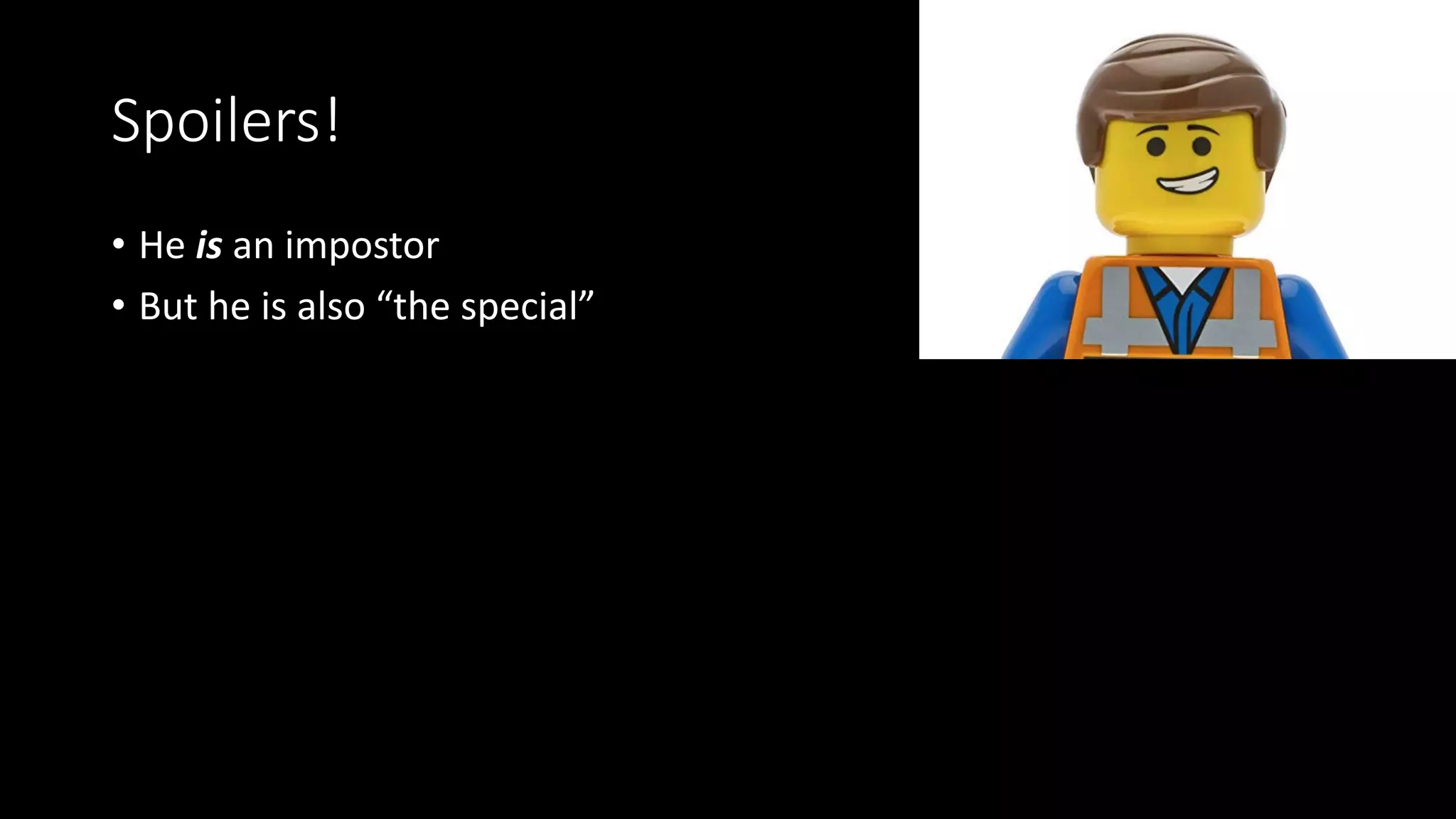
Spoilers!
• He is an impostor
• But he is also “the special”
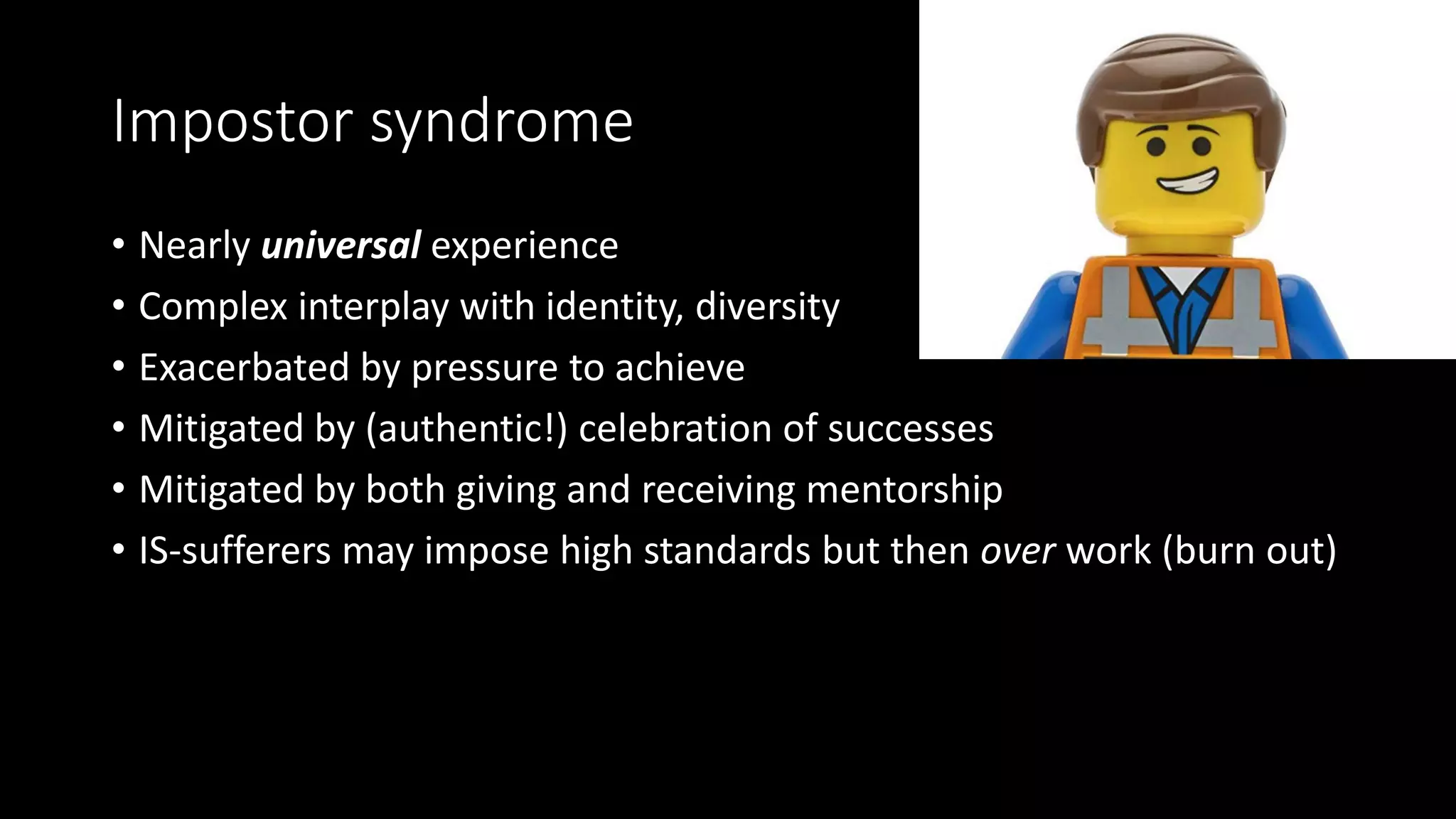
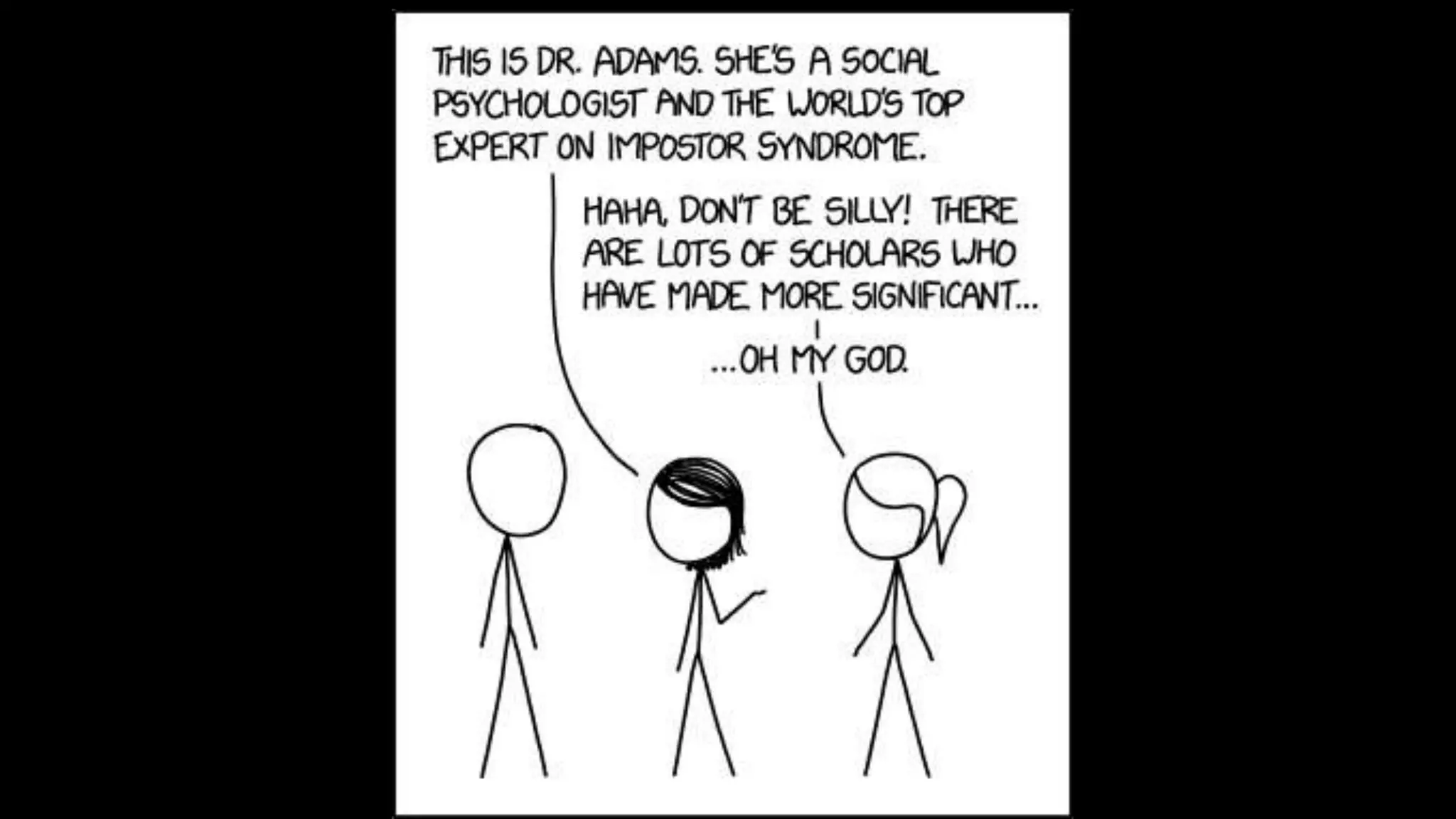
Impostor syndrome
• Nearly universal experience
• Complex interplay with identity, diversity
• Exacerbated by pressure to achieve
• Mitigated by (authentic!) celebration of successes
• Mitigated by both giving and receiving mentorship
• IS-sufferers may impose high standards but then over work (burn out)
Corollary: the Dunning–Kruger effect
The fool doth think he is wise,
but the wise man knows himself to be a fool.
– William Shakespeare, As You Like It
Those who think they know never learn.
—from the Tao Te Ching
An ignorant mind is precisely not a spotless, empty
vessel, but one that’s filled with the clutter of irrelevant
or misleading life experiences, theories, facts, intuitions,
strategies, algorithms, heuristics, metaphors, and
hunches that regrettably have the look and feel of
useful and accurate knowledge.
-David Dunning
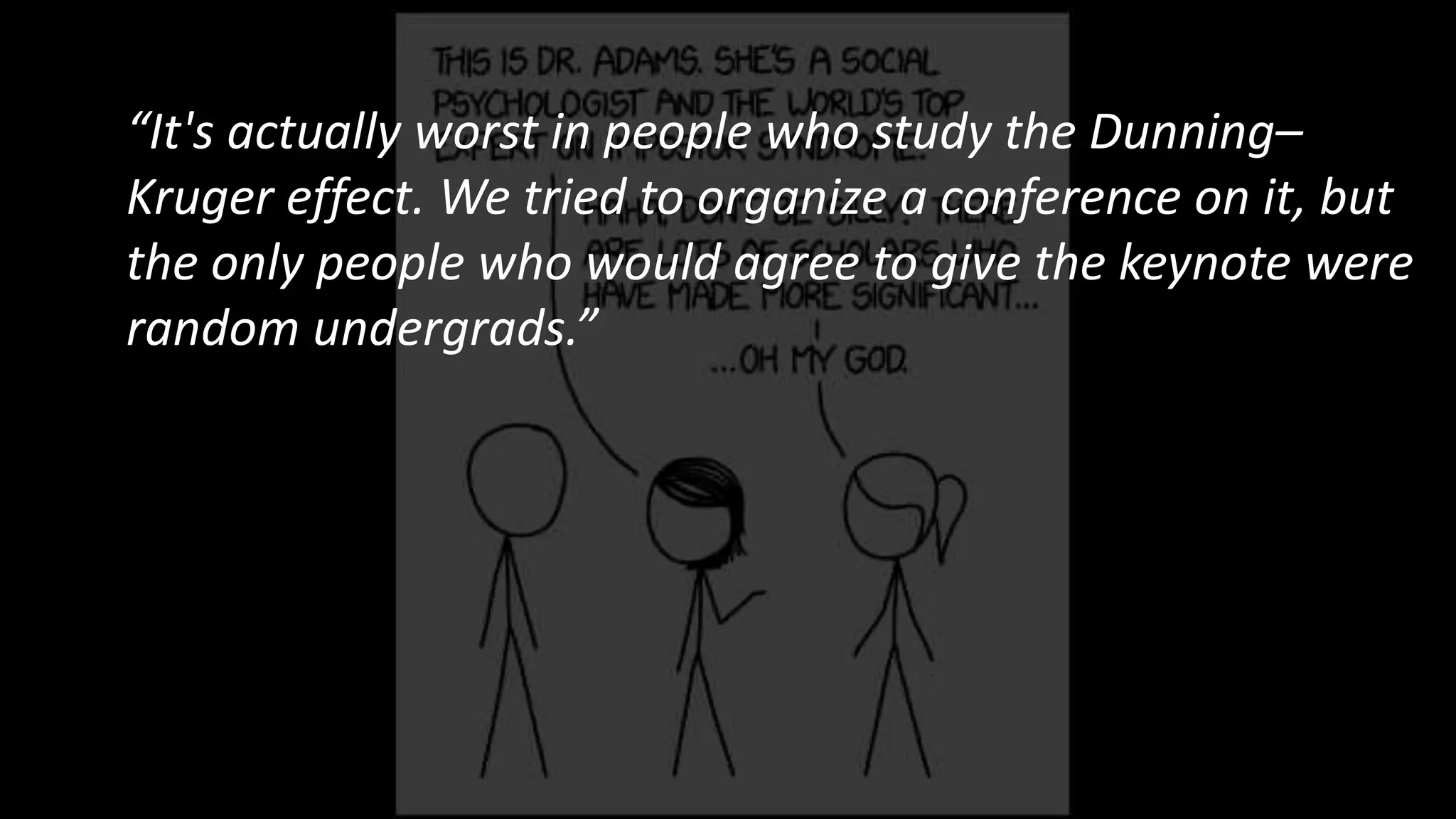
“It's actually worst in people who study the Dunning–
Kruger effect. We tried to organize a conference on it, but
the only people who would agree to give the keynote were
random undergrads.”
Is there an antidote to both poisons?
• Demoralization is a losing strategy
• Hype is a losing strategy
The antidote to Hubris is.. Arête?
• If the problem is ‘hubris’ then perhaps the antidote is ‘arête’
• Moderation (self-restraint) vs excess
• Justice vs transgression (literally “error”)
• Be authentically curious about ourselves
• (Remember kids playing? Duplo?)
Arête: avoid thinking errors…for great justice!
• Justice == error (transgression) correction
• Both IS and DKE are thinking errors
• How would we detect + correct errors in a distributed system?
• What does good error handling look like in your code?
• Can we apply any of that expertise to our own minds?
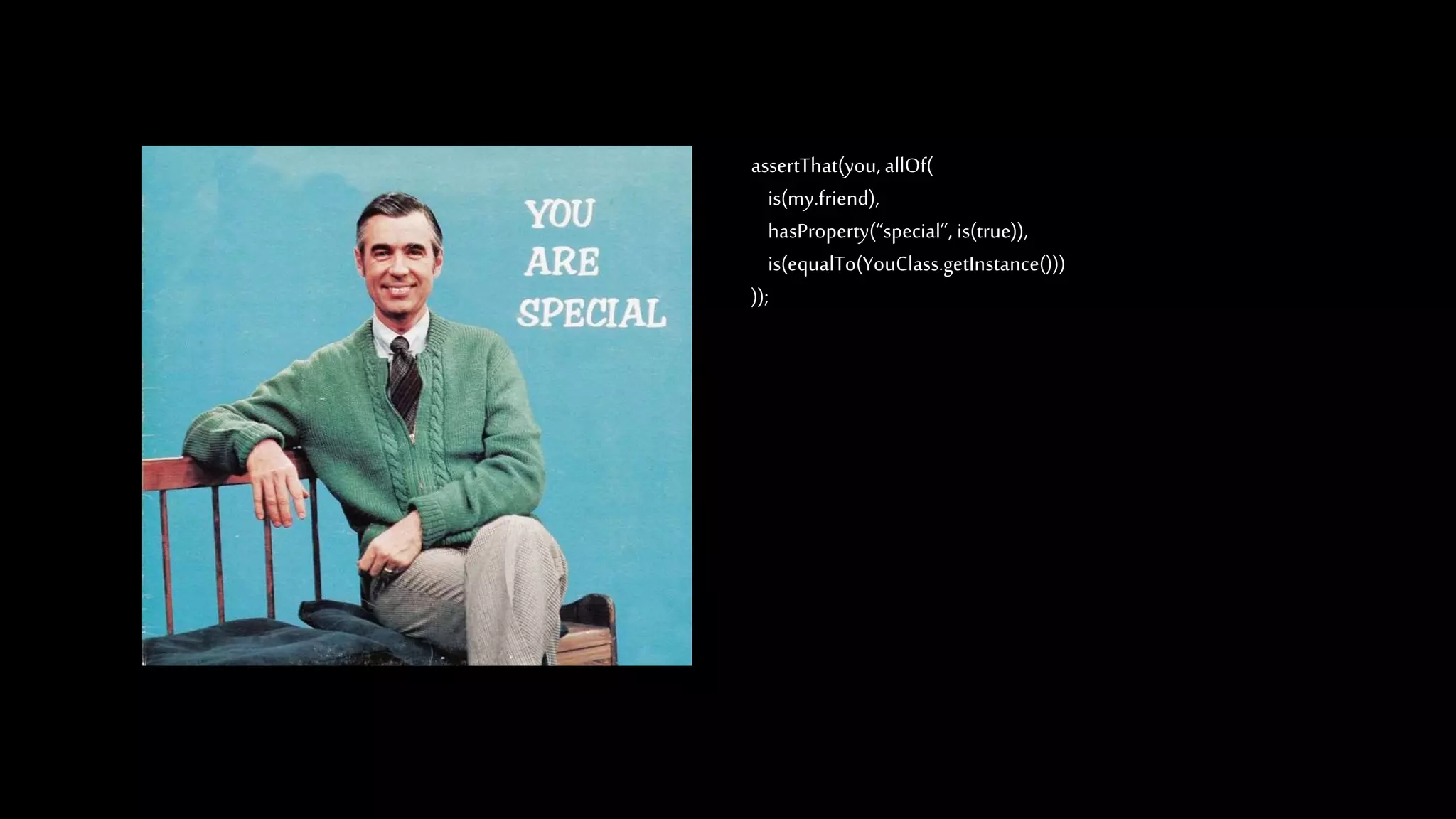
assertThat(you, allOf(
is(my.friend),
hasProperty(“special”, is(true)),
is(equalTo(YouClass.getInstance()))
));
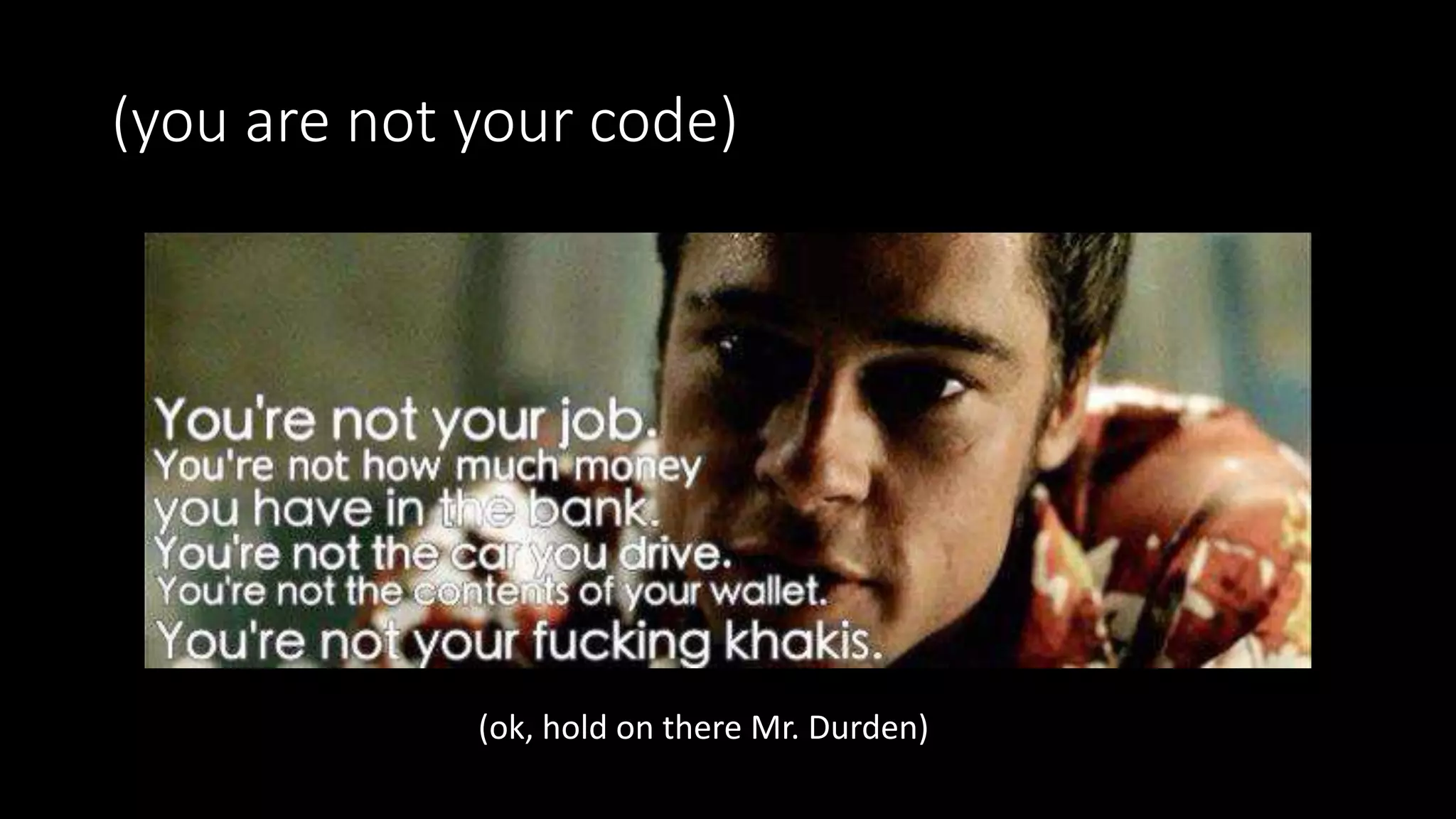
(you are not your code)
(ok, hold on there Mr. Durden)
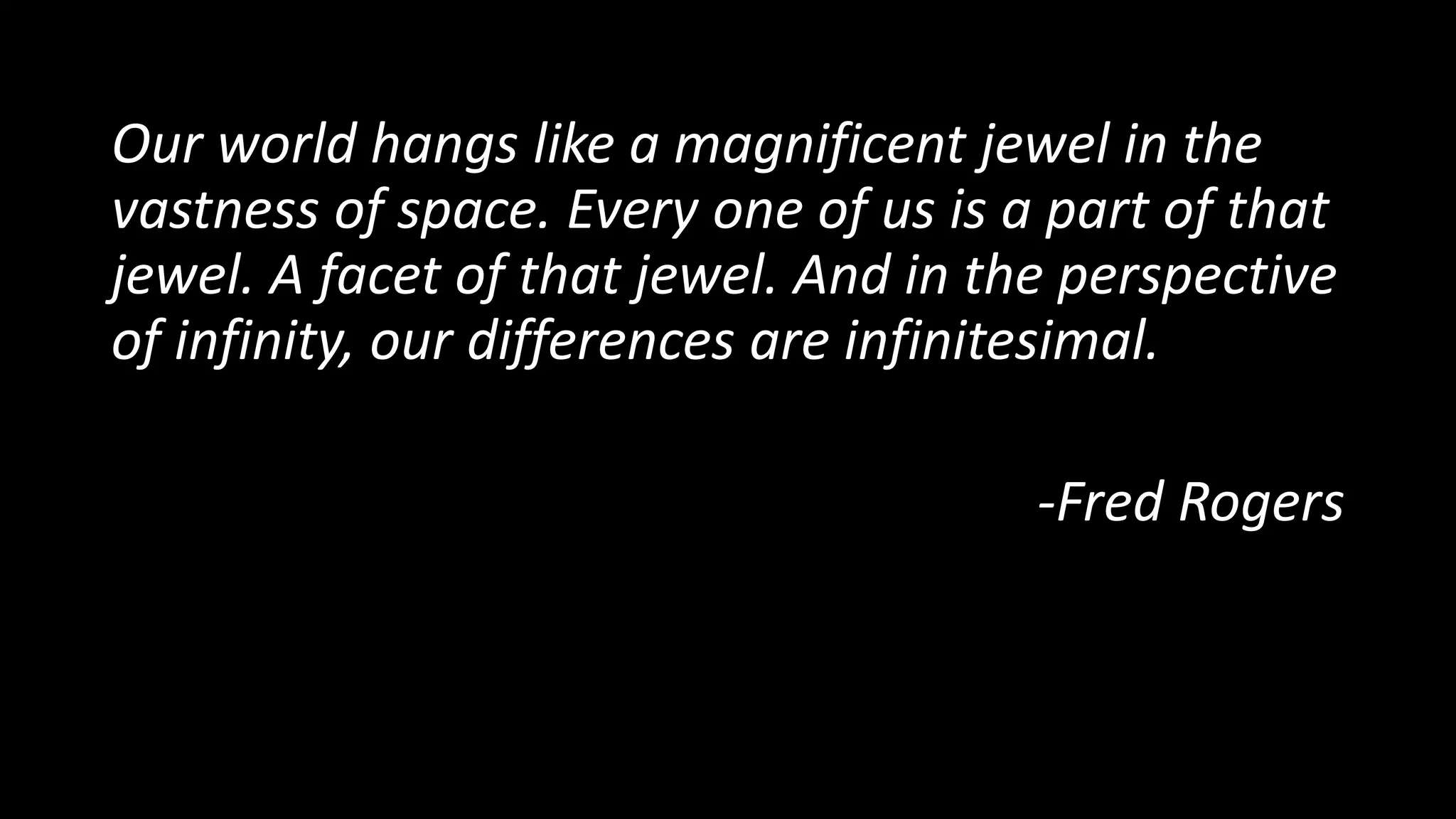
Our world hangs like a magnificent jewel in the
vastness of space. Every one of us is a part of that
jewel. A facet of that jewel. And in the perspective
of infinity, our differences are infinitesimal.
-Fred Rogers
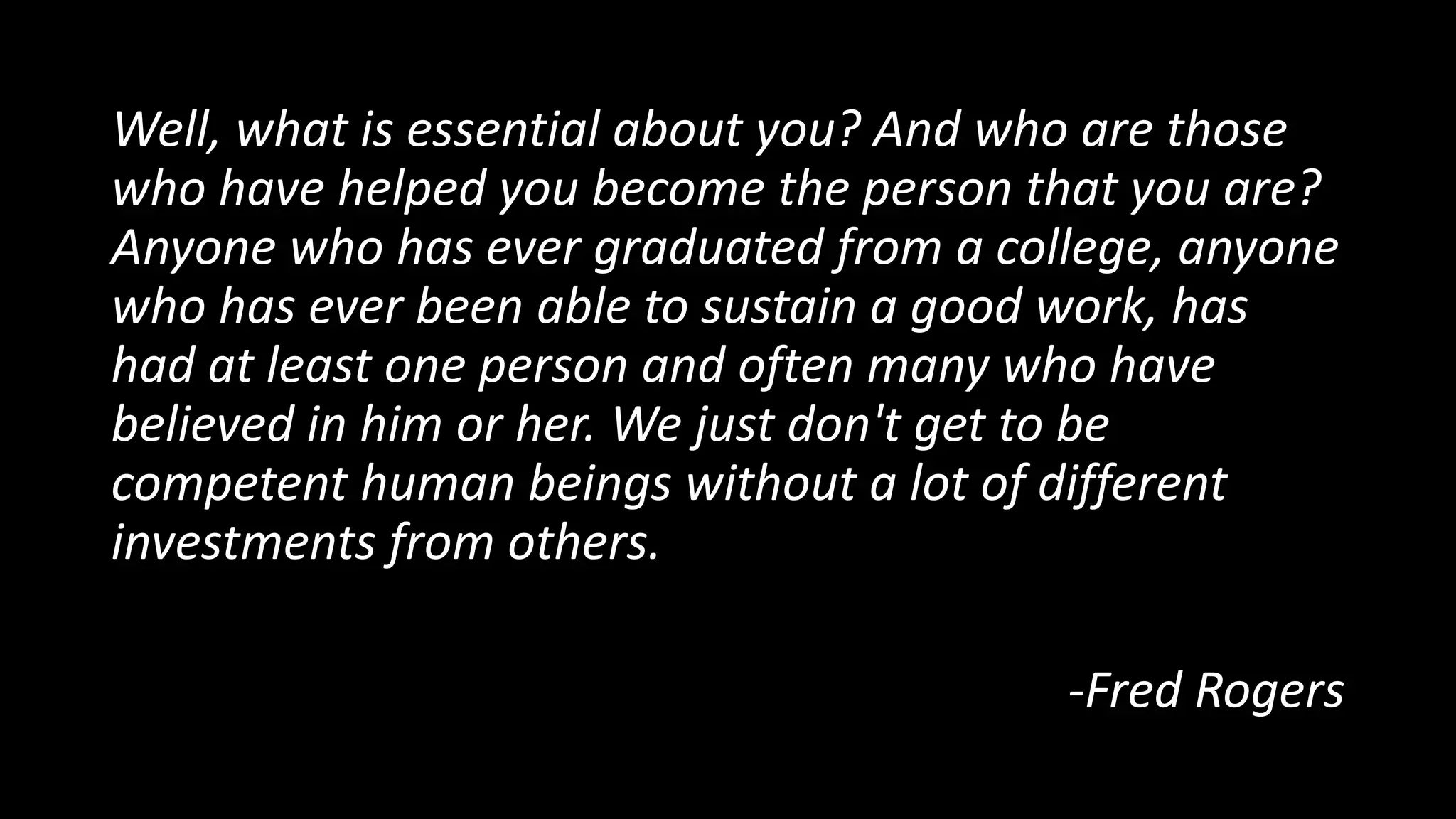
Well, what is essential about you? And who are those
who have helped you become the person that you are?
Anyone who has ever graduated from a college, anyone
who has ever been able to sustain a good work, has
had at least one person and often many who have
believed in him or her. We just don't get to be
competent human beings without a lot of different
investments from others.
-Fred Rogers
Mentorship, feedback loops, other ways?
• Both giving and receiving mentorship protect against IS and DKE
• Envision mentorship as a kind of fault tolerance for thinking errors
• Other processes and mechanisms for fault tolerant thinking?
• “Correction of Errors” document
• https://blog.mischel.com/2018/01/24/responding-to-errors-at-amazon
• Kudos
• Feedback
• Do you know better ones?
Just 600 hours to go until “quality”!
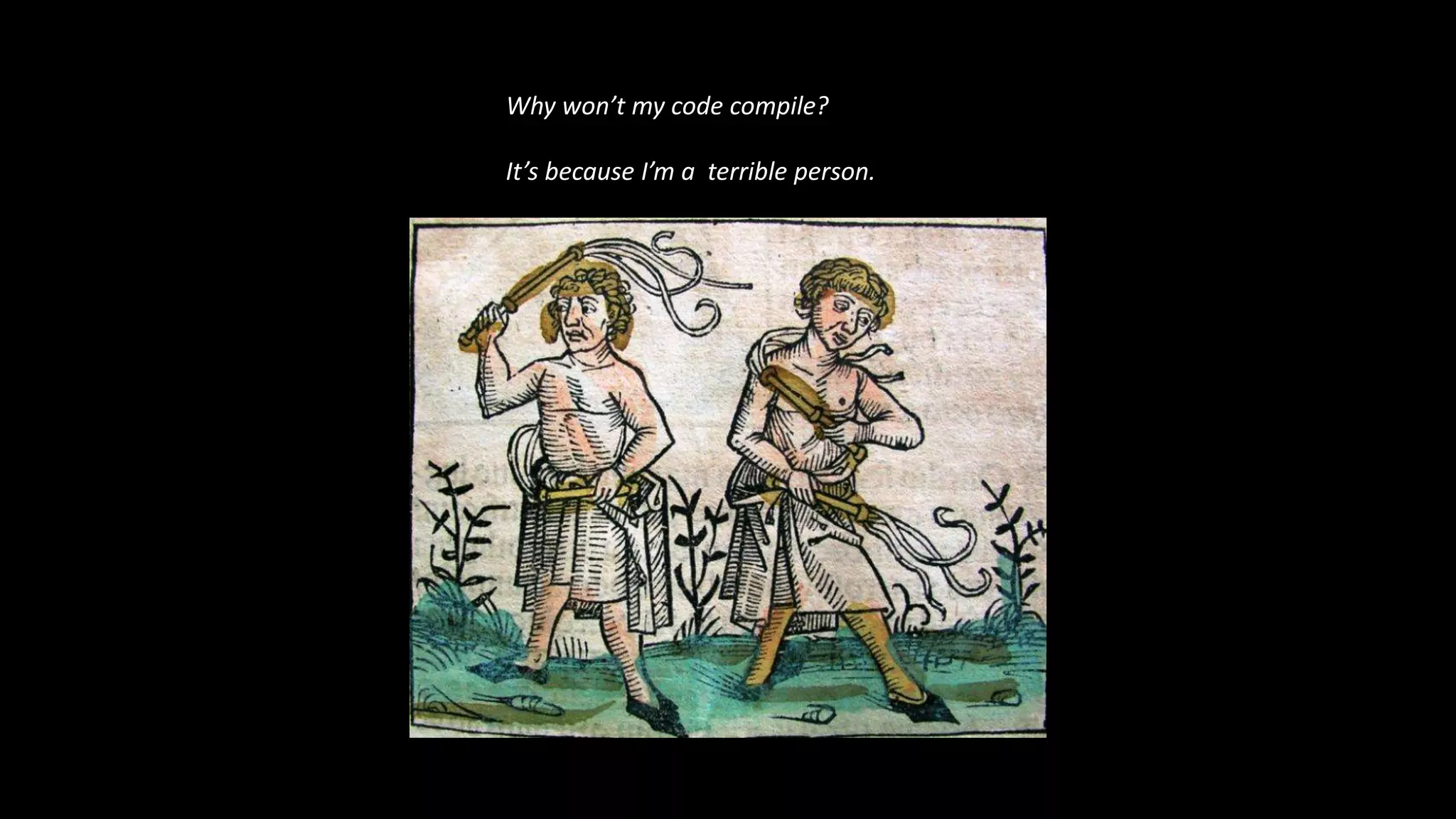
Why won’t my code compile?
It’s because I’m a terrible person.
Overworking is another thinking error.
…What does the data about work hours tell us?
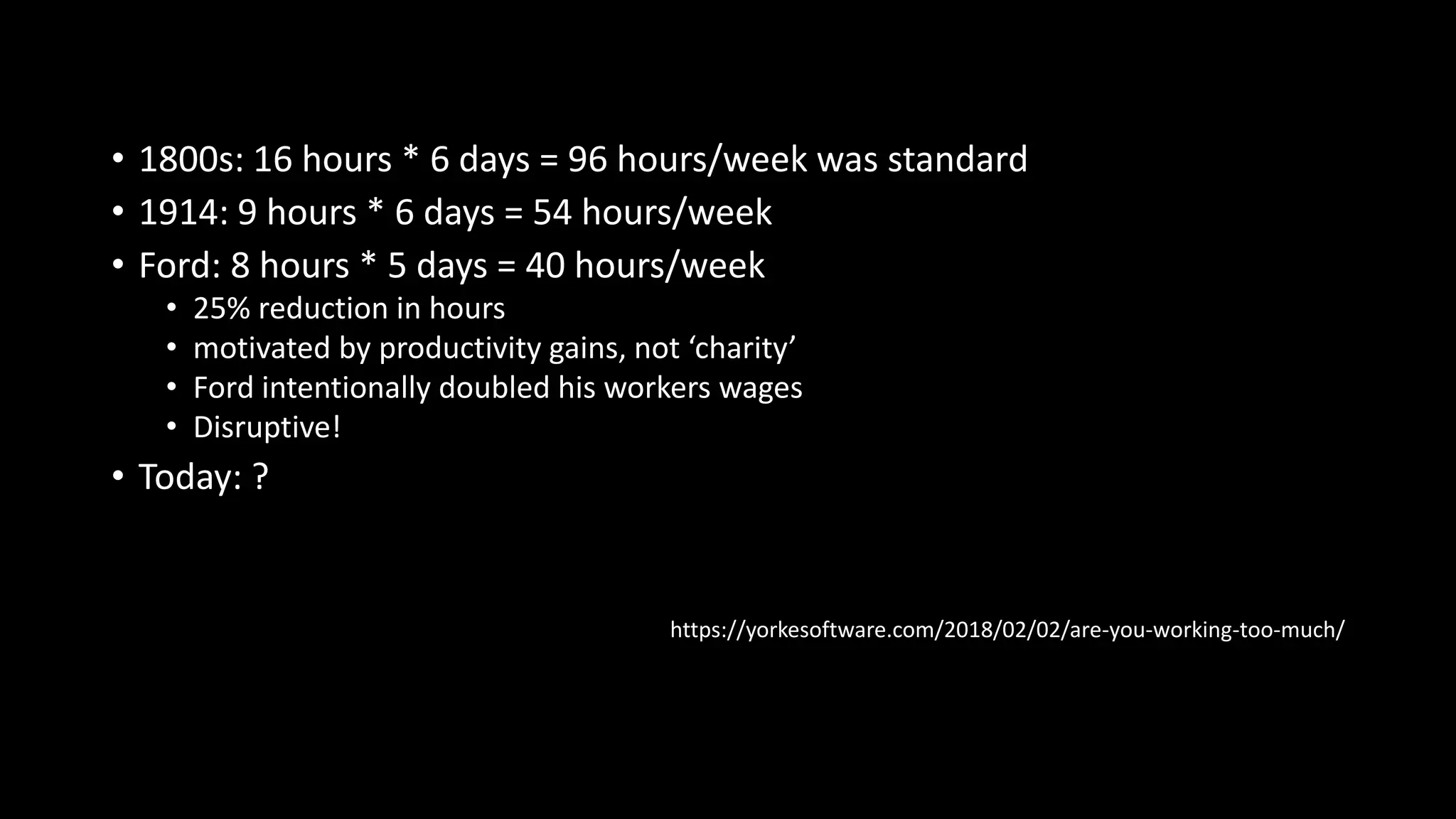
• 1800s: 16 hours * 6 days = 96 hours/week was standard
• 1914: 9 hours * 6 days = 54 hours/week
• Ford: 8 hours * 5 days = 40 hours/week
• 25% reduction in hours
• motivated by productivity gains, not ‘charity’
• Ford intentionally doubled his workers wages
• Disruptive!
• Today: ?
https://yorkesoftware.com/2018/02/02/are-you-working-too-much/
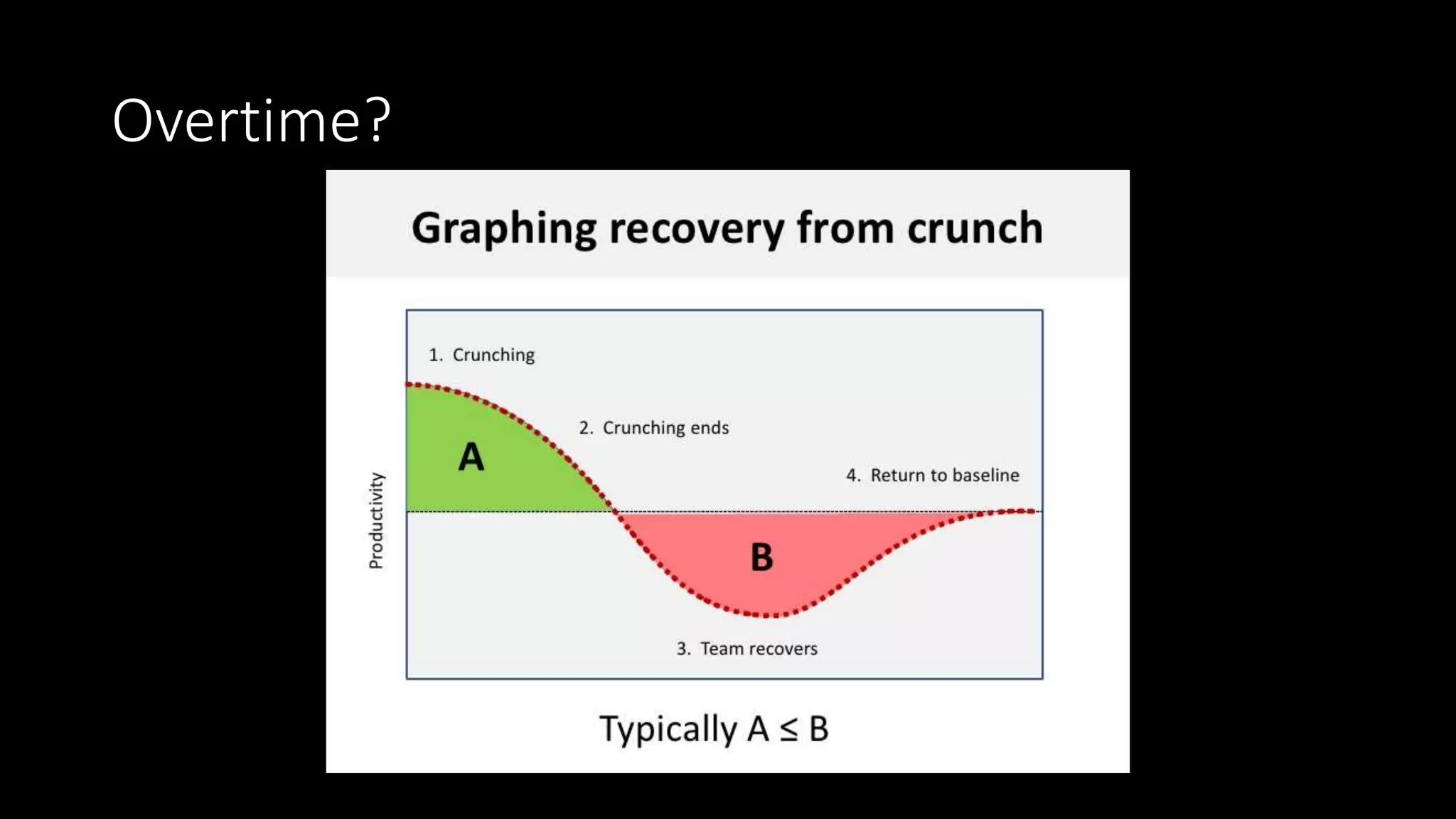
Overtime?
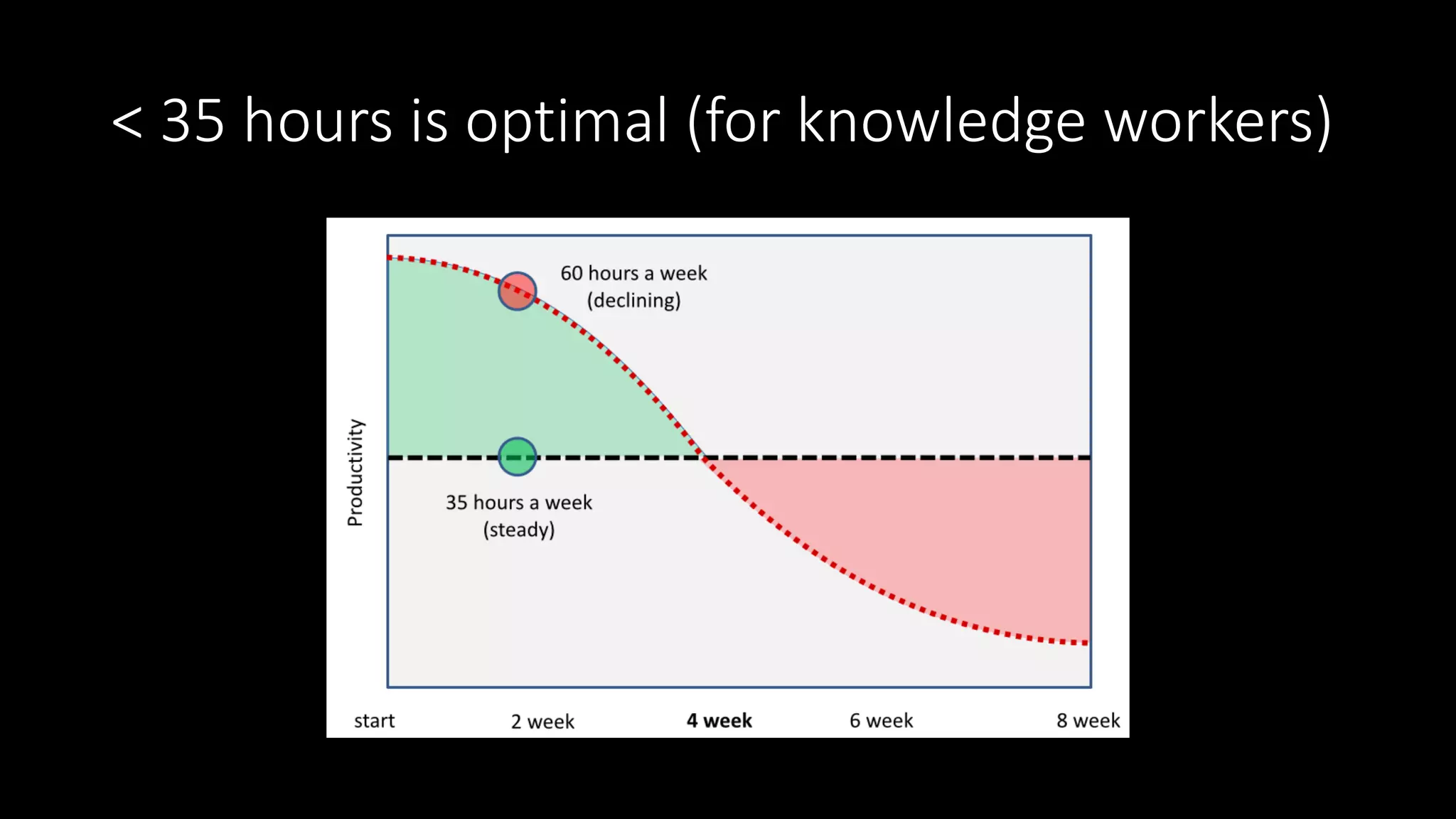
< 35 hours is optimal (for knowledge workers)
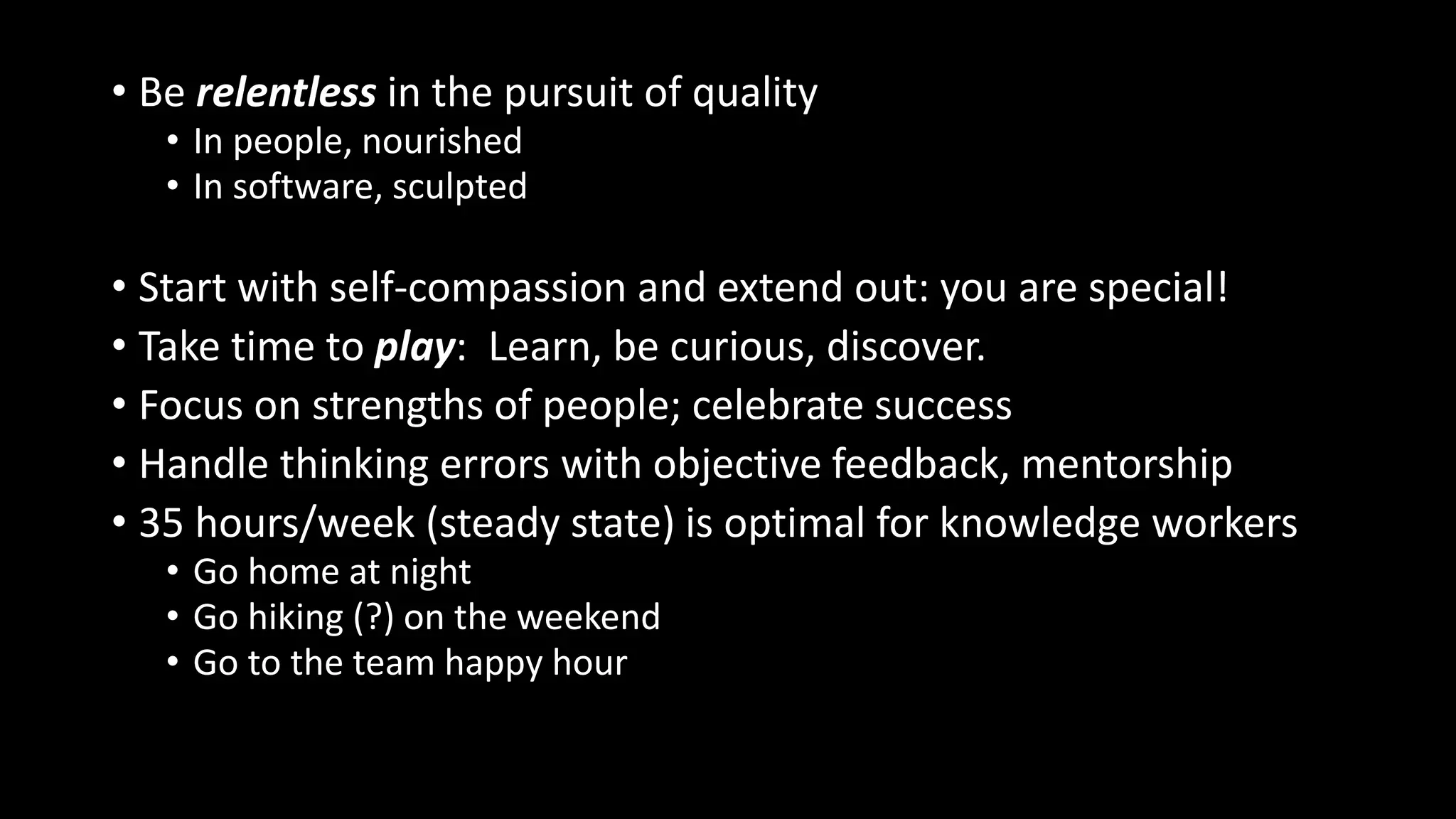
• Be relentless in the pursuit of quality
• In people, nourished
• In software, sculpted
• Start with self-compassion and extend out: you are special!
• Take time to play: Learn, be curious, discover.
• Focus on strengths of people; celebrate success
• Handle thinking errors with objective feedback, mentorship
• 35 hours/week (steady state) is optimal for knowledge workers
• Go home at night
• Go hiking (?) on the weekend
• Go to the team happy hour

Soft on People, Hard on Code: interpersonal approaches that promote high quality software

  • 1.
    Soft on people,hard on code Interpersonal approaches that promote high quality software
  • 2.
    Have you everplayed with Lego?
  • 17.
    How did weget from Duplo to Odan?
  • 18.
  • 19.
    What is softwarequality? Some possible definitions and measures (unless you know better ones) • Customer Satisfaction • Conformance to Requirements • Freedom from defects (as a % or as a rate) • KPIs, SLAs, Performance • Design, elegance • Documentation, processes, testability, support • “Operational excellence” • Feedback loops • Truth, beauty, justice? (ἀρετή) • ? • (wait! Don’t forget to add a dash of Security™!)
  • 20.
    What are themagic ingredients?
  • 21.
    High Quality softwareis not produced from a mere checklist of requirements and desirable attributes (or standards). It is produced by master builders… ?
  • 22.
    It is producedby master builders… • Good judgement • Rich Experience(s) • Accurate knowledge • Correct intuition • Intrinsic love of quality • (human beings, not machines)
  • 23.
    Do we understandthe cause and effect? Duplo is the pre-condition “Odan” is the desired result The underlying root cause is…
  • 24.
    “Nobody ever saidI was special!” – President Business
  • 25.
    Key metric: Customersatisfaction (…customers are never satisfied)
  • 26.
  • 29.
    If you thinkthis is too hard on literary criticism, read the Wikipedia article on deconstruction.
  • 31.
    Spoilers! • He isan impostor • But he is also “the special”
  • 32.
    Impostor syndrome • Nearlyuniversal experience • Complex interplay with identity, diversity • Exacerbated by pressure to achieve • Mitigated by (authentic!) celebration of successes • Mitigated by both giving and receiving mentorship • IS-sufferers may impose high standards but then over work (burn out)
  • 33.
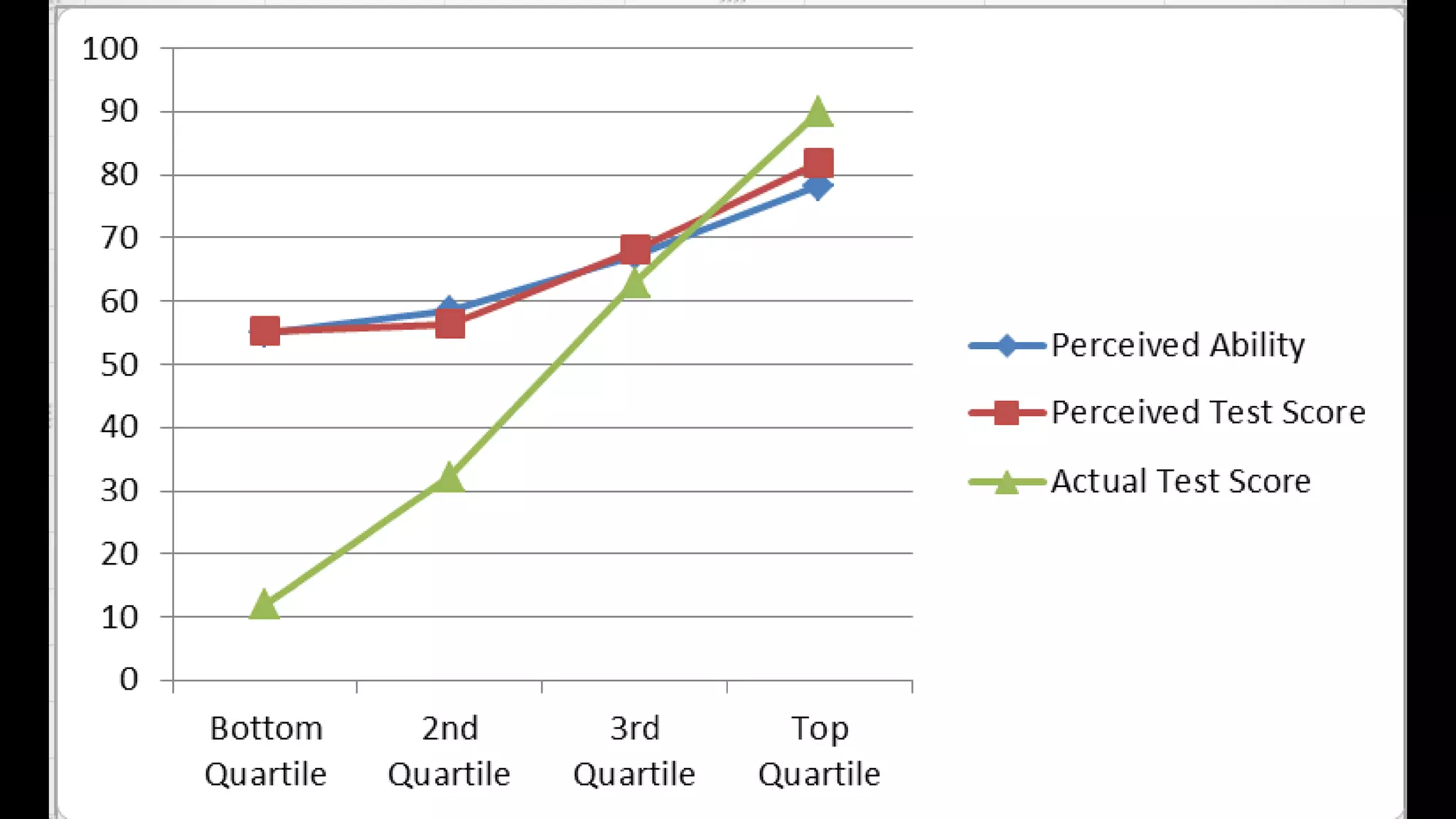
    Corollary: the Dunning–Krugereffect The fool doth think he is wise, but the wise man knows himself to be a fool. – William Shakespeare, As You Like It Those who think they know never learn. —from the Tao Te Ching
  • 34.
    An ignorant mindis precisely not a spotless, empty vessel, but one that’s filled with the clutter of irrelevant or misleading life experiences, theories, facts, intuitions, strategies, algorithms, heuristics, metaphors, and hunches that regrettably have the look and feel of useful and accurate knowledge. -David Dunning
  • 39.
    “It's actually worstin people who study the Dunning– Kruger effect. We tried to organize a conference on it, but the only people who would agree to give the keynote were random undergrads.”
  • 41.
    Is there anantidote to both poisons?
  • 42.
    Is there anantidote to both poisons?
  • 43.
    Is there anantidote to both poisons? • Demoralization is a losing strategy • Hype is a losing strategy
  • 44.
    The antidote toHubris is.. Arête? • If the problem is ‘hubris’ then perhaps the antidote is ‘arête’ • Moderation (self-restraint) vs excess • Justice vs transgression (literally “error”) • Be authentically curious about ourselves • (Remember kids playing? Duplo?)
  • 45.
    Arête: avoid thinkingerrors…for great justice! • Justice == error (transgression) correction • Both IS and DKE are thinking errors • How would we detect + correct errors in a distributed system? • What does good error handling look like in your code? • Can we apply any of that expertise to our own minds?
  • 46.
  • 47.
    (you are notyour code) (ok, hold on there Mr. Durden)
  • 48.
    Our world hangslike a magnificent jewel in the vastness of space. Every one of us is a part of that jewel. A facet of that jewel. And in the perspective of infinity, our differences are infinitesimal. -Fred Rogers
  • 49.
    Well, what isessential about you? And who are those who have helped you become the person that you are? Anyone who has ever graduated from a college, anyone who has ever been able to sustain a good work, has had at least one person and often many who have believed in him or her. We just don't get to be competent human beings without a lot of different investments from others. -Fred Rogers
  • 50.
    Mentorship, feedback loops,other ways? • Both giving and receiving mentorship protect against IS and DKE • Envision mentorship as a kind of fault tolerance for thinking errors • Other processes and mechanisms for fault tolerant thinking? • “Correction of Errors” document • https://blog.mischel.com/2018/01/24/responding-to-errors-at-amazon • Kudos • Feedback • Do you know better ones?
  • 51.
    Just 600 hoursto go until “quality”!
  • 52.
    Why won’t mycode compile? It’s because I’m a terrible person.
  • 53.
    Overworking is anotherthinking error.
  • 54.
    …What does thedata about work hours tell us?
  • 55.
    • 1800s: 16hours * 6 days = 96 hours/week was standard • 1914: 9 hours * 6 days = 54 hours/week • Ford: 8 hours * 5 days = 40 hours/week • 25% reduction in hours • motivated by productivity gains, not ‘charity’ • Ford intentionally doubled his workers wages • Disruptive! • Today: ? https://yorkesoftware.com/2018/02/02/are-you-working-too-much/
  • 56.
  • 57.
    < 35 hoursis optimal (for knowledge workers)
  • 58.
    • Be relentlessin the pursuit of quality • In people, nourished • In software, sculpted • Start with self-compassion and extend out: you are special! • Take time to play: Learn, be curious, discover. • Focus on strengths of people; celebrate success • Handle thinking errors with objective feedback, mentorship • 35 hours/week (steady state) is optimal for knowledge workers • Go home at night • Go hiking (?) on the weekend • Go to the team happy hour

Editor's Notes

  • #2 My name is (do intro spiel) Today we’ll talk about what software quality is but we’ll talk more generally about how quality, in an abstract sense can only be achieved by people who have a deep intrinsic sense of quality inside of themselves...and what produces that sense, that ability to achieve inside of people. We’ll talk about impostor syndrome and the related Dunning-Kruger effect and how to move ourselves and the people we interact with past those obstacles. Finally we’ll look at some data around effective work hours and how to optimize for quality.
  • #3 Have you ever played with Lego? What was it? Was it good? Was it AMAZING? (pause to try and solicit real responses)
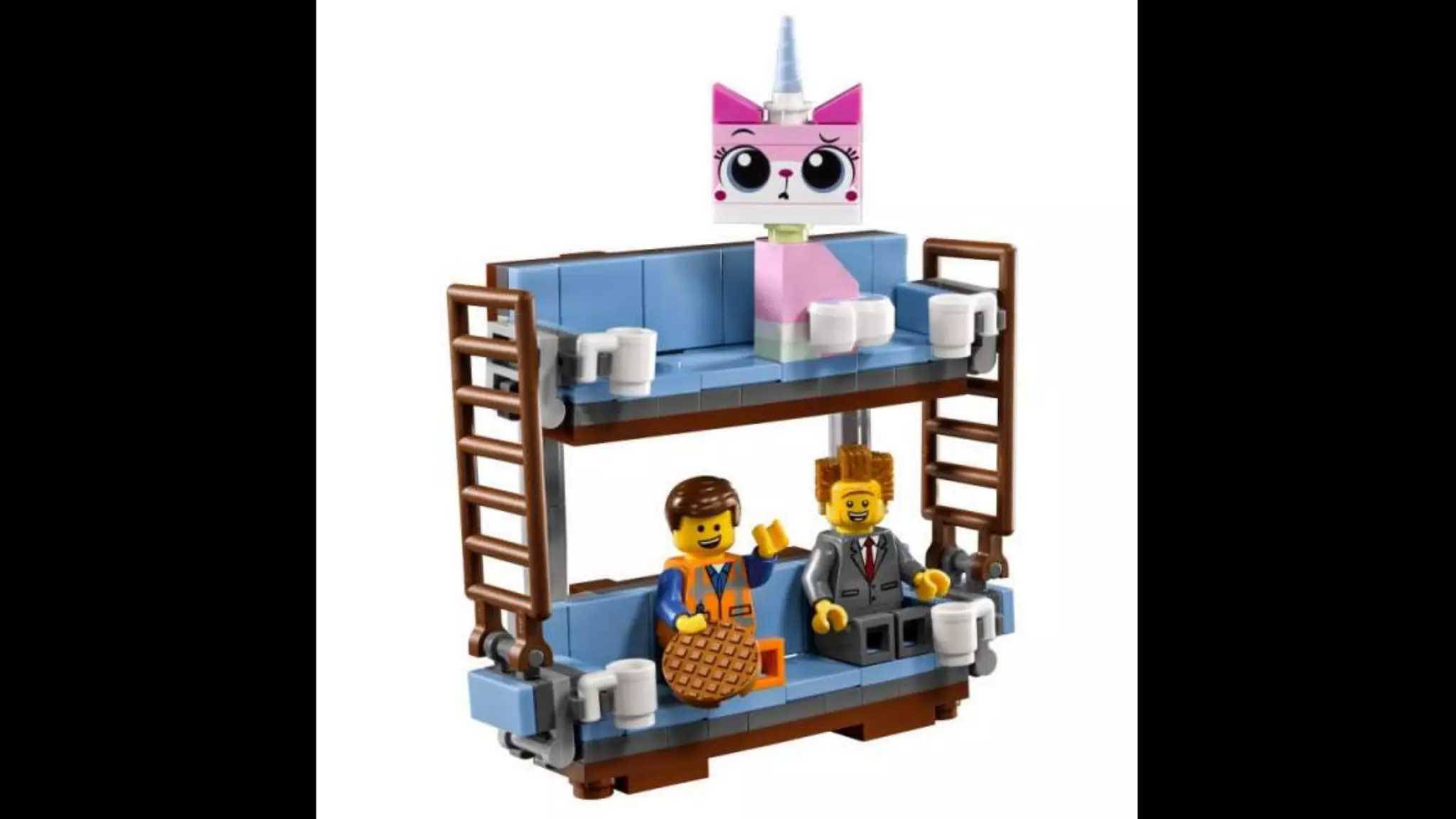
  • #4 Were your first experiences with Lego perhaps silly or childish? Maybe, like many of us, you were literally a child. http://legosse.com.br/lego/70818
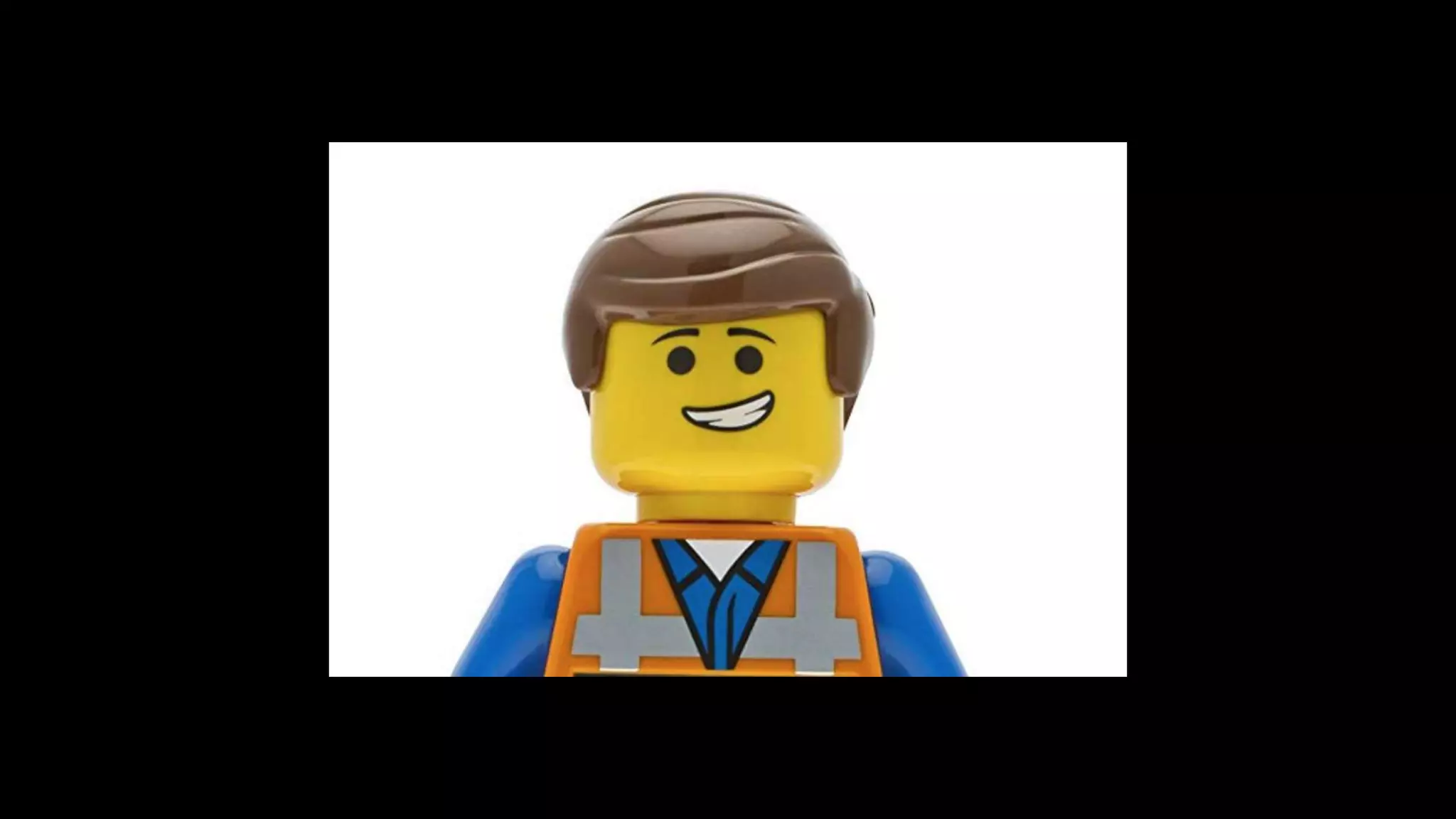
  • #5 Maybe your first creations, or any of your creations, were not objectively “good”. ...but did you have fun? https://www.amazon.com/LEGO-Minifigure-plastic-display-official/dp/B00GMA3ZXQ
  • #6 Did your very first Lego creation have to be “amazing” or impressive for it to be fun and worthwhile? (No!) I’m guessing your first experience with Lego was as a child. And I'm wondering, if you could go back to meet the kid-version of yourself and talk about Lego creations, what would you say? https://www.lego.com/en-us/aboutus/news-room/2016/march/2015-annual-result
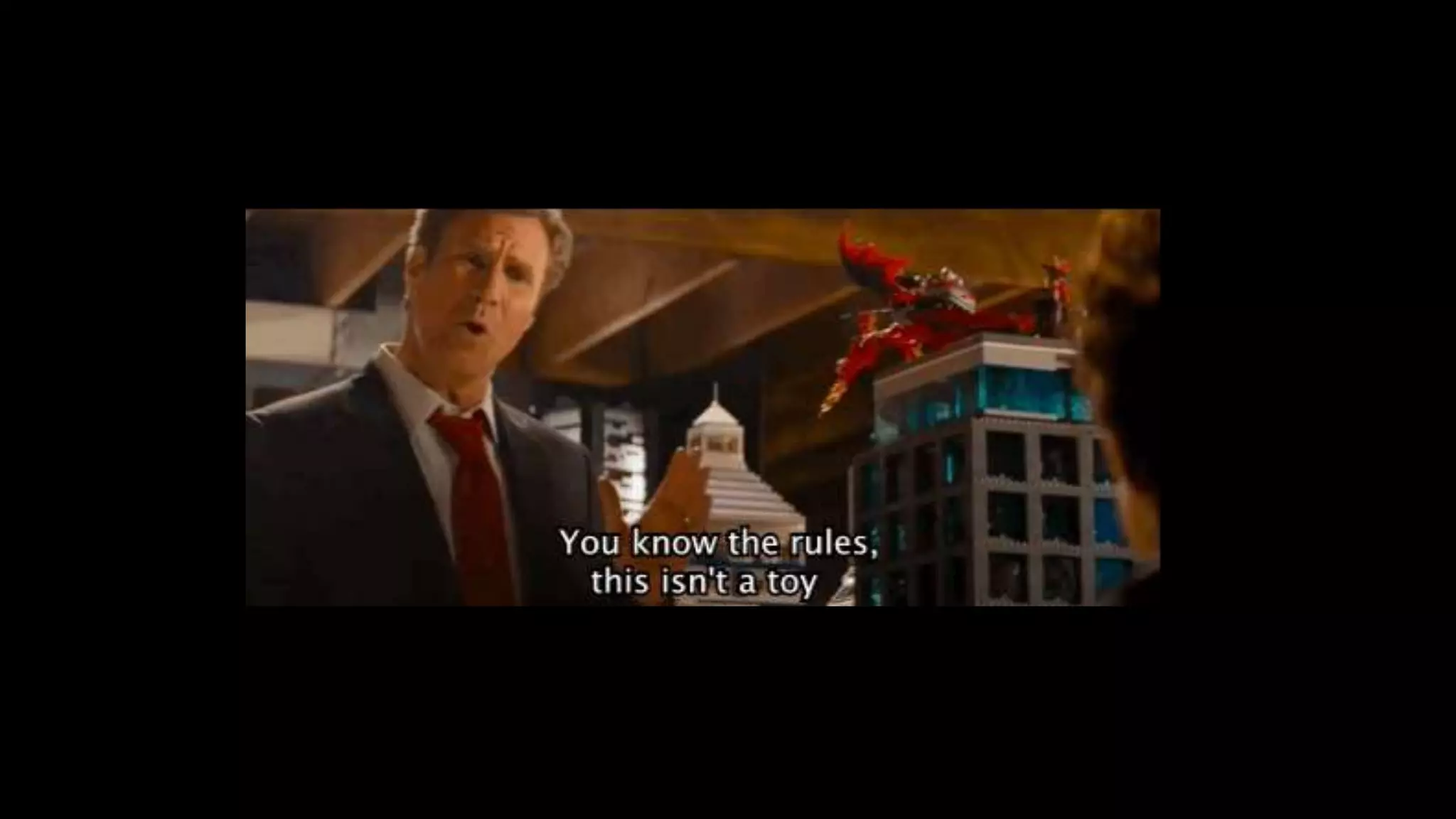
  • #7 Would you try and “coach” that child in some way? http://rebloggy.com/post/mygifs-will-ferrell-lego-chris-pratt-legos-the-lego-movie/84337293472
  • #8 Maybe nudge them…to use more pieces? Or take it more seriously?
  • #9 Different building techniques? More advanced, sophisticated techniques?
  • #10 I’m sure we’d all tell that kind how important it is to improve the ‘structural integrity’ of their creations. We’d have a lengthy discussion about "build quality” and aesthetics. Right? No. How would you really treat a kid version of yourself? Wouldn't it make more sense to just tell kid-you how awesome and special their creation is, and talk about it objectively for what it is (not about all the things it could be)? "Oh, I see you you've put a jet pack on top of his hair. neat!" Of course, we don't expect children to produce works of art out of Lego. That’s not their job…
  • #11  (Has anybody seen this before?) Odan welcomes you to our mystical paradise. http://worldofodan.blogspot.com/p/about.html https://www.flickr.com/photos/7931559@N08/8072336678/in/photostream/
  • #12 Well known for our exotic locals, lush flora and quiet retreats, we have much to offer in the way of relaxation and spiritual growth. http://worldofodan.blogspot.com/p/about.html https://www.flickr.com/photos/7931559@N08/8072336678/in/photostream/
  • #13 Attune yourself to the Odanian vibration with our state-of-the-art astral travel chambers http://worldofodan.blogspot.com/p/about.html
  • #14 Meditate with spiritual Otaki masters. Savor our Issi'ecia melons which will ease you into a naturally induced out-of-body state. http://worldofodan.blogspot.com/p/about.html
  • #15 No matter what your level of enlightenment, those looking for spiritual advancement will find Odan to be a delightful vacation destination. https://www.flickr.com/photos/7931559@N08/8602791769
  • #17 What you’re looking at now is an art print of the master work titled “THE MILLENNIAL CELEBRATION OF THE ETERNAL CHOIR AT K'AL YNE, ODAN”. It measures 6 feet by 6 feet by 4 feet and was constructed using over 200,000 pieces at a “cost” of about 600 “dev hours” (and yes, let's imagine them as "dev hours" for today) The website for ‘world of Odan’ includes a detailed backstory on the people, government, science, and religion of Odan. It also includes that blurb I just read to you which is "published" by the Odanian “board of tourism”. There’s a backstory not just to the world of Odan but, from what I can tell, the journey this creator went through in order to build this over the course of 2 years. That journey included both a failed kickstarter (when he was about 20% complete) and later a successful kickstarter (after the fact, to help him fund future endeavors). What do you think it would be like to talk to the creator about his experience in producing this? What do you think he felt and experienced over the course of those 600 hours? I think we can also safely make a statement about this work: it’s very high quality. Whatever that means for a Lego build to be high quality, this seems to fit that definition. But then it begs the question…. https://www.wired.com/2013/10/legos-are-no-longer-just-a-toy-theyre-an-art-form/ http://worldofodan.blogspot.com/p/about.html http://worldofodan.blogspot.com/p/blog-page_9.html https://www.kickstarter.com/projects/mikedoyle/contact-1-a-200000-piece-lego-masterwork
  • #18 How do we move from a little kid playing with Lego in their bedroom for the first time to a master builder producing a 200k piece work of art over 600 hours? Do I just need to buy 200,000 pieces of Lego. Set aside 600 hours to stick them together and Profit?
  • #19 So we talked about Lego quality....let's talk for a minute now about software quality. What is it? (get inputs from audience and write on whiteboard 1-5 min)
  • #20 https://www.gettyimages.ca/detail/photo/greek-coin-gold-stater-with-nike-holding-high-res-stock-photography/540264640 This could potentially turn into a very lofty and philosophical discussion, and I don't mean for us to get too esoteric about quality today...but it is worth thinking about how open ended the question could be. I've also intentionally included this image of a Greek coin, the golden 'stater' of Alexander. It has an image of the Goddess Nike presenting the laurel wreath of achievement or victory. That's because the Greek idea of 'quality' or 'the good' or 'arete' is really closely tied to something deep inside of people that gives them to ability to achieve a result. And perhaps that is even an aspirational result, or a continuously evolving result.... such as in Olympic races or the high jump where past victories lead to "raising the bar"
  • #21 I also want to ask: are these just a checklist of ingredients? Like 200,000 pieces plus 600 hours and voila? Or is it like Odan where we have some other necessary magic to transport us from Duplo to master builder? We could probably label it 'creativity' but it seems to be more than just that one word. It's much more than just 'creativity' but that's part of it.
  • #22 High Quality software is not produced from a checklist of requirements and desirable attributes (or standards). The abandonment of the traditional waterfall model should be a clue that requirements need to evolve to produce the right result. Quality software is produced by “master builders”, people who possess not only technical skills but also…
  • #23 Quality is produced by “master builders”, people who possess not only technical skills but also… good judgement, rich experiences, accurate knowledge, correct intuition, and a fundamental desire to pursue quality for it’s own sake. Master builders create because they are passionate about what they are creating and the journey that the act of creation will take them on.
  • #24 And we need to be clear about cause and effect here: masters create high standards for themselves which helps lead to high quality output, not the other way around. The kid playing with Duplo does not grow up to be a master builder by being told they need to understand the studs-not-on-top or “SNOT” building technique. Rather they learn to love Lego and develop an intrinsic sense of quality, and somewhere along the way they discover advanced techniques or are introduced to them when at the appropriate level and challenge themselves with higher standards https://innovalug.com/post/43/snot-stone-wall-tutorial
  • #25 And even if we are not working with kids, because for the most part, software engineers are grown-*** adults (right? Sortof?), we do need to insist on high standards in a way that leads to genuine adoption of them. Adoption of high standards is not achieved by clobbering people with rigid expetations, it’s achieved by appealing to the master builder inside that naturally desires to achieve the right result. No less than kids do, grown adults, even engineers, need to begin from a solid foundation of dignity, self-compassion, and yes, being told they are special (in an age appropriate way). We can build on that foundation with respect, recognition of success, the freedom to play, to have fun with the work we are doing, and eventually to move towards the calculated risk taking that is needed to produce audacious master works. http://cinemagogue.com/2014/05/14/never-lego-of-hope-for-reconciliation/
  • #26  Also, if our key measure of quality is customer satisfaction, then “high quality” or “high standards” are likely to be an ever moving target, a process, an aspiration, the pursuit of virtue rather than a destination.
  • #27 That's great. But what if the people I work with aren't master builders, they just don’t seem special. And (I hope no one finds this out but) what if I'm not a master builder? How can I produce quality software if I'm secretly not very good at this and have no clue what I'm doing?
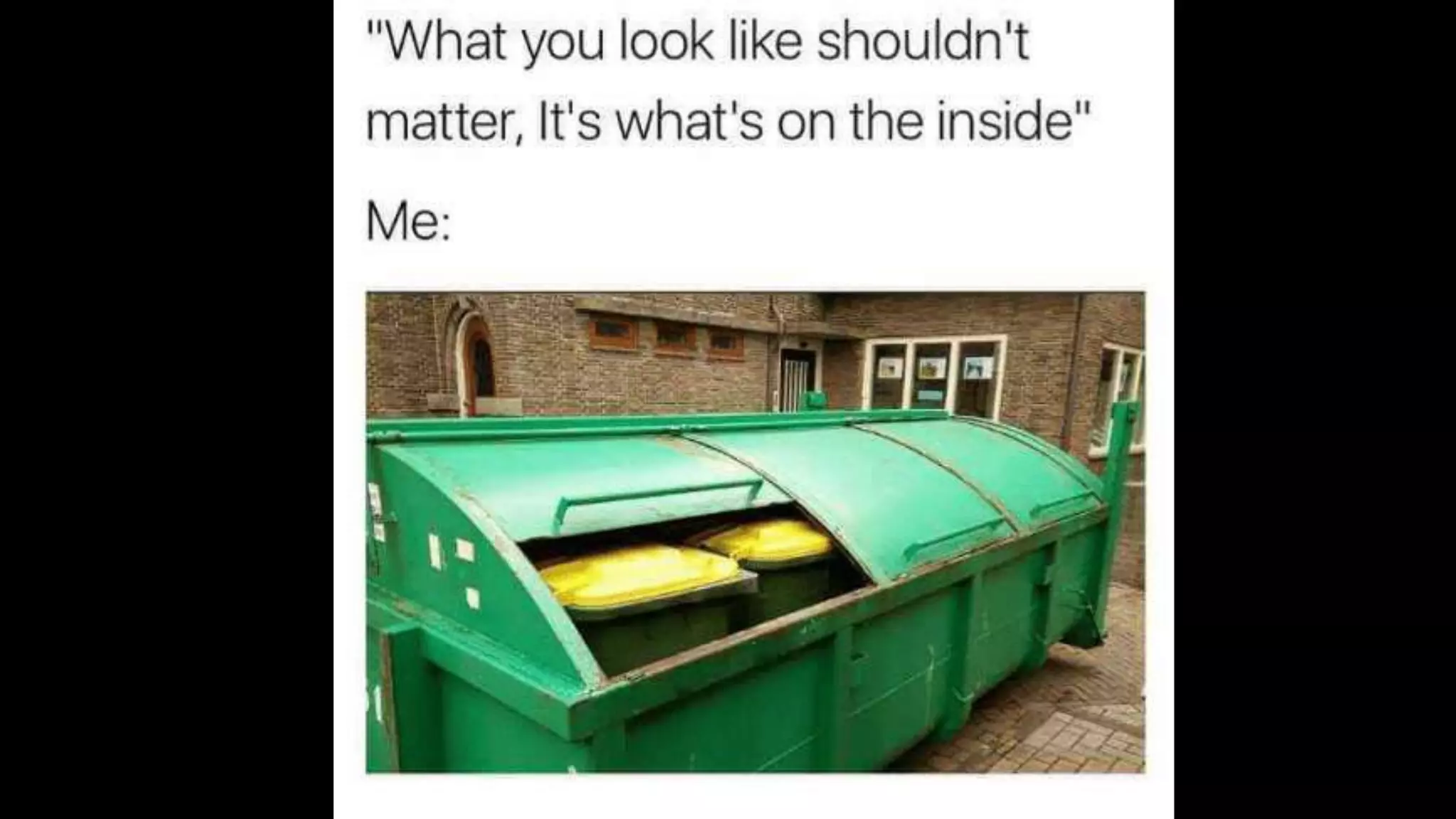
  • #28 That’s a valid question. You could be working with idiots, narcissists and prima-donnas, or worse still the asshole on your team might be you. (I know on my team, it’s definitely me) I'm literally trash. https://ballmemes.com/i/what-you-look-like-shouldnt-matter-its-whats-on-the-22759347
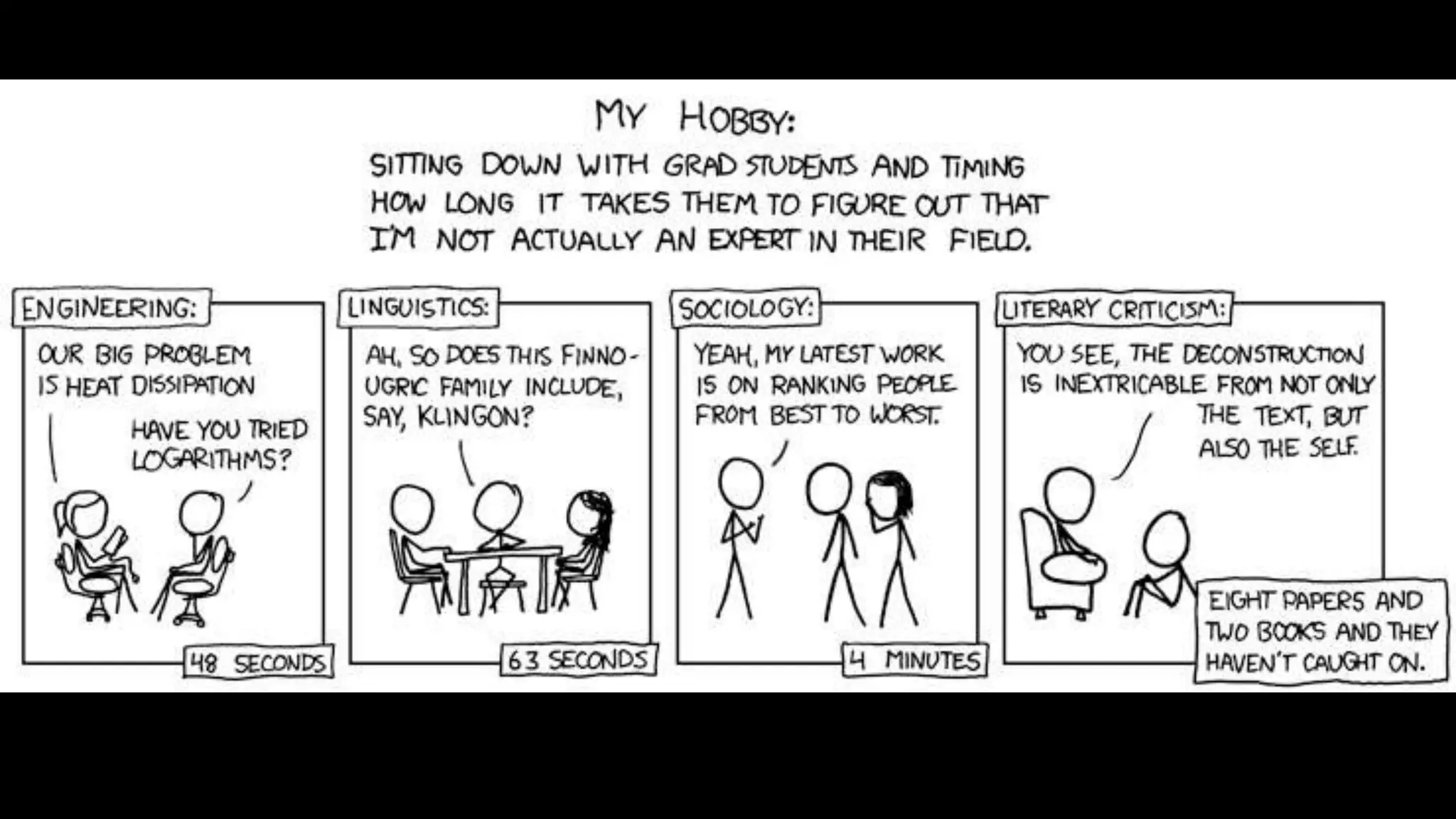
  • #29 https://xkcd.com/451/
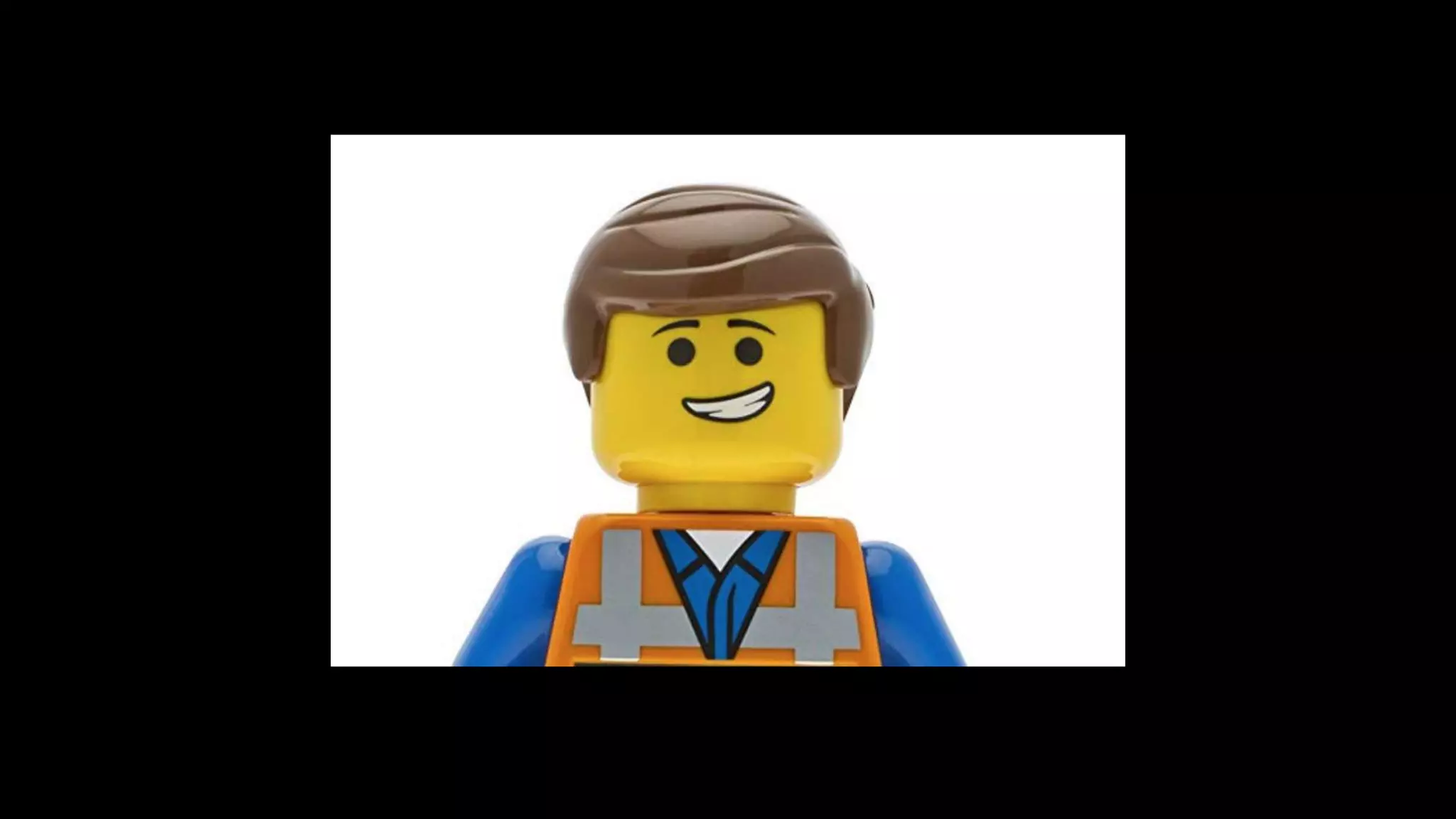
  • #31 If you are at all familiar with the Lego movie, you know that Emmet, the main character, is kinda clueless and has nothing special about him…at some point he even lies and make a bunch of mistakes. If he was on your dev team, he could easily be the one pushing buggy code and bad deployments He is mistakenly believed to be ”the special” but he just gets thrown into that by accident and coasts along most of the movie as this impostor…
  • #32 SPOILER warning! The interesting point about Emmet in the Lego movie is that he is an impostor, he is incompetent (at first), he is NOT perfect, yet he also is “the special”. And it doesn’t really matter if he was destined to be that or it was all an accident. In some sense the fact that he is ordinary and unexceptional is what makes him unique and “the special”.
  • #33 Impostor syndrome is critical for us to talk about because it is an almost universal experience that cuts across racial or gender lines. There’s an interesting interplay between feelings of impostor syndrome and identity too…When the first studies were published in the 70s (?) it was presumed to be a issue that only women faced (the study authors were two women), but later it was found that men are at least equally effected. The feelings and stories we tell ourselves about being an imposter might be nominally tied to our gender, race, ethnicity, religion, disability, or all kinds of unique experiences that contribute to our identity yet the core of it is a common experience and cuts across all of those lines.
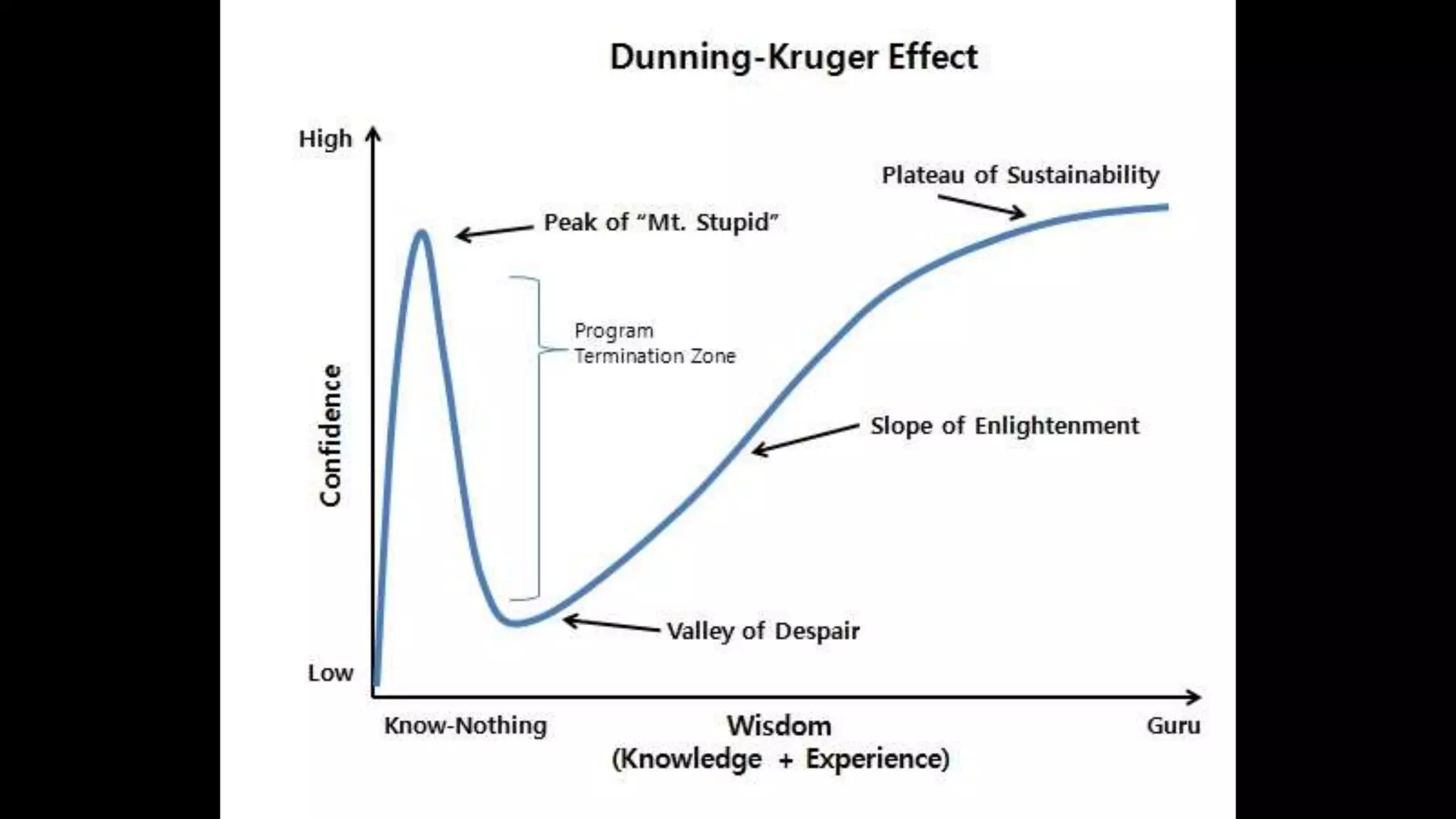
  • #34 One of the authors of the 1999 paper, Justin Kruger, writes in a later article: “…incompetent people do not recognize—scratch that, cannot recognize—just how incompetent they are,” He further explains: “What’s curious is that, in many cases, incompetence does not leave people disoriented, perplexed, or cautious. Instead, the incompetent are often blessed with an inappropriate confidence, buoyed by something that feels to them like knowledge.” Original paper: http://psycnet.apa.org/?&fa=main.doiLanding&doi=10.1037/0022-3514.77.6.1121 Justin Kruger quotes from his article: https://psmag.com/social-justice/confident-idiots-92793
  • #35 Notice the list here….this is the inverse of what defines our master builders.
  • #36 https://theness.com/neurologicablog/index.php/lessons-from-dunning-kruger/ I apologize, I’m a little uncertain about the source of the data used for this graph but I believe it’s from the original 1999 study published by dunning-kruger. In some ways it raises more questions that it answers for me…like are these undergrads or grad students? Were they grading on a curve? The cynical part of me is noticing that some where near the D and C students, they know exactly where they stand (do they care?).
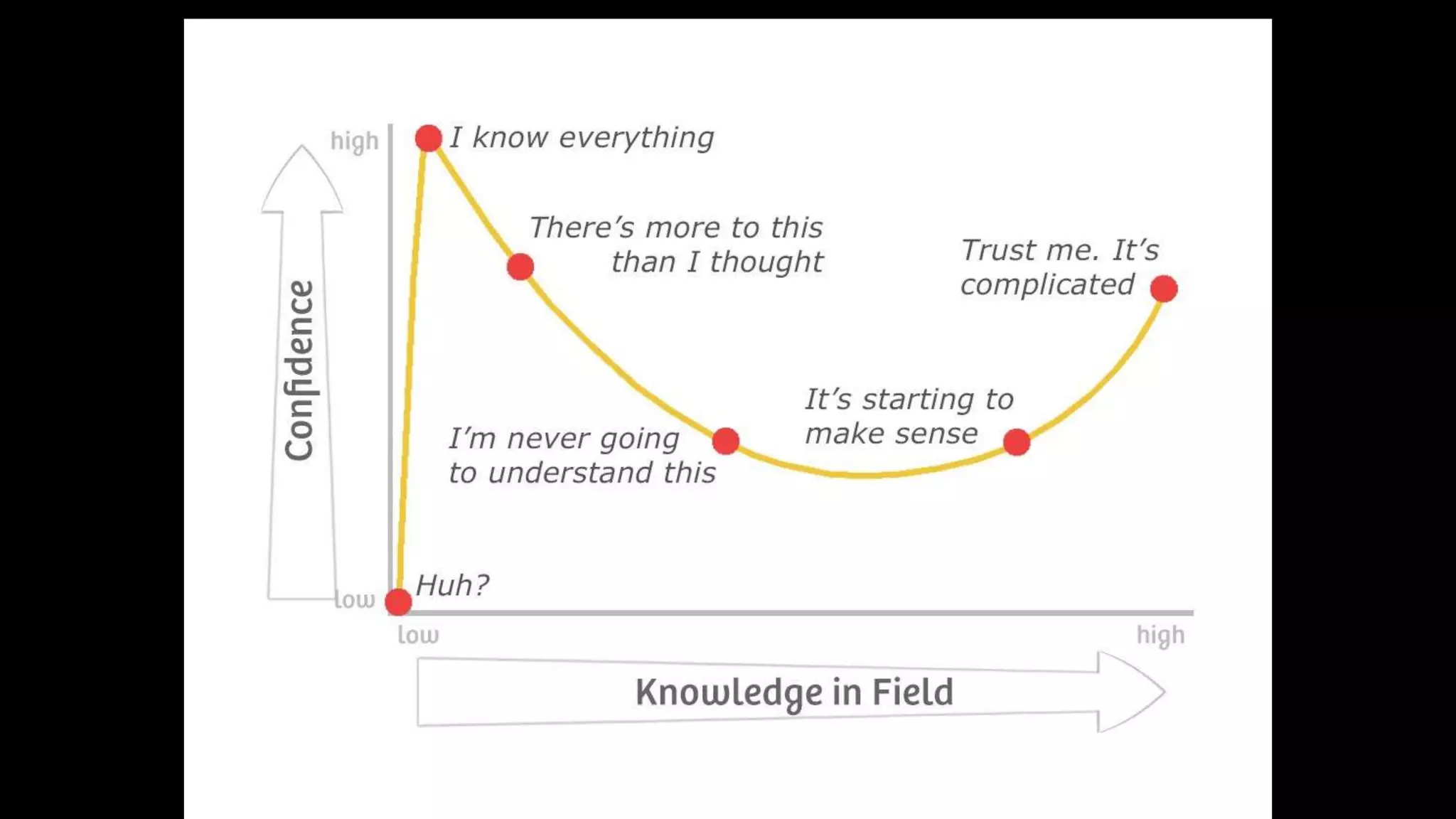
  • #37 Here’s one example of graphing the dunning kruger effect. I like the text but the shape is actually wrong so ignore that for a moment. From https://www.skepticalraptor.com/skepticalraptorblog.php/massive-dunning-kruger-epidemic-observed-anti-vaccine/
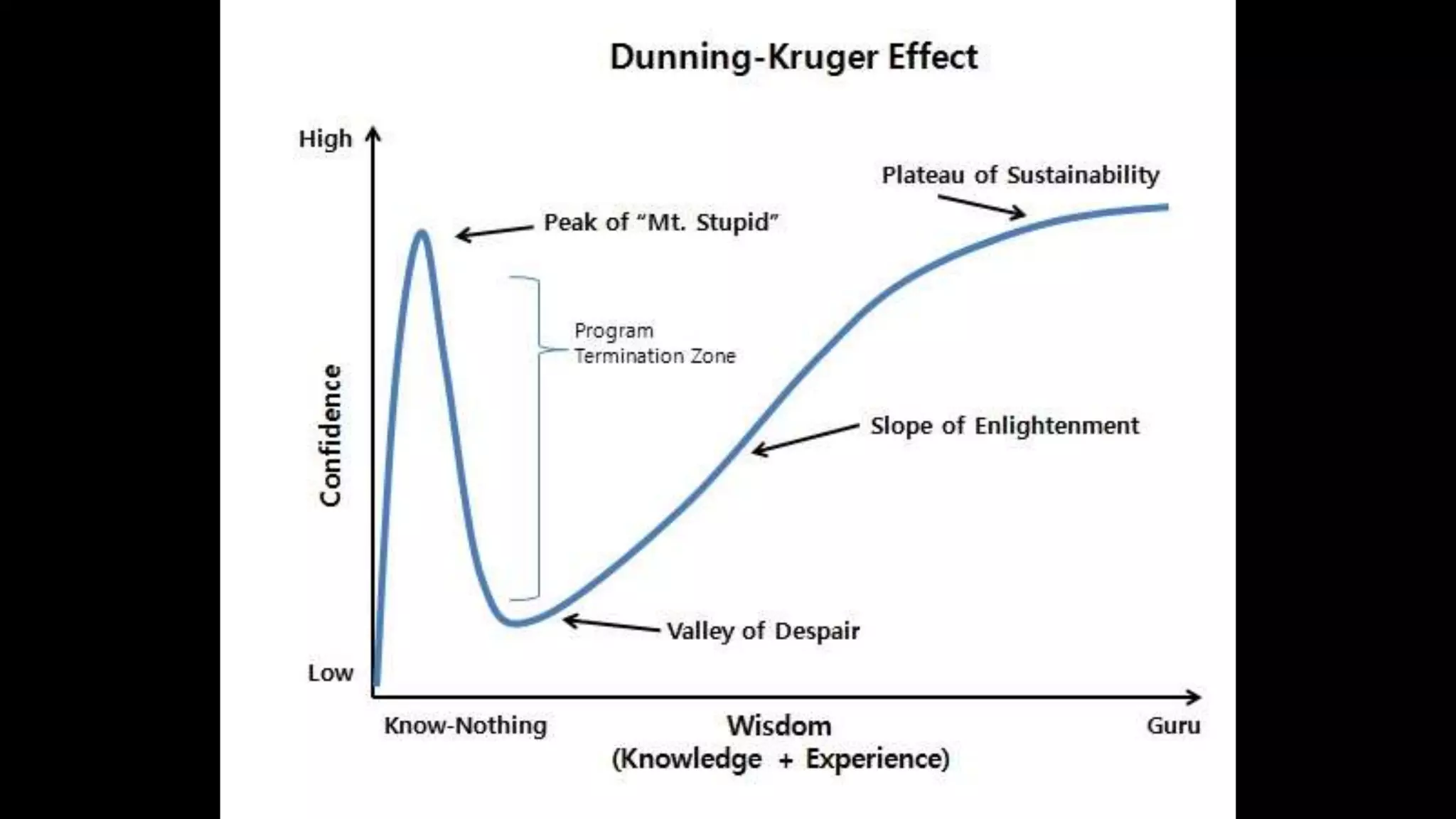
  • #38 “Here’s another variation of the graph with a slightly different shape (maybe taking some liberties). This is from an article by Mike Dudkey on medium.com where he discusses experts in one programming language criticizing other languages.” So another thing to consider is that maybe we could visualize not just a single graph with this form but a series of similar graphs for every domain of knowledge that might work in. You could be an true expert in one domain while being, regrettable, at the "Peak of Mt. Stupid" in another, perhaps even a somewhat related, domain https://medium.com/@mike.dudkey78/ladies-and-gentlemen-here-comes-the-dunning-kruger-effect-f31b09d52573
  • #39 https://xkcd.com/1954/ “It's actually worst in people who study the Dunning–Kruger effect. We tried to organize a conference on it, but the only people who would agree to give the keynote were random undergrads.”
  • #40 https://xkcd.com/1954/ “It's actually worst in people who study the Dunning–Kruger effect. We tried to organize a conference on it, but the only people who would agree to give the keynote were random undergrads.”
  • #41 But here’s what I really want you to take away from this graph: where are the inflection points? (pause for responses) The first one is really where we have the DKE and the second one is where impostor syndrome begins. So both of them are important…and if the goal is to produce quality software by producing experienced, knowledgeable, passionate "master builders", then we really have to move beyond both of those points. It’s not enough to let people stay stuck at either one. If we want to build the world of Odan, we actually need to change to overall level of knowledge and experience in our communities (or orgs, or teams, or selves) AS WELL AS as build an appropriate amount of confidence such that people are unleashed to create master works of software --and again, not just the wisdom but the also confidence matters because to succeed in the marketplace, we need to take healthy risks! So the question is how?
  • #43 Conjecture: I believe there is a way we can move people (including ourselves) past both of those inflection points without agonizing over whether we're guilty of dunning-kruger or impostor syndrome. Clearly, we need a solution that is not merely telling people they are dumber or smarter than they think and to feel better (or worse).
  • #44 We need something that helps people to have an objective understanding of how well they are doing...in addition to staying motivated to keep moving along the path of greater knowledge and experience. (and meritorious confidence) Demoralization is a losing strategy. Hype is also a losing strategy
  • #45 If the ”peak of Mt Stupid” comes from hubris, from foolishly, brashly believing you know it all and plowing ahead like a tragic Greek hero to your doom then perhaps we need to think back to that other Greek term we mentioned earlier: arete. I am not an expert by in Greek philosophy, but I do find interesting how it might advance our discussion here so, I apologize for any misuse of these terms or misrepresenting the classical ideas. What I understand is that arete is largely about self-restraint: NOT beating yourself up and also NOT hyping yourself up). authentic curiosity about our own level of knowledge will begin to resolve this dilemma between incompetence vs insecurity. http://arnel-m.blogspot.com/2011/11/on-arete-and-hubris.html
  • #46 A key observation is that both of the inflection points are thinking errors. The Greek word for transgression (or if you like, the word from which the religious word 'sin' is derived) is really about error. And I want to emphasize error because to me, as a programmer, that's a magic word that conjures up lots of ideas about handling and recovery. Or at amazon, we sometimes talk about writing a special kind of document called a “Correct of errors” So let me hear from you: how should we handle errors in systems? In software? In code? (pause to get input and talk about error handling if it feels appropriate)
  • #47 It’s ok to tell everyone, literally everyone that you interact with that they are special. In fact, even the malicious actors, the Lokis, the Lord businesses, and the n00bs at the peak of Mt. Stupid, it’s even ok to tell them that they are special. You might need to qualify where their successes and strengths are…you might even need to work hard to understand them and find where they are gifted or unique but you can, if you are a master builder, authentically identify them as special.
  • #48 And we also need to note that people are not special because of their ability to produce something of value. You are not your code. Rather your ability to produce quality anything comes about a result of, initially, someone recognizing what is special about you, and over time nourishing and growing that inner sense. We need to be careful not to mix up cause and effect here, just like when we looked at Duplo vs Odan and high standards.
  • #49 Fred Rogers, Commencement Address at Dartmouth College June 9th, 2002 https://en.wikiquote.org/wiki/Fred_Rogers I love this quote from Mr. Rogers because it is a beautiful metaphor much like many of those from his Children’s TV show, but it’s clearly targeted at adults. This is from a commencement address at Dartmouth in 2002. And it's worth noting because this idea is not just 'feel good' stuff, this is not just hype....He had a profound influence on people of all ages and used his influence to produce social change.
  • #50 Fred Rogers, Commencement Address at Dartmouth College June 9th, 2002 https://en.wikiquote.org/wiki/Fred_Rogers And he goes on later in the same address to talk about how people become competent.
  • #51 https://blog.mischel.com/2018/01/24/responding-to-errors-at-amazon/ So these are some ways that we might create master builders and protect ourselves and others from IS and DKE... I especially want us to think about mentorship, or any other kinds of human interaction as a special sort of mechanism for preventing and recovering from thinking errors. It's fault tolerance for people, on the mental and emotional level. Maybe there are other ways too...I've got a few here like the COE document...what would you add to this list?
  • #52 Now that we have a way to bring out the best in people and turn them into master builders, we should just get them all to working hard and 600 hours later they’ll have produced Odan, right?
  • #53 Or maybe our managers and team mates don’t put pressure on us to work more hours, maybe we push ourselves to work more hours. I sometimes wonder if we, as programmers, have a commonly shared belief that we can produce high quality code through longer hours because during our first programming experiences with a complicated piece of software...perhaps as undergrads, much of the time was spent in a painful trial and error process...and maybe it feels familiar to put ourselves through lots of pain when we’re under pressure. I don’t know for certain if this is true, but I sometimes have observed myself or junior developers pushing themselves to work longer hours and later nights with diminishing returns because we think everything will suddenly fall into place…yet maybe we can’t get it there precisely because we are so exhausted. https://publicautonomy.org/2015/11/27/neoliberal-guilt/
  • #54 Overworking (which we’ll quantify in a moment) is the same kind of thinking error that got us into the impostor syndrome. The 600 hours spent on Odan are 600 quality hours, not 600 frantic, insecure, irrelevant, incompetent, or unfocused hours.
  • #55 And there is a TON of data on this topic. It seems it's been heavily studied and I'm just going to quickly go over a few points before we finish up.
  • #56 https://yorkesoftware.com/2018/02/02/are-you-working-too-much/ First a little history…
  • #57 Observations: Crunch time gains are usually lower than what we lose during recover https://yorkesoftware.com/2018/02/02/are-you-working-too-much/y period. Crunch periods typically max out at 2-3 weeks.
  • #58 Observations: going over 35 is extremely risky because poor productivity in the realm of knowledge work could mean making mistakes…using bad judgement. The cost of cleanup could far exceed short term productivity gains. And again, crunch periods typically max out at 2-3 weeks. Use wisely!