The Neurological Assessment
1 – Introduction and Overview
Marc Colbeck
https://www.slideshare.net/MarcColbeck/marc-colbeck-the-neurological-assessment-for-paramedics
Download the PowerPoint
presentation
• You can use this for your own study or to
present to others
• References and speaker notes are in the
notes section to each slide
• Go to www.slideshare.net
© Marc Colbeck and Paramedicine.com, used by permission of the author. See: https://creativecommons.org/licenses/by-nc-sa/4.0/
Maintaining this note in the file is sufficient attribution of authorship as per the author.
4 |
Contents
1. Introduction & Overview
2. Mental Status
a. Alertness,
b. Orientation,
c. Memory,
d. GCS
3. Eyes, Neck and Movement
4. The Cranial Nerves
5. The Stroke Exam
6. The Dermatome Exam
7. The Myotome Exam
8. Examining the Reflexes
9. CNS Tracts
a. Sensory and Motor
“How is your patient”?
1. The patient is alert and oriented to person
place and time, with memory of distant,
recent and incident, and no amnesic gaps.
2. They have no major CNS issues like
syncope/presyncope, vertigo, headaches,
seizures or trauma.
3. Pupils are PEARL with midline conjugate
gaze, tracking well and accommodating
normally.
4. Cranial nerve, dermatome, myotome exams
and simple reflexes are all normal.
6 |
Natasha Richardson
• Tony Award winning actress, married to Liam Neeson,
daughter of Vanessa Redgrave (another famous actor)
• In 2009 fell on a beginners trail while skiing, no LOC,
no obvious head injury
• Taken to the ski resort infirmary, appeared well and
even joked about the incident, signed forms declining
further treatment and left the infirmary against
medical advice.
• 2.5 hours later, ambulance recalled, she was taken to
hospital where she ultimately died due to an epidural
hematoma.
• A classic/famous case that prompts clinicians to
wonder: “How can we tell if my patient’s brain is OK”?
7 |
Review of the Nervous System
Brain and
Spinal
Column
“SAME”
Sensory = Afferent
Motor = Efferent
Autonomic
=
Automatic
Central
Nervous System
Peripheral
Nervous System
Efferent (Motor)
Nervous System
Autonomic
Nervous System
Sympathetic
Nervous System
Parasympathetic
Nervous System
Afferent (Sensory)
Nervous System
Somatic (body)
Nervous System
The rest of
the body
8 |
The General Assessment – General Questions
• Mental Status: AVPU / GCS
• Orientation (Person, Place and Time)
• Memory (Distant, Recent, Incident)
• Amnesia: Retrograde (before incident)
Anterograde (after incident)
• Have you been dizzy or had problems with your
balance or falling? (rule in/out vertigo)
• Have you had any sensory problems (touch, sight,
hearing, smell, taste)? Any paraesthesia's? (tingling)
• Have you noticed any unexpected weakness in your
face/eyelids, arms/hand, legs/feet?
• Have you ever had a scan of your brain and/or spinal
cord? (If yes, why? And what did it show?)
• Is there a history of neurological or muscle problems
in your family?
Medical History?
• Headache/Migraine? Meningitis? Encephalitis?
Epilepsy or seizures? ‘Blackouts’? Head or
back/spinal injuries? Previous operations? STI’s?
Cardiovascular disease? Atrial fibrillation (may be
experienced as ‘palpitations’ or general weakness),
Hypertension? Alcohol/drug use?
What medications are you taking?
• Antihypertensives suggest increased ICP or prior
hypertension and can produce postural dizziness and
syncope,
• Antidysrhythmics suggests cardiogenic syncope,
• Anti-epileptic drugs suggest seizures,
• Tranquilisers can induce ataxia, sedation or
Parkinsonian tremor
• Antipsychotics (specifically antagonize dopamine D2
receptors can produce bizarre postural difficulties
(extrapyramidal symptoms – more later)
Leave Questions in the Comments
The Neurological Assessment
2 – Mental Status
Marc Colbeck
© Marc Colbeck and Paramedicine.com, used by permission of the author. See: https://creativecommons.org/licenses/by-nc-sa/4.0/
Maintaining this note in the file is sufficient attribution of authorship as per the author.
12 |
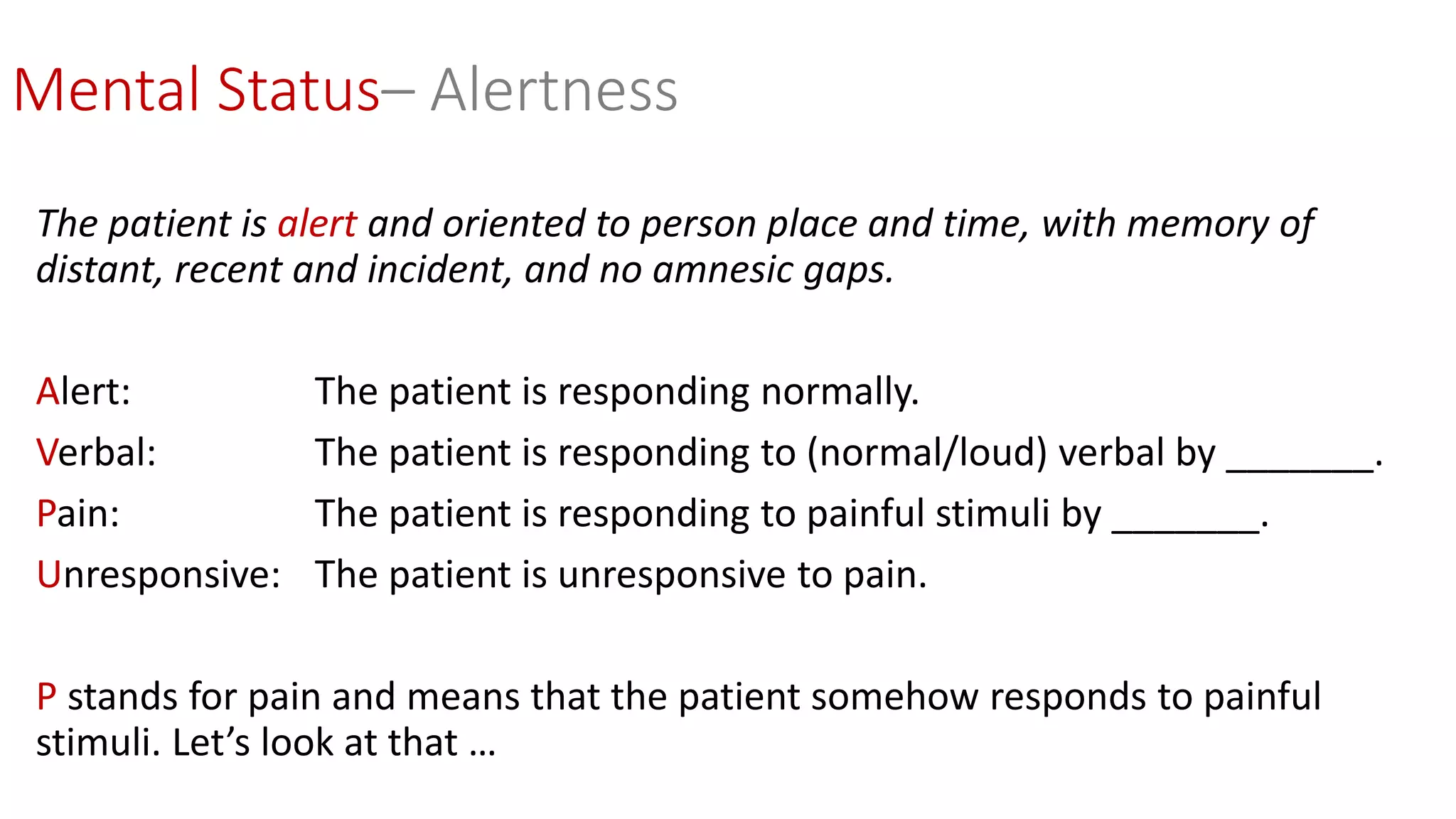
Mental Status – Alertness
• Awareness is a description of how well someone responds to changes in their
environment
• We report this by using the statement “The patient is responding to (this sort
of stimulus) __________ by (doing this) _____________
• Normally we use the simple AVPU scale
The patient is alert and oriented to person place and time, with memory of
distant, recent and incident, and no amnesic gaps.
Alert: The patient is responding normally.
Verbal: The patient is responding to (normal/loud) verbal by _______.
Pain: The patient is responding to painful stimuli by _______.
Unresponsive: The patient is unresponsive to pain.
P stands for pain and means that the patient somehow responds to painful
stimuli. Let’s look at that …
Mental Status– Alertness
14 |
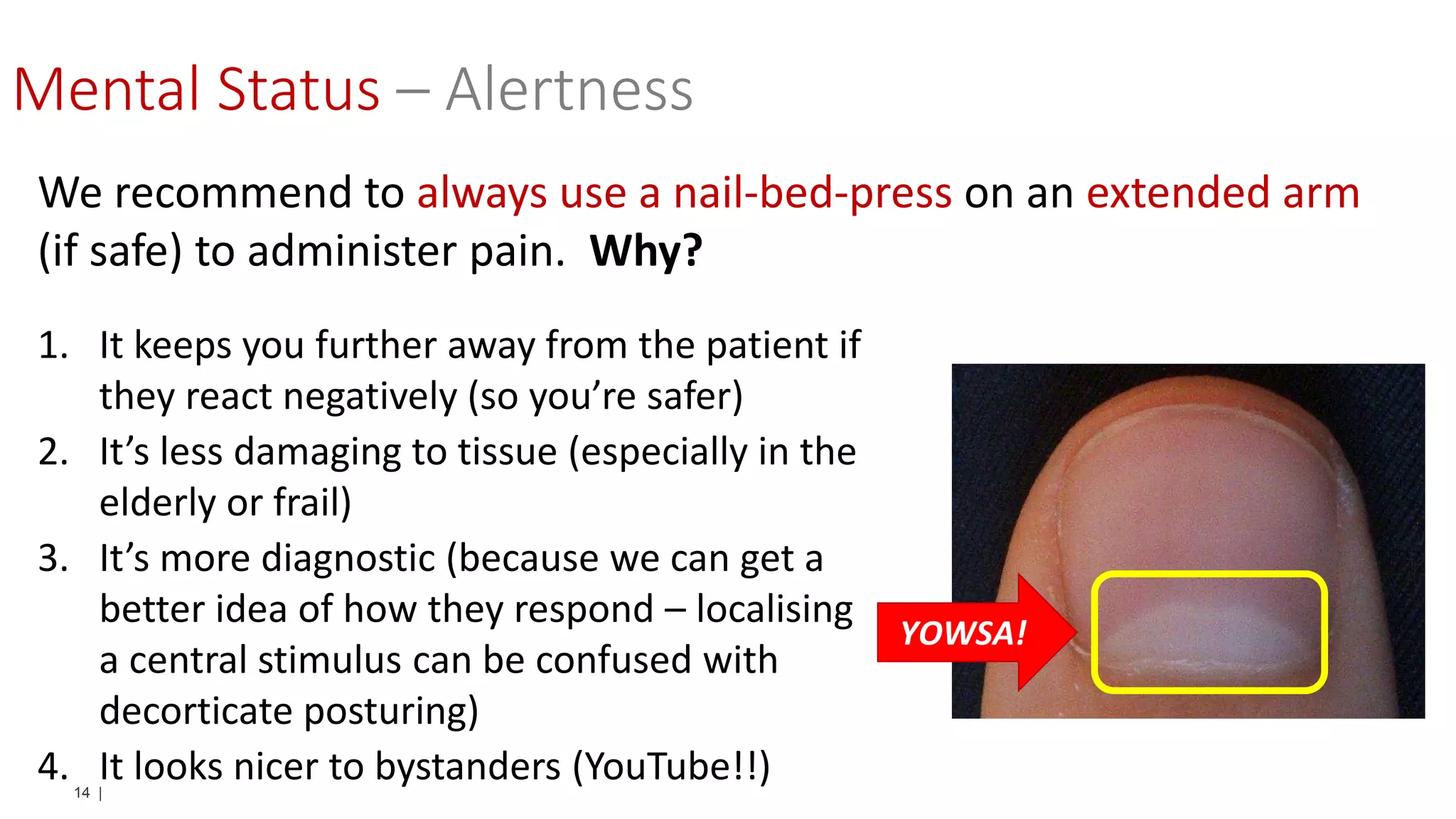
Mental Status – Alertness
We recommend to always use a nail-bed-press on an extended arm
(if safe) to administer pain. Why?
1. It keeps you further away from the patient if
they react negatively (so you’re safer)
2. It’s less damaging to tissue (especially in the
elderly or frail)
3. It’s more diagnostic (because we can get a
better idea of how they respond – localising
a central stimulus can be confused with
decorticate posturing)
4. It looks nicer to bystanders (YouTube!!)
YOWSA!
15 |
Good! Bad! That’s why!
Mental Status – Alertness
The patient is alert and oriented to person place and time, with memory of
distant, recent and incident, and no amnesic gaps.
1. Oriented to person They know their name
2. Oriented to place They know where they are
3. Oriented to time They know (roughly) what time it is
Mental Status – Orientation
Mental Status – Memory (1)
The patient is alert and oriented to person place and time, with memory of
distant, recent and incident, and no amnesic gaps.
1. Distant memory (where they were born)
2. Recent memory (what they had for breakfast, or dinner last night)
3. Incident memory (what happened to them)
Mental Status – Memory (2)
The patient is alert and oriented to person place and time, with memory of
distant, recent and incident, and no amnesic gaps.
Awhileago
Now
Time
Incident
Retrograde
Amnesia
Anterograde
Amnesia
………………………………………………………………………………………………...?Gaps?.................................................................
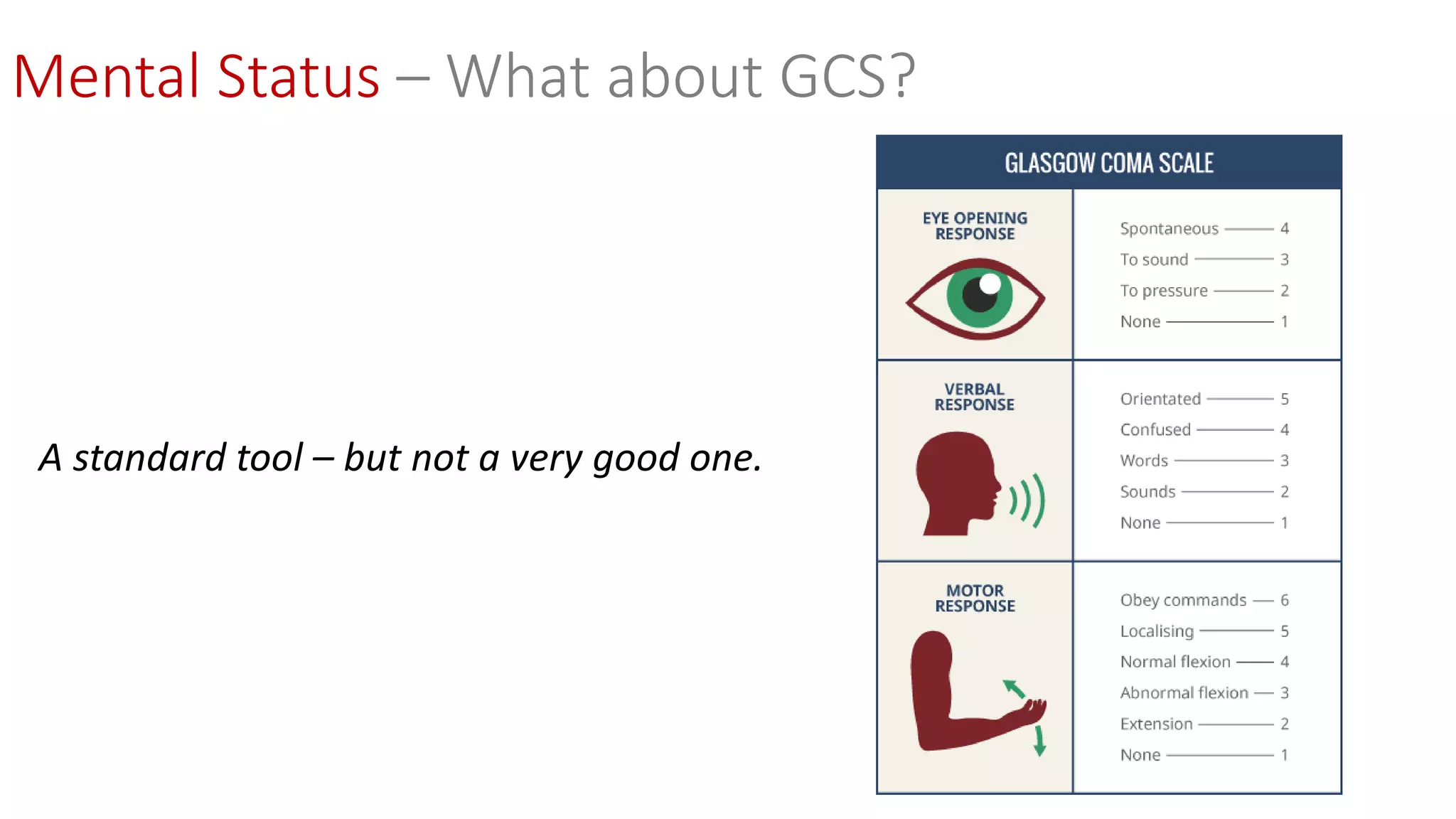
Mental Status – What about GCS?
A standard tool – but not a very good one.
20 |
Mental Status – GCS: Problems with use
1. Not originally intended to be converted into a single score — the
components (E4,V5, M6) are more important than the total score
2. The same GCS score will predict different TBI mortality depending on the
components
• GCS of 4 with the components 1+1+2 (E+V+M) predicts a mortality rate of 48%
• GCS of 4 with the components 2+1+1 (E+V+M) predicts a mortality rate of 19%
3. Does not incorporate brain-stem reflexes
4. Motor score does not factor in unilateral pathology
5. Unreliable in patients in the middle range of 9-12
6. Grossly predictive for populations but cannot accurately predict outcomes in
individual patients.
21 |
Mental Status – GCS: Problems performing
1. Designed as a tool for repeated bedside assessment of various neurological functions in
patients in a neurosurgical ward, not for use in TBI
2. It is difficult for untrained staff to apply properly, especially distinguishing between
M= 3,4,5 (even neurosurgeons get it wrong ~50% of the time)
3. Variation in scoring “Verbal” scores in intubated patients
4. Subject to language barriers
5. Cannot be applied to small children
6. May be affected by other factors influencing level of consciousness, e.g. drugs such as
alcohol and sedatives
7. GCS is often used in settings such as toxicology where it is unvalidated
8. Debates within the literature as to when GCS can be first applied after TBI, i.e when is the
first post-resuscitation GCS applicable.
1. Controversy in the literature
2. There is poor inter-observer reliability
3. Reproducibility is poor (only 50% in neurosurgeons!)
4. There is little evidence demonstrating validity and reliability of the GCS
5. Not proven to be better than unstructured clinical judgement
6. There are numerous other neurological scoring systems that have demonstrated
greater validity and reliability e.g. the FOUR score, AVPU in children
7. GCS 8 does not reliably correlate with the presence or absence of airway reflexes
Do read:
http://lifeinthefastlane.com/ccc/glasgow-coma-scale-gcs/
and
http://www.scancrit.com/2011/11/28/why-the-glasgow-coma-scale-has-got-to-go/
Mental Status – GCS: Accuracy problems
Leave Questions in the Comments
24 |
End Section
The Neurological Assessment
3 – Eyes, Neck, Movement
Marc Colbeck
© Marc Colbeck and Paramedicine.com, used by permission of the author. See: https://creativecommons.org/licenses/by-nc-sa/4.0/
Maintaining this note in the file is sufficient attribution of authorship as per the author.
27 |
The General Assessment – The eyes: PEARL
1. Ideally should be done in a darkened environment (e.g. the
ambulance with the lights off) – examinations done in sunlight
are not optimal
2. Have the patient take off their glasses (contacts are ok) and
gaze into the distance, behind you
3. Shine the light on one pupil and watch that pupil’s reaction, it
should constrict – don’t use a super powerful flashlight!
4. Miosis means constriction, Mydriasis means dilation
5. When the pupil receiving the light constricts it’s called the
‘direct response’, but the other pupil (not receiving the light)
will also constrict; this is called the ‘consensual response’.
28 |
6. The pupils should be the same size as each other when the
lights are off, and each should constrict equally when a light is
shone on them.
7. The pupils should both be round, symmetrical, midline and
dark.
8. Non round can occur due to trauma, surgery, age, inflammation
or ischaemia.
9. Under normal illumination, the average adult’s pupil size
measures around 3.5 mm but can range from 1.0 mm to 10 mm
and decreases as one ages due to senile miosis.
The General Assessment – The eyes: PEARL
29 |
10. The pupils may be different sizes due to head injury, drugs, trauma to the
eye or many other factors. Any difference of more than 1 mm is called
Anisocoria.
11. 20% of the population naturally has (harmless) physiologic anisocoria.
This normal anisocoria should be the same in bright light and in dim light.
If it changes according to the light record which pupils is changing size in
the different light, and which pupils is less reactive in the different light. If
you note anisocoria, ask the patient if it is normal for them. If not, ask
them if they have taken any drugs recently, had something in their eye, or
experienced any trauma?
12. Pupils should be PEARL, if they are now not (when they previously were) it
suggests that their brain is not ok
The General Assessment – The eyes: PEARL
30 |
1. The pupils should both be midline when staring straight ahead
and should move together in the same way (conjugate gaze). If
they are not, or do not, that is a dysconjugate gaze.
2. People who are conscious will normally ‘track’ (follow) a moving
object in front of them. When you enter a scene, note if the
patient is ‘tracking’.
The General Assessment – The eyes: Conjugate
gaze and tracking
31 |
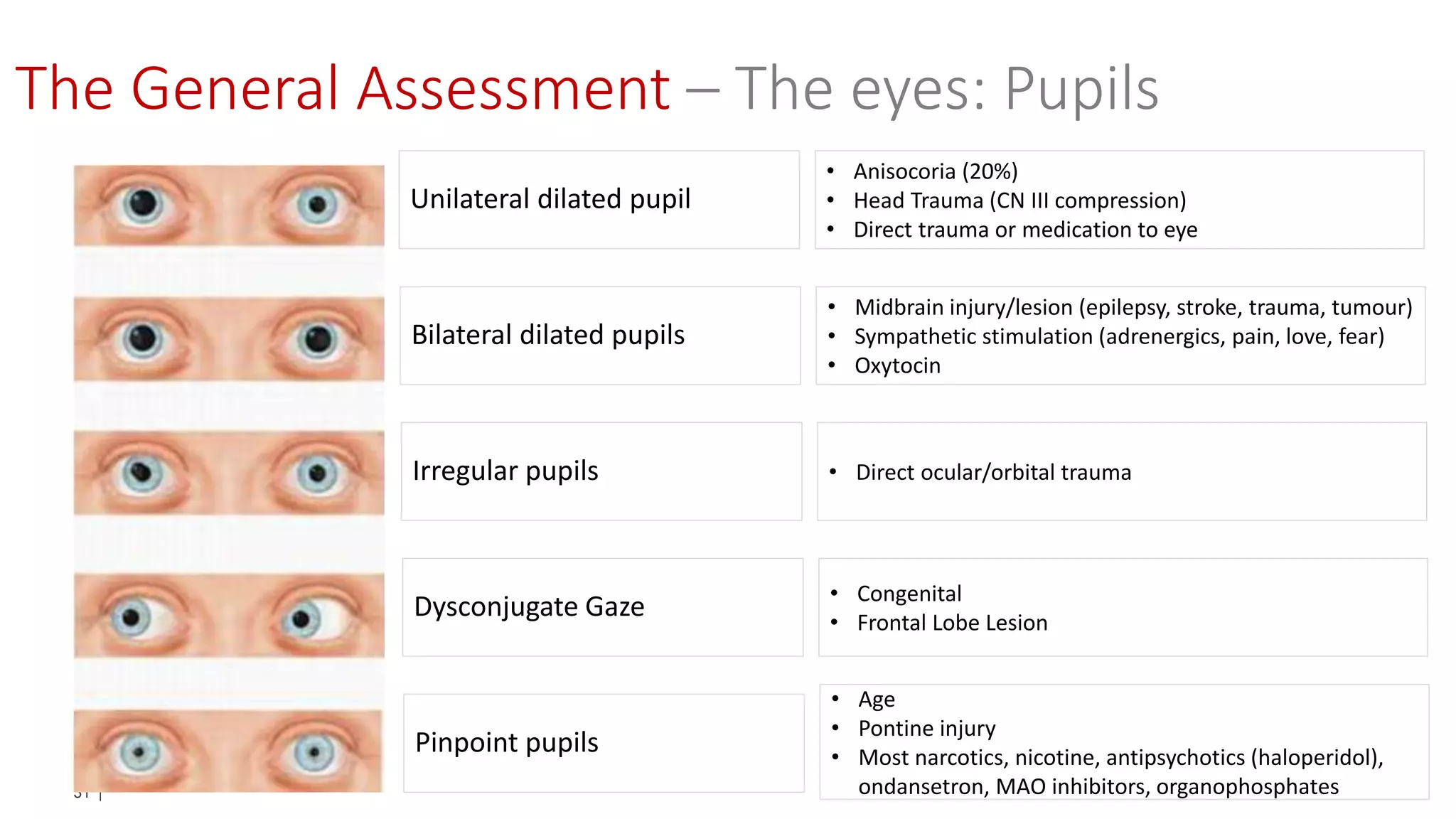
Unilateral dilated pupil
Bilateral dilated pupils
Irregular pupils
Dysconjugate Gaze
Pinpoint pupils
• Anisocoria (20%)
• Head Trauma (CN III compression)
• Direct trauma or medication to eye
• Midbrain injury/lesion (epilepsy, stroke, trauma, tumour)
• Sympathetic stimulation (adrenergics, pain, love, fear)
• Oxytocin
• Direct ocular/orbital trauma
• Congenital
• Frontal Lobe Lesion
• Age
• Pontine injury
• Most narcotics, nicotine, antipsychotics (haloperidol),
ondansetron, MAO inhibitors, organophosphates
The General Assessment – The eyes: Pupils
32 |
A rhythmic regular oscillation of the eyes
New onset nystagmus suggests that the brain is not ok
Types
1. Vertical (up and down)
2. Horizontal (side to side)
3. Rotary (in a circle)
4. Physiological (normal) – fine nystagmus is
common at the extreme ranges of gaze
Causes
• Congenital
• Eye problems (including cataracts, strabismus
and focusing problems)
• Inner ear problems (including Meniere’s
disease)
• CNS problems (including head injury, stroke,
and multiple sclerosis)
• Medications or alcohol
The General Assessment – The eyes: Nystagmus
33 |
• Ask the patient to alternate between looking at a distant object, then at your
finger, spending about 2-3 seconds on each.
• As the eyes focus on your finger the eyes should cross equally and the pupils
should constrict.
• The ability to do so is called ‘accommodation’
• Lack of accommodation suggests that the brain is not ok
The General Assessment – The eyes: Accommodation
34 |
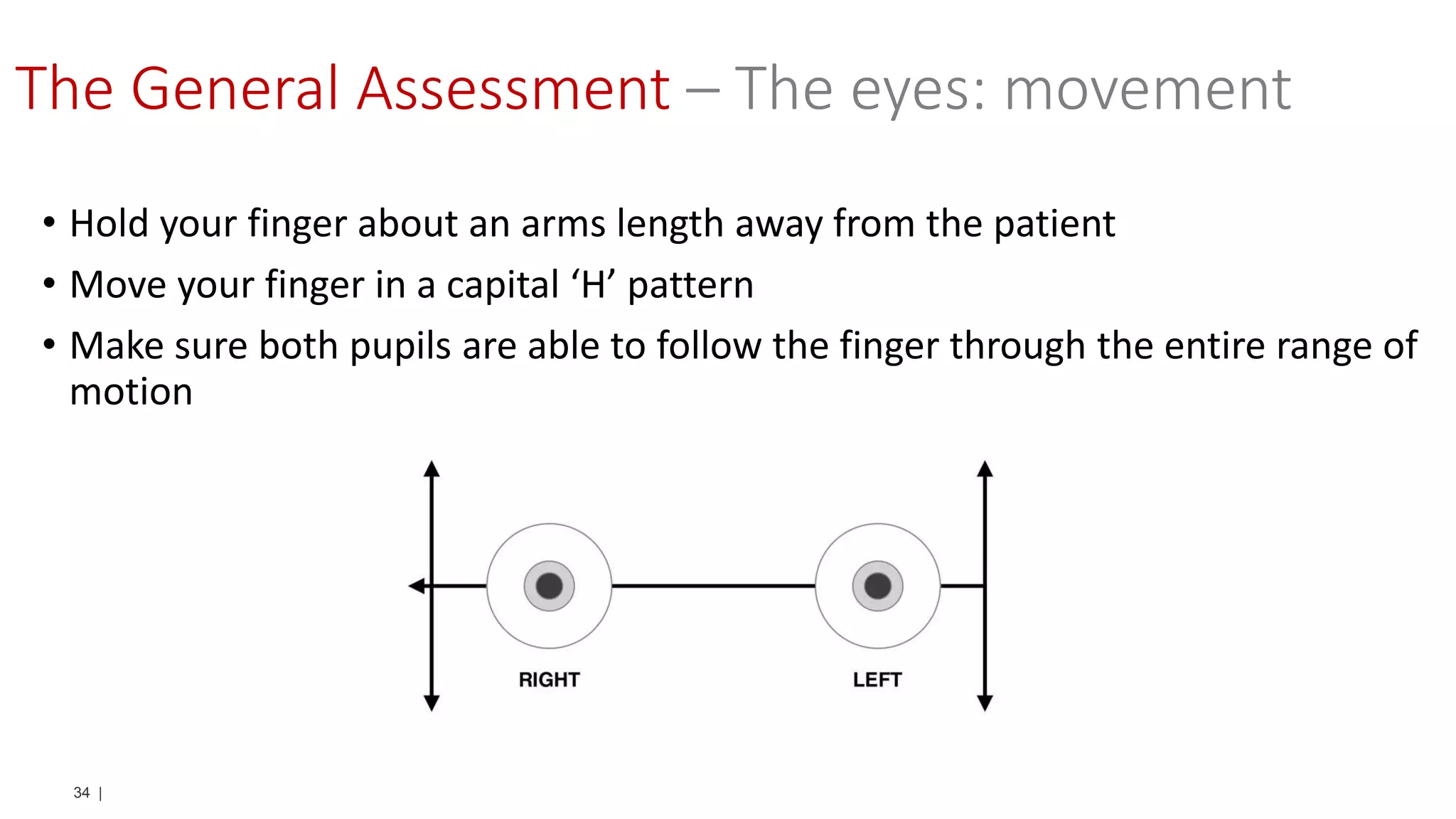
• Hold your finger about an arms length away from the patient
• Move your finger in a capital ‘H’ pattern
• Make sure both pupils are able to follow the finger through the entire range of
motion
The General Assessment – The eyes: movement
35 |
• Also called ‘nuchal rigidity’
• We are always concerned about possible inflammation of the meninges
(meningitis)
• Fever, headache and neck stiffness are the ‘classic signs’ of meningitis, but they
are weak predictors (+LR=0.92, -LR=0.88) and their absence does not rule out
meningitis.
• Clinical tests for it, from least to most sensitive, are:
1. Kernig sign (resistance to passive knee extension)
2. Brudzinski sign (full or partial flexion of the hips and knees when the neck is flexed)
3. Difficulty touching the chin to the chest with the mouth closed
4. Difficulty touching the forehead (or chin) to the knee
The General Assessment – Neck Stiffness
36 |
Brudzinski’s
Kernig’s
The General Assessment – Neck Stiffness
37 |
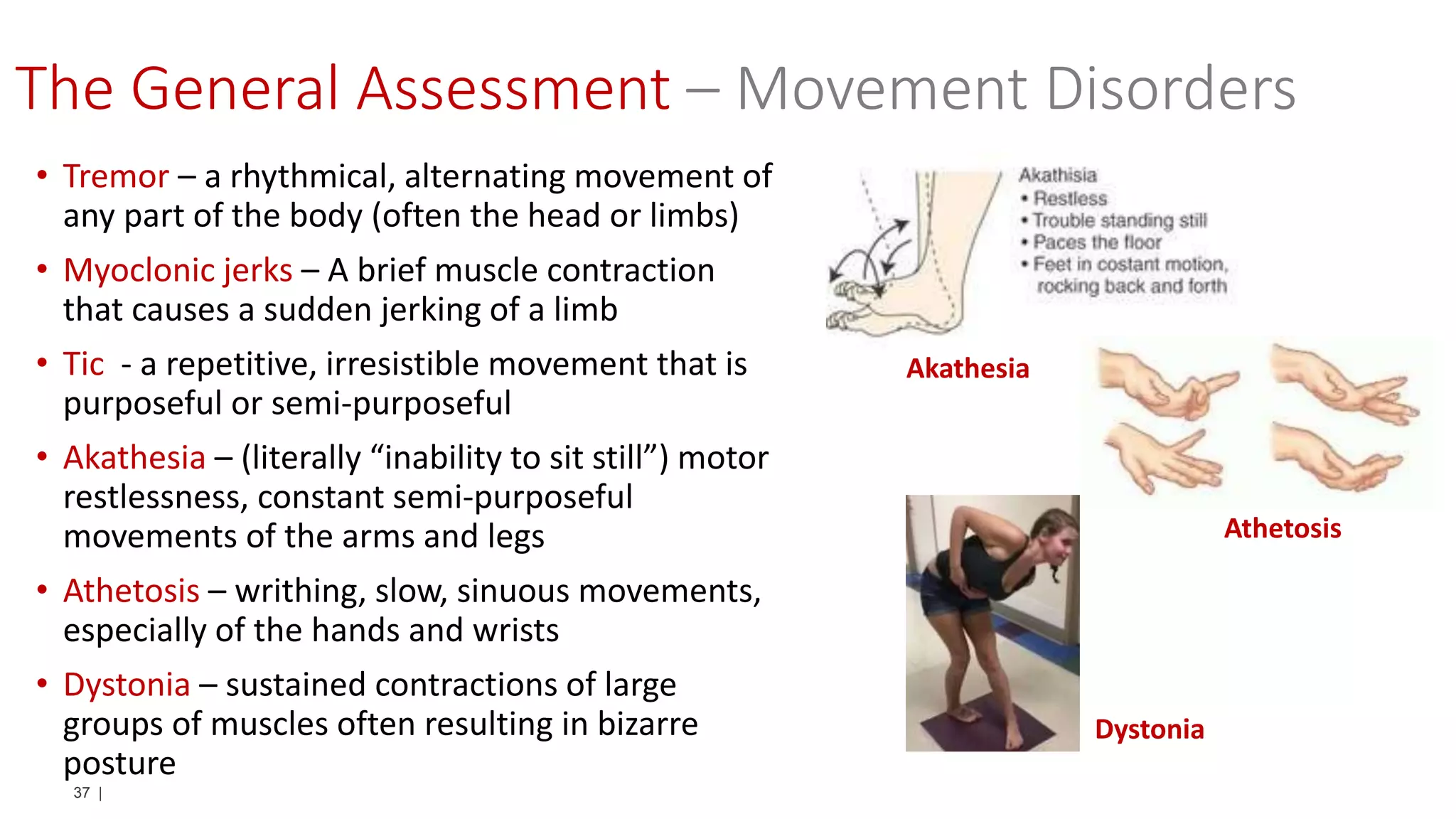
• Tremor – a rhythmical, alternating movement of
any part of the body (often the head or limbs)
• Myoclonic jerks – A brief muscle contraction
that causes a sudden jerking of a limb
• Tic - a repetitive, irresistible movement that is
purposeful or semi-purposeful
• Akathesia – (literally “inability to sit still”) motor
restlessness, constant semi-purposeful
movements of the arms and legs
• Athetosis – writhing, slow, sinuous movements,
especially of the hands and wrists
• Dystonia – sustained contractions of large
groups of muscles often resulting in bizarre
posture
Akathesia
Athetosis
Dystonia
The General Assessment – Movement Disorders
Leave Questions in the Comments
39 |
End Section
The Neurological Assessment
4 – The Cranial Nerves
Marc Colbeck
© Marc Colbeck and Paramedicine.com, used by permission of the author. See: https://creativecommons.org/licenses/by-nc-sa/4.0/
Maintaining this note in the file is sufficient attribution of authorship as per the author.
The first nerves to exit the brain are the cranial nerves
1. Olfactory Oh
2. Optic Oh
3. Occulomotor Oh
4. Trochlear To
5. Trigeminal Touch
6. Abducens And
7. Facial Feel
8. Auditory (Vestibulocochlear) A
9. Glossopharyngeal Girls
10. Vagus Veil
11. spinal Accessory And
12. Hypoglossal Hair
1. Sensory Some
2. Sensory Say
3. Motor Marry
4. Motor Money
5. Both But
6. Motor My
7. Both Brother
8. Sensory Says
9. Both Big
10. Both Brains
11. Motor Matter
12. Motor More
NAME Type
The Head – The Cranial Nerves
!7
Assessing the Head
“A 7, a W, a snap! …. then down the hole”
!
The Head – Smell
Have you noticed anything odd with your sense
of smell lately?
I’m going to open this alcohol swab, can you
smell it normally?
1. Olfactory
The Head – Eyes
1. Tracking well
2. Midline conjugate gaze
3. PEARL
4. Accommodating (cross and close)
5. Normal Oculomotor Movement (H)
Have you had any troubles with your vision lately?
Are you seeing clearly now?
2. Optic
3. Occulomotor
4. Trochlear
6. Abducens
Cranial Nerves - Assessment
Interesting, but not essential. No need to memorise.
The Head – Face
5: Can you feeling me touching
your face at these points
7: Make a big smile for me
7: Shut your eyelids and don’t let
me open them
7: Wrinkle up your forehead
Have you noticed any weakness
in your face or eyes recently?
5. Trigeminal
7. Facial
The Head – Ears
8: Can you hear me rubbing my
fingers beside your ears?
Have you noticed any difficulties
with your hearing recently?
Have you been dizzy, or had trouble
with feeling like the room has been
spinning?
8. Auditory
The Head – Holes
12. Hypoglossal
10. Vagus
9. Glossopharyngeal
11. Accessory
12: Stick out your tongue
10: Open your mouth and say “ahh”
9: Try to swallow, then cough gently
11: Shrug your shoulders
Have you noticed your voice has changed at all?
Is it more hoarse?
Have you had any difficulty speaking or swallowing?
Test CN Name Function
Smell 1 Olfactory Sensory
PEARL 2 Optic Sensory
Eye movement
(H-test)
3 Occulomotor Motor
4 Trochlear Motor
6 Abducens Motor
Face Touch 5 Trigeminal Both
Smile
Eyelid Strength
Forehead wrinkles
7 Facial Both
Hearing 8 Auditory/Vestibulocochlear Sensory
Tongue protrusion
(swallowing)
12 Hypoglossal Motor
Uvula rise
(swallowing)
10 Vagus Both
Hoarse Voice/Cough
(swallowing)
9 Glossopharyngeal Both
Turn and Shrug 11 Accessory (Spinal) Motor
The Head – The Cranial Nerves
Leave Questions in the Comments
53 |
End Section
The Neurological Assessment
5 – Stroke Exam
Marc Colbeck
© Marc Colbeck and Paramedicine.com, used by permission of the author. See: https://creativecommons.org/licenses/by-nc-sa/4.0/
Maintaining this note in the file is sufficient attribution of authorship as per the author.
• Forehead wrinkling
• Palpebral fissure (not ptosis!)
• Eye squeeze
• Nasolabial fold
• Tongue protrusion
• Smile
(below the eyes)
Bilateral Innervation
Unilateral Innervation
The Facial Neuro Exam
Neuro Assessment – Stroke Assessment
• Vertigo (brainstem or cerebellar)
• Diploplia (double vision)
• Restricted ocular motion (H test)
• Dysarthria (difficulty speaking)
• Dysphasia (language difficulties)
• Dysphagia (difficulty swallowing)
• Ataxia (difficulty coordinating moving)
• Limb Hemiplegia / Hemiparesis
Neuro Assessment – Stroke Assessment
The Body Neuro Exam
• 70% of all ischemic strokes
• Bilaterally normal forehead-wrinkle
(“forehead sparing”), mild eye-clench
weakness, and mild palpebral fissure
widening.
• Lower facial deficits on contralateral
side of cortical lesion (flattened naso-
labial fold, smile weakness, tongue
protruding away from the side of the
lesion).
• Body weakness, also on contralateral
side of cortical lesion (same side as the
face), +dysarthria, +dysphagia
Neuro Assessment – Cortical Stroke (MCA)
Bottom
of eyes
“Forehead
Sparing”
Stroke
IpsilateralContralateral
• Facial deficits throughout ipsilateral side
of brainstem lesion (unilaterally weak
forehead wrinkling, widened palpebral
fissure, weakened eye clench, flattened
naso-labial fold, smile weakness, tongue
protruding toward the side of the lesion)
• Body weakness on the contralateral side
of the brainstem lesion (opposite side as
the face …“crossed sign”)
Neuro Assessment – Pontine Stroke (PCA) NO
“Forehead
Sparing”
“Crossed
Findings”
Ipsilateral Contralateral
Bottom
of eyes
Stroke
Leave Questions in the Comments
61 |
End Section
The Neurological Assessment
6 – The Dermatomes
Marc Colbeck
© Marc Colbeck and Paramedicine.com, used by permission of the author. See: https://creativecommons.org/licenses/by-nc-sa/4.0/
Maintaining this note in the file is sufficient attribution of authorship as per the author.
64 |
The nerves exit the spine at specific locations
(between the vertebrae) and connect with
sensory organs, or muscles.
1. Can the patient feel us touching them?
2. Can they move their body?
Neuro Assessment – How to …
65 |
The nerves exit the spine at specific locations
(between the vertebrae) and connect with
sensory organs, or muscles.
1. Can the patient feel us touching them?
2. Can they move their body?
Neuro Assessment – How to …
Assessing Dermatomes – Instructions
• Stroke with a ‘light touch’
• Use the tip of your (closed) paramedic shears
• Stroke on the same way on both sides of the body in
order to test the patient bilaterally
• This can be done over clothes, but it’s better if it’s done
directly on the skin
• This can easily be done on any patient lying supine (or
prone) on your stretcher
• Instruct the patient by saying: “I’m going to very lightly
stroke your skin with the tip of my scissors and I want
you to tell me if there are any places where either you
can’t feel me touching you, or, if it feels strange or
different when I do”
Assessing Dermatomes
The Stroke Tests
1. Stroke from behind the ear to the collarbone,
then out to the shoulder (C2-C5) on both sides
of the body. (Red line)
2. Touch both thumbs (C6), the first two fingers
(C7) and the inner two fingers on each hand
(C8). (Red dots)
3. Stroke from the collar bone, lateral to the
breast, then down to the inguinal line bilaterally,
(T1-T12). (Yellow lines)
4. Stroke from the belt line, down the middle of
the thigh to the patella, then laterally to the
side of the calf (L1-L5). (Blue lines)
5. Stroke across either the back of the hamstrings
or the back calves (whichever is accessible) (S1-
S2). (Purple lines)
• S3-S5 are peri-anal and are not assessed
No #1
2-5
6,7,8
1-12
1-5
1-2
Leave Questions in the Comments
69 |
End Section
The Neurological Assessment
7 – The Myotomes
Marc Colbeck
© Marc Colbeck and Paramedicine.com, used by permission of the author. See: https://creativecommons.org/licenses/by-nc-sa/4.0/
Maintaining this note in the file is sufficient attribution of authorship as per the author.
72 |
The nerves exit the spine at specific locations
(between the vertebrae) and connect with
sensory organs, or muscles.
1. Can the patient feel us touching them?
2. Can they move their body?
Neuro Assessment – How to …
Assessing Myotomes – Flexion/Extension
1. Neck Flexion/Extension (chin-chest/chin-sky): C1, C2
2. Neck lateral flexion (ear-shoulder): C3
3. Shoulder elevation (shrug): C4, CNXI
4. Shoulder abduction (hands together above head): C5
5. Pronator Drift -
6. Elbow flexion (curl arm): C6
7. Elbow extension (straighten arm): C7
8. Finger flexion (make a fist): C8
9. Finger abduction (spreading): T1
10. Hip flexion (lifting knees): L2
11. Knee extension (straighten leg): L3
12. Knee flexion (bend leg) S2
13. Ankle dorsiflexion (all toes-head) L4
14. Hallux dorsiflexion (big toe up against resistance) L5
15. Ankle plantarflexion (gas pedal) S1
16. Plantar Babinski Reflex -
Leave Questions in the Comments
75 |
End Section
The Neurological Assessment
8 – The Reflexes
Marc Colbeck
© Marc Colbeck and Paramedicine.com, used by permission of the author. See: https://creativecommons.org/licenses/by-nc-sa/4.0/
Maintaining this note in the file is sufficient attribution of authorship as per the author.
78 |
• Not usually intentionally tested by paramedics, however …
1. The gag reflex
• Intact sensory from C9
• Intact motor from C10
2. The cough reflex
• Intact motor C10
3. The Plantar-Babinski reflex
• Tests the patency of the pyramidal tracts (next slide)
Assessing Reflexes – The Plantar-Babinski reflex
1. Be sure to stimulate the lateral aspect of the sole of
the foot, arcing across the ball of the foot to the
hallux (big toe) as lightly as possible to produce a
response
2. Plantar flexion of the hallux is normal in anyone
older than 2 years.
3. Dorsiflexion (or extension) of the hallux is a
‘Babinski’ response and is abnormal. It suggests a
upper motor neuron (brain-to-spine) lesion.
4. Do not use the terms ‘positive Babinski’ or ‘negative
Babinski’ as there are ambiguous.
5. Do not stimulate the foot so much that the ankle
jerks – that’s just testing how ticklish they are!
1
2
3
Dorsiflexion
Plantar flexion
Leave Questions in the Comments
81 |
End Section
The Neurological Assessment
9 – The CNS Tracts
Marc Colbeck
© Marc Colbeck and Paramedicine.com, used by permission of the author. See: https://creativecommons.org/licenses/by-nc-sa/4.0/
Maintaining this note in the file is sufficient attribution of authorship as per the author.
84 |
Important CNS Tracts – what we will be learning…
The Brain
Sensory Tracts (↑)
Anterolateral
spinothalamic tract
Motor Tracts (↓)
Pyramidal Tracts
Corticobulbar
Tract
Facial muscles
Corticospinal
Tract
Voluntary Body
Muscles
Extrapyramidal Tracts
5 different tracts
involuntary
motor reflexes
walking about
complicated
movements
(especially in
our hands)
control of our
posture
85 |
Nerves travel together in bundles called ‘tracts’.
Sensory
Tracts
(Ascending)
Sensory
input from
the body
to the
brain
Motor
Tracts
(Descending)
Motor input
from the
brain to the
body
Important CNS Tracts – Sensory Tracts
86 |
The tract that transmits signals
from the skin to the brain goes
up through the anterior and
lateral parts of the spinal cord
to the thalamus, and so is
called the anterolateral
spinothalamic tract
Important CNS Tracts – Sensory Tracts
Sensory
Tracts
(Ascending)
Sensory
input from
the body
to the
brain
87 |
The Brain
Important CNS Tracts
Sensory Tracts (↑) Motor Tracts (↓)
Anterolateral
spinothalamic tract
88 |
1.Impulses originate in the various motor
centres of the brain
2.Travel through upper motor neurons to
ganglia in the CNS
3.Travel from ganglia through lower motor
neurons to muscles
4.The lower motor neurons attach to
muscle at the neuro-muscular junction.
Important CNS Tracts – Motor Tracts
89 |
Important Points:
1.Acetylcholine
2.Acetylcholinesterase
Important CNS Tracts – Neuromuscular Junction
* Neuromuscular blocking agents
90 |
The motor tracts
are divided into
two different types.
These different types
take different pathways
through the brain and
have different functions.
The two different types
of descending motor
tracks are:
1. Pyramidal tracts
2. Extrapyramidal tracts
Important CNS Tracts – Motor Tracts
91 |
The Brain
Sensory Tracts (↑)
Anterolateral
spinothalamic tract
Motor Tracts (↓)
Pyramidal Tracts Extrapyramidal Tracts
Important CNS Tracts – The Pyramidal Tracts
92 |
What do the pyramids have to do with paramedicine?
?
Important CNS Tracts – The Pyramidal Tracts
93 |
• In the medulla of the brainstem are
two “column-ish” things, called the
medullary pyramids
• Some of our motor tracts do go
through the pyramids (the pyramidal
tracts)
• Other motor tracts do not go through
the pyramids (the extrapyramidal
tracts)
Medulla
Important CNS Tracts – The Pyramidal Tracts
95 |
Let’s look first at the pyramidal tracts:
• There are actually two pyramidal tracts
• Both these tracts have neurons that start in the
upper part of the brain (the cerebral cortex)
• Some go from the brain to the cranial nerves
and modulate facial movement through the
corticobulbar tract
• Some go from the brain to large voluntary
muscles and control body movement
corticospinal tract.
Important CNS Tracts – The Pyramidal Tracts
Corticospinal
(to body)
Corticobulbar
(to face)
96 |
The Brain
Sensory Tracts (↑)
Anterolateral
spinothalamic tract
Motor Tracts (↓)
Pyramidal Tracts
Corticobulbar
Tract
Corticospinal
Tract
Facial muscles
Voluntary Body
Muscles
Important CNS Tracts
97 |
• There are several extra pyramidal tracts
• All these tracts have neurons that start in the
lower part of the brain (the brainstem)
• Collectively, the tracts control:
• our involuntary motor reflexes
• walking about
• complicated movements (especially in our
hands) and
• control of our posture
Important CNS Tracts – The Extrapyramidal Tracts
98 |
• Normally there is an important balance maintained
between dopamine and acetylcholine in our brains
• Several antipsychotic medications (including droperidol!)
can cause an imbalance between dopamine and
acetlycholine
• The imbalance between dopamine and acetylcholine can
result in side effects in the extrapyramidal system
(extrapyramidal side effects, or, EPS).
• These manifest as 4 distinct, bizarre motions
Important CNS Tracts – The Extrapyramidal Tracts
99 |
Serious neurological symptoms that may occur after initiation of antipsychotic drugs:
• 4 hours - Acute dystonia …treated with anticholinergics
• 4 days - Akinesia (Parkinson-like syndrome) …treated with dopamine agonists
• 4 weeks - Akathesia
• 4 months - tArdive dyskinesia (often permanent)
Important CNS Tracts – The Extrapyramidal Symptoms
Acute Dystonic Reaction
youtube.com/watch?v=2krwEbm5hBo
100
|
• Some CPGs refer to these as ‘acute dystonic reactions’
• Anticholinergics (benztropine), antihistamines, benzodiazepines
and beta blockers are all used in various ways to treat EPS
• Most EPS are not immediately life threatening, so this treatment
is usually performed by ICP/CCP’s or in-hospital
• EPS emergencies with airway involvement require ICP/CCP’s (for
intubation and pharmaceutical treatment)
Important CNS Tracts – Extrapyramidal Treatment
101
|
The Brain
Sensory Tracts (↑)
Anterolateral
spinothalamic tract
Motor Tracts (↓)
Pyramidal Tracts
Corticobulbar
Tract
Corticospinal
Tract
Facial muscles
Voluntary Body
Muscles
Extrapyramidal Tracts
5 Different Tracts
involuntary
motor reflexes
walking about
complicated movements (especially in our hands)
complicated
movements
(especially in
our hands)
control of our
posture
Important CNS Tracts – Overview
102
|
The Brain
Sensory Tracts (↑)
Anterolateral
spinothalamic tract
Motor Tracts (↓)
Pyramidal Tracts
Corticobulbar
Tract
Corticospinal
Tract
Facial muscles
Voluntary Body
Muscles
Extrapyramidal Tracts
5 Different Tracts
involuntary
motor reflexes
walking about
complicated
movements
(especially in
our hands)
control of our
posture
When the sensory tracts
are damaged we have a
diminished (or lost) sense
of touch (test the
dermatomes)
When the motor tracts are
damaged we have a
diminished (or lost) ability to
move (test the myotomes)
Babinski’s sign indicates
corticospinal tract
dysfunction
De corticate posturing (which
literally means ‘bad corticate’
posturing) also indicates
(severe) corticospinal tract
dysfunction
Problems here
result in Akathesia
and Tardive
Dyskinesia
symptoms
Problems here result
in Parkinsonism
symptoms
Problems here result
in acute dystonic
symptoms (what
drugs have they
had?)
Important CNS Tracts – Overview
When the cerebrum of the brain is
damaged we can see “de cerebrate”
posturing (which literally means bad brain’
posturing)
Facial weakness indicates
corticobulbar dysfunction
revealed (in our cranial
nerve exam)
103
|
Summary
1.Introduction & Overview
2.Mental Status
a. Alertness,
b. Orientation,
c. Memory,
d. GCS
3.Eyes, Neck and Movement
4.The Cranial Nerves
5.The Stroke Exam
6.The Dermatome Exam
7.The Myotome Exam
8.Examining the Reflexes
9.CNS Tracts
a. Sensory and Motor
“How is your patient”?
1. The patient is alert and oriented to person
place and time, with memory of distant,
recent and incident, and no amnesic gaps.
2. They have no major CNS issues like
syncope/presyncope, vertigo, headaches,
seizures or trauma.
3. Pupils are PEARL with midline conjugate
gaze, tracking well and accommodating
normally.
4. Cranial nerve, dermatome, myotome exams
and simple reflexes are all normal.
Leave Questions in the Comments
106
|
End Section

The Paramedic Neurological Assessment

  • 1.
    The Neurological Assessment 1– Introduction and Overview Marc Colbeck
  • 2.
    https://www.slideshare.net/MarcColbeck/marc-colbeck-the-neurological-assessment-for-paramedics Download the PowerPoint presentation •You can use this for your own study or to present to others • References and speaker notes are in the notes section to each slide • Go to www.slideshare.net
  • 3.
    © Marc Colbeckand Paramedicine.com, used by permission of the author. See: https://creativecommons.org/licenses/by-nc-sa/4.0/ Maintaining this note in the file is sufficient attribution of authorship as per the author.
  • 4.
    4 | Contents 1. Introduction& Overview 2. Mental Status a. Alertness, b. Orientation, c. Memory, d. GCS 3. Eyes, Neck and Movement 4. The Cranial Nerves 5. The Stroke Exam 6. The Dermatome Exam 7. The Myotome Exam 8. Examining the Reflexes 9. CNS Tracts a. Sensory and Motor
  • 5.
    “How is yourpatient”? 1. The patient is alert and oriented to person place and time, with memory of distant, recent and incident, and no amnesic gaps. 2. They have no major CNS issues like syncope/presyncope, vertigo, headaches, seizures or trauma. 3. Pupils are PEARL with midline conjugate gaze, tracking well and accommodating normally. 4. Cranial nerve, dermatome, myotome exams and simple reflexes are all normal.
  • 6.
    6 | Natasha Richardson •Tony Award winning actress, married to Liam Neeson, daughter of Vanessa Redgrave (another famous actor) • In 2009 fell on a beginners trail while skiing, no LOC, no obvious head injury • Taken to the ski resort infirmary, appeared well and even joked about the incident, signed forms declining further treatment and left the infirmary against medical advice. • 2.5 hours later, ambulance recalled, she was taken to hospital where she ultimately died due to an epidural hematoma. • A classic/famous case that prompts clinicians to wonder: “How can we tell if my patient’s brain is OK”?
  • 7.
    7 | Review ofthe Nervous System Brain and Spinal Column “SAME” Sensory = Afferent Motor = Efferent Autonomic = Automatic Central Nervous System Peripheral Nervous System Efferent (Motor) Nervous System Autonomic Nervous System Sympathetic Nervous System Parasympathetic Nervous System Afferent (Sensory) Nervous System Somatic (body) Nervous System The rest of the body
  • 8.
    8 | The GeneralAssessment – General Questions • Mental Status: AVPU / GCS • Orientation (Person, Place and Time) • Memory (Distant, Recent, Incident) • Amnesia: Retrograde (before incident) Anterograde (after incident) • Have you been dizzy or had problems with your balance or falling? (rule in/out vertigo) • Have you had any sensory problems (touch, sight, hearing, smell, taste)? Any paraesthesia's? (tingling) • Have you noticed any unexpected weakness in your face/eyelids, arms/hand, legs/feet? • Have you ever had a scan of your brain and/or spinal cord? (If yes, why? And what did it show?) • Is there a history of neurological or muscle problems in your family? Medical History? • Headache/Migraine? Meningitis? Encephalitis? Epilepsy or seizures? ‘Blackouts’? Head or back/spinal injuries? Previous operations? STI’s? Cardiovascular disease? Atrial fibrillation (may be experienced as ‘palpitations’ or general weakness), Hypertension? Alcohol/drug use? What medications are you taking? • Antihypertensives suggest increased ICP or prior hypertension and can produce postural dizziness and syncope, • Antidysrhythmics suggests cardiogenic syncope, • Anti-epileptic drugs suggest seizures, • Tranquilisers can induce ataxia, sedation or Parkinsonian tremor • Antipsychotics (specifically antagonize dopamine D2 receptors can produce bizarre postural difficulties (extrapyramidal symptoms – more later)
  • 9.
    Leave Questions inthe Comments
  • 10.
    The Neurological Assessment 2– Mental Status Marc Colbeck
  • 11.
    © Marc Colbeckand Paramedicine.com, used by permission of the author. See: https://creativecommons.org/licenses/by-nc-sa/4.0/ Maintaining this note in the file is sufficient attribution of authorship as per the author.
  • 12.
    12 | Mental Status– Alertness • Awareness is a description of how well someone responds to changes in their environment • We report this by using the statement “The patient is responding to (this sort of stimulus) __________ by (doing this) _____________ • Normally we use the simple AVPU scale
  • 13.
    The patient isalert and oriented to person place and time, with memory of distant, recent and incident, and no amnesic gaps. Alert: The patient is responding normally. Verbal: The patient is responding to (normal/loud) verbal by _______. Pain: The patient is responding to painful stimuli by _______. Unresponsive: The patient is unresponsive to pain. P stands for pain and means that the patient somehow responds to painful stimuli. Let’s look at that … Mental Status– Alertness
  • 14.
    14 | Mental Status– Alertness We recommend to always use a nail-bed-press on an extended arm (if safe) to administer pain. Why? 1. It keeps you further away from the patient if they react negatively (so you’re safer) 2. It’s less damaging to tissue (especially in the elderly or frail) 3. It’s more diagnostic (because we can get a better idea of how they respond – localising a central stimulus can be confused with decorticate posturing) 4. It looks nicer to bystanders (YouTube!!) YOWSA!
  • 15.
    15 | Good! Bad!That’s why! Mental Status – Alertness
  • 16.
    The patient isalert and oriented to person place and time, with memory of distant, recent and incident, and no amnesic gaps. 1. Oriented to person They know their name 2. Oriented to place They know where they are 3. Oriented to time They know (roughly) what time it is Mental Status – Orientation
  • 17.
    Mental Status –Memory (1) The patient is alert and oriented to person place and time, with memory of distant, recent and incident, and no amnesic gaps. 1. Distant memory (where they were born) 2. Recent memory (what they had for breakfast, or dinner last night) 3. Incident memory (what happened to them)
  • 18.
    Mental Status –Memory (2) The patient is alert and oriented to person place and time, with memory of distant, recent and incident, and no amnesic gaps. Awhileago Now Time Incident Retrograde Amnesia Anterograde Amnesia ………………………………………………………………………………………………...?Gaps?.................................................................
  • 19.
    Mental Status –What about GCS? A standard tool – but not a very good one.
  • 20.
    20 | Mental Status– GCS: Problems with use 1. Not originally intended to be converted into a single score — the components (E4,V5, M6) are more important than the total score 2. The same GCS score will predict different TBI mortality depending on the components • GCS of 4 with the components 1+1+2 (E+V+M) predicts a mortality rate of 48% • GCS of 4 with the components 2+1+1 (E+V+M) predicts a mortality rate of 19% 3. Does not incorporate brain-stem reflexes 4. Motor score does not factor in unilateral pathology 5. Unreliable in patients in the middle range of 9-12 6. Grossly predictive for populations but cannot accurately predict outcomes in individual patients.
  • 21.
    21 | Mental Status– GCS: Problems performing 1. Designed as a tool for repeated bedside assessment of various neurological functions in patients in a neurosurgical ward, not for use in TBI 2. It is difficult for untrained staff to apply properly, especially distinguishing between M= 3,4,5 (even neurosurgeons get it wrong ~50% of the time) 3. Variation in scoring “Verbal” scores in intubated patients 4. Subject to language barriers 5. Cannot be applied to small children 6. May be affected by other factors influencing level of consciousness, e.g. drugs such as alcohol and sedatives 7. GCS is often used in settings such as toxicology where it is unvalidated 8. Debates within the literature as to when GCS can be first applied after TBI, i.e when is the first post-resuscitation GCS applicable.
  • 22.
    1. Controversy inthe literature 2. There is poor inter-observer reliability 3. Reproducibility is poor (only 50% in neurosurgeons!) 4. There is little evidence demonstrating validity and reliability of the GCS 5. Not proven to be better than unstructured clinical judgement 6. There are numerous other neurological scoring systems that have demonstrated greater validity and reliability e.g. the FOUR score, AVPU in children 7. GCS 8 does not reliably correlate with the presence or absence of airway reflexes Do read: http://lifeinthefastlane.com/ccc/glasgow-coma-scale-gcs/ and http://www.scancrit.com/2011/11/28/why-the-glasgow-coma-scale-has-got-to-go/ Mental Status – GCS: Accuracy problems
  • 23.
    Leave Questions inthe Comments
  • 24.
  • 25.
    The Neurological Assessment 3– Eyes, Neck, Movement Marc Colbeck
  • 26.
    © Marc Colbeckand Paramedicine.com, used by permission of the author. See: https://creativecommons.org/licenses/by-nc-sa/4.0/ Maintaining this note in the file is sufficient attribution of authorship as per the author.
  • 27.
    27 | The GeneralAssessment – The eyes: PEARL 1. Ideally should be done in a darkened environment (e.g. the ambulance with the lights off) – examinations done in sunlight are not optimal 2. Have the patient take off their glasses (contacts are ok) and gaze into the distance, behind you 3. Shine the light on one pupil and watch that pupil’s reaction, it should constrict – don’t use a super powerful flashlight! 4. Miosis means constriction, Mydriasis means dilation 5. When the pupil receiving the light constricts it’s called the ‘direct response’, but the other pupil (not receiving the light) will also constrict; this is called the ‘consensual response’.
  • 28.
    28 | 6. Thepupils should be the same size as each other when the lights are off, and each should constrict equally when a light is shone on them. 7. The pupils should both be round, symmetrical, midline and dark. 8. Non round can occur due to trauma, surgery, age, inflammation or ischaemia. 9. Under normal illumination, the average adult’s pupil size measures around 3.5 mm but can range from 1.0 mm to 10 mm and decreases as one ages due to senile miosis. The General Assessment – The eyes: PEARL
  • 29.
    29 | 10. Thepupils may be different sizes due to head injury, drugs, trauma to the eye or many other factors. Any difference of more than 1 mm is called Anisocoria. 11. 20% of the population naturally has (harmless) physiologic anisocoria. This normal anisocoria should be the same in bright light and in dim light. If it changes according to the light record which pupils is changing size in the different light, and which pupils is less reactive in the different light. If you note anisocoria, ask the patient if it is normal for them. If not, ask them if they have taken any drugs recently, had something in their eye, or experienced any trauma? 12. Pupils should be PEARL, if they are now not (when they previously were) it suggests that their brain is not ok The General Assessment – The eyes: PEARL
  • 30.
    30 | 1. Thepupils should both be midline when staring straight ahead and should move together in the same way (conjugate gaze). If they are not, or do not, that is a dysconjugate gaze. 2. People who are conscious will normally ‘track’ (follow) a moving object in front of them. When you enter a scene, note if the patient is ‘tracking’. The General Assessment – The eyes: Conjugate gaze and tracking
  • 31.
    31 | Unilateral dilatedpupil Bilateral dilated pupils Irregular pupils Dysconjugate Gaze Pinpoint pupils • Anisocoria (20%) • Head Trauma (CN III compression) • Direct trauma or medication to eye • Midbrain injury/lesion (epilepsy, stroke, trauma, tumour) • Sympathetic stimulation (adrenergics, pain, love, fear) • Oxytocin • Direct ocular/orbital trauma • Congenital • Frontal Lobe Lesion • Age • Pontine injury • Most narcotics, nicotine, antipsychotics (haloperidol), ondansetron, MAO inhibitors, organophosphates The General Assessment – The eyes: Pupils
  • 32.
    32 | A rhythmicregular oscillation of the eyes New onset nystagmus suggests that the brain is not ok Types 1. Vertical (up and down) 2. Horizontal (side to side) 3. Rotary (in a circle) 4. Physiological (normal) – fine nystagmus is common at the extreme ranges of gaze Causes • Congenital • Eye problems (including cataracts, strabismus and focusing problems) • Inner ear problems (including Meniere’s disease) • CNS problems (including head injury, stroke, and multiple sclerosis) • Medications or alcohol The General Assessment – The eyes: Nystagmus
  • 33.
    33 | • Askthe patient to alternate between looking at a distant object, then at your finger, spending about 2-3 seconds on each. • As the eyes focus on your finger the eyes should cross equally and the pupils should constrict. • The ability to do so is called ‘accommodation’ • Lack of accommodation suggests that the brain is not ok The General Assessment – The eyes: Accommodation
  • 34.
    34 | • Holdyour finger about an arms length away from the patient • Move your finger in a capital ‘H’ pattern • Make sure both pupils are able to follow the finger through the entire range of motion The General Assessment – The eyes: movement
  • 35.
    35 | • Alsocalled ‘nuchal rigidity’ • We are always concerned about possible inflammation of the meninges (meningitis) • Fever, headache and neck stiffness are the ‘classic signs’ of meningitis, but they are weak predictors (+LR=0.92, -LR=0.88) and their absence does not rule out meningitis. • Clinical tests for it, from least to most sensitive, are: 1. Kernig sign (resistance to passive knee extension) 2. Brudzinski sign (full or partial flexion of the hips and knees when the neck is flexed) 3. Difficulty touching the chin to the chest with the mouth closed 4. Difficulty touching the forehead (or chin) to the knee The General Assessment – Neck Stiffness
  • 36.
    36 | Brudzinski’s Kernig’s The GeneralAssessment – Neck Stiffness
  • 37.
    37 | • Tremor– a rhythmical, alternating movement of any part of the body (often the head or limbs) • Myoclonic jerks – A brief muscle contraction that causes a sudden jerking of a limb • Tic - a repetitive, irresistible movement that is purposeful or semi-purposeful • Akathesia – (literally “inability to sit still”) motor restlessness, constant semi-purposeful movements of the arms and legs • Athetosis – writhing, slow, sinuous movements, especially of the hands and wrists • Dystonia – sustained contractions of large groups of muscles often resulting in bizarre posture Akathesia Athetosis Dystonia The General Assessment – Movement Disorders
  • 38.
    Leave Questions inthe Comments
  • 39.
  • 40.
    The Neurological Assessment 4– The Cranial Nerves Marc Colbeck
  • 41.
    © Marc Colbeckand Paramedicine.com, used by permission of the author. See: https://creativecommons.org/licenses/by-nc-sa/4.0/ Maintaining this note in the file is sufficient attribution of authorship as per the author.
  • 42.
    The first nervesto exit the brain are the cranial nerves 1. Olfactory Oh 2. Optic Oh 3. Occulomotor Oh 4. Trochlear To 5. Trigeminal Touch 6. Abducens And 7. Facial Feel 8. Auditory (Vestibulocochlear) A 9. Glossopharyngeal Girls 10. Vagus Veil 11. spinal Accessory And 12. Hypoglossal Hair 1. Sensory Some 2. Sensory Say 3. Motor Marry 4. Motor Money 5. Both But 6. Motor My 7. Both Brother 8. Sensory Says 9. Both Big 10. Both Brains 11. Motor Matter 12. Motor More NAME Type The Head – The Cranial Nerves
  • 43.
    !7 Assessing the Head “A7, a W, a snap! …. then down the hole” !
  • 44.
    The Head –Smell Have you noticed anything odd with your sense of smell lately? I’m going to open this alcohol swab, can you smell it normally? 1. Olfactory
  • 45.
    The Head –Eyes 1. Tracking well 2. Midline conjugate gaze 3. PEARL 4. Accommodating (cross and close) 5. Normal Oculomotor Movement (H) Have you had any troubles with your vision lately? Are you seeing clearly now? 2. Optic 3. Occulomotor 4. Trochlear 6. Abducens
  • 46.
    Cranial Nerves -Assessment Interesting, but not essential. No need to memorise.
  • 47.
    The Head –Face 5: Can you feeling me touching your face at these points 7: Make a big smile for me 7: Shut your eyelids and don’t let me open them 7: Wrinkle up your forehead Have you noticed any weakness in your face or eyes recently? 5. Trigeminal 7. Facial
  • 48.
    The Head –Ears 8: Can you hear me rubbing my fingers beside your ears? Have you noticed any difficulties with your hearing recently? Have you been dizzy, or had trouble with feeling like the room has been spinning? 8. Auditory
  • 49.
    The Head –Holes 12. Hypoglossal 10. Vagus 9. Glossopharyngeal 11. Accessory 12: Stick out your tongue 10: Open your mouth and say “ahh” 9: Try to swallow, then cough gently 11: Shrug your shoulders Have you noticed your voice has changed at all? Is it more hoarse? Have you had any difficulty speaking or swallowing?
  • 50.
    Test CN NameFunction Smell 1 Olfactory Sensory PEARL 2 Optic Sensory Eye movement (H-test) 3 Occulomotor Motor 4 Trochlear Motor 6 Abducens Motor Face Touch 5 Trigeminal Both Smile Eyelid Strength Forehead wrinkles 7 Facial Both Hearing 8 Auditory/Vestibulocochlear Sensory Tongue protrusion (swallowing) 12 Hypoglossal Motor Uvula rise (swallowing) 10 Vagus Both Hoarse Voice/Cough (swallowing) 9 Glossopharyngeal Both Turn and Shrug 11 Accessory (Spinal) Motor The Head – The Cranial Nerves
  • 51.
    Leave Questions inthe Comments
  • 52.
  • 53.
    The Neurological Assessment 5– Stroke Exam Marc Colbeck
  • 54.
    © Marc Colbeckand Paramedicine.com, used by permission of the author. See: https://creativecommons.org/licenses/by-nc-sa/4.0/ Maintaining this note in the file is sufficient attribution of authorship as per the author.
  • 55.
    • Forehead wrinkling •Palpebral fissure (not ptosis!) • Eye squeeze • Nasolabial fold • Tongue protrusion • Smile (below the eyes) Bilateral Innervation Unilateral Innervation The Facial Neuro Exam Neuro Assessment – Stroke Assessment
  • 56.
    • Vertigo (brainstemor cerebellar) • Diploplia (double vision) • Restricted ocular motion (H test) • Dysarthria (difficulty speaking) • Dysphasia (language difficulties) • Dysphagia (difficulty swallowing) • Ataxia (difficulty coordinating moving) • Limb Hemiplegia / Hemiparesis Neuro Assessment – Stroke Assessment The Body Neuro Exam
  • 57.
    • 70% ofall ischemic strokes • Bilaterally normal forehead-wrinkle (“forehead sparing”), mild eye-clench weakness, and mild palpebral fissure widening. • Lower facial deficits on contralateral side of cortical lesion (flattened naso- labial fold, smile weakness, tongue protruding away from the side of the lesion). • Body weakness, also on contralateral side of cortical lesion (same side as the face), +dysarthria, +dysphagia Neuro Assessment – Cortical Stroke (MCA) Bottom of eyes “Forehead Sparing” Stroke IpsilateralContralateral
  • 58.
    • Facial deficitsthroughout ipsilateral side of brainstem lesion (unilaterally weak forehead wrinkling, widened palpebral fissure, weakened eye clench, flattened naso-labial fold, smile weakness, tongue protruding toward the side of the lesion) • Body weakness on the contralateral side of the brainstem lesion (opposite side as the face …“crossed sign”) Neuro Assessment – Pontine Stroke (PCA) NO “Forehead Sparing” “Crossed Findings” Ipsilateral Contralateral Bottom of eyes Stroke
  • 59.
    Leave Questions inthe Comments
  • 60.
  • 61.
    The Neurological Assessment 6– The Dermatomes Marc Colbeck
  • 62.
    © Marc Colbeckand Paramedicine.com, used by permission of the author. See: https://creativecommons.org/licenses/by-nc-sa/4.0/ Maintaining this note in the file is sufficient attribution of authorship as per the author.
  • 63.
    64 | The nervesexit the spine at specific locations (between the vertebrae) and connect with sensory organs, or muscles. 1. Can the patient feel us touching them? 2. Can they move their body? Neuro Assessment – How to …
  • 64.
    65 | The nervesexit the spine at specific locations (between the vertebrae) and connect with sensory organs, or muscles. 1. Can the patient feel us touching them? 2. Can they move their body? Neuro Assessment – How to …
  • 65.
    Assessing Dermatomes –Instructions • Stroke with a ‘light touch’ • Use the tip of your (closed) paramedic shears • Stroke on the same way on both sides of the body in order to test the patient bilaterally • This can be done over clothes, but it’s better if it’s done directly on the skin • This can easily be done on any patient lying supine (or prone) on your stretcher • Instruct the patient by saying: “I’m going to very lightly stroke your skin with the tip of my scissors and I want you to tell me if there are any places where either you can’t feel me touching you, or, if it feels strange or different when I do”
  • 66.
    Assessing Dermatomes The StrokeTests 1. Stroke from behind the ear to the collarbone, then out to the shoulder (C2-C5) on both sides of the body. (Red line) 2. Touch both thumbs (C6), the first two fingers (C7) and the inner two fingers on each hand (C8). (Red dots) 3. Stroke from the collar bone, lateral to the breast, then down to the inguinal line bilaterally, (T1-T12). (Yellow lines) 4. Stroke from the belt line, down the middle of the thigh to the patella, then laterally to the side of the calf (L1-L5). (Blue lines) 5. Stroke across either the back of the hamstrings or the back calves (whichever is accessible) (S1- S2). (Purple lines) • S3-S5 are peri-anal and are not assessed No #1 2-5 6,7,8 1-12 1-5 1-2
  • 67.
    Leave Questions inthe Comments
  • 68.
  • 69.
    The Neurological Assessment 7– The Myotomes Marc Colbeck
  • 70.
    © Marc Colbeckand Paramedicine.com, used by permission of the author. See: https://creativecommons.org/licenses/by-nc-sa/4.0/ Maintaining this note in the file is sufficient attribution of authorship as per the author.
  • 71.
    72 | The nervesexit the spine at specific locations (between the vertebrae) and connect with sensory organs, or muscles. 1. Can the patient feel us touching them? 2. Can they move their body? Neuro Assessment – How to …
  • 72.
    Assessing Myotomes –Flexion/Extension 1. Neck Flexion/Extension (chin-chest/chin-sky): C1, C2 2. Neck lateral flexion (ear-shoulder): C3 3. Shoulder elevation (shrug): C4, CNXI 4. Shoulder abduction (hands together above head): C5 5. Pronator Drift - 6. Elbow flexion (curl arm): C6 7. Elbow extension (straighten arm): C7 8. Finger flexion (make a fist): C8 9. Finger abduction (spreading): T1 10. Hip flexion (lifting knees): L2 11. Knee extension (straighten leg): L3 12. Knee flexion (bend leg) S2 13. Ankle dorsiflexion (all toes-head) L4 14. Hallux dorsiflexion (big toe up against resistance) L5 15. Ankle plantarflexion (gas pedal) S1 16. Plantar Babinski Reflex -
  • 73.
    Leave Questions inthe Comments
  • 74.
  • 75.
    The Neurological Assessment 8– The Reflexes Marc Colbeck
  • 76.
    © Marc Colbeckand Paramedicine.com, used by permission of the author. See: https://creativecommons.org/licenses/by-nc-sa/4.0/ Maintaining this note in the file is sufficient attribution of authorship as per the author.
  • 77.
    78 | • Notusually intentionally tested by paramedics, however … 1. The gag reflex • Intact sensory from C9 • Intact motor from C10 2. The cough reflex • Intact motor C10 3. The Plantar-Babinski reflex • Tests the patency of the pyramidal tracts (next slide) Assessing Reflexes – The Plantar-Babinski reflex
  • 78.
    Assessing Reflexes –The Plantar-Babinski reflex 1. Be sure to stimulate the lateral aspect of the sole of the foot, arcing across the ball of the foot to the hallux (big toe) as lightly as possible to produce a response 2. Plantar flexion of the hallux is normal in anyone older than 2 years. 3. Dorsiflexion (or extension) of the hallux is a ‘Babinski’ response and is abnormal. It suggests a upper motor neuron (brain-to-spine) lesion. 4. Do not use the terms ‘positive Babinski’ or ‘negative Babinski’ as there are ambiguous. 5. Do not stimulate the foot so much that the ankle jerks – that’s just testing how ticklish they are! 1 2 3 Dorsiflexion Plantar flexion
  • 79.
    Leave Questions inthe Comments
  • 80.
  • 81.
    The Neurological Assessment 9– The CNS Tracts Marc Colbeck
  • 82.
    © Marc Colbeckand Paramedicine.com, used by permission of the author. See: https://creativecommons.org/licenses/by-nc-sa/4.0/ Maintaining this note in the file is sufficient attribution of authorship as per the author.
  • 83.
    84 | Important CNSTracts – what we will be learning… The Brain Sensory Tracts (↑) Anterolateral spinothalamic tract Motor Tracts (↓) Pyramidal Tracts Corticobulbar Tract Facial muscles Corticospinal Tract Voluntary Body Muscles Extrapyramidal Tracts 5 different tracts involuntary motor reflexes walking about complicated movements (especially in our hands) control of our posture
  • 84.
    85 | Nerves traveltogether in bundles called ‘tracts’. Sensory Tracts (Ascending) Sensory input from the body to the brain Motor Tracts (Descending) Motor input from the brain to the body Important CNS Tracts – Sensory Tracts
  • 85.
    86 | The tractthat transmits signals from the skin to the brain goes up through the anterior and lateral parts of the spinal cord to the thalamus, and so is called the anterolateral spinothalamic tract Important CNS Tracts – Sensory Tracts Sensory Tracts (Ascending) Sensory input from the body to the brain
  • 86.
    87 | The Brain ImportantCNS Tracts Sensory Tracts (↑) Motor Tracts (↓) Anterolateral spinothalamic tract
  • 87.
    88 | 1.Impulses originatein the various motor centres of the brain 2.Travel through upper motor neurons to ganglia in the CNS 3.Travel from ganglia through lower motor neurons to muscles 4.The lower motor neurons attach to muscle at the neuro-muscular junction. Important CNS Tracts – Motor Tracts
  • 88.
    89 | Important Points: 1.Acetylcholine 2.Acetylcholinesterase ImportantCNS Tracts – Neuromuscular Junction * Neuromuscular blocking agents
  • 89.
    90 | The motortracts are divided into two different types. These different types take different pathways through the brain and have different functions. The two different types of descending motor tracks are: 1. Pyramidal tracts 2. Extrapyramidal tracts Important CNS Tracts – Motor Tracts
  • 90.
    91 | The Brain SensoryTracts (↑) Anterolateral spinothalamic tract Motor Tracts (↓) Pyramidal Tracts Extrapyramidal Tracts Important CNS Tracts – The Pyramidal Tracts
  • 91.
    92 | What dothe pyramids have to do with paramedicine? ? Important CNS Tracts – The Pyramidal Tracts
  • 92.
    93 | • Inthe medulla of the brainstem are two “column-ish” things, called the medullary pyramids • Some of our motor tracts do go through the pyramids (the pyramidal tracts) • Other motor tracts do not go through the pyramids (the extrapyramidal tracts) Medulla Important CNS Tracts – The Pyramidal Tracts
  • 93.
    95 | Let’s lookfirst at the pyramidal tracts: • There are actually two pyramidal tracts • Both these tracts have neurons that start in the upper part of the brain (the cerebral cortex) • Some go from the brain to the cranial nerves and modulate facial movement through the corticobulbar tract • Some go from the brain to large voluntary muscles and control body movement corticospinal tract. Important CNS Tracts – The Pyramidal Tracts Corticospinal (to body) Corticobulbar (to face)
  • 94.
    96 | The Brain SensoryTracts (↑) Anterolateral spinothalamic tract Motor Tracts (↓) Pyramidal Tracts Corticobulbar Tract Corticospinal Tract Facial muscles Voluntary Body Muscles Important CNS Tracts
  • 95.
    97 | • Thereare several extra pyramidal tracts • All these tracts have neurons that start in the lower part of the brain (the brainstem) • Collectively, the tracts control: • our involuntary motor reflexes • walking about • complicated movements (especially in our hands) and • control of our posture Important CNS Tracts – The Extrapyramidal Tracts
  • 96.
    98 | • Normallythere is an important balance maintained between dopamine and acetylcholine in our brains • Several antipsychotic medications (including droperidol!) can cause an imbalance between dopamine and acetlycholine • The imbalance between dopamine and acetylcholine can result in side effects in the extrapyramidal system (extrapyramidal side effects, or, EPS). • These manifest as 4 distinct, bizarre motions Important CNS Tracts – The Extrapyramidal Tracts
  • 97.
    99 | Serious neurologicalsymptoms that may occur after initiation of antipsychotic drugs: • 4 hours - Acute dystonia …treated with anticholinergics • 4 days - Akinesia (Parkinson-like syndrome) …treated with dopamine agonists • 4 weeks - Akathesia • 4 months - tArdive dyskinesia (often permanent) Important CNS Tracts – The Extrapyramidal Symptoms Acute Dystonic Reaction youtube.com/watch?v=2krwEbm5hBo
  • 98.
    100 | • Some CPGsrefer to these as ‘acute dystonic reactions’ • Anticholinergics (benztropine), antihistamines, benzodiazepines and beta blockers are all used in various ways to treat EPS • Most EPS are not immediately life threatening, so this treatment is usually performed by ICP/CCP’s or in-hospital • EPS emergencies with airway involvement require ICP/CCP’s (for intubation and pharmaceutical treatment) Important CNS Tracts – Extrapyramidal Treatment
  • 99.
    101 | The Brain Sensory Tracts(↑) Anterolateral spinothalamic tract Motor Tracts (↓) Pyramidal Tracts Corticobulbar Tract Corticospinal Tract Facial muscles Voluntary Body Muscles Extrapyramidal Tracts 5 Different Tracts involuntary motor reflexes walking about complicated movements (especially in our hands) complicated movements (especially in our hands) control of our posture Important CNS Tracts – Overview
  • 100.
    102 | The Brain Sensory Tracts(↑) Anterolateral spinothalamic tract Motor Tracts (↓) Pyramidal Tracts Corticobulbar Tract Corticospinal Tract Facial muscles Voluntary Body Muscles Extrapyramidal Tracts 5 Different Tracts involuntary motor reflexes walking about complicated movements (especially in our hands) control of our posture When the sensory tracts are damaged we have a diminished (or lost) sense of touch (test the dermatomes) When the motor tracts are damaged we have a diminished (or lost) ability to move (test the myotomes) Babinski’s sign indicates corticospinal tract dysfunction De corticate posturing (which literally means ‘bad corticate’ posturing) also indicates (severe) corticospinal tract dysfunction Problems here result in Akathesia and Tardive Dyskinesia symptoms Problems here result in Parkinsonism symptoms Problems here result in acute dystonic symptoms (what drugs have they had?) Important CNS Tracts – Overview When the cerebrum of the brain is damaged we can see “de cerebrate” posturing (which literally means bad brain’ posturing) Facial weakness indicates corticobulbar dysfunction revealed (in our cranial nerve exam)
  • 101.
    103 | Summary 1.Introduction & Overview 2.MentalStatus a. Alertness, b. Orientation, c. Memory, d. GCS 3.Eyes, Neck and Movement 4.The Cranial Nerves 5.The Stroke Exam 6.The Dermatome Exam 7.The Myotome Exam 8.Examining the Reflexes 9.CNS Tracts a. Sensory and Motor
  • 102.
    “How is yourpatient”? 1. The patient is alert and oriented to person place and time, with memory of distant, recent and incident, and no amnesic gaps. 2. They have no major CNS issues like syncope/presyncope, vertigo, headaches, seizures or trauma. 3. Pupils are PEARL with midline conjugate gaze, tracking well and accommodating normally. 4. Cranial nerve, dermatome, myotome exams and simple reflexes are all normal.
  • 103.
    Leave Questions inthe Comments
  • 104.

Editor's Notes

  • #2 © Paramedicine.com, used by permission of the author. Content licensed under creative commons “share and share alike” license. See: https://creativecommons.org/licenses/by-sa/2.5/au/. Maintaining this note in the file is sufficient attribution of authorship as per the author.
  • #3 © Marc Colbeck and Paramedicine.com, used by permission of the author. See: https://creativecommons.org/licenses/by-nc-sa/4.0/ Maintaining this note in the file is sufficient attribution of authorship as per the author.
  • #4 © Marc Colbeck and Paramedicine.com, used by permission of the author. See: https://creativecommons.org/licenses/by-nc-sa/4.0/ Maintaining this note in the file is sufficient attribution of authorship as per the author.
  • #7 http://abcnews.go.com/Entertainment/Movies/story?id=7119825&page=1
  • #12 © Marc Colbeck and Paramedicine.com, used by permission of the author. See: https://creativecommons.org/licenses/by-nc-sa/4.0/ Maintaining this note in the file is sufficient attribution of authorship as per the author.
  • #16 I always suggest that the students occasionally (so it doesn’t become expected) try to grab other students suddenly when that student is applying a ‘painful’ stimulus to them. It REALLY keeps the students on their toes. It’s GREAT safety training.
  • #20 Image: https://www.thompsons-scotland.co.uk/images/glasgow-coma-scale-image.png
  • #21 http://lifeinthefastlane.com/ccc/glasgow-coma-scale-gcs/
  • #22 http://lifeinthefastlane.com/ccc/glasgow-coma-scale-gcs/
  • #23 http://lifeinthefastlane.com/ccc/glasgow-coma-scale-gcs/ http://www.scancrit.com/2011/11/28/why-the-glasgow-coma-scale-has-got-to-go/
  • #25 http://lifeinthefastlane.com/ccc/glasgow-coma-scale-gcs/
  • #27 © Marc Colbeck and Paramedicine.com, used by permission of the author. See: https://creativecommons.org/licenses/by-nc-sa/4.0/ Maintaining this note in the file is sufficient attribution of authorship as per the author.
  • #28 Pensyl CD, Benjamin WJ. “Ocular Motility” Borish’s Clinical Refraction 2nd ed. St. Louis: Butterworth Heinemann Elsevier, 2006. 356-65. Print. Lam BL, Thompson HS, Corbett JJ. The prevalence of simple anisocoria.  Am J Ophthalmol. 1987 Jul 15; 104(1): 69-73
  • #29 Pensyl CD, Benjamin WJ. “Ocular Motility” Borish’s Clinical Refraction 2nd ed. St. Louis: Butterworth Heinemann Elsevier, 2006. 356-65. Print. Lam BL, Thompson HS, Corbett JJ. The prevalence of simple anisocoria.  Am J Ophthalmol. 1987 Jul 15; 104(1): 69-73 David Bowie’s blown pupil: (from Wikipedia) – “He received a serious injury at school in 1962 when his friend George Underwood punched him in the left eye during a fight over a girl. After a series of operations during a four-month hospitalisation,[17] his doctors determined that the damage could not be fully repaired and Bowie was left with faulty depth perception and a permanently dilated pupil, which gave a false impression of a change in the iris's colour; the eye later became one of Bowie's most recognisable features.[18] Despite their altercation, Bowie remained on good terms with Underwood, who went on to create the artwork for Bowie's early albums.[19]”
  • #30 Pensyl CD, Benjamin WJ. “Ocular Motility” Borish’s Clinical Refraction 2nd ed. St. Louis: Butterworth Heinemann Elsevier, 2006. 356-65. Print. Lam BL, Thompson HS, Corbett JJ. The prevalence of simple anisocoria.  Am J Ophthalmol. 1987 Jul 15; 104(1): 69-73
  • #31 Pensyl CD, Benjamin WJ. “Ocular Motility” Borish’s Clinical Refraction 2nd ed. St. Louis: Butterworth Heinemann Elsevier, 2006. 356-65. Print. Lam BL, Thompson HS, Corbett JJ. The prevalence of simple anisocoria.  Am J Ophthalmol. 1987 Jul 15; 104(1): 69-73
  • #32 https://i.pinimg.com/736x/bd/11/ad/bd11ada2f1865225e481168237da953f--perrla-nursing-assessment-neuro-icu-nursing.jpg
  • #34 https://image.slidesharecdn.com/somethingaboutpupil-160723195802/95/pupil-basic-21-638.jpg?cb=1469304643
  • #36 Thomas, K. E., Hasbun, R., Jekel, J., & Quagliarello, V. J. (2002). The diagnostic accuracy of Kernig’s sign, Brudzinski’s sign, and nuchal rigidity in adults with suspected meningitis. Clinical Infectious Diseases : An Official Publication of the Infectious Diseases Society of America, 35(June 1999), 46–52. http://doi.org/10.1086/340979 https://www.uptodate.com/contents/clinical-features-and-diagnosis-of-acute-bacterial-meningitis-in-adults http://www.merckmanuals.com/professional/neurologic-disorders/meningitis/overview-of-meningitis
  • #37 Thomas, K. E., Hasbun, R., Jekel, J., & Quagliarello, V. J. (2002). The diagnostic accuracy of Kernig’s sign, Brudzinski’s sign, and nuchal rigidity in adults with suspected meningitis. Clinical Infectious Diseases : An Official Publication of the Infectious Diseases Society of America, 35(June 1999), 46–52. http://doi.org/10.1086/340979 https://www.uptodate.com/contents/clinical-features-and-diagnosis-of-acute-bacterial-meningitis-in-adults http://www.merckmanuals.com/professional/neurologic-disorders/meningitis/overview-of-meningitis
  • #38 Thomas, K. E., Hasbun, R., Jekel, J., & Quagliarello, V. J. (2002). The diagnostic accuracy of Kernig’s sign, Brudzinski’s sign, and nuchal rigidity in adults with suspected meningitis. Clinical Infectious Diseases : An Official Publication of the Infectious Diseases Society of America, 35(June 1999), 46–52. http://doi.org/10.1086/340979 https://www.uptodate.com/contents/clinical-features-and-diagnosis-of-acute-bacterial-meningitis-in-adults http://www.merckmanuals.com/professional/neurologic-disorders/meningitis/overview-of-meningitis
  • #40 http://lifeinthefastlane.com/ccc/glasgow-coma-scale-gcs/
  • #42 © Marc Colbeck and Paramedicine.com, used by permission of the author. See: https://creativecommons.org/licenses/by-nc-sa/4.0/ Maintaining this note in the file is sufficient attribution of authorship as per the author.
  • #43 This is how the cranial nerves are NORMALLY taught – but we’re going to teach them differently. Instead of trying to memorize a chart and then attempting to transfer that to a patient, we’re FIRST going to learn to assess a patient … THEN we’ll figure out what the assessment means. This is a much more successful way to teach a cranial nerve exam.
  • #44 This assessment (cranial nerves, dermatomes and myotomes) has been developed as a part of the Australasian Paramedic CPGs. This work is shared under a Attribution-NonCommercial 4.0 International (CC BY-NC 4.0) Creative Commons License.
  • #47 https://i0.wp.com/www.stepwards.com/wp-content/uploads/2015/12/Screen-Shot-2015-12-27-at-8.21.06-PM.png
  • #54 http://lifeinthefastlane.com/ccc/glasgow-coma-scale-gcs/
  • #56 © Marc Colbeck and Paramedicine.com, used by permission of the author. See: https://creativecommons.org/licenses/by-nc-sa/4.0/ Maintaining this note in the file is sufficient attribution of authorship as per the author.
  • #57 This focuses on assessing the face. Note, the palpebral fissure (PF) is a measurement of how much space is ‘open’ between the top and bottom eyelid (or, how much of the eyeball is visible). THIS is what is affected in a stroke. In a stroke, the PF INCREASES (because it takes muscles to close our eyes – dead people leave their eyes open). Ptosis is a drooping of the UPPER eyelid, which actually decreases the palpebral fissure, and is not a sign of stroke. (Despite the fact that we ALL teach that it is!). Point out this is a myth that they are likely to hear. The area above the bottom of the eyes is innervated by two nerves, so it is more likely to be functioning during a CVA, the lower half of the face is innervated by one, so it is less likely to be functioning during a CVA Forehead wrinkling – CVA patients can’t wrinkle their forehead Palpebral fissure – CVA patients have a narrowed PF Eye squeeze - CVA patients have weakened ability Nasolabial fold - CVA patients have a flattened NLF Tongue protrusion - CVA patients have decreased ability to do this Smile - CVA patients have decreased ability to do this
  • #58 H test: The patient will be asked to focus on a near target (most likely his/her finger) and follow it as he/she traces a broad letter "H." This tests the ability of the eyes to follow the target. It will indicate any problem with the nerve supply to the eye muscles or problems with the muscles themselves.
  • #62 http://lifeinthefastlane.com/ccc/glasgow-coma-scale-gcs/
  • #64 © Marc Colbeck and Paramedicine.com, used by permission of the author. See: https://creativecommons.org/licenses/by-nc-sa/4.0/ Maintaining this note in the file is sufficient attribution of authorship as per the author.
  • #65 http://www.deogratiasclinic.com/wp-content/uploads/2016/04/spinenerves.jpg
  • #66 http://www.deogratiasclinic.com/wp-content/uploads/2016/04/spinenerves.jpg
  • #70 http://lifeinthefastlane.com/ccc/glasgow-coma-scale-gcs/
  • #72 © Marc Colbeck and Paramedicine.com, used by permission of the author. See: https://creativecommons.org/licenses/by-nc-sa/4.0/ Maintaining this note in the file is sufficient attribution of authorship as per the author.
  • #73 http://www.deogratiasclinic.com/wp-content/uploads/2016/04/spinenerves.jpg
  • #76 http://lifeinthefastlane.com/ccc/glasgow-coma-scale-gcs/
  • #78 © Marc Colbeck and Paramedicine.com, used by permission of the author. See: https://creativecommons.org/licenses/by-nc-sa/4.0/ Maintaining this note in the file is sufficient attribution of authorship as per the author.
  • #80 http://www.farmaciasaude.pt/site/images/stories/artigosimage/reflexo_babinski.png Note that the ABSENCE of a Babinski sign does not RULE OUT pyramidal tract dysfunction. Reported sensitivity range is 35–90%, specificity 77–99%, inter-observer agreement 0.09 to 0.3 and intra-observer concordance 0.59. (3rd reference below) Sumner, A. J. (2014). The Babinski sign. Journal of the Neurological Sciences, 343(1–2), 2. http://doi.org/10.1016/j.jns.2014.05.026 Kumar, S. P., & Ramasubramanian, D. (2000). The Babinski Sign - A Reappraisal. Neurol India, 48(4), 314–318. Isaza Jaramillo, S. P., Uribe Uribe, C. S., García Jimenez, F. a., Cornejo-Ochoa, W., Álvarez Restrepo, J. F., & Román, G. C. (2014). Accuracy of the Babinski sign in the identification of pyramidal tract dysfunction. Journal of the Neurological Sciences, 343(1–2), 66–68. http://doi.org/10.1016/j.jns.2014.05.028
  • #82 http://lifeinthefastlane.com/ccc/glasgow-coma-scale-gcs/
  • #84 © Marc Colbeck and Paramedicine.com, used by permission of the author. See: https://creativecommons.org/licenses/by-nc-sa/4.0/ Maintaining this note in the file is sufficient attribution of authorship as per the author.
  • #86 https://cdn.xl.thumbs.canstockphoto.com/canstock6477464.jpg
  • #87 https://cdn.xl.thumbs.canstockphoto.com/canstock6477464.jpg
  • #91 https://cdn.xl.thumbs.canstockphoto.com/canstock6477464.jpg
  • #95 https://ddxof.com/wp-content/uploads/2015/06/lateral_corticospinal-400x531.png http://slideplayer.com/slide/7932479/25/images/87/Extrapyramidal+Tracts.jpg
  • #99 http://lh3.ggpht.com/-tVt-y7ik9yI/VKm16mcjLbI/AAAAAAAAAoQ/klu4tHAkFco/droperidol_thumb%25255B1%25255D.png?imgmax=800
  • #100 https://nursekey.com/wp-content/uploads/2016/11/F000497f49-03-9781437717075.jpg We’re not exactly sure WHY this happens, and it doesn’t happen in everyone, but it does happen: https://www.ncbi.nlm.nih.gov/pmc/articles/PMC5472076/
  • #101 UpToDate: Neuroleptic malignant syndrome Pharmacotherapy for schizophrenia: Side effect management Anticholinergic poisoning Anderson, E. P., & Freeman, E. B. (2004). Recognition of Movement Disorders : Extrapyramidal Side Effects and Tardive Dyskinesia. Would You Recognize Them If You See Them? Practical Gastroenterology, (Special Edition), 14–26.
  • #107 http://lifeinthefastlane.com/ccc/glasgow-coma-scale-gcs/