PREDICTABLE YIELDS
USING REMOTE & FIELD
MONITORING
Colin S. Campbell1,2, Bryan G. Hopkins3, Neil C. Hansen3, Ryan G.
Smith4, Florian Detsch1, Tim Appelhans1, and Ryan Christiansen5
1METER Group, Inc., 2Washington State University, 3Brigham Young
University, 4Missouri S&T University, 5BKR Farms
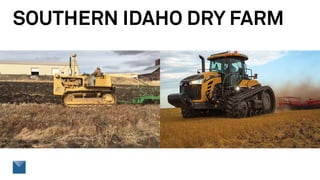
SOUTHERN IDAHO DRY FARM
MANAGING IRRIGATION
WHEN TO TURN WATER ON & OFF
What we need
• Knowledge of if and how much water is available to plants
• Information at the same scale as the ability to control the water (# of valves)
What we have
• Measurements of water in the field
• Drone data
• Satellite products
Next steps
• Combine them to extract key information from each, drive overall knowledge
Challenge
• How are these scales connected and does combining them provide meaningful
results?
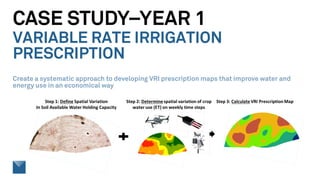
CASE STUDY–YEAR 1
VARIABLE RATE IRRIGATION
PRESCRIPTION
Create a systematic approach to developing VRI prescription maps that improve water and
energy use in an economical way
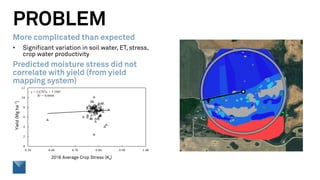
PROBLEM
More complicated than expected
• Significant variation in soil water, ET, stress,
crop water productivity
Predicted moisture stress did not
correlate with yield (from yield
mapping system)
Yield(Mgha-1)
2016 Average Crop Stress (Ks)
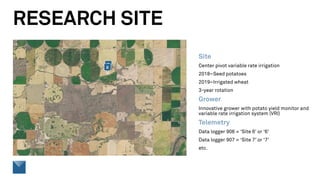
RESEARCH SITE
Site
Center pivot variable rate irrigation
2018–Seed potatoes
2019–Irrigated wheat
3-year rotation
Grower
Innovative grower with potato yield monitor and
variable rate irrigation system (VRI)
Telemetry
Data logger 906 = ‘Site 6’ or ‘6’
Data logger 907 = ‘Site 7’ or ‘7’
etc.
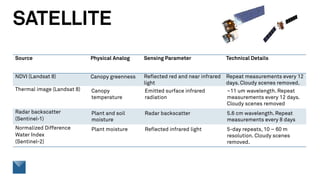
SATELLITE
Source Physical Analog Sensing Parameter Technical Details
NDVI (Landsat 8) Canopy greenness Reflected red and near infrared
light
Repeat measurements every 12
days. Cloudy scenes removed.
Thermal image (Landsat 8) Canopy
temperature
Emitted surface infrared
radiation
~11 um wavelength. Repeat
measurements every 12 days.
Cloudy scenes removed
Radar backscatter
(Sentinel-1)
Plant and soil
moisture
Radar backscatter 5.6 cm wavelength. Repeat
measurements every 8 days
Normalized Difference
Water Index
(Sentinel-2)
Plant moisture Reflected infrared light 5-day repeats, 10 – 60 m
resolution. Cloudy scenes
removed.
QUICK FIELD
DEPLOYMENT
Sensor auto-recognition
Bluetooth smartphone setup
Integrated solar panel
GPS location data
Cloud-enabled via cellular
network
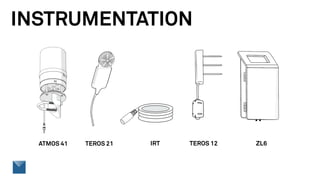
INSTRUMENTATION
ZL6TEROS 21 TEROS 12ATMOS 41 IRT
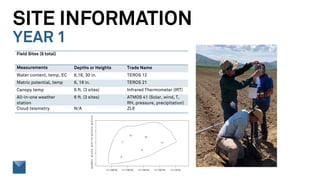
SITE INFORMATION
YEAR 1
Field Sites (6 total)
Measurements Depths or Heights Trade Name
Water content, temp, EC 6,18, 30 in. TEROS 12
Matric potential, temp 6, 18 in. TEROS 21
Canopy temp 6 ft. (3 sites) Infrared Thermometer (IRT)
All-in-one weather
station
6 ft. (3 sites) ATMOS 41 (Solar, wind, T,
RH, pressure, precipitation)
Cloud telemetry N/A ZL6
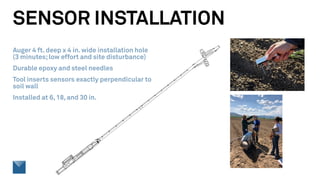
SENSOR INSTALLATION
Auger 4 ft. deep x 4 in.wide installation hole
(3 minutes;low effort and site disturbance)
Durable epoxy and steel needles
Tool inserts sensors exactly perpendicular to
soil wall
Installed at 6, 18, and 30 in.
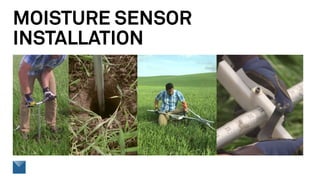
MOISTURE SENSOR
INSTALLATION
MOISTURE SENSOR
INSTALLATION
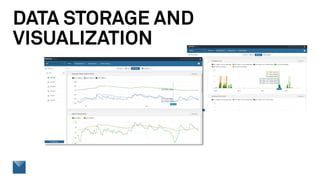
DATA STORAGE AND
VISUALIZATION
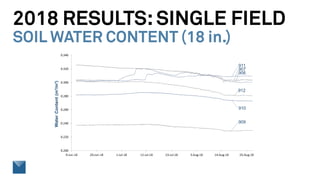
2018 RESULTS:SINGLE FIELD
SOIL WATER CONTENT (18 in.)
2018 RESULTS:SINGLE FIELD
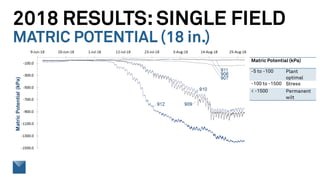
MATRIC POTENTIAL (18 in.)
Matric Potential (kPa)
-5 to -100 Plant
optimal
-100 to -1500 Stress
< -1500 Permanent
wilt
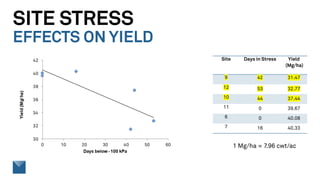
SITE STRESS
EFFECTS ON YIELD
1 Mg/ha = 7.96 cwt/ac
Site Days in Stress Yield
(Mg/ha)
9 42 31.47
12 53 32.77
10 44 37.44
11 0 39.67
6 0 40.08
7 16 40.33
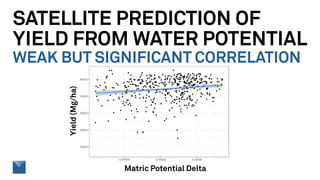
SATELLITE PREDICTION OF
YIELD FROM WATER POTENTIAL
WEAK BUT SIGNIFICANT CORRELATION
Yield(Mg/ha)
Matric Potential Delta
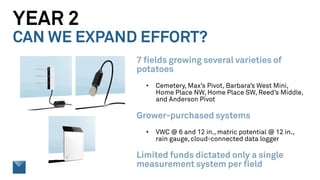
YEAR 2
CAN WE EXPAND EFFORT?
7 fields growing several varieties of
potatoes
• Cemetery, Max’s Pivot, Barbara’s West Mini,
Home Place NW, Home Place SW, Reed’s Middle,
and Anderson Pivot
Grower-purchased systems
• VWC @ 6 and 12 in., matric potential @ 12 in.,
rain gauge, cloud-connected data logger
Limited funds dictated only a single
measurement system per field
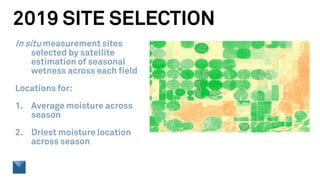
2019 SITE SELECTION
In situ measurement sites
selected by satellite
estimation of seasonal
wetness across each field
Locations for:
1. Average moisture across
season
2. Driest moisture location
across season
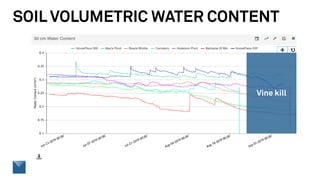
SOIL VOLUMETRIC WATER CONTENT
Vine kill
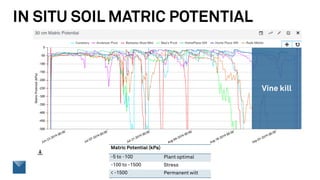
IN SITU SOIL MATRIC POTENTIAL
Vine kill
Matric Potential (kPa)
-5 to -100 Plant optimal
-100 to -1500 Stress
< -1500 Permanent wilt
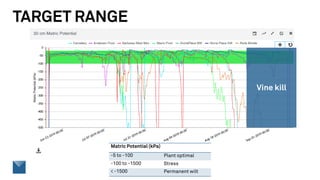
TARGET RANGE
Vine kill
Matric Potential (kPa)
-5 to -100 Plant optimal
-100 to -1500 Stress
< -1500 Permanent wilt
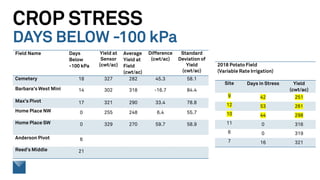
CROP STRESS
DAYS BELOW -100 kPa
2018 Potato Field
(Variable Rate Irrigation)
Site Days in Stress Yield
(cwt/ac)
9 42 251
12 53 261
10 44 298
11 0 316
6 0 319
7 16 321
Field Name Days
Below
-100 kPa
Yield at
Sensor
(cwt/ac)
Average
Yield at
Field
(cwt/ac)
Difference
(cwt/ac)
Standard
Deviation of
Yield
(cwt/ac)
Cemetery 18 327 282 45.3 58.1
Barbara's West Mini 14 302 318 -16.7 84.4
Max’s Pivot 17 321 290 33.4 78.8
Home Place NW 0 255 248 6.4 55.7
Home Place SW 0 329 270 59.7 58.9
Anderson Pivot 6
Reed’s Middle 21
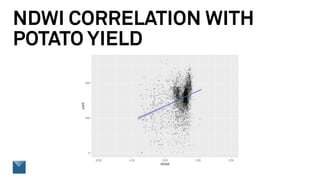
NDWI CORRELATION WITH
POTATO YIELD
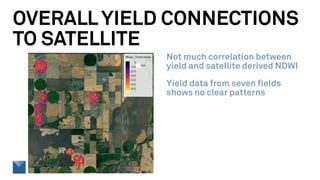
OVERALLYIELD CONNECTIONS
TO SATELLITE
Not much correlation between
yield and satellite derived NDWI
Yield data from seven fields
shows no clear patterns
GROWER FEEDBACK
Looked at data on ZENTRA Cloud every day!
Much lower water use
• Typical year: 20 to 25 in of water
• This year: 17.5 to 19 in. of water
• Note: cooler year – need verification from ET analysis
Potato ‘average’ sites–right on average
• Dug potatoes at typically dry spot and typically wet spot along with measured
location
• Always close to average of the field, like yield map finding
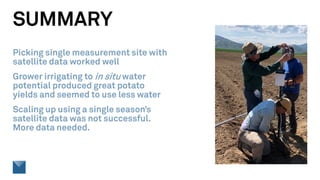
SUMMARY
Picking single measurement site with
satellite data worked well
Grower irrigating to in situ water
potential produced great potato
yields and seemed to use less water
Scaling up using a single season’s
satellite data was not successful.
More data needed.
QUESTIONS?

Predictable Yields Using Remote and Field Monitoring

  • 2.
    PREDICTABLE YIELDS USING REMOTE& FIELD MONITORING Colin S. Campbell1,2, Bryan G. Hopkins3, Neil C. Hansen3, Ryan G. Smith4, Florian Detsch1, Tim Appelhans1, and Ryan Christiansen5 1METER Group, Inc., 2Washington State University, 3Brigham Young University, 4Missouri S&T University, 5BKR Farms
  • 3.
  • 4.
    MANAGING IRRIGATION WHEN TOTURN WATER ON & OFF What we need • Knowledge of if and how much water is available to plants • Information at the same scale as the ability to control the water (# of valves) What we have • Measurements of water in the field • Drone data • Satellite products Next steps • Combine them to extract key information from each, drive overall knowledge Challenge • How are these scales connected and does combining them provide meaningful results?
  • 5.
    CASE STUDY–YEAR 1 VARIABLERATE IRRIGATION PRESCRIPTION Create a systematic approach to developing VRI prescription maps that improve water and energy use in an economical way
  • 6.
    PROBLEM More complicated thanexpected • Significant variation in soil water, ET, stress, crop water productivity Predicted moisture stress did not correlate with yield (from yield mapping system) Yield(Mgha-1) 2016 Average Crop Stress (Ks)
  • 7.
    RESEARCH SITE Site Center pivotvariable rate irrigation 2018–Seed potatoes 2019–Irrigated wheat 3-year rotation Grower Innovative grower with potato yield monitor and variable rate irrigation system (VRI) Telemetry Data logger 906 = ‘Site 6’ or ‘6’ Data logger 907 = ‘Site 7’ or ‘7’ etc.
  • 8.
    SATELLITE Source Physical AnalogSensing Parameter Technical Details NDVI (Landsat 8) Canopy greenness Reflected red and near infrared light Repeat measurements every 12 days. Cloudy scenes removed. Thermal image (Landsat 8) Canopy temperature Emitted surface infrared radiation ~11 um wavelength. Repeat measurements every 12 days. Cloudy scenes removed Radar backscatter (Sentinel-1) Plant and soil moisture Radar backscatter 5.6 cm wavelength. Repeat measurements every 8 days Normalized Difference Water Index (Sentinel-2) Plant moisture Reflected infrared light 5-day repeats, 10 – 60 m resolution. Cloudy scenes removed.
  • 9.
    QUICK FIELD DEPLOYMENT Sensor auto-recognition Bluetoothsmartphone setup Integrated solar panel GPS location data Cloud-enabled via cellular network
  • 10.
  • 11.
    SITE INFORMATION YEAR 1 FieldSites (6 total) Measurements Depths or Heights Trade Name Water content, temp, EC 6,18, 30 in. TEROS 12 Matric potential, temp 6, 18 in. TEROS 21 Canopy temp 6 ft. (3 sites) Infrared Thermometer (IRT) All-in-one weather station 6 ft. (3 sites) ATMOS 41 (Solar, wind, T, RH, pressure, precipitation) Cloud telemetry N/A ZL6
  • 12.
    SENSOR INSTALLATION Auger 4ft. deep x 4 in.wide installation hole (3 minutes;low effort and site disturbance) Durable epoxy and steel needles Tool inserts sensors exactly perpendicular to soil wall Installed at 6, 18, and 30 in.
  • 13.
  • 14.
  • 15.
  • 16.
    2018 RESULTS:SINGLE FIELD SOILWATER CONTENT (18 in.)
  • 17.
    2018 RESULTS:SINGLE FIELD MATRICPOTENTIAL (18 in.) Matric Potential (kPa) -5 to -100 Plant optimal -100 to -1500 Stress < -1500 Permanent wilt
  • 18.
    SITE STRESS EFFECTS ONYIELD 1 Mg/ha = 7.96 cwt/ac Site Days in Stress Yield (Mg/ha) 9 42 31.47 12 53 32.77 10 44 37.44 11 0 39.67 6 0 40.08 7 16 40.33
  • 19.
    SATELLITE PREDICTION OF YIELDFROM WATER POTENTIAL WEAK BUT SIGNIFICANT CORRELATION Yield(Mg/ha) Matric Potential Delta
  • 20.
    YEAR 2 CAN WEEXPAND EFFORT? 7 fields growing several varieties of potatoes • Cemetery, Max’s Pivot, Barbara’s West Mini, Home Place NW, Home Place SW, Reed’s Middle, and Anderson Pivot Grower-purchased systems • VWC @ 6 and 12 in., matric potential @ 12 in., rain gauge, cloud-connected data logger Limited funds dictated only a single measurement system per field
  • 21.
    2019 SITE SELECTION Insitu measurement sites selected by satellite estimation of seasonal wetness across each field Locations for: 1. Average moisture across season 2. Driest moisture location across season
  • 22.
    SOIL VOLUMETRIC WATERCONTENT Vine kill
  • 23.
    IN SITU SOILMATRIC POTENTIAL Vine kill Matric Potential (kPa) -5 to -100 Plant optimal -100 to -1500 Stress < -1500 Permanent wilt
  • 24.
    TARGET RANGE Vine kill MatricPotential (kPa) -5 to -100 Plant optimal -100 to -1500 Stress < -1500 Permanent wilt
  • 25.
    CROP STRESS DAYS BELOW-100 kPa 2018 Potato Field (Variable Rate Irrigation) Site Days in Stress Yield (cwt/ac) 9 42 251 12 53 261 10 44 298 11 0 316 6 0 319 7 16 321 Field Name Days Below -100 kPa Yield at Sensor (cwt/ac) Average Yield at Field (cwt/ac) Difference (cwt/ac) Standard Deviation of Yield (cwt/ac) Cemetery 18 327 282 45.3 58.1 Barbara's West Mini 14 302 318 -16.7 84.4 Max’s Pivot 17 321 290 33.4 78.8 Home Place NW 0 255 248 6.4 55.7 Home Place SW 0 329 270 59.7 58.9 Anderson Pivot 6 Reed’s Middle 21
  • 26.
  • 27.
    OVERALLYIELD CONNECTIONS TO SATELLITE Notmuch correlation between yield and satellite derived NDWI Yield data from seven fields shows no clear patterns
  • 28.
    GROWER FEEDBACK Looked atdata on ZENTRA Cloud every day! Much lower water use • Typical year: 20 to 25 in of water • This year: 17.5 to 19 in. of water • Note: cooler year – need verification from ET analysis Potato ‘average’ sites–right on average • Dug potatoes at typically dry spot and typically wet spot along with measured location • Always close to average of the field, like yield map finding
  • 29.
    SUMMARY Picking single measurementsite with satellite data worked well Grower irrigating to in situ water potential produced great potato yields and seemed to use less water Scaling up using a single season’s satellite data was not successful. More data needed.
  • 30.