Education 4.0
Framework
Lydia T. Velunta, EdD
Public Schools District Supervisor
SCHOOLS DIVISION OF CITY OF SAN JOSE DEL MONTE
 depedcsjdm.weebly.com  sanjosedelmonte.city@deped.gov.ph  (044)307-3614
Session Objectives
• Provide the participants with the necessary knowledge and skills
to implement Education 4.0 framework and Innovation;
• Identify the benefits of Education 4.0 for students, teachers and
principals;
• Promote the use of Smart Schools/Classroom
• Identify the different types of Innovation
• Enumerate the DepEd Guidelines on Conducting a Project for
Innovation in School.
• Encourage & inspire the Teacher Innovator to conduct
Educational Innovation in School and their respective field of
study
EDUCATION 4.0
• Education 4.0 is desired approach to
learning that aligns itself with the emerging
Fourth Industrial Revolution (IR 4.0) and
focuses on transforming the future of
education through advanced technology
and automation.
Fourth
Industrial
Revolution
(IR 4.0)
Artificial
Intelligence
Robotics
Internet of
Things (IoT)
Cyber
Security
Fourth Industrial Revolution (IR 4.0)
“Our Work Immersion Program has
contributed to a high passing rate of 90
percent in the National Certificate
assessment administered by TESDA.
However, industry partners have
expressed concern that the time
allotment for work immersion is only for
familiarization and not for actual
skills acquisition.”
- Sara Z. Duterte
Vice President and Education Secretary
9 TRENDS RELATED
TO EDUCATION 4.0
9 Trends related to Education 4.0
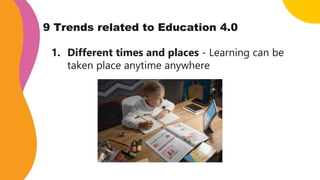
1. Different times and places - Learning can be
taken place anytime anywhere
9 Trends related to Education 4.0
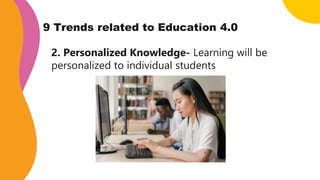
2. Personalized Knowledge- Learning will be
personalized to individual students
9 Trends related to Education 4.0
3. Free Choice- Students have a choice in determining
how they want to learn
9 Trends related to Education 4.0
4. Students will be exposed to more Project-based
Learning.
9 Trends related to Education 4.0
5. Familiarity in the
field - Students will be
exposed to more hands-
on learning through
field experience such as
internships, mentoring
projects and
collaborative projects.
9 Trends related to Education 4.0
6. Data Analysis -
Students will be
exposed to data
interpretation
9 Trends related to Education 4.0
7. New Pattern for
exams - Students
will be assessed
differently
9 Trends related to Education 4.0
8. Comprehensive
Approach - Students’
opinion will be
considered in
designing and
updating the
curriculum
9 Trends related to Education 4.0
9. Orientation is becoming more important -
Students will become more independent in their
own learning
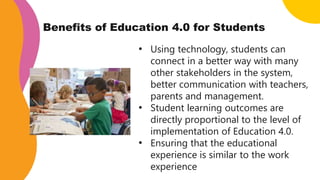
Benefits of Education 4.0 for Students
• Using technology, students can
connect in a better way with many
other stakeholders in the system,
better communication with teachers,
parents and management.
• Student learning outcomes are
directly proportional to the level of
implementation of Education 4.0.
• Ensuring that the educational
experience is similar to the work
experience
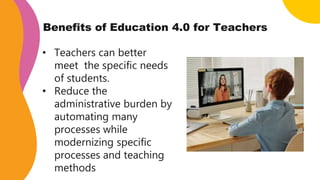
Benefits of Education 4.0 for Teachers
• Teachers can better
meet the specific needs
of students.
• Reduce the
administrative burden by
automating many
processes while
modernizing specific
processes and teaching
methods
Benefits of Education 4.0 for Principals and
School Leaders
• It gives them more time to focus on teaching,
learning, and creating an environment of inclusion
for all students.
• Less time spent on administrative tasks like record
keeping and more time available for planning
lessons or collaborating with colleagues
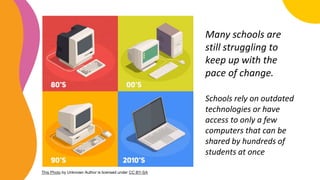
This Photo by Unknown Author is licensed under CC BY-SA
Many schools are
still struggling to
keep up with the
pace of change.
Schools rely on outdated
technologies or have
access to only a few
computers that can be
shared by hundreds of
students at once
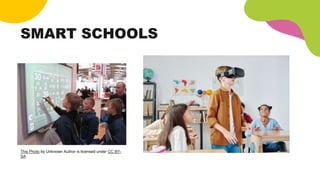
• Smart Schools are technologically
enhanced schools that deliver
students a better and more
effective educational experience.
• Unlike conventional school life, the
smart school concept makes use of
advanced technology and
equipment in classrooms to give
students a better learning
experience
SMART SCHOOLS
SMART SCHOOLS
This Photo by Unknown Author is licensed under CC BY-
SA
1. Easy Access to Online Information
• Data gathering any of their learning areas are
available at their fingertips.
• Access to Online Learning Resources to learn
more about the Learning areas
Benefits of Smart School
2. Digital Medium for Note-taking
• Students don’t need to carry heavy
textbooks to schools but just their
tab and digital pen.
• The Digital notes are easy to share
and so peers can make learning
more engaging by sharing their
personal notes on the subjects with
ease
Benefits of Smart School
3. A Smart Solution for Absentees
• In Smart Schools, you can record all
the lessons taught in the day.
• Even if a student falls sick and
missed out on a couple of lessons,
they have access to the recording
that they can fall back on and keep
with their studies
Benefits of Smart School
4. Interactive Learning Experience
• The teaching system and the tools
used in the school will encourage
students to be more interactive in
the school and participate more in
the learning experience, increasing
knowledge retention on a great
scale
Benefits of Smart School
5. Dynamic Perspective to Learning
• Smart classroom enables to have customized
learning experience
• Teachers will also be able to help all the
struggling students in their academics without
missing out anyone which usually happens in
traditional schools due to time restrictions
Benefits of Smart School
INNOVATION IN
EDUCATION
Innovation in Education
• Innovation is based on the creation or redesign of
products, processes, or entrepreneurial models for
the benefit of an organization
• Innovation in education is similarly focused on
making positive changes, but in this case, these
changes will directly benefit a classroom, school,
district, division, or even an organization’s training
and learning practices
INNOVATION
Curriculum/Instructio
nal Materials
Teaching
Strategy
Simplification
of Work
School
Improvement
Income
Generating
Project
Types of Innovative Projects
1. Innovation on Curriculum/Instructional
Material - This is a result of a match development
process what's principal products are often text-
based teaching are you learning material and
resources, that could be in the form of student
learning activities, workbook, skill book, resource
book, teaching devices, educational games,
manipulative, an interactive materials etc.
Types of Innovative Projects
2. Innovation on Teaching Strategy - This is a
process of systematically looking at effective
teaching strategy that is suited for appropriate to
specific learning content whose outcomes can be
measured in terms of increase in pupil achievement
level. it can be approach, teaching techniques or
method.
Types of Innovative Projects
3. Innovation on the Simplification of Work –
This is the process of creatively improving
the procedure and introducing a new
mechanism that result in cost reduction ,
time saving, makes task lighter and simpler.
Introduced techniques can be reporting
system, record keeping and other office
procedures.
Types of Innovative Projects
4. Income Generating Project – This is any
collaborative enterprise of students with the
assistance of parents and teacher-advisers.
IGP it's carefully planned to generate income
and achieve a particular aim or target,
leading to a solution of a perceived problem.
Types of Innovative Projects
5. Innovation on School Improvement
– This is done to improve programs , procedures and
physical aspect all schools that will enhance access,
quality and governance. this is not funded under
GPTA/HPTA, DepEd, LGUEs and other
stakeholders/partners in Education. fundraising and
other money-making contests are not allowed in the
process.
Implementing Guidelines for
Innovation Project
SDM No. 437, s 2021
1. The proposed project is aligned with DepEd
thrusts and contributory to the attainment of the
Department’s Vision and Mission.
2. The proponent must present the reasons for the
project, and what needs or problems he/she
wants to solve/address and innovate.
3. The proposed project must be qualified to
benefit the learners and other school
stakeholders.
Implementing Guidelines for
Innovation Project
SDM No. 437, s 2021
4. The proposed project must have a realistic
management plan and the resources needed to complete
the project within a calendar year.
5. If it is an infrastructure project, the proponent must
present or include a layout/ project design in her/his
project proposal. Ex: the establishment of solar panel,
windmill, e-library.
6. Sources of a fund to sustain the project must be in the
form of donations, income generating project (IGP), etc. It
should not be taken from the school MOOE fund.
Implementing Guidelines for
Innovation Project
SDM No. 437, s 2021
4. The proposed project must have a realistic
management plan and the resources needed to complete
the project within a calendar year.
5. If it is an infrastructure project, the proponent must
present or include a layout/ project design in her/his
project proposal. Ex: the establishment of solar panel,
windmill, e-library.
6. Sources of a fund to sustain the project must be in the
form of donations, income generating project (IGP), etc. It
should not be taken from the school MOOE fund.
Implementing Guidelines for
Innovation Project
SDM No. 437, s 2021
7. Solicitation is prohibited.
8. The proponent must show proof of donation,
MOA, or any evidence of the project’s sourcing.
9. When the project is already complete, the
project evaluators will monitor the project again
and will issue an evaluation form showing that the
project is already finished. The evaluation should be
a requisite for the approval of the final report.
Implementing Guidelines for
Innovation Project
SDM No. 437, s 2021
10. While the project is ongoing, the project
evaluators will come and visit to monitor the
status of implementation.
11. Different Evaluation Tools will be used
per critical stage to ensure quality assurance
12. The project must have a provision for
sustainability and replicability
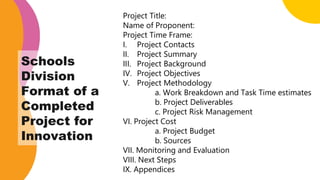
Project Title:
Name of Proponent:
Project Time Frame:
I. Project Contacts
II. Project Summary
III. Project Background
IV. Project Objectives
V. Project Methodology
a. Work Breakdown and Task Time estimates
b. Project Deliverables
c. Project Risk Management
VI. Project Cost
a. Project Budget
b. Sources
VII. Monitoring and Evaluation
VIII. Next Steps
IX. Appendices
Schools
Division
Format of a
Completed
Project for
Innovation
References
Halili, S. H. (2019). Technological advancements in education 4.0. The Online Journal of
Distance Education and e-Learning, 7(1), 63-69.
Hussin, A. A. (2018). Education 4.0 made simple: Ideas for teaching. International Journal
of Education and Literacy Studies, 6(3), 92-98.
Moid, S. (2020). Education 4.0: Future of Learning With Disruptive Technologies. In
Promoting Inclusive Growth in the Fourth Industrial Revolution (pp. 181-200). IGI Global.
Naveen J. (2022). Understanding Education 4.0: The Machine Learning-Driven Future Of
Learning, https://www.forbes.com/sites/naveenjoshi/2022/03/31/understanding-
education-40-the-machine-learning-driven-future-of-learning/?sh=3ad9aa45bc2d
Sharma, P. (2019). Digital revolution of education 4.0.
Tuscano, J, (2021). 2021 Quezon Tech4ED Webinar Series # 8: Education 4.0:
Transforming the Future of Education, https://www.youtube.com/watch?v=5Iy3B00NF-E

Education 4.0.pptx

  • 1.
    Education 4.0 Framework Lydia T.Velunta, EdD Public Schools District Supervisor SCHOOLS DIVISION OF CITY OF SAN JOSE DEL MONTE  depedcsjdm.weebly.com  sanjosedelmonte.city@deped.gov.ph  (044)307-3614
  • 2.
    Session Objectives • Providethe participants with the necessary knowledge and skills to implement Education 4.0 framework and Innovation; • Identify the benefits of Education 4.0 for students, teachers and principals; • Promote the use of Smart Schools/Classroom • Identify the different types of Innovation • Enumerate the DepEd Guidelines on Conducting a Project for Innovation in School. • Encourage & inspire the Teacher Innovator to conduct Educational Innovation in School and their respective field of study
  • 4.
    EDUCATION 4.0 • Education4.0 is desired approach to learning that aligns itself with the emerging Fourth Industrial Revolution (IR 4.0) and focuses on transforming the future of education through advanced technology and automation.
  • 5.
  • 6.
  • 7.
    “Our Work ImmersionProgram has contributed to a high passing rate of 90 percent in the National Certificate assessment administered by TESDA. However, industry partners have expressed concern that the time allotment for work immersion is only for familiarization and not for actual skills acquisition.” - Sara Z. Duterte Vice President and Education Secretary
  • 8.
    9 TRENDS RELATED TOEDUCATION 4.0
  • 9.
    9 Trends relatedto Education 4.0 1. Different times and places - Learning can be taken place anytime anywhere
  • 10.
    9 Trends relatedto Education 4.0 2. Personalized Knowledge- Learning will be personalized to individual students
  • 11.
    9 Trends relatedto Education 4.0 3. Free Choice- Students have a choice in determining how they want to learn
  • 12.
    9 Trends relatedto Education 4.0 4. Students will be exposed to more Project-based Learning.
  • 13.
    9 Trends relatedto Education 4.0 5. Familiarity in the field - Students will be exposed to more hands- on learning through field experience such as internships, mentoring projects and collaborative projects.
  • 14.
    9 Trends relatedto Education 4.0 6. Data Analysis - Students will be exposed to data interpretation
  • 15.
    9 Trends relatedto Education 4.0 7. New Pattern for exams - Students will be assessed differently
  • 16.
    9 Trends relatedto Education 4.0 8. Comprehensive Approach - Students’ opinion will be considered in designing and updating the curriculum
  • 17.
    9 Trends relatedto Education 4.0 9. Orientation is becoming more important - Students will become more independent in their own learning
  • 18.
    Benefits of Education4.0 for Students • Using technology, students can connect in a better way with many other stakeholders in the system, better communication with teachers, parents and management. • Student learning outcomes are directly proportional to the level of implementation of Education 4.0. • Ensuring that the educational experience is similar to the work experience
  • 19.
    Benefits of Education4.0 for Teachers • Teachers can better meet the specific needs of students. • Reduce the administrative burden by automating many processes while modernizing specific processes and teaching methods
  • 20.
    Benefits of Education4.0 for Principals and School Leaders • It gives them more time to focus on teaching, learning, and creating an environment of inclusion for all students. • Less time spent on administrative tasks like record keeping and more time available for planning lessons or collaborating with colleagues
  • 21.
    This Photo byUnknown Author is licensed under CC BY-SA Many schools are still struggling to keep up with the pace of change. Schools rely on outdated technologies or have access to only a few computers that can be shared by hundreds of students at once
  • 22.
    • Smart Schoolsare technologically enhanced schools that deliver students a better and more effective educational experience. • Unlike conventional school life, the smart school concept makes use of advanced technology and equipment in classrooms to give students a better learning experience SMART SCHOOLS
  • 23.
    SMART SCHOOLS This Photoby Unknown Author is licensed under CC BY- SA
  • 24.
    1. Easy Accessto Online Information • Data gathering any of their learning areas are available at their fingertips. • Access to Online Learning Resources to learn more about the Learning areas Benefits of Smart School
  • 25.
    2. Digital Mediumfor Note-taking • Students don’t need to carry heavy textbooks to schools but just their tab and digital pen. • The Digital notes are easy to share and so peers can make learning more engaging by sharing their personal notes on the subjects with ease Benefits of Smart School
  • 26.
    3. A SmartSolution for Absentees • In Smart Schools, you can record all the lessons taught in the day. • Even if a student falls sick and missed out on a couple of lessons, they have access to the recording that they can fall back on and keep with their studies Benefits of Smart School
  • 27.
    4. Interactive LearningExperience • The teaching system and the tools used in the school will encourage students to be more interactive in the school and participate more in the learning experience, increasing knowledge retention on a great scale Benefits of Smart School
  • 28.
    5. Dynamic Perspectiveto Learning • Smart classroom enables to have customized learning experience • Teachers will also be able to help all the struggling students in their academics without missing out anyone which usually happens in traditional schools due to time restrictions Benefits of Smart School
  • 29.
  • 30.
    Innovation in Education •Innovation is based on the creation or redesign of products, processes, or entrepreneurial models for the benefit of an organization • Innovation in education is similarly focused on making positive changes, but in this case, these changes will directly benefit a classroom, school, district, division, or even an organization’s training and learning practices
  • 31.
  • 32.
    Types of InnovativeProjects 1. Innovation on Curriculum/Instructional Material - This is a result of a match development process what's principal products are often text- based teaching are you learning material and resources, that could be in the form of student learning activities, workbook, skill book, resource book, teaching devices, educational games, manipulative, an interactive materials etc.
  • 33.
    Types of InnovativeProjects 2. Innovation on Teaching Strategy - This is a process of systematically looking at effective teaching strategy that is suited for appropriate to specific learning content whose outcomes can be measured in terms of increase in pupil achievement level. it can be approach, teaching techniques or method.
  • 34.
    Types of InnovativeProjects 3. Innovation on the Simplification of Work – This is the process of creatively improving the procedure and introducing a new mechanism that result in cost reduction , time saving, makes task lighter and simpler. Introduced techniques can be reporting system, record keeping and other office procedures.
  • 35.
    Types of InnovativeProjects 4. Income Generating Project – This is any collaborative enterprise of students with the assistance of parents and teacher-advisers. IGP it's carefully planned to generate income and achieve a particular aim or target, leading to a solution of a perceived problem.
  • 36.
    Types of InnovativeProjects 5. Innovation on School Improvement – This is done to improve programs , procedures and physical aspect all schools that will enhance access, quality and governance. this is not funded under GPTA/HPTA, DepEd, LGUEs and other stakeholders/partners in Education. fundraising and other money-making contests are not allowed in the process.
  • 37.
    Implementing Guidelines for InnovationProject SDM No. 437, s 2021 1. The proposed project is aligned with DepEd thrusts and contributory to the attainment of the Department’s Vision and Mission. 2. The proponent must present the reasons for the project, and what needs or problems he/she wants to solve/address and innovate. 3. The proposed project must be qualified to benefit the learners and other school stakeholders.
  • 38.
    Implementing Guidelines for InnovationProject SDM No. 437, s 2021 4. The proposed project must have a realistic management plan and the resources needed to complete the project within a calendar year. 5. If it is an infrastructure project, the proponent must present or include a layout/ project design in her/his project proposal. Ex: the establishment of solar panel, windmill, e-library. 6. Sources of a fund to sustain the project must be in the form of donations, income generating project (IGP), etc. It should not be taken from the school MOOE fund.
  • 39.
    Implementing Guidelines for InnovationProject SDM No. 437, s 2021 4. The proposed project must have a realistic management plan and the resources needed to complete the project within a calendar year. 5. If it is an infrastructure project, the proponent must present or include a layout/ project design in her/his project proposal. Ex: the establishment of solar panel, windmill, e-library. 6. Sources of a fund to sustain the project must be in the form of donations, income generating project (IGP), etc. It should not be taken from the school MOOE fund.
  • 40.
    Implementing Guidelines for InnovationProject SDM No. 437, s 2021 7. Solicitation is prohibited. 8. The proponent must show proof of donation, MOA, or any evidence of the project’s sourcing. 9. When the project is already complete, the project evaluators will monitor the project again and will issue an evaluation form showing that the project is already finished. The evaluation should be a requisite for the approval of the final report.
  • 41.
    Implementing Guidelines for InnovationProject SDM No. 437, s 2021 10. While the project is ongoing, the project evaluators will come and visit to monitor the status of implementation. 11. Different Evaluation Tools will be used per critical stage to ensure quality assurance 12. The project must have a provision for sustainability and replicability
  • 42.
    Project Title: Name ofProponent: Project Time Frame: I. Project Contacts II. Project Summary III. Project Background IV. Project Objectives V. Project Methodology a. Work Breakdown and Task Time estimates b. Project Deliverables c. Project Risk Management VI. Project Cost a. Project Budget b. Sources VII. Monitoring and Evaluation VIII. Next Steps IX. Appendices Schools Division Format of a Completed Project for Innovation
  • 45.
    References Halili, S. H.(2019). Technological advancements in education 4.0. The Online Journal of Distance Education and e-Learning, 7(1), 63-69. Hussin, A. A. (2018). Education 4.0 made simple: Ideas for teaching. International Journal of Education and Literacy Studies, 6(3), 92-98. Moid, S. (2020). Education 4.0: Future of Learning With Disruptive Technologies. In Promoting Inclusive Growth in the Fourth Industrial Revolution (pp. 181-200). IGI Global. Naveen J. (2022). Understanding Education 4.0: The Machine Learning-Driven Future Of Learning, https://www.forbes.com/sites/naveenjoshi/2022/03/31/understanding- education-40-the-machine-learning-driven-future-of-learning/?sh=3ad9aa45bc2d Sharma, P. (2019). Digital revolution of education 4.0. Tuscano, J, (2021). 2021 Quezon Tech4ED Webinar Series # 8: Education 4.0: Transforming the Future of Education, https://www.youtube.com/watch?v=5Iy3B00NF-E

Editor's Notes

  • #4 Before we get start with our session, I just want to give you an inspirational message from Herbert Spencer, The Great aim of Education is not knowledge, but action. It means that education is not a preparation for life, but an opportunity to make the most of life. It means that education should train us in all the things that are necessary to discover, accomplish and enjoy what lies within our reach. It means also that education is not the accumulation of facts and information, but rather equipping students with the tools and skills needed to be successful. In an age when technology is advancing at a rapid pace, it’s important that we equip our students with the 21st-century skills they need to become productive members of society.
  • #5 Education 4.0 is desired approach to learning that aligns itself with the emerging Fourth Industrial Revolution (IR 4.0) and focuses on transforming the future of education through advanced technology and automation. This means that Education 4.0 promotes education differently, mainly by consuming technology-based tools and resources. This means that students will not learn to use textbooks, pens, and essay teachers in traditional classrooms. Instead, Education 4.0 allows remote students to access the Internet and enroll in courses through a variety of open online courses, video chats, or voice calls to learn more dynamic material about the same students. You may not learn as much as you do.
  • #6 Innovation and technology development are widespread in such fields as artificial intelligence, robotics, the Internet of Things, autonomous vehicles, biotechnology and nanotechnology, 3D printing, materials science, cloud computing, and energy storage; all of which now impact our everyday lives. These discoveries were so fast that the fourth industrial revolution had formed, which almost confused almost every sector. Thus Education 4.0 is developed for Industry 4.0 and prepares qualified and qualified professionals to prepare for a very global and digital work environment.
  • #7 The Fourth Industrial Revolution is a time of rapid change and disruption, in which the old order of things is being transformed by new technologies. These changes are not only affecting our lives, but also the way we educate students to make them ready for this new world. Industry 4.0 follows three previous technological transformations: steam power, which was the transforming power of the 19th century; electricity that transformed for most of the twentieth century and the era of the computer era of the 70’s. These discoveries were so fast that the fourth industrial revolution had formed, which almost confused almost every sector
  • #8 Through Basic Education Report 2023, Vice President and Education Secretary Sara Duterte on Monday, Jan. 30, presented the “current state” challenges faced by the Department of Education (DepEd) when it comes to the delivery of basic education among Filipino learners. And one of the things discussed was the issue with the SHS graduates. Based on the Basic Education report 2023 in Senior High School, our work immersion program has contributed to a high passing rate of 90 percent in the National Certificate assessment administered by TESDA. However, industry partners have expressed concern that the time allotment for work immersion is only for familiarization and not for actual skills acquisition. This means that the students are only exposed to the working environment and not trained on how to do certain tasks. To address this concern, we need to rethink the curriculum and make it more hands-on. We should also provide our students with additional training so that they can be fully competent when they graduate from our program. Since The fourth industrial revolution (RI 4.0) brought about a state of change in education, schools must prepare their students for a world where these cyber-physical systems are prevalent across all industries.
  • #9 As technology is rapidly changing the world around us, many people worry that technology will replace human intelligence. Here are the 9 trends related to Education 4.0
  • #10  There are nine trends related to Education 4.0 First, learning can be taken place anytime anywhere. Students will get the more prospects to study virtually in numerous places. Online learning tools offer opportunities for distance learning and the pace of each. The class is twisted creatively. In other words, the students can learn theoretical part outside the classroom and the actual part can be learn face-to-face and interactively manner. This means that students can learn at their own pace and have more time for hands-on experience and projects. Additionally, the role of teachers is changing. Teachers are becoming more like coaches and mentors than lecturers. They will help students to develop critical thinking skills and encourage them to learn by doing.
  • #11 Second, learning will be personalized to individual students. They will be introduced to harder tasks only after a certain mastery level is achieved. More practices will be provided if the instructors see a need in it. Positive reinforcements are used to promote positive learning experience and boost students’ confidence about their own academic abilities.
  • #12  Third, students have a choice in determining how they want to learn. Although the learning outcomes of a subject are preset by the institutions/bodies in charge of the curriculum, students are still free to choose the learning tools or techniques that they prefer. Among the options that lecturers can adopt to enable students to be creative in their learning are blended learning, flipped classroom and BYOD (Bring Your Own Device) approach.
  • #13 Fourth, students will be exposed to more project-based learning. Students adapt to project-based learning and work when their careers coincide with the future of the free economy. This means that you have to learn how to apply the technology in different short-term situations. Students should be familiar with the training in high school projects. These are the building blocks of organizational skills, collaboration, and time management that all students can study.
  • #14 Fifth, students will be exposed to more hands-on learning through field experience such as internships, mentoring projects and collaborative projects. The advancement of the technology enables the learning of certain domains effectively, thus making more room for acquiring skills that involve human knowledge and face-to-face interaction. This means that students will be able to learn more about their subjects and the world around them. The advancement of technology also allows students to collaborate with each other or with professionals in the field online. Because technology can improve efficiency in some areas, this process provides the skills that only human knowledge and face-to-face contact need. That is why this course emphasizes on-the-spot experience. The school offers students the opportunity to acquire practical skills that represent their work. In short, this course will create more space for students to undertake internships, mentoring projects and collaborative projects (such as projects).
  • #15 Sixth, students will be exposed to data interpretation in which they are required to apply their theoretical knowledge to numbers and use their reasoning skills to make inferences based on logic and trends from given sets of data. Mathematics is considered one of three types of literature, but in the near future, the passive components of this culture will not be relevant. The computer quickly processes each statistical test, describes and analyses the data, and predicts future trends. As a result, human interpretations of this data will become more important parts of future programs. Applying theoretical knowledge to numbers and using human reasoning to capture the logic and trends of these data is a key aspect of this ability This only means that students will be able to spend more time on the creative part of mathematical literacy such as problem solving, critical thinking and investigation skills. Furthermore, students will be exposed to higher levels of abstraction as they are required to think outside the box and see the big picture.
  • #16 Seventh, students will be assessed differently and the conventional platforms to assess students may become irrelevant or insufficient. While the course platform assesses students' abilities at each stage, it may be too much or not enough to measure skills based on questions and answers. Many people believe that exams are designed to help complete student materials and forget about exams the next day. Educators fear that exams may not effectively measure the skills students should acquire when they get their first job. The actual knowledge of the students can be measured in the learning process, which improves the testing of knowledge applications when working on field projects Students’ factual knowledge can be assessed during the learning process, while the application of the knowledge can be tested when they are working on their projects in the field.
  • #17 Eighth, students’ opinion will be considered in designing and updating the curriculum. Their inputs help the curriculum designers maintain curriculum contemporariness, up-to-date and usefulness. Meaning that students will Meaning that students will be included in the decision-making process of curriculum development, and it will help the teachers to understand the students’ expectations and needs. It is important to note that the students’ involvement in curriculum development will not only help them learn more about the subject, but it will also give them an opportunity to be involved in an exciting and meaningful learning experience.
  • #18 Lastly, students will become more independent in their own learning, thus forcing teachers to assume a new role as facilitators who will guide the students through their learning process. It is important that in Education 4.0, teachers should be able to provide personalized learning that is relevant to the individual student and their needs. This will allow students to develop critical thinking skills and become more independent learners. In conclusion, Education 4.0 will change the way of teaching and learning forever. It is important that we prepare our students for the future by providing them with the necessary tools and skills they need to succeed in an ever-changing world. The nine trends of Education 4.0 shift the major learning responsibilities from the teachers to the learners. Instructors should play their roles to support the transition and should never consider it a threat to the conventional teaching profession.
  • #19 This is the most important goal of Education 4.0 for all educational institutions: to encourage students and improve students' learning outcomes. Students are the main stakeholders of the educational ecosystem and are the main beneficiaries of the educational ecosystem. Education 4.0 treats students as beneficiaries as before. Using technology, students can connect in a better way with many other stakeholders in the system, better communication with teachers, parents and management. Student learning outcomes are directly proportional to the level of implementation of Education 4.0. Thus, it helps improve learning as most of the tools and methods that support Education 4.0 will help you learn more effectively and effectively than traditional teaching methods. Ensuring that the educational experience is similar to the work experience. This means that Education 4.0 is a more realistic and practical learning method, which can produce excellent results for student learning. Generally, it allows students to achieve better learning outcomes based on real scientific or professional interests
  • #20 Education 4.0 is a smart, virtual and digital revolution for the benefit of many stakeholders, including teachers and educators. Teachers may think that the Education 4.0 personalized learning philosophy will give more work, but it is not. In contrast, Education 4.0 is beneficial for school teachers and educators in educational institutions for the reason that they can better meet the specific needs of students. Education 4.0 permits teachers and educators by providing best methods & techniques to facilitate work. School management systems allow teachers to communicate better with students, but do it more effectively and quickly. Reduce the administrative burden by automating many processes while modernizing specific processes and teaching methods. Education 4.0 aims to improve performance by enhancing teacher skills and improving student learning outcomes
  • #21 The benefits of Education 4.0 for principals and school leaders are numerous. As the world’s education system continues to evolve, it becomes increasingly important for administrators to embrace new technologies that can help them keep up with the ever-changing landscape of learning—or even lead it. It gives them more time to focus on teaching, learning, and creating an environment of inclusion for all students. With the right technology infrastructure in place, educators can use their time more efficiently and effectively. That means less time spent on administrative tasks like record keeping and more time available for planning lessons or collaborating with colleagues
  • #22 Now, more than ever before, educators are turning to technology to help them better serve the needs of their students. But when it comes down to choosing the right tools for the job, many schools find themselves at a loss. They don’t know where or how. The problem is that many schools are still struggling to keep up with the pace of change. They rely on outdated technologies or have access to only a few computers that can be shared by hundreds of students at once. This often means that teachers and administrators spend their time doing things like tracking attendance, managing classroom schedules, and collecting homework assignments rather than focusing on what really matters: educating kids. To address this problem, many schools are turning to digital solutions. But as you might expect, it’s not always easy for educators to find the right tools for their needs. In this guide, we’ll take a look at some of the most common problems faced by schools today and how technology can help solve them. The right technology infrastructure can also help administrators make the most of their budgets. When they don’t have to spend money on expensive hardware or software, they can allocate more of those funds toward educational initiatives like professional development opportunities for teachers or new curricula that engage students.
  • #23 Smart Schools are technologically enhanced schools that deliver students a better and more effective educational experience. Unlike conventional school life, the smart school concept makes use of advanced technology and equipment in classrooms to give students a better learning experience The smart school concept aims to equip students with the necessary knowledge and skills they need to thrive in a rapidly changing world. The idea is that by using modern technology, teachers can improve their effectiveness and efficiency while also helping students learn more effectively. Smart Schools are equipped with the latest technology, such as interactive whiteboards, wireless networks and computer labs. They also have access to a variety of educational software programs and applications that allow students to learn new skills in a fun, but professional manner.
  • #24 Smart Schools are equipped with the latest technology, such as interactive whiteboards, wireless networks and computer labs. They also have access to a variety of educational software programs and applications that allow students to learn new skills in a fun, but professional manner.
  • #25 1. Easy Access to Online Information As a smart school incorporates various gadgets with internet connection such as mobiles, tabs, and and laptops, students can easily access online information Data gathering any of their learning areas are available at their fingertips. Both teacher and students can Access to Online Learning Resources to learn more about the Learning areas rather than just what is in the syllabus to get the better understanding of the lessons.
  • #26 2. Digital Medium for Note-taking Students can save a lot of their learning time by making use of the digital medium for note-taking. Students don’t need to carry heavy textbooks to schools but just their tab and digital pen. The Digital notes are easy to share and so peers can make learning more engaging by sharing their personal notes on the subjects with ease. It is important to note that the digital medium is not only useful for students but also for teachers. Teachers can use this medium to share their lessons with other educators in order to improve their teaching methods and techniques. The Digital technology has made it possible for students and teachers to access a wide range of resources and learning materials from anywhere in the world at any time.
  • #27 2. Digital Medium for Note-taking In Smart Schools, you can record all the lessons taught in the day. Even if a student falls sick and missed out on a couple of lessons, they have access to the recording that they can fall back on and keep with their studies It means that teachers don’t have to worry about their students missing out on lessons.
  • #28 Another major benefit of a smart school is that it makes the teaching environment much more interactive. the teaching system and the tools used in the school will encourage students to be more interactive in the school and participate more in the learning experience, increasing knowledge retention on a great scale with fun quizzes, online tests, group activities and more, the technology will give all the students a role to play in a classroom thus increasing the bond between the students and the teacher and among fellow students the technology enables students and teachers to communicate even outside the school via emails and other special communication platforms the school uses .
  • #29 Dynamic Perspective to Learning One of the main benefits of smart classroom enables to have customized learning experience. with this, teachers will also be able to help all the struggling students in their academics without missing out anyone which usually happens in traditional schools due to time restrictions. It is important that students have a personalized learning experience because they can learn better at their own pace which is helpful in improving their academic results.
  • #30 One of the major things in Education 4.0 is Innovation. There is a lot of innovation happening in the education sector. There are a lot of startups that are trying to solve the problems of education with new technologies and innovative teaching methods.
  • #31 Innovation is based in the creation or redesign of products, processes, or entrepreneurial models for the benefit of an organization Innovation in education is similarly focused on making positive changes, but in this case, these changes will directly benefit a classroom, school, district, division, or even an organization’s training and learning practices. Many schools and districts are looking to innovation as a way to improve the quality of education, especially in an era when funding and resources are limited. In order for schools and districts to be successful in their efforts at innovation, they need to have a clear sense of what it is and how it can be used effectively.
  • #32 Innovation in education can be applied to all aspects of the Curriculum, Instructional Materials, Teaching Strategy, Simplification of Work, Simplification of Work and even Income Generating projects. It can also be used to improve school facilities and services for students. Innovation in education is a powerful tool for change. A well-designed innovation project can help teachers, administrators, and other staff members learn how to use new technologies effectively, improve classroom instruction, and enhance student engagement. Innovation projects can also increase participation in professional development activities, which helps school districts keep their teachers up-to-date on the latest educational trends. Innovation in education is not simply about creating new technology or instructional materials. It also involves a change in how we approach the way we teach and learn. For example, teachers can use a variety of tools and strategies to reach students with different learning styles, interests and abilities
  • #33  1. Innovation on Curriculum/Instructional Material - This is a result of a match development process what's principal products are often text-based teaching are you learning material and resources, that could be in the form of student learning activities, workbook, skill book, resource book, teaching devices, educational games, manipulative, an interactive materials etc.
  • #34 2. Innovation on Teaching Strategy - This is a process of systematically looking at effective teaching strategy that is suited for appropriate to specific learning content whose outcomes can be measured in terms of increase in pupil achievement level. it can be approach, teaching techniques or method.
  • #35 3. Innovation on the Simplification of Work – This is the process of creatively improving the procedure and introducing a new mechanism that result in cost reduction , time saving, makes task lighter and simpler. Introduced techniques can be reporting system, record keeping and other office procedures.
  • #36 4. Income Generating Project – This is any collaborative enterprise of students with the assistance of parents and teacher-advisers. IGP it's carefully planned to generate income and achieve a particular aim or target, leading to a solution of a perceived problem. It can be in the form of a small business conducted within the school or agriculture , livelihood , technology , industry , in services we applied new approaches and with marketing done inside and outside school. it is not a GPTA, HRPTA, school project or another agency –initiated program.
  • #37 5. Innovation on School Improvement – This is done to improve programs , procedures and physical aspect all schools that will enhance access, quality and governance. this is not funded under GPTA/HPTA, DepEd, LGUEs and other stakeholders/partners in Education. fundraising and other money-making contests are not allowed in the process.
  • #38  Implementing Guidelines for Innovation Project SDM No. 437, s 2021 The proposed project is aligned with DepEd thrusts and contributory to the attainment of the Department’s Vision and Mission. The proponent must present the reasons for the project, and what needs or problems he/she wants to solve/address and innovate. The proposed project must be qualified to benefit the learners and other school stakeholders.
  • #39  Implementing Guidelines for Innovation Project SDM No. 437, s 2021 The proposed project is aligned with DepEd thrusts and contributory to the attainment of the Department’s Vision and Mission. The proponent must present the reasons for the project, and what needs or problems he/she wants to solve/address and innovate. The proposed project must be qualified to benefit the learners and other school stakeholders.
  • #40  Implementing Guidelines for Innovation Project SDM No. 437, s 2021 4. The proposed project must have a realistic management plan and the resources needed to complete the project within a calendar year. 5. If it is an infrastructure project, the proponent must present or include a layout/ project design in her/his project proposal. Ex: the establishment of solar panel, windmill, e-library. 6. Sources of a fund to sustain the project must be in the form of donations, income generating project (IGP), etc. It should not be taken from the school MOOE fund.
  • #41  Implementing Guidelines for Innovation Project SDM No. 437, s 2021 7. Solicitation is prohibited. 8. The proponent must show proof of donation, MOA, or any evidence of the project’s sourcing. 9. When the project is already complete, the evaluators will monitor the project again and will issue an evaluation form showing that the project is already finished. The evaluation should be a requisite for the approval of the final report.
  • #42  Implementing Guidelines for Innovation Project SDM No. 437, s 2021 10. While the project is ongoing, the project evaluators will come and visit to monitor the status of implementation. 11. Different Evaluation Tools will be used per critical stage to ensure quality assurance 12. The project must have a provision for sustainability and replicability
  • #43 This is the Schools Division Format of a Completed Project for Innovation At this session I encourage all teaching and non-teaching personnel to create and innovate initiative projects geared towards the improvement of the teaching learning process and governance
  • #44 At this point I want to give you an inspirational message Education is the path to innovation. This means that if you want to innovate, then you need to learn more. If you want to be a great writer, then read books on writing and study other writers. If you want to be an inventor, then build things and experiment with new ideas.