INNOVATING
WITH
OPEN KNOWLEDGE
Lorna M. Campbell, LTW
The case for Open Access & Open Knowledge
Free & open access to publicly‐funded research outputs:
• Disseminates research outputs quickly & widely.
• Enables research process to operate more efficiently.
• Increases use & understanding of research by business, government,
charities and the wider public.
• Fosters technology transfer & innovation.
• Provides social & economic benefits.
• Inline with Government commitment to transparency and open data.
• Contributes to the global Open Knowledge movement.
The case for Open Access & Open Knowledge
Access to Open Knowledge
Universities make research available through:
• Open Access journals
• Open Access repositories
• Pre-print repositories
• Data libraries
• Research explorer services
• Research & innovation services
• Commercial search tools
The case for Open Access & Open Knowledge
But…..
It’s not easy for those outwith academia to know how to access open research
outputs, even though they’re freely & openly available to all.
To improve technology transfer we need to do more to disseminate Open
Access research to:
• General public
• Creative individuals
• Entrepreneurs
• SMEs
The case for Open Access & Open Knowledge
Innovating with Open Knowledge Project
2016 IS Innovation Fund Project. Generously funded by Gavin McLachlan &
Hugh Edmiston, steered by Melissa Highton.
• Aim: Create a FutureLearn MOOC.
• Target audience: SMESs & entrepreneurs.
• Scope: Provide learners with the information literacy skills to find and
access free and open content produced by HE.
• Featuring: Case studies of SMEs and entrepreneurs who have
capitalised on UoE’s open research outputs.
The case for Open Access & Open Knowledge
Constraints and stumbling blocks
• Time scales were very tight.
• Had to create entire course from scratch.
• Took time to define scope and learning design of course.
• Sought to create a course without using MOOC team & media
producers.
• Used DIY film kit instead.
• Struggled to find examples of SMEs and entrepreneurs using open
research outputs.
• Scheduling interviews in tight timescales was challenging.
• Project didn’t align with existing services.
The case for Open Access & Open Knowledge
Solution
• Broaden scope of case studies to include creative individuals,
authors, private researchers, & independent scholars.
• Create cases studies as a series of CC licensed OER videos.
• Make resources available through Media Hopper Create.
• Build a Wordpress site to contextualise case studies & draw
materials together.
The case for Open Access & Open Knowledge
Open Educational Resources (OER)
“Open educational resources (OER) are digital resources that are
used in the context of teaching and learning, which have been
released by the copyright holder under an open licence permitting
their use or re-purposing by others.”
(University of Edinburgh Open Educational Resources Policy
https://www.ed.ac.uk/files/atoms/files/openeducationalresourcespolicy.pdf)
Open.Ed OER Service
• http://open.ed.ac.uk/
The case for Open Access & Open Knowledge
Innovating with Open Knowledge
• 12 case studies
• 48 short CC BY SA licensed videos
• Supplementary text resources and learning activities
• Media Hopper Create channel
• https://media.ed.ac.uk/channel/Innovating+with+Open+K
nowledge/
• Innovating with Open Knowledge website
• https://openinnovation.is.ed.ac.uk/
The case for Open Access & Open Knowledge
Case Studies
Demonstrate how entrepreneurs & creative individuals can find,
use and engage with:
• Scholarly works & publications
• Open science
• Images & media
• Physical resources & maker spaces
• Data & software
The case for Open Access & Open Knowledge
Case Studies
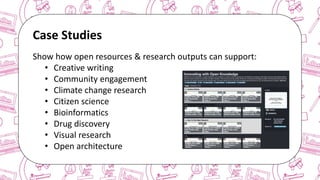
Show how open resources & research outputs can support:
• Creative writing
• Community engagement
• Climate change research
• Citizen science
• Bioinformatics
• Drug discovery
• Visual research
• Open architecture
The case for Open Access & Open Knowledge
Case Studies
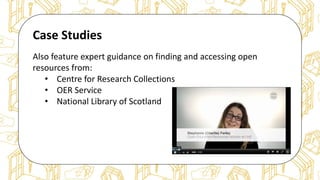
Also feature expert guidance on finding and accessing open
resources from:
• Centre for Research Collections
• OER Service
• National Library of Scotland
The case for Open Access & Open Knowledge
Case Studies
• Creative Writing: Writing historical fiction with Peter Ramscombe
• Citizenship: The Conscientious Objectors Project with Nick Williams at WEA Scotland
• Climate Change: Solving Climate Change with Ecometrica
• Citizen Science: Dog Life with Dylan Clements
• Bioinformatics: Bioinformatics in the Classroom with Heleen Plaisir & Daniel Barker
• Drug Discovery: Parkure with Lysimachos Zografos
• Crafts: Bookbinding with Emma Frazer
• Heritage: The Leith Improvement Scheme with Fraser Parkinson
• Maker Spaces: Ucreate with Mike Boyd
• Grand designs: The Wikihouse with Akiko Kobayashi and Duncan Bain
• Open Source Software: with Scott Wilson, Cetis LLP & OSS Watch
The case for Open Access & Open Knowledge
Case Studies
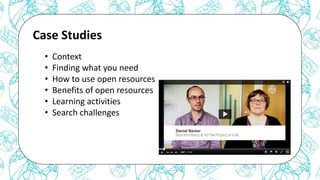
• Context
• Finding what you need
• How to use open resources
• Benefits of open resources
• Learning activities
• Search challenges
The case for Open Access & Open Knowledge
Open Educational Resources (OER)
Please take these resources and:
• Reuse
• Revise
• Remix
• Redistribute
• Retain
(The Access Compromise and the 5th R by David Wiley https://opencontent.org/blog/archives/3221)
The case for Open Access & Open Knowledge
Innovating with Open Knowledge
Media Hopper Create channel
• https://media.ed.ac.uk/channel/Innovating+with+Open+Kno
wledge/
Innovating with Open Knowledge website
• https://openinnovation.is.ed.ac.uk/
The case for Open Access & Open Knowledge
Acknowledgments
• Funding: IS Innovation Fund & CSG (G. McLachlan, H. Edmiston, M.
Highton).
• Case studies created by Morna Simpson, Enterprise Porridge Ltd & Geek Girl
Scotland.
• Graphics © Jackie Aim, Interactive Content Team, University of Edinburgh.
• Project manager: Lorna M. Campbell, LTW, University of Edinburgh.
• All resources CC BY SA University of Edinburgh, unless otherwise indicated.

Innovating with Open Knowledge

  • 1.
  • 2.
    The case forOpen Access & Open Knowledge The case for Open Access & Open Knowledge Free & open access to publicly‐funded research outputs: • Disseminates research outputs quickly & widely. • Enables research process to operate more efficiently. • Increases use & understanding of research by business, government, charities and the wider public. • Fosters technology transfer & innovation. • Provides social & economic benefits. • Inline with Government commitment to transparency and open data. • Contributes to the global Open Knowledge movement.
  • 3.
    The case forOpen Access & Open Knowledge Access to Open Knowledge Universities make research available through: • Open Access journals • Open Access repositories • Pre-print repositories • Data libraries • Research explorer services • Research & innovation services • Commercial search tools
  • 4.
    The case forOpen Access & Open Knowledge But….. It’s not easy for those outwith academia to know how to access open research outputs, even though they’re freely & openly available to all. To improve technology transfer we need to do more to disseminate Open Access research to: • General public • Creative individuals • Entrepreneurs • SMEs
  • 5.
    The case forOpen Access & Open Knowledge Innovating with Open Knowledge Project 2016 IS Innovation Fund Project. Generously funded by Gavin McLachlan & Hugh Edmiston, steered by Melissa Highton. • Aim: Create a FutureLearn MOOC. • Target audience: SMESs & entrepreneurs. • Scope: Provide learners with the information literacy skills to find and access free and open content produced by HE. • Featuring: Case studies of SMEs and entrepreneurs who have capitalised on UoE’s open research outputs.
  • 6.
    The case forOpen Access & Open Knowledge Constraints and stumbling blocks • Time scales were very tight. • Had to create entire course from scratch. • Took time to define scope and learning design of course. • Sought to create a course without using MOOC team & media producers. • Used DIY film kit instead. • Struggled to find examples of SMEs and entrepreneurs using open research outputs. • Scheduling interviews in tight timescales was challenging. • Project didn’t align with existing services.
  • 7.
    The case forOpen Access & Open Knowledge Solution • Broaden scope of case studies to include creative individuals, authors, private researchers, & independent scholars. • Create cases studies as a series of CC licensed OER videos. • Make resources available through Media Hopper Create. • Build a Wordpress site to contextualise case studies & draw materials together.
  • 8.
    The case forOpen Access & Open Knowledge Open Educational Resources (OER) “Open educational resources (OER) are digital resources that are used in the context of teaching and learning, which have been released by the copyright holder under an open licence permitting their use or re-purposing by others.” (University of Edinburgh Open Educational Resources Policy https://www.ed.ac.uk/files/atoms/files/openeducationalresourcespolicy.pdf) Open.Ed OER Service • http://open.ed.ac.uk/
  • 9.
    The case forOpen Access & Open Knowledge Innovating with Open Knowledge • 12 case studies • 48 short CC BY SA licensed videos • Supplementary text resources and learning activities • Media Hopper Create channel • https://media.ed.ac.uk/channel/Innovating+with+Open+K nowledge/ • Innovating with Open Knowledge website • https://openinnovation.is.ed.ac.uk/
  • 10.
    The case forOpen Access & Open Knowledge Case Studies Demonstrate how entrepreneurs & creative individuals can find, use and engage with: • Scholarly works & publications • Open science • Images & media • Physical resources & maker spaces • Data & software
  • 11.
    The case forOpen Access & Open Knowledge Case Studies Show how open resources & research outputs can support: • Creative writing • Community engagement • Climate change research • Citizen science • Bioinformatics • Drug discovery • Visual research • Open architecture
  • 12.
    The case forOpen Access & Open Knowledge Case Studies Also feature expert guidance on finding and accessing open resources from: • Centre for Research Collections • OER Service • National Library of Scotland
  • 13.
    The case forOpen Access & Open Knowledge Case Studies • Creative Writing: Writing historical fiction with Peter Ramscombe • Citizenship: The Conscientious Objectors Project with Nick Williams at WEA Scotland • Climate Change: Solving Climate Change with Ecometrica • Citizen Science: Dog Life with Dylan Clements • Bioinformatics: Bioinformatics in the Classroom with Heleen Plaisir & Daniel Barker • Drug Discovery: Parkure with Lysimachos Zografos • Crafts: Bookbinding with Emma Frazer • Heritage: The Leith Improvement Scheme with Fraser Parkinson • Maker Spaces: Ucreate with Mike Boyd • Grand designs: The Wikihouse with Akiko Kobayashi and Duncan Bain • Open Source Software: with Scott Wilson, Cetis LLP & OSS Watch
  • 14.
    The case forOpen Access & Open Knowledge Case Studies • Context • Finding what you need • How to use open resources • Benefits of open resources • Learning activities • Search challenges
  • 15.
    The case forOpen Access & Open Knowledge Open Educational Resources (OER) Please take these resources and: • Reuse • Revise • Remix • Redistribute • Retain (The Access Compromise and the 5th R by David Wiley https://opencontent.org/blog/archives/3221)
  • 16.
    The case forOpen Access & Open Knowledge Innovating with Open Knowledge Media Hopper Create channel • https://media.ed.ac.uk/channel/Innovating+with+Open+Kno wledge/ Innovating with Open Knowledge website • https://openinnovation.is.ed.ac.uk/
  • 17.
    The case forOpen Access & Open Knowledge Acknowledgments • Funding: IS Innovation Fund & CSG (G. McLachlan, H. Edmiston, M. Highton). • Case studies created by Morna Simpson, Enterprise Porridge Ltd & Geek Girl Scotland. • Graphics © Jackie Aim, Interactive Content Team, University of Edinburgh. • Project manager: Lorna M. Campbell, LTW, University of Edinburgh. • All resources CC BY SA University of Edinburgh, unless otherwise indicated.

Editor's Notes

  • #4 Since the Finch Report & RCUK’s Open Access Mandate UK Universities increasingly make their open research outputs available through a wide range of channels
  • #5 And this is the challenge that an IS Innovation Fund project sought to address.