Open Access, Plan S and New Models for
Academic Publishing
Dominic Tate
Head of Library Research Support
Edinburgh University Library
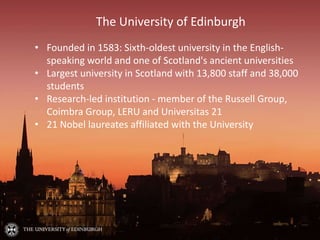
The University of Edinburgh
• Founded in 1583: Sixth-oldest university in the English-
speaking world and one of Scotland's ancient universities
• Largest university in Scotland with 13,800 staff and 38,000
students
• Research-led institution - member of the Russell Group,
Coimbra Group, LERU and Universitas 21
• 21 Nobel laureates affiliated with the University
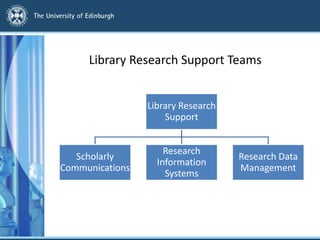
Library Research Support Teams
Library Research
Support
Scholarly
Communications
Research
Information
Systems
Research Data
Management
Scholarly Communications Team
• Provides support for staff and students regarding Open Access
publications
• Advises on matters to do with copyright
• Manages funds to pay for Open Access article-processing
charges (APCs)
• Implementation of Open Access for REF
• Strategic Leadership for Plan S and Open Science
Open Access Publications
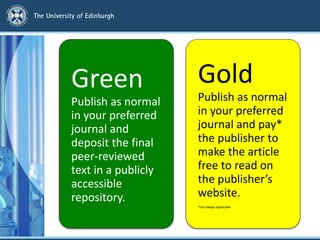
Green
Publish as normal
in your preferred
journal and
deposit the final
peer-reviewed
text in a publicly
accessible
repository.
Gold
Publish as normal
in your preferred
journal and pay*
the publisher to
make the article
free to read on
the publisher’s
website.
*not always applicable
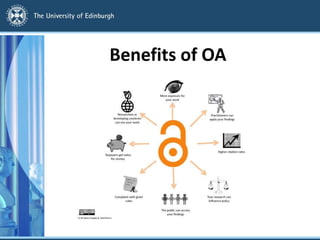
Benefits of OA
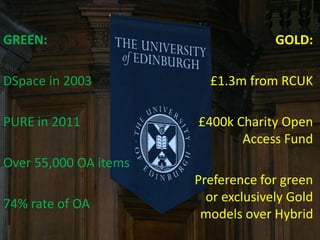
GOLD:
£1.3m from RCUK
£400k Charity Open
Access Fund
Preference for green
or exclusively Gold
models over Hybrid
GREEN:
DSpace in 2003
PURE in 2011
Over 55,000 OA items
74% rate of OA
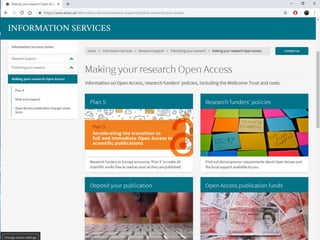
www.ed.ac.uk/openaccess
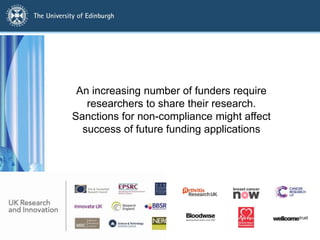
An increasing number of funders require
researchers to share their research.
Sanctions for non-compliance might affect
success of future funding applications
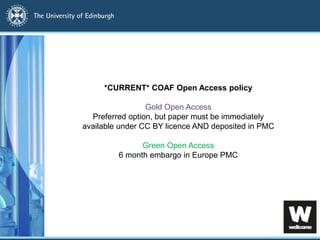
*CURRENT* COAF Open Access policy
Gold Open Access
Preferred option, but paper must be immediately
available under CC BY licence AND deposited in PMC
Green Open Access
6 month embargo in Europe PMC
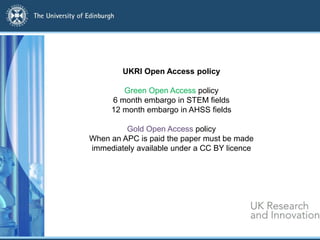
UKRI Open Access policy
Green Open Access policy
6 month embargo in STEM fields
12 month embargo in AHSS fields
Gold Open Access policy
When an APC is paid the paper must be made
immediately available under a CC BY licence
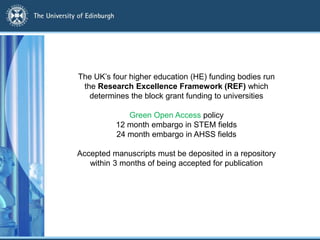
The UK’s four higher education (HE) funding bodies run
the Research Excellence Framework (REF) which
determines the block grant funding to universities
Green Open Access policy
12 month embargo in STEM fields
24 month embargo in AHSS fields
Accepted manuscripts must be deposited in a repository
within 3 months of being accepted for publication
So…what is REF?
• RESEARCH EXCELLENCE FRAMEWORK– successor to
previous Research Assessment Exercises (RAE)
• Conducted every 6 or 7 years (last one in 2014, next
exercise in 2021, submission in November 2020)
• UK national exercise to measure the quantity and
quality of research carried out in UK Universities
• Outcome affects distribution of research funding
REF Submissions Include…
• Statistics about staff, students and finances
• Information about the research environment
• Impact Case Studies - detailing the effect the
university’s research has had on society in the wider
world
• Example research outputs for each staff member
returned
Scope & Timeline
• Open Access Policy applies to all journal articles &
conference proceedings ACCEPTED for publication
from April 1st 2016
– We started work on implementation back in 2015
• We need to ensure that we are 100% compliant with
this new requirement to ensure that every
researcher can select any publication for inclusion in
the next REF.
– There will be extra credit available in “Research
Environment” for doing more than the bare minimum
Implications
• “Any output that falls within the scope of this policy
and is submitted to REF2021 but does not meet the
requirements without a valid exception will be given
an unclassified score and will not be assessed.”
• There is very little scope for retro-active compliance
so we must ensure everyone is aware of the
requirements.
– There is a real risk that ‘top papers’ by senior researchers
could fail to be assessed if they are not put in the
repository at the point of acceptance!
How has this changed things?
• Open Access now affects everybody (not just holders
of certain grants)
• Open Access is no longer optional, even for un-
funded research
• Open Access is now being discussed amongst
researchers
• Open Access can no longer be delayed, or ignored.
So…what next?
• Despite any difficulties – we are very much in
support of the policy which essentially says “if you
can make this Open Access then you must do so”.
• We are monitoring compliance – currently sitting at
around 92%...so there is still work to do!!
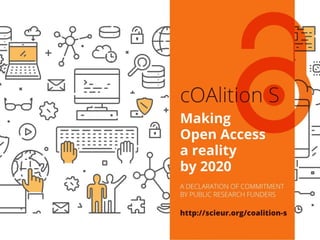
• PLAN S will be the next big challenge for us – even
more rigorous OA requirements are coming our way.
Principles of Plan S
• Will *now* begin in 2021
• Will be a phased implementation
• Relaxation of stringent technical rules
• No embargo periods
• Predicated on expected transition to
Gold
• Green acceptable without embargo
DORA
• San Francisco Declaration on Research Assessment
• Covers all kinds of research metrics
• Metrics to be used responsibly
• No single metric to be used in isolation
• University of Edinburgh first signatory in Scotland…
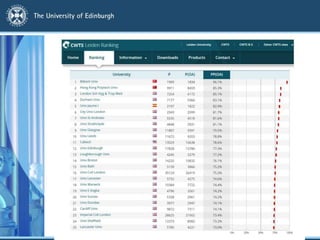
CWTS Leiden Rankings
Annual global ranking based exclusively on
bibliometric factors.
Scottish (and British) universities doing
exceptionally well on Open Access
https://oascotland.wordpress.com
Open Monographs
What Open Monographs ARE
• Open Access long-format publications (books)
• Published version is OA – could be an exclusively OA publisher, or a
traditional publisher
• There is typically a fee to make the book open access, but there is no costs to
buy or access the book.
• Content normally licenced using creative commons of some variety (liberal or
more restrictive).
• Can be machine-read/text-mined.
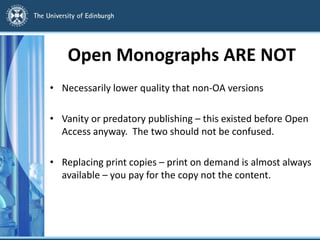
Open Monographs ARE NOT
• Necessarily lower quality that non-OA versions
• Vanity or predatory publishing – this existed before Open
Access anyway. The two should not be confused.
• Replacing print copies – print on demand is almost always
available – you pay for the copy not the content.
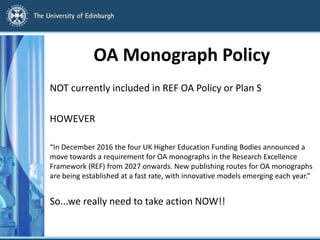
OA Monograph Policy
NOT currently included in REF OA Policy or Plan S
HOWEVER
“In December 2016 the four UK Higher Education Funding Bodies announced a
move towards a requirement for OA monographs in the Research Excellence
Framework (REF) from 2027 onwards. New publishing routes for OA monographs
are being established at a fast rate, with innovative models emerging each year.”
So...we really need to take action NOW!!
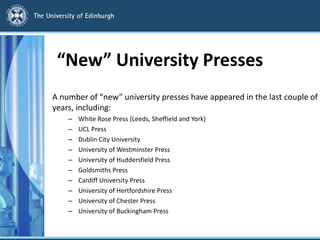
“New” University Presses
A number of “new” university presses have appeared in the last couple of
years, including:
– White Rose Press (Leeds, Sheffield and York)
– UCL Press
– Dublin City University
– University of Westminster Press
– University of Huddersfield Press
– Goldsmiths Press
– Cardiff University Press
– University of Hertfordshire Press
– University of Chester Press
– University of Buckingham Press
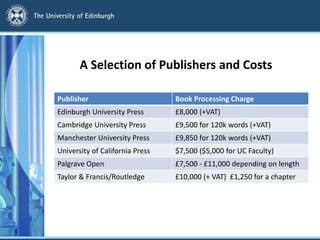
A Selection of Publishers and Costs
Publisher Book Processing Charge
Edinburgh University Press £8,000 (+VAT)
Cambridge University Press £9,500 for 120k words (+VAT)
Manchester University Press £9,850 for 120k words (+VAT)
University of California Press $7,500 ($5,000 for UC Faculty)
Palgrave Open £7,500 - £11,000 depending on length
Taylor & Francis/Routledge £10,000 (+ VAT) £1,250 for a chapter
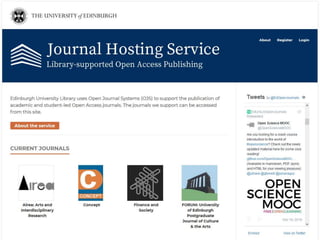
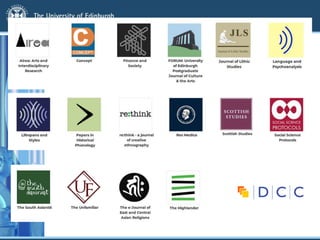
Edinburgh’s journal hosting service
— started in 2009 – no dedicated staff, no
promotion
— currently 18 student and academic-led journals
— arts, humanities, social sciences and medicine
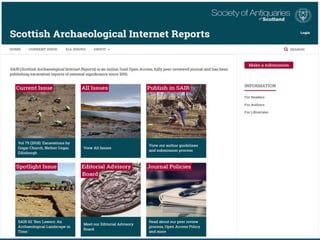
— fully Open Access, Creative Commons
licences, no APCs
— over 140,000 full-text downloads in 2018
— Open Journal Systems (OJS)
— support from Library-based developers
Scottish Universities Press Proposal
• Initial discussions begun by SCURL https://scurl.ac.uk/
• Sub-group with representation from Edinburgh,
Glasgow, Dundee and GCU.
• Contractor appointed for scoping exercise
• Idea: a new, OA press collaboratively operated on
behalf of all the universities and research
organisations in Scotland.
We are missing opportunities!
• There is an opportunity for Universities to play a
greater role in the publication process.
• Each time something appears only in print, or in a
closed format, we are losing out on opportunities
for wider readership.
• Accessibility can only bring benefits – greater
chances of collaboration, wider readership, benefit
for society.
Library & University Collections
The University of Edinburgh
Questions, comments, comparisons?
dominic.tate@ed.ac.uk
Thank You!

Open Access, Plan S and New Models for Academic Publishing

  • 1.
    Open Access, PlanS and New Models for Academic Publishing Dominic Tate Head of Library Research Support Edinburgh University Library
  • 2.
    The University ofEdinburgh • Founded in 1583: Sixth-oldest university in the English- speaking world and one of Scotland's ancient universities • Largest university in Scotland with 13,800 staff and 38,000 students • Research-led institution - member of the Russell Group, Coimbra Group, LERU and Universitas 21 • 21 Nobel laureates affiliated with the University
  • 3.
    Library Research SupportTeams Library Research Support Scholarly Communications Research Information Systems Research Data Management
  • 4.
    Scholarly Communications Team •Provides support for staff and students regarding Open Access publications • Advises on matters to do with copyright • Manages funds to pay for Open Access article-processing charges (APCs) • Implementation of Open Access for REF • Strategic Leadership for Plan S and Open Science
  • 6.
  • 7.
    Green Publish as normal inyour preferred journal and deposit the final peer-reviewed text in a publicly accessible repository. Gold Publish as normal in your preferred journal and pay* the publisher to make the article free to read on the publisher’s website. *not always applicable
  • 8.
  • 9.
    GOLD: £1.3m from RCUK £400kCharity Open Access Fund Preference for green or exclusively Gold models over Hybrid GREEN: DSpace in 2003 PURE in 2011 Over 55,000 OA items 74% rate of OA
  • 10.
  • 11.
    An increasing numberof funders require researchers to share their research. Sanctions for non-compliance might affect success of future funding applications
  • 12.
    *CURRENT* COAF OpenAccess policy Gold Open Access Preferred option, but paper must be immediately available under CC BY licence AND deposited in PMC Green Open Access 6 month embargo in Europe PMC
  • 13.
    UKRI Open Accesspolicy Green Open Access policy 6 month embargo in STEM fields 12 month embargo in AHSS fields Gold Open Access policy When an APC is paid the paper must be made immediately available under a CC BY licence
  • 14.
    The UK’s fourhigher education (HE) funding bodies run the Research Excellence Framework (REF) which determines the block grant funding to universities Green Open Access policy 12 month embargo in STEM fields 24 month embargo in AHSS fields Accepted manuscripts must be deposited in a repository within 3 months of being accepted for publication
  • 15.
    So…what is REF? •RESEARCH EXCELLENCE FRAMEWORK– successor to previous Research Assessment Exercises (RAE) • Conducted every 6 or 7 years (last one in 2014, next exercise in 2021, submission in November 2020) • UK national exercise to measure the quantity and quality of research carried out in UK Universities • Outcome affects distribution of research funding
  • 16.
    REF Submissions Include… •Statistics about staff, students and finances • Information about the research environment • Impact Case Studies - detailing the effect the university’s research has had on society in the wider world • Example research outputs for each staff member returned
  • 17.
    Scope & Timeline •Open Access Policy applies to all journal articles & conference proceedings ACCEPTED for publication from April 1st 2016 – We started work on implementation back in 2015 • We need to ensure that we are 100% compliant with this new requirement to ensure that every researcher can select any publication for inclusion in the next REF. – There will be extra credit available in “Research Environment” for doing more than the bare minimum
  • 18.
    Implications • “Any outputthat falls within the scope of this policy and is submitted to REF2021 but does not meet the requirements without a valid exception will be given an unclassified score and will not be assessed.” • There is very little scope for retro-active compliance so we must ensure everyone is aware of the requirements. – There is a real risk that ‘top papers’ by senior researchers could fail to be assessed if they are not put in the repository at the point of acceptance!
  • 19.
    How has thischanged things? • Open Access now affects everybody (not just holders of certain grants) • Open Access is no longer optional, even for un- funded research • Open Access is now being discussed amongst researchers • Open Access can no longer be delayed, or ignored.
  • 20.
    So…what next? • Despiteany difficulties – we are very much in support of the policy which essentially says “if you can make this Open Access then you must do so”. • We are monitoring compliance – currently sitting at around 92%...so there is still work to do!! • PLAN S will be the next big challenge for us – even more rigorous OA requirements are coming our way.
  • 22.
    Principles of PlanS • Will *now* begin in 2021 • Will be a phased implementation • Relaxation of stringent technical rules • No embargo periods • Predicated on expected transition to Gold • Green acceptable without embargo
  • 23.
    DORA • San FranciscoDeclaration on Research Assessment • Covers all kinds of research metrics • Metrics to be used responsibly • No single metric to be used in isolation • University of Edinburgh first signatory in Scotland…
  • 24.
    CWTS Leiden Rankings Annualglobal ranking based exclusively on bibliometric factors. Scottish (and British) universities doing exceptionally well on Open Access https://oascotland.wordpress.com
  • 26.
  • 27.
    What Open MonographsARE • Open Access long-format publications (books) • Published version is OA – could be an exclusively OA publisher, or a traditional publisher • There is typically a fee to make the book open access, but there is no costs to buy or access the book. • Content normally licenced using creative commons of some variety (liberal or more restrictive). • Can be machine-read/text-mined.
  • 28.
    Open Monographs ARENOT • Necessarily lower quality that non-OA versions • Vanity or predatory publishing – this existed before Open Access anyway. The two should not be confused. • Replacing print copies – print on demand is almost always available – you pay for the copy not the content.
  • 29.
    OA Monograph Policy NOTcurrently included in REF OA Policy or Plan S HOWEVER “In December 2016 the four UK Higher Education Funding Bodies announced a move towards a requirement for OA monographs in the Research Excellence Framework (REF) from 2027 onwards. New publishing routes for OA monographs are being established at a fast rate, with innovative models emerging each year.” So...we really need to take action NOW!!
  • 30.
    “New” University Presses Anumber of “new” university presses have appeared in the last couple of years, including: – White Rose Press (Leeds, Sheffield and York) – UCL Press – Dublin City University – University of Westminster Press – University of Huddersfield Press – Goldsmiths Press – Cardiff University Press – University of Hertfordshire Press – University of Chester Press – University of Buckingham Press
  • 31.
    A Selection ofPublishers and Costs Publisher Book Processing Charge Edinburgh University Press £8,000 (+VAT) Cambridge University Press £9,500 for 120k words (+VAT) Manchester University Press £9,850 for 120k words (+VAT) University of California Press $7,500 ($5,000 for UC Faculty) Palgrave Open £7,500 - £11,000 depending on length Taylor & Francis/Routledge £10,000 (+ VAT) £1,250 for a chapter
  • 33.
    Edinburgh’s journal hostingservice — started in 2009 – no dedicated staff, no promotion — currently 18 student and academic-led journals — arts, humanities, social sciences and medicine — fully Open Access, Creative Commons licences, no APCs — over 140,000 full-text downloads in 2018 — Open Journal Systems (OJS) — support from Library-based developers
  • 37.
    Scottish Universities PressProposal • Initial discussions begun by SCURL https://scurl.ac.uk/ • Sub-group with representation from Edinburgh, Glasgow, Dundee and GCU. • Contractor appointed for scoping exercise • Idea: a new, OA press collaboratively operated on behalf of all the universities and research organisations in Scotland.
  • 38.
    We are missingopportunities! • There is an opportunity for Universities to play a greater role in the publication process. • Each time something appears only in print, or in a closed format, we are losing out on opportunities for wider readership. • Accessibility can only bring benefits – greater chances of collaboration, wider readership, benefit for society.
  • 39.
    Library & UniversityCollections The University of Edinburgh Questions, comments, comparisons? dominic.tate@ed.ac.uk Thank You!