LIBINKURIAN
Depaul institute of science and technology, angamaly
Indian Copyright Act, 1957
• First copyright in India in 1914
• Now, Indian Copyright Act,1957; w.e.f. 1958
• Further amendments in 1983,1984,1992,1994,1999
• adopted many English provisions, introduced new ideas and
concepts.
• Created Copyright Office and Copyright Board
• Introduced civil and criminal remedies against infringement
Definition
• Copyright is an exclusive right subject to the provisions of this
Act, to do or authorise the doing of any of the following acts in
respect of a work or any substantial part thereof
a) Inthe caseof a literary, dramatic or musical
work,not being a computerprogramme:
• To reproduce the work in any material form including the
storing of it in any medium by electronic means
• To make any translation of the work,
• To make any adaption of the work,
• To perform the work in public, or communicate it to the
public
• To issue copies of the work to the public not being copies
already in circulation
b) In caseof a computerprogramme
• To do any of the acts specified in clause (a),or
• To sell or give on commercial rental or offer for sale or for
commercial rental any copy of the computer programme
c) In the case of an artistic work
• To reproduce the work in any material form; 2D to 3D, 3D
to 2D
• To communicate the work to the public
• To include the work in any cinematograph film,
• To make any adaptation of the work
• To issue copies of the work to the public not being copies
already in circulation
d) In the case of a cinematograph
film
• To make the copy of the film
• To sell or give in hire the things which have been already be
sell or given hire
• To communicate the film to the public
e) In the case of sound recording
• To make any other sound recording embodying it,
• To sell or give in hire the things which have been already be
sell or given hire
• To communicate the sound recording to the public
Copyright Symbol ©
• Use of the "©" symbol
• Anyone who claims copyrights can use it
• not necessary to have a registration to use
the designations
• highly advisable to incorporate a copyright
notice
• Example:
Copyright © 2009 Microsoft Corporation
TERMOF COPYRIGHT
The general rule is that copyright lasts for 60 years. It is
counted-
From the death of the author
•Literary
•Dramatic
•Musical
•Artistic work
From the date of publication
•Cinematograph films
•Sound recordings
•Photographs
•Posthumous publication
•Works of government & international organizations
The work mist be
original
Creation of statute
multiple rights
copyright exists in
expression of ideas
and not mere idea
CHARACTERISTICS OF
COPYRIGHT
CHARACTERISTICSOF COPYRIGHT
Creation of statute
The copyright is granted and protected according to copyright Act. There
is no common law right
Multiple right
copyright is not a single right, rather it is a bundle of right in the
same work. It comprises of, in case of literary work, right to
reproduction, right to translation, right to adaptation, right to
dramatic and cinematographic version, right to public performation
and right to serial publication
The work must be original
The first and essential requirement for claming the copyright
is the originality of the work. There cannot be claim of copyright in
a copy of any other’s work or in a similar work
 Copyrightexistinexpressionofideasandnot
mereidea
The copyright exists only in expression of idea in some
material form; i.e. book, film, photograph or musical tone. Mere
idea unless expressed is not capable of claiming any copyright.
Ownership of copyright
• By virtue of section 17, the author of the work is the first
owner of the copyright in the work
Literary or dramatic work The author of the work
Musical work the composer
An artistic work (other than
photograph)
The artist
Photograph The person take the photograph
Cinematograph film The producer
Sound recording The producer
Literary, dramatic, musical or artist
work which is computer generated
The person who causes the work to
be created
RIGHTSOFOWNERSOFCOPYRIGHT
1. Multiple statutory right
the owner of the work can exploited and enjoy
monopoly right in his work in several manners.
2. Right to transfer
the author can transfer his right through assignment or grant
permissive use of copyright to any person
3. Negative right (right against infringement)
unauthorised use of copyright amount to infringement. The
act provides adequate remedies for preventing infringement
4. Moral right (special right of author)
section 57(1) of the copyright Act has recognized
moral rights as author’s special rights. These are;
a) to claim authorship of the work; and
b) to retrain or claim damages in respect of any
distortion, mutilation, modification etc
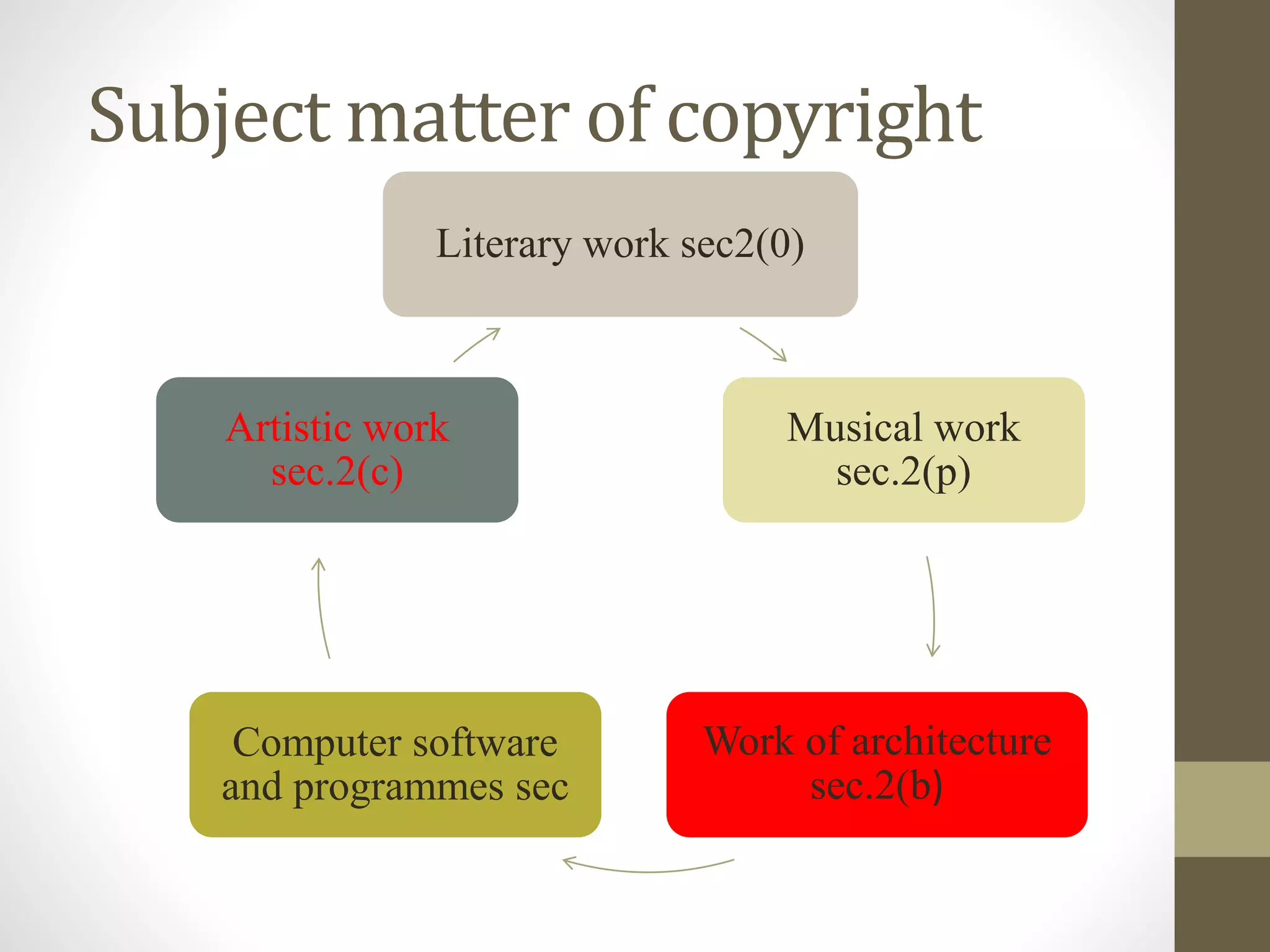
Subject matter of copyright
Literary work sec2(0)
Musical work
sec.2(p)
Work of architecture
sec.2(b)
Computer software
and programmes sec
Artistic work
sec.2(c)
WORK
• What is a work?
• A work means any of the following , namely, a literary,
dramatic, musical or artistic work, a cinematograph film, or a
sound recording.
An artistic work means-
a painting, a sculpture, a drawing (including a diagram,
map, chart or plan), an engraving or a photograph, whether or
not any such work possesses artistic quality;
• a work of architecture; and
• any other work of artistic craftsmanship.
Musical work
• "Musical work" means a work consisting of music and
includes any graphical notation of such work but does not
include any words or any action intended to be sung,
spoken or performed with the music.
Sound recording
• "Sound recording" means a recording of sounds from
which sounds may be produced regardless of the medium
on which such recording is made or the method by which
the sounds are produced. A CD-ROM are sound
recordings.
Cinematographfilm
• "Cinematograph film" means any work of visual recording on
any medium produced through a process from which a moving
image may be produced by any means and includes a sound
recording accompanying such visual recording and
"cinematograph" shall be construed as including any work
produced by any process analogous to cinematography
including video films.
"Government work" means a work which is made or
published by or under the direction or control of
• the government or any department of the government
• any legislature in India, and
• any court, tribunal or other judicial authority in India.
Indian work
“Indian work" means a literary, dramatic or musical work,
• the author of which is a citizen of India; or
• which is first published in India; or
• the author of which, in the case of an unpublished work
is, at the time of the making of the work, a citizen of India.
Licensing of copyright
1) Voluntary licence (sec 30)
Section 30 of the
copyright Act empower
the owner of copyright in
any existing or
prospective owner of the
copyright in any future
work to grant any
interest in the right by
license in writing signed
by him
2) Compulsory licence (sec 31)
The work must have been
published or performed in the
public.
The author must have refused
to republish or allow to republish
That by reason of such refusal
the work is withheld from public
The author must have refused to
allow communication to the public
of such work by broadcast
TERMINATION ANDASSIGNMENTOFLICENCE
• TERMINATION: The licence can be terminated by the copyright
board, after giving three months notice, if the owner of the
copyright publishes a translation in the same language at the
resonable price and of the same standards.
• ASSIGNMENT: It shall be in writing signed by the assignor or by
his duly authorised agent. It shall identify the specific works and
specify the rights assigned and the duration and territorial extent of
such assignment. It shall also specify the amount of royalty
payable, if any, to the author or his legal heirs during the currency
of the assignment and the assignment shall be subject to revision,
extension or termination on terms mutually agreed upon by the
parties.
• If the period of assignment is not stated, it shall be deemed to be
five years from the date of assignment.
• lapse of assignment: Where the assignee does not exercise the
rights assigned to him within a period of one year from the date
of assignment, the assignment in respect of such rights shall be
deemed to have lapsed after the expiry of the said period unless
otherwise specified in the assignment.
Copyright infringement
copyright infringement is the use of works protected by copyright
law without permission, infringing certain exclusive rights granted to
the copyright holder, such as the right to reproduce, distribute, display
or perform the protected work, or to make derivative works.
The following are some of the commonly known acts involving
infringement of copyright:
 Making infringing copies for sale or hire or selling or letting
them for hire;
 Permitting any place for the performance of works in public where
such performance constitutes infringement of copyright;
Distributing infringing copies for the purpose of trade or to such
an extent so as to affect prejudicially the interest of the owner of
copyright ;
Public exhibition of infringing copies by way of trade; and
 Importation of infringing copies into India.
REMEDIES AGAINST
INFRINGEMENT
CIVIL
REMEDIES
(SEC.54-62)
• Search and
seizure order
• Injunction
CRIMINAL
REMEDIES
• The infringement
of copyright is not
a civil wrong but
also an offence.
The criminal
proceeding can be
take against
infringement.
ADMINISTRATI
VE REMEDIES
• registrar and
copyright board
have the power
to take action
against
infringement
Criminal Remedies
• Criminal offences, if done knowingly
Imprisonment
• 6 months – 3years
Fine
• Rs.50,000 – Rs.200,000
• Seizure of infringing copies
Civil Remedies
Civil remedies
• Injunction
• Damages
• Delivery of infringing copy
• Damages for conversion
Jurisdiction in District Court
ADMINISTRATIVE REMEDIES
The Registrar of Copyrights has the powers of a civil court when
trying a suit under the Code of Civil Procedure in respect of the
following matters, namely,
• Summoning and enforcing the attendance of any person and
examining him on oath;
• Requiring the discovery and production of any document;
• Issuing commissions for the examination of witnesses or
documents;
• Requisitioning any public record or copy thereof from any
court or office;
• Any other matters which may be prescribed.
Copyright Registration
Copyright
Copyright

Copyright

  • 1.
    LIBINKURIAN Depaul institute ofscience and technology, angamaly
  • 2.
    Indian Copyright Act,1957 • First copyright in India in 1914 • Now, Indian Copyright Act,1957; w.e.f. 1958 • Further amendments in 1983,1984,1992,1994,1999 • adopted many English provisions, introduced new ideas and concepts. • Created Copyright Office and Copyright Board • Introduced civil and criminal remedies against infringement
  • 3.
    Definition • Copyright isan exclusive right subject to the provisions of this Act, to do or authorise the doing of any of the following acts in respect of a work or any substantial part thereof
  • 4.
    a) Inthe caseofa literary, dramatic or musical work,not being a computerprogramme: • To reproduce the work in any material form including the storing of it in any medium by electronic means • To make any translation of the work, • To make any adaption of the work, • To perform the work in public, or communicate it to the public • To issue copies of the work to the public not being copies already in circulation
  • 5.
    b) In caseofa computerprogramme • To do any of the acts specified in clause (a),or • To sell or give on commercial rental or offer for sale or for commercial rental any copy of the computer programme
  • 6.
    c) In thecase of an artistic work • To reproduce the work in any material form; 2D to 3D, 3D to 2D • To communicate the work to the public • To include the work in any cinematograph film, • To make any adaptation of the work • To issue copies of the work to the public not being copies already in circulation
  • 7.
    d) In thecase of a cinematograph film • To make the copy of the film • To sell or give in hire the things which have been already be sell or given hire • To communicate the film to the public
  • 8.
    e) In thecase of sound recording • To make any other sound recording embodying it, • To sell or give in hire the things which have been already be sell or given hire • To communicate the sound recording to the public
  • 9.
    Copyright Symbol © •Use of the "©" symbol • Anyone who claims copyrights can use it • not necessary to have a registration to use the designations • highly advisable to incorporate a copyright notice • Example: Copyright © 2009 Microsoft Corporation
  • 10.
    TERMOF COPYRIGHT The generalrule is that copyright lasts for 60 years. It is counted- From the death of the author •Literary •Dramatic •Musical •Artistic work From the date of publication •Cinematograph films •Sound recordings •Photographs •Posthumous publication •Works of government & international organizations
  • 11.
    The work mistbe original Creation of statute multiple rights copyright exists in expression of ideas and not mere idea CHARACTERISTICS OF COPYRIGHT
  • 12.
    CHARACTERISTICSOF COPYRIGHT Creation ofstatute The copyright is granted and protected according to copyright Act. There is no common law right Multiple right copyright is not a single right, rather it is a bundle of right in the same work. It comprises of, in case of literary work, right to reproduction, right to translation, right to adaptation, right to dramatic and cinematographic version, right to public performation and right to serial publication The work must be original The first and essential requirement for claming the copyright is the originality of the work. There cannot be claim of copyright in a copy of any other’s work or in a similar work
  • 13.
     Copyrightexistinexpressionofideasandnot mereidea The copyrightexists only in expression of idea in some material form; i.e. book, film, photograph or musical tone. Mere idea unless expressed is not capable of claiming any copyright.
  • 14.
    Ownership of copyright •By virtue of section 17, the author of the work is the first owner of the copyright in the work Literary or dramatic work The author of the work Musical work the composer An artistic work (other than photograph) The artist Photograph The person take the photograph Cinematograph film The producer Sound recording The producer Literary, dramatic, musical or artist work which is computer generated The person who causes the work to be created
  • 15.
    RIGHTSOFOWNERSOFCOPYRIGHT 1. Multiple statutoryright the owner of the work can exploited and enjoy monopoly right in his work in several manners. 2. Right to transfer the author can transfer his right through assignment or grant permissive use of copyright to any person 3. Negative right (right against infringement) unauthorised use of copyright amount to infringement. The act provides adequate remedies for preventing infringement
  • 16.
    4. Moral right(special right of author) section 57(1) of the copyright Act has recognized moral rights as author’s special rights. These are; a) to claim authorship of the work; and b) to retrain or claim damages in respect of any distortion, mutilation, modification etc
  • 17.
    Subject matter ofcopyright Literary work sec2(0) Musical work sec.2(p) Work of architecture sec.2(b) Computer software and programmes sec Artistic work sec.2(c)
  • 18.
    WORK • What isa work? • A work means any of the following , namely, a literary, dramatic, musical or artistic work, a cinematograph film, or a sound recording.
  • 19.
    An artistic workmeans- a painting, a sculpture, a drawing (including a diagram, map, chart or plan), an engraving or a photograph, whether or not any such work possesses artistic quality; • a work of architecture; and • any other work of artistic craftsmanship.
  • 20.
    Musical work • "Musicalwork" means a work consisting of music and includes any graphical notation of such work but does not include any words or any action intended to be sung, spoken or performed with the music. Sound recording • "Sound recording" means a recording of sounds from which sounds may be produced regardless of the medium on which such recording is made or the method by which the sounds are produced. A CD-ROM are sound recordings.
  • 21.
    Cinematographfilm • "Cinematograph film"means any work of visual recording on any medium produced through a process from which a moving image may be produced by any means and includes a sound recording accompanying such visual recording and "cinematograph" shall be construed as including any work produced by any process analogous to cinematography including video films. "Government work" means a work which is made or published by or under the direction or control of • the government or any department of the government • any legislature in India, and • any court, tribunal or other judicial authority in India.
  • 22.
    Indian work “Indian work"means a literary, dramatic or musical work, • the author of which is a citizen of India; or • which is first published in India; or • the author of which, in the case of an unpublished work is, at the time of the making of the work, a citizen of India.
  • 23.
    Licensing of copyright 1)Voluntary licence (sec 30) Section 30 of the copyright Act empower the owner of copyright in any existing or prospective owner of the copyright in any future work to grant any interest in the right by license in writing signed by him 2) Compulsory licence (sec 31) The work must have been published or performed in the public. The author must have refused to republish or allow to republish That by reason of such refusal the work is withheld from public The author must have refused to allow communication to the public of such work by broadcast
  • 24.
    TERMINATION ANDASSIGNMENTOFLICENCE • TERMINATION:The licence can be terminated by the copyright board, after giving three months notice, if the owner of the copyright publishes a translation in the same language at the resonable price and of the same standards. • ASSIGNMENT: It shall be in writing signed by the assignor or by his duly authorised agent. It shall identify the specific works and specify the rights assigned and the duration and territorial extent of such assignment. It shall also specify the amount of royalty payable, if any, to the author or his legal heirs during the currency of the assignment and the assignment shall be subject to revision, extension or termination on terms mutually agreed upon by the parties.
  • 25.
    • If theperiod of assignment is not stated, it shall be deemed to be five years from the date of assignment. • lapse of assignment: Where the assignee does not exercise the rights assigned to him within a period of one year from the date of assignment, the assignment in respect of such rights shall be deemed to have lapsed after the expiry of the said period unless otherwise specified in the assignment.
  • 26.
    Copyright infringement copyright infringementis the use of works protected by copyright law without permission, infringing certain exclusive rights granted to the copyright holder, such as the right to reproduce, distribute, display or perform the protected work, or to make derivative works. The following are some of the commonly known acts involving infringement of copyright:  Making infringing copies for sale or hire or selling or letting them for hire;  Permitting any place for the performance of works in public where such performance constitutes infringement of copyright;
  • 27.
    Distributing infringing copiesfor the purpose of trade or to such an extent so as to affect prejudicially the interest of the owner of copyright ; Public exhibition of infringing copies by way of trade; and  Importation of infringing copies into India.
  • 28.
    REMEDIES AGAINST INFRINGEMENT CIVIL REMEDIES (SEC.54-62) • Searchand seizure order • Injunction CRIMINAL REMEDIES • The infringement of copyright is not a civil wrong but also an offence. The criminal proceeding can be take against infringement. ADMINISTRATI VE REMEDIES • registrar and copyright board have the power to take action against infringement
  • 29.
    Criminal Remedies • Criminaloffences, if done knowingly Imprisonment • 6 months – 3years Fine • Rs.50,000 – Rs.200,000 • Seizure of infringing copies
  • 30.
    Civil Remedies Civil remedies •Injunction • Damages • Delivery of infringing copy • Damages for conversion Jurisdiction in District Court
  • 31.
    ADMINISTRATIVE REMEDIES The Registrarof Copyrights has the powers of a civil court when trying a suit under the Code of Civil Procedure in respect of the following matters, namely, • Summoning and enforcing the attendance of any person and examining him on oath; • Requiring the discovery and production of any document; • Issuing commissions for the examination of witnesses or documents; • Requisitioning any public record or copy thereof from any court or office; • Any other matters which may be prescribed.
  • 32.