(Employee Stock Ownership Plan)
ESOP
Legal, Finance & Tax At One Click
ESOP & IT’s IMPORTANCE
A reward for their performance.
A motivation for employees to keep increasing their performances.
A plan under which right to exercise shares of a company are given to its employees at a fixed
predetermined price over a period of time.
ESOP
Benefit for Startups to aligns the interest of the employee(s) with the interest of the founders of the company.
Improves the financial and operational performance of the company.
ESOP provide a tax shield for the company.
It is a better incentive plan for employees.
Under ESOP, the price of shares available to employees is lower than its market price.
Importance of ESOP are:
Legal, Finance & Tax At One Click
ESOP is:
Genesis
Evolved in US in 1950.
A lawyer and investment banker ‐ Louise Kelso in USA, was of the opinion that the
capitalist system would be stronger if all workers, not just a few shareholders, could
acquire and ownership interest in companies where they are employed. He
advocated granting of company stocks through a plan to the employees called
ESOP.
Later, the statutory framework for ESOP was introduced in US under the Employee
Retirement Income Security Act (ERISA) of 1974.
In India, Infosys Technologies Ltd. was the first company to issue ESOP in 1994.
Legal, Finance & Tax At One Click
Purpose of ESOP
• To attract, reward, motivate and retain employees.
• To enable employees to acquire beneficial ownership in their company 
without having to invest.
• To improve the overall performance of the company.
• To enhance job satisfaction of the employee due to ownership incentive.
• To help in wealth creation for employees.
“The performance of the company is the outcome of its employees’ efforts. The more they are 
encouraged to work efficiently,  better the position achieved by the company in the market.”
Legal, Finance & Tax At One Click
ESOP‐ The Non‐Cash Retention Solution
ESOP are rights given to employees to exercise shares of the
company. The ESOP compensation expense is a non‐cash expense.
ESOP, therefore, helps companies recruit and retain employees by
offering ownership benefits.
Legal, Finance & Tax At One Click
Whom To Issue ESOP
The ESOP can be issued to:
A permanent employee.
A director of the company who neither directly or indirectly
holds more than 10% of the outstanding equity shares of the
company.
Legal, Finance & Tax At One Click
The implementation of ESOP is done either by:
Direct Route
Trust Route
Implementation Process of ESOP:
Legal, Finance & Tax At One Click
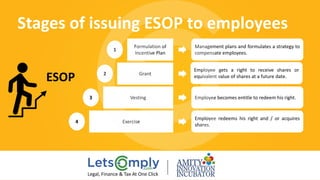
Stages of issuing ESOP to employees
Exercise
Vesting
Formulation of 
Incentive Plan
Grant
Employee redeems his right and / or acquires
shares.
Employee becomes entitle to redeem his right.
Employee gets a right to receive shares or
equivalent value of shares at a future date.
Management plans and formulates a strategy to
compensate employees.
1
2
3
4
ESOP
Legal, Finance & Tax At One Click
Rules 12(1), 12(2) and 12(4) read with Section 62(1)(b) of the Act require:
i. Approval of the ESOP Scheme by the members of the Company by way of a special
resolution;
ii. The explanatory statement shall disclose prescribed details namely total number of
ESOP to be granted, appraisal process, requirements of vesting, exercise price or pricing
formula, exercise period, lock‐in period, method of accounting, etc;
iii. There shall be separate resolutions in case of :‐ (a) grant of ESOP to employees of the
Subsidiary or Holding Company; or (b) in case of grant of ESOP to identified employees,
during any one year, equal to or exceeding 1% of the issued capital (excluding
outstanding warrants and conversions) of the company at the time of grant of option.
Procedural requirements to issue
Legal, Finance & Tax At One Click
Generally the following criterion are taken into consideration:
Performance
Length of Service
Criticality of Employees
Criteria To Issue ESOP
Legal, Finance & Tax At One Click
The exit can happen either by an Initial public offering (IPO) or a
strategic sale or a buy back guarantee from the company or
existing promoters.
Flipkart has sold a marginal stake worth between Rs 180 crore to
Rs 240 crore ($28‐36 million) from its employee stock option
(ESOP) Trust Fund and have monetised the wealthy for their
employees as first of such transaction aimed at retaining talent.
Exit Routes in ESOP
Legal, Finance & Tax At One Click
ESOP can’t be issued to the person if he is a promoter or a director
holding more than 10 per cent stake. But Sweat Equity is an option for
him.
According to S. 2(88) of the Companies Act, 2013, Sweat Equity Shares
mean equity shares issued by the company to its directors and / or
employees at a discount or for consideration other than cash for
providing know how or making available the rights in the nature of
intellectual property rights or value additions.
Sweat Equity: An ESOP with Slight Differences 
Legal, Finance & Tax At One Click
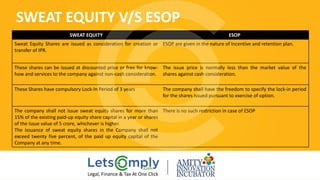
SWEAT EQUITY V/S ESOP
SWEAT EQUITY  ESOP
Sweat Equity Shares are issued as consideration for creation or
transfer of IPR.
ESOP are given in the nature of Incentive and retention plan.
These shares can be issued at discounted price or free for know‐
how and services to the company against non‐cash consideration.
The issue price is normally less than the market value of the
shares against cash consideration.
These Shares have compulsory Lock‐In Period of 3 years The company shall have the freedom to specify the lock‐in period
for the shares issued pursuant to exercise of option.
The company shall not issue sweat equity shares for more than
15% of the existing paid‐up equity share capital in a year or shares
of the issue value of 5 crore, whichever is higher.
The issuance of sweat equity shares in the Company shall not
exceed twenty five percent, of the paid up equity capital of the
Company at any time.
There is no such restriction in case of ESOP
Legal, Finance & Tax At One Click
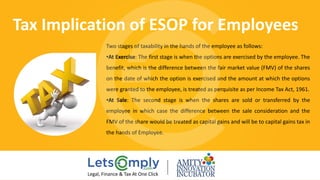
Two stages of taxability in the hands of the employee as follows:
•At Exercise: The first stage is when the options are exercised by the employee. The
benefit, which is the difference between the fair market value (FMV) of the shares
on the date of which the option is exercised and the amount at which the options
were granted to the employee, is treated as perquisite as per Income Tax Act, 1961.
•At Sale: The second stage is when the shares are sold or transferred by the
employee in which case the difference between the sale consideration and the
FMV of the share would be treated as capital gains and will be to capital gains tax in
the hands of Employee.
Tax Implication of ESOP for Employees
Legal, Finance & Tax At One Click
The case of Huawei Investment & Holding Co. Ltd (Huawei) and Zhongxing Telecom
Equipment (ZTE)
•Huawei implements an ESOP in 1990 to resolve its marketing and expansion problems.
Huawei made available 15% of its stocks to employees. ZTE did not adopt broad‐based
employee ownership. Moreover, only senior managers can hold ZTE shares, while
common employees could not hold ZTE shares
•Huawei restructured their ESOP model by shifting its focus from financing the company
to incentivizing employee productivity in 1997.
•To meet the requirements of Shenzhen Internal Employee Stock Ownership regulations,
Huawei introduced virtual stock options in 2001 and began to phase out their old ESOP
model.
Do’s and Don'ts with Case Studies
Legal, Finance & Tax At One Click
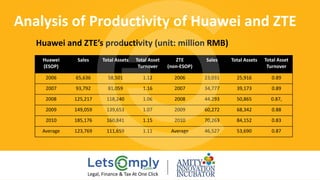
Huawei and ZTE’s productivity (unit: million RMB)
Analysis of Productivity of Huawei and ZTE
Huawei
(ESOP) 
Sales Total Assets  Total Asset 
Turnover
ZTE
(non‐ESOP)
Sales Total Assets  Total Asset 
Turnover
2006 65,636 58,501 1.12 2006 23,031 25,916 0.89 
2007 93,792 81,059 1.16 2007 34,777 39,173 0.89 
2008 125,217 118,240 1.06 2008 44,293 50,865 0.87, 
2009 149,059 139,653 1.07 2009 60,272 68,342 0.88 
2010 185,176 160,841 1.15 2010 70,263 84,152 0.83 
Average 123,769 111,659 1.11 Average 46,527 53,690 0.87 
Legal, Finance & Tax At One Click
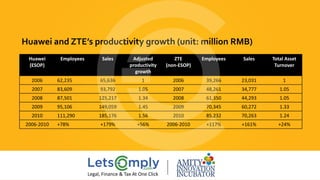
Huawei and ZTE’s productivity growth (unit: million RMB)
Huawei
(ESOP) 
Employees Sales Adjusted 
productivity 
growth 
ZTE
(non‐ESOP)
Employees Sales Total Asset 
Turnover
2006 62,235 65,636 1 2006 39,266 23,031 1 
2007 83,609 93,792 1.05 2007 48,261 34,777 1.05 
2008 87,501 125,217 1.34 2008 61,350 44,293 1.05  
2009 95,106 149,059 1.45 2009 70,345 60,272 1.33 
2010 111,290 185,176 1.56 2010 85,232 70,263 1.24 
2006‐2010 +78% +179% +56% 2006‐2010 +117% +161% +24% 
Legal, Finance & Tax At One Click
After analyzing the business attributes of Huawei and ZTE, it is to be
concluded that Huawei has a significant advantage because of its ESOP.
All of Huawei’s shares are owned by its employees while in ZTE, only
senior managers can hold some shares of ZTE. As Huawei’s CEO, Ren
Zhengfei, said ― Huawei belongs to its employees. If Huawei becomes
bigger and creates more profit, employees will acquire benefits more
from its ESOP and they will get huge motivation to work hard to enhance
productivity.
Outcome of the Analysis 
Legal, Finance & Tax At One Click
Some of the myths of an ESOP are as follows:
•The owner has to give up control of the business and hand it over to the employees
considered under ESOP.
•Interference of employee owner in the management of the company.
•Employees can immediately exercise their option after the issuance of shares under
ESOP.
•Everyone is treated equally while considering for ESOP grant.
All of these statements are NOT true. ESOP works as a productive and strategic tool to
involve and retain employees for collective growth of the organization.
Myths of ESOP in Employees’ Mind
Myths
Legal, Finance & Tax At One Click
ESOP: A good tool for Startups:
Startups use ESOP to hire good talent, as they cannot afford to pay very high salaries. Indian startups such as Flipkart, Snapdeal and
Housing.com, are such examples and now they are increasingly offering ESOP as part of their packages, to attract talent.
Benefits of ESOP for Startups:
•Retainer ship instrument‐ ESOP can be treated as a retainer ship instrument for startups as there is a lock in period for exercising the right
to purchase the shares. Thus, a business can retain its employees. If an employee opts for this option then he has to serve the lock in period
to become eligible to exercise it.
•Ownership feeling for employees‐ Employees get shares of the company in which they are working and, thereby, it realizes them of an
ownership feeling. In this way, they are motivated to work for the best of the company.
•Option in lieu of salary‐ Businesses that needs funds and are not in a position to spend hefty amounts can offer this option to their
employees in lieu of salary and motivate them to work for the betterment of the company.
ESOP: A Smart Option for Startups
Legal, Finance & Tax At One Click
Three Promoters of 
Startup with an idea
Company Incorporated by 
these promoters
That After 
Three‐ Four Years
Company will grow 
immensely
Company wants to hire
Employees but do not have funds 
then this ESOP concept would work
Legal, Finance & Tax At One Click
Boss
Company
Boss  gives the right to purchase shares of 
the company at a discounted price
Employee got this right and purchase shares 
and feel the sense of ownership in the company
Employee
Legal, Finance & Tax At One Click
While established companies use this option as a retention
tool for their top assets/brains; startups use it as a tool to hire
talent, as they cannot afford to pay very high salaries. What
makes an ESOP attractive, other than the value or potential
value of the shares or units, is the idea of ownership it imparts
to the employee holding it.
Conclusion
Legal, Finance & Tax At One Click
Thanks
Legal, Finance & Tax At One Click
For All Your 
Legal, Finance & Tax Compliances
Email Us At: Info@LetsComply.com Or
Call: +91‐ 971 70 70 500

Understanding Esop & Its Importance.

  • 1.
    (Employee Stock OwnershipPlan) ESOP Legal, Finance & Tax At One Click
  • 2.
    ESOP & IT’s IMPORTANCE A reward fortheir performance. A motivation for employees to keep increasing their performances. A plan under which right to exercise shares of a company are given to its employees at a fixed predetermined price over a period of time. ESOP Benefit for Startups to aligns the interest of the employee(s) with the interest of the founders of the company. Improves the financial and operational performance of the company. ESOP provide a tax shield for the company. It is a better incentive plan for employees. Under ESOP, the price of shares available to employees is lower than its market price. Importance of ESOP are: Legal, Finance & Tax At One Click ESOP is:
  • 3.
    Genesis Evolved in USin 1950. A lawyer and investment banker ‐ Louise Kelso in USA, was of the opinion that the capitalist system would be stronger if all workers, not just a few shareholders, could acquire and ownership interest in companies where they are employed. He advocated granting of company stocks through a plan to the employees called ESOP. Later, the statutory framework for ESOP was introduced in US under the Employee Retirement Income Security Act (ERISA) of 1974. In India, Infosys Technologies Ltd. was the first company to issue ESOP in 1994. Legal, Finance & Tax At One Click
  • 4.
    Purpose of ESOP • To attract, reward, motivate and retain employees. • To enable employees to acquire beneficial ownership in their company  without having to invest. •To improve the overall performance of the company. • To enhance job satisfaction of the employee due to ownership incentive. • To help in wealth creation for employees. “The performance of the company is the outcome of its employees’ efforts. The more they are  encouraged to work efficiently,  better the position achieved by the company in the market.” Legal, Finance & Tax At One Click
  • 5.
    ESOP‐ The Non‐Cash Retention Solution ESOP arerights given to employees to exercise shares of the company. The ESOP compensation expense is a non‐cash expense. ESOP, therefore, helps companies recruit and retain employees by offering ownership benefits. Legal, Finance & Tax At One Click
  • 6.
    Whom To Issue ESOP The ESOP canbe issued to: A permanent employee. A director of the company who neither directly or indirectly holds more than 10% of the outstanding equity shares of the company. Legal, Finance & Tax At One Click
  • 7.
    The implementation ofESOP is done either by: Direct Route Trust Route Implementation Process of ESOP: Legal, Finance & Tax At One Click
  • 8.
    Stages of issuing ESOP to employees Exercise Vesting Formulation of  Incentive Plan Grant Employee redeems hisright and / or acquires shares. Employee becomes entitle to redeem his right. Employee gets a right to receive shares or equivalent value of shares at a future date. Management plans and formulates a strategy to compensate employees. 1 2 3 4 ESOP Legal, Finance & Tax At One Click
  • 9.
    Rules 12(1), 12(2)and 12(4) read with Section 62(1)(b) of the Act require: i. Approval of the ESOP Scheme by the members of the Company by way of a special resolution; ii. The explanatory statement shall disclose prescribed details namely total number of ESOP to be granted, appraisal process, requirements of vesting, exercise price or pricing formula, exercise period, lock‐in period, method of accounting, etc; iii. There shall be separate resolutions in case of :‐ (a) grant of ESOP to employees of the Subsidiary or Holding Company; or (b) in case of grant of ESOP to identified employees, during any one year, equal to or exceeding 1% of the issued capital (excluding outstanding warrants and conversions) of the company at the time of grant of option. Procedural requirements to issue Legal, Finance & Tax At One Click
  • 10.
    Generally the followingcriterion are taken into consideration: Performance Length of Service Criticality of Employees Criteria To Issue ESOP Legal, Finance & Tax At One Click
  • 11.
    The exit canhappen either by an Initial public offering (IPO) or a strategic sale or a buy back guarantee from the company or existing promoters. Flipkart has sold a marginal stake worth between Rs 180 crore to Rs 240 crore ($28‐36 million) from its employee stock option (ESOP) Trust Fund and have monetised the wealthy for their employees as first of such transaction aimed at retaining talent. Exit Routes in ESOP Legal, Finance & Tax At One Click
  • 12.
    ESOP can’t beissued to the person if he is a promoter or a director holding more than 10 per cent stake. But Sweat Equity is an option for him. According to S. 2(88) of the Companies Act, 2013, Sweat Equity Shares mean equity shares issued by the company to its directors and / or employees at a discount or for consideration other than cash for providing know how or making available the rights in the nature of intellectual property rights or value additions. Sweat Equity: An ESOP with Slight Differences  Legal, Finance & Tax At One Click
  • 13.
    SWEAT EQUITY V/S ESOP SWEAT EQUITY  ESOP Sweat EquityShares are issued as consideration for creation or transfer of IPR. ESOP are given in the nature of Incentive and retention plan. These shares can be issued at discounted price or free for know‐ how and services to the company against non‐cash consideration. The issue price is normally less than the market value of the shares against cash consideration. These Shares have compulsory Lock‐In Period of 3 years The company shall have the freedom to specify the lock‐in period for the shares issued pursuant to exercise of option. The company shall not issue sweat equity shares for more than 15% of the existing paid‐up equity share capital in a year or shares of the issue value of 5 crore, whichever is higher. The issuance of sweat equity shares in the Company shall not exceed twenty five percent, of the paid up equity capital of the Company at any time. There is no such restriction in case of ESOP Legal, Finance & Tax At One Click
  • 14.
    Two stages oftaxability in the hands of the employee as follows: •At Exercise: The first stage is when the options are exercised by the employee. The benefit, which is the difference between the fair market value (FMV) of the shares on the date of which the option is exercised and the amount at which the options were granted to the employee, is treated as perquisite as per Income Tax Act, 1961. •At Sale: The second stage is when the shares are sold or transferred by the employee in which case the difference between the sale consideration and the FMV of the share would be treated as capital gains and will be to capital gains tax in the hands of Employee. Tax Implication of ESOP for Employees Legal, Finance & Tax At One Click
  • 15.
    The case ofHuawei Investment & Holding Co. Ltd (Huawei) and Zhongxing Telecom Equipment (ZTE) •Huawei implements an ESOP in 1990 to resolve its marketing and expansion problems. Huawei made available 15% of its stocks to employees. ZTE did not adopt broad‐based employee ownership. Moreover, only senior managers can hold ZTE shares, while common employees could not hold ZTE shares •Huawei restructured their ESOP model by shifting its focus from financing the company to incentivizing employee productivity in 1997. •To meet the requirements of Shenzhen Internal Employee Stock Ownership regulations, Huawei introduced virtual stock options in 2001 and began to phase out their old ESOP model. Do’s and Don'ts with Case Studies Legal, Finance & Tax At One Click
  • 16.
    Huawei and ZTE’s productivity (unit: million RMB) Analysis of Productivity of Huawei and ZTE Huawei (ESOP)  SalesTotal Assets  Total Asset  Turnover ZTE (non‐ESOP) Sales Total Assets  Total Asset  Turnover 2006 65,636 58,501 1.12 2006 23,031 25,916 0.89  2007 93,792 81,059 1.16 2007 34,777 39,173 0.89  2008 125,217 118,240 1.06 2008 44,293 50,865 0.87,  2009 149,059 139,653 1.07 2009 60,272 68,342 0.88  2010 185,176 160,841 1.15 2010 70,263 84,152 0.83  Average 123,769 111,659 1.11 Average 46,527 53,690 0.87  Legal, Finance & Tax At One Click
  • 17.
    Huawei and ZTE’s productivity growth (unit: million RMB) Huawei (ESOP)  Employees SalesAdjusted  productivity  growth  ZTE (non‐ESOP) Employees Sales Total Asset  Turnover 2006 62,235 65,636 1 2006 39,266 23,031 1  2007 83,609 93,792 1.05 2007 48,261 34,777 1.05  2008 87,501 125,217 1.34 2008 61,350 44,293 1.05   2009 95,106 149,059 1.45 2009 70,345 60,272 1.33  2010 111,290 185,176 1.56 2010 85,232 70,263 1.24  2006‐2010 +78% +179% +56% 2006‐2010 +117% +161% +24%  Legal, Finance & Tax At One Click
  • 18.
    After analyzing thebusiness attributes of Huawei and ZTE, it is to be concluded that Huawei has a significant advantage because of its ESOP. All of Huawei’s shares are owned by its employees while in ZTE, only senior managers can hold some shares of ZTE. As Huawei’s CEO, Ren Zhengfei, said ― Huawei belongs to its employees. If Huawei becomes bigger and creates more profit, employees will acquire benefits more from its ESOP and they will get huge motivation to work hard to enhance productivity. Outcome of the Analysis  Legal, Finance & Tax At One Click
  • 19.
    Some of themyths of an ESOP are as follows: •The owner has to give up control of the business and hand it over to the employees considered under ESOP. •Interference of employee owner in the management of the company. •Employees can immediately exercise their option after the issuance of shares under ESOP. •Everyone is treated equally while considering for ESOP grant. All of these statements are NOT true. ESOP works as a productive and strategic tool to involve and retain employees for collective growth of the organization. Myths of ESOP in Employees’ Mind Myths Legal, Finance & Tax At One Click
  • 20.
    ESOP: A goodtool for Startups: Startups use ESOP to hire good talent, as they cannot afford to pay very high salaries. Indian startups such as Flipkart, Snapdeal and Housing.com, are such examples and now they are increasingly offering ESOP as part of their packages, to attract talent. Benefits of ESOP for Startups: •Retainer ship instrument‐ ESOP can be treated as a retainer ship instrument for startups as there is a lock in period for exercising the right to purchase the shares. Thus, a business can retain its employees. If an employee opts for this option then he has to serve the lock in period to become eligible to exercise it. •Ownership feeling for employees‐ Employees get shares of the company in which they are working and, thereby, it realizes them of an ownership feeling. In this way, they are motivated to work for the best of the company. •Option in lieu of salary‐ Businesses that needs funds and are not in a position to spend hefty amounts can offer this option to their employees in lieu of salary and motivate them to work for the betterment of the company. ESOP: A Smart Option for Startups Legal, Finance & Tax At One Click
  • 21.
  • 22.
  • 23.
    While established companiesuse this option as a retention tool for their top assets/brains; startups use it as a tool to hire talent, as they cannot afford to pay very high salaries. What makes an ESOP attractive, other than the value or potential value of the shares or units, is the idea of ownership it imparts to the employee holding it. Conclusion Legal, Finance & Tax At One Click
  • 24.