Programming
Language
Evolution
M. A. K. DHANANJAYA
2020/PAS/ICT/M/041
What is a Programming
language?
A PROGRAMMING LANGUAGE IS A TYPE OF WRITTEN LANGUAGE
THAT TELLS COMPUTERS WHAT TO DO
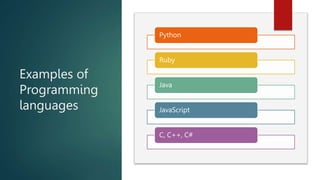
Examples of
Programming
languages
Python
Ruby
Java
JavaScript
C, C++, C#
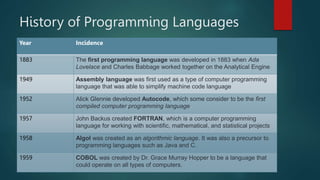
History of Programming Languages
Year Incidence
1883 The first programming language was developed in 1883 when Ada
Lovelace and Charles Babbage worked together on the Analytical Engine
1949 Assembly language was first used as a type of computer programming
language that was able to simplify machine code language
1952 Alick Glennie developed Autocode, which some consider to be the first
compiled computer programming language
1957 John Backus created FORTRAN, which is a computer programming
language for working with scientific, mathematical, and statistical projects
1958 Algol was created as an algorithmic language. It was also a precursor to
programming languages such as Java and C.
1959 COBOL was created by Dr. Grace Murray Hopper to be a language that
could operate on all types of computers.
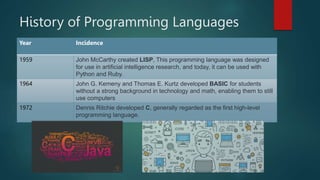
History of Programming Languages
Year Incidence
1959 John McCarthy created LISP, This programming language was designed
for use in artificial intelligence research, and today, it can be used with
Python and Ruby.
1964 John G. Kemeny and Thomas E. Kurtz developed BASIC for students
without a strong background in technology and math, enabling them to still
use computers
1972 Dennis Ritchie developed C, generally regarded as the first high-level
programming language.
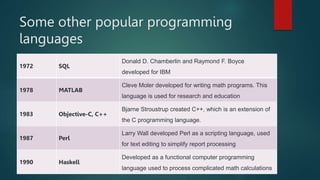
Some other popular programming
languages
1972 SQL
Donald D. Chamberlin and Raymond F. Boyce
developed for IBM
1978 MATLAB
Cleve Moler developed for writing math programs. This
language is used for research and education
1983 Objective-C, C++
Bjarne Stroustrup created C++, which is an extension of
the C programming language.
1987 Perl
Larry Wall developed Perl as a scripting language, used
for text editing to simplify report processing
1990 Haskell
Developed as a functional computer programming
language used to process complicated math calculations
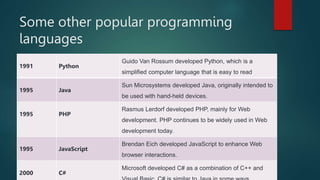
Some other popular programming
languages
1991 Python
Guido Van Rossum developed Python, which is a
simplified computer language that is easy to read
1995 Java
Sun Microsystems developed Java, originally intended to
be used with hand-held devices.
1995 PHP
Rasmus Lerdorf developed PHP, mainly for Web
development. PHP continues to be widely used in Web
development today.
1995 JavaScript
Brendan Eich developed JavaScript to enhance Web
browser interactions.
2000 C#
Microsoft developed C# as a combination of C++ and
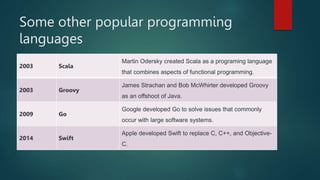
Some other popular programming
languages
2003 Scala
Martin Odersky created Scala as a programing language
that combines aspects of functional programming.
2003 Groovy
James Strachan and Bob McWhirter developed Groovy
as an offshoot of Java.
2009 Go
Google developed Go to solve issues that commonly
occur with large software systems.
2014 Swift
Apple developed Swift to replace C, C++, and Objective-
C.
Generation of Programming Languages
The first-generation languages are also called machine languages. This language is
machine-dependent.
written in binary code (0/1 form) because the computer can understand only binary
language.
Advantages
 Fast & efficient as statements are
directly written in binary language.
 No translator is required.
Disadvantages
 Difficult to learn binary codes.
 Difficult to understand – both programs &
where the error occurred.
First Generation Language
The second-generation languages are also called assembler languages.
Assembly language contains human-readable notations.
Assembler – converts assembly level instructions to machine level instructions.
Advantages
 It is easier to understand if compared
to machine language
 Modifications are easy
 Correction & location of errors are
easy
Disadvantages
 Assembler is required
 This language is machine-dependent, with
a different instruction set for different
machines.
Second Generation Language
It also called procedural language. It consists of the use of a series of English-like words
that humans can understand easily, to write instructions.
For execution, a program in this language needs to be translated into machine language
using Compiler/ Interpreter.
Ex: C, PASCAL, FORTRAN, COBOL, etc.
Advantages
 Use of English-like words makes it a
human-understandable language.
 Lesser number of lines of code as
compared to above 2 languages
 Same code can be copied to another
machine & compiler-specific to that
machine.
Disadvantages
 Compiler/ interpreter is needed
 Different compilers are needed for
different machines
Third Generation Language
The fourth-generation language is also called a non – procedural language/ 4GL. It enables
users to access the database. Examples: SQL, Foxpro, Focus, etc.
These languages are also human-friendly to understand.
Advantages
 Easy to understand & learn
 Less time required for application
creation
 It is less prone to errors
Disadvantages
 Memory consumption is high
 Has poor control over Hardware
 Less flexible
Fourth Generation Language
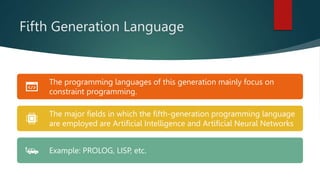
Fifth Generation Language
The programming languages of this generation mainly focus on
constraint programming.
The major fields in which the fifth-generation programming language
are employed are Artificial Intelligence and Artificial Neural Networks
Example: PROLOG, LISP, etc.
Advantages :
Machines can make decisions.
Programmer effort reduces to solve a problem.
Easier than 3GL or 4GL to learn and use.
Disadvantages :
Complex and long code.
More resources are required & they are expensive too.
Thank You

Programming Language Evolution

  • 1.
    Programming Language Evolution M. A. K.DHANANJAYA 2020/PAS/ICT/M/041
  • 2.
    What is aProgramming language? A PROGRAMMING LANGUAGE IS A TYPE OF WRITTEN LANGUAGE THAT TELLS COMPUTERS WHAT TO DO
  • 3.
  • 4.
    History of ProgrammingLanguages Year Incidence 1883 The first programming language was developed in 1883 when Ada Lovelace and Charles Babbage worked together on the Analytical Engine 1949 Assembly language was first used as a type of computer programming language that was able to simplify machine code language 1952 Alick Glennie developed Autocode, which some consider to be the first compiled computer programming language 1957 John Backus created FORTRAN, which is a computer programming language for working with scientific, mathematical, and statistical projects 1958 Algol was created as an algorithmic language. It was also a precursor to programming languages such as Java and C. 1959 COBOL was created by Dr. Grace Murray Hopper to be a language that could operate on all types of computers.
  • 5.
    History of ProgrammingLanguages Year Incidence 1959 John McCarthy created LISP, This programming language was designed for use in artificial intelligence research, and today, it can be used with Python and Ruby. 1964 John G. Kemeny and Thomas E. Kurtz developed BASIC for students without a strong background in technology and math, enabling them to still use computers 1972 Dennis Ritchie developed C, generally regarded as the first high-level programming language.
  • 6.
    Some other popularprogramming languages 1972 SQL Donald D. Chamberlin and Raymond F. Boyce developed for IBM 1978 MATLAB Cleve Moler developed for writing math programs. This language is used for research and education 1983 Objective-C, C++ Bjarne Stroustrup created C++, which is an extension of the C programming language. 1987 Perl Larry Wall developed Perl as a scripting language, used for text editing to simplify report processing 1990 Haskell Developed as a functional computer programming language used to process complicated math calculations
  • 7.
    Some other popularprogramming languages 1991 Python Guido Van Rossum developed Python, which is a simplified computer language that is easy to read 1995 Java Sun Microsystems developed Java, originally intended to be used with hand-held devices. 1995 PHP Rasmus Lerdorf developed PHP, mainly for Web development. PHP continues to be widely used in Web development today. 1995 JavaScript Brendan Eich developed JavaScript to enhance Web browser interactions. 2000 C# Microsoft developed C# as a combination of C++ and
  • 8.
    Some other popularprogramming languages 2003 Scala Martin Odersky created Scala as a programing language that combines aspects of functional programming. 2003 Groovy James Strachan and Bob McWhirter developed Groovy as an offshoot of Java. 2009 Go Google developed Go to solve issues that commonly occur with large software systems. 2014 Swift Apple developed Swift to replace C, C++, and Objective- C.
  • 9.
  • 10.
    The first-generation languagesare also called machine languages. This language is machine-dependent. written in binary code (0/1 form) because the computer can understand only binary language. Advantages  Fast & efficient as statements are directly written in binary language.  No translator is required. Disadvantages  Difficult to learn binary codes.  Difficult to understand – both programs & where the error occurred. First Generation Language
  • 11.
    The second-generation languagesare also called assembler languages. Assembly language contains human-readable notations. Assembler – converts assembly level instructions to machine level instructions. Advantages  It is easier to understand if compared to machine language  Modifications are easy  Correction & location of errors are easy Disadvantages  Assembler is required  This language is machine-dependent, with a different instruction set for different machines. Second Generation Language
  • 12.
    It also calledprocedural language. It consists of the use of a series of English-like words that humans can understand easily, to write instructions. For execution, a program in this language needs to be translated into machine language using Compiler/ Interpreter. Ex: C, PASCAL, FORTRAN, COBOL, etc. Advantages  Use of English-like words makes it a human-understandable language.  Lesser number of lines of code as compared to above 2 languages  Same code can be copied to another machine & compiler-specific to that machine. Disadvantages  Compiler/ interpreter is needed  Different compilers are needed for different machines Third Generation Language
  • 13.
    The fourth-generation languageis also called a non – procedural language/ 4GL. It enables users to access the database. Examples: SQL, Foxpro, Focus, etc. These languages are also human-friendly to understand. Advantages  Easy to understand & learn  Less time required for application creation  It is less prone to errors Disadvantages  Memory consumption is high  Has poor control over Hardware  Less flexible Fourth Generation Language
  • 14.
    Fifth Generation Language Theprogramming languages of this generation mainly focus on constraint programming. The major fields in which the fifth-generation programming language are employed are Artificial Intelligence and Artificial Neural Networks Example: PROLOG, LISP, etc.
  • 15.
    Advantages : Machines canmake decisions. Programmer effort reduces to solve a problem. Easier than 3GL or 4GL to learn and use. Disadvantages : Complex and long code. More resources are required & they are expensive too.
  • 16.