
Programming Language Evolution
What is a programming language ?
• A programming language is a type of written
language that tells computers what to do
Examples ?
• Python,
• Ruby,
• Java,
• JavaScript,
• C, C++, C#
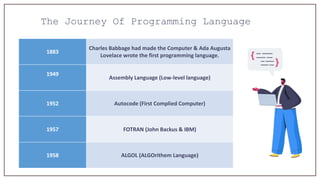
The Journey Of Programming Language
1883
Charles Babbage had made the Computer & Ada Augusta
Lovelace wrote the first programming language.
1949
Assembly Language (Low-level language)
1952 Autocode (First Complied Computer)
1957 FOTRAN (John Backus & IBM)
1958 ALGOL (ALGOrithem Language)
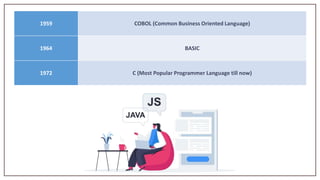
1959 COBOL (Common Business Oriented Language)
1964 BASIC
1972 C (Most Popular Programmer Language till now)
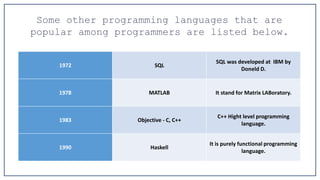
Some other programming languages that are
popular among programmers are listed below.
1972 SQL
SQL was developed at IBM by
Doneld D.
1978 MATLAB It stand for Matrix LABoratory.
1983 Objective - C, C++
C++ Hight level programming
language.
1990 Haskell
It is purely functional programming
language.
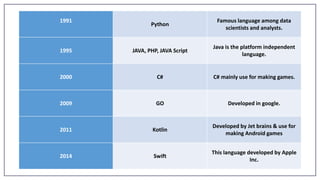
1991
Python
Famous language among data
scientists and analysts.
1995 JAVA, PHP, JAVA Script
Java is the platform independent
language.
2000 C# C# mainly use for making games.
2009 GO Developed in google.
2011 Kotlin
Developed by Jet brains & use for
making Android games
2014 Swift
This language developed by Apple
Inc.
Generations Of Programming
Language
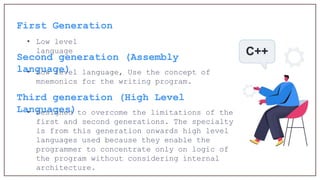
• Low level
language
First Generation
Second generation (Assembly
language)
• Low level language, Use the concept of
mnemonics for the writing program.
Third generation (High Level
Languages)
• Designed to overcome the limitations of the
first and second generations. The specialty
is from this generation onwards high level
languages used because they enable the
programmer to concentrate only on logic of
the program without considering internal
architecture.
• Mainly focus on constraint
programming. Major fields are
artificial intelligence &
artificial neural network.
Ex: mercury, prolog, OPS5
Fourth generation(Very High Level
Languages)
Fifth generation
• Designed to reduce the time, cost
& effort needed to develop types
of software applications.
Ex: SQL, CSS, ColdFusion
N.K.D.Prasad
2020/PAS/ICT/M/025
ICT 1-1

Programming Language Evolution.pptx

  • 1.
  • 2.
    What is aprogramming language ? • A programming language is a type of written language that tells computers what to do Examples ? • Python, • Ruby, • Java, • JavaScript, • C, C++, C#
  • 3.
    The Journey OfProgramming Language 1883 Charles Babbage had made the Computer & Ada Augusta Lovelace wrote the first programming language. 1949 Assembly Language (Low-level language) 1952 Autocode (First Complied Computer) 1957 FOTRAN (John Backus & IBM) 1958 ALGOL (ALGOrithem Language)
  • 4.
    1959 COBOL (CommonBusiness Oriented Language) 1964 BASIC 1972 C (Most Popular Programmer Language till now)
  • 5.
    Some other programminglanguages that are popular among programmers are listed below. 1972 SQL SQL was developed at IBM by Doneld D. 1978 MATLAB It stand for Matrix LABoratory. 1983 Objective - C, C++ C++ Hight level programming language. 1990 Haskell It is purely functional programming language.
  • 6.
    1991 Python Famous language amongdata scientists and analysts. 1995 JAVA, PHP, JAVA Script Java is the platform independent language. 2000 C# C# mainly use for making games. 2009 GO Developed in google. 2011 Kotlin Developed by Jet brains & use for making Android games 2014 Swift This language developed by Apple Inc.
  • 7.
  • 8.
    • Low level language FirstGeneration Second generation (Assembly language) • Low level language, Use the concept of mnemonics for the writing program. Third generation (High Level Languages) • Designed to overcome the limitations of the first and second generations. The specialty is from this generation onwards high level languages used because they enable the programmer to concentrate only on logic of the program without considering internal architecture.
  • 9.
    • Mainly focuson constraint programming. Major fields are artificial intelligence & artificial neural network. Ex: mercury, prolog, OPS5 Fourth generation(Very High Level Languages) Fifth generation • Designed to reduce the time, cost & effort needed to develop types of software applications. Ex: SQL, CSS, ColdFusion
  • 10.