DENSITY GRADIENT
CENTRIFUGATION
Submitted to : Akansha lal Madam
Submitted by : Purnima Upadhyay
Msc Biotechnology IInd sem
Overview : Density
Gradient Centrifugation
Centrifugation
01
Density Gradient
Centrifugation
02
Rate zonal centrifugation
03
Isopycnic Centrifugation
04
CONTENTS
Difference
05
Application
06
07
Centrifugation
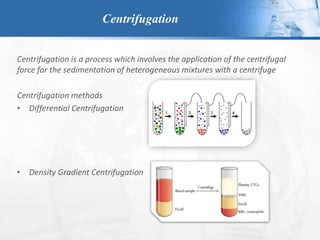
Centrifugation is a process which involves the application of the centrifugal
force for the sedimentation of heterogeneous mixtures with a centrifuge
Centrifugation methods
• Differential Centrifugation
• Density Gradient Centrifugation
Density Gradient Centrifugation
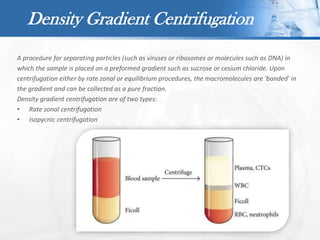
A procedure for separating particles (such as viruses or ribosomes or molecules such as DNA) in
which the sample is placed on a preformed gradient such as sucrose or cesium chloride. Upon
centrifugation either by rate zonal or equilibrium procedures, the macromolecules are 'banded' in
the gradient and can be collected as a pure fraction.
Density gradient centrifugation are of two types:
• Rate zonal centrifugation
• Isopycnic centrifugation
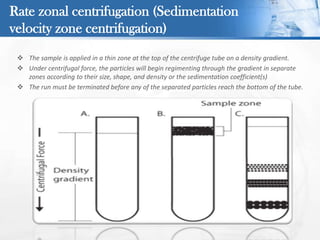
 The sample is applied in a thin zone at the top of the centrifuge tube on a density gradient.
 Under centrifugal force, the particles will begin regimenting through the gradient in separate
zones according to their size, shape, and density or the sedimentation coefficient(s)
 The run must be terminated before any of the separated particles reach the bottom of the tube.
Rate zonal centrifugation (Sedimentation
velocity zone centrifugation)
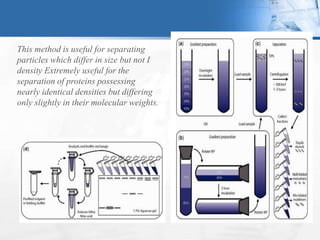
This method is useful for separating
particles which differ in size but not I
density Extremely useful for the
separation of proteins possessing
nearly identical densities but differing
only slightly in their molecular weights.
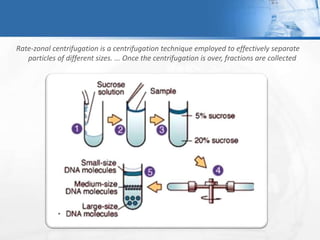
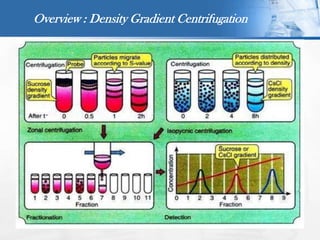
Rate-zonal centrifugation is a centrifugation technique employed to effectively separate
particles of different sizes. ... Once the centrifugation is over, fractions are collected
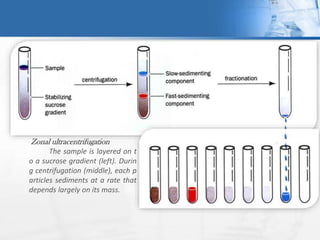
Zonal ultracentrifugation
The sample is layered on t
o a sucrose gradient (left). Durin
g centrifugation (middle), each p
articles sediments at a rate that
depends largely on its mass.
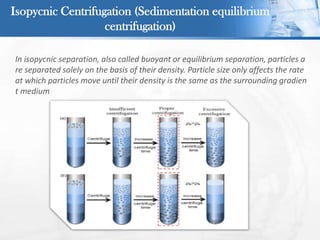
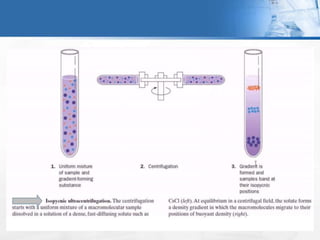
In isopycnic separation, also called buoyant or equilibrium separation, particles a
re separated solely on the basis of their density. Particle size only affects the rate
at which particles move until their density is the same as the surrounding gradien
t medium
Isopycnic Centrifugation (Sedimentation equilibrium
centrifugation)
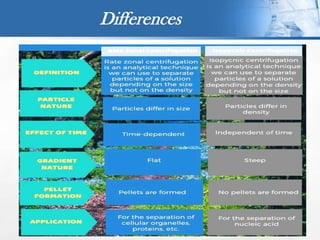
Differences
Overview : Density Gradient Centrifugation
 Purification of particles separated by differential centrifugation
 Isolation of enzymes
 Purification and separation of viruses(pox viruses),bacteria…
 Purification and separation of proteins
 Separation of biomolecules
 Separation of RNA – DNA hybrids and ribosomal subunits
 Separation of antibodies and viruse
Applications
Density gradient centrifugation

Density gradient centrifugation

  • 1.
    DENSITY GRADIENT CENTRIFUGATION Submitted to: Akansha lal Madam Submitted by : Purnima Upadhyay Msc Biotechnology IInd sem
  • 2.
    Overview : Density GradientCentrifugation Centrifugation 01 Density Gradient Centrifugation 02 Rate zonal centrifugation 03 Isopycnic Centrifugation 04 CONTENTS Difference 05 Application 06 07
  • 3.
    Centrifugation Centrifugation is aprocess which involves the application of the centrifugal force for the sedimentation of heterogeneous mixtures with a centrifuge Centrifugation methods • Differential Centrifugation • Density Gradient Centrifugation
  • 4.
    Density Gradient Centrifugation Aprocedure for separating particles (such as viruses or ribosomes or molecules such as DNA) in which the sample is placed on a preformed gradient such as sucrose or cesium chloride. Upon centrifugation either by rate zonal or equilibrium procedures, the macromolecules are 'banded' in the gradient and can be collected as a pure fraction. Density gradient centrifugation are of two types: • Rate zonal centrifugation • Isopycnic centrifugation
  • 5.
     The sampleis applied in a thin zone at the top of the centrifuge tube on a density gradient.  Under centrifugal force, the particles will begin regimenting through the gradient in separate zones according to their size, shape, and density or the sedimentation coefficient(s)  The run must be terminated before any of the separated particles reach the bottom of the tube. Rate zonal centrifugation (Sedimentation velocity zone centrifugation)
  • 6.
    This method isuseful for separating particles which differ in size but not I density Extremely useful for the separation of proteins possessing nearly identical densities but differing only slightly in their molecular weights.
  • 7.
    Rate-zonal centrifugation isa centrifugation technique employed to effectively separate particles of different sizes. ... Once the centrifugation is over, fractions are collected
  • 8.
    Zonal ultracentrifugation The sampleis layered on t o a sucrose gradient (left). Durin g centrifugation (middle), each p articles sediments at a rate that depends largely on its mass.
  • 9.
    In isopycnic separation,also called buoyant or equilibrium separation, particles a re separated solely on the basis of their density. Particle size only affects the rate at which particles move until their density is the same as the surrounding gradien t medium Isopycnic Centrifugation (Sedimentation equilibrium centrifugation)
  • 11.
  • 12.
    Overview : DensityGradient Centrifugation
  • 13.
     Purification ofparticles separated by differential centrifugation  Isolation of enzymes  Purification and separation of viruses(pox viruses),bacteria…  Purification and separation of proteins  Separation of biomolecules  Separation of RNA – DNA hybrids and ribosomal subunits  Separation of antibodies and viruse Applications