What’s My Noun?
Adjective/Noun
next
Taking the Fear
out of Math
© Math As A Second Language All Rights Reserved
Quantities
vs.
Numbers
In our previous lesson, we
emphasized the importance of this fact…
nextnext
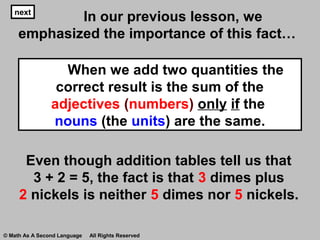
Even though addition tables tell us that
3 + 2 = 5, the fact is that 3 dimes plus
2 nickels is neither 5 dimes nor 5 nickels.
next
© Math As A Second Language All Rights Reserved
When we add two quantities the
correct result is the sum of the
adjectives (numbers) only if the
nouns (the units) are the same.
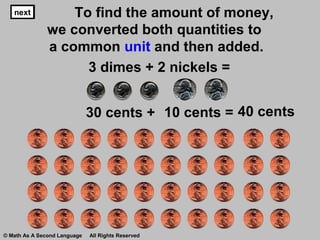
nextnext To find the amount of money,
we converted both quantities to
a common unit and then added.
3 dimes + 2 nickels =
30 cents + 40 cents
nextnext
10 cents =
next
© Math As A Second Language All Rights Reserved
nextnext
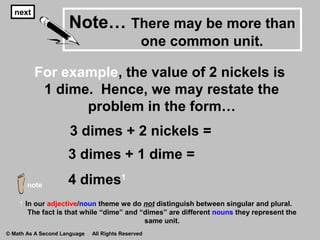
For example, the value of 2 nickels is
1 dime. Hence, we may restate the
problem in the form…
3 dimes + 2 nickels =
3 dimes + 1 dime =
4 dimes1
Note… There may be more than
one common unit.
note
1
In our adjective/noun theme we do not distinguish between singular and plural.
The fact is that while “dime” and “dimes” are different nouns they represent the
same unit.
next
© Math As A Second Language All Rights Reserved
nextnext
And even though 40, 4, and 8 are different
adjectives (numbers), 40 cents, 4 dimes
and 8 nickels all describe the same
quantity.
3 dimes + 2 nickels =
6 nickels + 2 nickels =
8 nickels
We could also have used nickels as
the common unit, in which case we could
have replaced 3 dimes by 6 nickels
to obtain…
© Math As A Second Language All Rights Reserved
A Preview of
Coming Attractions
At first glance, our emphasis on the
adjective/noun theme might seem like
little more than just a novelty, but as we
will see throughout the study of
arithmetic, this theme can greatly improve
students’ ability to internalize
all of arithmetic.
next
© Math As A Second Language All Rights Reserved
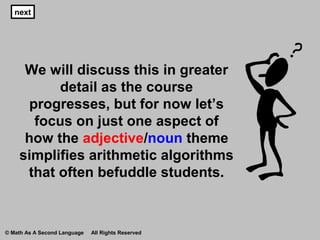
We will discuss this in greater
detail as the course
progresses, but for now let’s
focus on just one aspect of
how the adjective/noun theme
simplifies arithmetic algorithms
that often befuddle students.
next
© Math As A Second Language All Rights Reserved
nextnext
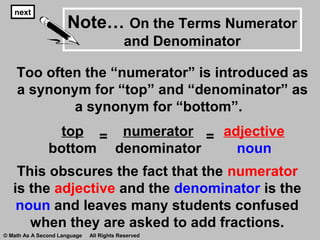
Too often the “numerator” is introduced as
a synonym for “top” and “denominator” as
a synonym for “bottom”.
Note… On the Terms Numerator
and Denominator
© Math As A Second Language All Rights Reserved
This obscures the fact that the numerator
is the adjective and the denominator is the
noun and leaves many students confused
when they are asked to add fractions.
top
bottom
numerator
denominator
adjective
noun
= =
nextnext
When adding two fractions, students
feel it is more natural to add the two
numerators to obtain the numerator of the
sum and to add the two denominators to
obtain the denominator of the sum.
For example, they would prefer that adding
1
/2 + 1
/2 would mean to do the following…
© Math As A Second Language All Rights Reserved
2
4
1
2
1
2
+ = 1 + 1
2 + 2
=
…which is a result that they will most
likely recognize as being incorrect”.
nextnext
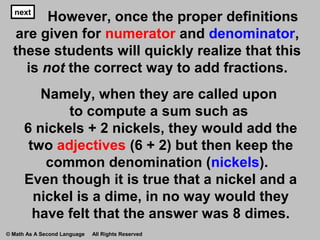
However, once the proper definitions
are given for numerator and denominator,
these students will quickly realize that this
is not the correct way to add fractions.
Namely, when they are called upon
to compute a sum such as
6 nickels + 2 nickels, they would add the
two adjectives (6 + 2) but then keep the
common denomination (nickels).
Even though it is true that a nickel and a
nickel is a dime, in no way would they
have felt that the answer was 8 dimes.
© Math As A Second Language All Rights Reserved
Guess My Noun
next
Guess My Noun is a fun way to
reinforce the notion of the
adjective/noun theme and how
3 + 2 = 40 can be a true statement.
next
For example, if there are certain facts you
want the students to know (such as the fact
that 7 days = 1 week) you might ask them to
supply the nouns for…
7 ______ = 1 ______.
© Math As A Second Language All Rights Reserved
next
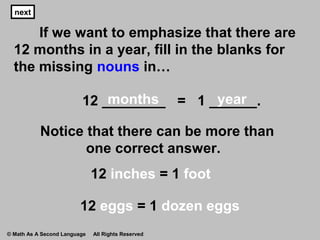
If we want to emphasize that there are
12 months in a year, fill in the blanks for
the missing nouns in…
12 ________ = 1 ______.
Notice that there can be more than
one correct answer.
next
12 inches = 1 foot
nextnextnext
months year
12 eggs = 1 dozen eggs
© Math As A Second Language All Rights Reserved
next
You might wonder why 12 was chosen
rather than 10 for the number of inches
in a foot. Such a question can lead to
the “discovery” of whole number
fractional parts.
next
For example, since “teen” means plus ten,
one might naturally assume that the first
teen should come after ten. That is, the
number we call eleven should have been
called “oneteen”.
next
© Math As A Second Language All Rights Reserved
So why does the first teen come after
twelve not ten?
next
As surprising as it might seem, the
concept of ten was not considered to be
important until the advent of place value.
next
Until that time, people preferred to avoid
the need for using fractions whenever
possible. Therefore, since 12 had more
proper divisors than 10, it meant that by
having a foot consist of 12 inches, more
fractional parts of a foot would be a
whole number than if there had been
10 inches in a foot.
© Math As A Second Language All Rights Reserved
next
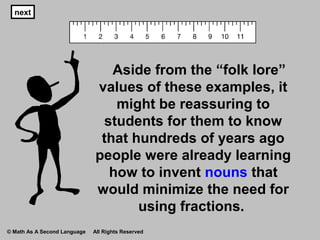
Aside from the “folk lore”
values of these examples, it
might be reassuring to
students for them to know
that hundreds of years ago
people were already learning
how to invent nouns that
would minimize the need for
using fractions.
© Math As A Second Language All Rights Reserved
next
You may prefer additional examples, and
you should feel free to create problems of
your own choosing. Students also may
want to create their own problems to
challenge their classmates.
next
© Math As A Second Language All Rights Reserved
Depending on the grade level you can ask
more difficult questions by having the
students add different quantities such as…
2 _____ + 12 ______ = 1 ______feet inches yard
next
next
Examples such as 3 + 2 = 40 are too
sophisticated for children in grades K – 2.
Instead, colored rods of different lengths
may help to reinforce the adjective/noun
theme at the lower grade levels.
nextnext
© Math As A Second Language All Rights Reserved
next
From a different perspective,
you could see that…
next
1 blue rod = 12 red rods
1 blue rod = 6 green rods
next
© Math As A Second Language All Rights Reserved
nextnext
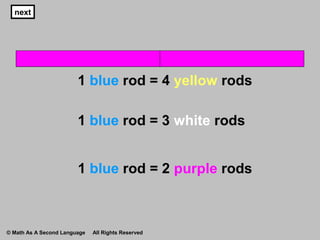
1 blue rod = 4 yellow rods
1 blue rod = 3 white rods
next
1 blue rod = 2 purple rods
© Math As A Second Language All Rights Reserved
next
Therefore…
next
2=1
3=1
4=1
6=
1
nextnext
© Math As A Second Language All Rights Reserved
nextnext
12
1
2
3
4
6 6
4 4
3 3 3
2 2 2 2 2
1 1 1 1 1 1 1 1 1 1 1
In summary…
nextnextnextnextnextnext
© Math As A Second Language All Rights Reserved
next
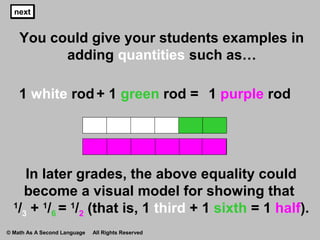
You could give your students examples in
adding quantities such as…
next
1 white rod 1 purple rod+ 1 green rod =
nextnext
In later grades, the above equality could
become a visual model for showing that
1
/3 + 1
/6 = 1
/2 (that is, 1 third + 1 sixth = 1 half).
nextnext
© Math As A Second Language All Rights Reserved
next
Another example might be…
next
5 red rods 3 yellow rods+ 1 white rod =
nextnext
(that is, 5 twelfths + 1 third = 3 fourths)
nextnext
© Math As A Second Language All Rights Reserved
next
If time is limited, assign them as
homework under the heading of such
phrases as “Fun With Math” and make sure
that students know that it is just for fun and
that they will not be graded. Rather they
should be encouraged to work on the
problems and share their results with the
class (as time permits).
Guess My Noun
© Math As A Second Language All Rights Reserved
Guess My Noun
next
We know that you are under pressure to
cover a certain amount of prescribed
content, and that as a result you may feel
that there is no time for such “games” in
your class. However, our approach to
helping students to better internalize
mathematics hinges on their thorough
grasp of adding quantities using the
adjective/noun theme, and the previous
examples are fun ways in which to learn.
© Math As A Second Language All Rights Reserved

#1 t quantities vs. numbers adjective noun

  • 1.
    What’s My Noun? Adjective/Noun next Takingthe Fear out of Math © Math As A Second Language All Rights Reserved Quantities vs. Numbers
  • 2.
    In our previouslesson, we emphasized the importance of this fact… nextnext Even though addition tables tell us that 3 + 2 = 5, the fact is that 3 dimes plus 2 nickels is neither 5 dimes nor 5 nickels. next © Math As A Second Language All Rights Reserved When we add two quantities the correct result is the sum of the adjectives (numbers) only if the nouns (the units) are the same.
  • 3.
    nextnext To findthe amount of money, we converted both quantities to a common unit and then added. 3 dimes + 2 nickels = 30 cents + 40 cents nextnext 10 cents = next © Math As A Second Language All Rights Reserved
  • 4.
    nextnext For example, thevalue of 2 nickels is 1 dime. Hence, we may restate the problem in the form… 3 dimes + 2 nickels = 3 dimes + 1 dime = 4 dimes1 Note… There may be more than one common unit. note 1 In our adjective/noun theme we do not distinguish between singular and plural. The fact is that while “dime” and “dimes” are different nouns they represent the same unit. next © Math As A Second Language All Rights Reserved
  • 5.
    nextnext And even though40, 4, and 8 are different adjectives (numbers), 40 cents, 4 dimes and 8 nickels all describe the same quantity. 3 dimes + 2 nickels = 6 nickels + 2 nickels = 8 nickels We could also have used nickels as the common unit, in which case we could have replaced 3 dimes by 6 nickels to obtain… © Math As A Second Language All Rights Reserved
  • 6.
    A Preview of ComingAttractions At first glance, our emphasis on the adjective/noun theme might seem like little more than just a novelty, but as we will see throughout the study of arithmetic, this theme can greatly improve students’ ability to internalize all of arithmetic. next © Math As A Second Language All Rights Reserved
  • 7.
    We will discussthis in greater detail as the course progresses, but for now let’s focus on just one aspect of how the adjective/noun theme simplifies arithmetic algorithms that often befuddle students. next © Math As A Second Language All Rights Reserved
  • 8.
    nextnext Too often the“numerator” is introduced as a synonym for “top” and “denominator” as a synonym for “bottom”. Note… On the Terms Numerator and Denominator © Math As A Second Language All Rights Reserved This obscures the fact that the numerator is the adjective and the denominator is the noun and leaves many students confused when they are asked to add fractions. top bottom numerator denominator adjective noun = =
  • 9.
    nextnext When adding twofractions, students feel it is more natural to add the two numerators to obtain the numerator of the sum and to add the two denominators to obtain the denominator of the sum. For example, they would prefer that adding 1 /2 + 1 /2 would mean to do the following… © Math As A Second Language All Rights Reserved 2 4 1 2 1 2 + = 1 + 1 2 + 2 = …which is a result that they will most likely recognize as being incorrect”.
  • 10.
    nextnext However, once theproper definitions are given for numerator and denominator, these students will quickly realize that this is not the correct way to add fractions. Namely, when they are called upon to compute a sum such as 6 nickels + 2 nickels, they would add the two adjectives (6 + 2) but then keep the common denomination (nickels). Even though it is true that a nickel and a nickel is a dime, in no way would they have felt that the answer was 8 dimes. © Math As A Second Language All Rights Reserved
  • 11.
    Guess My Noun next GuessMy Noun is a fun way to reinforce the notion of the adjective/noun theme and how 3 + 2 = 40 can be a true statement. next For example, if there are certain facts you want the students to know (such as the fact that 7 days = 1 week) you might ask them to supply the nouns for… 7 ______ = 1 ______. © Math As A Second Language All Rights Reserved
  • 12.
    next If we wantto emphasize that there are 12 months in a year, fill in the blanks for the missing nouns in… 12 ________ = 1 ______. Notice that there can be more than one correct answer. next 12 inches = 1 foot nextnextnext months year 12 eggs = 1 dozen eggs © Math As A Second Language All Rights Reserved
  • 13.
    next You might wonderwhy 12 was chosen rather than 10 for the number of inches in a foot. Such a question can lead to the “discovery” of whole number fractional parts. next For example, since “teen” means plus ten, one might naturally assume that the first teen should come after ten. That is, the number we call eleven should have been called “oneteen”. next © Math As A Second Language All Rights Reserved So why does the first teen come after twelve not ten?
  • 14.
    next As surprising asit might seem, the concept of ten was not considered to be important until the advent of place value. next Until that time, people preferred to avoid the need for using fractions whenever possible. Therefore, since 12 had more proper divisors than 10, it meant that by having a foot consist of 12 inches, more fractional parts of a foot would be a whole number than if there had been 10 inches in a foot. © Math As A Second Language All Rights Reserved
  • 15.
    next Aside from the“folk lore” values of these examples, it might be reassuring to students for them to know that hundreds of years ago people were already learning how to invent nouns that would minimize the need for using fractions. © Math As A Second Language All Rights Reserved
  • 16.
    next You may preferadditional examples, and you should feel free to create problems of your own choosing. Students also may want to create their own problems to challenge their classmates. next © Math As A Second Language All Rights Reserved Depending on the grade level you can ask more difficult questions by having the students add different quantities such as… 2 _____ + 12 ______ = 1 ______feet inches yard next
  • 17.
    next Examples such as3 + 2 = 40 are too sophisticated for children in grades K – 2. Instead, colored rods of different lengths may help to reinforce the adjective/noun theme at the lower grade levels. nextnext © Math As A Second Language All Rights Reserved
  • 18.
    next From a differentperspective, you could see that… next 1 blue rod = 12 red rods 1 blue rod = 6 green rods next © Math As A Second Language All Rights Reserved
  • 19.
    nextnext 1 blue rod= 4 yellow rods 1 blue rod = 3 white rods next 1 blue rod = 2 purple rods © Math As A Second Language All Rights Reserved
  • 20.
  • 21.
    nextnext 12 1 2 3 4 6 6 4 4 33 3 2 2 2 2 2 1 1 1 1 1 1 1 1 1 1 1 In summary… nextnextnextnextnextnext © Math As A Second Language All Rights Reserved
  • 22.
    next You could giveyour students examples in adding quantities such as… next 1 white rod 1 purple rod+ 1 green rod = nextnext In later grades, the above equality could become a visual model for showing that 1 /3 + 1 /6 = 1 /2 (that is, 1 third + 1 sixth = 1 half). nextnext © Math As A Second Language All Rights Reserved
  • 23.
    next Another example mightbe… next 5 red rods 3 yellow rods+ 1 white rod = nextnext (that is, 5 twelfths + 1 third = 3 fourths) nextnext © Math As A Second Language All Rights Reserved
  • 24.
    next If time islimited, assign them as homework under the heading of such phrases as “Fun With Math” and make sure that students know that it is just for fun and that they will not be graded. Rather they should be encouraged to work on the problems and share their results with the class (as time permits). Guess My Noun © Math As A Second Language All Rights Reserved
  • 25.
    Guess My Noun next Weknow that you are under pressure to cover a certain amount of prescribed content, and that as a result you may feel that there is no time for such “games” in your class. However, our approach to helping students to better internalize mathematics hinges on their thorough grasp of adding quantities using the adjective/noun theme, and the previous examples are fun ways in which to learn. © Math As A Second Language All Rights Reserved