1
Breaking Paradigms in old Fields. Finding “the reservoir key” for
Mature Fields Redevelopment, Part I: Reviewing infill projects in
complex reservoirs
Juan Diego Suarez Fromm
Jun 29th 2016
KW: Infill, Managed Pressure Drilling, HPHT gas, Chicontepec
“Progress is impossible without change, and those who cannot change their
minds cannot change anything”. George Bernard Shaw
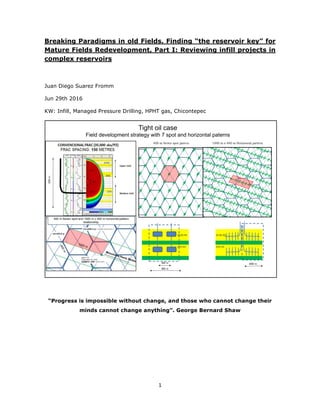
Z140-85 Z140-85
Z70-45 Z70-45
400 m Seven spot patern 1000 m x 400 m Horizontal pattern
400 m 1000 m
800 m
Tight oil case
Field development strategy with 7 spot and horizontal paterns
2
1. Introduction
The Oil and Gas industry has probably endured a permanent change: oil prices might
never recover to 2010-2014 boom prices [1,2]
.
From the Oil and Gas Operators’ point of view, reengineering processes, layoffs,
projects delays, contract negotiations with service providers and operating cost
reductions has been put in action and will likely continue in the near future [3]
.
During this year, the focus has changed from Exploration / Development to that of cost
& production optimization and the upcoming years will probably require greater efforts
in Mature Fields redevelopment.
A well-known technique is that of infill optimization [4,5]
- a field development strategy
that can be defined as “well spacing reduction in order to accelerate and increase
petroleum recovery factor through optimal cost effective and wellbore placement in a
reservoir”.
Some advantages for infill strategy are as follows:
 Minimum petroleum system uncertainty. The Petroleum accumulation is proved,
petrophysical / geo-mechanical rock properties, reservoir fluids, downhole
pressures, and base productivity are usually known within a limited range. So
we should be working with 2P reserves development.
 Minimum operational risk for specific wellbore designs and some completions
standards used in the field.
On the other hand, some disadvantages include:
 Paradigms on field development to be changed;
 Field history data availability;
 In general, greater subsurface team effort is needed for integration and
evaluation of reservoir models, compared to Appraisal / Initial Field
Development.
Upsides could be overlooked due to paradigms on field development. The
successful one in terms of reserves and cost effective capital expenditure
could be visualized as “finding the key for the field”. But as development
takes place over many years (decades), the “key” should be a dynamic
concept over time, correlated with technology availability, enabling us a
better understanding of petroleum resources size, quality and distribution.
Two field examples will be presented, where after 50 years of development; fresh oil
and gas were produced by changing some reservoir paradigms.
3
2. Gas & Condensate case
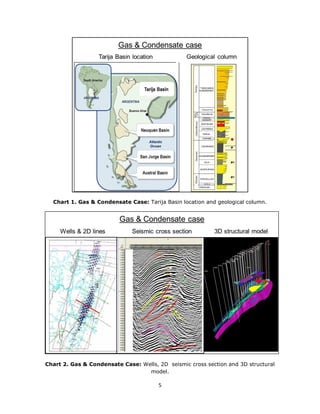
First case is about Mature Gas & Condensate Field in North Argentina. It belongs to
Tarija basin, a Palaeozoic deep thrust belt deposits from Carboniferous geological age
[6,7,8]
.
The reservoir has 3 stratigraphic units, gross thickness is about 400 meters of altering
tight sandstones and shales, in multi faulted anticline structure.
Exploration and appraisal phase started in late 50’s, where main development took
place in 60’s decade with about 60 wells drilled, 70% gas reserves were delimited and
80% were put onto production, achieving 5 years plateau of 180 MMpc/d gas and 7500
bpd condensate. During 70's decade, field production declined as a mature field.
Finally a reinjection gas project was implemented from early 80’s over 20 years due to
low commercial gas value in the region, shutting field production. Meanwhile, field
operator changed in 90’s and started to produce condensate wells, keeping dry gas
injection.
During this time, operators applied good practices reservoir management by
monitoring downhole static and flowing pressures in open and closed wells, producers
and injectors during almost 50 years of history.
After detailed structural settings reinterpretation (integration of surface geology,
seismic markers, well logs and section restoration analysis), the redevelopment started
in late 90’s with the successful appraisal well placement in a new deeper block,
allowing the operator to booked new gas, condensate and oil reserves.
Over 1990 decade, only 5 wells were drilled and put onto production with relative
success due to formation impairment associated with partially depleted regions,
resulting in halting the drilling campaign in 2005.
In the subsequent years, the lack off a consistent productivity / reserves model, turned
out to inconclusive postmortem, increasing technical risk and therefore lowering
economical attractiveness for new wells. So, field started again to decline production,
undergoing for second time the mature stage.
4
Two concepts remained as key factors for the project continuation:
 Formation damage due to reservoir compaction and depletion, increasing potential
of pore throat blocking, leading to new drilling process requirements (reservoir
stimulation was not possible due to high fracture pressure about 12.000 psi
combined with low reservoir pressure).
 Material balance upside due to massive bottom hole static pressure recovery in dry
gas producers and closed wells; and relative low final recovery factor forecast.
Resulting in 20/30% increase in material balance OGIP and 2P reserves.
Two years of reservoir engineering data integration leaded to infill, sidetracks and
replacement wells proposals. Among several technologies, the “Managed Pressure
Drilling” (MPD) was selected for production stage drilling, in combination with slotted
liner completion instead of standard cemented casing perforations.
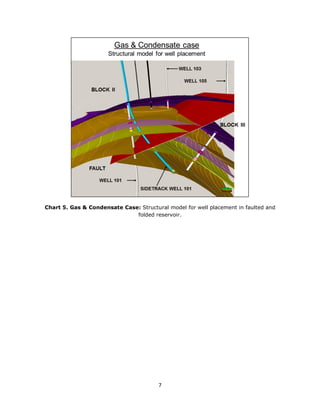
Inter spacing was reduced from 800 m to 400 m, in the crest of anticline central block,
where 80% of effective gas cumulative production had been released (net from gas re
injection). Also side tracks were proposed in recently damaged wells due to issues with
casing integrity.
In 2010 first side track well was drilled, reaching very good gas and condensate
productivity. Initial rates were achieved 40 years later with 30/50% of initial reservoir
pressure, reinforcing the hypothesis of formation damage sensibility and the
importance of the mud weight management in these kinds of reservoirs.
Up to date 4 new wells from original campaign were drilled, completed and put onto
production with good results. One possibility for near future is the extension to flanks
where tight rock, lower productivity and lower recovery factor take place.
5
Chart 1. Gas & Condensate Case: Tarija Basin location and geological column.
Chart 2. Gas & Condensate Case: Wells, 2D seismic cross section and 3D structural
model.
6
Chart 3. Gas & Condensate Case: Field production & gas re injection history.
Chart 4. Gas & Condensate Case: Ultimate Recovery Factor areal distribution, and
bottom hole reservoir pressure history.
1953 55 57 59 61 63 65 67 69 71 73 75 77 79 81 83 85 87 89 91 93 95 97 99 01 03 05 07 09
10
1
10
2
10
3
10
4
10
5
Date
AREA: CD RESERVORIO: TUP(62)
Gas Rate (Cal. Day) ( Kscm/d )
Oil Rate (Cal. Day) ( m3/d )
Water Rate (Cal. Day) ( m3/d )
Ginj.Cum ( Mscm )
Cumulative Gas Production ( Mscm )
Ginj.CalDay( Kscm/d )
Gas
Condensate
Water
Gas re injection
Main development First Natural decline Gas re injection – condensate prd
Gas & Condensate case
Field gas, condensate and water production & gas re injection history
North
58 – 69 %
R.F. Upside: ≈10%
Central
62 – 69 %
South
57 – 67 %
Yacimiento Campo Durán - Fm Tupambi
Evolución Pws POZOS SELECCIONADOS
(PR 3000 TVDSS)
0
50
100
150
200
250
300
350
400
1/50 12/53 10/57 9/61 8/65 7/69 6/73 5/77 4/81 3/85 2/89 1/93 12/96 11/00 10/04 9/08
Fecha
Pws[kg/cm2]
0
4000
8000
12000
16000
20000
24000
28000
32000
Gef:Gp-Giny[MMm3]
Pws YPF
Pws reiny de gas
Pws Tecpetrol
G efectiva [MMm3]
año 2007: Se produjo todo el gas reinyectadoReinyección de gas 1982 - 2000
año 2009: Extraídos 1000 MMm3 desde el
inicio de la reinyección de gas
1950/77: gas production 1978/2008: gas reinjection/prod
2008: balance
R.F. @ Economic Limit Bottom hole static pressure history
OGIP Upside: ≈25%
Gas & Cond case
7
Chart 5. Gas & Condensate Case: Structural model for well placement in faulted and
folded reservoir.
8
Chart 6. Gas & Condensate Case: Example of reservoir redevelopment:
Replacement well response after 40 years from initial original well production, and
Sidetrack well response after 15 years from initial replacement well production. Initial
productivity of 11 MMpc/d is achieved in spite of reservoir depletion due to successful
mud pressure management during the drilling stage.
Yac. Campo Durán - Fm. Tupambi
Perforación 'Near Balance' en Campo Durán. Proyecto ST CDxp-1001
0
100
200
300
400
500
600
700
1-57 12-60 12-64 12-68 12-72 12-76 12-80 12-84 12-88 12-92 12-96 12-00 12-04 12-08 12-12 12-16 12-20 12-24
Qg[Mm3/d]Qo[m3/d]Np[Mm3]
0
500
1000
1500
2000
2500
3000
3500
Gp[MMm3]
CD-15 Bloque II
(YPF)
ST CDxp-1001
(cuña perforada - pz original)
Julio 2008 CDxp-1001 (merma)
Rotura somera en el casing de producción 9 5/8” (aprox. 500 m) pincha tubing y descarga fluído E/C
csg 13 3/8”-9 5/8” con lodo inverso 1900 g/l – baritina (etapa de perforación de Los Monos)
CDxp-1001 Bloque II & III
(Tecpetrol)
Febrero 2008 CDxp-1001 (recup. Prd)
Limpieza con CTU CaCO3 - pozo vivo HCl 15%+N2
Replacement well after 40 years. Sidetrack after 15 years
First well
(1957)
Reservoir impairment (cement bond break)
Replacement well
(1997)
Live well perforations clean up
HCl jetting with CTU (2007)
Sidetrack well
(2012)
Peak 11 MMpc/d
Gas:Millionscubicmetergas/d,Cond:cubicmeters/d
CondCum:1000cubicmeters
GasCum:Millionscubicmetergas
Gas & Condensate case
9
3. Tight Oil case
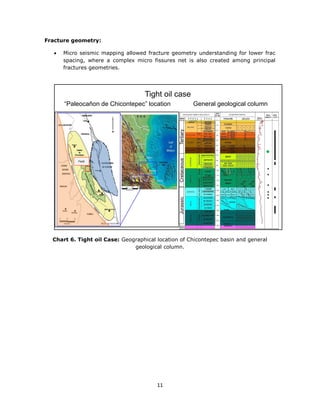
Second case is a tight oil field located in North Veracruz, Mexico. “Chicontepec Medio”
is a Tertiary reservoir from Tampico-Misantla basin, an important onshore play, and
well known by its low recovery factor and marginal cash flow [9]
.
The reservoir is very complex from structural, stratigraphic and diagenetic point of
view. Extensive and compressive faults systems coexist due to tectonic activity during
deposition of sediments. Characterized by 300 m gross thickness of shallow turbidites,
alternating sandstones and shales, where petro physical properties have been affected
by pore cementing and other diagenesis processes [10]
.
Leading to high vertical and horizontal heterogeneity, the scale of reservoir variations
runs from metres to centimetres.
Some rock quality predictive methods as seismic inversion have been applied with
some success. But appraisal wells are still needed in some regions many decades later
from discovery in order to delimit the reservoirs.
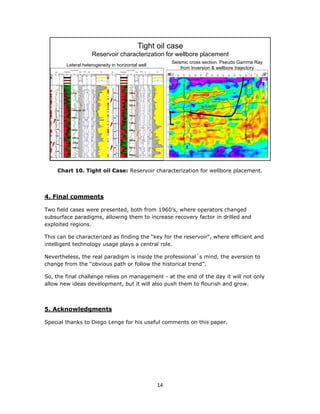
Seven spot pattern with 400 m well spacing has been the field development strategy
for 50 years, showing a great variation on productivity in the same reservoir unit
between adjacent wells, even with good reservoir continuity, according to seismic and
wells correlation. Due to low permeability, hydraulic fractures are needed, leading to
relative low initial productivity and reserves.
These factors motivated the evaluation of multi fractured horizontal wells, following the
concept of shale gas development strategy.
Challenges for horizontal wells compared to vertical wells:
 Shallow reservoirs (low cost for vertical wells).
 Reserves distributed in 200 m of layered reservoir (one fractured horizontal well
cannot reach and drain the entire column).
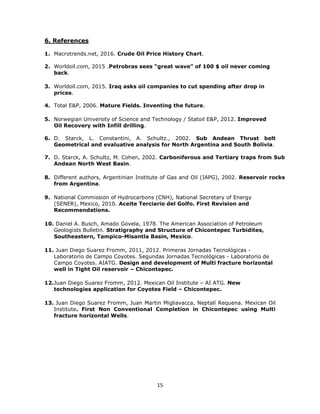
 Lateral heterogeneity for horizontal wellbore placement.
 Geo mechanical issues in some shale zones. Lack of experience in horizontal
drilling and multifrac completion.
In order to mitigate technical risks, the first horizontal well was planned in the central
part of the field, where higher production and recovery factor has been achieved after
50 years of exploitation. A detailed reservoir characterization and production
performance assessment was achieved due to existing wells.
With this scenario, reservoir pressure was the main risk; keeping in mind that reservoir
target was one of the champion units from the field, leading to potential depletion
issues during drilling, completion, stimulation, and production performance for
horizontal wells.
10
Large amount of data were available but not yet integrated.
An extensive review and reinterpretation took place:
 Material balance and decline analysis review.
 Update of static model.
 Dynamic model construction. History matching for main productive block.
 Geo mechanical model was built from compression test in plugs, Young
Modulus, Poisson Modulus, Brightness calculations from logs, fracture gradients
from pre pad test and micro seismic mapping results from previous vertical
wells, seismic inversion correlation with logs (gamma ray, sonic and density).
Main outputs were:
 More confidence on final recovery factor for vertical fractured wells and for
projected horizontal multi fractured new wells.
 Principal horizontal stress directions and minimum horizontal stress gradients
distributions. Current reservoir pressure distribution.
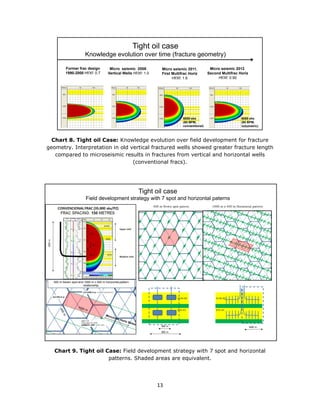
 Greater fracture vertical growing was reinterpreted from old fractured vertical
wells, due to brittleness of rock.
With the above considerations a new static, dynamic, and geo mechanical reservoir
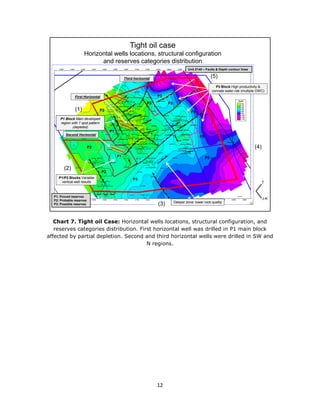
model was built, allowing the ranking of new locations with lower geological risk for
horizontal wellbore placement, along the Minimum Horizontal Stress direction. A robust
fracture design was matched with micro seismic fracture geometry. Also mud weight
window was optimized, allowing better casing depths.
Sensibility scenarios were run with different horizontal length and number of fractures,
finding that 1000 m horizontal length, 400 m spacing between horizontals, and 150 m
fracture spacing are optimal from technical, economical and risk points of view.
The first horizontal drilled well showed excellent results. The second and third
horizontal well were drilled in undeveloped regions, obtaining similar results [11,12,13]
.
The main conclusions were:
Field development:
 Initial productivity x 10 times vertical frac well.
 Projected ultimate recovery x 8 times vertical frac well.
 Projected final oil Recovery Factor increased from 5% to 7%.
 Total well cost reduction: 5% respect to seven spot pattern.
 Operative Expenditure Costs reduction (including minor workover): 30%
respect to seven spot pattern.
 In addition, first horizontal well showed that significant undeveloped reserves
can be produced in drilled zones, in spite of lower reservoir pressure.
11
Fracture geometry:
 Micro seismic mapping allowed fracture geometry understanding for lower frac
spacing, where a complex micro fissures net is also created among principal
fractures geometries.
Chart 6. Tight oil Case: Geographical location of Chicontepec basin and general
geological column.
Tight oil case
SIERRA
MADRE
ORIENTAL
PLATAFORMA
DETUXPAN
CAMPO
COYOTES
Field
“Paleocañon de Chicontepec” location General geological column
JurassicCretaceousTertiary
12
Chart 7. Tight oil Case: Horizontal wells locations, structural configuration, and
reserves categories distribution. First horizontal well was drilled in P1 main block
affected by partial depletion. Second and third horizontal wells were drilled in SW and
N regions.
Unit Z140 – Faults & Depth contour lines
P3
P2
P1
P2
P2
P3
P3
P3
P2
P1
P3
P1 Block Main developed
region with 7 spot pattern
(depleted)
(1)
(2)
P3
(3)
(4)
(5)
T
J-K
P1/P2 Blocks Variable
vertical well results
P1: Proved reserves
P2: Probable reserves
P3: Possible reserves
First Horizontal
Second Horizontal
Third horizontal
P3 Block High productivity &
connate water risk (multiple OWC)
Tight oil case
Horizontal wells locations, structural configuration
and reserves categories distribution
Deeper zone: lower rock quality
13
Chart 8. Tight oil Case: Knowledge evolution over field development for fracture
geometry. Interpretation in old vertical fractured wells showed greater fracture length
compared to microseismic results in fractures from vertical and horizontal wells
(conventional fracs).
Chart 9. Tight oil Case: Field development strategy with 7 spot and horizontal
patterns. Shaded areas are equivalent.
Tight oil case
Knowledge evolution over time (fracture geometry)
Former frac design
1990-2000 Hf/Xf: 0.7
Micro seismic 2008:
Vertical Wells Hf/Xf: 1.0
Micro seismic 2011.
First Multifrac Horiz
Hf/Xf: 1.6
Micro seismic 2012.
Second Multifrac Horiz
Hf/Xf: 0.90
6000 sks
(60 BPM,
conventional)
6000 sks
(60 BPM,
volumetric)
Z140-85 Z140-85
Z70-45 Z70-45
400 m Seven spot patern 1000 m x 400 m Horizontal pattern
400 m 1000 m
800 m
Tight oil case
Field development strategy with 7 spot and horizontal paterns
14
Chart 10. Tight oil Case: Reservoir characterization for wellbore placement.
4. Final comments
Two field cases were presented, both from 1960’s, where operators changed
subsurface paradigms, allowing them to increase recovery factor in drilled and
exploited regions.
This can be characterized as finding the “key for the reservoir”, where efficient and
intelligent technology usage plays a central role.
Nevertheless, the real paradigm is inside the professional´s mind, the aversion to
change from the “obvious path or follow the historical trend”.
So, the final challenge relies on management - at the end of the day it will not only
allow new ideas development, but it will also push them to flourish and grow.
5. Acknowledgments
Special thanks to Diego Lenge for his useful comments on this paper.
Tight oil case
Reservoir characterization for wellbore placement
Lateral heterogeneity in horizontal well
Seismic cross section. Pseudo Gamma Ray
from Inversion & wellbore trajectory
15
6. References
1. Macrotrends.net, 2016. Crude Oil Price History Chart.
2. Worldoil.com, 2015 .Petrobras sees “great wave” of 100 $ oil never coming
back.
3. Worldoil.com, 2015. Iraq asks oil companies to cut spending after drop in
prices.
4. Total E&P, 2006. Mature Fields. Inventing the future.
5. Norwegian University of Science and Technology / Statoil E&P, 2012. Improved
Oil Recovery with Infill drilling.
6. D. Starck, L. Constantini, A. Schultz., 2002. Sub Andean Thrust belt
Geometrical and evaluative analysis for North Argentina and South Bolivia.
7. D. Starck, A. Schultz, M. Cohen, 2002. Carboniferous and Tertiary traps from Sub
Andean North West Basin.
8. Different authors, Argentinian Institute of Gas and Oil (IAPG), 2002. Reservoir rocks
from Argentina.
9. National Commission of Hydrocarbons (CNH), National Secretary of Energy
(SENER), Mexico, 2010. Aceite Terciario del Golfo. First Revision and
Recommendations.
10. Daniel A. Busch, Amado Govela, 1978. The American Association of Petroleum
Geologists Bulletin. Stratigraphy and Structure of Chicontepec Turbidites,
Southeastern, Tampico-Misantla Basin, Mexico.
11. Juan Diego Suarez Fromm, 2011, 2012. Primeras Jornadas Tecnológicas -
Laboratorio de Campo Coyotes. Segundas Jornadas Tecnológicas - Laboratorio de
Campo Coyotes. AIATG. Design and development of Multi fracture horizontal
well in Tight Oil reservoir – Chicontepec.
12.Juan Diego Suarez Fromm, 2012. Mexican Oil Institute – AI ATG. New
technologies application for Coyotes Field – Chicontepec.
13. Juan Diego Suarez Fromm, Juan Martin Migliavacca, Neptalí Requena. Mexican Oil
Institute. First Non Conventional Completion in Chicontepec using Multi
fracture horizontal Wells.

Breaking Paradigms in old Fields. Finding “the reservoir key” for Mature Fields Redevelopment, Part I: Reviewing infill projects in complex reservoirs.

  • 1.
    1 Breaking Paradigms inold Fields. Finding “the reservoir key” for Mature Fields Redevelopment, Part I: Reviewing infill projects in complex reservoirs Juan Diego Suarez Fromm Jun 29th 2016 KW: Infill, Managed Pressure Drilling, HPHT gas, Chicontepec “Progress is impossible without change, and those who cannot change their minds cannot change anything”. George Bernard Shaw Z140-85 Z140-85 Z70-45 Z70-45 400 m Seven spot patern 1000 m x 400 m Horizontal pattern 400 m 1000 m 800 m Tight oil case Field development strategy with 7 spot and horizontal paterns
  • 2.
    2 1. Introduction The Oiland Gas industry has probably endured a permanent change: oil prices might never recover to 2010-2014 boom prices [1,2] . From the Oil and Gas Operators’ point of view, reengineering processes, layoffs, projects delays, contract negotiations with service providers and operating cost reductions has been put in action and will likely continue in the near future [3] . During this year, the focus has changed from Exploration / Development to that of cost & production optimization and the upcoming years will probably require greater efforts in Mature Fields redevelopment. A well-known technique is that of infill optimization [4,5] - a field development strategy that can be defined as “well spacing reduction in order to accelerate and increase petroleum recovery factor through optimal cost effective and wellbore placement in a reservoir”. Some advantages for infill strategy are as follows:  Minimum petroleum system uncertainty. The Petroleum accumulation is proved, petrophysical / geo-mechanical rock properties, reservoir fluids, downhole pressures, and base productivity are usually known within a limited range. So we should be working with 2P reserves development.  Minimum operational risk for specific wellbore designs and some completions standards used in the field. On the other hand, some disadvantages include:  Paradigms on field development to be changed;  Field history data availability;  In general, greater subsurface team effort is needed for integration and evaluation of reservoir models, compared to Appraisal / Initial Field Development. Upsides could be overlooked due to paradigms on field development. The successful one in terms of reserves and cost effective capital expenditure could be visualized as “finding the key for the field”. But as development takes place over many years (decades), the “key” should be a dynamic concept over time, correlated with technology availability, enabling us a better understanding of petroleum resources size, quality and distribution. Two field examples will be presented, where after 50 years of development; fresh oil and gas were produced by changing some reservoir paradigms.
  • 3.
    3 2. Gas &Condensate case First case is about Mature Gas & Condensate Field in North Argentina. It belongs to Tarija basin, a Palaeozoic deep thrust belt deposits from Carboniferous geological age [6,7,8] . The reservoir has 3 stratigraphic units, gross thickness is about 400 meters of altering tight sandstones and shales, in multi faulted anticline structure. Exploration and appraisal phase started in late 50’s, where main development took place in 60’s decade with about 60 wells drilled, 70% gas reserves were delimited and 80% were put onto production, achieving 5 years plateau of 180 MMpc/d gas and 7500 bpd condensate. During 70's decade, field production declined as a mature field. Finally a reinjection gas project was implemented from early 80’s over 20 years due to low commercial gas value in the region, shutting field production. Meanwhile, field operator changed in 90’s and started to produce condensate wells, keeping dry gas injection. During this time, operators applied good practices reservoir management by monitoring downhole static and flowing pressures in open and closed wells, producers and injectors during almost 50 years of history. After detailed structural settings reinterpretation (integration of surface geology, seismic markers, well logs and section restoration analysis), the redevelopment started in late 90’s with the successful appraisal well placement in a new deeper block, allowing the operator to booked new gas, condensate and oil reserves. Over 1990 decade, only 5 wells were drilled and put onto production with relative success due to formation impairment associated with partially depleted regions, resulting in halting the drilling campaign in 2005. In the subsequent years, the lack off a consistent productivity / reserves model, turned out to inconclusive postmortem, increasing technical risk and therefore lowering economical attractiveness for new wells. So, field started again to decline production, undergoing for second time the mature stage.
  • 4.
    4 Two concepts remainedas key factors for the project continuation:  Formation damage due to reservoir compaction and depletion, increasing potential of pore throat blocking, leading to new drilling process requirements (reservoir stimulation was not possible due to high fracture pressure about 12.000 psi combined with low reservoir pressure).  Material balance upside due to massive bottom hole static pressure recovery in dry gas producers and closed wells; and relative low final recovery factor forecast. Resulting in 20/30% increase in material balance OGIP and 2P reserves. Two years of reservoir engineering data integration leaded to infill, sidetracks and replacement wells proposals. Among several technologies, the “Managed Pressure Drilling” (MPD) was selected for production stage drilling, in combination with slotted liner completion instead of standard cemented casing perforations. Inter spacing was reduced from 800 m to 400 m, in the crest of anticline central block, where 80% of effective gas cumulative production had been released (net from gas re injection). Also side tracks were proposed in recently damaged wells due to issues with casing integrity. In 2010 first side track well was drilled, reaching very good gas and condensate productivity. Initial rates were achieved 40 years later with 30/50% of initial reservoir pressure, reinforcing the hypothesis of formation damage sensibility and the importance of the mud weight management in these kinds of reservoirs. Up to date 4 new wells from original campaign were drilled, completed and put onto production with good results. One possibility for near future is the extension to flanks where tight rock, lower productivity and lower recovery factor take place.
  • 5.
    5 Chart 1. Gas& Condensate Case: Tarija Basin location and geological column. Chart 2. Gas & Condensate Case: Wells, 2D seismic cross section and 3D structural model.
  • 6.
    6 Chart 3. Gas& Condensate Case: Field production & gas re injection history. Chart 4. Gas & Condensate Case: Ultimate Recovery Factor areal distribution, and bottom hole reservoir pressure history. 1953 55 57 59 61 63 65 67 69 71 73 75 77 79 81 83 85 87 89 91 93 95 97 99 01 03 05 07 09 10 1 10 2 10 3 10 4 10 5 Date AREA: CD RESERVORIO: TUP(62) Gas Rate (Cal. Day) ( Kscm/d ) Oil Rate (Cal. Day) ( m3/d ) Water Rate (Cal. Day) ( m3/d ) Ginj.Cum ( Mscm ) Cumulative Gas Production ( Mscm ) Ginj.CalDay( Kscm/d ) Gas Condensate Water Gas re injection Main development First Natural decline Gas re injection – condensate prd Gas & Condensate case Field gas, condensate and water production & gas re injection history North 58 – 69 % R.F. Upside: ≈10% Central 62 – 69 % South 57 – 67 % Yacimiento Campo Durán - Fm Tupambi Evolución Pws POZOS SELECCIONADOS (PR 3000 TVDSS) 0 50 100 150 200 250 300 350 400 1/50 12/53 10/57 9/61 8/65 7/69 6/73 5/77 4/81 3/85 2/89 1/93 12/96 11/00 10/04 9/08 Fecha Pws[kg/cm2] 0 4000 8000 12000 16000 20000 24000 28000 32000 Gef:Gp-Giny[MMm3] Pws YPF Pws reiny de gas Pws Tecpetrol G efectiva [MMm3] año 2007: Se produjo todo el gas reinyectadoReinyección de gas 1982 - 2000 año 2009: Extraídos 1000 MMm3 desde el inicio de la reinyección de gas 1950/77: gas production 1978/2008: gas reinjection/prod 2008: balance R.F. @ Economic Limit Bottom hole static pressure history OGIP Upside: ≈25% Gas & Cond case
  • 7.
    7 Chart 5. Gas& Condensate Case: Structural model for well placement in faulted and folded reservoir.
  • 8.
    8 Chart 6. Gas& Condensate Case: Example of reservoir redevelopment: Replacement well response after 40 years from initial original well production, and Sidetrack well response after 15 years from initial replacement well production. Initial productivity of 11 MMpc/d is achieved in spite of reservoir depletion due to successful mud pressure management during the drilling stage. Yac. Campo Durán - Fm. Tupambi Perforación 'Near Balance' en Campo Durán. Proyecto ST CDxp-1001 0 100 200 300 400 500 600 700 1-57 12-60 12-64 12-68 12-72 12-76 12-80 12-84 12-88 12-92 12-96 12-00 12-04 12-08 12-12 12-16 12-20 12-24 Qg[Mm3/d]Qo[m3/d]Np[Mm3] 0 500 1000 1500 2000 2500 3000 3500 Gp[MMm3] CD-15 Bloque II (YPF) ST CDxp-1001 (cuña perforada - pz original) Julio 2008 CDxp-1001 (merma) Rotura somera en el casing de producción 9 5/8” (aprox. 500 m) pincha tubing y descarga fluído E/C csg 13 3/8”-9 5/8” con lodo inverso 1900 g/l – baritina (etapa de perforación de Los Monos) CDxp-1001 Bloque II & III (Tecpetrol) Febrero 2008 CDxp-1001 (recup. Prd) Limpieza con CTU CaCO3 - pozo vivo HCl 15%+N2 Replacement well after 40 years. Sidetrack after 15 years First well (1957) Reservoir impairment (cement bond break) Replacement well (1997) Live well perforations clean up HCl jetting with CTU (2007) Sidetrack well (2012) Peak 11 MMpc/d Gas:Millionscubicmetergas/d,Cond:cubicmeters/d CondCum:1000cubicmeters GasCum:Millionscubicmetergas Gas & Condensate case
  • 9.
    9 3. Tight Oilcase Second case is a tight oil field located in North Veracruz, Mexico. “Chicontepec Medio” is a Tertiary reservoir from Tampico-Misantla basin, an important onshore play, and well known by its low recovery factor and marginal cash flow [9] . The reservoir is very complex from structural, stratigraphic and diagenetic point of view. Extensive and compressive faults systems coexist due to tectonic activity during deposition of sediments. Characterized by 300 m gross thickness of shallow turbidites, alternating sandstones and shales, where petro physical properties have been affected by pore cementing and other diagenesis processes [10] . Leading to high vertical and horizontal heterogeneity, the scale of reservoir variations runs from metres to centimetres. Some rock quality predictive methods as seismic inversion have been applied with some success. But appraisal wells are still needed in some regions many decades later from discovery in order to delimit the reservoirs. Seven spot pattern with 400 m well spacing has been the field development strategy for 50 years, showing a great variation on productivity in the same reservoir unit between adjacent wells, even with good reservoir continuity, according to seismic and wells correlation. Due to low permeability, hydraulic fractures are needed, leading to relative low initial productivity and reserves. These factors motivated the evaluation of multi fractured horizontal wells, following the concept of shale gas development strategy. Challenges for horizontal wells compared to vertical wells:  Shallow reservoirs (low cost for vertical wells).  Reserves distributed in 200 m of layered reservoir (one fractured horizontal well cannot reach and drain the entire column).  Lateral heterogeneity for horizontal wellbore placement.  Geo mechanical issues in some shale zones. Lack of experience in horizontal drilling and multifrac completion. In order to mitigate technical risks, the first horizontal well was planned in the central part of the field, where higher production and recovery factor has been achieved after 50 years of exploitation. A detailed reservoir characterization and production performance assessment was achieved due to existing wells. With this scenario, reservoir pressure was the main risk; keeping in mind that reservoir target was one of the champion units from the field, leading to potential depletion issues during drilling, completion, stimulation, and production performance for horizontal wells.
  • 10.
    10 Large amount ofdata were available but not yet integrated. An extensive review and reinterpretation took place:  Material balance and decline analysis review.  Update of static model.  Dynamic model construction. History matching for main productive block.  Geo mechanical model was built from compression test in plugs, Young Modulus, Poisson Modulus, Brightness calculations from logs, fracture gradients from pre pad test and micro seismic mapping results from previous vertical wells, seismic inversion correlation with logs (gamma ray, sonic and density). Main outputs were:  More confidence on final recovery factor for vertical fractured wells and for projected horizontal multi fractured new wells.  Principal horizontal stress directions and minimum horizontal stress gradients distributions. Current reservoir pressure distribution.  Greater fracture vertical growing was reinterpreted from old fractured vertical wells, due to brittleness of rock. With the above considerations a new static, dynamic, and geo mechanical reservoir model was built, allowing the ranking of new locations with lower geological risk for horizontal wellbore placement, along the Minimum Horizontal Stress direction. A robust fracture design was matched with micro seismic fracture geometry. Also mud weight window was optimized, allowing better casing depths. Sensibility scenarios were run with different horizontal length and number of fractures, finding that 1000 m horizontal length, 400 m spacing between horizontals, and 150 m fracture spacing are optimal from technical, economical and risk points of view. The first horizontal drilled well showed excellent results. The second and third horizontal well were drilled in undeveloped regions, obtaining similar results [11,12,13] . The main conclusions were: Field development:  Initial productivity x 10 times vertical frac well.  Projected ultimate recovery x 8 times vertical frac well.  Projected final oil Recovery Factor increased from 5% to 7%.  Total well cost reduction: 5% respect to seven spot pattern.  Operative Expenditure Costs reduction (including minor workover): 30% respect to seven spot pattern.  In addition, first horizontal well showed that significant undeveloped reserves can be produced in drilled zones, in spite of lower reservoir pressure.
  • 11.
    11 Fracture geometry:  Microseismic mapping allowed fracture geometry understanding for lower frac spacing, where a complex micro fissures net is also created among principal fractures geometries. Chart 6. Tight oil Case: Geographical location of Chicontepec basin and general geological column. Tight oil case SIERRA MADRE ORIENTAL PLATAFORMA DETUXPAN CAMPO COYOTES Field “Paleocañon de Chicontepec” location General geological column JurassicCretaceousTertiary
  • 12.
    12 Chart 7. Tightoil Case: Horizontal wells locations, structural configuration, and reserves categories distribution. First horizontal well was drilled in P1 main block affected by partial depletion. Second and third horizontal wells were drilled in SW and N regions. Unit Z140 – Faults & Depth contour lines P3 P2 P1 P2 P2 P3 P3 P3 P2 P1 P3 P1 Block Main developed region with 7 spot pattern (depleted) (1) (2) P3 (3) (4) (5) T J-K P1/P2 Blocks Variable vertical well results P1: Proved reserves P2: Probable reserves P3: Possible reserves First Horizontal Second Horizontal Third horizontal P3 Block High productivity & connate water risk (multiple OWC) Tight oil case Horizontal wells locations, structural configuration and reserves categories distribution Deeper zone: lower rock quality
  • 13.
    13 Chart 8. Tightoil Case: Knowledge evolution over field development for fracture geometry. Interpretation in old vertical fractured wells showed greater fracture length compared to microseismic results in fractures from vertical and horizontal wells (conventional fracs). Chart 9. Tight oil Case: Field development strategy with 7 spot and horizontal patterns. Shaded areas are equivalent. Tight oil case Knowledge evolution over time (fracture geometry) Former frac design 1990-2000 Hf/Xf: 0.7 Micro seismic 2008: Vertical Wells Hf/Xf: 1.0 Micro seismic 2011. First Multifrac Horiz Hf/Xf: 1.6 Micro seismic 2012. Second Multifrac Horiz Hf/Xf: 0.90 6000 sks (60 BPM, conventional) 6000 sks (60 BPM, volumetric) Z140-85 Z140-85 Z70-45 Z70-45 400 m Seven spot patern 1000 m x 400 m Horizontal pattern 400 m 1000 m 800 m Tight oil case Field development strategy with 7 spot and horizontal paterns
  • 14.
    14 Chart 10. Tightoil Case: Reservoir characterization for wellbore placement. 4. Final comments Two field cases were presented, both from 1960’s, where operators changed subsurface paradigms, allowing them to increase recovery factor in drilled and exploited regions. This can be characterized as finding the “key for the reservoir”, where efficient and intelligent technology usage plays a central role. Nevertheless, the real paradigm is inside the professional´s mind, the aversion to change from the “obvious path or follow the historical trend”. So, the final challenge relies on management - at the end of the day it will not only allow new ideas development, but it will also push them to flourish and grow. 5. Acknowledgments Special thanks to Diego Lenge for his useful comments on this paper. Tight oil case Reservoir characterization for wellbore placement Lateral heterogeneity in horizontal well Seismic cross section. Pseudo Gamma Ray from Inversion & wellbore trajectory
  • 15.
    15 6. References 1. Macrotrends.net,2016. Crude Oil Price History Chart. 2. Worldoil.com, 2015 .Petrobras sees “great wave” of 100 $ oil never coming back. 3. Worldoil.com, 2015. Iraq asks oil companies to cut spending after drop in prices. 4. Total E&P, 2006. Mature Fields. Inventing the future. 5. Norwegian University of Science and Technology / Statoil E&P, 2012. Improved Oil Recovery with Infill drilling. 6. D. Starck, L. Constantini, A. Schultz., 2002. Sub Andean Thrust belt Geometrical and evaluative analysis for North Argentina and South Bolivia. 7. D. Starck, A. Schultz, M. Cohen, 2002. Carboniferous and Tertiary traps from Sub Andean North West Basin. 8. Different authors, Argentinian Institute of Gas and Oil (IAPG), 2002. Reservoir rocks from Argentina. 9. National Commission of Hydrocarbons (CNH), National Secretary of Energy (SENER), Mexico, 2010. Aceite Terciario del Golfo. First Revision and Recommendations. 10. Daniel A. Busch, Amado Govela, 1978. The American Association of Petroleum Geologists Bulletin. Stratigraphy and Structure of Chicontepec Turbidites, Southeastern, Tampico-Misantla Basin, Mexico. 11. Juan Diego Suarez Fromm, 2011, 2012. Primeras Jornadas Tecnológicas - Laboratorio de Campo Coyotes. Segundas Jornadas Tecnológicas - Laboratorio de Campo Coyotes. AIATG. Design and development of Multi fracture horizontal well in Tight Oil reservoir – Chicontepec. 12.Juan Diego Suarez Fromm, 2012. Mexican Oil Institute – AI ATG. New technologies application for Coyotes Field – Chicontepec. 13. Juan Diego Suarez Fromm, Juan Martin Migliavacca, Neptalí Requena. Mexican Oil Institute. First Non Conventional Completion in Chicontepec using Multi fracture horizontal Wells.