IT30138 DATA MINING AND DATA
WAREHOUSE
Mr. Ankur Priyadarshi
Assistant Professor
Department of Computer Science and Information Technology
ankurpriyadarshi@cgu-odisha.ac.in
C. V. Raman Global University, Bhubaneswar, Odisha
Credits: 2
Vision and Mission
Vision of the C. V. Raman Global University: To emerge as a global leader in the arena of technical
education commensurate with the dynamic global scenario for the benefit of mankind.
Vision of the Department of CSE : To become a leader in providing high quality education and
research in the area of Computer Science, Information Technology, and allied areas.
Mission of C.V. Raman Global University :
❖ To provide state-of-art technical education in the undergraduate and
postgraduate levels;
❖ to work collaboratively with technical Institutes / Universities / Industries of
National and International repute;
❖ to keep abreast with latest technological advancements;
❖ to enhance the Research and Development activities”.
Mission of the Department of CSE:
M1: To develop human resource with sound theoretical and practical knowledge in the discipline of
Computer Science & Engineering.
M2: To work in groups for Research, Projects, and Co-Curricular activities involving modern methods,
tools and technology.
M3: To collaborate and interact with professionals from industry, academia, professional societies,
community groups for enhancement of quality of education.
Program Outcomes
❖ Engineering knowledge
❖ Problem analysis
❖ Design/development of solutions
❖ Conduct investigations of complex problems
❖ Modern tool usage
❖ The engineer and society
❖ Environment and Ethics
❖ Individual and team work
❖ Communication
❖ Project management and finance
❖ Life-long learning
Program Educational Objective (PEO)
PEO1- To provide the fundamental knowledge in mathematics, science and
engineering concepts for the development of engineering system
(Fundamental Knowledge).
PEO2- To apply current industry accepted computing practices and emerging
technologies to analyze, design, implement, test and verify high quality
computing systems and computer based solutions to real world problems
(Design and development).
PEO3- To enable the use of appropriate skill sets and its applications towards
social impacts of computing technologies in the career related activities (Skill
Set) and to produce Efficient team leaders, effective communicators and
capable of working in multi-disciplinary environment following ethical
values(Communication).
PEO4- To practice professionally and ethically in various positions of industry
or government and/or succeed in graduate (Professionalism (Societal
Contribution)
Course Outcomes
Upon successful completion of this course, students will be able to:
CO1: Identify data mining architecture and different pre-processing techniques
required for analysis of given dataset
CO2: Analyze frequent patterns, determine associations and correlations
CO3: Apply different classification and prediction to data mining applications
CO4: Use different clustering mechanisms for data mining
CO5: Use data warehouse and data mining techniques for numeric, textual, temporal
and unstructured data on the Web
Syllabus
Unit 1
Data Mining and Pre-processing (08 Hrs)
U1.1. Introduction: Need of Data Mining, Knowledge Discovery in Database (KDD), Architecture of Data
Mining System; Data Objects and Attribute Types, Statistical Description of Data, Data Visualization
U1.2.Data Preprocessing: Introduction to Data mining, Data mining Functionalities, Data preprocessing (data
summarization, data cleaning, data integration and transformation, data reduction– Feature selection and
extraction, dimensionality reduction, data discretization)
U1.3.Self-Study: Integration of Data Mining with a Database or Data Warehouse System, Issues in Data
Mining
LEARNING
OUTCOMES
Need of Data Mining
Growth of Data
What exactly is data
mining?
Technology
required for data
mining
History of data
mining
Why Data Mining?
A Quote on Data Mining
Dr. Penzias, a Nobel prize winner interviewed in
Computer World in January 1999, states concisely:
"Data mining will become more important, and companies
will throw away nothing about their customers because it
will be so valuable. If you're not doing this, you're out of
business."
Growth of Data
The Information Challenge
https://images.app.goo.gl/N8hekmd4BCqidnsJ6
1960s
Data Collection
[Computers, Tape]
1970s
Data Access
Relational Database
1980s
Application oriented RDBMS
Object Oriented Model
1990s
Data Mining
Data Warehousing
2000s
Big Data Analytics
No-SQL
Evolution of Data Mining
Applications of Data Mining
Cyclone Forecasting
https://images.app.goo.gl/GdiLivTrGZe9aYJY8
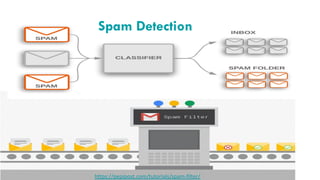
Spam Detection
https://pepipost.com/tutorials/spam-filter/
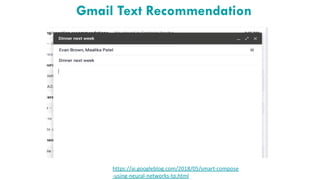
Gmail Text Recommendation
https://ai.googleblog.com/2018/05/smart-compose
-using-neural-networks-to.html
E-Commerce Application
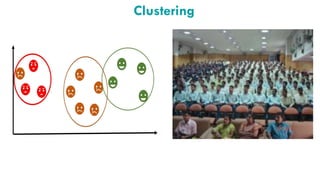
Clustering
Banking
What is mining?
Extraction of non-obvious, implicit, unknown and useful resources from planet.
What Is Data Mining?
● Data mining (knowledge discovery from data)
○ Extraction of interesting (non-trivial, implicit, previously unknown and potentially useful)
patterns or knowledge from huge amount of data
○ Data mining: a misnomer?
● Alternative names
○ Knowledge discovery (mining) in databases (KDD), knowledge extraction, data/pattern
analysis, data archeology, data dredging, information harvesting, business intelligence, etc.
● Watch out: Is everything “data mining”?
○ Simple search and query processing
○ (Deductive) expert systems
Quiz of the Day
Scan/Copy link it and give your choice
https://forms.gle/m97uenx3zYtKEV4y9
OPTION 1
Unknown
Answer - NO
OPTION 2
Implicit
Answer -
No
OPTION 3
Useful
Answer -
No
OPTION 4
Obvious
Answer -
yes
Answer of the Day
Q: Which of the following keyword is not associated with Data mining?
Getting to Know Your Data
(Data Objects and Attribute Types)
24
Unit 1: Data and Data Preprocessing
25
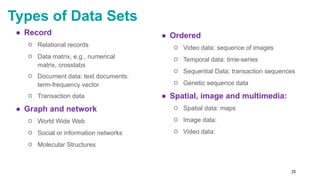
Types of Data Sets
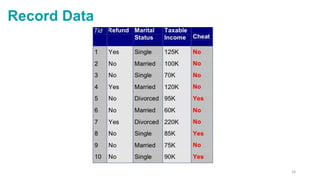
● Record
○ Relational records
○ Data matrix, e.g., numerical
matrix, crosstabs
○ Document data: text documents:
term-frequency vector
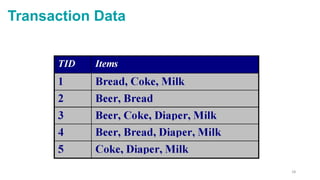
○ Transaction data
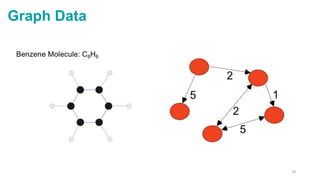
● Graph and network
○ World Wide Web
○ Social or information networks
○ Molecular Structures
● Ordered
○ Video data: sequence of images
○ Temporal data: time-series
○ Sequential Data: transaction sequences
○ Genetic sequence data
● Spatial, image and multimedia:
○ Spatial data: maps
○ Image data:
○ Video data:
26
Record Data
27
Data Matrix
28
Transaction Data
29
Graph Data
Spatial Data
Sequence Data
Data Objects
● Data sets are made up of data objects.
● A data object represents an entity.
● Examples:
○ sales database: customers, store items, sales
○ medical database: patients, treatments
○ university database: students, professors, courses
● Also called samples , examples, instances, data points,
objects, tuples.
● Data objects are described by attributes.
● Database rows -> data objects; columns ->attributes.
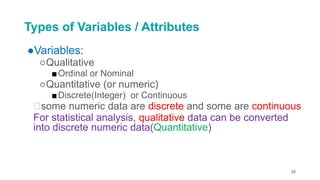
Types of Variables / Attributes
●Variables:
○Qualitative
■Ordinal or Nominal
○Quantitative (or numeric)
■Discrete(Integer) or Continuous
🡪some numeric data are discrete and some are continuous
For statistical analysis, qualitative data can be converted
into discrete numeric data(Quantitative)
34
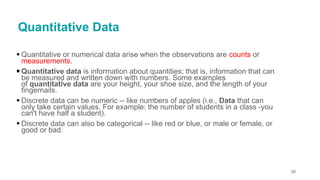
Quantitative Data
▪ Quantitative or numerical data arise when the observations are counts or
measurements.
▪ Quantitative data is information about quantities; that is, information that can
be measured and written down with numbers. Some examples
of quantitative data are your height, your shoe size, and the length of your
fingernails.
▪ Discrete data can be numeric -- like numbers of apples (i.e., Data that can
only take certain values. For example: the number of students in a class -you
can't have half a student).
▪ Discrete data can also be categorical -- like red or blue, or male or female, or
good or bad.
35
● The table shows a part of some (hypothetical) data on a group of 48
subjects.
'Age' and 'income' are continuous numeric variables,
'age group' is an ordinal qualitative variable,
and 'sex' is a nominal qualitative variable.
● The ordinal variable 'age group' is created from the continuous variable
'age' using five categories:
age group = 1 if age is less than 20;
age group = 2 if age is 20 to 29;
age group = 3 if age is 30 to 39;
age group = 4 if age is 40 to 49;
age group = 5 if age is 50 or more
36
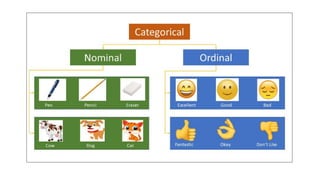
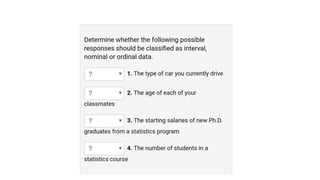
Types of Data :
Nominal, Ordinal, Interval and Ratio
Nominal:
▪Nominal scales are used for labeling variables, without any quantitative
value.
▪“Nominal” scales could simply be called “labels.”
▪No specific order
▪A good way to remember all of this is that “nominal” sounds a lot like
“name” and nominal scales are kind of like “names” or labels.
37
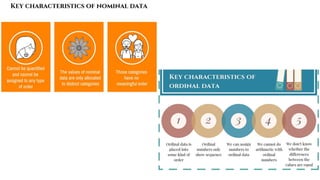
Ordinal Data
▪Ordinal scales are typically measures of non-numeric concepts like
satisfaction, happiness, ratings etc.
▪“Ordinal” is easy to remember because is sounds like “order” and
that’s the key to remember with “ordinal scales”–it is the order that
matters, but that’s all you really get from these.
39
Ordinal Data
Interval
▪Interval scales are numeric scales in which we know not only the order, but
also the exact differences between the values.
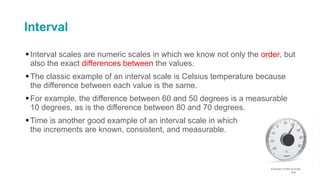
▪The classic example of an interval scale is Celsius temperature because
the difference between each value is the same.
▪For example, the difference between 60 and 50 degrees is a measurable
10 degrees, as is the difference between 80 and 70 degrees.
▪Time is another good example of an interval scale in which
the increments are known, consistent, and measurable.
44
Ratio:
▪ Ratio data has all properties of interval data such as – data should have numeric
values, a distance between the two points are equal etc. but, unlike interval data
where zero is arbitrary, in ratio data, zero is absolute.
▪ Ratio data has a defined zero point.
● Income, height, weight, annual sales, market share, product defect rates, time to
repurchase, unemployment rate, and crime rate are examples of ratio data.
▪ A very good example of ratio data is the measurement of heights. Height could
be measured in centimeters, meters, inches or feet. It is not possible to have a
negative height. When comparing to interval data for example temperature can
be – 10-degree Celsius but height cannot be in negative.
▪ Ratio data can be multiplied and divided, this is one of the major differences
between ratio data and interval data, which can only be added and subtracted.
45
Binary Attribute
● Binary
○ Nominal attribute with only 2 states (0 and 1)
○ Symmetric binary: both outcomes equally important
■ e.g., gender
○ Asymmetric binary: outcomes not equally important.
■ e.g., medical test (positive vs. negative)
■ Convention: assign 1 to most important outcome (e.g., HIV positive)
Discrete vs. Continuous Attributes
● Discrete Attribute
○ Has only a finite or countably infinite set of values
■ E.g., zip codes, profession, or the set of words in a collection of documents
○ Sometimes, represented as integer variables
○ Note: Binary attributes are a special case of discrete attributes
● Continuous Attribute
○ Has real numbers as attribute values
■ E.g., temperature, height, or weight
○ Practically, real values can only be measured and represented using a finite
number of digits
○ Continuous attributes are typically represented as floating-point variables
Discrete data can take on only integer values
whereas continuous data can take on any value.
For instance the number of cancer patients treated by a hospital each year is
discrete but your weight is continuous.
Some data are continuous but measured in a discrete way e.g. your age.
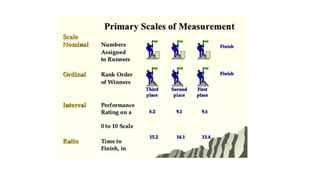
Case Study-1
● Let us take an example of “200 meter race” in a tournament where three runners are
participating from three different branches of CGU.
● Each runner is assigned a number (displayed in uniform) to differentiate from each
other. The number displayed in the uniform to identify runners is an example of
nominal scale.
● Once the race is over, the winner is declared along with the declaration of first runner
up and second runner up based on the criteria that who reaches the destination first,
second and last. The rank order of runners such as “second runner up as 3”, “first
runner up as 2” and the “winner as 1” is an example of ordinal scale.
● During the tournament, judge is asked to rate each runner on the scale of 1–10
based on certain criteria. The rating given by the judge is an example of interval
scale.
● The time spent by each runner in completing the race is an example of ratio scale.
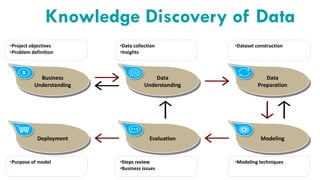
Evaluation
Business
Understanding
Data
Understanding
Data
Preparation
Modeling
Deployment
•Project objectives
•Problem definition
•Data collection
•Insights
•Dataset construction
•Purpose of model •Steps review
•Business issues
•Modeling techniques
Knowledge Discovery of Data
Interpretation/Evaluation
Data Mining
Transformation
Pre-processing
Selection
Target data
Processed data
Transformed data
Patterns
Knowledge
•Data visualization and result interpretation
•Model with algorithms such as clustering, regression
and classification
•Dimension-reduction
•Factor analysis
•Difference, or taking logarithm to be Normalization
•Data collection and sampling
•Correlation analysis
Knowledge Discovery of Data
55
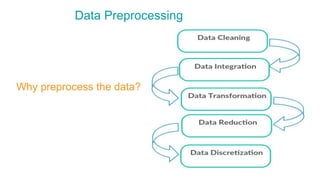
Data Preprocessing
Why preprocess the data?
56
Why Data Preprocessing?
●Data in the real world is dirty
○incomplete: lacking attribute values, lacking
certain attributes of interest, or containing only
aggregate data
■ e.g., occupation=“ ”
○noisy: containing errors or outliers
■ e.g., Salary=“-10”
○inconsistent: containing discrepancies in codes
or names
■ e.g., Age=“42” Birthday=“03/07/1997”
■ e.g., Was rating “1,2,3”, now rating “A, B, C”
■ e.g., discrepancy between duplicate records
57
Why Is Data Dirty?
● Incomplete data may come from
○ “Not applicable” data value when collected
○ Different considerations between the time when the data was
collected and when it is analyzed.
○ Human/hardware/software problems
● Noisy data (incorrect values) may come from
○ Faulty data collection instruments
○ Human or computer error at data entry
○ Errors in data transmission
● Inconsistent data may come from
○ Different data sources
○ Functional dependency violation (e.g., modify some linked data)
● Duplicate records also need data cleaning
58
Why Is Data Preprocessing Important?
● No quality data, no quality mining results!
○ Quality decisions must be based on quality data
■ e.g., duplicate or missing data may cause incorrect or even
misleading statistics.
○ Data warehouse needs consistent integration of quality
data
● Data extraction, cleaning, and transformation comprises
the majority of the work of building a data warehouse
59
Multi-Dimensional Measure of Data Quality
● A well-accepted multidimensional view:
○ Accuracy
○ Completeness
○ Consistency
○ Timeliness
○ Believability
○ Value added
○ Interpretability
○ Accessibility
● Broad categories:
○ Intrinsic, contextual, representational, and accessibility
60
Major Tasks in Data Preprocessing
● Data cleaning
○ Fill in missing values, smooth noisy data, identify or remove
outliers, and resolve inconsistencies
● Data integration
○ Integration of multiple databases, data cubes, or files
● Data transformation
○ Normalization and aggregation
● Data reduction
○ Obtains reduced representation in volume but produces the same
or similar analytical results
● Data discretization
○ Part of data reduction but with particular importance, especially for
numerical data
4
Topic
Topic
3
Topic
2
Topic
1
Types of
Learning
Supervised
Learning
Unsupervised
Learning
Classification
vs Regression
Outline
Data Mining Functionalities
62
63
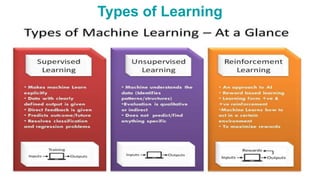
Types of Learning
Supervised Learning
●The training data includes both Inputs and Labels(Targets)
●what are Inputs and Labels(Targets)?? for example addition of two
numbers a=5,b=6 result =11, Inputs are 5,6 and Target is 11
Unsupervised Learning
●The training data does not include Targets here so we don’t tell the system
where to go , the system has to understand itself from the data we give.
Reinforcement Learning
●Though both supervised and reinforcement learning use mapping between input
and output, unlike supervised learning where the feedback provided to the agent
is correct set of actions for performing a task, reinforcement learning
uses rewards and punishments as signals for positive and negative behavior
●An RL problem can be best explained through games.
●Goal : to eat food
●Environment - Grid
●Reward for eating food
●Punishment - if killed by Ghost
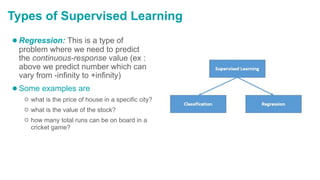
Types of Supervised Learning
●Regression: This is a type of
problem where we need to predict
the continuous-response value (ex :
above we predict number which can
vary from -infinity to +infinity)
●Some examples are
○ what is the price of house in a specific city?
○ what is the value of the stock?
○ how many total runs can be on board in a
cricket game?
●Classification: This is a type of problem where we predict the categorical
response value where the data can be separated into specific “classes” (ex:
we predict one of the values in a set of values).
●Some examples are :
○ this mail is spam or not?
○ will it rain today or not?
○ is this picture a cat or not?
○ Basically ‘Yes/No’ type questions called binary classification.
○ Other examples are :
○ this mail is spam or important or promotion?
○ is this picture a cat or a dog or a tiger?
○ This type is called multi-class classification.
Classification vs Regression
Unsupervised Learning
●Clustering: This is a type of problem where
we group similar things together.
●Bit similar to multi class classification but
here we don’t provide the labels, the system
understands from data itself and cluster the
data.
●Some examples are :
○ given news articles, cluster into different types of
news
○ given a set of tweets ,cluster based on content of
tweet
○ given a set of images, cluster them into different
objects
Data Cleaning and Integration
How to Handle Missing Data?
(Methods/Techniques)
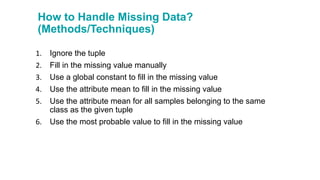
1. Ignore the tuple
2. Fill in the missing value manually
3. Use a global constant to fill in the missing value
4. Use the attribute mean to fill in the missing value
5. Use the attribute mean for all samples belonging to the same
class as the given tuple
6. Use the most probable value to fill in the missing value
How to Handle Missing Data? (Methods)
1. Ignore the tuple: This is usually done when the class label is missing
(assuming the mining task involves classification).
This method is not very effective, unless the tuple contains several attributes
with missing values.
It is especially poor when the percentage of missing values per attribute varies
considerably.
2. Fill in the missing value manually
● In general, this approach is time-consuming and may not be feasible given
a large data set with many missing values.
● 3. Use a global constant to fill in the missing value:
Replace all missing attribute values by the same constant, such as
a label like “Unknown” .
If missing values are replaced by, say, “Unknown,” then the mining
program may mistakenly think that they form an interesting
concept, since they all have a value in common—that of
“Unknown.”
Hence, although this method is simple, it is not fool proof.
● 4. Use the attribute mean to fill in the
missing value:
For example, suppose that the average
income of customers is $56,000.
Use this value to replace the missing
value for income.
● 5. Use the attribute mean for all samples belonging to the same
class as the given tuple:
For example, if classifying customers according to cheat, replace
the missing value with the average income value for customers in
the same credit risk category as that of the given tuple.
● 6. Use the most probable value to fill in the missing value:
This may be determined with regression, inference-based tools
using a Bayesian formalism, or decision tree induction.
For example, using the other customer attributes in your data set,
you
may construct a decision tree to predict the missing values for
income.
Note:
● Method 6 is a popular strategy.
Noisy Data
● “What is noise?”
● Noise: random error or variance in a measured variable
Incorrect attribute values may due to
○ faulty data collection instruments
○ data entry problems
○ data transmission problems
○ technology limitation
○ inconsistency in naming convention
Other data problems which requires data cleaning
○ duplicate records
○ incomplete data
○ inconsistent data
How to Handle Noisy Data?
(Techniques)
● How can we “smooth” out the data to remove the noise?
● (Data smoothing techniques)
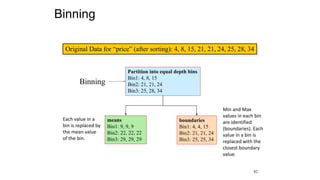
● 1. Binning
○ first sort data and partition into (equal-frequency) bins
○ then one can smooth by bin means, smooth by bin
median, smooth by bin boundaries, etc.
● 2. Regression
○ smooth by fitting the data into regression functions
● 3. Clustering
○ detect and remove outliers
● Combined computer and human inspection
○ detect suspicious values and check by human (e.g.,
deal with possible outliers)
82
Binning
Partition into equal depth bins
Bin1: 4, 8, 15
Bin2: 21, 21, 24
Bin3: 25, 28, 34
means
Bin1: 9, 9, 9
Bin2: 22, 22, 22
Bin3: 29, 29, 29
boundaries
Bin1: 4, 4, 15
Bin2: 21, 21, 24
Bin3: 25, 25, 34
Binning
Original Data for “price” (after sorting): 4, 8, 15, 21, 21, 24, 25, 28, 34
Each value in a
bin is replaced by
the mean value
of the bin.
Min and Max
values in each bin
are identified
(boundaries). Each
value in a bin is
replaced with the
closest boundary
value.
83
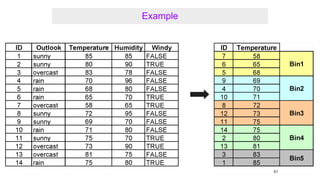
Example
84
Example
85
Smoothing Noisy Data - Example
The final table with the new values for the Temperature attribute.
86
Data Preprocessing
●Why preprocess the data?
●Data cleaning
●Data integration and transformation
●Data reduction
●Descriptive data summarization
●(Descriptive Statistical Measures )
Data integration and transformation
●Integration
●Merging of data from multiple data stores.
●Transformation
●Data are transformed or consolidated into forms appropriate for mining.
87
88
Data Integration
● Data integration:
○ Combines data from multiple sources into a coherent
store
●Number of issues to consider during data integration.
○ Schema integration
○ object matching
● Schema integration: e.g., A.cust-id ≡ B.cust-#
○ Integrate metadata from different sources
●For example, how can the data analyst or the computer be
sure that customer_id in one database and cust_number in
another refer to the same attribute?
Data Integration
Examples of metadata for each attribute include the name, meaning, data type,
and range of values permitted for the attribute, and null rules for handling blank,
zero, or null values.
Such metadata can be used to help avoid errors in schema integration.
The metadata may also be used to help transform the data (e.g., where data
codes for pay type in one database may be “H” and “S”, and 1 and 2 in another).
Hence, this step also relates to data cleaning, as described earlier.
Detecting and resolving data value conflicts
○ For the same real world entity, attribute values from different sources are
different
○ Possible reasons: different representations, different scales, e.g., metric vs.
British units
89
Data Integration
Redundancy is another important issue.
An attribute (such as annual revenue, for instance) may be redundant if
it can be “derived” from another attribute or set of attributes.
Inconsistencies in attribute or dimension naming can also cause
redundancies in the resulting data set.
Some redundancies can be detected by correlation analysis.
90
91
Handling Redundancy in Data Integration
● Redundant data occur often when integration of
multiple databases
○ Object identification: The same attribute or object may
have different names in different databases
○ Derivable data: One attribute may be a “derived”
attribute in another table, e.g., age
● Redundant attributes may be able to be detected by
correlation analysis
● Careful integration of the data from multiple sources may
help reduce/avoid redundancies and inconsistencies and
improve mining speed and quality
Feature Selection and Statistics
Data Reduction Strategies
●Why data reduction?
○ A database/data warehouse may store terabytes of data
○ Complex data analysis/mining may take a very long time to run
on the complete data set
●Data reduction
○ Obtain a reduced representation of the data set that is much
smaller in volume but yet produce the same (or almost the same)
analytical results
●Data reduction strategies
1. Attribute subset selection
2. Dimensionality reduction — e.g., remove unimportant attributes
Data Compression
1. Attribute Subset Selection
● Feature selection (i.e., attribute subset selection):
▪ Attribute subset selection reduces the data set size by
removing irrelevant or redundant attributes (or dimensions).
▪ The goal of attribute subset selection is to find a minimum
set of attributes such that the resulting probability distribution
of the data classes is as close as possible to the original
distribution obtained using all attributes.
▪ How can we find a ‘good’ subset of the original attributes?
1. For n attributes, there are 2n
possible subsets
An exhaustive search(Generate-Test) for the optimal subset of
attributes can be prohibitively expensive, especially as n and
the number of data classes increase.
1. Attribute Subset Selection
●Heuristic methods that explore a reduced search
space are commonly used for attribute subset
selection.
●Heuristic methods (due to exponential # of choices):
○ Step-wise forward selection
○ Step-wise backward elimination
○ Combining forward selection and backward elimination
○ Decision-tree induction
Data Preprocessing
●Why preprocess the data?
●Data cleaning
●Data integration and transformation
●Data reduction
●Descriptive data summarization
●(Descriptive Statistical Measures )
Descriptive data summarization
● For data pre-processing to be successful,
▪ It is essential to have an overall picture of your data.
▪ Descriptive data summarization techniques can be used to identify the
typical properties of your data and highlight which data values should be
treated as noise or outliers.
▪ So, the basic concepts of descriptive data summarization are to be
discussed.
Mining Data - Descriptive Characteristics
● Motivation
To better understand the data:
○ Central tendency
○ Dispersion (variation and spread) of data
Measuring the Central Tendency (Mean)
Various ways to measure the central tendency of data
●The most common and most effective numerical measure of the “center” of a
set of data is the (arithmetic) mean.
Measuring the Central Tendency
▪Issue:
●A major problem with the mean is its sensitivity to extreme (e.g.,
outlier) values. Even a small number of extreme values can corrupt
the mean.
●Can not be applied to categorical data
●For example, the mean salary at a company may be substantially
pushed up by that of a few highly paid managers
●So, it is not always the best way of measuring the center of the data
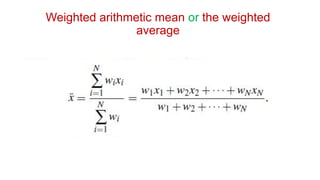
Weighted arithmetic mean or the weighted
average
Trimmed mean
To offset the effect caused by a small number of extreme values(low or
high outlier), we can use the trimmed mean, which is the mean
obtained after chopping off values at the high and low extremes.
which is the mean obtained after chopping off values at the high and
low extremes.
For example, we can sort the values observed for salary and remove
the top and bottom 2% before computing the mean.
●Issue:
●We should avoid trimming too large a portion (such as 20%) at both
ends as this can result in the loss of valuable information.
Symmetric vs Skewed Data
Median:
● For skewed (asymmetric) data, a better measure of the center of data is the
median.
● Suppose that a given data set of N distinct values is sorted in numerical order.
● If N is odd, then the median is the middle value of the ordered set; otherwise
(i.e., if N is even), the median is the average of the middle two values.
● A holistic measure is a measure that must be computed on the entire data set
as a whole. It cannot be computed by partitioning the given data into subsets.
● The median is an example of a holistic measure.
● Holistic measures are much more expensive to compute than distributive
measures
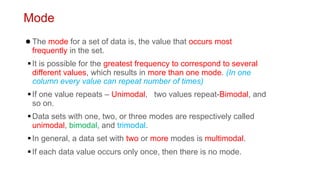
Mode
●The mode for a set of data is, the value that occurs most
frequently in the set.
▪It is possible for the greatest frequency to correspond to several
different values, which results in more than one mode. (In one
column every value can repeat number of times)
▪If one value repeats – Unimodal, two values repeat-Bimodal, and
so on.
▪Data sets with one, two, or three modes are respectively called
unimodal, bimodal, and trimodal.
▪In general, a data set with two or more modes is multimodal.
▪If each data value occurs only once, then there is no mode.
Mode
▪In a unimodal frequency curve with perfect symmetric data distribution, the
mean, median, and mode are all at the same center value
●However, data in most real applications are not symmetric.
▪They may instead be either positively skewed, where the mode occurs at a
value that is smaller than the median or negatively skewed, where the
mode occurs at a value greater than the median.
Measuring the Dispersion of Data
●The degree to which numerical data tend to spread is called the dispersion,
or variance of the data.
●The most common measures of data dispersion are …
✔Range,
✔The five-number summary (based on quartiles),
✔The interquartile range, and
✔The standard deviation
Boxplots can be plotted based on the five-number summary and are
a useful tool for identifying outliers.
Measuring the Dispersion of Data - Range
●Let x1;x2; : : : ;xn be a set of observations for some
attribute.
●The range of the set is the difference between the largest
(max()) and smallest (min()) values.
Measuring the Dispersion of Data
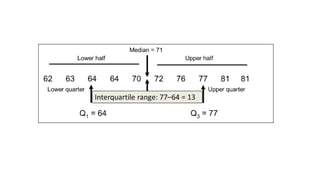
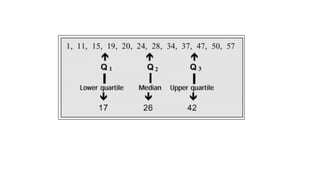
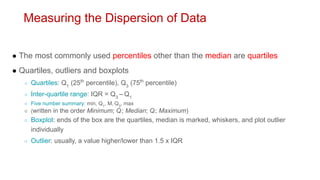
● The most commonly used percentiles other than the median are quartiles
● Quartiles, outliers and boxplots
○ Quartiles: Q1
(25th
percentile), Q3
(75th
percentile)
○ Inter-quartile range: IQR = Q3
– Q1
○ Five number summary: min, Q1
, M, Q3
, max
○ (written in the order Minimum; Q1; Median; Q3; Maximum)
○ Boxplot: ends of the box are the quartiles, median is marked, whiskers, and plot outlier
individually
○ Outlier: usually, a value higher/lower than 1.5 x IQR
Data Transformation and Reduction
Data Transformation
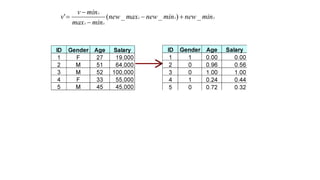
Data Transformation: Normalization
●Min-max normalization: to [new_minA
, new_maxA
]
○ Ex. Let income range $12,000 to $98,000 normalized to [0.0, 1.0]. Then
$73,600 is mapped to
Data Transformation: Normalization
●Z-score normalization (μ: mean, σ: standard deviation): (zero-mean
normalization)
○
○ Ex. Let μ = 54,000, σ = 16,000. Then $73,600 is mapped to
Mean = 80.3
Stdev = 9.84
Data Preprocessing
●Why preprocess the data?
●Data cleaning
●Data integration and transformation
●Data reduction
●Descriptive data summarization
●(Descriptive Statistical Measures )
Data Reduction Strategies
●Why data reduction?
○ A database/data warehouse may store terabytes of data
○ Complex data analysis/mining may take a very long time to run
on the complete data set
●Data reduction
○ Obtain a reduced representation of the data set that is much
smaller in volume but yet produce the same (or almost the same)
analytical results
●Data reduction strategies
1. Attribute subset selection
2. Dimensionality reduction — e.g., remove unimportant attributes
Data Compression
1. Attribute Subset Selection
● Feature selection (i.e., attribute subset selection):
▪ Attribute subset selection reduces the data set size by
removing irrelevant or redundant attributes (or dimensions).
▪ The goal of attribute subset selection is to find a minimum
set of attributes such that the resulting probability distribution
of the data classes is as close as possible to the original
distribution obtained using all attributes.
▪ How can we find a ‘good’ subset of the original attributes?
1. For n attributes, there are 2n
possible subsets
An exhaustive search(Generate-Test) for the optimal subset of
attributes can be prohibitively expensive, especially as n and
the number of data classes increase.
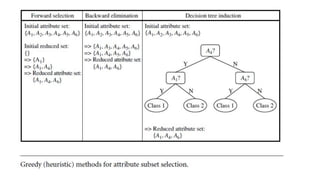
1. Attribute Subset Selection
●Heuristic methods that explore a reduced search
space are commonly used for attribute subset
selection.
●Heuristic methods (due to exponential # of choices):
○ Step-wise forward selection
○ Step-wise backward elimination
○ Combining forward selection and backward elimination
○ Decision-tree induction
DMDW Unit 1.pdf

DMDW Unit 1.pdf

  • 1.
    IT30138 DATA MININGAND DATA WAREHOUSE Mr. Ankur Priyadarshi Assistant Professor Department of Computer Science and Information Technology ankurpriyadarshi@cgu-odisha.ac.in C. V. Raman Global University, Bhubaneswar, Odisha Credits: 2
  • 2.
    Vision and Mission Visionof the C. V. Raman Global University: To emerge as a global leader in the arena of technical education commensurate with the dynamic global scenario for the benefit of mankind. Vision of the Department of CSE : To become a leader in providing high quality education and research in the area of Computer Science, Information Technology, and allied areas. Mission of C.V. Raman Global University : ❖ To provide state-of-art technical education in the undergraduate and postgraduate levels; ❖ to work collaboratively with technical Institutes / Universities / Industries of National and International repute; ❖ to keep abreast with latest technological advancements; ❖ to enhance the Research and Development activities”. Mission of the Department of CSE: M1: To develop human resource with sound theoretical and practical knowledge in the discipline of Computer Science & Engineering. M2: To work in groups for Research, Projects, and Co-Curricular activities involving modern methods, tools and technology. M3: To collaborate and interact with professionals from industry, academia, professional societies, community groups for enhancement of quality of education.
  • 3.
    Program Outcomes ❖ Engineeringknowledge ❖ Problem analysis ❖ Design/development of solutions ❖ Conduct investigations of complex problems ❖ Modern tool usage ❖ The engineer and society ❖ Environment and Ethics ❖ Individual and team work ❖ Communication ❖ Project management and finance ❖ Life-long learning
  • 4.
    Program Educational Objective(PEO) PEO1- To provide the fundamental knowledge in mathematics, science and engineering concepts for the development of engineering system (Fundamental Knowledge). PEO2- To apply current industry accepted computing practices and emerging technologies to analyze, design, implement, test and verify high quality computing systems and computer based solutions to real world problems (Design and development). PEO3- To enable the use of appropriate skill sets and its applications towards social impacts of computing technologies in the career related activities (Skill Set) and to produce Efficient team leaders, effective communicators and capable of working in multi-disciplinary environment following ethical values(Communication). PEO4- To practice professionally and ethically in various positions of industry or government and/or succeed in graduate (Professionalism (Societal Contribution)
  • 5.
    Course Outcomes Upon successfulcompletion of this course, students will be able to: CO1: Identify data mining architecture and different pre-processing techniques required for analysis of given dataset CO2: Analyze frequent patterns, determine associations and correlations CO3: Apply different classification and prediction to data mining applications CO4: Use different clustering mechanisms for data mining CO5: Use data warehouse and data mining techniques for numeric, textual, temporal and unstructured data on the Web
  • 6.
    Syllabus Unit 1 Data Miningand Pre-processing (08 Hrs) U1.1. Introduction: Need of Data Mining, Knowledge Discovery in Database (KDD), Architecture of Data Mining System; Data Objects and Attribute Types, Statistical Description of Data, Data Visualization U1.2.Data Preprocessing: Introduction to Data mining, Data mining Functionalities, Data preprocessing (data summarization, data cleaning, data integration and transformation, data reduction– Feature selection and extraction, dimensionality reduction, data discretization) U1.3.Self-Study: Integration of Data Mining with a Database or Data Warehouse System, Issues in Data Mining
  • 7.
    LEARNING OUTCOMES Need of DataMining Growth of Data What exactly is data mining? Technology required for data mining History of data mining
  • 8.
  • 9.
    A Quote onData Mining Dr. Penzias, a Nobel prize winner interviewed in Computer World in January 1999, states concisely: "Data mining will become more important, and companies will throw away nothing about their customers because it will be so valuable. If you're not doing this, you're out of business."
  • 10.
  • 11.
  • 12.
    1960s Data Collection [Computers, Tape] 1970s DataAccess Relational Database 1980s Application oriented RDBMS Object Oriented Model 1990s Data Mining Data Warehousing 2000s Big Data Analytics No-SQL Evolution of Data Mining
  • 13.
  • 14.
  • 15.
  • 16.
  • 17.
  • 18.
  • 19.
  • 20.
    What is mining? Extractionof non-obvious, implicit, unknown and useful resources from planet.
  • 21.
    What Is DataMining? ● Data mining (knowledge discovery from data) ○ Extraction of interesting (non-trivial, implicit, previously unknown and potentially useful) patterns or knowledge from huge amount of data ○ Data mining: a misnomer? ● Alternative names ○ Knowledge discovery (mining) in databases (KDD), knowledge extraction, data/pattern analysis, data archeology, data dredging, information harvesting, business intelligence, etc. ● Watch out: Is everything “data mining”? ○ Simple search and query processing ○ (Deductive) expert systems
  • 22.
    Quiz of theDay Scan/Copy link it and give your choice https://forms.gle/m97uenx3zYtKEV4y9
  • 23.
    OPTION 1 Unknown Answer -NO OPTION 2 Implicit Answer - No OPTION 3 Useful Answer - No OPTION 4 Obvious Answer - yes Answer of the Day Q: Which of the following keyword is not associated with Data mining?
  • 24.
    Getting to KnowYour Data (Data Objects and Attribute Types) 24 Unit 1: Data and Data Preprocessing
  • 25.
    25 Types of DataSets ● Record ○ Relational records ○ Data matrix, e.g., numerical matrix, crosstabs ○ Document data: text documents: term-frequency vector ○ Transaction data ● Graph and network ○ World Wide Web ○ Social or information networks ○ Molecular Structures ● Ordered ○ Video data: sequence of images ○ Temporal data: time-series ○ Sequential Data: transaction sequences ○ Genetic sequence data ● Spatial, image and multimedia: ○ Spatial data: maps ○ Image data: ○ Video data:
  • 26.
  • 27.
  • 28.
  • 29.
  • 30.
  • 31.
  • 32.
    Data Objects ● Datasets are made up of data objects. ● A data object represents an entity. ● Examples: ○ sales database: customers, store items, sales ○ medical database: patients, treatments ○ university database: students, professors, courses ● Also called samples , examples, instances, data points, objects, tuples. ● Data objects are described by attributes. ● Database rows -> data objects; columns ->attributes.
  • 34.
    Types of Variables/ Attributes ●Variables: ○Qualitative ■Ordinal or Nominal ○Quantitative (or numeric) ■Discrete(Integer) or Continuous 🡪some numeric data are discrete and some are continuous For statistical analysis, qualitative data can be converted into discrete numeric data(Quantitative) 34
  • 35.
    Quantitative Data ▪ Quantitativeor numerical data arise when the observations are counts or measurements. ▪ Quantitative data is information about quantities; that is, information that can be measured and written down with numbers. Some examples of quantitative data are your height, your shoe size, and the length of your fingernails. ▪ Discrete data can be numeric -- like numbers of apples (i.e., Data that can only take certain values. For example: the number of students in a class -you can't have half a student). ▪ Discrete data can also be categorical -- like red or blue, or male or female, or good or bad. 35
  • 36.
    ● The tableshows a part of some (hypothetical) data on a group of 48 subjects. 'Age' and 'income' are continuous numeric variables, 'age group' is an ordinal qualitative variable, and 'sex' is a nominal qualitative variable. ● The ordinal variable 'age group' is created from the continuous variable 'age' using five categories: age group = 1 if age is less than 20; age group = 2 if age is 20 to 29; age group = 3 if age is 30 to 39; age group = 4 if age is 40 to 49; age group = 5 if age is 50 or more 36
  • 37.
    Types of Data: Nominal, Ordinal, Interval and Ratio Nominal: ▪Nominal scales are used for labeling variables, without any quantitative value. ▪“Nominal” scales could simply be called “labels.” ▪No specific order ▪A good way to remember all of this is that “nominal” sounds a lot like “name” and nominal scales are kind of like “names” or labels. 37
  • 39.
    Ordinal Data ▪Ordinal scalesare typically measures of non-numeric concepts like satisfaction, happiness, ratings etc. ▪“Ordinal” is easy to remember because is sounds like “order” and that’s the key to remember with “ordinal scales”–it is the order that matters, but that’s all you really get from these. 39
  • 40.
  • 44.
    Interval ▪Interval scales arenumeric scales in which we know not only the order, but also the exact differences between the values. ▪The classic example of an interval scale is Celsius temperature because the difference between each value is the same. ▪For example, the difference between 60 and 50 degrees is a measurable 10 degrees, as is the difference between 80 and 70 degrees. ▪Time is another good example of an interval scale in which the increments are known, consistent, and measurable. 44
  • 45.
    Ratio: ▪ Ratio datahas all properties of interval data such as – data should have numeric values, a distance between the two points are equal etc. but, unlike interval data where zero is arbitrary, in ratio data, zero is absolute. ▪ Ratio data has a defined zero point. ● Income, height, weight, annual sales, market share, product defect rates, time to repurchase, unemployment rate, and crime rate are examples of ratio data. ▪ A very good example of ratio data is the measurement of heights. Height could be measured in centimeters, meters, inches or feet. It is not possible to have a negative height. When comparing to interval data for example temperature can be – 10-degree Celsius but height cannot be in negative. ▪ Ratio data can be multiplied and divided, this is one of the major differences between ratio data and interval data, which can only be added and subtracted. 45
  • 46.
    Binary Attribute ● Binary ○Nominal attribute with only 2 states (0 and 1) ○ Symmetric binary: both outcomes equally important ■ e.g., gender ○ Asymmetric binary: outcomes not equally important. ■ e.g., medical test (positive vs. negative) ■ Convention: assign 1 to most important outcome (e.g., HIV positive)
  • 47.
    Discrete vs. ContinuousAttributes ● Discrete Attribute ○ Has only a finite or countably infinite set of values ■ E.g., zip codes, profession, or the set of words in a collection of documents ○ Sometimes, represented as integer variables ○ Note: Binary attributes are a special case of discrete attributes ● Continuous Attribute ○ Has real numbers as attribute values ■ E.g., temperature, height, or weight ○ Practically, real values can only be measured and represented using a finite number of digits ○ Continuous attributes are typically represented as floating-point variables Discrete data can take on only integer values whereas continuous data can take on any value. For instance the number of cancer patients treated by a hospital each year is discrete but your weight is continuous. Some data are continuous but measured in a discrete way e.g. your age.
  • 51.
    Case Study-1 ● Letus take an example of “200 meter race” in a tournament where three runners are participating from three different branches of CGU. ● Each runner is assigned a number (displayed in uniform) to differentiate from each other. The number displayed in the uniform to identify runners is an example of nominal scale. ● Once the race is over, the winner is declared along with the declaration of first runner up and second runner up based on the criteria that who reaches the destination first, second and last. The rank order of runners such as “second runner up as 3”, “first runner up as 2” and the “winner as 1” is an example of ordinal scale. ● During the tournament, judge is asked to rate each runner on the scale of 1–10 based on certain criteria. The rating given by the judge is an example of interval scale. ● The time spent by each runner in completing the race is an example of ratio scale.
  • 53.
    Evaluation Business Understanding Data Understanding Data Preparation Modeling Deployment •Project objectives •Problem definition •Datacollection •Insights •Dataset construction •Purpose of model •Steps review •Business issues •Modeling techniques Knowledge Discovery of Data
  • 54.
    Interpretation/Evaluation Data Mining Transformation Pre-processing Selection Target data Processeddata Transformed data Patterns Knowledge •Data visualization and result interpretation •Model with algorithms such as clustering, regression and classification •Dimension-reduction •Factor analysis •Difference, or taking logarithm to be Normalization •Data collection and sampling •Correlation analysis Knowledge Discovery of Data
  • 55.
  • 56.
    56 Why Data Preprocessing? ●Datain the real world is dirty ○incomplete: lacking attribute values, lacking certain attributes of interest, or containing only aggregate data ■ e.g., occupation=“ ” ○noisy: containing errors or outliers ■ e.g., Salary=“-10” ○inconsistent: containing discrepancies in codes or names ■ e.g., Age=“42” Birthday=“03/07/1997” ■ e.g., Was rating “1,2,3”, now rating “A, B, C” ■ e.g., discrepancy between duplicate records
  • 57.
    57 Why Is DataDirty? ● Incomplete data may come from ○ “Not applicable” data value when collected ○ Different considerations between the time when the data was collected and when it is analyzed. ○ Human/hardware/software problems ● Noisy data (incorrect values) may come from ○ Faulty data collection instruments ○ Human or computer error at data entry ○ Errors in data transmission ● Inconsistent data may come from ○ Different data sources ○ Functional dependency violation (e.g., modify some linked data) ● Duplicate records also need data cleaning
  • 58.
    58 Why Is DataPreprocessing Important? ● No quality data, no quality mining results! ○ Quality decisions must be based on quality data ■ e.g., duplicate or missing data may cause incorrect or even misleading statistics. ○ Data warehouse needs consistent integration of quality data ● Data extraction, cleaning, and transformation comprises the majority of the work of building a data warehouse
  • 59.
    59 Multi-Dimensional Measure ofData Quality ● A well-accepted multidimensional view: ○ Accuracy ○ Completeness ○ Consistency ○ Timeliness ○ Believability ○ Value added ○ Interpretability ○ Accessibility ● Broad categories: ○ Intrinsic, contextual, representational, and accessibility
  • 60.
    60 Major Tasks inData Preprocessing ● Data cleaning ○ Fill in missing values, smooth noisy data, identify or remove outliers, and resolve inconsistencies ● Data integration ○ Integration of multiple databases, data cubes, or files ● Data transformation ○ Normalization and aggregation ● Data reduction ○ Obtains reduced representation in volume but produces the same or similar analytical results ● Data discretization ○ Part of data reduction but with particular importance, especially for numerical data
  • 61.
  • 62.
  • 63.
  • 64.
    Supervised Learning ●The trainingdata includes both Inputs and Labels(Targets) ●what are Inputs and Labels(Targets)?? for example addition of two numbers a=5,b=6 result =11, Inputs are 5,6 and Target is 11
  • 65.
    Unsupervised Learning ●The trainingdata does not include Targets here so we don’t tell the system where to go , the system has to understand itself from the data we give.
  • 66.
    Reinforcement Learning ●Though bothsupervised and reinforcement learning use mapping between input and output, unlike supervised learning where the feedback provided to the agent is correct set of actions for performing a task, reinforcement learning uses rewards and punishments as signals for positive and negative behavior
  • 67.
    ●An RL problemcan be best explained through games. ●Goal : to eat food ●Environment - Grid ●Reward for eating food ●Punishment - if killed by Ghost
  • 68.
    Types of SupervisedLearning ●Regression: This is a type of problem where we need to predict the continuous-response value (ex : above we predict number which can vary from -infinity to +infinity) ●Some examples are ○ what is the price of house in a specific city? ○ what is the value of the stock? ○ how many total runs can be on board in a cricket game?
  • 69.
    ●Classification: This isa type of problem where we predict the categorical response value where the data can be separated into specific “classes” (ex: we predict one of the values in a set of values). ●Some examples are : ○ this mail is spam or not? ○ will it rain today or not? ○ is this picture a cat or not? ○ Basically ‘Yes/No’ type questions called binary classification. ○ Other examples are : ○ this mail is spam or important or promotion? ○ is this picture a cat or a dog or a tiger? ○ This type is called multi-class classification.
  • 70.
  • 71.
    Unsupervised Learning ●Clustering: Thisis a type of problem where we group similar things together. ●Bit similar to multi class classification but here we don’t provide the labels, the system understands from data itself and cluster the data. ●Some examples are : ○ given news articles, cluster into different types of news ○ given a set of tweets ,cluster based on content of tweet ○ given a set of images, cluster them into different objects
  • 72.
    Data Cleaning andIntegration
  • 73.
    How to HandleMissing Data? (Methods/Techniques) 1. Ignore the tuple 2. Fill in the missing value manually 3. Use a global constant to fill in the missing value 4. Use the attribute mean to fill in the missing value 5. Use the attribute mean for all samples belonging to the same class as the given tuple 6. Use the most probable value to fill in the missing value
  • 74.
    How to HandleMissing Data? (Methods) 1. Ignore the tuple: This is usually done when the class label is missing (assuming the mining task involves classification). This method is not very effective, unless the tuple contains several attributes with missing values. It is especially poor when the percentage of missing values per attribute varies considerably.
  • 75.
    2. Fill inthe missing value manually ● In general, this approach is time-consuming and may not be feasible given a large data set with many missing values.
  • 76.
    ● 3. Usea global constant to fill in the missing value: Replace all missing attribute values by the same constant, such as a label like “Unknown” . If missing values are replaced by, say, “Unknown,” then the mining program may mistakenly think that they form an interesting concept, since they all have a value in common—that of “Unknown.” Hence, although this method is simple, it is not fool proof.
  • 77.
    ● 4. Usethe attribute mean to fill in the missing value: For example, suppose that the average income of customers is $56,000. Use this value to replace the missing value for income.
  • 78.
    ● 5. Usethe attribute mean for all samples belonging to the same class as the given tuple: For example, if classifying customers according to cheat, replace the missing value with the average income value for customers in the same credit risk category as that of the given tuple.
  • 79.
    ● 6. Usethe most probable value to fill in the missing value: This may be determined with regression, inference-based tools using a Bayesian formalism, or decision tree induction. For example, using the other customer attributes in your data set, you may construct a decision tree to predict the missing values for income. Note: ● Method 6 is a popular strategy.
  • 80.
    Noisy Data ● “Whatis noise?” ● Noise: random error or variance in a measured variable Incorrect attribute values may due to ○ faulty data collection instruments ○ data entry problems ○ data transmission problems ○ technology limitation ○ inconsistency in naming convention Other data problems which requires data cleaning ○ duplicate records ○ incomplete data ○ inconsistent data
  • 81.
    How to HandleNoisy Data? (Techniques) ● How can we “smooth” out the data to remove the noise? ● (Data smoothing techniques) ● 1. Binning ○ first sort data and partition into (equal-frequency) bins ○ then one can smooth by bin means, smooth by bin median, smooth by bin boundaries, etc. ● 2. Regression ○ smooth by fitting the data into regression functions ● 3. Clustering ○ detect and remove outliers ● Combined computer and human inspection ○ detect suspicious values and check by human (e.g., deal with possible outliers)
  • 82.
    82 Binning Partition into equaldepth bins Bin1: 4, 8, 15 Bin2: 21, 21, 24 Bin3: 25, 28, 34 means Bin1: 9, 9, 9 Bin2: 22, 22, 22 Bin3: 29, 29, 29 boundaries Bin1: 4, 4, 15 Bin2: 21, 21, 24 Bin3: 25, 25, 34 Binning Original Data for “price” (after sorting): 4, 8, 15, 21, 21, 24, 25, 28, 34 Each value in a bin is replaced by the mean value of the bin. Min and Max values in each bin are identified (boundaries). Each value in a bin is replaced with the closest boundary value.
  • 83.
  • 84.
  • 85.
    85 Smoothing Noisy Data- Example The final table with the new values for the Temperature attribute.
  • 86.
    86 Data Preprocessing ●Why preprocessthe data? ●Data cleaning ●Data integration and transformation ●Data reduction ●Descriptive data summarization ●(Descriptive Statistical Measures )
  • 87.
    Data integration andtransformation ●Integration ●Merging of data from multiple data stores. ●Transformation ●Data are transformed or consolidated into forms appropriate for mining. 87
  • 88.
    88 Data Integration ● Dataintegration: ○ Combines data from multiple sources into a coherent store ●Number of issues to consider during data integration. ○ Schema integration ○ object matching ● Schema integration: e.g., A.cust-id ≡ B.cust-# ○ Integrate metadata from different sources ●For example, how can the data analyst or the computer be sure that customer_id in one database and cust_number in another refer to the same attribute?
  • 89.
    Data Integration Examples ofmetadata for each attribute include the name, meaning, data type, and range of values permitted for the attribute, and null rules for handling blank, zero, or null values. Such metadata can be used to help avoid errors in schema integration. The metadata may also be used to help transform the data (e.g., where data codes for pay type in one database may be “H” and “S”, and 1 and 2 in another). Hence, this step also relates to data cleaning, as described earlier. Detecting and resolving data value conflicts ○ For the same real world entity, attribute values from different sources are different ○ Possible reasons: different representations, different scales, e.g., metric vs. British units 89
  • 90.
    Data Integration Redundancy isanother important issue. An attribute (such as annual revenue, for instance) may be redundant if it can be “derived” from another attribute or set of attributes. Inconsistencies in attribute or dimension naming can also cause redundancies in the resulting data set. Some redundancies can be detected by correlation analysis. 90
  • 91.
    91 Handling Redundancy inData Integration ● Redundant data occur often when integration of multiple databases ○ Object identification: The same attribute or object may have different names in different databases ○ Derivable data: One attribute may be a “derived” attribute in another table, e.g., age ● Redundant attributes may be able to be detected by correlation analysis ● Careful integration of the data from multiple sources may help reduce/avoid redundancies and inconsistencies and improve mining speed and quality
  • 92.
  • 94.
    Data Reduction Strategies ●Whydata reduction? ○ A database/data warehouse may store terabytes of data ○ Complex data analysis/mining may take a very long time to run on the complete data set ●Data reduction ○ Obtain a reduced representation of the data set that is much smaller in volume but yet produce the same (or almost the same) analytical results ●Data reduction strategies 1. Attribute subset selection 2. Dimensionality reduction — e.g., remove unimportant attributes Data Compression
  • 95.
    1. Attribute SubsetSelection ● Feature selection (i.e., attribute subset selection): ▪ Attribute subset selection reduces the data set size by removing irrelevant or redundant attributes (or dimensions). ▪ The goal of attribute subset selection is to find a minimum set of attributes such that the resulting probability distribution of the data classes is as close as possible to the original distribution obtained using all attributes. ▪ How can we find a ‘good’ subset of the original attributes? 1. For n attributes, there are 2n possible subsets An exhaustive search(Generate-Test) for the optimal subset of attributes can be prohibitively expensive, especially as n and the number of data classes increase.
  • 96.
    1. Attribute SubsetSelection ●Heuristic methods that explore a reduced search space are commonly used for attribute subset selection. ●Heuristic methods (due to exponential # of choices): ○ Step-wise forward selection ○ Step-wise backward elimination ○ Combining forward selection and backward elimination ○ Decision-tree induction
  • 98.
    Data Preprocessing ●Why preprocessthe data? ●Data cleaning ●Data integration and transformation ●Data reduction ●Descriptive data summarization ●(Descriptive Statistical Measures )
  • 99.
    Descriptive data summarization ●For data pre-processing to be successful, ▪ It is essential to have an overall picture of your data. ▪ Descriptive data summarization techniques can be used to identify the typical properties of your data and highlight which data values should be treated as noise or outliers. ▪ So, the basic concepts of descriptive data summarization are to be discussed.
  • 100.
    Mining Data -Descriptive Characteristics ● Motivation To better understand the data: ○ Central tendency ○ Dispersion (variation and spread) of data
  • 101.
    Measuring the CentralTendency (Mean) Various ways to measure the central tendency of data ●The most common and most effective numerical measure of the “center” of a set of data is the (arithmetic) mean.
  • 102.
    Measuring the CentralTendency ▪Issue: ●A major problem with the mean is its sensitivity to extreme (e.g., outlier) values. Even a small number of extreme values can corrupt the mean. ●Can not be applied to categorical data ●For example, the mean salary at a company may be substantially pushed up by that of a few highly paid managers ●So, it is not always the best way of measuring the center of the data
  • 103.
    Weighted arithmetic meanor the weighted average
  • 104.
    Trimmed mean To offsetthe effect caused by a small number of extreme values(low or high outlier), we can use the trimmed mean, which is the mean obtained after chopping off values at the high and low extremes. which is the mean obtained after chopping off values at the high and low extremes. For example, we can sort the values observed for salary and remove the top and bottom 2% before computing the mean. ●Issue: ●We should avoid trimming too large a portion (such as 20%) at both ends as this can result in the loss of valuable information.
  • 105.
  • 106.
    Median: ● For skewed(asymmetric) data, a better measure of the center of data is the median. ● Suppose that a given data set of N distinct values is sorted in numerical order. ● If N is odd, then the median is the middle value of the ordered set; otherwise (i.e., if N is even), the median is the average of the middle two values. ● A holistic measure is a measure that must be computed on the entire data set as a whole. It cannot be computed by partitioning the given data into subsets. ● The median is an example of a holistic measure. ● Holistic measures are much more expensive to compute than distributive measures
  • 107.
    Mode ●The mode fora set of data is, the value that occurs most frequently in the set. ▪It is possible for the greatest frequency to correspond to several different values, which results in more than one mode. (In one column every value can repeat number of times) ▪If one value repeats – Unimodal, two values repeat-Bimodal, and so on. ▪Data sets with one, two, or three modes are respectively called unimodal, bimodal, and trimodal. ▪In general, a data set with two or more modes is multimodal. ▪If each data value occurs only once, then there is no mode.
  • 108.
    Mode ▪In a unimodalfrequency curve with perfect symmetric data distribution, the mean, median, and mode are all at the same center value ●However, data in most real applications are not symmetric. ▪They may instead be either positively skewed, where the mode occurs at a value that is smaller than the median or negatively skewed, where the mode occurs at a value greater than the median.
  • 109.
    Measuring the Dispersionof Data ●The degree to which numerical data tend to spread is called the dispersion, or variance of the data. ●The most common measures of data dispersion are … ✔Range, ✔The five-number summary (based on quartiles), ✔The interquartile range, and ✔The standard deviation Boxplots can be plotted based on the five-number summary and are a useful tool for identifying outliers.
  • 110.
    Measuring the Dispersionof Data - Range ●Let x1;x2; : : : ;xn be a set of observations for some attribute. ●The range of the set is the difference between the largest (max()) and smallest (min()) values.
  • 111.
    Measuring the Dispersionof Data ● The most commonly used percentiles other than the median are quartiles ● Quartiles, outliers and boxplots ○ Quartiles: Q1 (25th percentile), Q3 (75th percentile) ○ Inter-quartile range: IQR = Q3 – Q1 ○ Five number summary: min, Q1 , M, Q3 , max ○ (written in the order Minimum; Q1; Median; Q3; Maximum) ○ Boxplot: ends of the box are the quartiles, median is marked, whiskers, and plot outlier individually ○ Outlier: usually, a value higher/lower than 1.5 x IQR
  • 115.
  • 116.
  • 117.
    Data Transformation: Normalization ●Min-maxnormalization: to [new_minA , new_maxA ] ○ Ex. Let income range $12,000 to $98,000 normalized to [0.0, 1.0]. Then $73,600 is mapped to
  • 119.
    Data Transformation: Normalization ●Z-scorenormalization (μ: mean, σ: standard deviation): (zero-mean normalization) ○ ○ Ex. Let μ = 54,000, σ = 16,000. Then $73,600 is mapped to
  • 120.
  • 121.
    Data Preprocessing ●Why preprocessthe data? ●Data cleaning ●Data integration and transformation ●Data reduction ●Descriptive data summarization ●(Descriptive Statistical Measures )
  • 122.
    Data Reduction Strategies ●Whydata reduction? ○ A database/data warehouse may store terabytes of data ○ Complex data analysis/mining may take a very long time to run on the complete data set ●Data reduction ○ Obtain a reduced representation of the data set that is much smaller in volume but yet produce the same (or almost the same) analytical results ●Data reduction strategies 1. Attribute subset selection 2. Dimensionality reduction — e.g., remove unimportant attributes Data Compression
  • 123.
    1. Attribute SubsetSelection ● Feature selection (i.e., attribute subset selection): ▪ Attribute subset selection reduces the data set size by removing irrelevant or redundant attributes (or dimensions). ▪ The goal of attribute subset selection is to find a minimum set of attributes such that the resulting probability distribution of the data classes is as close as possible to the original distribution obtained using all attributes. ▪ How can we find a ‘good’ subset of the original attributes? 1. For n attributes, there are 2n possible subsets An exhaustive search(Generate-Test) for the optimal subset of attributes can be prohibitively expensive, especially as n and the number of data classes increase.
  • 124.
    1. Attribute SubsetSelection ●Heuristic methods that explore a reduced search space are commonly used for attribute subset selection. ●Heuristic methods (due to exponential # of choices): ○ Step-wise forward selection ○ Step-wise backward elimination ○ Combining forward selection and backward elimination ○ Decision-tree induction