Intro To OSHA Objectives
• EO 3.1: Describe major sections of the Occupational Safety and
Health Act of 1970, Public Law - 91-596 (OSH Act).
• EO 3.2: Explain the functions of the Occupational Safety and Health
Administration (OSHA).
• EO 3.3: Describe the positive impact of OSHA on worker safety and
health.
• EO 3.4: Describe employer and worker rights and responsibilities.
1
Intro To OSHA Objectives
• Describe the organization, origin and codification of OSHA standards.
EO 4.1: Describe the system of organization for the Code of Federal
Regulations (CFR).
• EO 4.2: Identify major parts within Title 29 Labor.
• EO 4.3: Discuss the origin of OSHA standards.
• EO 4.4: Explain the codification system for general industry standards.
• EO 4.5: Identify tasks for which general industry standards or
construction standards apply.
• EO 4.6: Describe types of consensus or proprietary standards that
may be legally binding because they are incorporated by reference or
commonly used in an industry.
• EO 4.7: Explain the importance of a regulation’s preamble, including
its purpose, location and type of information.
• EO 4.8: Identify the purpose and type of information found in OSHA
Directives, including Enforcement and Compliance Directives (CPL).
• EO 4.9: Identify the purpose and type of information found in letters
of interpretation.
2
Intro To OSHA Objectives
• Describe the process and rules for OSHA inspections, citations,
penalties, and policies.
• EO 5.1: Discuss the legal basis of inspections, citations and penalties
in the OSH Act.
• EO 5.2: Describe the major sections of Part 1903.
• EO 5.3: Describe the inspection process.
• EO 5.4: Describe OSHA inspection priorities.
• EO 5.5: Indicate the various types of OSHA violations.
• EO 5.6: Describe the post-inspection process.
• EO 5.7: Identify the most frequently cited standards in general
industry.
• EO 5.8: Identify consensus standards commonly cited under section
5(a)(1) for general industry.
• EO 5.9: Explain the responsibilities and liabilities of each type of
employer on a multiemployer workplace.
3
Introduction to
OSHA
John Newquist
Draft 5 25 2020
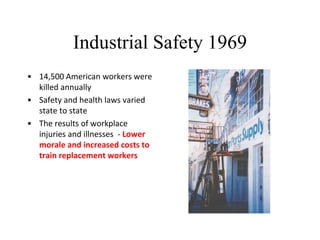
Industrial Safety 1969
• 14,500 American workers were
killed annually
• Safety and health laws varied
state to state
• The results of workplace
injuries and illnesses - Lower
morale and increased costs to
train replacement workers
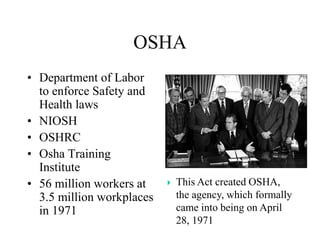
OSHA
• Department of Labor
to enforce Safety and
Health laws
• NIOSH
• OSHRC
• Osha Training
Institute
• 56 million workers at
3.5 million workplaces
in 1971
 This Act created OSHA,
the agency, which formally
came into being on April
28, 1971
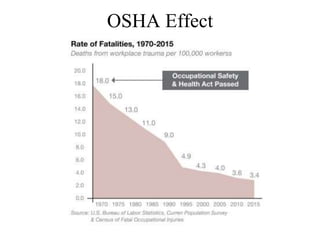
OSHA Effect
Code of Federal Regulations
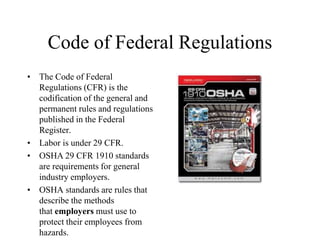
• The Code of Federal
Regulations (CFR) is the
codification of the general and
permanent rules and regulations
published in the Federal
Register.
• Labor is under 29 CFR.
• OSHA 29 CFR 1910 standards
are requirements for general
industry employers.
• OSHA standards are rules that
describe the methods
that employers must use to
protect their employees from
hazards.
Code of Federal Regulations
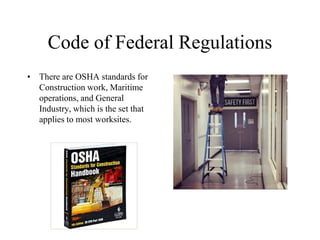
• There are OSHA standards for
Construction work, Maritime
operations, and General
Industry, which is the set that
applies to most worksites.
Code of Federal Regulations
• There are OSHA standards for
Construction work, Maritime
operations, and General
Industry, which is the set that
applies to most worksites.
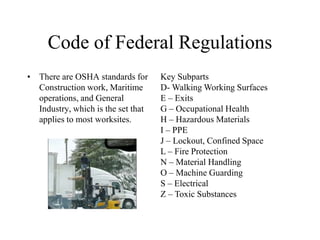
Key Subparts
D- Walking Working Surfaces
E – Exits
G – Occupational Health
H – Hazardous Materials
I – PPE
J – Lockout, Confined Space
L – Fire Protection
N – Material Handling
O – Machine Guarding
S – Electrical
Z – Toxic Substances
Construction or General Industry?
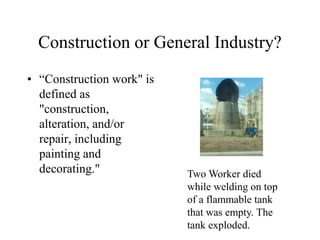
• “Construction work" is
defined as
"construction,
alteration, and/or
repair, including
painting and
decorating." Two Worker died
while welding on top
of a flammable tank
that was empty. The
tank exploded.
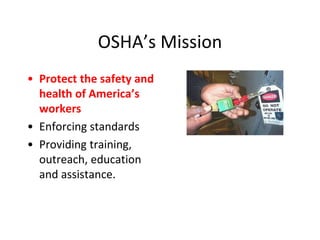
OSHA’s Mission
• Protect the safety and
health of America’s
workers
• Enforcing standards
• Providing training,
outreach, education
and assistance.
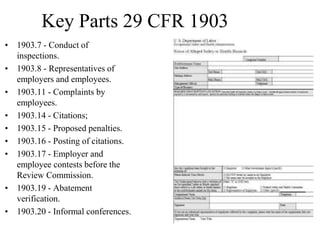
Key Parts 29 CFR 1903
• 1903.7 - Conduct of
inspections.
• 1903.8 - Representatives of
employers and employees.
• 1903.11 - Complaints by
employees.
• 1903.14 - Citations;
• 1903.15 - Proposed penalties.
• 1903.16 - Posting of citations.
• 1903.17 - Employer and
employee contests before the
Review Commission.
• 1903.19 - Abatement
verification.
• 1903.20 - Informal conferences.
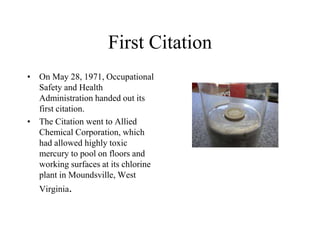
First Citation
• On May 28, 1971, Occupational
Safety and Health
Administration handed out its
first citation.
• The Citation went to Allied
Chemical Corporation, which
had allowed highly toxic
mercury to pool on floors and
working surfaces at its chlorine
plant in Moundsville, West
Virginia.
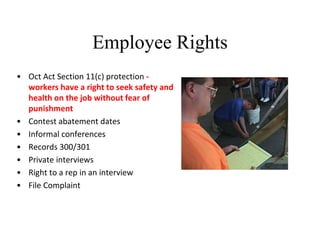
Employee Rights
• Oct Act Section 11(c) protection -
workers have a right to seek safety and
health on the job without fear of
punishment
• Contest abatement dates
• Informal conferences
• Records 300/301
• Private interviews
• Right to a rep in an interview
• File Complaint
General Duty Clause
• Section 5(a)(1)
• "a place of
employment which is
free from recognized
hazards that are
causing or are likely to
cause death or serious
physical harm to [its]
employees."
Not wearing seatbelts is a
common citation under the
general duty clause.
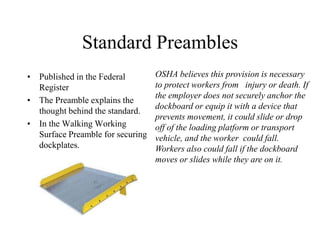
Standard Preambles
• Published in the Federal
Register
• The Preamble explains the
thought behind the standard.
• In the Walking Working
Surface Preamble for securing
dockplates.
OSHA believes this provision is necessary
to protect workers from injury or death. If
the employer does not securely anchor the
dockboard or equip it with a device that
prevents movement, it could slide or drop
off of the loading platform or transport
vehicle, and the worker could fall.
Workers also could fall if the dockboard
moves or slides while they are on it.
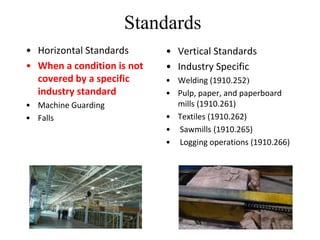
Standards
• Horizontal Standards
• When a condition is not
covered by a specific
industry standard
• Machine Guarding
• Falls
• Vertical Standards
• Industry Specific
• Welding (1910.252)
• Pulp, paper, and paperboard
mills (1910.261)
• Textiles (1910.262)
• Sawmills (1910.265)
• Logging operations (1910.266)
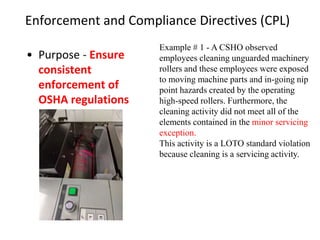
Enforcement and Compliance Directives (CPL)
• Purpose - Ensure
consistent
enforcement of
OSHA regulations
Example # 1 - A CSHO observed
employees cleaning unguarded machinery
rollers and these employees were exposed
to moving machine parts and in-going nip
point hazards created by the operating
high-speed rollers. Furthermore, the
cleaning activity did not meet all of the
elements contained in the minor servicing
exception.
This activity is a LOTO standard violation
because cleaning is a servicing activity.
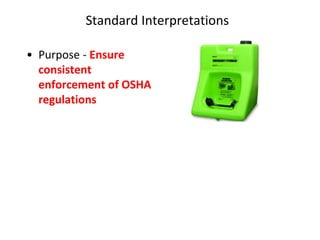
Standard Interpretations
• Purpose - Ensure
consistent
enforcement of OSHA
regulations
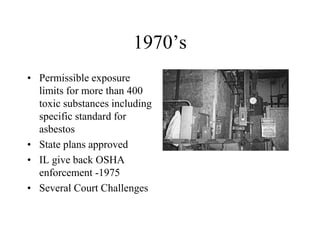
1970’s
• Permissible exposure
limits for more than 400
toxic substances including
specific standard for
asbestos
• State plans approved
• IL give back OSHA
enforcement -1975
• Several Court Challenges
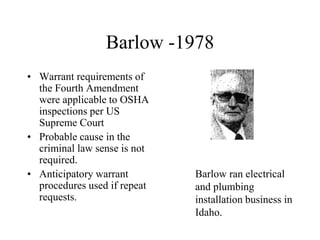
Barlow -1978
• Warrant requirements of
the Fourth Amendment
were applicable to OSHA
inspections per US
Supreme Court
• Probable cause in the
criminal law sense is not
required.
• Anticipatory warrant
procedures used if repeat
requests.
Barlow ran electrical
and plumbing
installation business in
Idaho.
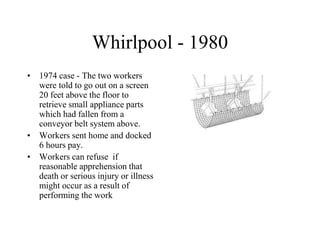
Whirlpool - 1980
• 1974 case - The two workers
were told to go out on a screen
20 feet above the floor to
retrieve small appliance parts
which had fallen from a
conveyor belt system above.
• Workers sent home and docked
6 hours pay.
• Workers can refuse if
reasonable apprehension that
death or serious injury or illness
might occur as a result of
performing the work
1980’s
• Access to medical and
exposure records
• Hazard communication
• Updated asbestos
• Ethylene oxide,
formaldehyde, and benzene.
• Hazardous waste operations
and emergency response
• Lockout/tagout of
hazardous energy sources.
• Egregious
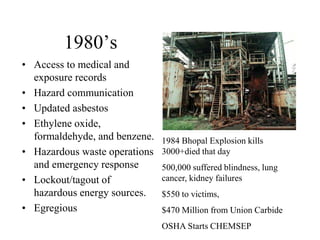
1984 Bhopal Explosion kills
3000+died that day
500,000 suffered blindness, lung
cancer, kidney failures
$550 to victims,
$470 Million from Union Carbide
OSHA Starts CHEMSEP
1990’s
• Confined Space
• Respirators
• Personal Protective
Equipment
• Process Safety
• Forklift Training
• www.osha.gov
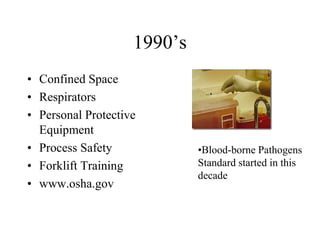
•Blood-borne Pathogens
Standard started in this
decade
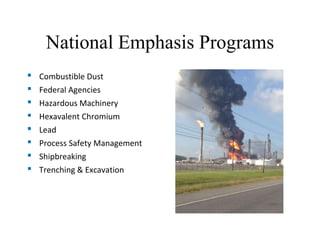
National Emphasis Programs
▪ Combustible Dust
▪ Federal Agencies
▪ Hazardous Machinery
▪ Hexavalent Chromium
▪ Lead
▪ Process Safety Management
▪ Shipbreaking
▪ Trenching & Excavation
Region V
Local Emphasis Programs
▪ Building Renovation/Rehab and
Demolition
▪ Powered Industrial Vehicles
▪ Fall Hazards
▪ Grain Handling Facilities
▪ High Rise Building Construction
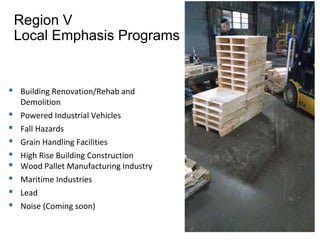
▪ Wood Pallet Manufacturing Industry
▪ Maritime Industries
▪ Lead
▪ Noise (Coming soon)
Types of Inspections
• Imminent Danger
• Fatalities 800-321-
OSHA within 8 hours
• Amputation,
Hospitalization, Eye
Loss within 24 hours
• Complaints – 5 days
• Referrals
• General Schedule
• Follow Up
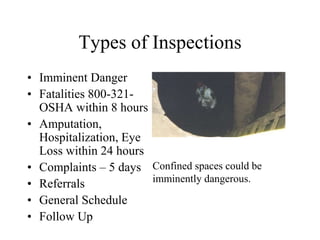
Confined spaces could be
imminently dangerous.
Inspection Process
• Present Credentials
• Opening conference
• Walk around
inspection
• Closing conference
• Six month to complete
inspection and issue
citations.
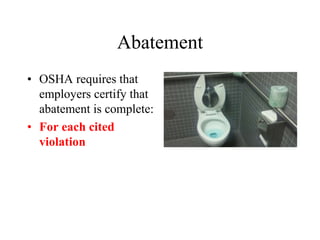
Abatement
• OSHA requires that
employers certify that
abatement is complete:
• For each cited
violation
Multi-Employer Citations
• Exposing
• Creating
• Controlling
• Correcting
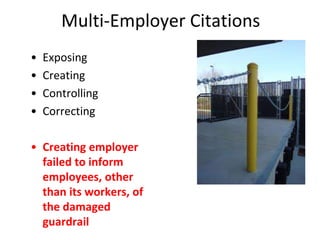
• Creating employer
failed to inform
employees, other
than its workers, of
the damaged
guardrail
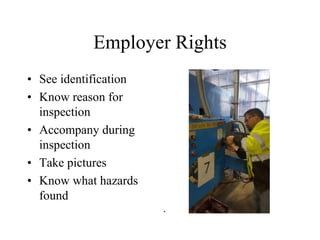
Employer Rights
• See identification
• Know reason for
inspection
• Accompany during
inspection
• Take pictures
• Know what hazards
found
.
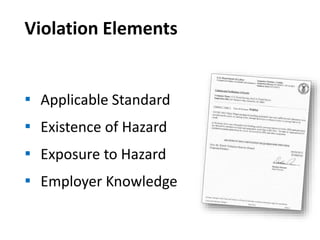
Violation Elements
▪ Applicable Standard
▪ Existence of Hazard
▪ Exposure to Hazard
▪ Employer Knowledge
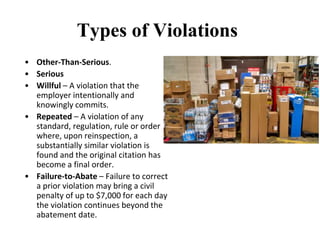
Types of Violations
• Other-Than-Serious.
• Serious
• Willful – A violation that the
employer intentionally and
knowingly commits.
• Repeated – A violation of any
standard, regulation, rule or order
where, upon reinspection, a
substantially similar violation is
found and the original citation has
become a final order.
• Failure-to-Abate – Failure to correct
a prior violation may bring a civil
penalty of up to $7,000 for each day
the violation continues beyond the
abatement date.
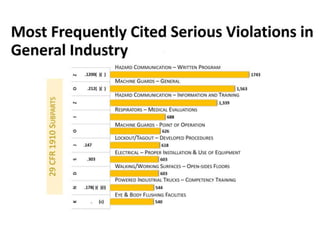
Top 10 Violations
37
Level
2020 Maximum Penalty
Serious $13,494 per violation
OTS $13,494 per violation
Willful or
Repeat
$134,937 per violation
Failure to
Abate
$13,494 per day unabated
beyond the abatement date
[generally limited to 30 days
maximum]
OSHA Penalty Levels: 2019
Penalty Adjustment Factors
• Size – A maximum penalty reduction of 60% is
permitted for small businesses.
• Good Faith – A penalty reduction of up to 25% is
permitted. Credit for Good Faith normally requires
an employer to have an effective safety and health
program.
• History – A reduction of 10% is given to
employers who have not been cited by OSHA for
any serious, willful, or repeated violations in the
past three years.
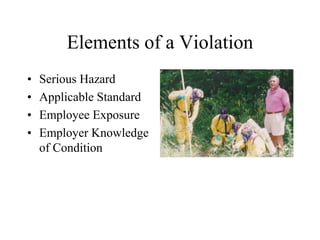
Elements of a Violation
• Serious Hazard
• Applicable Standard
• Employee Exposure
• Employer Knowledge
of Condition
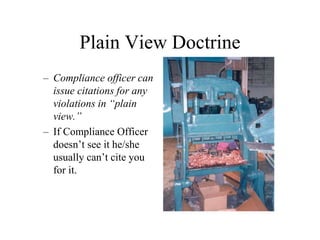
Plain View Doctrine
– Compliance officer can
issue citations for any
violations in “plain
view.”
– If Compliance Officer
doesn’t see it he/she
usually can’t cite you
for it.
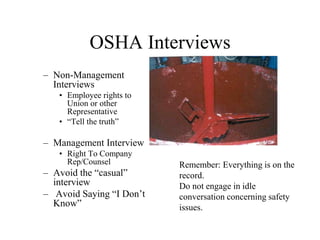
OSHA Interviews
– Non-Management
Interviews
• Employee rights to
Union or other
Representative
• “Tell the truth”
– Management Interview
• Right To Company
Rep/Counsel
– Avoid the “casual”
interview
– Avoid Saying “I Don’t
Know”
Remember: Everything is on the
record.
Do not engage in idle
conversation concerning safety
issues.
Nov 2018
• A federal grand jury in the
Northern District of Ohio
has indicted two managers
at Extrudex Aluminum
Inc. in Ohio for
conspiracy to obstruct
justice during a 2012
workplace fatality
investigation by the U.S.
Department of Labor's
Occupational Safety and
Health Administration
(OSHA).
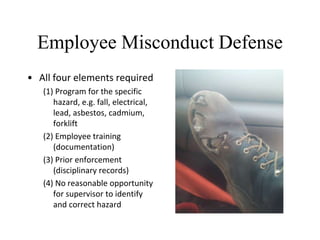
Employee Misconduct Defense
• All four elements required
(1) Program for the specific
hazard, e.g. fall, electrical,
lead, asbestos, cadmium,
forklift
(2) Employee training
(documentation)
(3) Prior enforcement
(disciplinary records)
(4) No reasonable opportunity
for supervisor to identify
and correct hazard
Appeals Process
• Informal Conference – 15
days
• Notice of Contest – 15
days
• Administrative Law Judge
• OSHA Review
Commission
• US Appeals Court
• Supreme Court
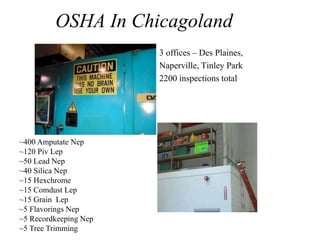
OSHA In Chicagoland
• 3 offices – Des Plaines,
• Naperville, Tinley Park
• 2200 inspections total
~400 Amputate Nep
~120 Piv Lep
~50 Lead Nep
~40 Silica Nep
~15 Hexchrome
~15 Comdust Lep
~15 Grain Lep
~5 Flavorings Nep
~5 Recordkeeping Nep
~5 Tree Trimming
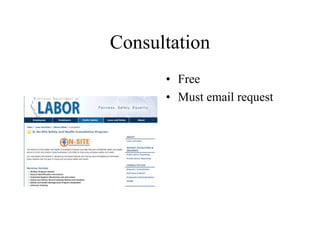
Consultation
• Free
• Must email request

Introduction to OSHA

  • 1.
    Intro To OSHAObjectives • EO 3.1: Describe major sections of the Occupational Safety and Health Act of 1970, Public Law - 91-596 (OSH Act). • EO 3.2: Explain the functions of the Occupational Safety and Health Administration (OSHA). • EO 3.3: Describe the positive impact of OSHA on worker safety and health. • EO 3.4: Describe employer and worker rights and responsibilities. 1
  • 2.
    Intro To OSHAObjectives • Describe the organization, origin and codification of OSHA standards. EO 4.1: Describe the system of organization for the Code of Federal Regulations (CFR). • EO 4.2: Identify major parts within Title 29 Labor. • EO 4.3: Discuss the origin of OSHA standards. • EO 4.4: Explain the codification system for general industry standards. • EO 4.5: Identify tasks for which general industry standards or construction standards apply. • EO 4.6: Describe types of consensus or proprietary standards that may be legally binding because they are incorporated by reference or commonly used in an industry. • EO 4.7: Explain the importance of a regulation’s preamble, including its purpose, location and type of information. • EO 4.8: Identify the purpose and type of information found in OSHA Directives, including Enforcement and Compliance Directives (CPL). • EO 4.9: Identify the purpose and type of information found in letters of interpretation. 2
  • 3.
    Intro To OSHAObjectives • Describe the process and rules for OSHA inspections, citations, penalties, and policies. • EO 5.1: Discuss the legal basis of inspections, citations and penalties in the OSH Act. • EO 5.2: Describe the major sections of Part 1903. • EO 5.3: Describe the inspection process. • EO 5.4: Describe OSHA inspection priorities. • EO 5.5: Indicate the various types of OSHA violations. • EO 5.6: Describe the post-inspection process. • EO 5.7: Identify the most frequently cited standards in general industry. • EO 5.8: Identify consensus standards commonly cited under section 5(a)(1) for general industry. • EO 5.9: Explain the responsibilities and liabilities of each type of employer on a multiemployer workplace. 3
  • 4.
  • 5.
    Industrial Safety 1969 •14,500 American workers were killed annually • Safety and health laws varied state to state • The results of workplace injuries and illnesses - Lower morale and increased costs to train replacement workers
  • 6.
    OSHA • Department ofLabor to enforce Safety and Health laws • NIOSH • OSHRC • Osha Training Institute • 56 million workers at 3.5 million workplaces in 1971  This Act created OSHA, the agency, which formally came into being on April 28, 1971
  • 7.
  • 8.
    Code of FederalRegulations • The Code of Federal Regulations (CFR) is the codification of the general and permanent rules and regulations published in the Federal Register. • Labor is under 29 CFR. • OSHA 29 CFR 1910 standards are requirements for general industry employers. • OSHA standards are rules that describe the methods that employers must use to protect their employees from hazards.
  • 9.
    Code of FederalRegulations • There are OSHA standards for Construction work, Maritime operations, and General Industry, which is the set that applies to most worksites.
  • 10.
    Code of FederalRegulations • There are OSHA standards for Construction work, Maritime operations, and General Industry, which is the set that applies to most worksites. Key Subparts D- Walking Working Surfaces E – Exits G – Occupational Health H – Hazardous Materials I – PPE J – Lockout, Confined Space L – Fire Protection N – Material Handling O – Machine Guarding S – Electrical Z – Toxic Substances
  • 11.
    Construction or GeneralIndustry? • “Construction work" is defined as "construction, alteration, and/or repair, including painting and decorating." Two Worker died while welding on top of a flammable tank that was empty. The tank exploded.
  • 12.
    OSHA’s Mission • Protectthe safety and health of America’s workers • Enforcing standards • Providing training, outreach, education and assistance.
  • 14.
    Key Parts 29CFR 1903 • 1903.7 - Conduct of inspections. • 1903.8 - Representatives of employers and employees. • 1903.11 - Complaints by employees. • 1903.14 - Citations; • 1903.15 - Proposed penalties. • 1903.16 - Posting of citations. • 1903.17 - Employer and employee contests before the Review Commission. • 1903.19 - Abatement verification. • 1903.20 - Informal conferences.
  • 15.
    First Citation • OnMay 28, 1971, Occupational Safety and Health Administration handed out its first citation. • The Citation went to Allied Chemical Corporation, which had allowed highly toxic mercury to pool on floors and working surfaces at its chlorine plant in Moundsville, West Virginia.
  • 16.
    Employee Rights • OctAct Section 11(c) protection - workers have a right to seek safety and health on the job without fear of punishment • Contest abatement dates • Informal conferences • Records 300/301 • Private interviews • Right to a rep in an interview • File Complaint
  • 17.
    General Duty Clause •Section 5(a)(1) • "a place of employment which is free from recognized hazards that are causing or are likely to cause death or serious physical harm to [its] employees." Not wearing seatbelts is a common citation under the general duty clause.
  • 18.
    Standard Preambles • Publishedin the Federal Register • The Preamble explains the thought behind the standard. • In the Walking Working Surface Preamble for securing dockplates. OSHA believes this provision is necessary to protect workers from injury or death. If the employer does not securely anchor the dockboard or equip it with a device that prevents movement, it could slide or drop off of the loading platform or transport vehicle, and the worker could fall. Workers also could fall if the dockboard moves or slides while they are on it.
  • 19.
    Standards • Horizontal Standards •When a condition is not covered by a specific industry standard • Machine Guarding • Falls • Vertical Standards • Industry Specific • Welding (1910.252) • Pulp, paper, and paperboard mills (1910.261) • Textiles (1910.262) • Sawmills (1910.265) • Logging operations (1910.266)
  • 20.
    Enforcement and ComplianceDirectives (CPL) • Purpose - Ensure consistent enforcement of OSHA regulations Example # 1 - A CSHO observed employees cleaning unguarded machinery rollers and these employees were exposed to moving machine parts and in-going nip point hazards created by the operating high-speed rollers. Furthermore, the cleaning activity did not meet all of the elements contained in the minor servicing exception. This activity is a LOTO standard violation because cleaning is a servicing activity.
  • 21.
    Standard Interpretations • Purpose- Ensure consistent enforcement of OSHA regulations
  • 22.
    1970’s • Permissible exposure limitsfor more than 400 toxic substances including specific standard for asbestos • State plans approved • IL give back OSHA enforcement -1975 • Several Court Challenges
  • 23.
    Barlow -1978 • Warrantrequirements of the Fourth Amendment were applicable to OSHA inspections per US Supreme Court • Probable cause in the criminal law sense is not required. • Anticipatory warrant procedures used if repeat requests. Barlow ran electrical and plumbing installation business in Idaho.
  • 24.
    Whirlpool - 1980 •1974 case - The two workers were told to go out on a screen 20 feet above the floor to retrieve small appliance parts which had fallen from a conveyor belt system above. • Workers sent home and docked 6 hours pay. • Workers can refuse if reasonable apprehension that death or serious injury or illness might occur as a result of performing the work
  • 25.
    1980’s • Access tomedical and exposure records • Hazard communication • Updated asbestos • Ethylene oxide, formaldehyde, and benzene. • Hazardous waste operations and emergency response • Lockout/tagout of hazardous energy sources. • Egregious 1984 Bhopal Explosion kills 3000+died that day 500,000 suffered blindness, lung cancer, kidney failures $550 to victims, $470 Million from Union Carbide OSHA Starts CHEMSEP
  • 26.
    1990’s • Confined Space •Respirators • Personal Protective Equipment • Process Safety • Forklift Training • www.osha.gov •Blood-borne Pathogens Standard started in this decade
  • 27.
    National Emphasis Programs ▪Combustible Dust ▪ Federal Agencies ▪ Hazardous Machinery ▪ Hexavalent Chromium ▪ Lead ▪ Process Safety Management ▪ Shipbreaking ▪ Trenching & Excavation
  • 28.
    Region V Local EmphasisPrograms ▪ Building Renovation/Rehab and Demolition ▪ Powered Industrial Vehicles ▪ Fall Hazards ▪ Grain Handling Facilities ▪ High Rise Building Construction ▪ Wood Pallet Manufacturing Industry ▪ Maritime Industries ▪ Lead ▪ Noise (Coming soon)
  • 29.
    Types of Inspections •Imminent Danger • Fatalities 800-321- OSHA within 8 hours • Amputation, Hospitalization, Eye Loss within 24 hours • Complaints – 5 days • Referrals • General Schedule • Follow Up Confined spaces could be imminently dangerous.
  • 30.
    Inspection Process • PresentCredentials • Opening conference • Walk around inspection • Closing conference • Six month to complete inspection and issue citations.
  • 31.
    Abatement • OSHA requiresthat employers certify that abatement is complete: • For each cited violation
  • 32.
    Multi-Employer Citations • Exposing •Creating • Controlling • Correcting • Creating employer failed to inform employees, other than its workers, of the damaged guardrail
  • 33.
    Employer Rights • Seeidentification • Know reason for inspection • Accompany during inspection • Take pictures • Know what hazards found .
  • 34.
    Violation Elements ▪ ApplicableStandard ▪ Existence of Hazard ▪ Exposure to Hazard ▪ Employer Knowledge
  • 35.
    Types of Violations •Other-Than-Serious. • Serious • Willful – A violation that the employer intentionally and knowingly commits. • Repeated – A violation of any standard, regulation, rule or order where, upon reinspection, a substantially similar violation is found and the original citation has become a final order. • Failure-to-Abate – Failure to correct a prior violation may bring a civil penalty of up to $7,000 for each day the violation continues beyond the abatement date.
  • 36.
  • 37.
    37 Level 2020 Maximum Penalty Serious$13,494 per violation OTS $13,494 per violation Willful or Repeat $134,937 per violation Failure to Abate $13,494 per day unabated beyond the abatement date [generally limited to 30 days maximum] OSHA Penalty Levels: 2019
  • 38.
    Penalty Adjustment Factors •Size – A maximum penalty reduction of 60% is permitted for small businesses. • Good Faith – A penalty reduction of up to 25% is permitted. Credit for Good Faith normally requires an employer to have an effective safety and health program. • History – A reduction of 10% is given to employers who have not been cited by OSHA for any serious, willful, or repeated violations in the past three years.
  • 39.
    Elements of aViolation • Serious Hazard • Applicable Standard • Employee Exposure • Employer Knowledge of Condition
  • 40.
    Plain View Doctrine –Compliance officer can issue citations for any violations in “plain view.” – If Compliance Officer doesn’t see it he/she usually can’t cite you for it.
  • 41.
    OSHA Interviews – Non-Management Interviews •Employee rights to Union or other Representative • “Tell the truth” – Management Interview • Right To Company Rep/Counsel – Avoid the “casual” interview – Avoid Saying “I Don’t Know” Remember: Everything is on the record. Do not engage in idle conversation concerning safety issues.
  • 42.
    Nov 2018 • Afederal grand jury in the Northern District of Ohio has indicted two managers at Extrudex Aluminum Inc. in Ohio for conspiracy to obstruct justice during a 2012 workplace fatality investigation by the U.S. Department of Labor's Occupational Safety and Health Administration (OSHA).
  • 43.
    Employee Misconduct Defense •All four elements required (1) Program for the specific hazard, e.g. fall, electrical, lead, asbestos, cadmium, forklift (2) Employee training (documentation) (3) Prior enforcement (disciplinary records) (4) No reasonable opportunity for supervisor to identify and correct hazard
  • 44.
    Appeals Process • InformalConference – 15 days • Notice of Contest – 15 days • Administrative Law Judge • OSHA Review Commission • US Appeals Court • Supreme Court
  • 45.
    OSHA In Chicagoland •3 offices – Des Plaines, • Naperville, Tinley Park • 2200 inspections total ~400 Amputate Nep ~120 Piv Lep ~50 Lead Nep ~40 Silica Nep ~15 Hexchrome ~15 Comdust Lep ~15 Grain Lep ~5 Flavorings Nep ~5 Recordkeeping Nep ~5 Tree Trimming
  • 46.