INSULINS Rabia Tahir, Pharm.D. New York Harbor Healthcare System
HISTORY of INSULIN Diabetes  -> 3500 years.  “ Control” only by diet in past.  Insulin discovered in 1921. Insulin used in 1 st  diabetic patient in 1922. 1 st  protein  -> chemically synthesized in 1963.
INSULIN INDICATIONS Type I Diabetes Absolute deficiency of insulin Type II Diabetes Insulin resistance  Relative insulin deficiency
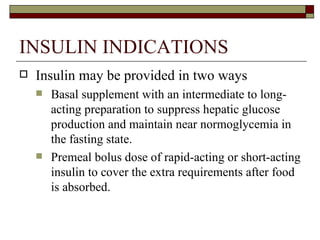
INSULIN INDICATIONS Insulin may be provided in two ways Basal supplement with an intermediate to long-acting preparation to suppress hepatic glucose production and maintain near normoglycemia in the fasting state. Premeal bolus dose of rapid-acting or short-acting insulin to cover the extra requirements after food is absorbed.
TYPES of INSULIN 20 types available  Which one should be used? Individuals lifestyle Physicians preference  Patients blood sugar level
TYPES of INSULIN Which one should be used? Source of insulin  Obtained from pork pancreas or is made chemically identical to human insulin by recombinant DNA technology.  Beginning in January 2006,   pork insulin for human use will no longer be manufactured or marketed in the U.S..   How soon it starts working  -> onset. When it starts working the hardest -> peak. How long it lasts in body -> duration.
TYPES of INSULIN Insulin onset, peak, and duration of effect must match meal patterns and exercise schedules  ->  achieve near normal blood glucose values throughout the day. Four basic forms Rapid-acting insulins Short-acting insulins Intermediate-acting insulins Long-acting insulins
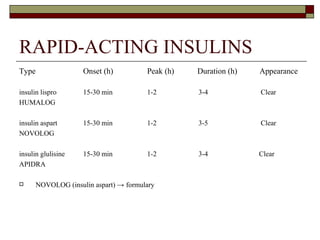
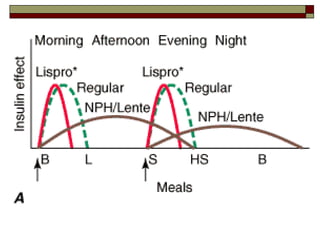
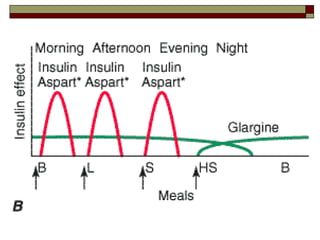
RAPID-ACTING INSULINS Type Onset (h) Peak (h)   Duration (h)  Appearance insulin lispro 15-30 min 1-2   3-4   Clear HUMALOG insulin aspart 15-30 min 1-2   3-5   Clear NOVOLOG insulin glulisine 15-30 min 1-2   3-4   Clear APIDRA NOVOLOG (insulin aspart)  ->  formulary
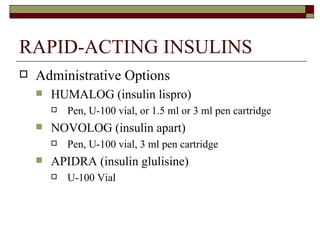
RAPID-ACTING INSULINS Administrative Options HUMALOG (insulin lispro) Pen, U-100 vial, or 1.5 ml or 3 ml pen cartridge NOVOLOG (insulin apart) Pen, U-100 vial, 3 ml pen cartridge APIDRA (insulin glulisine)  U-100 Vial
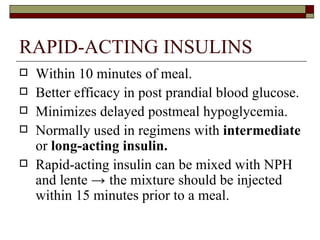
RAPID-ACTING INSULINS Within 10 minutes of meal.  Better efficacy in post prandial blood glucose. Minimizes delayed postmeal hypoglycemia. Normally used in regimens with  intermediate  or  long-acting insulin. Rapid-acting insulin can be mixed with NPH and lente  ->  the mixture should be injected within 15 minutes prior to a meal.
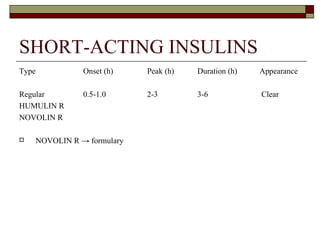
SHORT-ACTING INSULINS Type Onset (h) Peak (h)   Duration (h)  Appearance Regular 0.5-1.0 2-3   3-6    Clear  HUMULIN R NOVOLIN R  NOVOLIN R  -> formulary
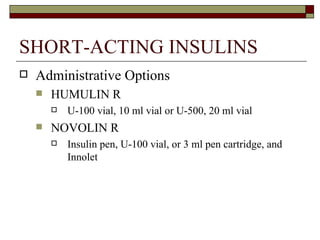
SHORT-ACTING INSULINS Administrative Options HUMULIN R  U-100 vial, 10 ml vial or U-500, 20 ml vial NOVOLIN R Insulin pen, U-100 vial, or 3 ml pen cartridge, and Innolet
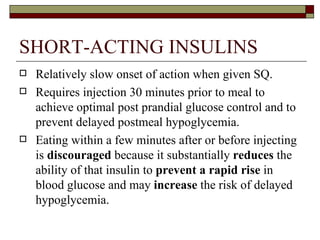
SHORT-ACTING INSULINS Relatively slow onset of action when given SQ. Requires injection 30 minutes prior to meal to achieve optimal post prandial glucose control and to prevent delayed postmeal hypoglycemia.  Eating within a few minutes after or before injecting is  discouraged  because it substantially  reduces  the ability of that insulin to  prevent a rapid rise  in blood glucose and may  increase  the risk of delayed hypoglycemia.
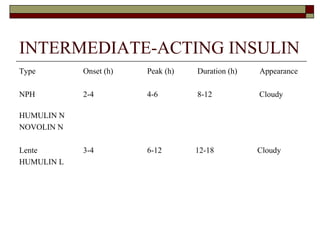
INTERMEDIATE-ACTING INSULIN Type Onset (h) Peak (h)   Duration (h)  Appearance NPH 2-4 4-6   8-12   Cloudy  HUMULIN N NOVOLIN N Lente 3-4 6-12   12-18   Cloudy HUMULIN L
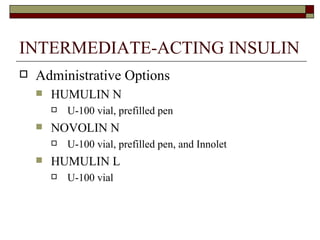
INTERMEDIATE-ACTING INSULIN Administrative Options HUMULIN N U-100 vial, prefilled pen NOVOLIN N  U-100 vial, prefilled pen, and Innolet  HUMULIN L  U-100 vial
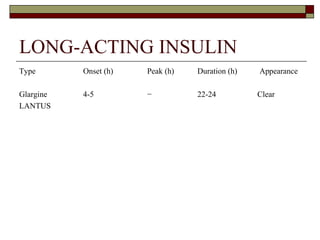
LONG-ACTING INSULIN Type Onset (h) Peak (h)   Duration (h)  Appearance Glargine 4-5 −   22-24   Clear LANTUS
LONG-ACTING INSULIN Administrative Options LANTUS U-100 vial
LONG-ACTING INSULIN LANTUS ‘ peakless’’ analog  ->  less nocturnal hypoglycemia than NPH when given at bedtime Usually given once a day only
PREMIXED INSULIN Fixed ratio insulins are dosed according to patient needs 15 minutes before meals Premixed insulin analogs HUMALOG Mix 75/25 (75% neutral protamine lispro, 25% lispro) U-100 vial, prefilled pen NOVOLOG Mix 70/30 (70% aspart protamine suspension, 30% aspart)  U-100 vial, prefilled pen, 3 ml pen cartridge
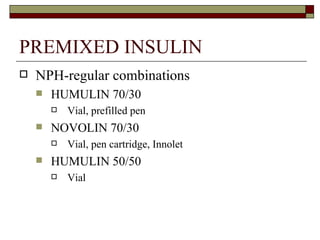
PREMIXED INSULIN NPH-regular combinations  HUMULIN 70/30 Vial, prefilled pen NOVOLIN 70/30 Vial, pen cartridge, Innolet HUMULIN 50/50 Vial
 
 
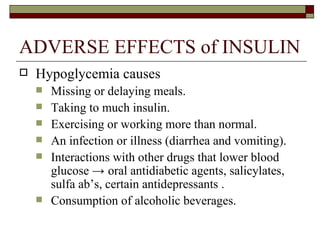
ADVERSE EFFECTS of INSULIN Hypoglycemia causes Missing or delaying meals.  Taking to much insulin. Exercising or working more than normal. An infection or illness (diarrhea and vomiting). Interactions with other drugs that lower blood glucose  ->  oral antidiabetic agents, salicylates, sulfa ab’s, certain antidepressants  . Consumption of alcoholic beverages.
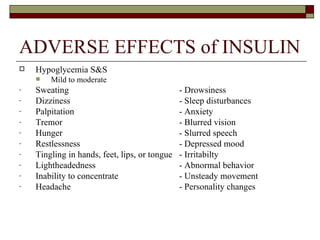
ADVERSE EFFECTS of INSULIN Hypoglycemia S&S Mild to moderate  Sweating - Drowsiness Dizziness - Sleep disturbances Palpitation - Anxiety Tremor - Blurred vision Hunger - Slurred speech Restlessness - Depressed mood Tingling in hands, feet, lips, or tongue - Irritabilty Lightheadedness - Abnormal behavior Inability to concentrate - Unsteady movement Headache - Personality changes
ADVERSE EFFECTS of INSULIN Hypoglycemia S&S Severe Disorientation Unconsciousness  Seizures Death
ADVERSE EFFECTS of INSULIN Hypoglycemia Treatment (< 50mg/dl). Mild to moderate  Rule of 15  -> 15g carbohydrate every 15 min until BG is greater than 70mg/dl, then follow simple meal.  Severe or continuing  Unable to take sugar by mouth or are unconscious may need Dextrose 50% 50 ml infusion or Glucagon 1mg IM, SQ, or IV.
ADVERSE EFFECTS of INSULIN Allergic reaction  Generalized reaction Uncommon but life threatening  ->  itchy rash over entire body, SOB, wheezing, confusion, low BP, tachycardia, sweating. Local reaction At injection site and is common  ->  itching, redness, hardness, or swelling.
ADVERSE EFFECTS of INSULIN Lipodystrophy  Change in fat below injection site Lipoatrophy  Lipohypertrophy Avoid injections in areas of skin that have theses reactions.
MIXING INSULINS Formulations and particle size distribution vary with insulin products. Mixing  ->  physiochemical changes can occur either immediately or over time. Serum insulin concentrations tend to reach a single peak.
MIXING INSULINS GUIDELINES Pt’s well controlled on mixed insulin regimen  ->  maintain their standard procedure.  No other medication or diluents should be mixed with insulin. Glargine (LANTUS) should not be mixed with any insulin. Use of commercially available premixed insulins may be used if insulin ratio is appropriate to Pt insulin requirement.  NPH and short-acting insulin when mixed can be used immediately or stored for future use.
MIXING INSULINS GUIDELINES Rapid-acting insulin can be mixed with NPH, lente, and ultralente.  When rapid acting insulin is mixed with either an intermediate or long-acting insulin  ->  mixture should be injected within 15 min before meal. Mixing of short-acting and lente insulins is not recommended except for Pt already adequately controlled on such mixture. Phosphate-buffered insulins (NPH) should not be mixed lente insulins.
INSULIN STORAGE Unopened vials, cartridges and pens. If refrigerated use until expiration date (standard) If room temperature (below 30 º C) use within 28 days Opened  Vials within 28 days at room temperature or refrigerated Pen and pen cartridges within 28 days at room temperature ( do not refrigerate)  Do not use if insulin has been frozen or exposed to high temperatures (<2  º C or  > 30 º C). Excess agitation should be avoided.
INSULIN ADMINISTRATION  Check vial before use to inspect for changes  ->  loss of potency.  Vial and pens should be rolled in palms of hands before drawing with needle  ->  except with rapid and short acting insulin.  If mixing insulins  ->  clear insulin should be drawn into syringe first.
INSULIN  DELIVERY DEVICES Insulin pens  Pens with cartridges  ->  users turn a dial to select the desired dose of insulin  ->  press a plunger on the end to deliver  insulin. Needle should be embedded within skin for 5 seconds after complete depression of plunger.  Air bubbles in pen reduces rate of insulin flow. Avoid leaving needle on pen between injections and prime needle with 2 units of insulin.
INSULIN  DELIVERY DEVICES Jet injectors  Option for people who do not want to use needles. Use high pressure air to send a fine spray of insulin through the skin as a fine stream.  Have no needles  ->  advantage in patients unable to use syringes or with needle phobias. More rapid absorption of short-acting insulins Costly and may traumatize skin.
INJECTION SITE Subcutaneous tissue of upper arm. Anterior and lateral aspects of the thigh, buttocks, and abdomen. IM not recommended.  Rotation of injection site recommended. Prevent lipohypertrophy and lipoatrophy.  Rotating within one area is recommended.
INJECTION SITE Variable absorption between sites.  Abdomen > arms >thighs > buttocks Exercise increases rate of absorption.  Areas of lipohypertrophy have slower absorption.  IM > SC absorption.
PREVENTING PAINFUL INJECTIONS Inject insulin at room temp. Make sure no air bubbles remain in syringe before injection. Wait for topical alcohol to evaporate before injection. Relax muscle at injection site at time of injection  Penetrating skin quickly. Not changing direction of needle during insertion or withdrawal.
CONCLUSION Insulin type and species Injection technique Site of injection Individual Pt response differences  Onset Peak Duration

Insulin Ce

  • 1.
    INSULINS Rabia Tahir,Pharm.D. New York Harbor Healthcare System
  • 2.
    HISTORY of INSULINDiabetes -> 3500 years. “ Control” only by diet in past. Insulin discovered in 1921. Insulin used in 1 st diabetic patient in 1922. 1 st protein -> chemically synthesized in 1963.
  • 3.
    INSULIN INDICATIONS TypeI Diabetes Absolute deficiency of insulin Type II Diabetes Insulin resistance Relative insulin deficiency
  • 4.
    INSULIN INDICATIONS Insulinmay be provided in two ways Basal supplement with an intermediate to long-acting preparation to suppress hepatic glucose production and maintain near normoglycemia in the fasting state. Premeal bolus dose of rapid-acting or short-acting insulin to cover the extra requirements after food is absorbed.
  • 5.
    TYPES of INSULIN20 types available Which one should be used? Individuals lifestyle Physicians preference Patients blood sugar level
  • 6.
    TYPES of INSULINWhich one should be used? Source of insulin Obtained from pork pancreas or is made chemically identical to human insulin by recombinant DNA technology. Beginning in January 2006, pork insulin for human use will no longer be manufactured or marketed in the U.S..  How soon it starts working -> onset. When it starts working the hardest -> peak. How long it lasts in body -> duration.
  • 7.
    TYPES of INSULINInsulin onset, peak, and duration of effect must match meal patterns and exercise schedules -> achieve near normal blood glucose values throughout the day. Four basic forms Rapid-acting insulins Short-acting insulins Intermediate-acting insulins Long-acting insulins
  • 8.
    RAPID-ACTING INSULINS TypeOnset (h) Peak (h) Duration (h) Appearance insulin lispro 15-30 min 1-2 3-4 Clear HUMALOG insulin aspart 15-30 min 1-2 3-5 Clear NOVOLOG insulin glulisine 15-30 min 1-2 3-4 Clear APIDRA NOVOLOG (insulin aspart) -> formulary
  • 9.
    RAPID-ACTING INSULINS AdministrativeOptions HUMALOG (insulin lispro) Pen, U-100 vial, or 1.5 ml or 3 ml pen cartridge NOVOLOG (insulin apart) Pen, U-100 vial, 3 ml pen cartridge APIDRA (insulin glulisine) U-100 Vial
  • 10.
    RAPID-ACTING INSULINS Within10 minutes of meal. Better efficacy in post prandial blood glucose. Minimizes delayed postmeal hypoglycemia. Normally used in regimens with intermediate or long-acting insulin. Rapid-acting insulin can be mixed with NPH and lente -> the mixture should be injected within 15 minutes prior to a meal.
  • 11.
    SHORT-ACTING INSULINS TypeOnset (h) Peak (h) Duration (h) Appearance Regular 0.5-1.0 2-3 3-6 Clear HUMULIN R NOVOLIN R NOVOLIN R -> formulary
  • 12.
    SHORT-ACTING INSULINS AdministrativeOptions HUMULIN R U-100 vial, 10 ml vial or U-500, 20 ml vial NOVOLIN R Insulin pen, U-100 vial, or 3 ml pen cartridge, and Innolet
  • 13.
    SHORT-ACTING INSULINS Relativelyslow onset of action when given SQ. Requires injection 30 minutes prior to meal to achieve optimal post prandial glucose control and to prevent delayed postmeal hypoglycemia. Eating within a few minutes after or before injecting is discouraged because it substantially reduces the ability of that insulin to prevent a rapid rise in blood glucose and may increase the risk of delayed hypoglycemia.
  • 14.
    INTERMEDIATE-ACTING INSULIN TypeOnset (h) Peak (h) Duration (h) Appearance NPH 2-4 4-6 8-12 Cloudy HUMULIN N NOVOLIN N Lente 3-4 6-12 12-18 Cloudy HUMULIN L
  • 15.
    INTERMEDIATE-ACTING INSULIN AdministrativeOptions HUMULIN N U-100 vial, prefilled pen NOVOLIN N U-100 vial, prefilled pen, and Innolet HUMULIN L U-100 vial
  • 16.
    LONG-ACTING INSULIN TypeOnset (h) Peak (h) Duration (h) Appearance Glargine 4-5 − 22-24 Clear LANTUS
  • 17.
    LONG-ACTING INSULIN AdministrativeOptions LANTUS U-100 vial
  • 18.
    LONG-ACTING INSULIN LANTUS‘ peakless’’ analog -> less nocturnal hypoglycemia than NPH when given at bedtime Usually given once a day only
  • 19.
    PREMIXED INSULIN Fixedratio insulins are dosed according to patient needs 15 minutes before meals Premixed insulin analogs HUMALOG Mix 75/25 (75% neutral protamine lispro, 25% lispro) U-100 vial, prefilled pen NOVOLOG Mix 70/30 (70% aspart protamine suspension, 30% aspart) U-100 vial, prefilled pen, 3 ml pen cartridge
  • 20.
    PREMIXED INSULIN NPH-regularcombinations HUMULIN 70/30 Vial, prefilled pen NOVOLIN 70/30 Vial, pen cartridge, Innolet HUMULIN 50/50 Vial
  • 21.
  • 22.
  • 23.
    ADVERSE EFFECTS ofINSULIN Hypoglycemia causes Missing or delaying meals. Taking to much insulin. Exercising or working more than normal. An infection or illness (diarrhea and vomiting). Interactions with other drugs that lower blood glucose -> oral antidiabetic agents, salicylates, sulfa ab’s, certain antidepressants . Consumption of alcoholic beverages.
  • 24.
    ADVERSE EFFECTS ofINSULIN Hypoglycemia S&S Mild to moderate Sweating - Drowsiness Dizziness - Sleep disturbances Palpitation - Anxiety Tremor - Blurred vision Hunger - Slurred speech Restlessness - Depressed mood Tingling in hands, feet, lips, or tongue - Irritabilty Lightheadedness - Abnormal behavior Inability to concentrate - Unsteady movement Headache - Personality changes
  • 25.
    ADVERSE EFFECTS ofINSULIN Hypoglycemia S&S Severe Disorientation Unconsciousness Seizures Death
  • 26.
    ADVERSE EFFECTS ofINSULIN Hypoglycemia Treatment (< 50mg/dl). Mild to moderate Rule of 15 -> 15g carbohydrate every 15 min until BG is greater than 70mg/dl, then follow simple meal. Severe or continuing Unable to take sugar by mouth or are unconscious may need Dextrose 50% 50 ml infusion or Glucagon 1mg IM, SQ, or IV.
  • 27.
    ADVERSE EFFECTS ofINSULIN Allergic reaction Generalized reaction Uncommon but life threatening -> itchy rash over entire body, SOB, wheezing, confusion, low BP, tachycardia, sweating. Local reaction At injection site and is common -> itching, redness, hardness, or swelling.
  • 28.
    ADVERSE EFFECTS ofINSULIN Lipodystrophy Change in fat below injection site Lipoatrophy Lipohypertrophy Avoid injections in areas of skin that have theses reactions.
  • 29.
    MIXING INSULINS Formulationsand particle size distribution vary with insulin products. Mixing -> physiochemical changes can occur either immediately or over time. Serum insulin concentrations tend to reach a single peak.
  • 30.
    MIXING INSULINS GUIDELINESPt’s well controlled on mixed insulin regimen -> maintain their standard procedure. No other medication or diluents should be mixed with insulin. Glargine (LANTUS) should not be mixed with any insulin. Use of commercially available premixed insulins may be used if insulin ratio is appropriate to Pt insulin requirement. NPH and short-acting insulin when mixed can be used immediately or stored for future use.
  • 31.
    MIXING INSULINS GUIDELINESRapid-acting insulin can be mixed with NPH, lente, and ultralente. When rapid acting insulin is mixed with either an intermediate or long-acting insulin -> mixture should be injected within 15 min before meal. Mixing of short-acting and lente insulins is not recommended except for Pt already adequately controlled on such mixture. Phosphate-buffered insulins (NPH) should not be mixed lente insulins.
  • 32.
    INSULIN STORAGE Unopenedvials, cartridges and pens. If refrigerated use until expiration date (standard) If room temperature (below 30 º C) use within 28 days Opened Vials within 28 days at room temperature or refrigerated Pen and pen cartridges within 28 days at room temperature ( do not refrigerate) Do not use if insulin has been frozen or exposed to high temperatures (<2 º C or > 30 º C). Excess agitation should be avoided.
  • 33.
    INSULIN ADMINISTRATION Check vial before use to inspect for changes -> loss of potency. Vial and pens should be rolled in palms of hands before drawing with needle -> except with rapid and short acting insulin. If mixing insulins -> clear insulin should be drawn into syringe first.
  • 34.
    INSULIN DELIVERYDEVICES Insulin pens Pens with cartridges -> users turn a dial to select the desired dose of insulin -> press a plunger on the end to deliver insulin. Needle should be embedded within skin for 5 seconds after complete depression of plunger. Air bubbles in pen reduces rate of insulin flow. Avoid leaving needle on pen between injections and prime needle with 2 units of insulin.
  • 35.
    INSULIN DELIVERYDEVICES Jet injectors Option for people who do not want to use needles. Use high pressure air to send a fine spray of insulin through the skin as a fine stream. Have no needles -> advantage in patients unable to use syringes or with needle phobias. More rapid absorption of short-acting insulins Costly and may traumatize skin.
  • 36.
    INJECTION SITE Subcutaneoustissue of upper arm. Anterior and lateral aspects of the thigh, buttocks, and abdomen. IM not recommended. Rotation of injection site recommended. Prevent lipohypertrophy and lipoatrophy. Rotating within one area is recommended.
  • 37.
    INJECTION SITE Variableabsorption between sites. Abdomen > arms >thighs > buttocks Exercise increases rate of absorption. Areas of lipohypertrophy have slower absorption. IM > SC absorption.
  • 38.
    PREVENTING PAINFUL INJECTIONSInject insulin at room temp. Make sure no air bubbles remain in syringe before injection. Wait for topical alcohol to evaporate before injection. Relax muscle at injection site at time of injection Penetrating skin quickly. Not changing direction of needle during insertion or withdrawal.
  • 39.
    CONCLUSION Insulin typeand species Injection technique Site of injection Individual Pt response differences Onset Peak Duration