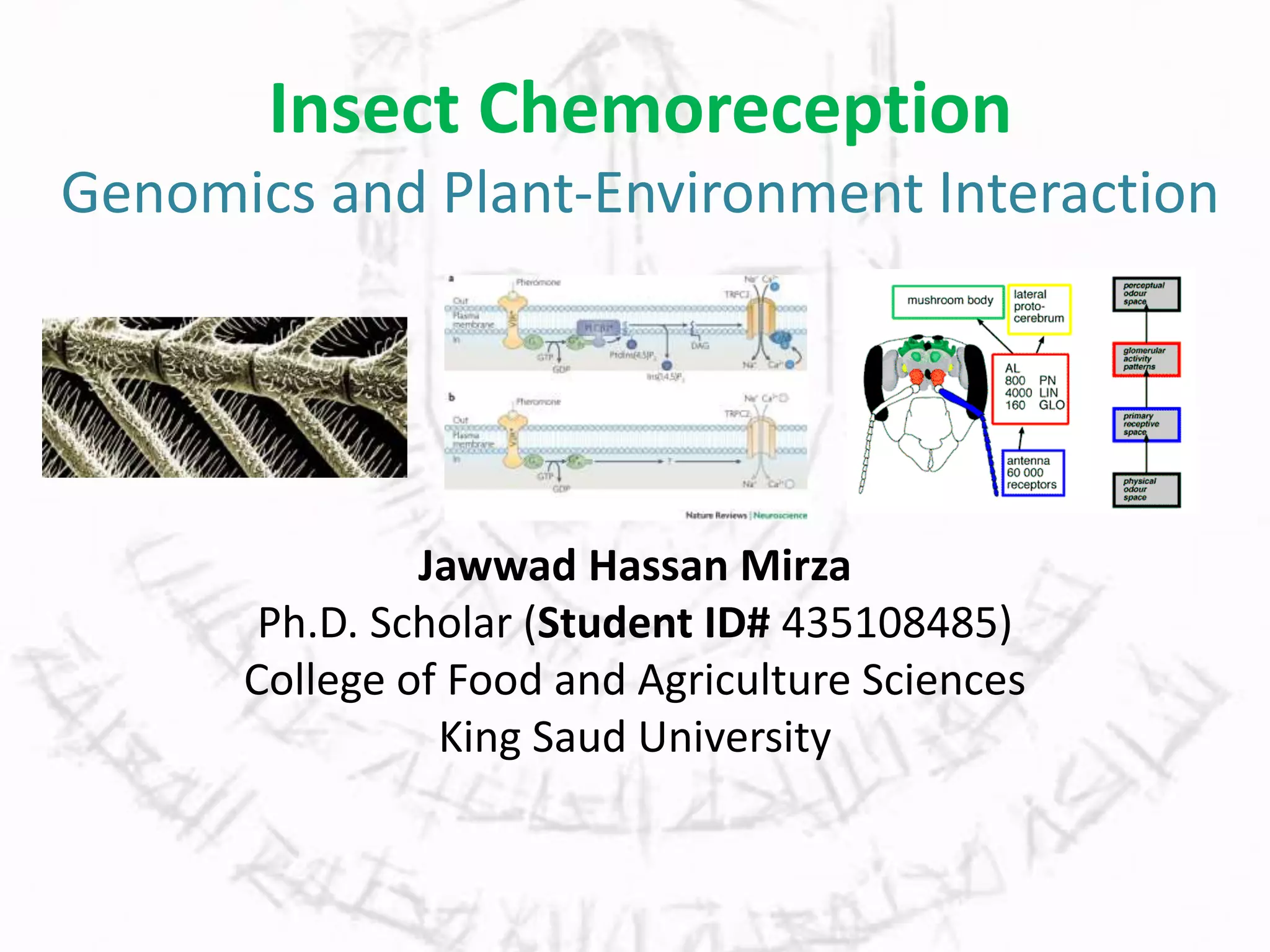
Insect Chemoreception
Genomics and Plant-Environment Interaction
Jawwad Hassan Mirza
Ph.D. Scholar (Student ID# 435108485)
College of Food and Agriculture Sciences
King Saud University
Introduction
• Many types of Receptors
• Chemoreceptors, most important of all
• Chemosensory organ = SENSILLA
• Taste (Gustatory) and Smell (Olfactory) Receptors
• Involved in:
– Finding food
– Accessing food quality
– Identifying mates
– Searching for oviposition site
– Avoid toxins and predators
Buck and Axel 1991; Hallem et al, 2004
GUSTATORY RECEPTORS OLFACTORY RECEPTORS
ANTENNAE
MAXILLARY PALP
WINGS
OVIPOSITOR LEGS
MOUTH PARTS
Genomics of Insect
Chemoreception
Role of Genes and Receptors
REMEMBER!!
Chemoreceptor superfamily includes many Olfactory and
Gustatory Receptor Families
Robertson et al, 2003
CHEMORECEPTORS
• 60 Or and 60 Gr family genes , 130
chemoreceptor proteins in D. melanogaster
• Families of odorant and gustatory receptors are
evolutionarily related
• Four Gr genes are expressed in subsets of
neurons in the antenna and/or maxillary palp
• Antennal Grs if function as odorant receptors,
olfactory receptor function has evolved
separately several times within the superfamily
Scott et al, 2001; Dunipace et al, 2001
• Or83b is extremely divergent from the other
Or proteins and is expressed in most olfactory
receptor neurons
• The genes encoding these proteins are evenly
spread throughout the genome
• The amino acid differences between the Gr
and Or proteins extremely high
– Evolving need to adapt to new ecological niches
Scott et al, 2001; Dunipace et al, 2001
OLFACTORY RECEPTORS
OLFACTORY RECEPTORS
• Olfactory Receptor Neurons (ORNs) express a single Olfactory Receptor
protein (Or)
• Each ORN expressing a particular Or converges on a single glomerulus in
each antennal lobe
• Allow activation of glomeruli interpreted as a particular odor
Hallem et al, 2006
1. FRUIT FLY (Drosophila melanogaster)
• 1st Insect OR discovered (62 ORs by 60 genes)
• 7 transmembrane (7TM) domains with
G-protein coupled receptors (GPCRs)
• DmOr83b mediate function of other ORs in ORN
• DmOr83b determines:
– Odor response profile
– Spontaneous firing rate
– Response dynamics
– Signaling mode
Hallem et al, 2006
2. HONEY BEE (Apis mellifera)
• Locating Flower and Social Communication
• Visit the same flower with 90% success
• Use Olfactory Receptors at Antennae
• Glomeruli = 165 (far more than any other insect)
– large number of receptors
• AmOr2 = ortholog of DmOr83b
• Genome encodes 165 functional ORs
• Allow bees to recognize diverse floral odor
• Huge number ORs relates to co-evolution of
BEES and ANGIOSPERMS
• 16,000 ORs in Drones, 2700 ORs in workers
Brockmann and Brückner, 2001
3. MOTHS (Heliothus virescens)
• Recognition of odor by specialized sensory neurons
• Transduce the chemical signal into an electrical
neuronal response
• Wire the olfactory information from the periphery to
the antennal lobes
• Transduction process via the G protein-controlled PLC
• Chemicals cause reaction of hydrolysis of
phosphatidylinositol (PIP2) and the formation of
second messengers (inositol triphosphate and
diacylglycerol)
Steinbrecht, 1999
• The HR5 receptor is expressed in sensory
neurons located in the vicinity of sensory hairs
comprise contact-chemoreceptors, first
presumed gustatory receptor of moth.
• All receptor types expressed in the antennae
of males and females, involved in the
detection of general odors
• High number and diversity of receptor to
perceive the broad spectrum of plant-derived
odors
• Essential for this insect to find its host plants,
such as tobacco, cotton, soybean and
sunflower
Matthews and Tunstall, 1994
GUSTATORY RECEPTORS
• Anterior wing margin, the chemosensory
sensilla harbour gustatory receptors in D.
melanogastor
• Group of 7TM-domain candidate GPCRs were
identified in the D. melanogaster genome.
• expressed in gustatory organs such as the mouthparts
• 68 GRs by 60 genes
• GRs sometime work as Ors
Clyne et al, 2000
SEM of D. melanogaster wing anterior margin
• IN BEES, GR family is not diverse because:
– angiosperms not evolved the pollens/nectors
– Larvae in hive fed by adults
– mostly use antenna to touch objects
Insect Chemoreception
Interaction with Plants and Environment
THEORIES OF HOST SELECTION
• Brues (1920)proposed a “BOTANICAL INSTINCT THEORY”,
“insects select host plants that meet specific
nutritional and ecological requirements for that
insect not offered by other plant species”
• Fraenkel (1959)proposed “THE TOKEN STIMULI THEORY”,
“insect host plant selection is determined by
specific secondary plant substances or
phytochemicals, i.e. glycosides, phenols, tannins,
alkaloids, terpenoids, and saponins.”
Matthews and Tunstall, 1994
PLANTS vs INSECTS
• Important component of an ecosystem
• Plants release chemicals for insects:
– To attract (for pollination, for predation)
– To repel (self defense)
• Honey bees vs Flowering Plants
• Tobacco Plant vs Tobacco budworm
Matthews and Tunstall, 1994
• Plants chemically respond differently for both
the abiotic and biotic injuries
• Plant release chemical when under attack by
phytophagous pests warning neighboring
plants.
Matthews and Tunstall, 1994
WHAT WE LEARNED!
• Chemoreception is vital for insect survival
• Manipulation for pest control
• Better Bio-agents and Enhanced crop productivity
References
• Hallem E.A., Dahanukar A., Carlson J.R., Dahanukar A., Carlson J.R., Carlson J.R., 2006. Insect
odor and taste receptors. Annu. Rev. Entomol. 51: 113–135.
• Hallem EA, Nicole Fox A, Zwiebel LJ, Carlson JR, 2004. Olfaction: mosquito receptor for
human-sweat odorant. Nature. 427:212-213.
• Clyne P.J., Warr C.G., Carlson J.R., Warr C.G., Carlson J.R., Carlson J.R., 2000. Candidate taste
receptors in Drosophila. Science. 287:1830–1834.
• Robertson H.M., Warr C.G., Carlson J.R., Warr C.G., Carlson J.R., Carlson J.R., 2003. Molecular
evolution of the insect chemoreceptor superfamily in Drosophila melanogaster . Proc. Natl.
Acad. Sci. 100:14537–14542.
• Brockmann A., Brückner D., 2001. Structural differences in the drone olfactory system of two
phylogenetically distant Apis species, A. florea and A. mellifera. Naturwissenschaften. 88:78–
81.
• Buck L, Axel R, 1991. A novel multigene family may encode odorant receptors: a molecular
basis for odor recognition. Cell, 65, 175–187.
• Scott, K., Brady, R., Jr., Cravchik, A., Morozov, P., Rzhetsky, A., Zuker, C. & Axel, R., 2001. Cell
104, 661–673.
• Dunipace, L., Meister, S., McNealy, C. & Amrein, H., 2001 Curr. Biol. 11, 821–835.
• Matthews, G.A. & Tunstall, J.P., 1994. Insect Pests of Cotton. CAB International, Wallingford,
UK.
• Steinbrecht, R., 1999. Olfactory receptors. In Eguchi, E. & Tominaga, Y. (eds), Atlas of
Arthropod Sensory Receptors. V. Springer, Tokyo.
THANK YOU FOR YOUR TIME
QUESTIONS ARE INVITED

Genomics of insect chemoreception

  • 1.
    Insect Chemoreception Genomics andPlant-Environment Interaction Jawwad Hassan Mirza Ph.D. Scholar (Student ID# 435108485) College of Food and Agriculture Sciences King Saud University
  • 2.
    Introduction • Many typesof Receptors • Chemoreceptors, most important of all • Chemosensory organ = SENSILLA • Taste (Gustatory) and Smell (Olfactory) Receptors • Involved in: – Finding food – Accessing food quality – Identifying mates – Searching for oviposition site – Avoid toxins and predators Buck and Axel 1991; Hallem et al, 2004
  • 4.
    GUSTATORY RECEPTORS OLFACTORYRECEPTORS ANTENNAE MAXILLARY PALP WINGS OVIPOSITOR LEGS MOUTH PARTS
  • 5.
  • 6.
    REMEMBER!! Chemoreceptor superfamily includesmany Olfactory and Gustatory Receptor Families Robertson et al, 2003
  • 7.
    CHEMORECEPTORS • 60 Orand 60 Gr family genes , 130 chemoreceptor proteins in D. melanogaster • Families of odorant and gustatory receptors are evolutionarily related • Four Gr genes are expressed in subsets of neurons in the antenna and/or maxillary palp • Antennal Grs if function as odorant receptors, olfactory receptor function has evolved separately several times within the superfamily Scott et al, 2001; Dunipace et al, 2001
  • 8.
    • Or83b isextremely divergent from the other Or proteins and is expressed in most olfactory receptor neurons • The genes encoding these proteins are evenly spread throughout the genome • The amino acid differences between the Gr and Or proteins extremely high – Evolving need to adapt to new ecological niches Scott et al, 2001; Dunipace et al, 2001
  • 9.
  • 10.
    OLFACTORY RECEPTORS • OlfactoryReceptor Neurons (ORNs) express a single Olfactory Receptor protein (Or) • Each ORN expressing a particular Or converges on a single glomerulus in each antennal lobe • Allow activation of glomeruli interpreted as a particular odor Hallem et al, 2006
  • 11.
    1. FRUIT FLY(Drosophila melanogaster) • 1st Insect OR discovered (62 ORs by 60 genes) • 7 transmembrane (7TM) domains with G-protein coupled receptors (GPCRs) • DmOr83b mediate function of other ORs in ORN • DmOr83b determines: – Odor response profile – Spontaneous firing rate – Response dynamics – Signaling mode Hallem et al, 2006
  • 12.
    2. HONEY BEE(Apis mellifera) • Locating Flower and Social Communication • Visit the same flower with 90% success • Use Olfactory Receptors at Antennae • Glomeruli = 165 (far more than any other insect) – large number of receptors • AmOr2 = ortholog of DmOr83b
  • 13.
    • Genome encodes165 functional ORs • Allow bees to recognize diverse floral odor • Huge number ORs relates to co-evolution of BEES and ANGIOSPERMS • 16,000 ORs in Drones, 2700 ORs in workers Brockmann and Brückner, 2001
  • 14.
    3. MOTHS (Heliothusvirescens) • Recognition of odor by specialized sensory neurons • Transduce the chemical signal into an electrical neuronal response • Wire the olfactory information from the periphery to the antennal lobes • Transduction process via the G protein-controlled PLC • Chemicals cause reaction of hydrolysis of phosphatidylinositol (PIP2) and the formation of second messengers (inositol triphosphate and diacylglycerol) Steinbrecht, 1999
  • 15.
    • The HR5receptor is expressed in sensory neurons located in the vicinity of sensory hairs comprise contact-chemoreceptors, first presumed gustatory receptor of moth. • All receptor types expressed in the antennae of males and females, involved in the detection of general odors • High number and diversity of receptor to perceive the broad spectrum of plant-derived odors • Essential for this insect to find its host plants, such as tobacco, cotton, soybean and sunflower Matthews and Tunstall, 1994
  • 16.
    GUSTATORY RECEPTORS • Anteriorwing margin, the chemosensory sensilla harbour gustatory receptors in D. melanogastor • Group of 7TM-domain candidate GPCRs were identified in the D. melanogaster genome. • expressed in gustatory organs such as the mouthparts • 68 GRs by 60 genes • GRs sometime work as Ors Clyne et al, 2000
  • 17.
    SEM of D.melanogaster wing anterior margin
  • 18.
    • IN BEES,GR family is not diverse because: – angiosperms not evolved the pollens/nectors – Larvae in hive fed by adults – mostly use antenna to touch objects
  • 19.
  • 20.
    THEORIES OF HOSTSELECTION • Brues (1920)proposed a “BOTANICAL INSTINCT THEORY”, “insects select host plants that meet specific nutritional and ecological requirements for that insect not offered by other plant species” • Fraenkel (1959)proposed “THE TOKEN STIMULI THEORY”, “insect host plant selection is determined by specific secondary plant substances or phytochemicals, i.e. glycosides, phenols, tannins, alkaloids, terpenoids, and saponins.” Matthews and Tunstall, 1994
  • 21.
    PLANTS vs INSECTS •Important component of an ecosystem • Plants release chemicals for insects: – To attract (for pollination, for predation) – To repel (self defense) • Honey bees vs Flowering Plants • Tobacco Plant vs Tobacco budworm Matthews and Tunstall, 1994
  • 22.
    • Plants chemicallyrespond differently for both the abiotic and biotic injuries • Plant release chemical when under attack by phytophagous pests warning neighboring plants. Matthews and Tunstall, 1994
  • 23.
    WHAT WE LEARNED! •Chemoreception is vital for insect survival • Manipulation for pest control • Better Bio-agents and Enhanced crop productivity
  • 24.
    References • Hallem E.A.,Dahanukar A., Carlson J.R., Dahanukar A., Carlson J.R., Carlson J.R., 2006. Insect odor and taste receptors. Annu. Rev. Entomol. 51: 113–135. • Hallem EA, Nicole Fox A, Zwiebel LJ, Carlson JR, 2004. Olfaction: mosquito receptor for human-sweat odorant. Nature. 427:212-213. • Clyne P.J., Warr C.G., Carlson J.R., Warr C.G., Carlson J.R., Carlson J.R., 2000. Candidate taste receptors in Drosophila. Science. 287:1830–1834. • Robertson H.M., Warr C.G., Carlson J.R., Warr C.G., Carlson J.R., Carlson J.R., 2003. Molecular evolution of the insect chemoreceptor superfamily in Drosophila melanogaster . Proc. Natl. Acad. Sci. 100:14537–14542. • Brockmann A., Brückner D., 2001. Structural differences in the drone olfactory system of two phylogenetically distant Apis species, A. florea and A. mellifera. Naturwissenschaften. 88:78– 81. • Buck L, Axel R, 1991. A novel multigene family may encode odorant receptors: a molecular basis for odor recognition. Cell, 65, 175–187. • Scott, K., Brady, R., Jr., Cravchik, A., Morozov, P., Rzhetsky, A., Zuker, C. & Axel, R., 2001. Cell 104, 661–673. • Dunipace, L., Meister, S., McNealy, C. & Amrein, H., 2001 Curr. Biol. 11, 821–835. • Matthews, G.A. & Tunstall, J.P., 1994. Insect Pests of Cotton. CAB International, Wallingford, UK. • Steinbrecht, R., 1999. Olfactory receptors. In Eguchi, E. & Tominaga, Y. (eds), Atlas of Arthropod Sensory Receptors. V. Springer, Tokyo.
  • 25.
    THANK YOU FORYOUR TIME QUESTIONS ARE INVITED