1-24
© Ian Phillips 2019
© Ian Phillips 2019
This and other presentations available at ... https://ianp24.blogspot.com
From Science to Product ...
... How Science Enables Products
Seminar at ...
Department of Electrical Engineering and Electronics
University of Liverpool, UK.
28Feb19
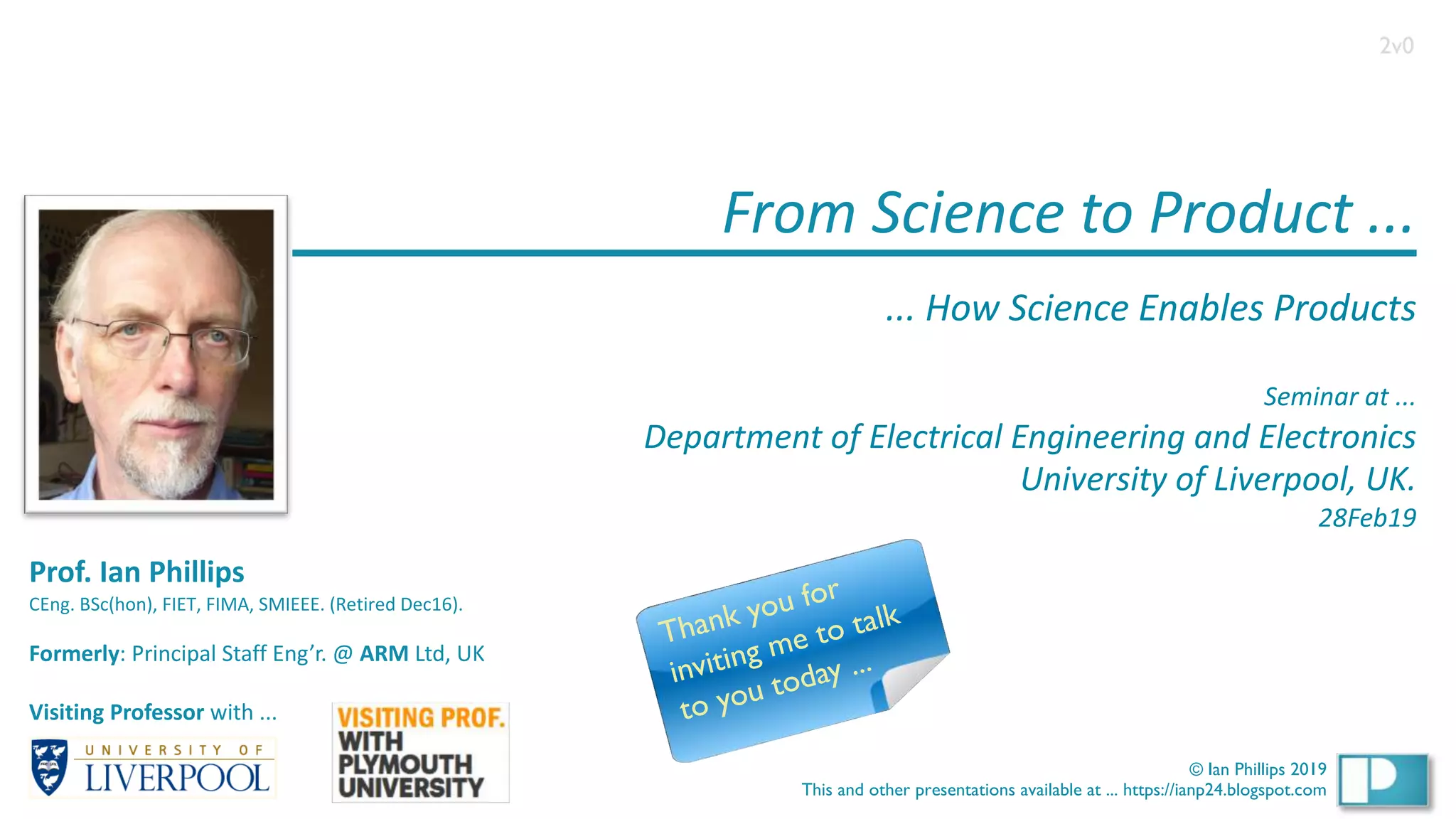
Prof. Ian Phillips
CEng. BSc(hon), FIET, FIMA, SMIEEE. (Retired Dec16).
Formerly: Principal Staff Eng’r. @ ARM Ltd, UK
Visiting Professor with ...
2v0
Thank you for
inviting me to talk
to you today ...
2-24
© Ian Phillips 2019
Science >> Product: Why Should You Care ?
§ Gov. Needs Economic Growth and supports Research to this end ...
§ Put lots of money into support of ‘good’ research programs (EPSRC ~£1Bpa)
§ Sees (apparently) highly regarded papers and scientific outcomes
§ Anticipates exploitation in local (UK) Industries to contribute to (UK) Employment and thus (UK)GDP
§ But are disappointed at (UK)Industries ‘disinterest’ in these outcomes
... Gov. Agencies need to see exploitation to justify the ongoing Research Budget! ... Or it will be cut!
§ Businesses Needs a Competitive Edge ...
§ But don’t see Academic Research as part of the solution
§ Focused on (End) Customer Needs
§ Prefers Low-Risk Evolutionary Products
§ Approached by Universities and Government to take Good Research Outcomes ... But don’t
... Businesses doesn’t benefit from the Funding or the Knowledge in Universities ... To Stay Competitive!
... Wherever your career takes you, you will be in one of these situations!
3-24
© Ian Phillips 2019
Age of the ...
Universe – 13.6Byr
Earth – 4.5Byr
Life – 3.5Byr
The Exploitation of Science ...
First 32,000 yrs got us to this far!
Produce
Research
Develop
§ Cro-Magnon Man (Us!) – 35,000 yr ago
§ Evolved from Homo-Sapien (Wise Human) >100,000 yr
§ Mission: Survive Nature (1,000 gen’n)
§ The Philosophers – 2,500-1,000 yr ago
§ Pythagoras, Socrates, Plato, Aristotle, Archimedes, ...
§ Mission: Understanding Nature
§ The Scientists – 1,000-500 yrs ago
§ Galileo, Descartes, (1000 ad)
§ Electricity - William Gilbert (1600ad)
§ Mission: Manipulation of Nature
§ The Engineers – 260 yrs ago
§ Industrial Revolution (1750: 8 gen’n)
§ Mission: Exploitation of Nature
§ Science - First Meets – Exploitation
§ Technology Based Business Emerges
... Technology’s BIG-BANG was just 270 yr ago!
4-24
© Ian Phillips 2019
What do People Need?
© Ian Phillips 2018
§ In 1972, Pioneer 10 Carried this very revealing message about humanity to the stars ...
§ That we have big brains, dexterous fore-limbs, a perception of time ... and are Natural Consumers!
... We clearly need ‘extensions’ to our bodies to enable us to do almost anything!
5-24
© Ian Phillips 2019
Products to Satisfy Human Needs ...
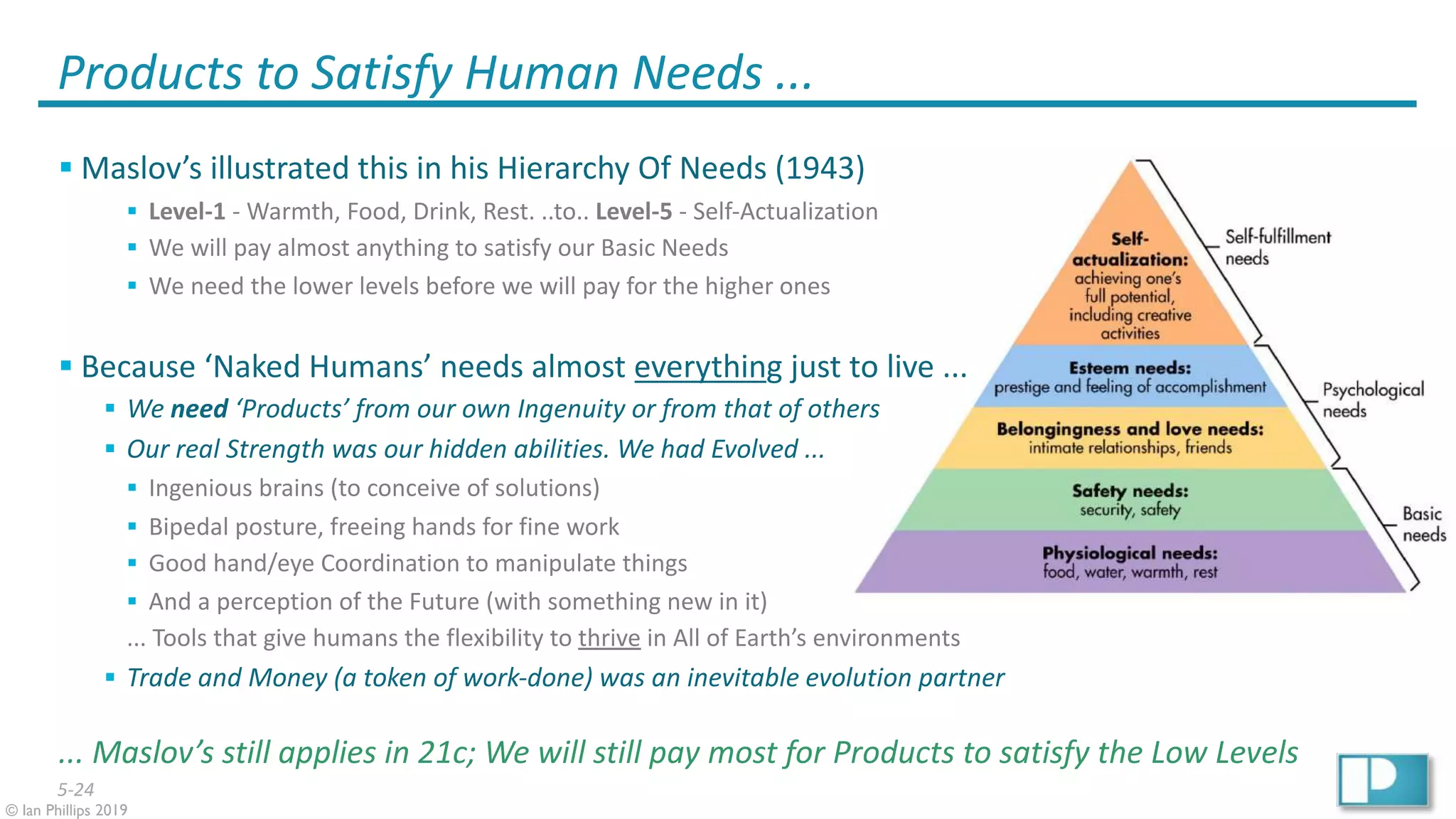
§ Maslov’s illustrated this in his Hierarchy Of Needs (1943)
§ Level-1 - Warmth, Food, Drink, Rest. ..to.. Level-5 - Self-Actualization
§ We will pay almost anything to satisfy our Basic Needs
§ We need the lower levels before we will pay for the higher ones
§ Because ‘Naked Humans’ needs almost everything just to live ...
§ We need ‘Products’ from our own Ingenuity or from that of others
§ Our real Strength was our hidden abilities. We had Evolved ...
§ Ingenious brains (to conceive of solutions)
§ Bipedal posture, freeing hands for fine work
§ Good hand/eye Coordination to manipulate things
§ And a perception of the Future (with something new in it)
... Tools that give humans the flexibility to thrive in All of Earth’s environments
§ Trade and Money (a token of work-done) was an inevitable evolution partner
... Maslov’s still applies in 21c; We will still pay most for Products to satisfy the Low Levels
6-24
© Ian Phillips 2019
End-Customers buy Function not Technology ...
Products have to embody Function & Form
7-24
© Ian Phillips 2019
Not All Tech. Products are Visible ...
... But they still deliver End-Customer Functionality
8-24
© Ian Phillips 2019
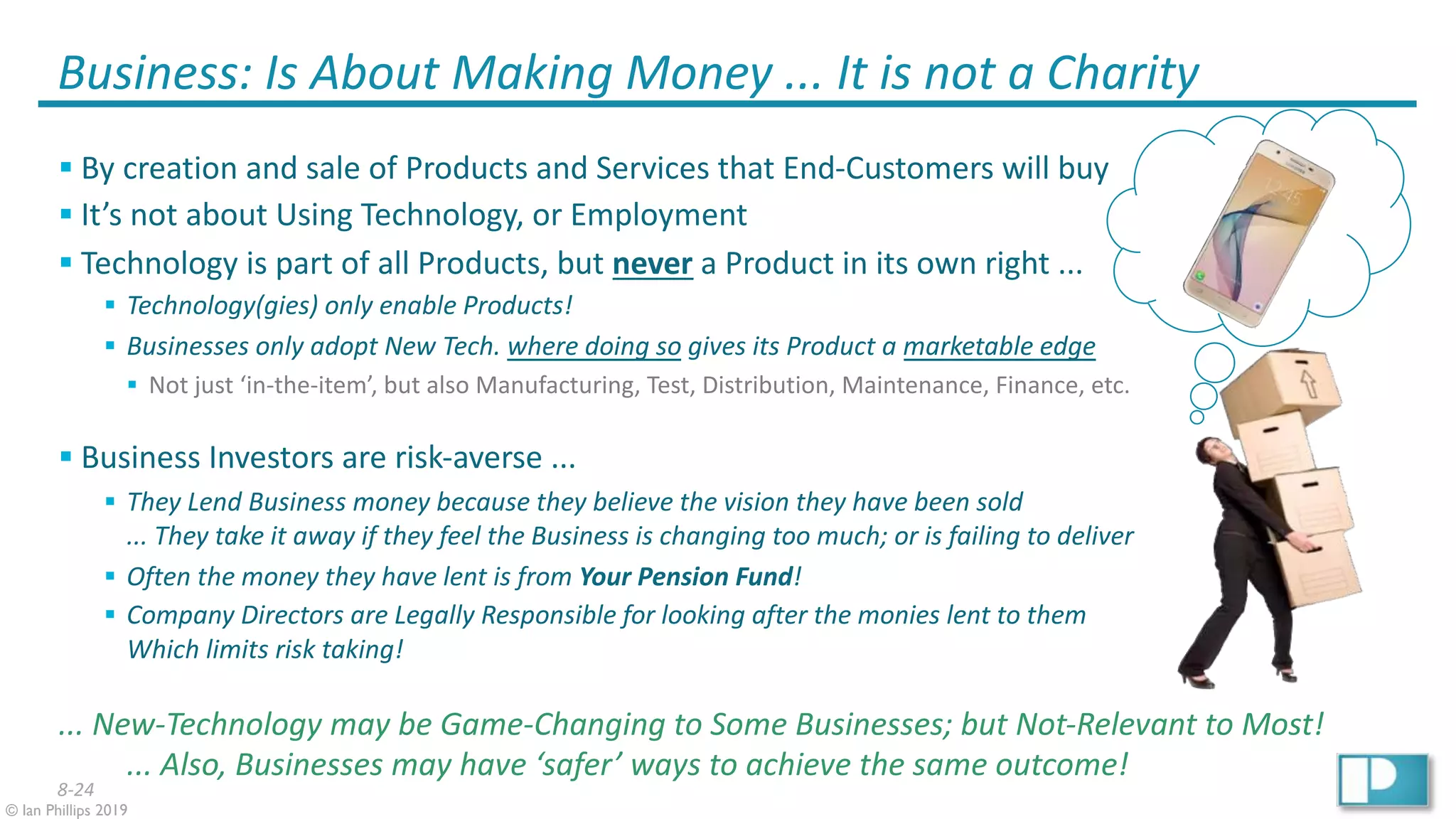
Business: Is About Making Money ... It is not a Charity
§ By creation and sale of Products and Services that End-Customers will buy
§ It’s not about Using Technology, or Employment
§ Technology is part of all Products, but never a Product in its own right ...
§ Technology(gies) only enable Products!
§ Businesses only adopt New Tech. where doing so gives its Product a marketable edge
§ Not just ‘in-the-item’, but also Manufacturing, Test, Distribution, Maintenance, Finance, etc.
§ Business Investors are risk-averse ...
§ They Lend Business money because they believe the vision they have been sold
... They take it away if they feel the Business is changing too much; or is failing to deliver
§ Often the money they have lent is from Your Pension Fund!
§ Company Directors are Legally Responsible for looking after the monies lent to them
Which limits risk taking!
... New-Technology may be Game-Changing to Some Businesses; but Not-Relevant to Most!
... Also, Businesses may have ‘safer’ ways to achieve the same outcome!
9-24
© Ian Phillips 2019
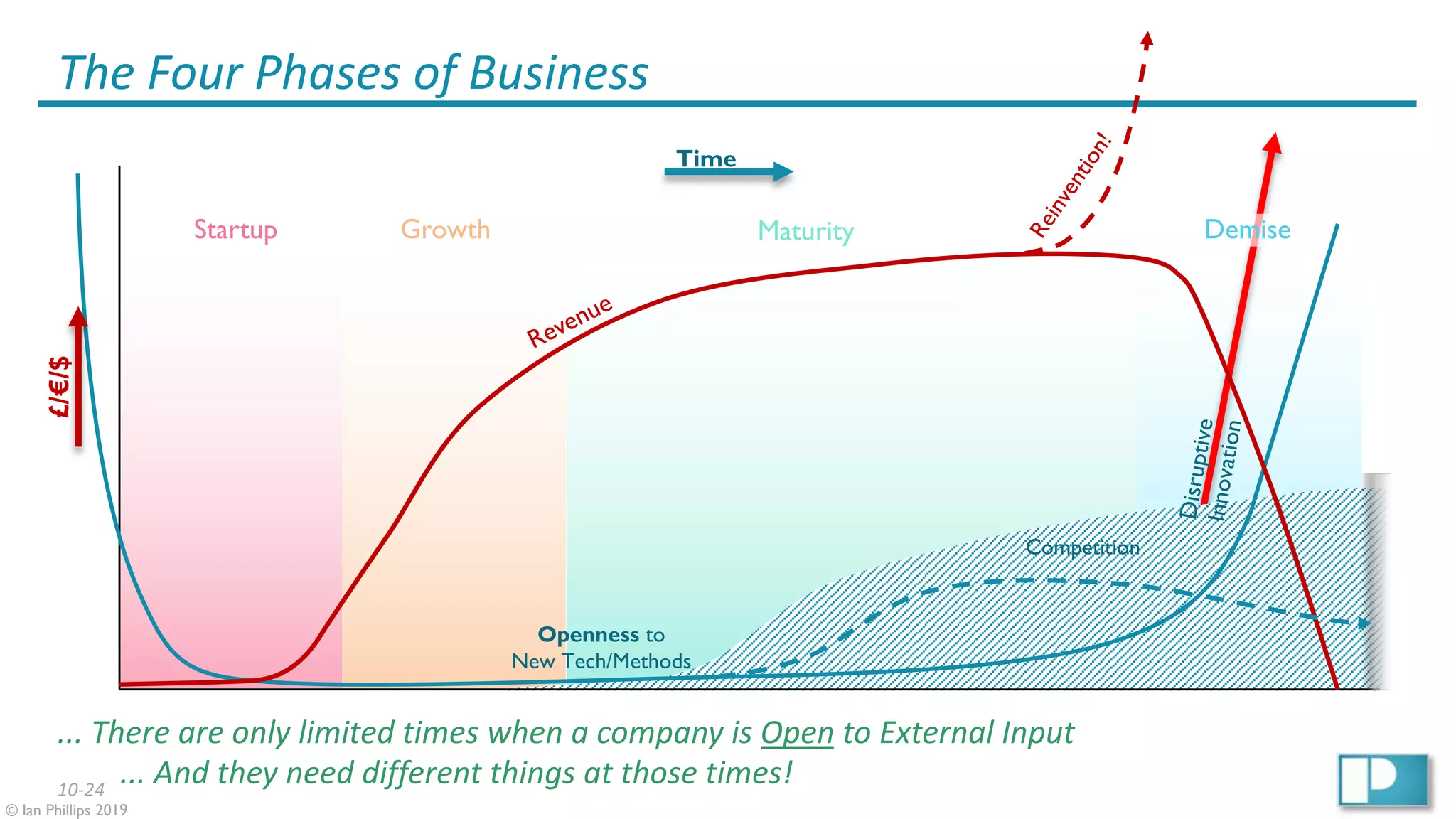
The Four Phases of Business£/€/$
... Most Businesses are unaware of the Phase they are in, or the way it changes them
Time
Startup Growth Maturity Demise
P1: Startup ... Company is formed to deliver something to a Customer or Market.
Everybody is irreplaceable. Everybody focuses on the Product Deliverable (not just engineering). Everybody knows the risk; has
an identified roll in the ‘machine’; and is critical to the companies survival. Background Science, Technology and Knowledge
came with the group; No time for ‘new investigations’ or what-if’s.
P2: Growth ... Follows success of the First Phase.
Founders move to Marketing, Sales and Business roles, to support the product. New people come in to replace their technical
roles. Organization starts to rationalize; reduces vulnerability to individuals. Procedures are introduced in some areas to help
newcomers fit in, but don’t work everywhere (Why some roles still need Engineers not Technicians). May scan the Technology
horizon ... But mostly adapt what is already known (Least risk)
P3: Maturity (Cruising) ... Following success of the Second Phase
Business has too many Families, Mortgages, Dependents and Investors to take significant risk any more. Caution and logic
prevail; evolution not revolution in products. Procedures make Everybody Replaceable; but stymie change, flexibility and
revolution. Re-Invention may be required, but the Status-Quo always resists change ?
P4: Demise
All Business Die when a Disruptor (Disruptive Technology1) finally enters their main market. Panic search for new
Technology to refresh the business ... but really clutching at straws!
[1] The Innovators Dilemma (1997) Clayton M. Christensen.
10-24
© Ian Phillips 2019
Competition
The Four Phases of Business£/€/$
... There are only limited times when a company is Open to External Input
... And they need different things at those times!
Time
Openness to
New Tech/Methods
Startup Growth Maturity Demise
Revenue
Disruptive
Innovation
Reinvention!
11-24
© Ian Phillips 2019
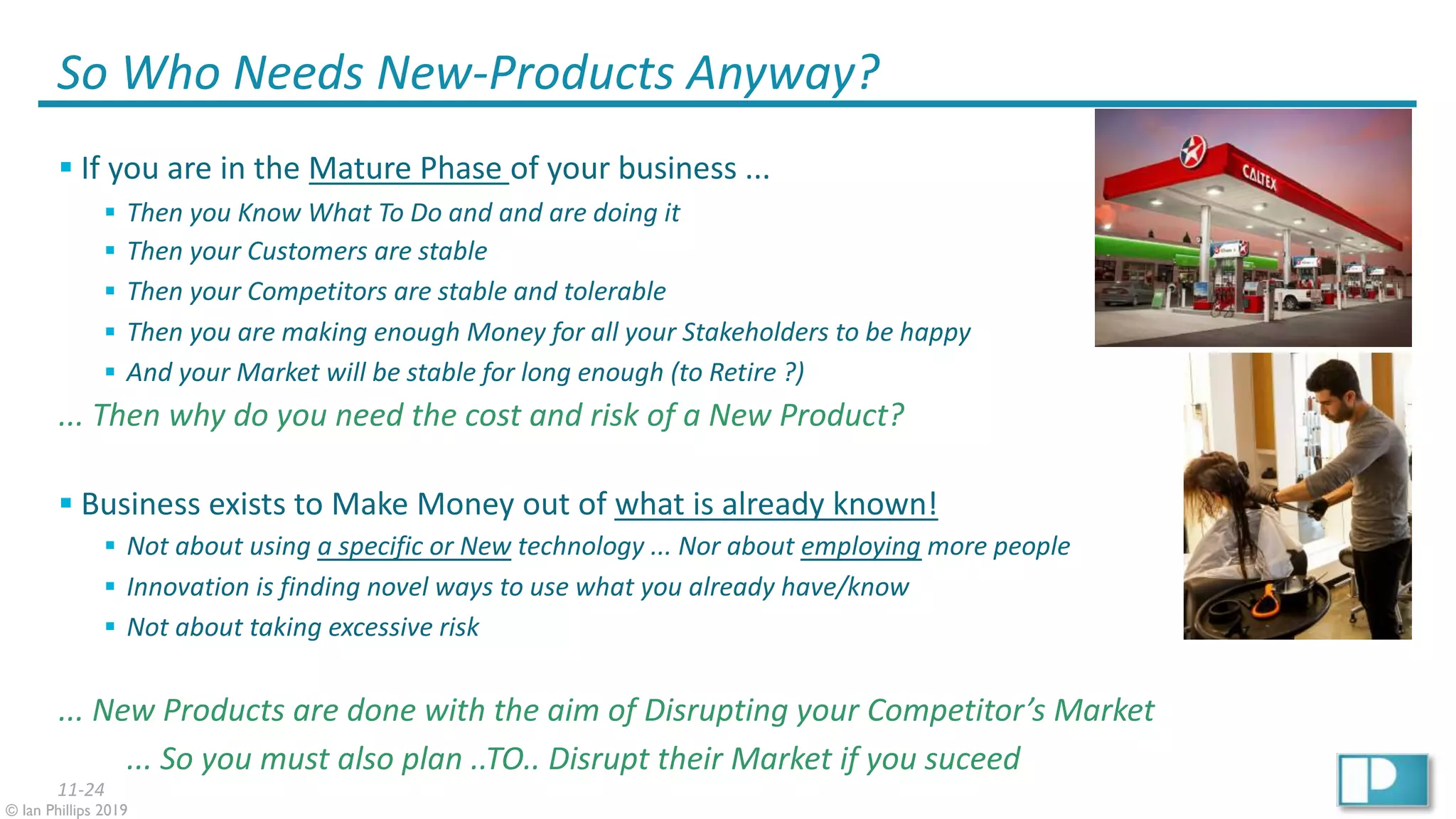
So Who Needs New-Products Anyway?
§ If you are in the Mature Phase of your business ...
§ Then you Know What To Do and and are doing it
§ Then your Customers are stable
§ Then your Competitors are stable and tolerable
§ Then you are making enough Money for all your Stakeholders to be happy
§ And your Market will be stable for long enough (to Retire ?)
... Then why do you need the cost and risk of a New Product?
§ Business exists to Make Money out of what is already known!
§ Not about using a specific or New technology ... Nor about employing more people
§ Innovation is finding novel ways to use what you already have/know
§ Not about taking excessive risk
... New Products are done with the aim of Disrupting your Competitor’s Market
... So you must also plan ..TO.. Disrupt their Market if you suceed
12-24
© Ian Phillips 2019
Flexibility (Openness to New Tech/Methods)
Investors Need Businesses to Remain Focused ...
Time
Startup Growth Maturity Demise
Revenue
1:20
19:20
Break-Even
Years!
Net-Worth
... They like you to have ‘Skin in the Game’
£/€/$
13-24
© Ian Phillips 2019
Products Advance by Small Competitive-Steps
...YEARS ...
14-24
© Ian Phillips 2019
Successful Businesses Supply what their Customers Need
§ To be Valuable, Technology must be in the supply-chain
or life-cycle of an End-Customer’s actual need!
§ A Product includes all its Physical Components
but also its Virtual (Invisible) ones ...
§ The Factory and Production Lines
§ Software
§ The Support Team and Training
§ Documents, Tools and Methods
§ The cost of installation (NRE!)
§ If the customer ‘didn’t actually need that’ or if it fails to
meet expectation, the Business may well fold!
... If you oversold your technology the relationship will be spoiled forever!
Sales
15-24
© Ian Phillips 2019
But Business Does Needs Research ...
§ To "Establish the path, before it has to walk down it"...
§ It can be near term (Using Internal Resources)
§ It can be long(er) term (Using Internal & External Resources)
§ It Needs Technical Research to Establish the Technologies,
Tools & Methods it will need to use for the Technical
Aspects of and around its Next Product Design...
§ And lay the framework for introduction of NEW Technologies in the longer-term
§ Considerations include: Performance, risk, cost (initial and ongoing), staffing; Also manufacturing, test,
conformance, support and maintenance; and Legal and Regulatory aspects
§ It also Needs Non-Technical Research to establish the other Business related aspects; in
particular the introduction of NEW Technologies to support Business Operations
(Which may be asynchronous to Technology Product Development)
16-24
© Ian Phillips 2019
‘Selling’ Your Research Outcomes to Business
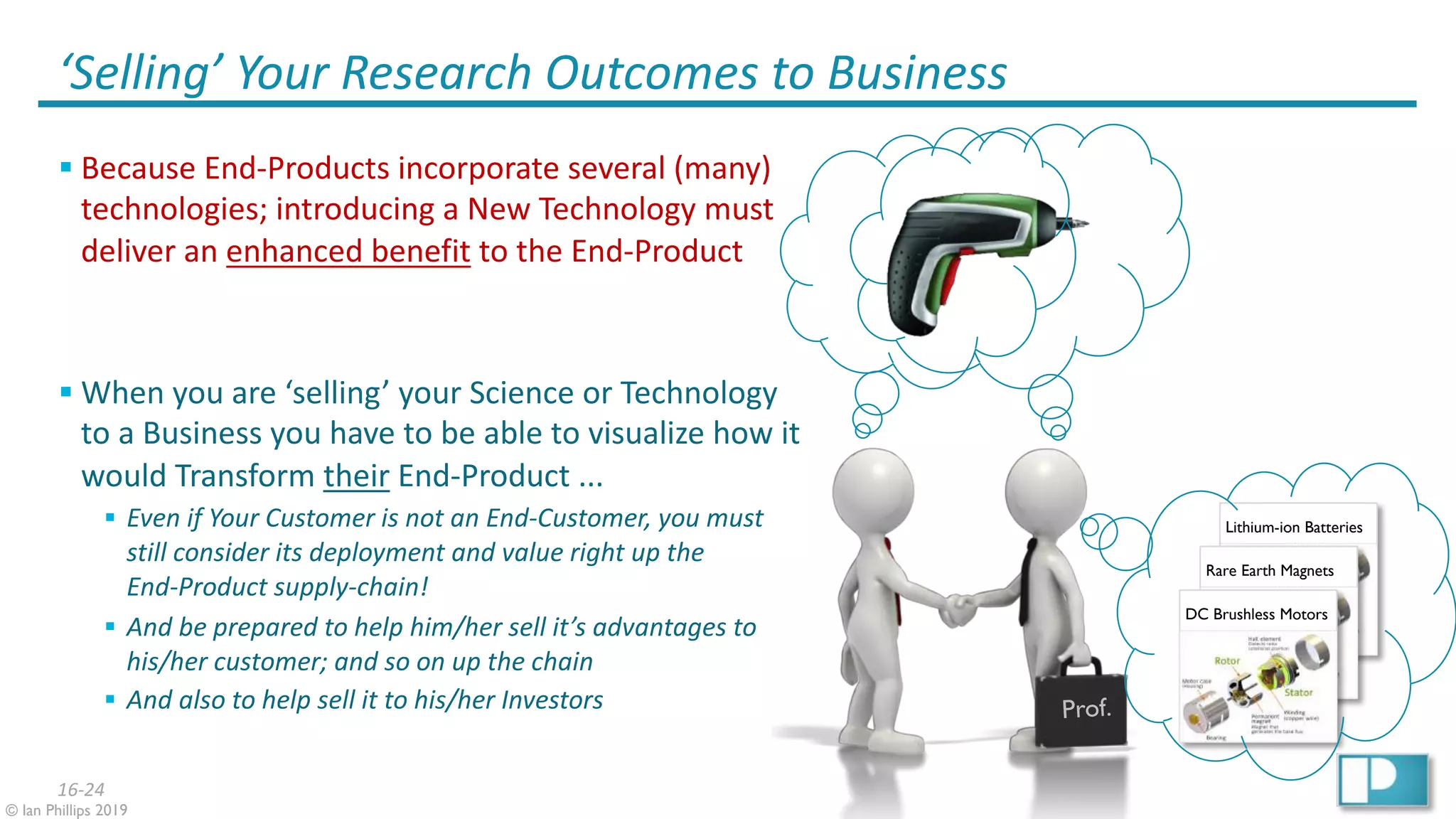
§ Because End-Products incorporate several (many)
technologies; introducing a New Technology must
deliver an enhanced benefit to the End-Product
§ When you are ‘selling’ your Science or Technology
to a Business you have to be able to visualize how it
would Transform their End-Product ...
§ Even if Your Customer is not an End-Customer, you must
still consider its deployment and value right up the
End-Product supply-chain!
§ And be prepared to help him/her sell it’s advantages to
his/her customer; and so on up the chain
§ And also to help sell it to his/her Investors
Lithium-ion Batteries
Rare Earth Magnets
DC Brushless Motors
Prof.
17-24
© Ian Phillips 2019
Technology Readiness Level
§ A Capability is a TRL 9 Technology Installed in a Businesses and is
Ready-to-use in the creation of a Mission-Critical Product.
(Release-Status TRL 9: Shown to Reliably Work as Expected, Ready for mission-critical use)
§ A Technology or Methodology is a Packaged science or method
supported by reliable models; with adequate performance to allow
it to be assessed for use in a Product context.
(Beta-Status TRL 7-9: Mostly Works as Expected)
§ A Science is an observed (physical) phenomena with a basic model
(Method) that predicts its properties
(Alpha-Status TRL 1-6: Demonstration; Shown to be Possible)
NASA Technology Readiness Levels
18-24
© Ian Phillips 2019
How Big An Edge is Business looking for?
§ Before it will be incorporated into a Planned Product evolution ...
1. 2x for Technology 1-2yr from Customer Use – Usually done In-House research/development
§ Reliable, available, supported by commercial grade tools, api’s and models (TRL9)
2. 10x for Science/Technology 3-5yr from Use – Frequently In-Supplier research/development
§ Demonstrated with prototype tools, api’s and models (TRL 7-9)
3. 100x for Science 5+yr from Use – Should be the focus for Academic Research
§ Model shown to agree with implementation, such that its potential can be assessed (TRL 3-6)
... Performance Gain over the status-quo, includes functional and non-functional aspects
(like cost, power, productivity, size, quality, etc)
§ Bear in mind higher promised-figures will be diluted as they get closer to being Reliable
§ Gains will be assessed against the Cost of Deployment
(Training, Risk (quality, time, money), License, Cash-Flow, Resource Availability, Marketing, Sales)
... Also that most Businesses already have a list of things they would like to do,
so your ‘offering’ has to compete with them for budget and resource.
19-24
© Ian Phillips 2019
Scientific Roles ...
§ Scientists Discover ... Discover and Quantify Fundamentals of Nature
§ They work with the Unknown
§ They Investigate the Universe to Identify Novelty within it
§ They use Imagination, Knowledge, Knowhow and Ingenuity (Theoretical bias)
§ They Quantify and Numerate it, and Demonstrate its Predictability (Technology)
§ Engineers Create ... Create Products or Tools that have Never Been
§ They Specify, Architect & Detail Solutions, using their theoretical knowledge of Science, Technologies and
Methods, to meet the needs of their Customers (May be Dept. Head ..to.. the End Customer)
§ They Overcome the Unknowns they encounter, with their wider Knowledge, Knowhow and Ingenuity
§ They Deliver Prototypes of what they Architected by applying those Technologies and Methods
§ Technicians Apply ... Are Expert Practitioners in Areas of the Known
§ Use their technical skills to replicate what other (Engineers) specified
§ Use their technical skills to operate Tools and Equipment (to a high degree of proficiency)
§ Use their technical skills to Debug and Reinstate Product, and implement Prescribed changes
§ Use tools and equipment to implement Prescribed Methods
Scientists Investigate That
Which Already Is; Engineers
Create That Which Has Never
Been.
Albert Einstein
20-24
© Ian Phillips 2019
Employee Profile Across Business Life ...Heads
... When Reinvention is required, there can be insufficient ‘right’ people around to do it!
Time
Startup Growth Maturity Demise
Revenue
Reinvention!
Scientists &
Engineers
Engineers &
Technicians
Technicians &
Operatives
21-24
© Ian Phillips 2019
The Wise Business Advice of Politicians ...
§ So are (UK)Industries really slow to take opportunities that EPSRC-£M offers?
§ Businesses are not Charities or Government Institutions; they live the ‘Compete or Die’ scenario daily
§ If a technology is not relevant to them (no matter how ‘PC’) ... Then they must Move-On!
§ Stable Businesses seldom listen to ‘The business guidance from Politicians’
§ They don’t need Politicians to guide their business plans
§ Government Cash doesn’t solve many real business issues; even when it is real
§ Politicians seldom have real business experience
§ Political and Business interests seldom align ...
§ Politicians love Competition ... Businesses hate it
§ There is never real Businesses in ‘market failures’ ... Though Politicians frequently have to deliver them
§ Politicians do not help when the going gets tough ... Unless you are too-big to fail (Are Universities too-big to fail?)
... So Do You Think Business ever trust the guidance of Politicians?
22-24
© Ian Phillips 2019
Partnership: Getting Science into Business
§ Know your Science ...
§ Good REF marks are interesting; but that’s about all
§ You need to know what it could do of great value to support their specific need
§ Look for at least x2 improvement; up to x100 for longer term delivery
§ Research without a clear link to product is commercially uninteresting! (eg: Graphene)
§ How far is it away from ready for use in a mission-critical role for such a Business?
... Be realistic about its readiness for use
§ Know your Customer(s)
§ Do you really understand what they do?
§ Do you really understand what they need; Do they really understand what they will get?
§ Are you talking with the appropriate person? (Tech-Transfer is a 2-way Process)
... Businesses are more fragile than you can imagine; this could kill them and make all unemployed!
... Help your Customer understand Their Future; and let them Guide You in yours!
23-24
© Ian Phillips 2019
Conclusions
§ Sciences/Technologies Enable Products; but are never End-Products in their own right!
§ Businesses Exist to Profit from the Exploitation of Knowledge and Know-How
§ Employees are necessary to achieve this; so are investors
§ They cease to exist when they fail to profit
§ They are more fragile than you can imagine
§ To get a Science into a Product it has to offer a significant End-Product advantage
§ To keep a Business out of a Competitive Downward-Spiral
§ It has to ‘complete’ with less-risky alternatives in the pursuit of profitability
§ Detached Research is Useless
§ Keep a target life-cycle to an End-Product in mind, all the time
§ Find Partner(s); guide them and be guided by them
§ Make them your Customer(s)
... Remember its what YOU buy that pays for everybody in its life-cycle
24-24
© Ian Phillips 2019
© Ian Phillips 2019
This and other presentations available at ... https://ianp24.blogspot.com
Thank you for Listening ...
This presentation and others available at
...
http://ianp24.blogspot.com

Science to Product 2v0

  • 1.
    1-24 © Ian Phillips2019 © Ian Phillips 2019 This and other presentations available at ... https://ianp24.blogspot.com From Science to Product ... ... How Science Enables Products Seminar at ... Department of Electrical Engineering and Electronics University of Liverpool, UK. 28Feb19 Prof. Ian Phillips CEng. BSc(hon), FIET, FIMA, SMIEEE. (Retired Dec16). Formerly: Principal Staff Eng’r. @ ARM Ltd, UK Visiting Professor with ... 2v0 Thank you for inviting me to talk to you today ...
  • 2.
    2-24 © Ian Phillips2019 Science >> Product: Why Should You Care ? § Gov. Needs Economic Growth and supports Research to this end ... § Put lots of money into support of ‘good’ research programs (EPSRC ~£1Bpa) § Sees (apparently) highly regarded papers and scientific outcomes § Anticipates exploitation in local (UK) Industries to contribute to (UK) Employment and thus (UK)GDP § But are disappointed at (UK)Industries ‘disinterest’ in these outcomes ... Gov. Agencies need to see exploitation to justify the ongoing Research Budget! ... Or it will be cut! § Businesses Needs a Competitive Edge ... § But don’t see Academic Research as part of the solution § Focused on (End) Customer Needs § Prefers Low-Risk Evolutionary Products § Approached by Universities and Government to take Good Research Outcomes ... But don’t ... Businesses doesn’t benefit from the Funding or the Knowledge in Universities ... To Stay Competitive! ... Wherever your career takes you, you will be in one of these situations!
  • 3.
    3-24 © Ian Phillips2019 Age of the ... Universe – 13.6Byr Earth – 4.5Byr Life – 3.5Byr The Exploitation of Science ... First 32,000 yrs got us to this far! Produce Research Develop § Cro-Magnon Man (Us!) – 35,000 yr ago § Evolved from Homo-Sapien (Wise Human) >100,000 yr § Mission: Survive Nature (1,000 gen’n) § The Philosophers – 2,500-1,000 yr ago § Pythagoras, Socrates, Plato, Aristotle, Archimedes, ... § Mission: Understanding Nature § The Scientists – 1,000-500 yrs ago § Galileo, Descartes, (1000 ad) § Electricity - William Gilbert (1600ad) § Mission: Manipulation of Nature § The Engineers – 260 yrs ago § Industrial Revolution (1750: 8 gen’n) § Mission: Exploitation of Nature § Science - First Meets – Exploitation § Technology Based Business Emerges ... Technology’s BIG-BANG was just 270 yr ago!
  • 4.
    4-24 © Ian Phillips2019 What do People Need? © Ian Phillips 2018 § In 1972, Pioneer 10 Carried this very revealing message about humanity to the stars ... § That we have big brains, dexterous fore-limbs, a perception of time ... and are Natural Consumers! ... We clearly need ‘extensions’ to our bodies to enable us to do almost anything!
  • 5.
    5-24 © Ian Phillips2019 Products to Satisfy Human Needs ... § Maslov’s illustrated this in his Hierarchy Of Needs (1943) § Level-1 - Warmth, Food, Drink, Rest. ..to.. Level-5 - Self-Actualization § We will pay almost anything to satisfy our Basic Needs § We need the lower levels before we will pay for the higher ones § Because ‘Naked Humans’ needs almost everything just to live ... § We need ‘Products’ from our own Ingenuity or from that of others § Our real Strength was our hidden abilities. We had Evolved ... § Ingenious brains (to conceive of solutions) § Bipedal posture, freeing hands for fine work § Good hand/eye Coordination to manipulate things § And a perception of the Future (with something new in it) ... Tools that give humans the flexibility to thrive in All of Earth’s environments § Trade and Money (a token of work-done) was an inevitable evolution partner ... Maslov’s still applies in 21c; We will still pay most for Products to satisfy the Low Levels
  • 6.
    6-24 © Ian Phillips2019 End-Customers buy Function not Technology ... Products have to embody Function & Form
  • 7.
    7-24 © Ian Phillips2019 Not All Tech. Products are Visible ... ... But they still deliver End-Customer Functionality
  • 8.
    8-24 © Ian Phillips2019 Business: Is About Making Money ... It is not a Charity § By creation and sale of Products and Services that End-Customers will buy § It’s not about Using Technology, or Employment § Technology is part of all Products, but never a Product in its own right ... § Technology(gies) only enable Products! § Businesses only adopt New Tech. where doing so gives its Product a marketable edge § Not just ‘in-the-item’, but also Manufacturing, Test, Distribution, Maintenance, Finance, etc. § Business Investors are risk-averse ... § They Lend Business money because they believe the vision they have been sold ... They take it away if they feel the Business is changing too much; or is failing to deliver § Often the money they have lent is from Your Pension Fund! § Company Directors are Legally Responsible for looking after the monies lent to them Which limits risk taking! ... New-Technology may be Game-Changing to Some Businesses; but Not-Relevant to Most! ... Also, Businesses may have ‘safer’ ways to achieve the same outcome!
  • 9.
    9-24 © Ian Phillips2019 The Four Phases of Business£/€/$ ... Most Businesses are unaware of the Phase they are in, or the way it changes them Time Startup Growth Maturity Demise P1: Startup ... Company is formed to deliver something to a Customer or Market. Everybody is irreplaceable. Everybody focuses on the Product Deliverable (not just engineering). Everybody knows the risk; has an identified roll in the ‘machine’; and is critical to the companies survival. Background Science, Technology and Knowledge came with the group; No time for ‘new investigations’ or what-if’s. P2: Growth ... Follows success of the First Phase. Founders move to Marketing, Sales and Business roles, to support the product. New people come in to replace their technical roles. Organization starts to rationalize; reduces vulnerability to individuals. Procedures are introduced in some areas to help newcomers fit in, but don’t work everywhere (Why some roles still need Engineers not Technicians). May scan the Technology horizon ... But mostly adapt what is already known (Least risk) P3: Maturity (Cruising) ... Following success of the Second Phase Business has too many Families, Mortgages, Dependents and Investors to take significant risk any more. Caution and logic prevail; evolution not revolution in products. Procedures make Everybody Replaceable; but stymie change, flexibility and revolution. Re-Invention may be required, but the Status-Quo always resists change ? P4: Demise All Business Die when a Disruptor (Disruptive Technology1) finally enters their main market. Panic search for new Technology to refresh the business ... but really clutching at straws! [1] The Innovators Dilemma (1997) Clayton M. Christensen.
  • 10.
    10-24 © Ian Phillips2019 Competition The Four Phases of Business£/€/$ ... There are only limited times when a company is Open to External Input ... And they need different things at those times! Time Openness to New Tech/Methods Startup Growth Maturity Demise Revenue Disruptive Innovation Reinvention!
  • 11.
    11-24 © Ian Phillips2019 So Who Needs New-Products Anyway? § If you are in the Mature Phase of your business ... § Then you Know What To Do and and are doing it § Then your Customers are stable § Then your Competitors are stable and tolerable § Then you are making enough Money for all your Stakeholders to be happy § And your Market will be stable for long enough (to Retire ?) ... Then why do you need the cost and risk of a New Product? § Business exists to Make Money out of what is already known! § Not about using a specific or New technology ... Nor about employing more people § Innovation is finding novel ways to use what you already have/know § Not about taking excessive risk ... New Products are done with the aim of Disrupting your Competitor’s Market ... So you must also plan ..TO.. Disrupt their Market if you suceed
  • 12.
    12-24 © Ian Phillips2019 Flexibility (Openness to New Tech/Methods) Investors Need Businesses to Remain Focused ... Time Startup Growth Maturity Demise Revenue 1:20 19:20 Break-Even Years! Net-Worth ... They like you to have ‘Skin in the Game’ £/€/$
  • 13.
    13-24 © Ian Phillips2019 Products Advance by Small Competitive-Steps ...YEARS ...
  • 14.
    14-24 © Ian Phillips2019 Successful Businesses Supply what their Customers Need § To be Valuable, Technology must be in the supply-chain or life-cycle of an End-Customer’s actual need! § A Product includes all its Physical Components but also its Virtual (Invisible) ones ... § The Factory and Production Lines § Software § The Support Team and Training § Documents, Tools and Methods § The cost of installation (NRE!) § If the customer ‘didn’t actually need that’ or if it fails to meet expectation, the Business may well fold! ... If you oversold your technology the relationship will be spoiled forever! Sales
  • 15.
    15-24 © Ian Phillips2019 But Business Does Needs Research ... § To "Establish the path, before it has to walk down it"... § It can be near term (Using Internal Resources) § It can be long(er) term (Using Internal & External Resources) § It Needs Technical Research to Establish the Technologies, Tools & Methods it will need to use for the Technical Aspects of and around its Next Product Design... § And lay the framework for introduction of NEW Technologies in the longer-term § Considerations include: Performance, risk, cost (initial and ongoing), staffing; Also manufacturing, test, conformance, support and maintenance; and Legal and Regulatory aspects § It also Needs Non-Technical Research to establish the other Business related aspects; in particular the introduction of NEW Technologies to support Business Operations (Which may be asynchronous to Technology Product Development)
  • 16.
    16-24 © Ian Phillips2019 ‘Selling’ Your Research Outcomes to Business § Because End-Products incorporate several (many) technologies; introducing a New Technology must deliver an enhanced benefit to the End-Product § When you are ‘selling’ your Science or Technology to a Business you have to be able to visualize how it would Transform their End-Product ... § Even if Your Customer is not an End-Customer, you must still consider its deployment and value right up the End-Product supply-chain! § And be prepared to help him/her sell it’s advantages to his/her customer; and so on up the chain § And also to help sell it to his/her Investors Lithium-ion Batteries Rare Earth Magnets DC Brushless Motors Prof.
  • 17.
    17-24 © Ian Phillips2019 Technology Readiness Level § A Capability is a TRL 9 Technology Installed in a Businesses and is Ready-to-use in the creation of a Mission-Critical Product. (Release-Status TRL 9: Shown to Reliably Work as Expected, Ready for mission-critical use) § A Technology or Methodology is a Packaged science or method supported by reliable models; with adequate performance to allow it to be assessed for use in a Product context. (Beta-Status TRL 7-9: Mostly Works as Expected) § A Science is an observed (physical) phenomena with a basic model (Method) that predicts its properties (Alpha-Status TRL 1-6: Demonstration; Shown to be Possible) NASA Technology Readiness Levels
  • 18.
    18-24 © Ian Phillips2019 How Big An Edge is Business looking for? § Before it will be incorporated into a Planned Product evolution ... 1. 2x for Technology 1-2yr from Customer Use – Usually done In-House research/development § Reliable, available, supported by commercial grade tools, api’s and models (TRL9) 2. 10x for Science/Technology 3-5yr from Use – Frequently In-Supplier research/development § Demonstrated with prototype tools, api’s and models (TRL 7-9) 3. 100x for Science 5+yr from Use – Should be the focus for Academic Research § Model shown to agree with implementation, such that its potential can be assessed (TRL 3-6) ... Performance Gain over the status-quo, includes functional and non-functional aspects (like cost, power, productivity, size, quality, etc) § Bear in mind higher promised-figures will be diluted as they get closer to being Reliable § Gains will be assessed against the Cost of Deployment (Training, Risk (quality, time, money), License, Cash-Flow, Resource Availability, Marketing, Sales) ... Also that most Businesses already have a list of things they would like to do, so your ‘offering’ has to compete with them for budget and resource.
  • 19.
    19-24 © Ian Phillips2019 Scientific Roles ... § Scientists Discover ... Discover and Quantify Fundamentals of Nature § They work with the Unknown § They Investigate the Universe to Identify Novelty within it § They use Imagination, Knowledge, Knowhow and Ingenuity (Theoretical bias) § They Quantify and Numerate it, and Demonstrate its Predictability (Technology) § Engineers Create ... Create Products or Tools that have Never Been § They Specify, Architect & Detail Solutions, using their theoretical knowledge of Science, Technologies and Methods, to meet the needs of their Customers (May be Dept. Head ..to.. the End Customer) § They Overcome the Unknowns they encounter, with their wider Knowledge, Knowhow and Ingenuity § They Deliver Prototypes of what they Architected by applying those Technologies and Methods § Technicians Apply ... Are Expert Practitioners in Areas of the Known § Use their technical skills to replicate what other (Engineers) specified § Use their technical skills to operate Tools and Equipment (to a high degree of proficiency) § Use their technical skills to Debug and Reinstate Product, and implement Prescribed changes § Use tools and equipment to implement Prescribed Methods Scientists Investigate That Which Already Is; Engineers Create That Which Has Never Been. Albert Einstein
  • 20.
    20-24 © Ian Phillips2019 Employee Profile Across Business Life ...Heads ... When Reinvention is required, there can be insufficient ‘right’ people around to do it! Time Startup Growth Maturity Demise Revenue Reinvention! Scientists & Engineers Engineers & Technicians Technicians & Operatives
  • 21.
    21-24 © Ian Phillips2019 The Wise Business Advice of Politicians ... § So are (UK)Industries really slow to take opportunities that EPSRC-£M offers? § Businesses are not Charities or Government Institutions; they live the ‘Compete or Die’ scenario daily § If a technology is not relevant to them (no matter how ‘PC’) ... Then they must Move-On! § Stable Businesses seldom listen to ‘The business guidance from Politicians’ § They don’t need Politicians to guide their business plans § Government Cash doesn’t solve many real business issues; even when it is real § Politicians seldom have real business experience § Political and Business interests seldom align ... § Politicians love Competition ... Businesses hate it § There is never real Businesses in ‘market failures’ ... Though Politicians frequently have to deliver them § Politicians do not help when the going gets tough ... Unless you are too-big to fail (Are Universities too-big to fail?) ... So Do You Think Business ever trust the guidance of Politicians?
  • 22.
    22-24 © Ian Phillips2019 Partnership: Getting Science into Business § Know your Science ... § Good REF marks are interesting; but that’s about all § You need to know what it could do of great value to support their specific need § Look for at least x2 improvement; up to x100 for longer term delivery § Research without a clear link to product is commercially uninteresting! (eg: Graphene) § How far is it away from ready for use in a mission-critical role for such a Business? ... Be realistic about its readiness for use § Know your Customer(s) § Do you really understand what they do? § Do you really understand what they need; Do they really understand what they will get? § Are you talking with the appropriate person? (Tech-Transfer is a 2-way Process) ... Businesses are more fragile than you can imagine; this could kill them and make all unemployed! ... Help your Customer understand Their Future; and let them Guide You in yours!
  • 23.
    23-24 © Ian Phillips2019 Conclusions § Sciences/Technologies Enable Products; but are never End-Products in their own right! § Businesses Exist to Profit from the Exploitation of Knowledge and Know-How § Employees are necessary to achieve this; so are investors § They cease to exist when they fail to profit § They are more fragile than you can imagine § To get a Science into a Product it has to offer a significant End-Product advantage § To keep a Business out of a Competitive Downward-Spiral § It has to ‘complete’ with less-risky alternatives in the pursuit of profitability § Detached Research is Useless § Keep a target life-cycle to an End-Product in mind, all the time § Find Partner(s); guide them and be guided by them § Make them your Customer(s) ... Remember its what YOU buy that pays for everybody in its life-cycle
  • 24.
    24-24 © Ian Phillips2019 © Ian Phillips 2019 This and other presentations available at ... https://ianp24.blogspot.com Thank you for Listening ... This presentation and others available at ... http://ianp24.blogspot.com