J O D I E F O W K E S
H A N N A H S E N G E R
S T I L L L I F E P H O T O G R A P H Y
D E F I N I T I O N
• Still Life images can be just about
anything that doesn’t move. The
definition of a still life subject is an
inanimate object. It often involves
subjects that are simple and
commonplace, elevating the
familiar and making them
dynamic and interesting.They are
life forms however they don’t
move.
• Because the subjects are smaller,
lighting coverage is less and
alternatively less power is
needed. Rather than the need for
a massive amount of studio
equipment, still life setups can be
lit with just daylight from a large
window.
After the Walk, Martin Zalba
Sánchez Cotán (Spanish Golden Age), Antonio Diaz
W H A T M A K E S A S U C C E S S F U L
S T I L L L I F E P H O T O ?
• Still life photography is a demanding art, one in which the
photographers are expected to be able to form their work with a
refined sense of lighting, coupled with compositional skills. The
still life photographer makes pictures rather than takes them.
• All elements of picture making in still life photography are under
control. The photographer ideally should be involved in the
process of setting up the scene because the subjects
arrangement is important.
• Still life photography often uses a neutral, unobtrusive
background so as to not detract or distract from the subject.
• Lighting is crucial because still life subjects tend to be small.
Studio lighting is not necessary but can be useful for control.
H O W I S T H E G E N R E U S E D ?
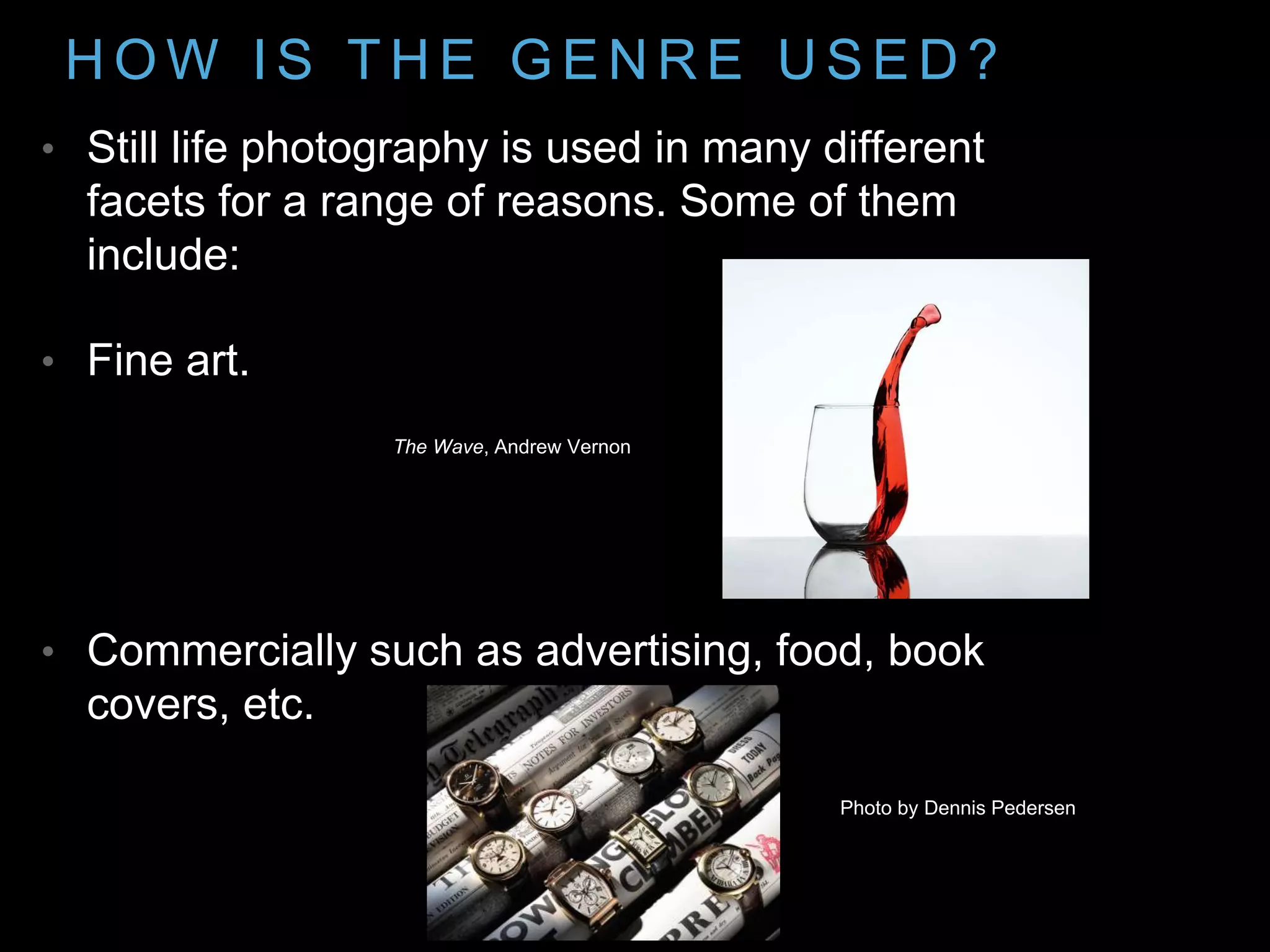
• Still life photography is used in many different
facets for a range of reasons. Some of them
include:
• Fine art.
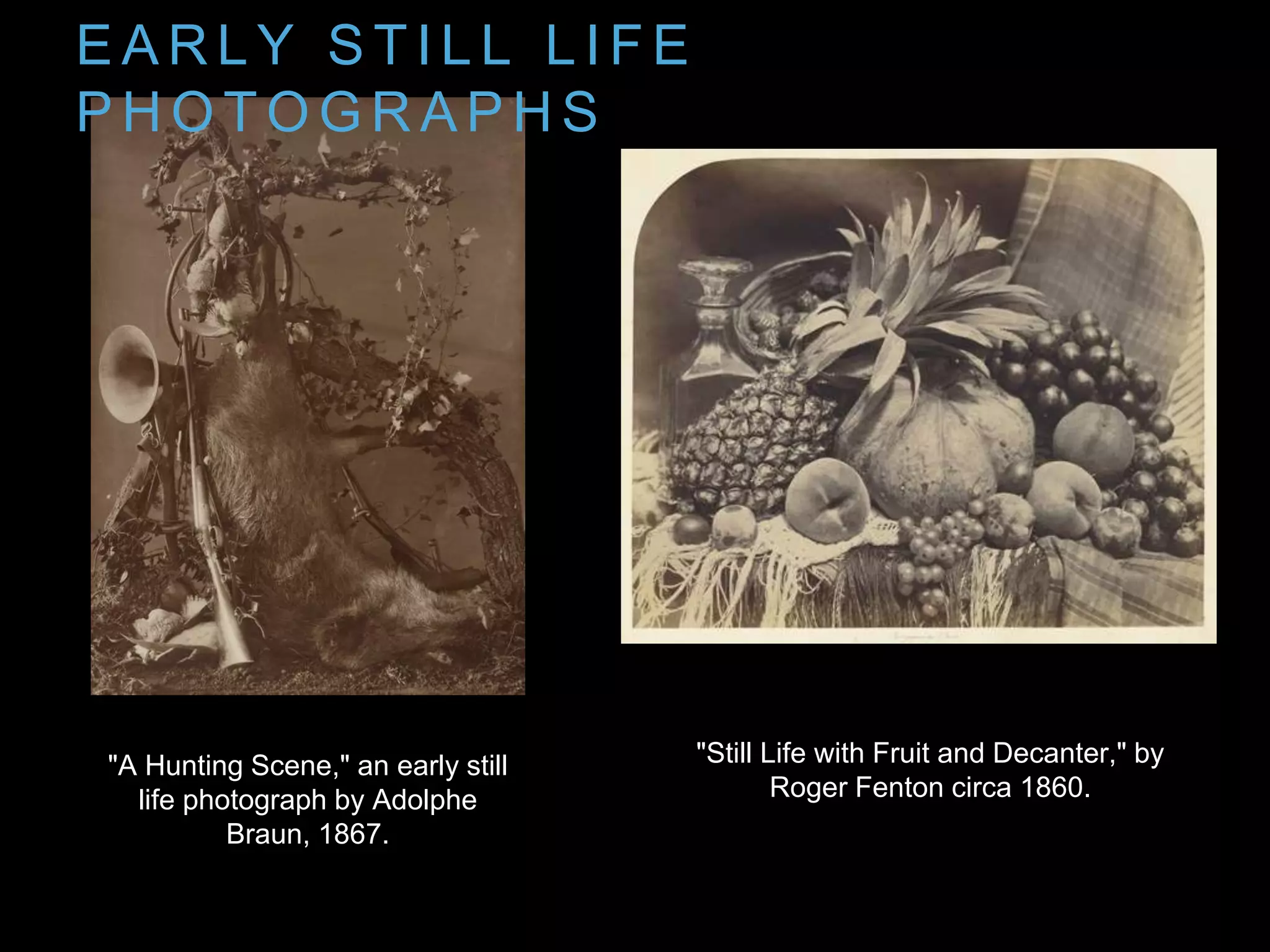
• Commercially such as advertising, food, book
covers, etc.
The Wave, Andrew Vernon
Photo by Dennis Pedersen
H I S T O R Y O F S T I L L L I F E
P H O T O G R A P H Y
• Still life photography has been popular among
photographers since the early 19th century, and still is
today. Early photographers adopted the still life genre
from the painters at the time.
• In the early years of photography, still life was a
practical and a creative choice. In the 19th century,
exposure times were measured in minutes rather than
seconds. Because of the need for long exposures,
anything that moved would be very difficult to
photograph such as landscapes or people.
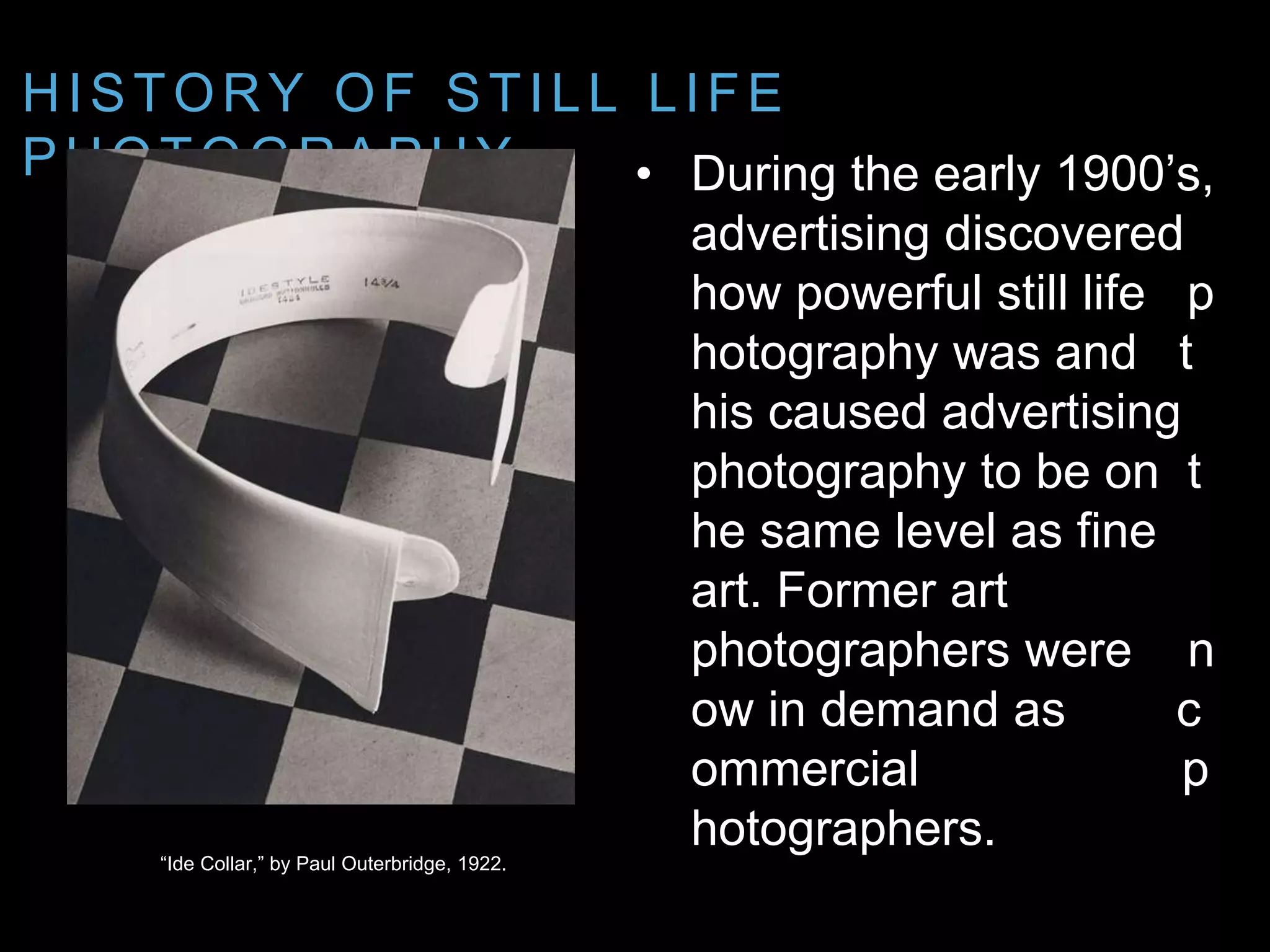
"A Hunting Scene," an early still
life photograph by Adolphe
Braun, 1867.
"Still Life with Fruit and Decanter," by
Roger Fenton circa 1860.
E A R L Y S T I L L L I F E
P H O T O G R A P H S
HISTORY OF STILL LIFE
PHOTOGRAPHY • During the early 1900’s,
advertising discovered
how powerful still life p
hotography was and t
his caused advertising
photography to be on t
he same level as fine
art. Former art
photographers were n
ow in demand as c
ommercial p
hotographers.
“Ide Collar,” by Paul Outerbridge, 1922.
MODERN EXAMPLES
OF STILL LIFE
PHOTOGRAPHY
S T I L L L I F E P H O T O G R A P H Y - H O W H A S
I T C H A N G E D ?
• The term "still life" changed in the 20th century, creating a broader
spectrum of photographs which could be defined as still life..
"Stopping Time" by scientist and photographer H
arold Edgerton. The image captures a bullet piercing fr
uit at high speed.
“Storefront, Avenue des Gobelins,” by Eugene Atget, 1925
There aren't any living figures in the photograph so it cant r
ightfully be a portrait but because the mannequin s
ubjects are inanimate, it could be considered a still life p
hoto.

Still Life Powerpoint

  • 1.
    J O DI E F O W K E S H A N N A H S E N G E R S T I L L L I F E P H O T O G R A P H Y
  • 2.
    D E FI N I T I O N • Still Life images can be just about anything that doesn’t move. The definition of a still life subject is an inanimate object. It often involves subjects that are simple and commonplace, elevating the familiar and making them dynamic and interesting.They are life forms however they don’t move. • Because the subjects are smaller, lighting coverage is less and alternatively less power is needed. Rather than the need for a massive amount of studio equipment, still life setups can be lit with just daylight from a large window. After the Walk, Martin Zalba Sánchez Cotán (Spanish Golden Age), Antonio Diaz
  • 3.
    W H AT M A K E S A S U C C E S S F U L S T I L L L I F E P H O T O ? • Still life photography is a demanding art, one in which the photographers are expected to be able to form their work with a refined sense of lighting, coupled with compositional skills. The still life photographer makes pictures rather than takes them. • All elements of picture making in still life photography are under control. The photographer ideally should be involved in the process of setting up the scene because the subjects arrangement is important. • Still life photography often uses a neutral, unobtrusive background so as to not detract or distract from the subject. • Lighting is crucial because still life subjects tend to be small. Studio lighting is not necessary but can be useful for control.
  • 4.
    H O WI S T H E G E N R E U S E D ? • Still life photography is used in many different facets for a range of reasons. Some of them include: • Fine art. • Commercially such as advertising, food, book covers, etc. The Wave, Andrew Vernon Photo by Dennis Pedersen
  • 5.
    H I ST O R Y O F S T I L L L I F E P H O T O G R A P H Y • Still life photography has been popular among photographers since the early 19th century, and still is today. Early photographers adopted the still life genre from the painters at the time. • In the early years of photography, still life was a practical and a creative choice. In the 19th century, exposure times were measured in minutes rather than seconds. Because of the need for long exposures, anything that moved would be very difficult to photograph such as landscapes or people.
  • 6.
    "A Hunting Scene,"an early still life photograph by Adolphe Braun, 1867. "Still Life with Fruit and Decanter," by Roger Fenton circa 1860. E A R L Y S T I L L L I F E P H O T O G R A P H S
  • 7.
    HISTORY OF STILLLIFE PHOTOGRAPHY • During the early 1900’s, advertising discovered how powerful still life p hotography was and t his caused advertising photography to be on t he same level as fine art. Former art photographers were n ow in demand as c ommercial p hotographers. “Ide Collar,” by Paul Outerbridge, 1922.
  • 8.
    MODERN EXAMPLES OF STILLLIFE PHOTOGRAPHY
  • 9.
    S T IL L L I F E P H O T O G R A P H Y - H O W H A S I T C H A N G E D ? • The term "still life" changed in the 20th century, creating a broader spectrum of photographs which could be defined as still life.. "Stopping Time" by scientist and photographer H arold Edgerton. The image captures a bullet piercing fr uit at high speed. “Storefront, Avenue des Gobelins,” by Eugene Atget, 1925 There aren't any living figures in the photograph so it cant r ightfully be a portrait but because the mannequin s ubjects are inanimate, it could be considered a still life p hoto.