The Cold
War Era:
1947-1970
Present by-Gyayak jain
12th Humanities
Acknowledgement
I would like to express my special thanks of
gratitude to my teacher Mr.Hitendra Jain
Sir as well as our principal Mr.Saumitra
Singh Thakur who gave me the golden
opportunity to do this wonderful project on
the topic The Cold War Era, which also
helped me in doing a lot of Research and i
came to know about so many new things I
am really thankful to them.
Secondly I would also like to thank my
parents and friends who helped me a lot in
finalizing this project within the limited time
frame.
What is Cold War?
The cold war
referred to the
competition ,the
tension and a series
of confrontation
Between two
countries.
For Example :-
between USA and USSR.
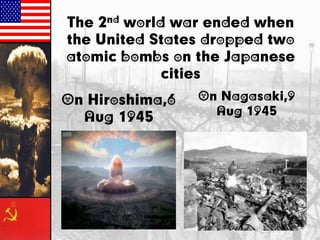
On Hiroshima,6
Aug 1945
The 2nd world war ended when
the United States dropped two
atomic bombs on the Japanese
cities
On Nagasaki,9
Aug 1945
• The end of Second World
War was the beginning of
Cold War.
• The Allied forces in Second
World War was led by the
Britain ,France,USSR and
Russia defeated the Axis
power led by Germany, Italy
and Japan.
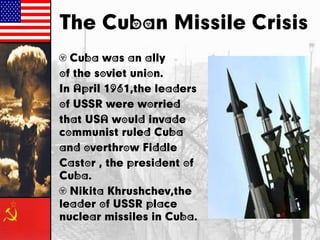
The Cuban Missile Crisis
• Cuba was an ally
of the soviet union.
In April 1961,the leaders
of USSR were worried
that USA would invade
communist ruled Cuba
and overthrow Fiddle
Castor , the president of
Cuba.
• Nikita Khrushchev,the
leader of USSR place
nuclear missiles in Cuba.
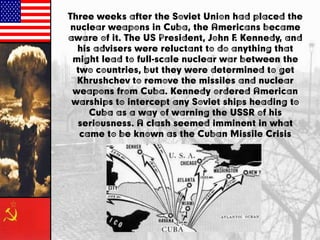
Three weeks after the Soviet Union had placed the
nuclear weapons in Cuba, the Americans became
aware of it. The US President, John F. Kennedy, and
his advisers were reluctant to do anything that
might lead to full-scale nuclear war between the
two countries, but they were determined to get
Khrushchev to remove the missiles and nuclear
weapons from Cuba. Kennedy ordered American
warships to intercept any Soviet ships heading to
Cuba as a way of warning the USSR of his
seriousness. A clash seemed imminent in what
came to be known as the Cuban Missile Crisis
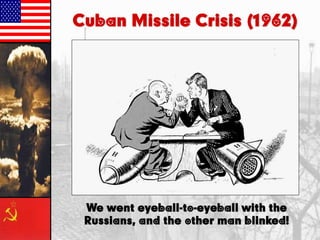
Cuban Missile Crisis (1962)
We went eyeball-to-eyeball with the
Russians, and the other man blinked!
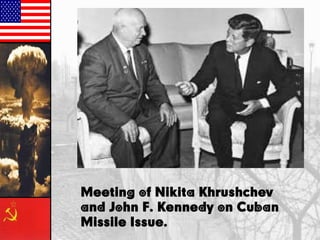
Meeting of Nikita Khrushchev
and John F. Kennedy on Cuban
Missile Issue.
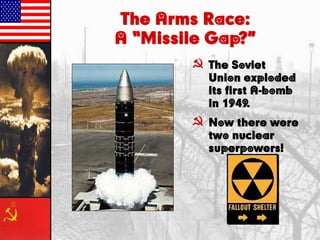
The Arms Race:
A “Missile Gap?”
} The Soviet
Union exploded
its first A-bomb
in 1949.
} Now there were
two nuclear
superpowers!
The Emergence of
two power blocks.
The World was divided into two
power blocks.Western Alliances
and Eastern Alliances.
The smaller states int the
alliances used the link to the
superpower (USA & USSR) for
their own purposes.They got the
promise of protection ,weapons
and economic aid against their
local rival.
The western
alliance was
formalised into
an organisation,
the NORTH
ATLANTIC
TREATY
Organisation.
EASTERN
ALLIANCE
The
eastern
alliance is
known as
the Warsaw
pact, was led
by the soviet
union.
WESTERN
ALLIANCE
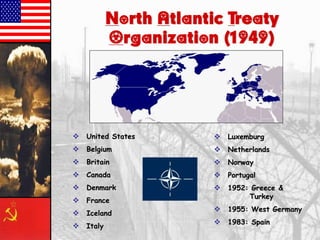
North Atlantic Treaty
Organization (1949)
 United States
 Belgium
 Britain
 Canada
 Denmark
 France
 Iceland
 Italy
 Luxemburg
 Netherlands
 Norway
 Portugal
 1952: Greece &
Turkey
 1955: West Germany
 1983: Spain
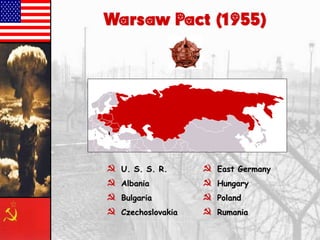
Warsaw Pact (1955)
} U. S. S. R.
} Albania
} Bulgaria
} Czechoslovakia
} East Germany
} Hungary
} Poland
} Rumania
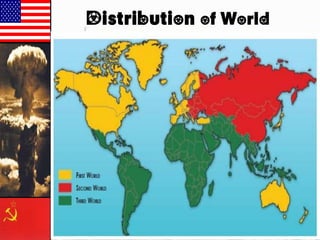
Distribution of World
Other Alliance
In East, South East and West
Asia the USA built two alliance
system to make its hold in these
regions, called -
 South east Asian Treaty
Organization (SEATO) in 1954.
Australia, France, Britain, New
Zealand, Pakistan, Thailand
and USA were members.
 The Central treaty
organisation (CENTO) in 1955
NON ALIGNED
MOVEMENT
What is Non –
Alignment
Movement (NAM)?
Non- Alignment movement
gave the newly
independent countries a
way of staying out of the
alliances.
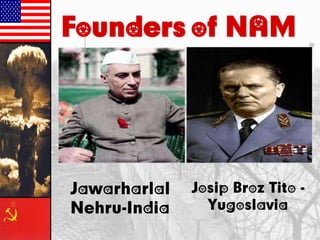
Founders of NAM
Josip Broz Tito -
Yugoslavia
Jawarharlal
Nehru-India
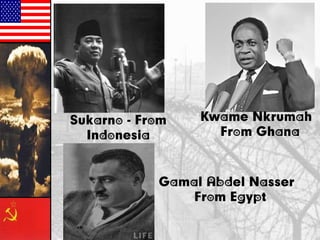
Gamal Abdel Nasser
From Egypt
Kwame Nkrumah
From Ghana
Sukarno - From
Indonesia
NEW INTERNATIONAL
ECONOMIC ORDER
The NIEO aims at Restructuring
the existing institution and
establishing new organizations
which will govern the flow of
trade, technology and capital
resources for the benefit of the
whole world in general and the
developing countries.
The Global trading system
according to UNCTAD in NIEO.
(Report 1972 )
• The Least Developed Countries (LDCs)
should be given the control over their
natural resources which are exploited
by the developed countries.
• They should be given access to western
markets so that they can sell their
products and therefore make trades
more useful for the poorer countries.
• Reduce the cost of technology from the
western countries.
• LDC should be provided greater role in
international economic institutions.
India and the cold war!
• As a leader of NAM India took
particular care in staying away
from the two alliance and raise
voice against the newly
decolonised countries becoming
part of these alliances.
• India took international
decisions and stances that
served the interests of the
superpowers and their allies.
• India often balanced one
superpower against the other.
CRITICISM OF INDIA’S Non
Alignment Policy
• India’s NAM said to be unprincipled.
• It is suggested that India was inconsistent
and took contradictory postures.
• India signed the treaty of friendship in
1971 with USSR for 20 years.
• The Indian government view was that India
needed diplomatic and military support
during Bangladesh crisis.
• That in any case the treaty did not stop
India from having good relationship with
other countries including US.
The Cold War Era, World War, World Politics, Project, PPT, PowerPoint presentation

The Cold War Era, World War, World Politics, Project, PPT, PowerPoint presentation

  • 1.
    The Cold War Era: 1947-1970 Presentby-Gyayak jain 12th Humanities
  • 2.
    Acknowledgement I would liketo express my special thanks of gratitude to my teacher Mr.Hitendra Jain Sir as well as our principal Mr.Saumitra Singh Thakur who gave me the golden opportunity to do this wonderful project on the topic The Cold War Era, which also helped me in doing a lot of Research and i came to know about so many new things I am really thankful to them. Secondly I would also like to thank my parents and friends who helped me a lot in finalizing this project within the limited time frame.
  • 3.
    What is ColdWar? The cold war referred to the competition ,the tension and a series of confrontation Between two countries. For Example :- between USA and USSR.
  • 4.
    On Hiroshima,6 Aug 1945 The2nd world war ended when the United States dropped two atomic bombs on the Japanese cities On Nagasaki,9 Aug 1945
  • 5.
    • The endof Second World War was the beginning of Cold War. • The Allied forces in Second World War was led by the Britain ,France,USSR and Russia defeated the Axis power led by Germany, Italy and Japan.
  • 6.
    The Cuban MissileCrisis • Cuba was an ally of the soviet union. In April 1961,the leaders of USSR were worried that USA would invade communist ruled Cuba and overthrow Fiddle Castor , the president of Cuba. • Nikita Khrushchev,the leader of USSR place nuclear missiles in Cuba.
  • 7.
    Three weeks afterthe Soviet Union had placed the nuclear weapons in Cuba, the Americans became aware of it. The US President, John F. Kennedy, and his advisers were reluctant to do anything that might lead to full-scale nuclear war between the two countries, but they were determined to get Khrushchev to remove the missiles and nuclear weapons from Cuba. Kennedy ordered American warships to intercept any Soviet ships heading to Cuba as a way of warning the USSR of his seriousness. A clash seemed imminent in what came to be known as the Cuban Missile Crisis
  • 8.
    Cuban Missile Crisis(1962) We went eyeball-to-eyeball with the Russians, and the other man blinked!
  • 9.
    Meeting of NikitaKhrushchev and John F. Kennedy on Cuban Missile Issue.
  • 10.
    The Arms Race: A“Missile Gap?” } The Soviet Union exploded its first A-bomb in 1949. } Now there were two nuclear superpowers!
  • 11.
    The Emergence of twopower blocks. The World was divided into two power blocks.Western Alliances and Eastern Alliances. The smaller states int the alliances used the link to the superpower (USA & USSR) for their own purposes.They got the promise of protection ,weapons and economic aid against their local rival.
  • 12.
    The western alliance was formalisedinto an organisation, the NORTH ATLANTIC TREATY Organisation. EASTERN ALLIANCE The eastern alliance is known as the Warsaw pact, was led by the soviet union. WESTERN ALLIANCE
  • 13.
    North Atlantic Treaty Organization(1949)  United States  Belgium  Britain  Canada  Denmark  France  Iceland  Italy  Luxemburg  Netherlands  Norway  Portugal  1952: Greece & Turkey  1955: West Germany  1983: Spain
  • 14.
    Warsaw Pact (1955) }U. S. S. R. } Albania } Bulgaria } Czechoslovakia } East Germany } Hungary } Poland } Rumania
  • 15.
  • 16.
    Other Alliance In East,South East and West Asia the USA built two alliance system to make its hold in these regions, called -  South east Asian Treaty Organization (SEATO) in 1954. Australia, France, Britain, New Zealand, Pakistan, Thailand and USA were members.  The Central treaty organisation (CENTO) in 1955
  • 17.
    NON ALIGNED MOVEMENT What isNon – Alignment Movement (NAM)? Non- Alignment movement gave the newly independent countries a way of staying out of the alliances.
  • 18.
    Founders of NAM JosipBroz Tito - Yugoslavia Jawarharlal Nehru-India
  • 19.
    Gamal Abdel Nasser FromEgypt Kwame Nkrumah From Ghana Sukarno - From Indonesia
  • 20.
    NEW INTERNATIONAL ECONOMIC ORDER TheNIEO aims at Restructuring the existing institution and establishing new organizations which will govern the flow of trade, technology and capital resources for the benefit of the whole world in general and the developing countries.
  • 21.
    The Global tradingsystem according to UNCTAD in NIEO. (Report 1972 ) • The Least Developed Countries (LDCs) should be given the control over their natural resources which are exploited by the developed countries. • They should be given access to western markets so that they can sell their products and therefore make trades more useful for the poorer countries. • Reduce the cost of technology from the western countries. • LDC should be provided greater role in international economic institutions.
  • 22.
    India and thecold war! • As a leader of NAM India took particular care in staying away from the two alliance and raise voice against the newly decolonised countries becoming part of these alliances. • India took international decisions and stances that served the interests of the superpowers and their allies. • India often balanced one superpower against the other.
  • 23.
    CRITICISM OF INDIA’SNon Alignment Policy • India’s NAM said to be unprincipled. • It is suggested that India was inconsistent and took contradictory postures. • India signed the treaty of friendship in 1971 with USSR for 20 years. • The Indian government view was that India needed diplomatic and military support during Bangladesh crisis. • That in any case the treaty did not stop India from having good relationship with other countries including US.