
U.S. NCAP Update 
2014 Global NCAP Annual Meeting 
October 30, 2014 
1
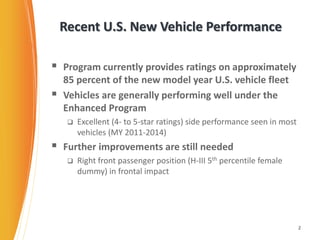
Recent U.S. New Vehicle Performance 
 Program currently provides ratings on approximately 
85 percent of the new model year U.S. vehicle fleet 
 Vehicles are generally performing well under the 
Enhanced Program 
 Excellent (4- to 5-star ratings) side performance seen in most 
vehicles (MY 2011-2014) 
 Further improvements are still needed 
 Right front passenger position (H-III 5th percentile female 
dummy) in frontal impact 
2
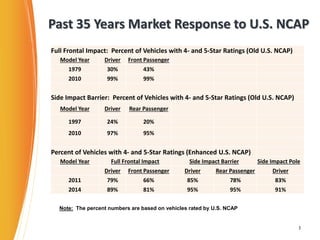
Past 35 Years Market Response to U.S. NCAP 
3 
Full Frontal Impact: Percent of Vehicles with 4- and 5-Star Ratings (Old U.S. NCAP) 
Model Year Driver Front Passenger 
1979 30% 43% 
2010 99% 99% 
Side Impact Barrier: Percent of Vehicles with 4- and 5-Star Ratings (Old U.S. NCAP) 
Model Year Driver Rear Passenger 
1997 24% 20% 
2010 97% 95% 
Percent of Vehicles with 4- and 5-Star Ratings (Enhanced U.S. NCAP) 
Model Year Full Frontal Impact Side Impact Barrier Side Impact Pole 
Driver Front Passenger Driver Rear Passenger Driver 
2011 79% 66% 85% 78% 83% 
2014 89% 81% 95% 95% 91% 
Note: The percent numbers are based on vehicles rated by U.S. NCAP
Penetration of U.S. NCAP Advanced 
Technologies Into the U.S. Marketplace 
4 
Lane Departure Warning Systems : MY 2011-2015 
Model 
Year 
Total 
Manufacturers Total Makes 
Total Trim 
Lines Offering 
LDW 
Total trim lines with confirming 
data provided and therefore 
recommended on Safercar.gov 
2011 7 9 601 51 
2012 7 9 812 68 
2013 10 17 1483 125 
2014 16 24 2424 173 
2015 19 28 3205 310 
1 – 29 optional, 31 unclear 
2 – All optional 
3 – 1 standard, all others optional 
4 – 4 standard, 6 unclear, all others optional 
5 – 8 standard, 2 unclear, all others optional
Penetration of U.S. NCAP Advanced 
Technologies Into the U.S. Marketplace (Cont.) 
5 
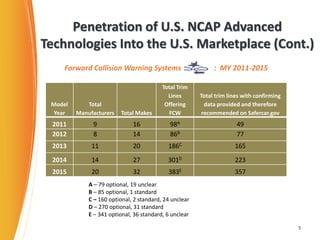
Forward Collision Warning Systems : MY 2011-2015 
Model 
Year 
Total 
Manufacturers Total Makes 
Total Trim 
Lines 
Offering 
FCW 
Total trim lines with confirming 
data provided and therefore 
recommended on Safercar.gov 
2011 9 16 98A 49 
2012 8 14 86B 77 
2013 11 20 186C 165 
2014 14 27 301D 223 
2015 20 32 383E 357 
A – 79 optional, 19 unclear 
B – 85 optional, 1 standard 
C – 160 optional, 2 standard, 24 unclear 
D – 270 optional, 31 standard 
E – 341 optional, 36 standard, 6 unclear
Penetration of U.S. NCAP Advanced 
Technologies Into the U.S. Marketplace (Cont.) 
6 
Model 
Year 
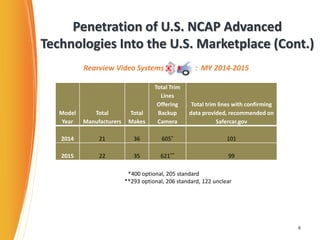
Rearview Video Systems : MY 2014-2015 
Total 
Manufacturers 
Total 
Makes 
Total Trim 
Lines 
Offering 
Backup 
Camera 
Total trim lines with confirming 
data provided, recommended on 
Safercar.gov 
2014 21 36 605* 101 
2015 22 35 621** 99 
*400 optional, 205 standard 
**293 optional, 206 standard, 122 unclear
U.S. NCAP Success and Goal 
Success 
 Manufacturers respond to our crash test programs by 
designing vehicles to achieve 4- and 5-star ratings at a 
much faster pace than ever before 
 Full frontal impact test (old program) – more than 2 decades 
 Side impact barrier test (old program) – about 10 years 
 Enhanced full frontal impact, side impact barrier and pole 
tests – less than 4 years 
 Steady increases of vehicles with advanced 
technologies that are recommended by our program 
Goal 
 Encourage continuous advancement of vehicle safety 
7
Recent U.S. NCAP Activities 
 April 2013 – Published a notice seeking public input 
on potential areas for improvements 
 Received public comments; stakeholder meetings 
were held 
 September 2013 – Replaced ESC with rearview video 
systems as one of the 3 recommended advanced 
technologies 
8
Next Steps for U.S. NCAP 
 Publish a 5-year plan outlining research that NHTSA 
plans to conduct to support near- and long-term 
upgrades 
 Publish a notice for near-term upgrades to U.S. NCAP 
 Increase efforts to further promote U.S. NCAP 
 Digital materials about 5-Star Safety and advanced safety 
technologies 
 Partners outreach 
9
Jennifer N. Dang 
Chief, U.S. NCAP 
Email: Jenny.Dang@dot.gov 
Visit us at www.SaferCar.gov 
10 
Questions?
Overarching Public Comments 
 Any changes to U.S. NCAP should be based on real-world 
data 
 Sufficient lead time should be considered 
 Consideration of performance requirements and test 
procedures of other NCAP programs, global 
regulations, and organization such as ISO and SAE 
 Consistency between U.S. NCAP and Federal motor 
vehicle safety standards 
 Suggestions on how crash avoidance should be 
treated in U.S. NCAP were conflicted 
 A single vehicle rating vs. separate ratings for crash avoidance 
and crashworthiness 
 No ratings for crash avoidance systems other than at the 
level of individual technologies 
11

US NCAP update

  • 1.
    U.S. NCAP Update 2014 Global NCAP Annual Meeting October 30, 2014 1
  • 2.
    Recent U.S. NewVehicle Performance  Program currently provides ratings on approximately 85 percent of the new model year U.S. vehicle fleet  Vehicles are generally performing well under the Enhanced Program  Excellent (4- to 5-star ratings) side performance seen in most vehicles (MY 2011-2014)  Further improvements are still needed  Right front passenger position (H-III 5th percentile female dummy) in frontal impact 2
  • 3.
    Past 35 YearsMarket Response to U.S. NCAP 3 Full Frontal Impact: Percent of Vehicles with 4- and 5-Star Ratings (Old U.S. NCAP) Model Year Driver Front Passenger 1979 30% 43% 2010 99% 99% Side Impact Barrier: Percent of Vehicles with 4- and 5-Star Ratings (Old U.S. NCAP) Model Year Driver Rear Passenger 1997 24% 20% 2010 97% 95% Percent of Vehicles with 4- and 5-Star Ratings (Enhanced U.S. NCAP) Model Year Full Frontal Impact Side Impact Barrier Side Impact Pole Driver Front Passenger Driver Rear Passenger Driver 2011 79% 66% 85% 78% 83% 2014 89% 81% 95% 95% 91% Note: The percent numbers are based on vehicles rated by U.S. NCAP
  • 4.
    Penetration of U.S.NCAP Advanced Technologies Into the U.S. Marketplace 4 Lane Departure Warning Systems : MY 2011-2015 Model Year Total Manufacturers Total Makes Total Trim Lines Offering LDW Total trim lines with confirming data provided and therefore recommended on Safercar.gov 2011 7 9 601 51 2012 7 9 812 68 2013 10 17 1483 125 2014 16 24 2424 173 2015 19 28 3205 310 1 – 29 optional, 31 unclear 2 – All optional 3 – 1 standard, all others optional 4 – 4 standard, 6 unclear, all others optional 5 – 8 standard, 2 unclear, all others optional
  • 5.
    Penetration of U.S.NCAP Advanced Technologies Into the U.S. Marketplace (Cont.) 5 Forward Collision Warning Systems : MY 2011-2015 Model Year Total Manufacturers Total Makes Total Trim Lines Offering FCW Total trim lines with confirming data provided and therefore recommended on Safercar.gov 2011 9 16 98A 49 2012 8 14 86B 77 2013 11 20 186C 165 2014 14 27 301D 223 2015 20 32 383E 357 A – 79 optional, 19 unclear B – 85 optional, 1 standard C – 160 optional, 2 standard, 24 unclear D – 270 optional, 31 standard E – 341 optional, 36 standard, 6 unclear
  • 6.
    Penetration of U.S.NCAP Advanced Technologies Into the U.S. Marketplace (Cont.) 6 Model Year Rearview Video Systems : MY 2014-2015 Total Manufacturers Total Makes Total Trim Lines Offering Backup Camera Total trim lines with confirming data provided, recommended on Safercar.gov 2014 21 36 605* 101 2015 22 35 621** 99 *400 optional, 205 standard **293 optional, 206 standard, 122 unclear
  • 7.
    U.S. NCAP Successand Goal Success  Manufacturers respond to our crash test programs by designing vehicles to achieve 4- and 5-star ratings at a much faster pace than ever before  Full frontal impact test (old program) – more than 2 decades  Side impact barrier test (old program) – about 10 years  Enhanced full frontal impact, side impact barrier and pole tests – less than 4 years  Steady increases of vehicles with advanced technologies that are recommended by our program Goal  Encourage continuous advancement of vehicle safety 7
  • 8.
    Recent U.S. NCAPActivities  April 2013 – Published a notice seeking public input on potential areas for improvements  Received public comments; stakeholder meetings were held  September 2013 – Replaced ESC with rearview video systems as one of the 3 recommended advanced technologies 8
  • 9.
    Next Steps forU.S. NCAP  Publish a 5-year plan outlining research that NHTSA plans to conduct to support near- and long-term upgrades  Publish a notice for near-term upgrades to U.S. NCAP  Increase efforts to further promote U.S. NCAP  Digital materials about 5-Star Safety and advanced safety technologies  Partners outreach 9
  • 10.
    Jennifer N. Dang Chief, U.S. NCAP Email: Jenny.Dang@dot.gov Visit us at www.SaferCar.gov 10 Questions?
  • 11.
    Overarching Public Comments  Any changes to U.S. NCAP should be based on real-world data  Sufficient lead time should be considered  Consideration of performance requirements and test procedures of other NCAP programs, global regulations, and organization such as ISO and SAE  Consistency between U.S. NCAP and Federal motor vehicle safety standards  Suggestions on how crash avoidance should be treated in U.S. NCAP were conflicted  A single vehicle rating vs. separate ratings for crash avoidance and crashworthiness  No ratings for crash avoidance systems other than at the level of individual technologies 11