


Tracking progress to “well below
2°C” in overshoot scenarios
Glen Peters (CICERO), Oliver Geden (SWP, MPI-M), Andreas Löschel (Uni of Münster)
Negative CO2 Emissions (22-24/05/2018, Gothenburg)
• If “overshoot” is allowed, can Paris ever fail?
• The temperature response is slow, and is therefore a bad
metric to track progress
• What are alternative metrics, or alternative framings, for
tracking progress of the Paris Agreement?
– When have we succeeded?
– When have we failed?
Background
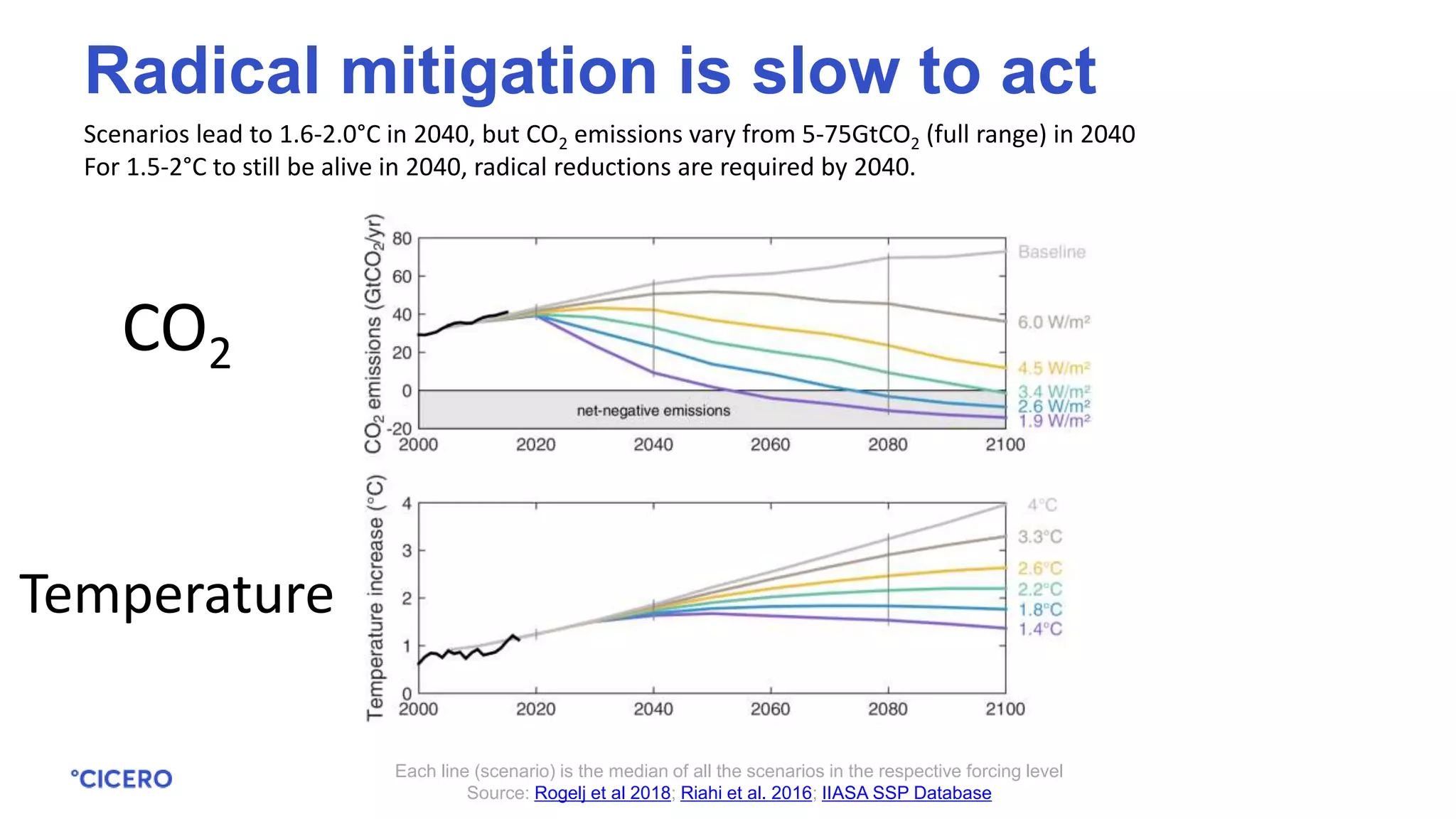
Scenarios lead to 1.6-2.0°C in 2040, but CO2 emissions vary from 5-75GtCO2 (full range) in 2040
For 1.5-2°C to still be alive in 2040, radical reductions are required by 2040.
Each line (scenario) is the median of all the scenarios in the respective forcing level
Source: Rogelj et al 2018; Riahi et al. 2016; IIASA SSP Database
Radical mitigation is slow to act
CO2
Temperature
Interpreting the Paris Agreement
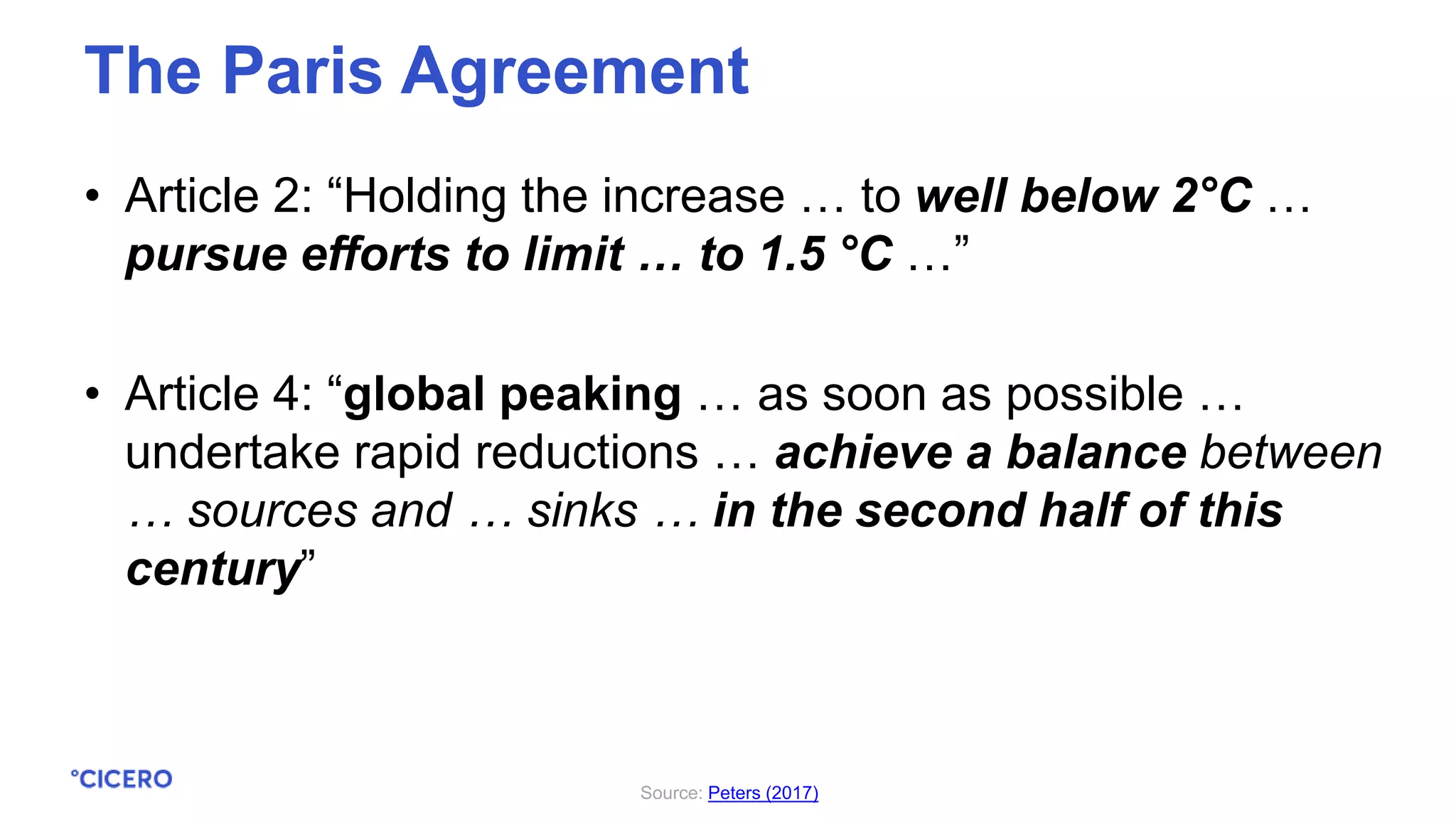
• Article 2: “Holding the increase … to well below 2°C …
pursue efforts to limit … to 1.5 °C …”
• Article 4: “global peaking … as soon as possible …
undertake rapid reductions … achieve a balance between
… sources and … sinks … in the second half of this
century”
The Paris Agreement
Source: Peters (2017)
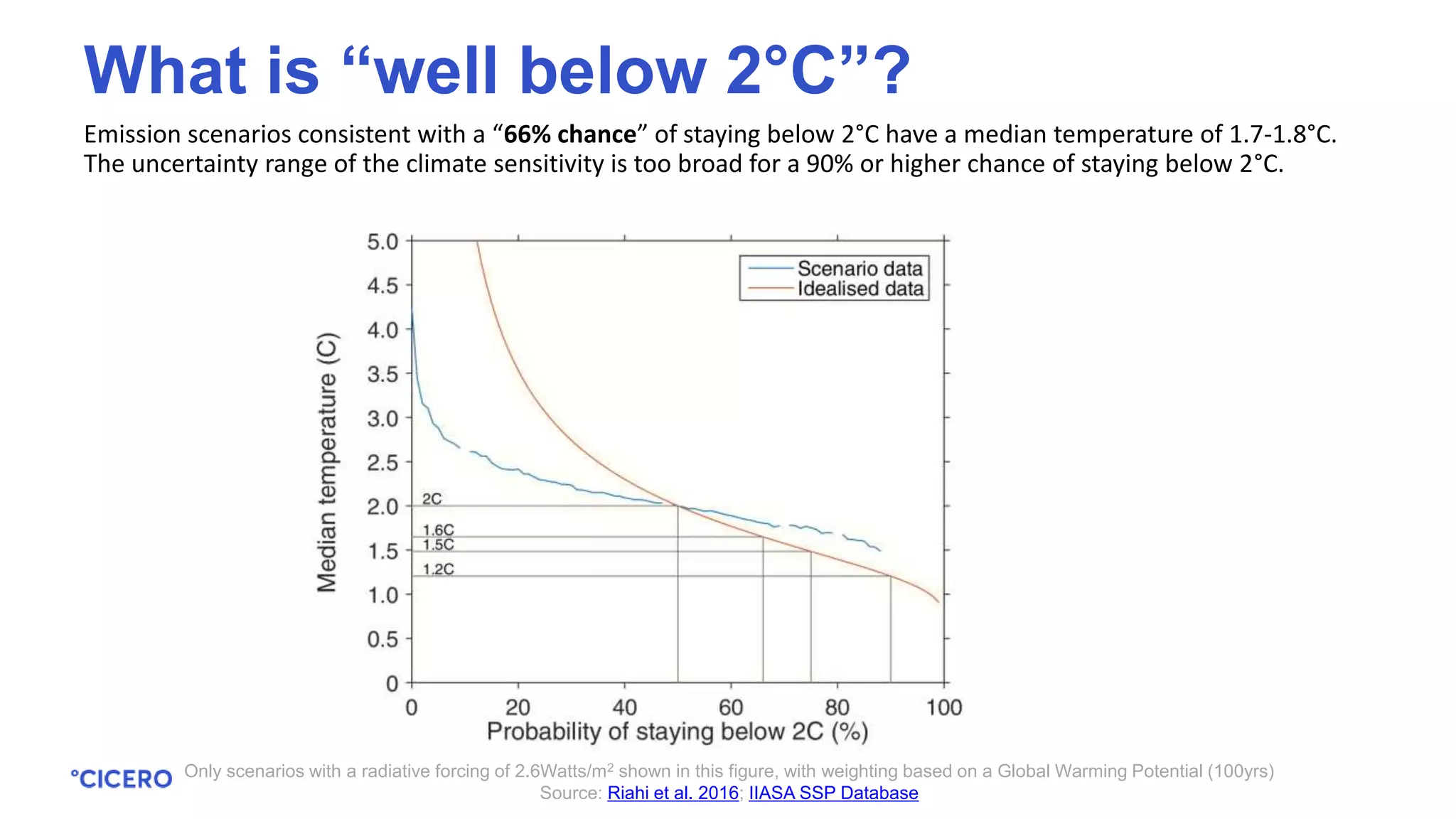
Emission scenarios consistent with a “66% chance” of staying below 2°C have a median temperature of 1.7-1.8°C.
The uncertainty range of the climate sensitivity is too broad for a 90% or higher chance of staying below 2°C.
Only scenarios with a radiative forcing of 2.6Watts/m2 shown in this figure, with weighting based on a Global Warming Potential (100yrs)
Source: Riahi et al. 2016; IIASA SSP Database
What is “well below 2°C”?
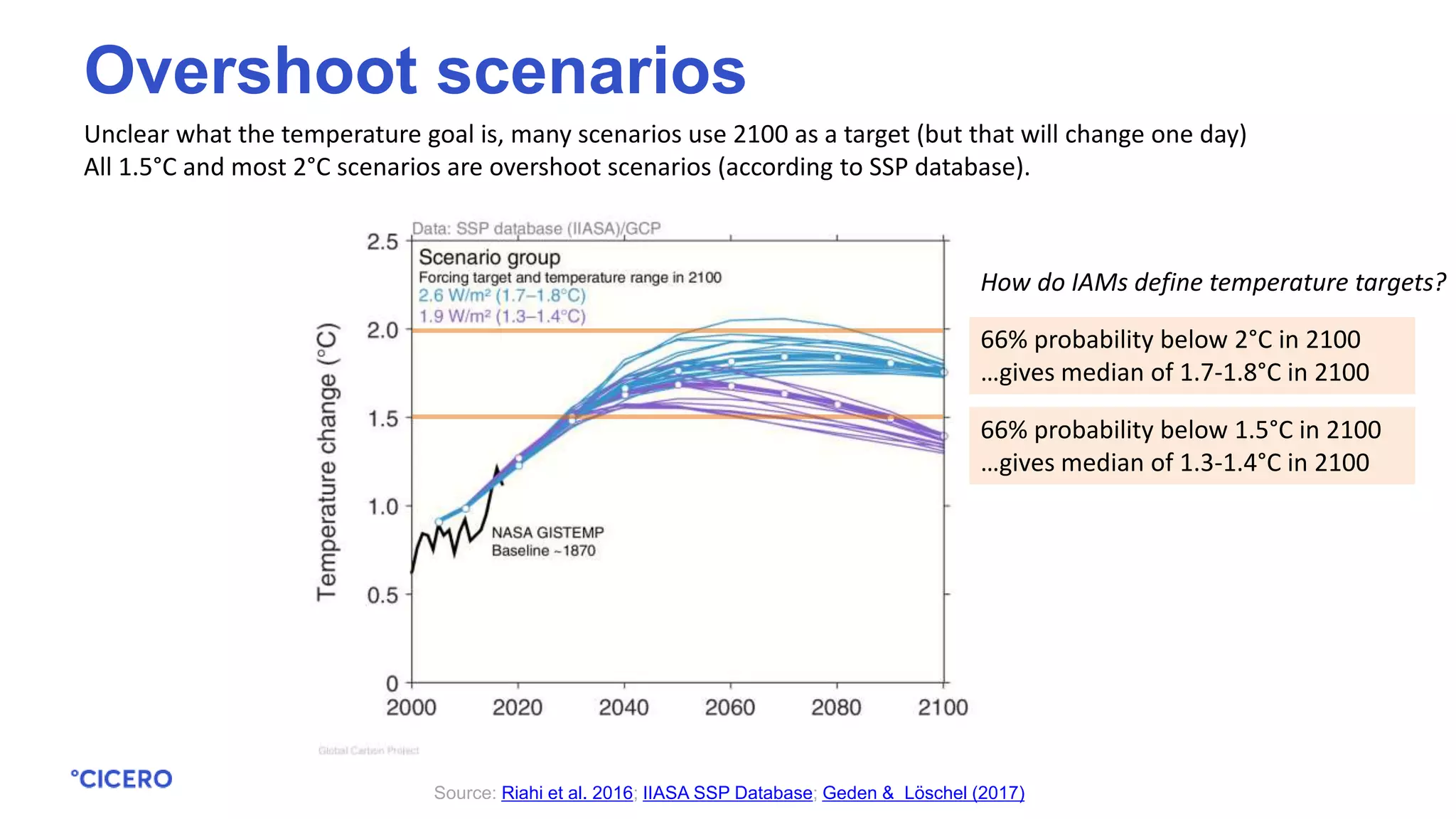
Unclear what the temperature goal is, many scenarios use 2100 as a target (but that will change one day)
All 1.5°C and most 2°C scenarios are overshoot scenarios (according to SSP database).
Source: Riahi et al. 2016; IIASA SSP Database; Geden & Löschel (2017)
Overshoot scenarios
66% probability below 2°C in 2100
…gives median of 1.7-1.8°C in 2100
66% probability below 1.5°C in 2100
…gives median of 1.3-1.4°C in 2100
How do IAMs define temperature targets?
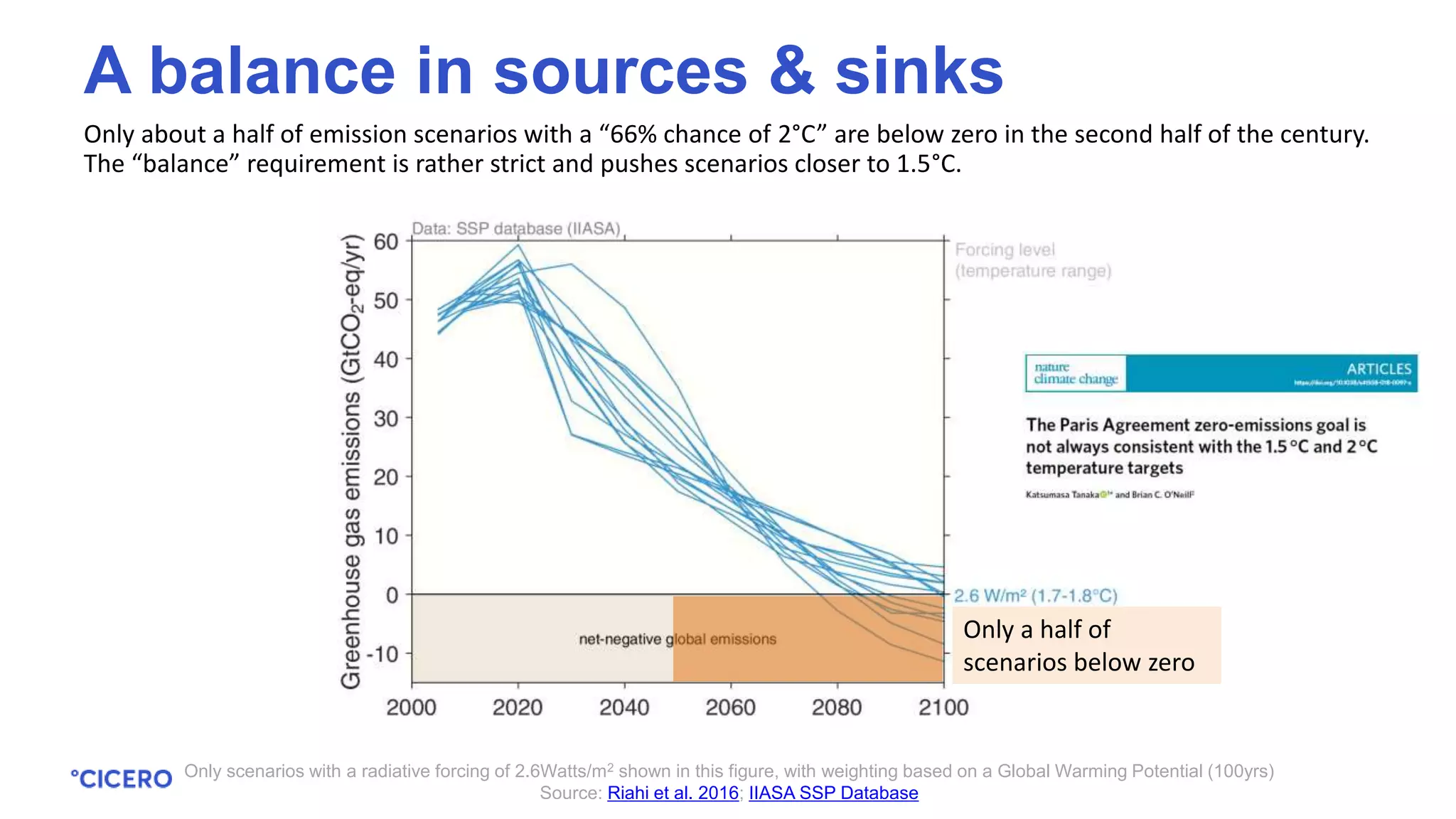
Only about a half of emission scenarios with a “66% chance of 2°C” are below zero in the second half of the century.
The “balance” requirement is rather strict and pushes scenarios closer to 1.5°C.
Only scenarios with a radiative forcing of 2.6Watts/m2 shown in this figure, with weighting based on a Global Warming Potential (100yrs)
Source: Riahi et al. 2016; IIASA SSP Database
A balance in sources & sinks
Only a half of
scenarios below zero
5 minutes to midnight
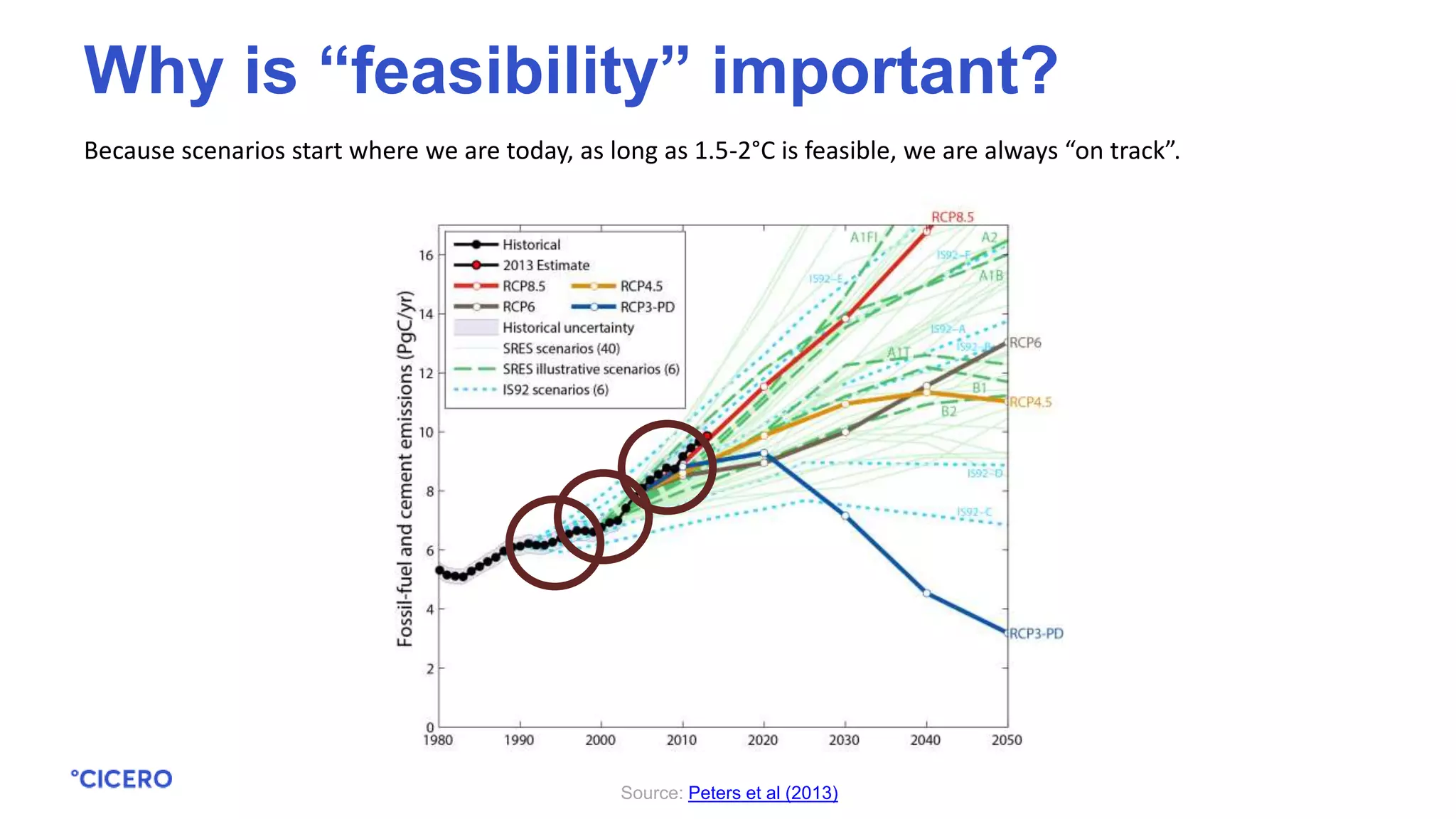
Because scenarios start where we are today, as long as 1.5-2°C is feasible, we are always “on track”.
Source: Peters et al (2013)
Why is “feasibility” important?
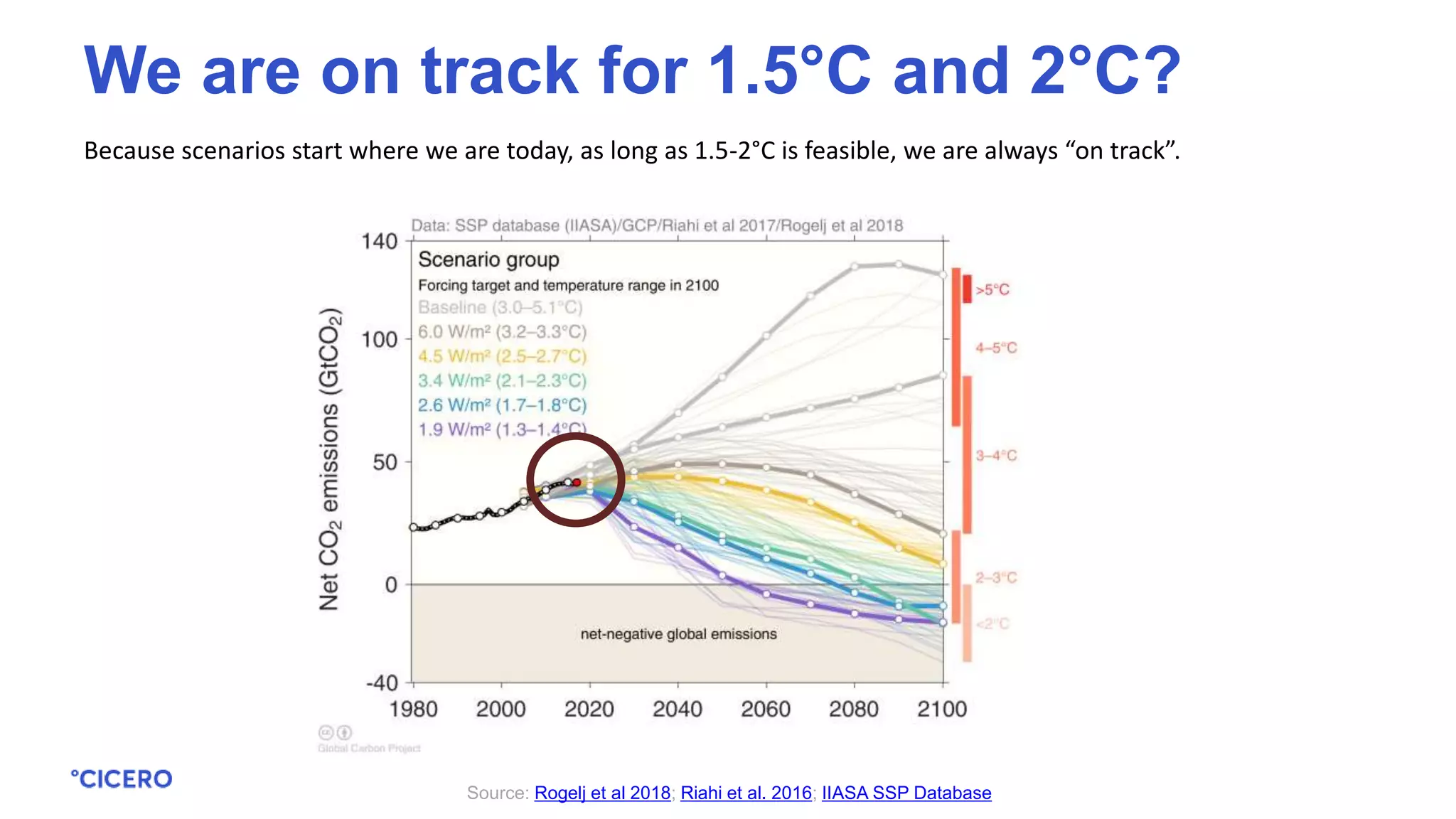
Because scenarios start where we are today, as long as 1.5-2°C is feasible, we are always “on track”.
Source: Rogelj et al 2018; Riahi et al. 2016; IIASA SSP Database
We are on track for 1.5°C and 2°C?
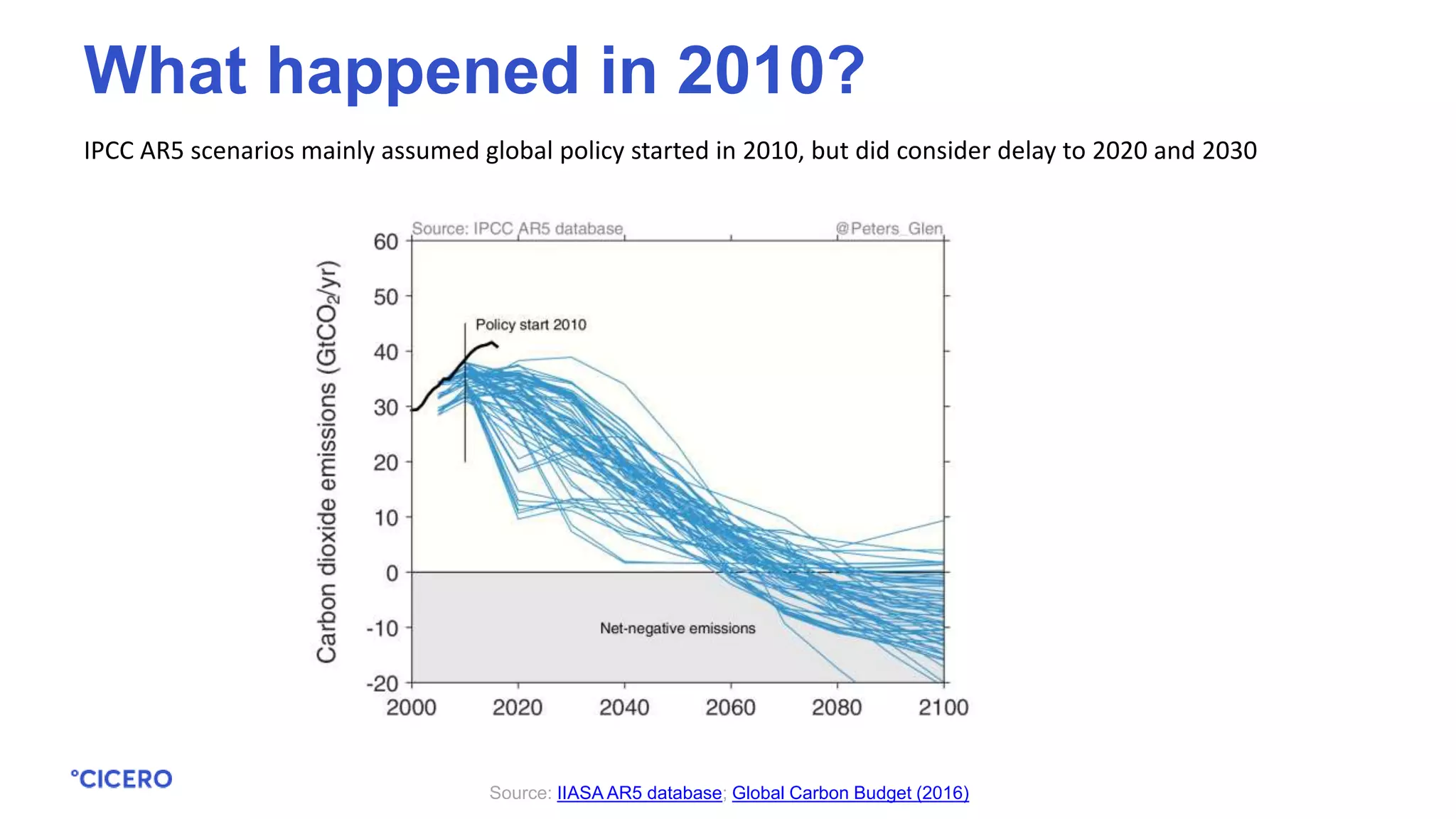
IPCC AR5 scenarios mainly assumed global policy started in 2010, but did consider delay to 2020 and 2030
Source: IIASA AR5 database; Global Carbon Budget (2016)
What happened in 2010?
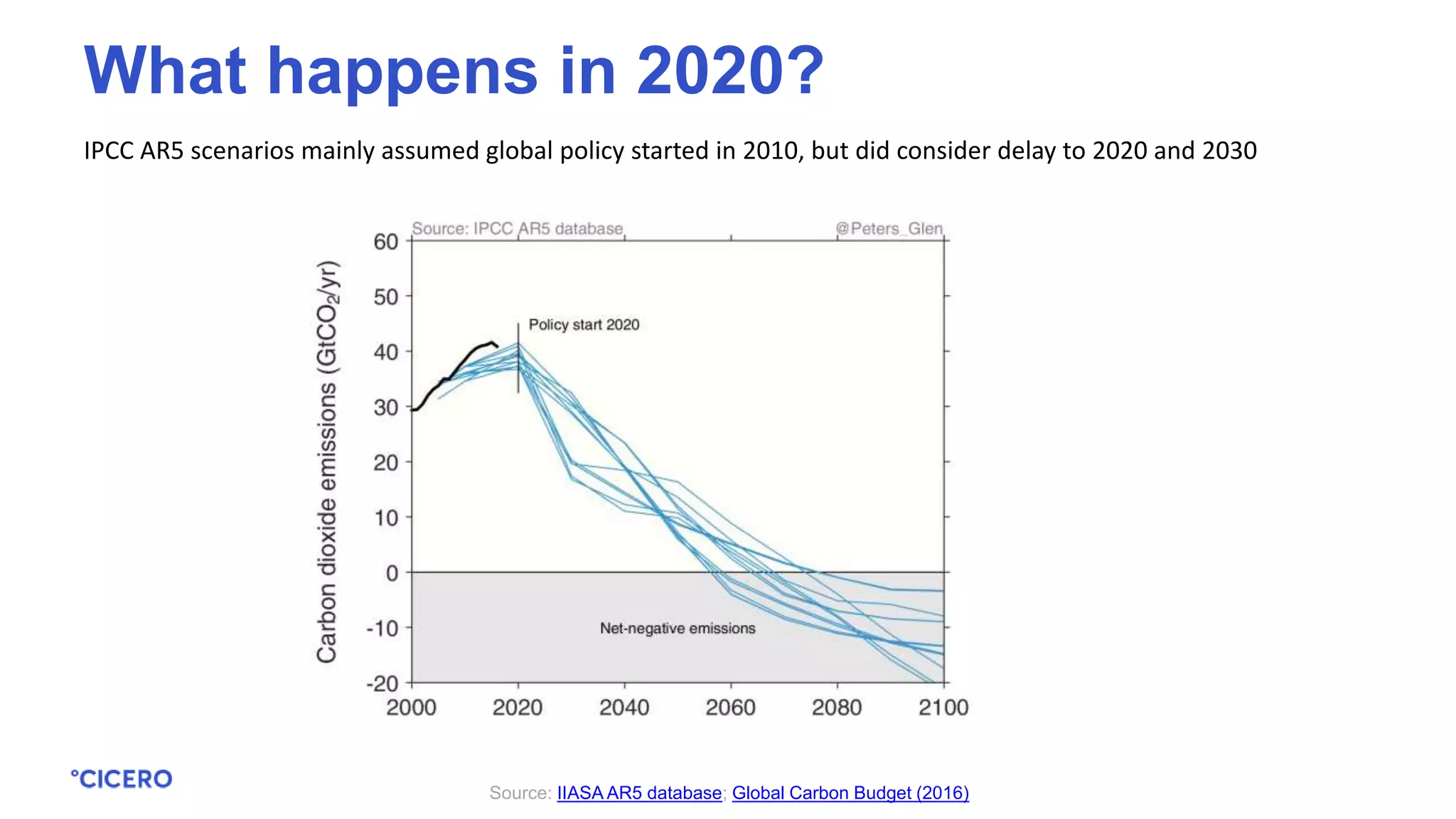
IPCC AR5 scenarios mainly assumed global policy started in 2010, but did consider delay to 2020 and 2030
Source: IIASA AR5 database; Global Carbon Budget (2016)
What happens in 2020?
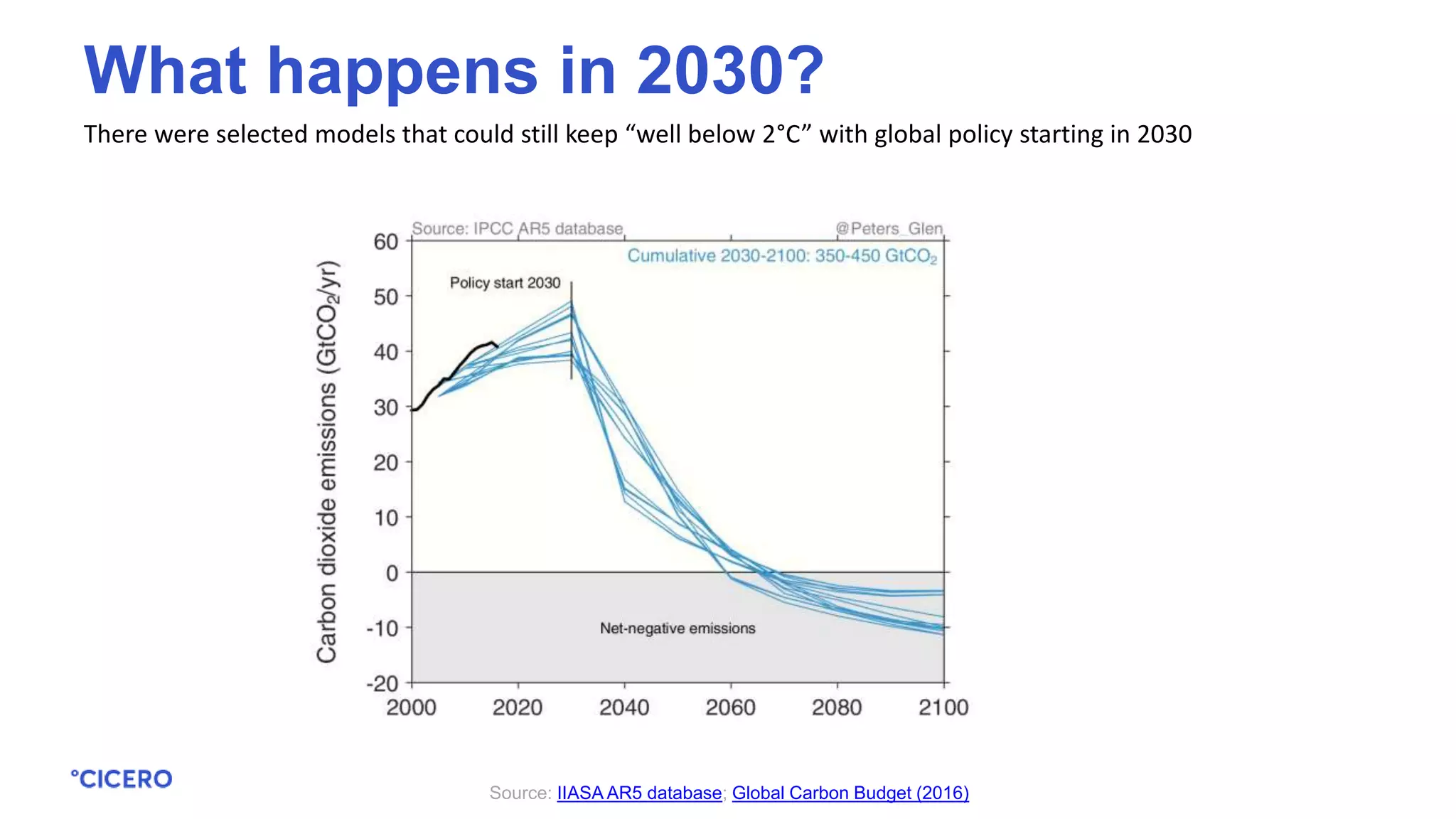
There were selected models that could still keep “well below 2°C” with global policy starting in 2030
Source: IIASA AR5 database; Global Carbon Budget (2016)
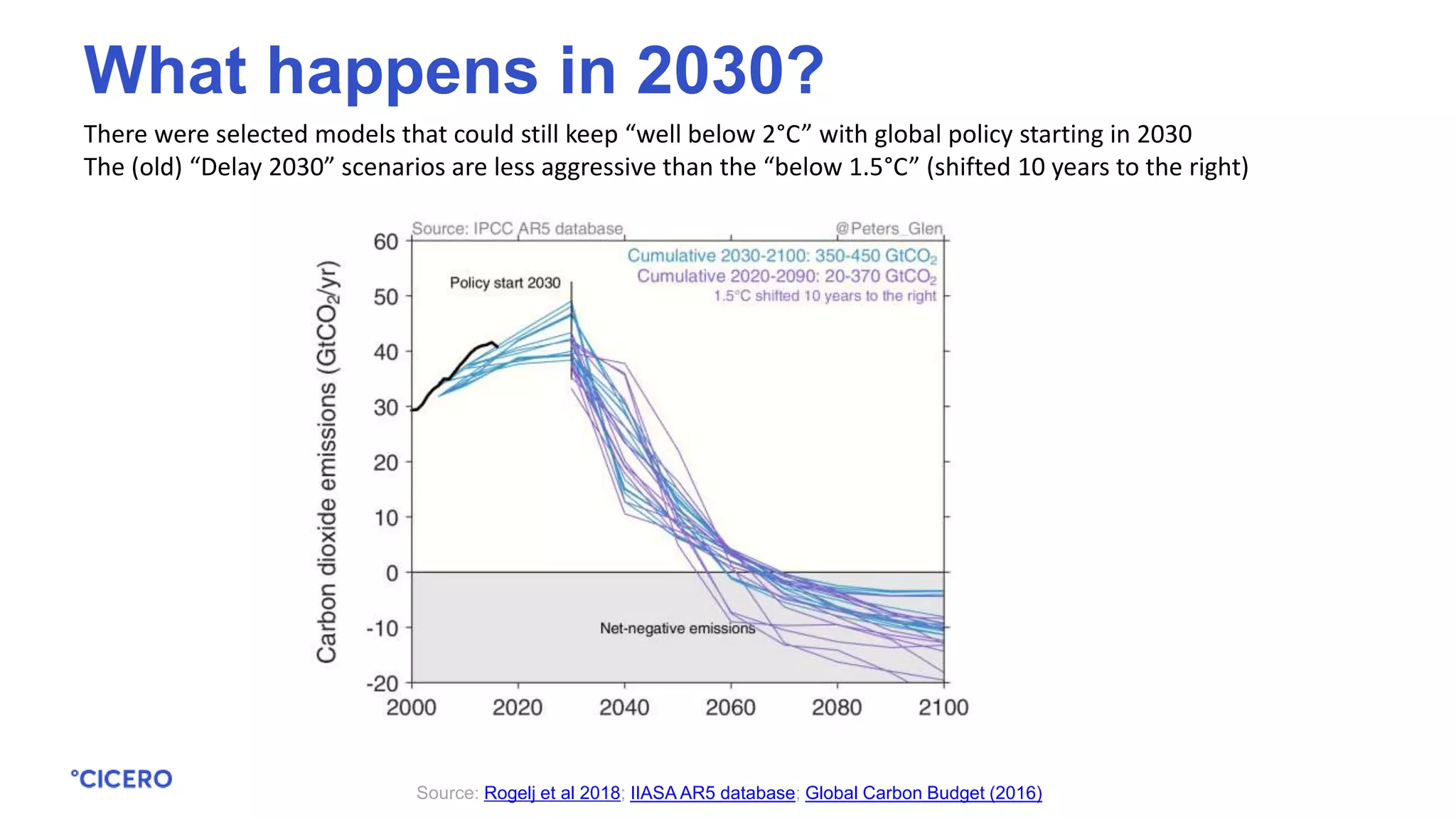
What happens in 2030?
There were selected models that could still keep “well below 2°C” with global policy starting in 2030
The (old) “Delay 2030” scenarios are less aggressive than the “below 1.5°C” (shifted 10 years to the right)
Source: Rogelj et al 2018; IIASA AR5 database; Global Carbon Budget (2016)
What happens in 2030?
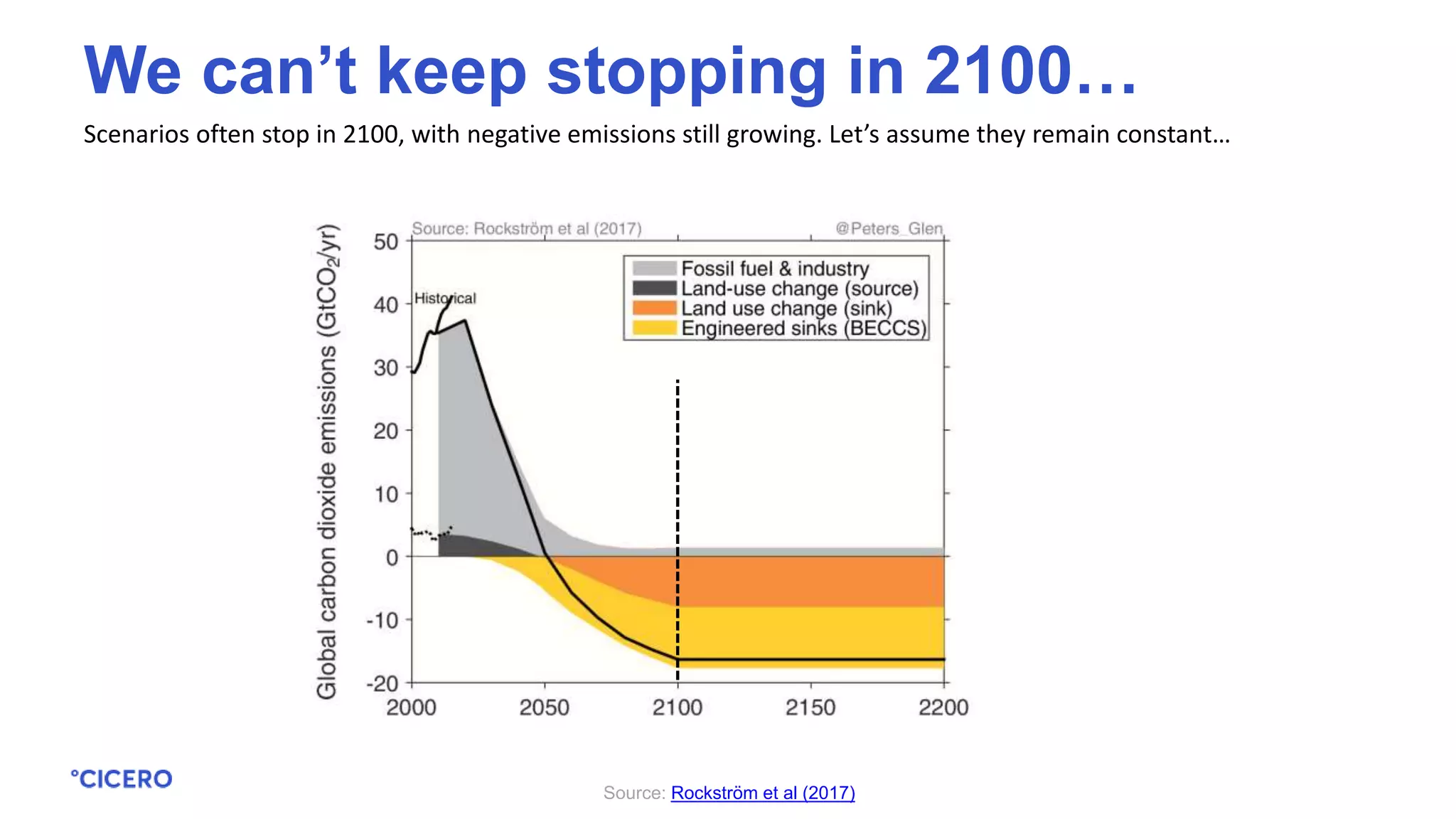
Scenarios often stop in 2100, with negative emissions still growing. Let’s assume they remain constant…
Source: Rockström et al (2017)
We can’t keep stopping in 2100…
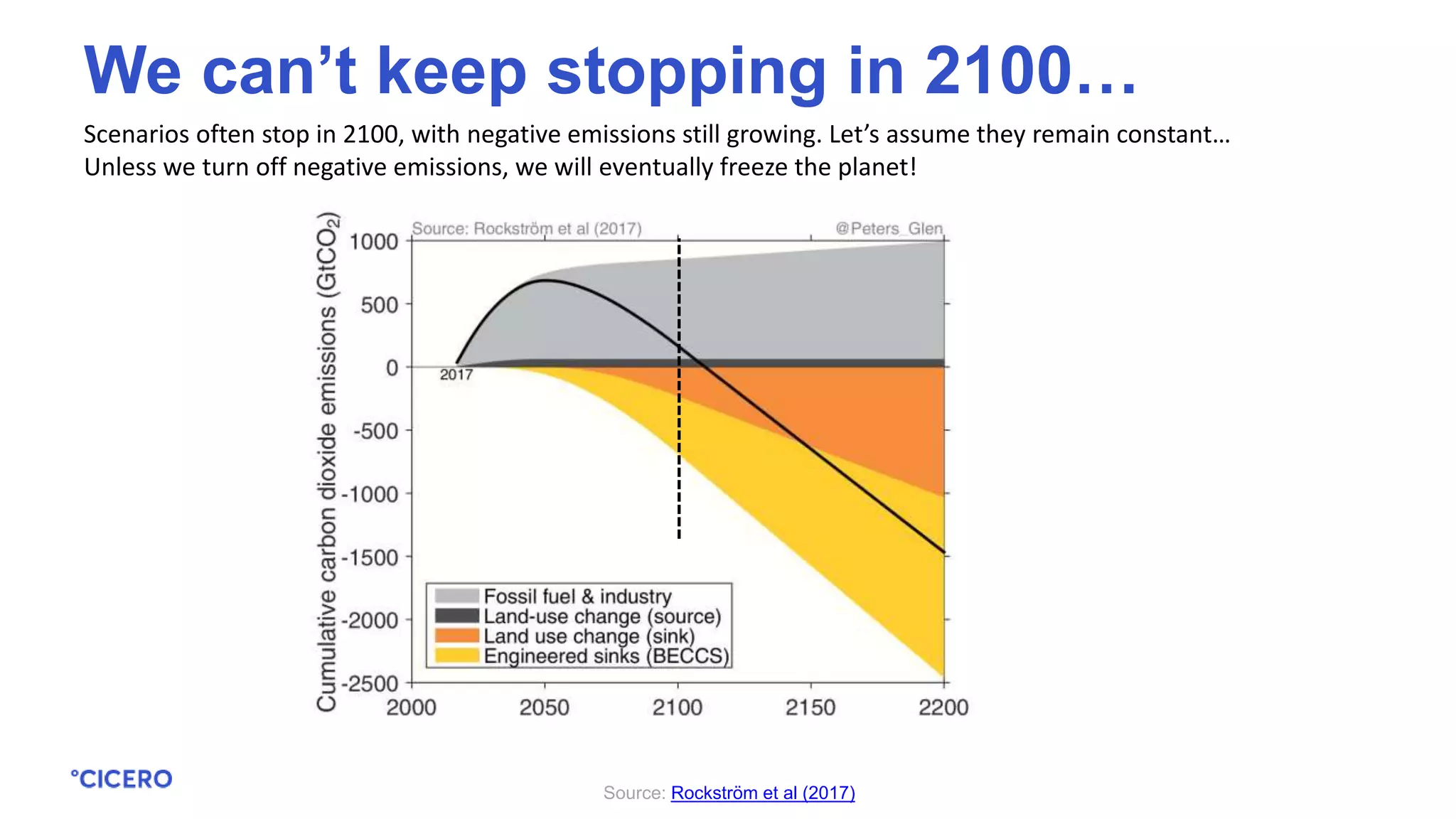
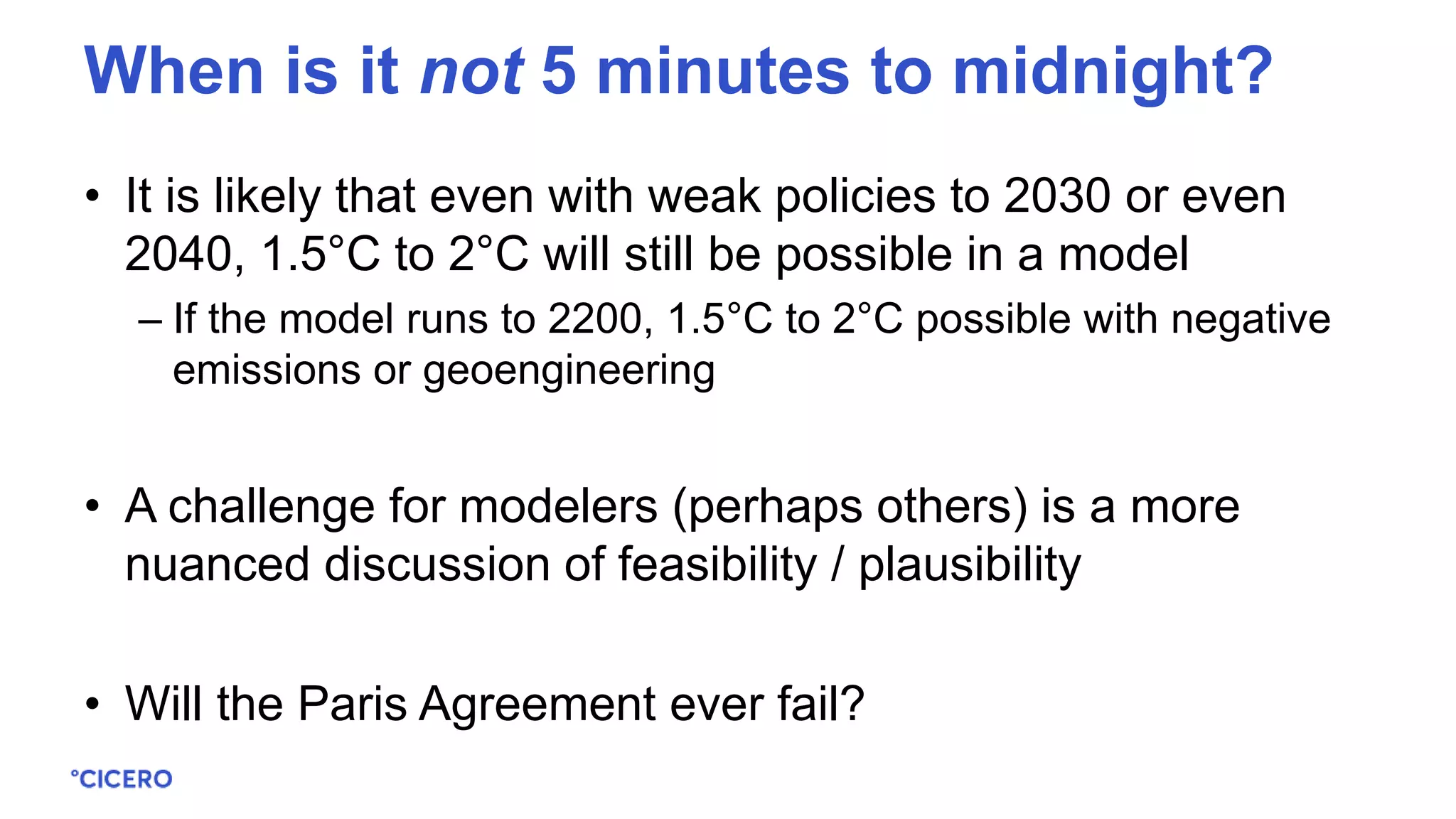
Scenarios often stop in 2100, with negative emissions still growing. Let’s assume they remain constant…
Unless we turn off negative emissions, we will eventually freeze the planet!
Source: Rockström et al (2017)
We can’t keep stopping in 2100…
• It is likely that even with weak policies to 2030 or even
2040, 1.5°C to 2°C will still be possible in a model
– If the model runs to 2200, 1.5°C to 2°C possible with negative
emissions or geoengineering
• A challenge for modelers (perhaps others) is a more
nuanced discussion of feasibility / plausibility
• Will the Paris Agreement ever fail?
When is it not 5 minutes to midnight?
Alternative metrics to track progress
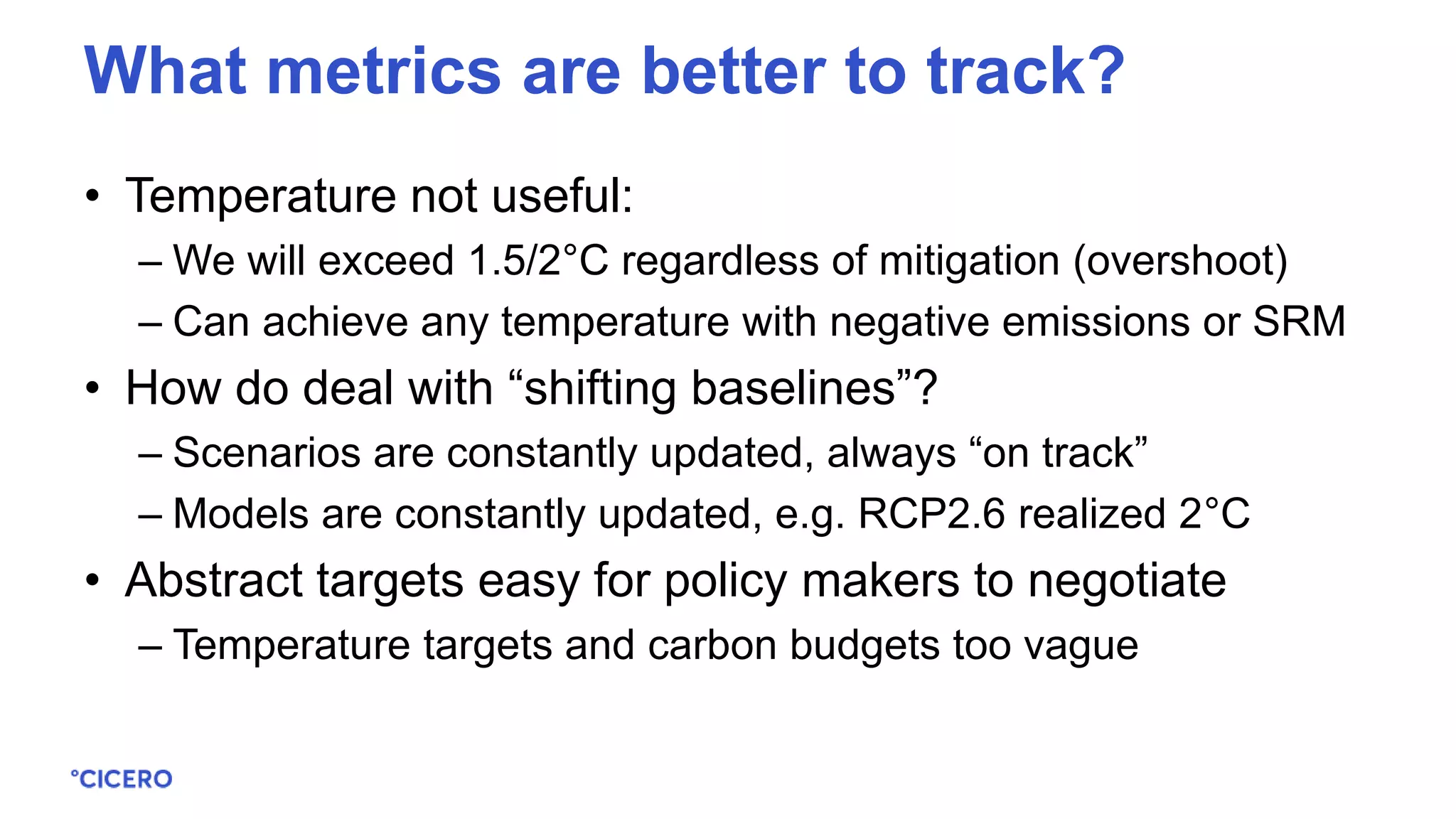
• Temperature not useful:
– We will exceed 1.5/2°C regardless of mitigation (overshoot)
– Can achieve any temperature with negative emissions or SRM
• How do deal with “shifting baselines”?
– Scenarios are constantly updated, always “on track”
– Models are constantly updated, e.g. RCP2.6 realized 2°C
• Abstract targets easy for policy makers to negotiate
– Temperature targets and carbon budgets too vague
What metrics are better to track?
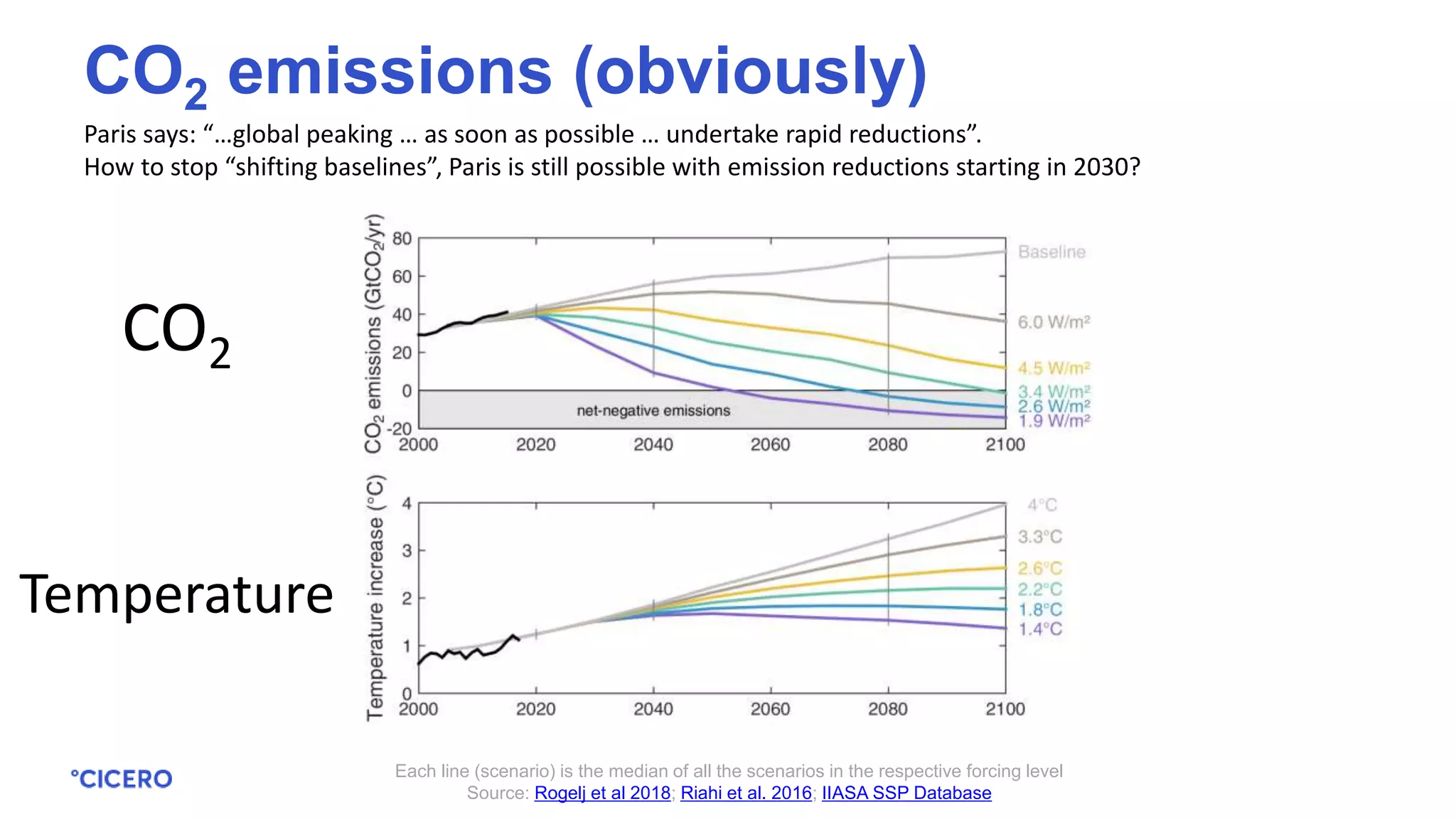
Paris says: “…global peaking … as soon as possible … undertake rapid reductions”.
How to stop “shifting baselines”, Paris is still possible with emission reductions starting in 2030?
Each line (scenario) is the median of all the scenarios in the respective forcing level
Source: Rogelj et al 2018; Riahi et al. 2016; IIASA SSP Database
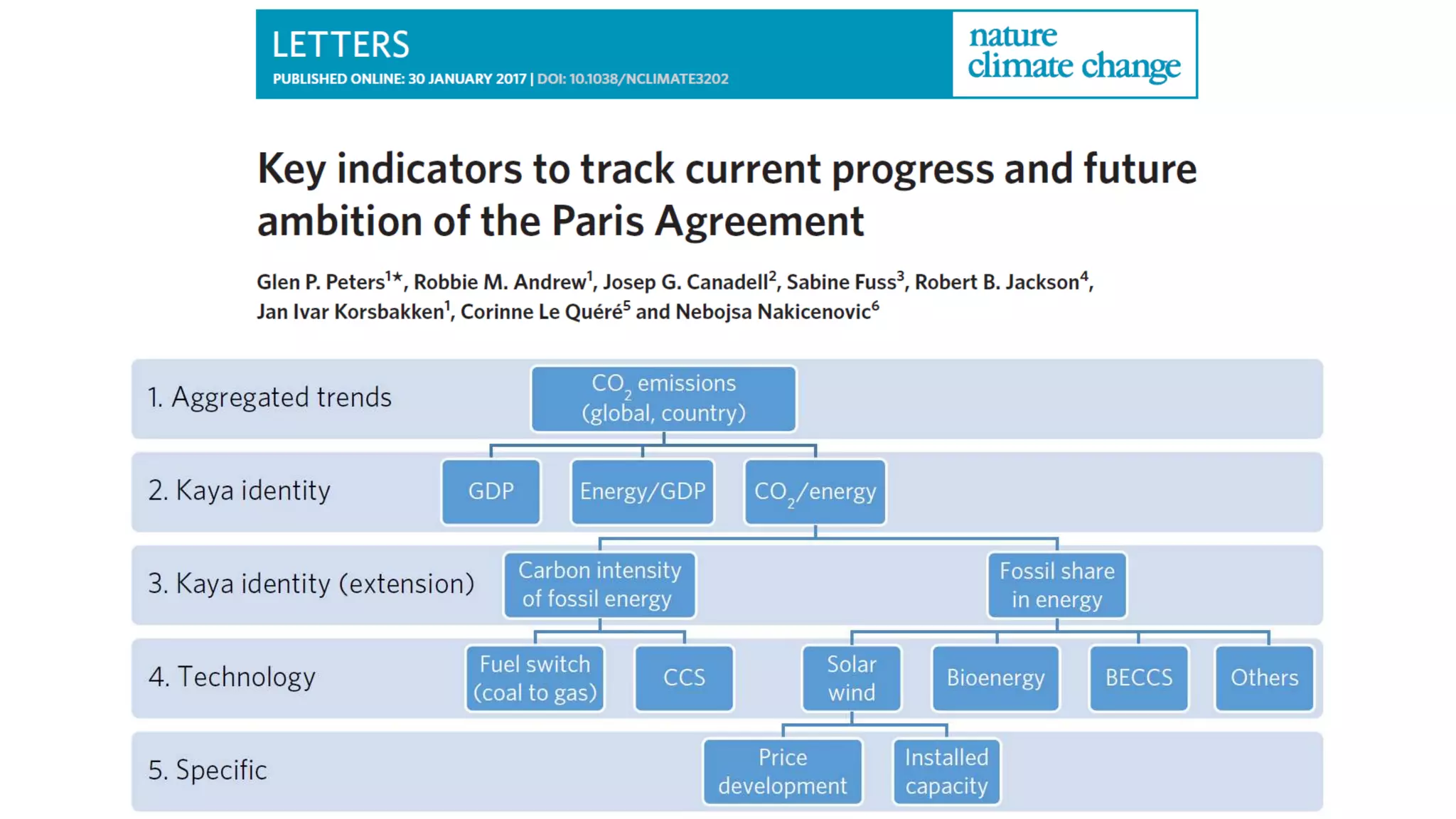
CO2 emissions (obviously)
CO2
Temperature
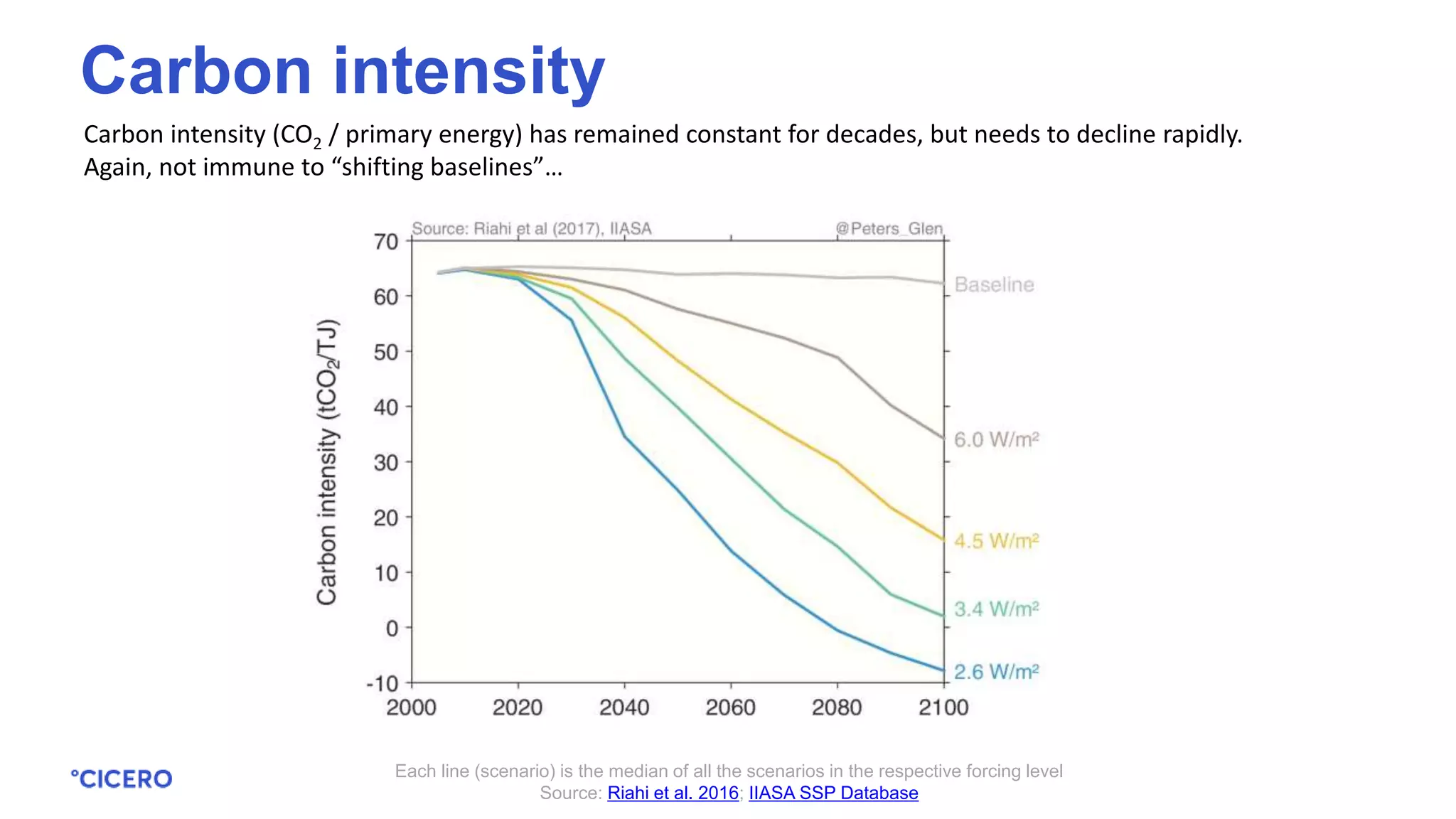
Carbon intensity (CO2 / primary energy) has remained constant for decades, but needs to decline rapidly.
Again, not immune to “shifting baselines”…
Each line (scenario) is the median of all the scenarios in the respective forcing level
Source: Riahi et al. 2016; IIASA SSP Database
Carbon intensity
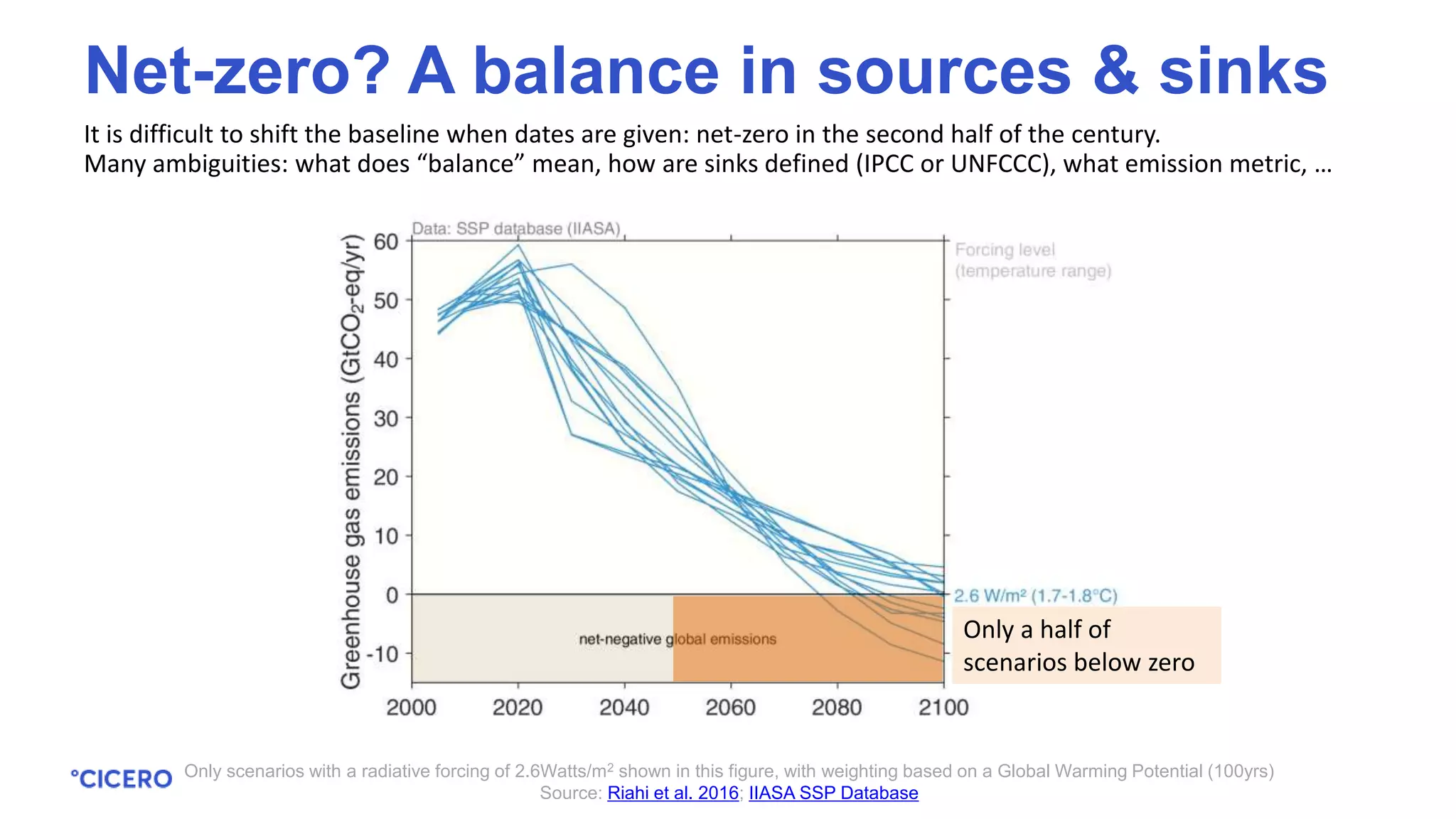
It is difficult to shift the baseline when dates are given: net-zero in the second half of the century.
Many ambiguities: what does “balance” mean, how are sinks defined (IPCC or UNFCCC), what emission metric, …
Only scenarios with a radiative forcing of 2.6Watts/m2 shown in this figure, with weighting based on a Global Warming Potential (100yrs)
Source: Riahi et al. 2016; IIASA SSP Database
Net-zero? A balance in sources & sinks
Only a half of
scenarios below zero
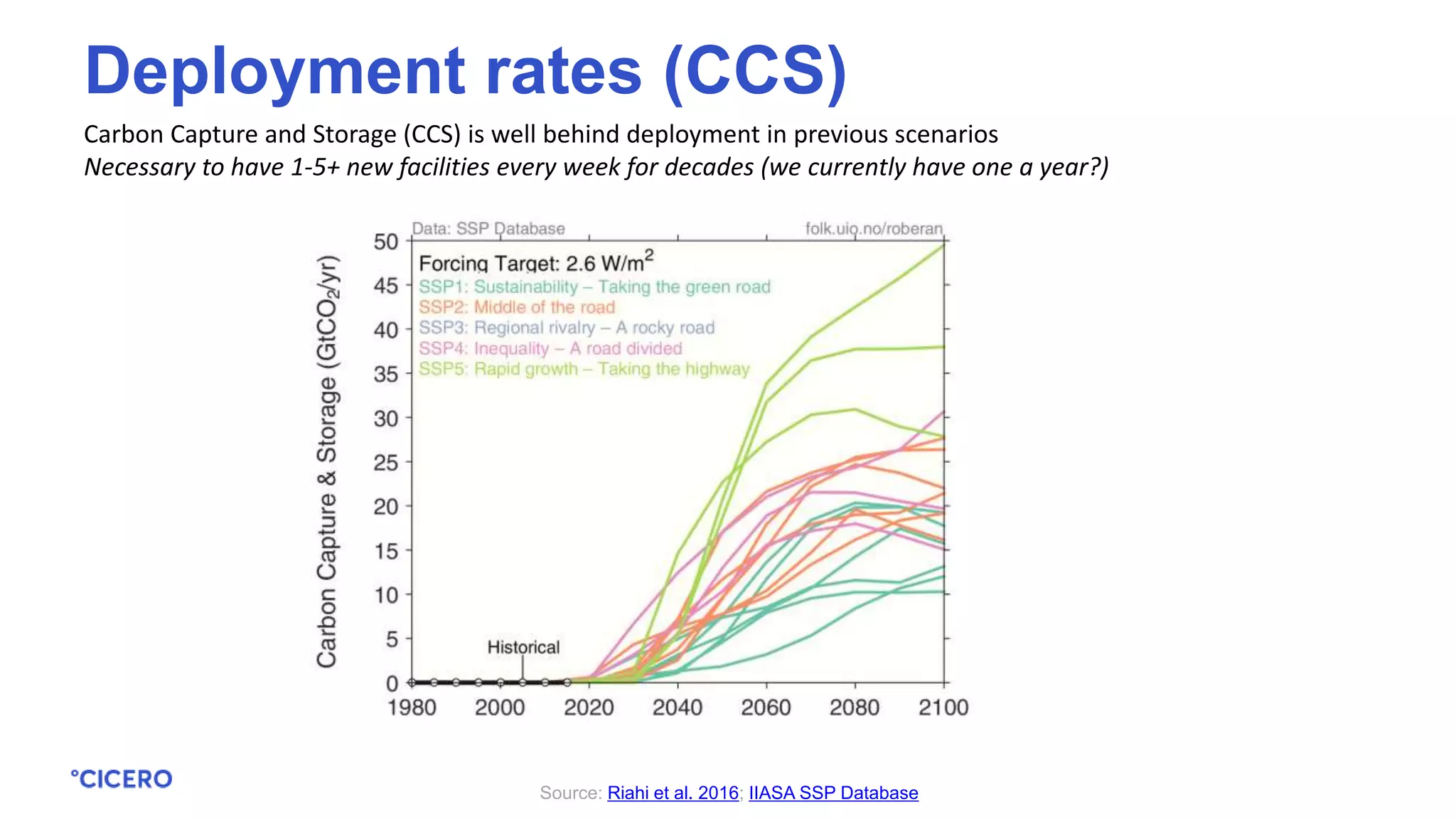
Carbon Capture and Storage (CCS) is well behind deployment in previous scenarios
Necessary to have 1-5+ new facilities every week for decades (we currently have one a year?)
Source: Riahi et al. 2016; IIASA SSP Database
Deployment rates (CCS)
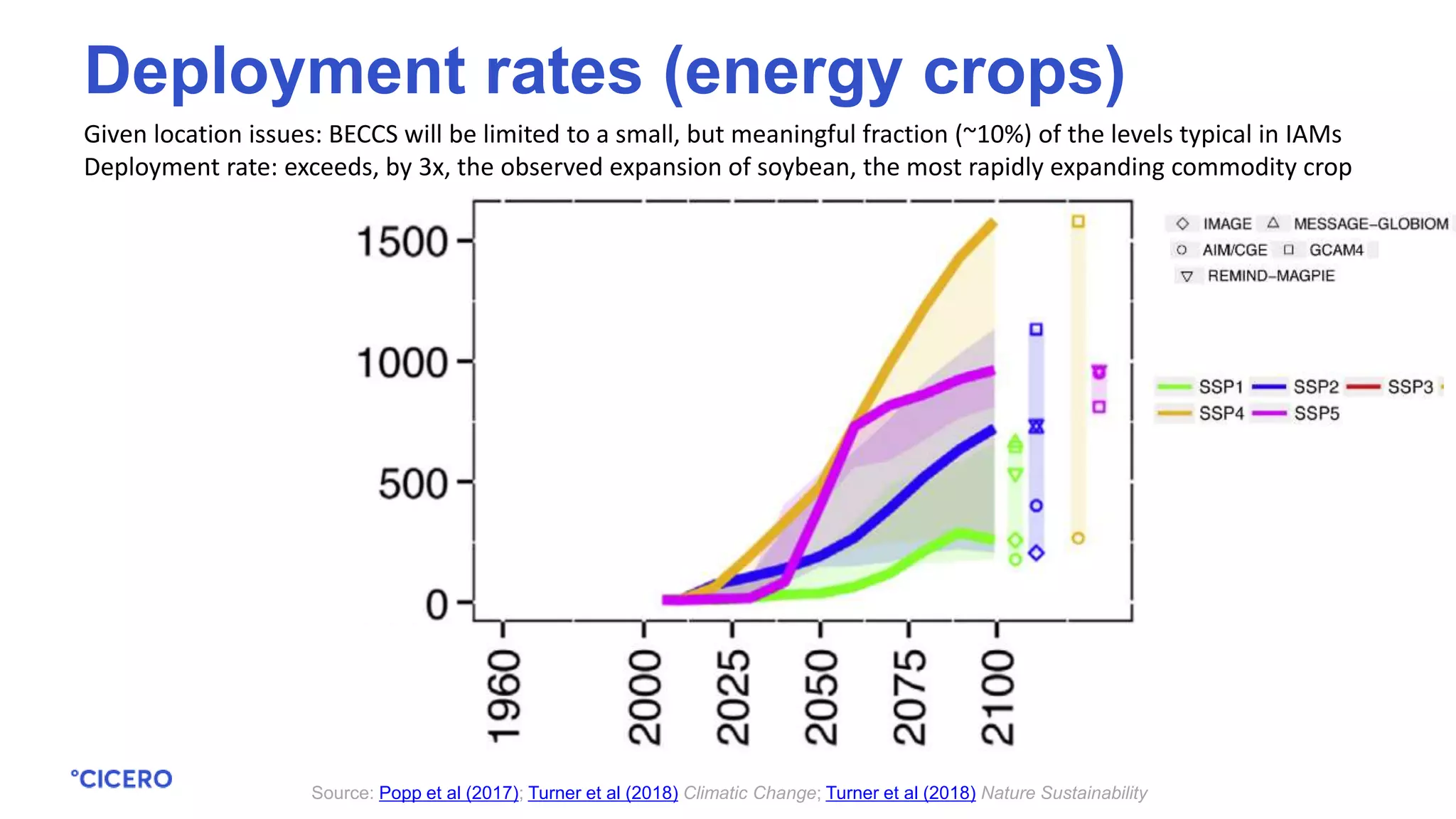
Given location issues: BECCS will be limited to a small, but meaningful fraction (~10%) of the levels typical in IAMs
Deployment rate: exceeds, by 3x, the observed expansion of soybean, the most rapidly expanding commodity crop
Source: Popp et al (2017); Turner et al (2018) Climatic Change; Turner et al (2018) Nature Sustainability
Deployment rates (energy crops)
Summary
• “Overshoot” scenarios mean that 1.5/2°C always ‘alive’
• Lack of (open) feasibility discussion gives a false
impression that we are always “5 minutes to midnight”
– This will continue unless we stop “shifting baselines”
• Need metrics to track progress
– Move from abstract to concrete (e.g., budgets to technology)
– Move from global to country to region
– Concrete goals / targets
– Don’t take “on track” as the starting point
Tracking progress
Peters_Glen
cicero.oslo.no
cicerosenterforklimaforskning
glen.peters@cicero.oslo.no
Glen Peters

Tracking progress to "well below 2°C" in overshoot scenrios

  • 1.
    Tracking progress to“well below 2°C” in overshoot scenarios Glen Peters (CICERO), Oliver Geden (SWP, MPI-M), Andreas Löschel (Uni of Münster) Negative CO2 Emissions (22-24/05/2018, Gothenburg)
  • 2.
    • If “overshoot”is allowed, can Paris ever fail? • The temperature response is slow, and is therefore a bad metric to track progress • What are alternative metrics, or alternative framings, for tracking progress of the Paris Agreement? – When have we succeeded? – When have we failed? Background
  • 3.
    Scenarios lead to1.6-2.0°C in 2040, but CO2 emissions vary from 5-75GtCO2 (full range) in 2040 For 1.5-2°C to still be alive in 2040, radical reductions are required by 2040. Each line (scenario) is the median of all the scenarios in the respective forcing level Source: Rogelj et al 2018; Riahi et al. 2016; IIASA SSP Database Radical mitigation is slow to act CO2 Temperature
  • 4.
  • 5.
    • Article 2:“Holding the increase … to well below 2°C … pursue efforts to limit … to 1.5 °C …” • Article 4: “global peaking … as soon as possible … undertake rapid reductions … achieve a balance between … sources and … sinks … in the second half of this century” The Paris Agreement Source: Peters (2017)
  • 6.
    Emission scenarios consistentwith a “66% chance” of staying below 2°C have a median temperature of 1.7-1.8°C. The uncertainty range of the climate sensitivity is too broad for a 90% or higher chance of staying below 2°C. Only scenarios with a radiative forcing of 2.6Watts/m2 shown in this figure, with weighting based on a Global Warming Potential (100yrs) Source: Riahi et al. 2016; IIASA SSP Database What is “well below 2°C”?
  • 7.
    Unclear what thetemperature goal is, many scenarios use 2100 as a target (but that will change one day) All 1.5°C and most 2°C scenarios are overshoot scenarios (according to SSP database). Source: Riahi et al. 2016; IIASA SSP Database; Geden & Löschel (2017) Overshoot scenarios 66% probability below 2°C in 2100 …gives median of 1.7-1.8°C in 2100 66% probability below 1.5°C in 2100 …gives median of 1.3-1.4°C in 2100 How do IAMs define temperature targets?
  • 8.
    Only about ahalf of emission scenarios with a “66% chance of 2°C” are below zero in the second half of the century. The “balance” requirement is rather strict and pushes scenarios closer to 1.5°C. Only scenarios with a radiative forcing of 2.6Watts/m2 shown in this figure, with weighting based on a Global Warming Potential (100yrs) Source: Riahi et al. 2016; IIASA SSP Database A balance in sources & sinks Only a half of scenarios below zero
  • 9.
    5 minutes tomidnight
  • 10.
    Because scenarios startwhere we are today, as long as 1.5-2°C is feasible, we are always “on track”. Source: Peters et al (2013) Why is “feasibility” important?
  • 11.
    Because scenarios startwhere we are today, as long as 1.5-2°C is feasible, we are always “on track”. Source: Rogelj et al 2018; Riahi et al. 2016; IIASA SSP Database We are on track for 1.5°C and 2°C?
  • 12.
    IPCC AR5 scenariosmainly assumed global policy started in 2010, but did consider delay to 2020 and 2030 Source: IIASA AR5 database; Global Carbon Budget (2016) What happened in 2010?
  • 13.
    IPCC AR5 scenariosmainly assumed global policy started in 2010, but did consider delay to 2020 and 2030 Source: IIASA AR5 database; Global Carbon Budget (2016) What happens in 2020?
  • 14.
    There were selectedmodels that could still keep “well below 2°C” with global policy starting in 2030 Source: IIASA AR5 database; Global Carbon Budget (2016) What happens in 2030?
  • 15.
    There were selectedmodels that could still keep “well below 2°C” with global policy starting in 2030 The (old) “Delay 2030” scenarios are less aggressive than the “below 1.5°C” (shifted 10 years to the right) Source: Rogelj et al 2018; IIASA AR5 database; Global Carbon Budget (2016) What happens in 2030?
  • 16.
    Scenarios often stopin 2100, with negative emissions still growing. Let’s assume they remain constant… Source: Rockström et al (2017) We can’t keep stopping in 2100…
  • 17.
    Scenarios often stopin 2100, with negative emissions still growing. Let’s assume they remain constant… Unless we turn off negative emissions, we will eventually freeze the planet! Source: Rockström et al (2017) We can’t keep stopping in 2100…
  • 18.
    • It islikely that even with weak policies to 2030 or even 2040, 1.5°C to 2°C will still be possible in a model – If the model runs to 2200, 1.5°C to 2°C possible with negative emissions or geoengineering • A challenge for modelers (perhaps others) is a more nuanced discussion of feasibility / plausibility • Will the Paris Agreement ever fail? When is it not 5 minutes to midnight?
  • 19.
    Alternative metrics totrack progress
  • 20.
    • Temperature notuseful: – We will exceed 1.5/2°C regardless of mitigation (overshoot) – Can achieve any temperature with negative emissions or SRM • How do deal with “shifting baselines”? – Scenarios are constantly updated, always “on track” – Models are constantly updated, e.g. RCP2.6 realized 2°C • Abstract targets easy for policy makers to negotiate – Temperature targets and carbon budgets too vague What metrics are better to track?
  • 22.
    Paris says: “…globalpeaking … as soon as possible … undertake rapid reductions”. How to stop “shifting baselines”, Paris is still possible with emission reductions starting in 2030? Each line (scenario) is the median of all the scenarios in the respective forcing level Source: Rogelj et al 2018; Riahi et al. 2016; IIASA SSP Database CO2 emissions (obviously) CO2 Temperature
  • 23.
    Carbon intensity (CO2/ primary energy) has remained constant for decades, but needs to decline rapidly. Again, not immune to “shifting baselines”… Each line (scenario) is the median of all the scenarios in the respective forcing level Source: Riahi et al. 2016; IIASA SSP Database Carbon intensity
  • 24.
    It is difficultto shift the baseline when dates are given: net-zero in the second half of the century. Many ambiguities: what does “balance” mean, how are sinks defined (IPCC or UNFCCC), what emission metric, … Only scenarios with a radiative forcing of 2.6Watts/m2 shown in this figure, with weighting based on a Global Warming Potential (100yrs) Source: Riahi et al. 2016; IIASA SSP Database Net-zero? A balance in sources & sinks Only a half of scenarios below zero
  • 25.
    Carbon Capture andStorage (CCS) is well behind deployment in previous scenarios Necessary to have 1-5+ new facilities every week for decades (we currently have one a year?) Source: Riahi et al. 2016; IIASA SSP Database Deployment rates (CCS)
  • 26.
    Given location issues:BECCS will be limited to a small, but meaningful fraction (~10%) of the levels typical in IAMs Deployment rate: exceeds, by 3x, the observed expansion of soybean, the most rapidly expanding commodity crop Source: Popp et al (2017); Turner et al (2018) Climatic Change; Turner et al (2018) Nature Sustainability Deployment rates (energy crops)
  • 28.
  • 29.
    • “Overshoot” scenariosmean that 1.5/2°C always ‘alive’ • Lack of (open) feasibility discussion gives a false impression that we are always “5 minutes to midnight” – This will continue unless we stop “shifting baselines” • Need metrics to track progress – Move from abstract to concrete (e.g., budgets to technology) – Move from global to country to region – Concrete goals / targets – Don’t take “on track” as the starting point Tracking progress
  • 30.

Editor's Notes