ITP:- Introduction
Ø Thrombocytopenia - platelet count < 2.5th lower percentile of the
normal. (150 – 450 x 109/L)
ØFor Evaluation <100 X109/L
Ø Primary immune thrombocytopenia (ITP) is an autoimmune disorder
• isolated thrombocytopenia in the absence of other causes.
Ø ITP is mediated by antiplatelet autoantibodies.
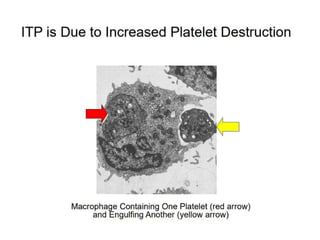
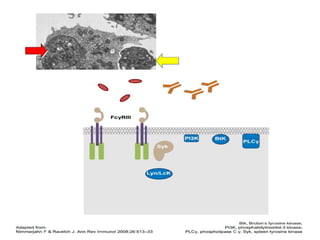
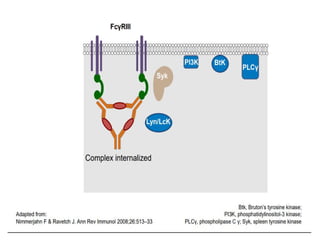
• Antibody-coated platelets are phagocytosed by macrophages in
the reticuloendothelial system, leading to accelerated platelet
clearance.
Ø Macrophages also act as antigen-presenting cells interacting with CD
8+ and CD 4+ T cells that in turn stimulate antibody-producing B
cells.
ØPathogenic loop sustains autoantibody production.
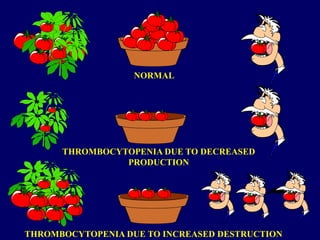
NORMAL
THROMBOCYTOPENIA DUE TO DECREASED
PRODUCTION
THROMBOCYTOPENIA DUE TO INCREASED DESTRUCTION
Classification of ITP
Ø ITP may be classified as Primary or Secondary.
ØSecondary to an underlying disease (eg, SLE, MCTD,
HCV, HIV, or a lymphoproliferative disease).
Ø ITP can also be classified by disease duration:
– Newly diagnosed (0-3 months)
– Persistent (>3-12 months)
– Chronic (>12 months).
– “Refractory”:- refer to patients who failed splenectomy,
ØGiven the declining rate of splenectomy in ITP, it will not
be used here.
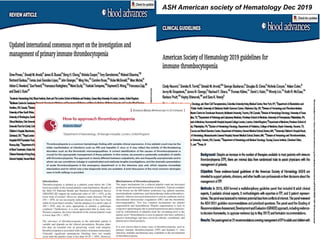
ASH American society of Hematology Dec 2019
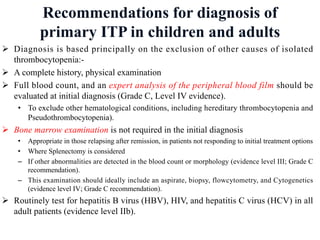
Recommendations for diagnosis of
primary ITP in children and adults
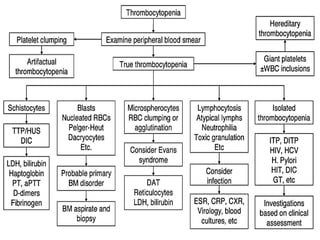
Ø Diagnosis is based principally on the exclusion of other causes of isolated
thrombocytopenia:-
Ø A complete history, physical examination
Ø Full blood count, and an expert analysis of the peripheral blood film should be
evaluated at initial diagnosis (Grade C, Level IV evidence).
• To exclude other hematological conditions, including hereditary thrombocytopenia and
Pseudothrombocytopenia).
Ø Bone marrow examination is not required in the initial diagnosis
• Appropriate in those relapsing after remission, in patients not responding to initial treatment options
• Where Splenectomy is considered
– If other abnormalities are detected in the blood count or morphology (evidence level III; Grade C
recommendation).
– This examination should ideally include an aspirate, biopsy, flowcytometry, and Cytogenetics
(evidence level IV; Grade C recommendation).
Ø Routinely test for hepatitis B virus (HBV), HIV, and hepatitis C virus (HCV) in all
adult patients (evidence level IIb).
Recommendations for initial treatment of
newly diagnosed patients
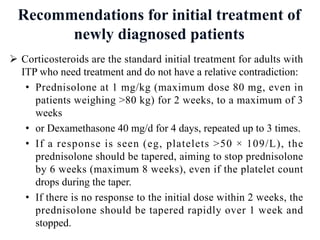
Ø Corticosteroids are the standard initial treatment for adults with
ITP who need treatment and do not have a relative contradiction:
• Prednisolone at 1 mg/kg (maximum dose 80 mg, even in
patients weighing >80 kg) for 2 weeks, to a maximum of 3
weeks
• or Dexamethasone 40 mg/d for 4 days, repeated up to 3 times.
• If a response is seen (eg, platelets >50 × 109/L), the
prednisolone should be tapered, aiming to stop prednisolone
by 6 weeks (maximum 8 weeks), even if the platelet count
drops during the taper.
• If there is no response to the initial dose within 2 weeks, the
prednisolone should be tapered rapidly over 1 week and
stopped.
Recommendations for initial treatment of
newly diagnosed patients
Ø Use of IVIg (1 g/kg on 1 or 2 consecutive days or 0.4 g/kg per day for 5 days), or IV
anti-D (50-75 µg/kg once)
• Appropriate in patients with bleeding, at high risk for bleeding
• Who require a surgical procedure, or who are unresponsive to steriods.
• Relevant contraindications to high-dose corticosteroid therapy (eg, insulin-
dependent diabetes, uncontrolled diabetes, psychiatric disorders, active
infection)
Ø If using anti-D, consideration needs to be exercised over potential triggering of DIC
or hemolysis. Steroid premedication should be considered for anti-D to minimize
acute infusion reactions (eg, headaches, fever-chills, and/or intravascular hemolysis).
Ø TPO receptor agonists (TPO-RAs) and rituximab are not considered initial therapies.
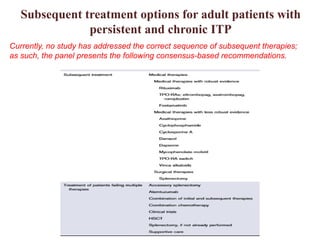
Currently, no study has addressed the correct sequence of subsequent therapies;
as such, the panel presents the following consensus-based recommendations.
Subsequent treatment options for adult patients with
persistent and chronic ITP
Subsequent therapy: medical
Medical therapies with robust evidence
ØTPO-RAs (Eltrombopag/Romiplostim):- excellent responses (>70%) (Grade A
recommendation, evidence level Ib).
• Response to continued TPO-RAs persists for up to 6 to 8 years and often allows other
ITP therapy to be reduced or discontinued.
• Cessation of treatment will lead to the return of thrombocytopenia in most cases, but
some patients (10%-30%) may achieve a durable response after TPO-RAs are tapered
and withdrawn.
ØEvidence from a systematic review of multiple uncontrolled trials and RCTs shows a response
to rituximab in 60% of patients.
• Long-term durable responses occur in 20% to 25% of adult patients (Grade B
recommendation, evidence level IIa).
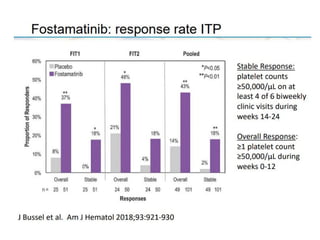
ØFostamatinib offers an alternative mechanism for reducing platelet destruction; it may provide
response rates of 43% but stable responses of only 18%.
Recommendations for subsequent therapy for
persistent and chronic ITP in adults: surgical
Ø Splenectomy is associated with long-term treatment-free remissions.
Ø Recommended to wait ≥12 to 24 months from diagnosis before performing
splenectomy because of the chance of remission or stabilization of a platelet count at a
hemostatic level (Grade C recommendation).
Ø When available, indium-labeled autologous platelet scanning may be useful prior to
splenectomy to confirm that the spleen is the main site of platelet sequestration (Grade B
recommendation).
Ø Laparoscopic splenectomy is as effective (Grade B recommendation).
Ø Postoperative thromboprophylaxis should be considered in patients undergoing splenectomy
as long as the platelet count is >30 to 50 × 109/L (Grade C recommendation).
Ø Splenectomy should be performed by a surgeon experienced in identifying accessory
splenic tissue, which is common and should be removed (Grade C recommendation).
Recommendations for when to start initial
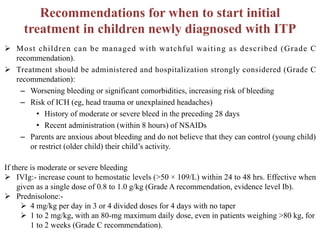
treatment in children newly diagnosed with ITP
Ø Most children can be managed with watchful waiting as described (Grade C
recommendation).
Ø Treatment should be administered and hospitalization strongly considered (Grade C
recommendation):
– Worsening bleeding or significant comorbidities, increasing risk of bleeding
– Risk of ICH (eg, head trauma or unexplained headaches)
• History of moderate or severe bleed in the preceding 28 days
• Recent administration (within 8 hours) of NSAIDs
– Parents are anxious about bleeding and do not believe that they can control (young child)
or restrict (older child) their child’s activity.
If there is moderate or severe bleeding
Ø IVIg:- increase count to hemostatic levels (>50 × 109/L) within 24 to 48 hrs. Effective when
given as a single dose of 0.8 to 1.0 g/kg (Grade A recommendation, evidence level Ib).
Ø Prednisolone:-
Ø 4 mg/kg per day in 3 or 4 divided doses for 4 days with no taper
Ø 1 to 2 mg/kg, with an 80-mg maximum daily dose, even in patients weighing >80 kg, for
1 to 2 weeks (Grade C recommendation).
Inpatient vs outpatient management:
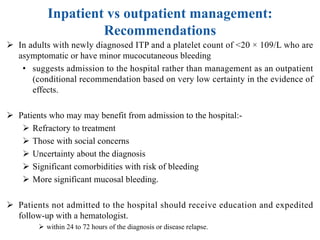
Recommendations
Ø In adults with newly diagnosed ITP and a platelet count of <20 × 109/L who are
asymptomatic or have minor mucocutaneous bleeding
• suggests admission to the hospital rather than management as an outpatient
(conditional recommendation based on very low certainty in the evidence of
effects.
Ø Patients who may may benefit from admission to the hospital:-
Ø Refractory to treatment
Ø Those with social concerns
Ø Uncertainty about the diagnosis
Ø Significant comorbidities with risk of bleeding
Ø More significant mucosal bleeding.
Ø Patients not admitted to the hospital should receive education and expedited
follow-up with a hematologist.
Ø within 24 to 72 hours of the diagnosis or disease relapse.
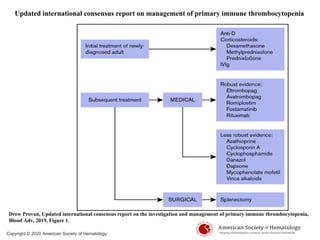
Updated international consensus report on management of primary immune thrombocytopenia
Drew Provan, Updated international consensus report on the investigation and management of primary immune thrombocytopenia,
Blood Adv, 2019, Figure 1.
Copyright © 2020 American Society of Hematology
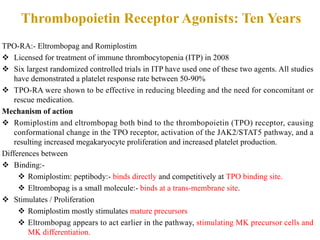
Thrombopoietin Receptor Agonists: Ten Years
TPO-RA:- Eltrombopag and Romiplostim
v Licensed for treatment of immune thrombocytopenia (ITP) in 2008
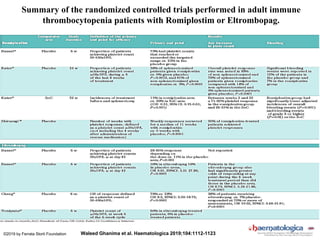
v Six largest randomized controlled trials in ITP have used one of these two agents. All studies
have demonstrated a platelet response rate between 50-90%
v TPO-RA were shown to be effective in reducing bleeding and the need for concomitant or
rescue medication.
Mechanism of action
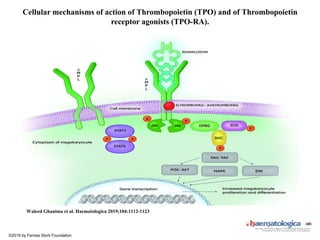
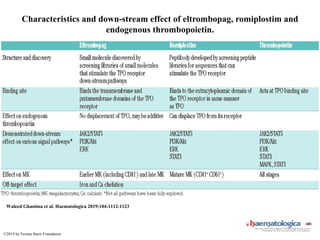
v Romiplostim and eltrombopag both bind to the thrombopoietin (TPO) receptor, causing
conformational change in the TPO receptor, activation of the JAK2/STAT5 pathway, and a
resulting increased megakaryocyte proliferation and increased platelet production.
Differences between
v Binding:-
v Romiplostim: peptibody:- binds directly and competitively at TPO binding site.
v Eltrombopag is a small molecule:- binds at a trans-membrane site.
v Stimulates / Proliferation
v Romiplostim mostly stimulates mature precursors
v Eltrombopag appears to act earlier in the pathway, stimulating MK precursor cells and
MK differentiation.
Cellular mechanisms of action of Thrombopoietin (TPO) and of Thrombopoietin
receptor agonists (TPO-RA).
Waleed Ghanima et al. Haematologica 2019;104:1112-1123
©2019 by Ferrata Storti Foundation
Characteristics and down-stream effect of eltrombopag, romiplostim and
endogenous thrombopoietin.
Waleed Ghanima et al. Haematologica 2019;104:1112-1123
©2019 by Ferrata Storti Foundation
Summary of the randomized controlled trials performed in adult immune
thrombocytopenia patients with Romiplostim or Eltrombopag.
Waleed Ghanima et al. Haematologica 2019;104:1112-1123©2019 by Ferrata Storti Foundation
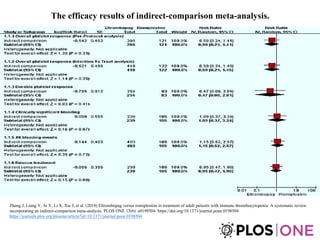
The efficacy results of indirect-comparison meta-analysis.
Zhang J, Liang Y, Ai Y, Li X, Xie J, et al. (2018) Eltrombopag versus romiplostim in treatment of adult patients with immune thrombocytopenia: A systematic review
incorporating an indirect-comparison meta-analysis. PLOS ONE 13(6): e0198504. https://doi.org/10.1371/journal.pone.0198504
https://journals.plos.org/plosone/article?id=10.1371/journal.pone.0198504
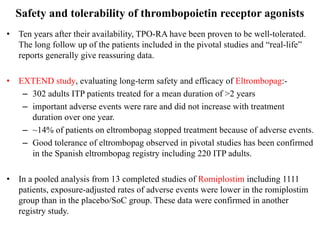
Safety and tolerability of thrombopoietin receptor agonists
• Ten years after their availability, TPO-RA have been proven to be well-tolerated.
The long follow up of the patients included in the pivotal studies and “real-life”
reports generally give reassuring data.
• EXTEND study, evaluating long-term safety and efficacy of Eltrombopag:-
– 302 adults ITP patients treated for a mean duration of >2 years
– important adverse events were rare and did not increase with treatment
duration over one year.
– ~14% of patients on eltrombopag stopped treatment because of adverse events.
– Good tolerance of eltrombopag observed in pivotal studies has been confirmed
in the Spanish eltrombopag registry including 220 ITP adults.
• In a pooled analysis from 13 completed studies of Romiplostim including 1111
patients, exposure-adjusted rates of adverse events were lower in the romiplostim
group than in the placebo/SoC group. These data were confirmed in another
registry study.
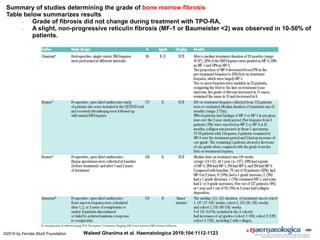
Summary of studies determining the grade of bone marrow fibrosis
Table below summarizes results
• Grade of fibrosis did not change during treatment with TPO-RA,
• A slight, non-progressive reticulin fibrosis (MF-1 or Baumeister <2) was observed in 10-50% of
patients.
Waleed Ghanima et al. Haematologica 2019;104:1112-1123©2019 by Ferrata Storti Foundation
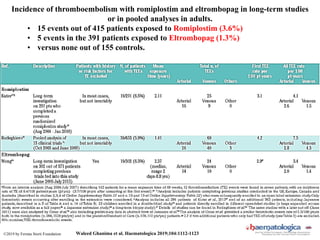
Incidence of thromboembolism with romiplostim and eltrombopag in long-term studies
or in pooled analyses in adults.
• 15 events out of 415 patients exposed to Romiplostim (3.6%)
• 5 events in the 391 patients exposed to Eltrombopag (1.3%)
• versus none out of 155 controls.
Waleed Ghanima et al. Haematologica 2019;104:1112-1123©2019 by Ferrata Storti Foundation
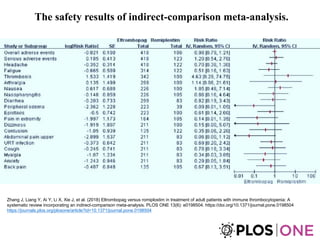
The safety results of indirect-comparison meta-analysis.
Zhang J, Liang Y, Ai Y, Li X, Xie J, et al. (2018) Eltrombopag versus romiplostim in treatment of adult patients with immune thrombocytopenia: A
systematic review incorporating an indirect-comparison meta-analysis. PLOS ONE 13(6): e0198504. https://doi.org/10.1371/journal.pone.0198504
https://journals.plos.org/plosone/article?id=10.1371/journal.pone.0198504
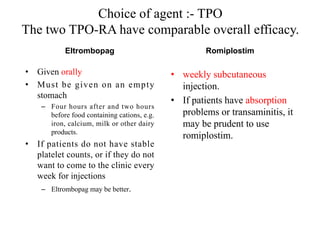
Choice of agent :- TPO
The two TPO-RA have comparable overall efficacy.
Eltrombopag
• Given orally
• Must be given on an empty
stomach
– Four hours after and two hours
before food containing cations, e.g.
iron, calcium, milk or other dairy
products.
• If patients do not have stable
platelet counts, or if they do not
want to come to the clinic every
week for injections
– Eltrombopag may be better.
Romiplostim
• weekly subcutaneous
injection.
• If patients have absorption
problems or transaminitis, it
may be prudent to use
romiplostim.
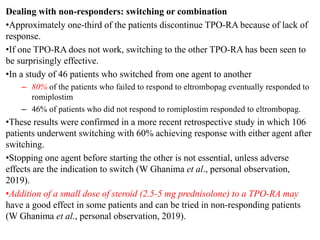
Dealing with non-responders: switching or combination
•Approximately one-third of the patients discontinue TPO-RA because of lack of
response.
•If one TPO-RA does not work, switching to the other TPO-RA has been seen to
be surprisingly effective.
•In a study of 46 patients who switched from one agent to another
– 80% of the patients who failed to respond to eltrombopag eventually responded to
romiplostim
– 46% of patients who did not respond to romiplostim responded to eltrombopag.
•These results were confirmed in a more recent retrospective study in which 106
patients underwent switching with 60% achieving response with either agent after
switching.
•Stopping one agent before starting the other is not essential, unless adverse
effects are the indication to switch (W Ghanima et al., personal observation,
2019).
•Addition of a small dose of steroid (2.5-5 mg prednisolone) to a TPO-RA may
have a good effect in some patients and can be tried in non-responding patients
(W Ghanima et al., personal observation, 2019).
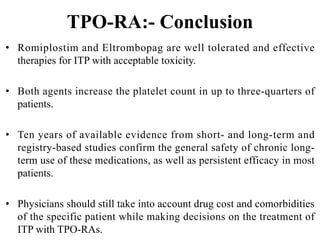
TPO-RA:- Conclusion
• Romiplostim and Eltrombopag are well tolerated and effective
therapies for ITP with acceptable toxicity.
• Both agents increase the platelet count in up to three-quarters of
patients.
• Ten years of available evidence from short- and long-term and
registry-based studies confirm the general safety of chronic long-
term use of these medications, as well as persistent efficacy in most
patients.
• Physicians should still take into account drug cost and comorbidities
of the specific patient while making decisions on the treatment of
ITP with TPO-RAs.
Newer therapeutics approach
Pathophysiology of ITP
To be discussed
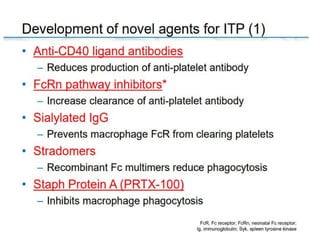
• SyK Inhibitors:- Fostamatinib
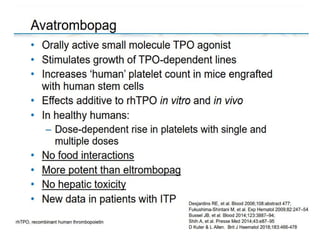
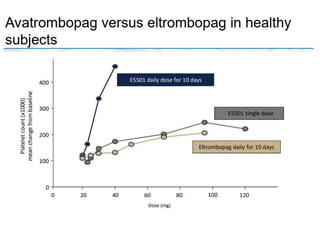
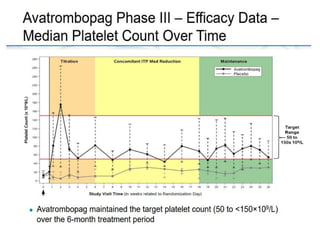
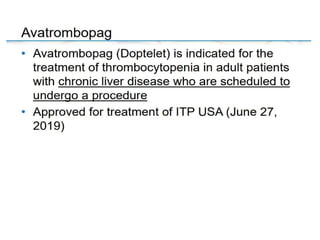
• Newer TPO:- Avatrombopag
• Recombinant TPO
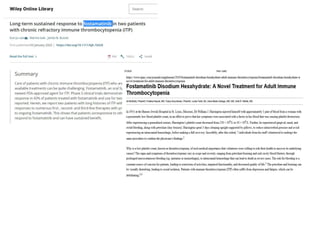
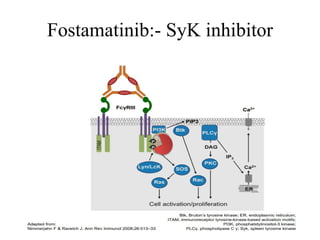
Fostamatinib:- SyK inhibitor
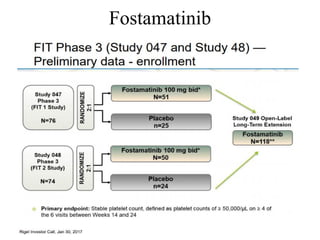
Fostamatinib
Fostamatinib in ITP
• Fostamatinib was approved by the FDA in April
2018
• Adults with chronic ITP who have had an
insufficient response to a previous treatment.
• First spleen tyrosine kinase (SYK) inhibitor
approved in the US.
• Approval was based on the FIT clinical program
(n=163), which included 2 randomized placebo-
controlled phase 3 trials and an open-label
extension trial.
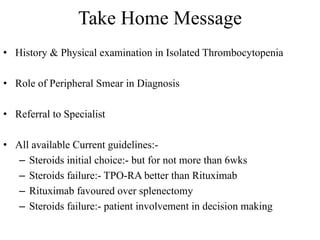
Take Home Message
• History & Physical examination in Isolated Thrombocytopenia
• Role of Peripheral Smear in Diagnosis
• Referral to Specialist
• All available Current guidelines:-
– Steroids initial choice:- but for not more than 6wks
– Steroids failure:- TPO-RA better than Rituximab
– Rituximab favoured over splenectomy
– Steroids failure:- patient involvement in decision making
What is New in ITP

What is New in ITP

  • 2.
    ITP:- Introduction Ø Thrombocytopenia- platelet count < 2.5th lower percentile of the normal. (150 – 450 x 109/L) ØFor Evaluation <100 X109/L Ø Primary immune thrombocytopenia (ITP) is an autoimmune disorder • isolated thrombocytopenia in the absence of other causes. Ø ITP is mediated by antiplatelet autoantibodies. • Antibody-coated platelets are phagocytosed by macrophages in the reticuloendothelial system, leading to accelerated platelet clearance. Ø Macrophages also act as antigen-presenting cells interacting with CD 8+ and CD 4+ T cells that in turn stimulate antibody-producing B cells. ØPathogenic loop sustains autoantibody production.
  • 3.
    NORMAL THROMBOCYTOPENIA DUE TODECREASED PRODUCTION THROMBOCYTOPENIA DUE TO INCREASED DESTRUCTION
  • 5.
    Classification of ITP ØITP may be classified as Primary or Secondary. ØSecondary to an underlying disease (eg, SLE, MCTD, HCV, HIV, or a lymphoproliferative disease). Ø ITP can also be classified by disease duration: – Newly diagnosed (0-3 months) – Persistent (>3-12 months) – Chronic (>12 months). – “Refractory”:- refer to patients who failed splenectomy, ØGiven the declining rate of splenectomy in ITP, it will not be used here.
  • 6.
    ASH American societyof Hematology Dec 2019
  • 7.
    Recommendations for diagnosisof primary ITP in children and adults Ø Diagnosis is based principally on the exclusion of other causes of isolated thrombocytopenia:- Ø A complete history, physical examination Ø Full blood count, and an expert analysis of the peripheral blood film should be evaluated at initial diagnosis (Grade C, Level IV evidence). • To exclude other hematological conditions, including hereditary thrombocytopenia and Pseudothrombocytopenia). Ø Bone marrow examination is not required in the initial diagnosis • Appropriate in those relapsing after remission, in patients not responding to initial treatment options • Where Splenectomy is considered – If other abnormalities are detected in the blood count or morphology (evidence level III; Grade C recommendation). – This examination should ideally include an aspirate, biopsy, flowcytometry, and Cytogenetics (evidence level IV; Grade C recommendation). Ø Routinely test for hepatitis B virus (HBV), HIV, and hepatitis C virus (HCV) in all adult patients (evidence level IIb).
  • 9.
    Recommendations for initialtreatment of newly diagnosed patients Ø Corticosteroids are the standard initial treatment for adults with ITP who need treatment and do not have a relative contradiction: • Prednisolone at 1 mg/kg (maximum dose 80 mg, even in patients weighing >80 kg) for 2 weeks, to a maximum of 3 weeks • or Dexamethasone 40 mg/d for 4 days, repeated up to 3 times. • If a response is seen (eg, platelets >50 × 109/L), the prednisolone should be tapered, aiming to stop prednisolone by 6 weeks (maximum 8 weeks), even if the platelet count drops during the taper. • If there is no response to the initial dose within 2 weeks, the prednisolone should be tapered rapidly over 1 week and stopped.
  • 10.
    Recommendations for initialtreatment of newly diagnosed patients Ø Use of IVIg (1 g/kg on 1 or 2 consecutive days or 0.4 g/kg per day for 5 days), or IV anti-D (50-75 µg/kg once) • Appropriate in patients with bleeding, at high risk for bleeding • Who require a surgical procedure, or who are unresponsive to steriods. • Relevant contraindications to high-dose corticosteroid therapy (eg, insulin- dependent diabetes, uncontrolled diabetes, psychiatric disorders, active infection) Ø If using anti-D, consideration needs to be exercised over potential triggering of DIC or hemolysis. Steroid premedication should be considered for anti-D to minimize acute infusion reactions (eg, headaches, fever-chills, and/or intravascular hemolysis). Ø TPO receptor agonists (TPO-RAs) and rituximab are not considered initial therapies.
  • 11.
    Currently, no studyhas addressed the correct sequence of subsequent therapies; as such, the panel presents the following consensus-based recommendations. Subsequent treatment options for adult patients with persistent and chronic ITP
  • 12.
    Subsequent therapy: medical Medicaltherapies with robust evidence ØTPO-RAs (Eltrombopag/Romiplostim):- excellent responses (>70%) (Grade A recommendation, evidence level Ib). • Response to continued TPO-RAs persists for up to 6 to 8 years and often allows other ITP therapy to be reduced or discontinued. • Cessation of treatment will lead to the return of thrombocytopenia in most cases, but some patients (10%-30%) may achieve a durable response after TPO-RAs are tapered and withdrawn. ØEvidence from a systematic review of multiple uncontrolled trials and RCTs shows a response to rituximab in 60% of patients. • Long-term durable responses occur in 20% to 25% of adult patients (Grade B recommendation, evidence level IIa). ØFostamatinib offers an alternative mechanism for reducing platelet destruction; it may provide response rates of 43% but stable responses of only 18%.
  • 13.
    Recommendations for subsequenttherapy for persistent and chronic ITP in adults: surgical Ø Splenectomy is associated with long-term treatment-free remissions. Ø Recommended to wait ≥12 to 24 months from diagnosis before performing splenectomy because of the chance of remission or stabilization of a platelet count at a hemostatic level (Grade C recommendation). Ø When available, indium-labeled autologous platelet scanning may be useful prior to splenectomy to confirm that the spleen is the main site of platelet sequestration (Grade B recommendation). Ø Laparoscopic splenectomy is as effective (Grade B recommendation). Ø Postoperative thromboprophylaxis should be considered in patients undergoing splenectomy as long as the platelet count is >30 to 50 × 109/L (Grade C recommendation). Ø Splenectomy should be performed by a surgeon experienced in identifying accessory splenic tissue, which is common and should be removed (Grade C recommendation).
  • 14.
    Recommendations for whento start initial treatment in children newly diagnosed with ITP Ø Most children can be managed with watchful waiting as described (Grade C recommendation). Ø Treatment should be administered and hospitalization strongly considered (Grade C recommendation): – Worsening bleeding or significant comorbidities, increasing risk of bleeding – Risk of ICH (eg, head trauma or unexplained headaches) • History of moderate or severe bleed in the preceding 28 days • Recent administration (within 8 hours) of NSAIDs – Parents are anxious about bleeding and do not believe that they can control (young child) or restrict (older child) their child’s activity. If there is moderate or severe bleeding Ø IVIg:- increase count to hemostatic levels (>50 × 109/L) within 24 to 48 hrs. Effective when given as a single dose of 0.8 to 1.0 g/kg (Grade A recommendation, evidence level Ib). Ø Prednisolone:- Ø 4 mg/kg per day in 3 or 4 divided doses for 4 days with no taper Ø 1 to 2 mg/kg, with an 80-mg maximum daily dose, even in patients weighing >80 kg, for 1 to 2 weeks (Grade C recommendation).
  • 15.
    Inpatient vs outpatientmanagement: Recommendations Ø In adults with newly diagnosed ITP and a platelet count of <20 × 109/L who are asymptomatic or have minor mucocutaneous bleeding • suggests admission to the hospital rather than management as an outpatient (conditional recommendation based on very low certainty in the evidence of effects. Ø Patients who may may benefit from admission to the hospital:- Ø Refractory to treatment Ø Those with social concerns Ø Uncertainty about the diagnosis Ø Significant comorbidities with risk of bleeding Ø More significant mucosal bleeding. Ø Patients not admitted to the hospital should receive education and expedited follow-up with a hematologist. Ø within 24 to 72 hours of the diagnosis or disease relapse.
  • 16.
    Updated international consensusreport on management of primary immune thrombocytopenia Drew Provan, Updated international consensus report on the investigation and management of primary immune thrombocytopenia, Blood Adv, 2019, Figure 1. Copyright © 2020 American Society of Hematology
  • 18.
    Thrombopoietin Receptor Agonists:Ten Years TPO-RA:- Eltrombopag and Romiplostim v Licensed for treatment of immune thrombocytopenia (ITP) in 2008 v Six largest randomized controlled trials in ITP have used one of these two agents. All studies have demonstrated a platelet response rate between 50-90% v TPO-RA were shown to be effective in reducing bleeding and the need for concomitant or rescue medication. Mechanism of action v Romiplostim and eltrombopag both bind to the thrombopoietin (TPO) receptor, causing conformational change in the TPO receptor, activation of the JAK2/STAT5 pathway, and a resulting increased megakaryocyte proliferation and increased platelet production. Differences between v Binding:- v Romiplostim: peptibody:- binds directly and competitively at TPO binding site. v Eltrombopag is a small molecule:- binds at a trans-membrane site. v Stimulates / Proliferation v Romiplostim mostly stimulates mature precursors v Eltrombopag appears to act earlier in the pathway, stimulating MK precursor cells and MK differentiation.
  • 19.
    Cellular mechanisms ofaction of Thrombopoietin (TPO) and of Thrombopoietin receptor agonists (TPO-RA). Waleed Ghanima et al. Haematologica 2019;104:1112-1123 ©2019 by Ferrata Storti Foundation
  • 20.
    Characteristics and down-streameffect of eltrombopag, romiplostim and endogenous thrombopoietin. Waleed Ghanima et al. Haematologica 2019;104:1112-1123 ©2019 by Ferrata Storti Foundation
  • 21.
    Summary of therandomized controlled trials performed in adult immune thrombocytopenia patients with Romiplostim or Eltrombopag. Waleed Ghanima et al. Haematologica 2019;104:1112-1123©2019 by Ferrata Storti Foundation
  • 22.
    The efficacy resultsof indirect-comparison meta-analysis. Zhang J, Liang Y, Ai Y, Li X, Xie J, et al. (2018) Eltrombopag versus romiplostim in treatment of adult patients with immune thrombocytopenia: A systematic review incorporating an indirect-comparison meta-analysis. PLOS ONE 13(6): e0198504. https://doi.org/10.1371/journal.pone.0198504 https://journals.plos.org/plosone/article?id=10.1371/journal.pone.0198504
  • 23.
    Safety and tolerabilityof thrombopoietin receptor agonists • Ten years after their availability, TPO-RA have been proven to be well-tolerated. The long follow up of the patients included in the pivotal studies and “real-life” reports generally give reassuring data. • EXTEND study, evaluating long-term safety and efficacy of Eltrombopag:- – 302 adults ITP patients treated for a mean duration of >2 years – important adverse events were rare and did not increase with treatment duration over one year. – ~14% of patients on eltrombopag stopped treatment because of adverse events. – Good tolerance of eltrombopag observed in pivotal studies has been confirmed in the Spanish eltrombopag registry including 220 ITP adults. • In a pooled analysis from 13 completed studies of Romiplostim including 1111 patients, exposure-adjusted rates of adverse events were lower in the romiplostim group than in the placebo/SoC group. These data were confirmed in another registry study.
  • 24.
    Summary of studiesdetermining the grade of bone marrow fibrosis Table below summarizes results • Grade of fibrosis did not change during treatment with TPO-RA, • A slight, non-progressive reticulin fibrosis (MF-1 or Baumeister <2) was observed in 10-50% of patients. Waleed Ghanima et al. Haematologica 2019;104:1112-1123©2019 by Ferrata Storti Foundation
  • 25.
    Incidence of thromboembolismwith romiplostim and eltrombopag in long-term studies or in pooled analyses in adults. • 15 events out of 415 patients exposed to Romiplostim (3.6%) • 5 events in the 391 patients exposed to Eltrombopag (1.3%) • versus none out of 155 controls. Waleed Ghanima et al. Haematologica 2019;104:1112-1123©2019 by Ferrata Storti Foundation
  • 26.
    The safety resultsof indirect-comparison meta-analysis. Zhang J, Liang Y, Ai Y, Li X, Xie J, et al. (2018) Eltrombopag versus romiplostim in treatment of adult patients with immune thrombocytopenia: A systematic review incorporating an indirect-comparison meta-analysis. PLOS ONE 13(6): e0198504. https://doi.org/10.1371/journal.pone.0198504 https://journals.plos.org/plosone/article?id=10.1371/journal.pone.0198504
  • 27.
    Choice of agent:- TPO The two TPO-RA have comparable overall efficacy. Eltrombopag • Given orally • Must be given on an empty stomach – Four hours after and two hours before food containing cations, e.g. iron, calcium, milk or other dairy products. • If patients do not have stable platelet counts, or if they do not want to come to the clinic every week for injections – Eltrombopag may be better. Romiplostim • weekly subcutaneous injection. • If patients have absorption problems or transaminitis, it may be prudent to use romiplostim.
  • 28.
    Dealing with non-responders:switching or combination •Approximately one-third of the patients discontinue TPO-RA because of lack of response. •If one TPO-RA does not work, switching to the other TPO-RA has been seen to be surprisingly effective. •In a study of 46 patients who switched from one agent to another – 80% of the patients who failed to respond to eltrombopag eventually responded to romiplostim – 46% of patients who did not respond to romiplostim responded to eltrombopag. •These results were confirmed in a more recent retrospective study in which 106 patients underwent switching with 60% achieving response with either agent after switching. •Stopping one agent before starting the other is not essential, unless adverse effects are the indication to switch (W Ghanima et al., personal observation, 2019). •Addition of a small dose of steroid (2.5-5 mg prednisolone) to a TPO-RA may have a good effect in some patients and can be tried in non-responding patients (W Ghanima et al., personal observation, 2019).
  • 29.
    TPO-RA:- Conclusion • Romiplostimand Eltrombopag are well tolerated and effective therapies for ITP with acceptable toxicity. • Both agents increase the platelet count in up to three-quarters of patients. • Ten years of available evidence from short- and long-term and registry-based studies confirm the general safety of chronic long- term use of these medications, as well as persistent efficacy in most patients. • Physicians should still take into account drug cost and comorbidities of the specific patient while making decisions on the treatment of ITP with TPO-RAs.
  • 30.
  • 36.
    To be discussed •SyK Inhibitors:- Fostamatinib • Newer TPO:- Avatrombopag • Recombinant TPO
  • 38.
  • 39.
  • 41.
    Fostamatinib in ITP •Fostamatinib was approved by the FDA in April 2018 • Adults with chronic ITP who have had an insufficient response to a previous treatment. • First spleen tyrosine kinase (SYK) inhibitor approved in the US. • Approval was based on the FIT clinical program (n=163), which included 2 randomized placebo- controlled phase 3 trials and an open-label extension trial.
  • 49.
    Take Home Message •History & Physical examination in Isolated Thrombocytopenia • Role of Peripheral Smear in Diagnosis • Referral to Specialist • All available Current guidelines:- – Steroids initial choice:- but for not more than 6wks – Steroids failure:- TPO-RA better than Rituximab – Rituximab favoured over splenectomy – Steroids failure:- patient involvement in decision making