What deviant behavior
entails.
Sociology classes.
4/6/2016Racheal 1
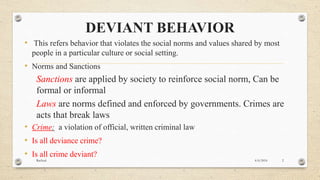
DEVIANT BEHAVIOR
• This refers behavior that violates the social norms and values shared by most
people in a particular culture or social setting.
• Norms and Sanctions
Sanctions are applied by society to reinforce social norm, Can be
formal or informal
Laws are norms defined and enforced by governments. Crimes are
acts that break laws
• Crime: a violation of official, written criminal law
• Is all deviance crime?
• Is all crime deviant?
4/6/2016Racheal 2
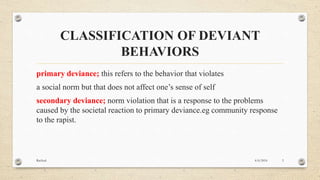
CLASSIFICATION OF DEVIANT
BEHAVIORS
primary deviance; this refers to the behavior that violates
a social norm but that does not affect one’s sense of self
secondary deviance; norm violation that is a response to the problems
caused by the societal reaction to primary deviance.eg community response
to the rapist.
4/6/2016Racheal 3
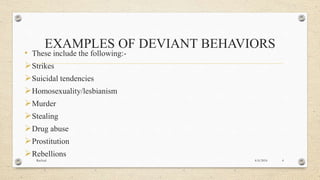
EXAMPLES OF DEVIANT BEHAVIORS
• These include the following:-
Strikes
Suicidal tendencies
Homosexuality/lesbianism
Murder
Stealing
Drug abuse
Prostitution
Rebellions
4/6/2016Racheal 4
PEOPLE AT RISK OF DEVELOPING
DEVIANT BEHAVIOR
Alcoholics
Street kids
Prostitutes
Government officials
Bankers
Students
4/6/2016Racheal 5
THEORIES OF DEVIANT BEHAVIOR
The Biological theory
These try to link biological factors with deviant behavior such as Some studies link
physical characteristics to delinquency. Aggression is connected to
factors present at birth
No decisive evidence that any personality traits are inherited
Functionalists
Argue that deviance serves a positive social function by clarifying moral
boundaries and promoting social cohesion
4/6/2016Racheal 6
Cont.
Psychological Theories
• Look at individual development, personality traits to explain deviance
• Individualistic explanations
Conflict theorists
Believe that a society’s inequalities are reproduced in its definitions of
deviance, so that the less powerful are more likely to be criminalized.
4/6/2016Racheal 7
Cont.
Merton’s structural strain theory
Argues that the Individuals who occupy favorable positions in the class structure
have legitimate ways to achieve success. Those who occupy unfavorable positions
lack such means. The goal of financial success combined with the unequal access to
resources creates deviance.
Merton’s 4 Types of Deviance
1. Innovators:
• Accept the culturally validated goal of success but find deviant
ways of going about reaching it.
• Embezzlers, bank robbers, drug dealers, corporate criminals,
crooked politicians 4/6/2016Racheal 8
Cont.
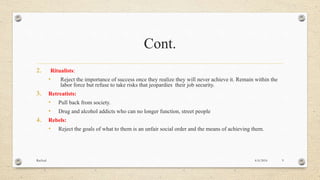
2. Ritualists:
• Reject the importance of success once they realize they will never achieve it. Remain within the
labor force but refuse to take risks that jeopardies their job security.
3. Retreatists:
• Pull back from society.
• Drug and alcohol addicts who can no longer function, street people
4. Rebels:
• Reject the goals of what to them is an unfair social order and the means of achieving them.
4/6/2016Racheal 9
Cont.
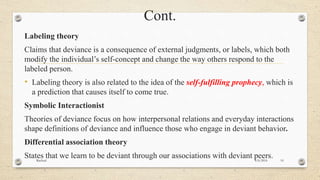
Labeling theory
Claims that deviance is a consequence of external judgments, or labels, which both
modify the individual’s self-concept and change the way others respond to the
labeled person.
• Labeling theory is also related to the idea of the self-fulfilling prophecy, which is
a prediction that causes itself to come true.
Symbolic Interactionist
Theories of deviance focus on how interpersonal relations and everyday interactions
shape definitions of deviance and influence those who engage in deviant behavior.
Differential association theory
States that we learn to be deviant through our associations with deviant peers.4/6/2016Racheal 10
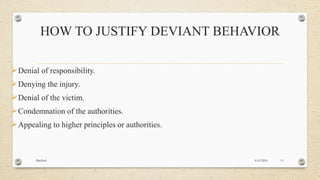
HOW TO JUSTIFY DEVIANT BEHAVIOR
Denial of responsibility.
Denying the injury.
Denial of the victim.
Condemnation of the authorities.
Appealing to higher principles or authorities.
4/6/2016Racheal 11
REFERANCE:
• Introduction to sociology by Robert Wonser
4/6/2016Racheal 12

Deviant behavior

  • 1.
    What deviant behavior entails. Sociologyclasses. 4/6/2016Racheal 1
  • 2.
    DEVIANT BEHAVIOR • Thisrefers behavior that violates the social norms and values shared by most people in a particular culture or social setting. • Norms and Sanctions Sanctions are applied by society to reinforce social norm, Can be formal or informal Laws are norms defined and enforced by governments. Crimes are acts that break laws • Crime: a violation of official, written criminal law • Is all deviance crime? • Is all crime deviant? 4/6/2016Racheal 2
  • 3.
    CLASSIFICATION OF DEVIANT BEHAVIORS primarydeviance; this refers to the behavior that violates a social norm but that does not affect one’s sense of self secondary deviance; norm violation that is a response to the problems caused by the societal reaction to primary deviance.eg community response to the rapist. 4/6/2016Racheal 3
  • 4.
    EXAMPLES OF DEVIANTBEHAVIORS • These include the following:- Strikes Suicidal tendencies Homosexuality/lesbianism Murder Stealing Drug abuse Prostitution Rebellions 4/6/2016Racheal 4
  • 5.
    PEOPLE AT RISKOF DEVELOPING DEVIANT BEHAVIOR Alcoholics Street kids Prostitutes Government officials Bankers Students 4/6/2016Racheal 5
  • 6.
    THEORIES OF DEVIANTBEHAVIOR The Biological theory These try to link biological factors with deviant behavior such as Some studies link physical characteristics to delinquency. Aggression is connected to factors present at birth No decisive evidence that any personality traits are inherited Functionalists Argue that deviance serves a positive social function by clarifying moral boundaries and promoting social cohesion 4/6/2016Racheal 6
  • 7.
    Cont. Psychological Theories • Lookat individual development, personality traits to explain deviance • Individualistic explanations Conflict theorists Believe that a society’s inequalities are reproduced in its definitions of deviance, so that the less powerful are more likely to be criminalized. 4/6/2016Racheal 7
  • 8.
    Cont. Merton’s structural straintheory Argues that the Individuals who occupy favorable positions in the class structure have legitimate ways to achieve success. Those who occupy unfavorable positions lack such means. The goal of financial success combined with the unequal access to resources creates deviance. Merton’s 4 Types of Deviance 1. Innovators: • Accept the culturally validated goal of success but find deviant ways of going about reaching it. • Embezzlers, bank robbers, drug dealers, corporate criminals, crooked politicians 4/6/2016Racheal 8
  • 9.
    Cont. 2. Ritualists: • Rejectthe importance of success once they realize they will never achieve it. Remain within the labor force but refuse to take risks that jeopardies their job security. 3. Retreatists: • Pull back from society. • Drug and alcohol addicts who can no longer function, street people 4. Rebels: • Reject the goals of what to them is an unfair social order and the means of achieving them. 4/6/2016Racheal 9
  • 10.
    Cont. Labeling theory Claims thatdeviance is a consequence of external judgments, or labels, which both modify the individual’s self-concept and change the way others respond to the labeled person. • Labeling theory is also related to the idea of the self-fulfilling prophecy, which is a prediction that causes itself to come true. Symbolic Interactionist Theories of deviance focus on how interpersonal relations and everyday interactions shape definitions of deviance and influence those who engage in deviant behavior. Differential association theory States that we learn to be deviant through our associations with deviant peers.4/6/2016Racheal 10
  • 11.
    HOW TO JUSTIFYDEVIANT BEHAVIOR Denial of responsibility. Denying the injury. Denial of the victim. Condemnation of the authorities. Appealing to higher principles or authorities. 4/6/2016Racheal 11
  • 12.
    REFERANCE: • Introduction tosociology by Robert Wonser 4/6/2016Racheal 12